|
시장보고서
상품코드
2063537
기업 헬스케어 플랫폼용 AI 시장 : 점유율 분석, 업계 동향과 통계, 성장 예측(2026-2031년)AI In Enterprise Healthcare Platforms - Market Share Analysis, Industry Trends & Statistics, Growth Forecasts (2026 - 2031) |
||||||
 Mordor Intelligence
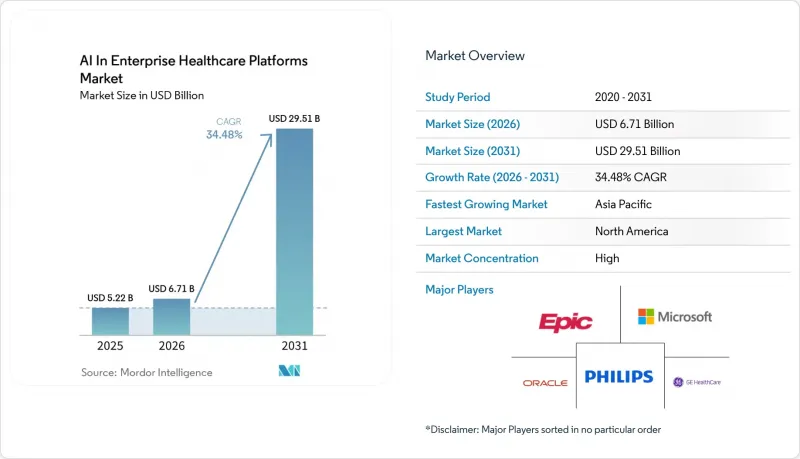
Mordor Intelligence에 의하면, 기업 헬스케어 플랫폼용 AI 시장 규모는 2025년에 52억 2,000만 달러에 이르고, 2031년까지 295억 1,000만 달러에 이를 것으로 예측되며, 2026년부터 2031년까지 CAGR 34.48%로 성장할 전망입니다.
본 보고서는 제공 형태(소프트웨어 및 서비스), 용도(의료 영상·진단 플랫폼, 기타), 배포 방식(클라우드, 기타), 최종 사용자(의료 제공업체, 기타), AI 기술(머신러닝·딥러닝, 기타), 지역(북미, 유럽, 기타)별로 분류되어 있습니다. 시장 전망은 금액(달러) 기준으로 제시되어 있습니다.
전 세계 기업 헬스케어 플랫폼용 AI 시장 동향과 인사이트
클라우드/SaaS로의 전환을 통해 기업 차원에서 AI를 신속하게 도입할 수 있게 되었습니다.
2026년의 기업 구매 담당자들은 클라우드 네이티브 플랫폼을 우선적으로 고려하고 있습니다. 이는 도입 기간을 수개월에서 수주로 단축할 수 있을 뿐만 아니라, 매니지드 서비스 및 종량제 추론 비용 모델을 통해 총 소유 비용(TCO)을 절감할 수 있기 때문입니다. 클라우드 제공업체는 현재 기존 임상 문서를 FHIR 리소스로 변환하는 네이티브 파이프라인을 제공하고 있으며, 여기에는 과거 의료 IT 예산의 상당 부분을 차지했던 매핑 및 데이터 정리 작업의 대부분을 제거하는 도구가 포함되어 있습니다. 클라우드 인프라 상에서 재구축된 EHR 제품군은 문서화, 처방, 코딩을 위한 내장 에이전트를 갖추고 있어, 별도의 추론 스택을 유지하거나 전체 워크플로우에 걸쳐 여러 포인트 솔루션을 통합해야 할 필요성을 줄여줍니다. 1단계 도입에서는 대개 앰비언트 문서화나 영상 진단의 선별에 중점을 둡니다. 이들은 신속하게 그 가치를 입증한 뒤, 기업 헬스케어 플랫폼 시장에서 ‘AI 속의 AI’로서 동일한 운영 계층에서 부서 간 경계를 넘나드는 보다 복잡한 에이전트 오케스트레이션으로 확장될 것입니다. 임상 어시스턴트와 캘린더, 엔터프라이즈 협업 등 생산성 향상 도구를 통합함으로써, 단일 화면에서 임상 데이터와 조직의 워크플로우로부터 맥락을 파악할 수 있는 통합된 상담원 경험이 실현됩니다.
앰비언트 임상 AI는 문서 작성 부담을 줄이고 ROI를 극대화합니다.
앰비언트 클리니컬 인텔리전스는 정확성을 저해하지 않으면서 문서 작성 시간을 단축하고 기록의 질을 향상시키기 위해 시범 단계에서 대규모 도입 단계로 전환되고 있으며, 2026년 많은 임상 AI 로드맵에서 최우선 과제로 자리 잡고 있습니다. 네이티브 EHR 기능은 현재 다수의 전문 분야를 지원하며, 기록을 코딩 및 품질 요건에 부합하도록 조정할 수 있습니다. 이를 통해 기업 헬스케어 플랫폼용 AI 시장에서 시간 절약을 수익 창출 및 규정 준수상의 이점으로 전환하는 데 도움이 됩니다. 앰비언트 솔루션은 ASR(음성 인식), 분야별 로직, EHR의 맥락을 결합하여 진료 기록의 내용을 진료 시의 근거와 연계함으로써, 임상의의 신뢰를 쌓고 감사 대응을 간소화합니다. AI가 탑재된 의료기기에 대한 규제가 명확해짐에 따라, 의료 기관이 실제 운영 환경에서 AI 도구를 도입할 때의 불확실성이 더욱 줄어들 것입니다. 다국어 ASR과 거버넌스 및 데이터 보안 제어 기능을 결합한 엔터프라이즈급 플랫폼은 앰비언트 문서 작성을 대규모로 표준화하려는 의료 시스템으로부터 주목을 받고 있습니다.
개인정보 보호/보안 및 PHI 거버넌스가 확장을 지연시킵니다.
의료 기관들은 PHI(개인 건강 정보)를 다루는 AI에 대한 관리를 강화하고 있으며, 이로 인해 실제 운영에 들어가기 전에 위험 평가, 데이터 최소화 전략, 감사 절차를 확정하는 데 필요한 시간이 길어지고 있습니다. 엔터프라이즈 시장의 구매자들은 에이전트형 시스템이 출력을 생성하는 방식에 대한 임상적·법적 우려를 해소하기 위해 증거 매핑과 설명 가능성을 점점 더 요구하고 있으며, 이로 인해 기업 헬스케어 플랫폼용 AI 시장의 도입 계획에 검증 및 문서화 작업이 추가되고 있습니다. 의료기기로 기능하는 헬스케어 AI는 수명 주기 전반에 걸친 감독 및 시판 후 감시 요건에 따라 지속적으로 운영되고 있으며, 이로 인해 공급업체와 의료 제공업체 양측 모두에게 지속적인 규정 준수 책임이 발생하고 있습니다. EU AI법에서 의료 분야를 고위험 범주로 분류할 경우, 적합성, 인적 감독, 기술 문서, 모니터링이 요구됩니다. 이로 인해 국제적으로 사업을 전개하는 조직은 여러 법역에 대응할 수 있는 거버넌스 프로그램을 도입해야 하는 상황에 놓여 있습니다. 이러한 다층적인 의무는 벤더, 특히 소규모 포인트 솔루션 제공업체에게 진입 장벽을 높여, 대규모 활용을 전제로 한 ‘거버넌스 바이 디자인’을 갖춘 플랫폼을 구매자들이 더욱 선호하게 만들고 있습니다.
부문별 분석
소프트웨어는 2025년에 56.72%의 점유율을 차지해, 2031년까지 연평균 성장률(CAGR) 39.34%로 성장할 것으로 전망됩니다. 이는 기업 헬스케어 AI 플랫폼 시장에서 추론, 오케스트레이션, 거버넌스를 핵심적인 임상 및 관리 워크플로에 통합한 통합형 운영 계층이 주도하고 있습니다. 현재 EHR 플랫폼에는 기본 제공되는 진료기록 작성 및 코딩 지원 기능이 내장되어 있어 별도의 도구가 필요하지 않기 때문에 워크플로우 통합이 강화되면서 도입이 가속화되고 있습니다. 에이전트 기능을 갖춘 클라우드 네이티브 EHR 제품군은 AI를 추가 기능이 아닌 핵심 계약에 통합함으로써 조달을 효율화하고 거버넌스를 일원화합니다. FHIR 데이터 스토어, PHI 거버넌스, 모델 액세스를 관리하는 하이퍼스케일러의 서비스는 기업 헬스케어 플랫폼용 AI 시장에서 임상 및 수익 주기의 전체 이용 사례에 걸친 에이전트를 구축하기 위한 기반을 제공합니다.
기업들이 AI 도입 준비, FHIR 전환, 검증 프레임워크, 배포 확대에 필요한 변경 관리를 위해 파트너와 협력함에 따라, 서비스는 소프트웨어의 성장에 발맞추어 발전하고 있습니다. AI 지원 기능과 관련된 임상 및 규제 관련 문서화에는 전체 라이프사이클에 걸친 감독이 필요하며, 많은 조직은 공급업체의 지원이나 내부 거버넌스 팀을 활용하여 이를 표준화하는 것을 선호합니다. 클라우드, EHR, 오케스트레이션 벤더들 역시 여러 의료기관으로 구성된 제공업체 시스템에서 통합 부담을 줄여주는 구현 가속기 및 툴킷을 제공합니다. 이러한 임베디드 소프트웨어와 전문 서비스의 결합을 통해 플랫폼 통합이 촉진되고 있으며, 기업 헬스케어 플랫폼용 AI 시장에서 수많은 벤더들이 등장하던 양상이 소수의 전략적 파트너십으로 대체되고 있습니다.
의료 영상·진단 플랫폼은 승인된 AI/ML 지원 기기의 광범위한 보급과 방사선과 업무 흐름 개선에 대한 확실한 실적을 바탕으로, 2025년에는 47.43%의 시장 점유율을 차지했습니다. 다중 모달 모델의 개선과 임상적 검증의 진전에 따라, 영상 분석 및 트리아지에 대한 신뢰성이 더욱 높아지고 있으며, 이에 따라 기업 헬스케어 플랫폼용 AI 시장 내 전체 부문으로의 확장이 가속화되고 있습니다. 또한, EHR(전자건강기록) 환경과 시각·언어 기능을 통합함으로써, 제한적인 단일 작업 알고리즘에서 소견과 다음 조치를 연결해 주는 어시스턴트와 같은 워크플로로 전환되는 것도 촉진되고 있습니다. 범용 생의학 모델 플랫폼이 확대됨에 따라, 영상 진단 팀은 설명 가능성과 감사 추적을 유지하면서 더 광범위한 기능을 도입할 수 있게 됩니다.
'수익 주기 코딩 자동화'는 연평균 성장률(CAGR) 37.65%를 기록하며 가장 빠르게 성장하고 있는 용도입니다. 이는 조직이 임상 데이터 수집을 코딩, 청구 거절 방지, 사전 승인 절차와 연계함으로써 기업 헬스케어 플랫폼용 AI 시장에서 현금 흐름과 규정 준수를 개선하고 있기 때문입니다. 코드 제안, 주문 생성, 문서화 구조화를 수행하는 내장형 어시스턴트는 후속 공정에서의 재작업이나 청구 거절을 줄여주며, 자동화를 측정 가능한 재무 성과와 연결합니다. 확인, 일정 조정, 문서 작성을 담당하는 컨택 센터 및 포인트 오브 케어 상담원은 관리 부담을 줄이면서 처리 능력을 향상시킵니다. 자동화된 워크플로가 확대됨에 따라, 구매자들은 문서 작성, 코딩, 승인 등의 각 단계를 단일한 거버넌스 체계 하의 프로세스로 통합하는 플랫폼을 선호하는 추세입니다.
지역별 분석
북미는 규제 명확화, 기존 EHR 도입 현황, 클라우드 성숙도가 맞물려 전사적 도입을 추진한 결과, 2025년에는 46.34%의 점유율로 기업 헬스케어 플랫폼용 AI 시장을 주도했습니다. FDA의 AI 지침과 주요 EHR 내 네이티브 AI 차트 기능의 급속한 확산은 임상 현장에서 AI의 대규모 활용이 정착되는 데 기여했습니다. EHR 플랫폼에서는 2025년 중반까지 앰비언트 문서화(Ambient Documentation)의 도입이 크게 진전되었으며, 이를 통해 전문 분야를 아우르는 보다 광범위한 에이전트 기반 워크플로우를 위한 기반이 마련되었습니다. 표준 기반 API 요구 사항과 보험사의 현대화 이니셔티브는 기업 헬스케어 플랫폼 시장에서 조직들이 FHIR 준수 자동화 워크플로를 도입하도록 지속적으로 촉진하고 있습니다.
유럽의 동향은 EU AI법에 의해 형성되고 있습니다. 이 법은 의료 분야를 고위험 분야로 분류하고, 적합성 평가, 인적 감독, 시판 후 감시에 관한 의무를 규정하고 있습니다. 디지털 헬스 인프라 및 상호운용성에 관한 정책이 잘 갖춰진 국가들에서는 통일된 거버넌스 하에서 내장형 EHR AI와 엄선된 마켓플레이스를 결합한 플랫폼형 접근 방식이 채택되고 있습니다. 각 벤더사가 MDR·IVDR 승인 절차를 준수하고 안전성 및 성능에 관한 근거를 마련해 나가면서, 기업 헬스케어 플랫폼용 AI 시장에서는 규정 준수를 최우선으로 하는 형태로 도입이 진행되고 있습니다. 클라우드와 엣지의 결합은 데이터 소재지에 관한 규제를 준수하면서도 진료 현장에서 고도의 에이전트 기능을 가능하게 하고 있습니다.
아시아태평양에서는 각국 정부가 AI 및 데이터 인프라에 투자하고, 의료 시스템이 광범위한 인구를 대상으로 디지털 기능을 확대함에 따라 2031년까지 연평균 성장률(CAGR) 39.12%로 성장할 것으로 전망됩니다. AI 도입, 지역 특화 언어 모델, 주권 클라우드에 관한 국가 전략은 앰비언트 문서화, 영상 진단 지원, 환자 접근 지원 기능을 결합한 플랫폼의 확산을 뒷받침하고 있습니다. 다국어 지원 기능과 지역 내 클라우드 서비스는 기업 헬스케어 플랫폼용 AI 시장에서 주권 및 지연 시간 요건을 충족하는 데 도움이 됩니다. 의료 제공업체와 보험사가 자동화를 위한 인센티브를 조정함에 따라, APAC 지역의 의료 시스템은 시범 단계에서 벗어나 임상, 운영, 수익 각 워크플로우를 연계하는 대규모 오케스트레이션 단계로 전환되고 있습니다.
기타 혜택:
- 엑셀 형식 시장 예측(ME) 시트
- 3개월간의 애널리스트 지원
자주 묻는 질문
목차
제1장 서론
제2장 조사 방법
제3장 주요 요약
제4장 시장 구도
제5장 시장 규모와 성장 예측
제6장 경쟁 구도
제7장 시장 기회와 향후 전망
JHS 26.06.23According to Mordor Intelligence, the aI in Enterprise Healthcare Platforms market size reached USD 5.22 billion in 2025 and is projected to reach USD 29.51 billion by 2031, advancing at a CAGR of 34.48% over 2026-2031.
This report is Segmented by Offering (Software and Services), Application (Medical Imaging and Diagnostics Platforms, and Others), Deployment (Cloud, and Others), End User (Healthcare Providers, and Others), AI Technology (Machine Learning and Deep Learning, and Others), and Geography (North America, Europe, and Others). The Market Forecasts are Provided in Terms of Value (USD).
Global AI In Enterprise Healthcare Platforms Market Trends and Insights
Cloud/SaaS Shift Enabling Rapid AI Deployment at Enterprise Scale
Enterprise buyers in 2026 prioritize cloud-native platforms because they compress implementation timelines from many months to a few weeks while lowering total cost of ownership through managed services and pay-per-use inference economics. Cloud providers now offer native pipelines that convert legacy clinical documents into FHIR resources, with tools that remove a significant portion of historical mapping and data wrangling work that previously dominated health IT budgets. EHR suites that have been rebuilt on cloud infrastructure bring embedded agents for documentation, ordering, and coding, reducing the need to maintain separate inference stacks or integrate multiple point solutions across workflows. Wave-one deployments often focus on ambient documentation or imaging triage, which prove value quickly and then scale into more complex agentic orchestration across departments on the same operating layer for AI inside the AI in Enterprise Healthcare Platforms market. Integration of clinical assistants with productivity tools, such as calendaring and enterprise collaboration, supports unified agent experiences that draw context from clinical data and organizational workflows in a single pane of glass.
Ambient Clinical AI Reduces Documentation Burden and Unlocks ROI
Ambient clinical intelligence has moved from pilots to scaled rollouts because it reduces documentation time and improves note quality without harming accuracy, which places it at the top of many clinical AI roadmaps in 2026. Native EHR capabilities now support large sets of specialties and can align notes with coding and quality needs, which helps convert time savings into revenue capture and compliance benefits inside the AI in Enterprise Healthcare Platforms market. Ambient solutions combine ASR, specialty logic, and EHR context, while mapping content to the evidence captured in the encounter, which builds clinician trust and simplifies audit readiness. Regulatory clarity for AI-enabled medical devices further reduces uncertainty for healthcare organizations as they deploy AI tools in production settings. Enterprise-grade platforms that pair multilingual ASR with governance and data security controls attract health systems looking to standardize ambient documentation at scale.
Privacy/Security and PHI Governance Slow Scale-Up
Healthcare organizations intensify controls on AI that touches PHI, which increases the time needed to finalize risk assessments, data minimization strategies, and audit procedures before production go-live. Enterprise buyers increasingly require evidence mapping and explainability to address clinical and legal concerns about how agentic systems produce outputs, which adds validation and documentation work to deployment plans in the AI in Enterprise Healthcare Platforms market. Healthcare AI that functions as a medical device continues to operate under lifecycle oversight and post-market monitoring expectations, which creates ongoing compliance responsibilities for both vendors and provider users. The EU AI Act's high-risk classification for healthcare requires conformity, human oversight, technical documentation, and monitoring, which motivates organizations with international footprints to adopt governance programs that can serve multiple jurisdictions. These layered obligations raise the bar for vendors, especially smaller point-solution providers, and tilt buyer preferences to platforms that include governance-by-design for scaled use.
Other drivers and restraints analyzed in the detailed report include:
- EHR Incumbents' Distribution Moats Accelerate Embedded AI Uptake
- Value-Based and Revenue-Cycle Pressures Push Automation Platform Buys
- Legacy Integration and Interoperability Complexity
For complete list of drivers and restraints, kindly check the Table Of Contents.
Segment Analysis
Software commanded 56.72% share in 2025 and is projected to grow at 39.34% CAGR through 2031, driven by unified operating layers that embed inference, orchestration, and governance within core clinical and administrative workflows in the AI in Enterprise Healthcare Platforms market. EHR platforms now embed native charting and coding assistants that reduce the need for separate tools, which tightens workflow integration and accelerates deployment. Cloud-native EHR suites with agentic capabilities bundle AI into the core contract rather than as add-ons, which streamlines procurement and centralizes governance. Hyperscaler services that manage FHIR data stores, PHI governance, and model access provide the primitives to build agents across clinical and revenue cycle use cases inside the AI in Enterprise Healthcare Platforms market.
Services follow software growth as enterprises engage partners for AI readiness, FHIR migration, validation frameworks, and change management needed to scale deployments. Clinical and regulatory documentation for AI-enabled features requires lifecycle oversight that many organizations prefer to standardize with vendor support and internal governance teams. Cloud, EHR, and orchestration vendors also provide implementation accelerators and toolkits that reduce integration overhead for multi-entity provider systems. This pairing of embedded software and professional services sustains platform consolidation, replacing vendor sprawl with a smaller set of strategic relationships across the AI in Enterprise Healthcare Platforms market.
Medical Imaging and Diagnostics Platforms held 47.43% share in 2025, supported by the breadth of authorized AI/ML-enabled devices and strong evidence for workflow gains in radiology. Improvements in multimodal models and clinical validation continue to increase confidence for image analysis and triage, which strengthens the case for department-wide scaling inside the AI in Enterprise Healthcare Platforms market. Integration of vision and language features with EHR context also helps move from narrow single-task algorithms to assistant-like workflows that connect findings with next-step actions. As general-purpose biomedical model platforms expand, imaging teams can adopt broader capabilities while maintaining explainability and audit trails.
Revenue Cycle and Coding Automation is the fastest-growing application at 37.65% CAGR, since organizations link clinical capture with coding, denials prevention, and prior authorization to improve cash flow and compliance in the AI in Enterprise Healthcare Platforms market. Embedded assistants that suggest codes, create orders, and structure documentation reduce downstream rework and denials, which aligns automation with measurable financial results. Contact center and point-of-care agents that handle verification, scheduling, and documentation lower administrative burden while improving throughput. As automated workflows expand, buyers favor platforms that connect documentation, coding, and authorization steps into a single governed path.
Geography Analysis
North America led the AI in Enterprise Healthcare Platforms market with 46.34% share in 2025 as regulatory clarity, EHR incumbent distribution, and cloud maturity combined to drive enterprise-wide deployments. The FDA's AI guidance and the rapid expansion of native AI charting inside major EHRs helped normalize AI use at scale in clinical settings. EHR platforms reported strong adoption of ambient documentation by mid-2025, which created an installed base for broader agentic workflows across specialties. Standards-based API requirements and payer modernization initiatives continue to push organizations to adopt FHIR-aligned automation flows in the AI in Enterprise Healthcare Platforms market.
Europe's trajectory is shaped by the EU AI Act, which classifies healthcare as high-risk and establishes obligations for conformity assessment, human oversight, and post-market monitoring. Countries with strong digital health infrastructure and interoperability policies are adopting platform approaches that combine embedded EHR AI with curated marketplaces under unified governance. As vendors align with MDR and IVDR pathways and build evidence for safety and performance, adoption proceeds in a compliance-first fashion inside the AI in Enterprise Healthcare Platforms market. Cloud and edge combinations support data-residency rules while enabling advanced agentic capability at the point of care.
Asia-Pacific is projected to grow at 39.12% CAGR through 2031 as governments invest in AI and data infrastructure and as health systems expand digital capabilities across large populations. National strategies around AI adoption, localized language models, and sovereign cloud efforts support platform deployments that combine ambient documentation, imaging support, and patient access assistants. Multilingual capabilities and in-region cloud services help meet sovereignty and latency needs in the AI in Enterprise Healthcare Platforms market. As providers and payers align incentives for automation, APAC health systems move from pilots to scaled orchestrations that connect clinical, operational, and revenue workflows.
- 3M
- Amazon Web Services (AWS)
- athenahealth
- Change Healthcare (Optum company)
- Cognizant (TriZetto)
- eClinicalWorks
- Epic Systems
- GE Healthcare
- Google Cloud
- Health Catalyst
- InterSystems
- Koninklijke Philips
- Microsoft (Nuance)
- NVIDIA (Healthcare & MONAI)
- Oracle
- R1 RCM
- Salesforce
- Sectra
- Siemens Healthineers
- Veradigm
Additional Benefits:
- The market estimate (ME) sheet in Excel format
- 3 months of analyst support
TABLE OF CONTENTS
1 Introduction
- 1.1 Study Assumptions and Market Definition
- 1.2 Scope of the Study
2 Research Methodology
3 Executive Summary
4 Market Landscape
- 4.1 Market Overview
- 4.2 Market Drivers
- 4.2.1 Cloud/SaaS Shift Enabling Rapid AI Deployment at Enterprise Scale
- 4.2.2 Ambient Clinical AI Reduces Documentation Burden and Unlocks ROI
- 4.2.3 EHR Incumbents' Distribution Moats Accelerate Embedded AI Uptake
- 4.2.4 Value-Based and Revenue-Cycle Pressures Push Automation Platform Buys
- 4.2.5 AI Governance/Safety Toolchains De-Risk Rollouts and Unlock Budgets
- 4.2.6 AI Marketplaces/Orchestration Unify Multi-Vendor Apps in Workflows
- 4.3 Market Restraints
- 4.3.1 Privacy/Security and PHI Governance Slow Scale-Up
- 4.3.2 Legacy Integration and Interoperability Complexity
- 4.3.3 Reimbursement Scrutiny on AI-Assisted Coding/PA Workflows
- 4.3.4 Ethical/Reputational Pushback Stalls Platform Deployments
- 4.4 Value-Chain Analysis
- 4.5 Regulatory Landscape
- 4.6 Technological Outlook
- 4.7 Porter's Five Forces Analysis
- 4.7.1 Threat of New Entrants
- 4.7.2 Bargaining Power of Suppliers
- 4.7.3 Bargaining Power of Buyers
- 4.7.4 Threat of Substitutes
- 4.7.5 Competitive Rivalry
5 Market Size & Growth Forecasts (Value, USD)
- 5.1 By Offering
- 5.1.1 Software
- 5.1.2 Services
- 5.2 By Application
- 5.2.1 Medical Imaging and Diagnostics Platforms
- 5.2.2 Clinical Documentation and Ambient Scribing
- 5.2.3 Clinical Decision Support and Care Orchestration
- 5.2.4 Revenue Cycle and Coding Automation
- 5.2.5 Patient Engagement/CRM and Contact Center AI
- 5.2.6 Cybersecurity/Privacy and PHI Redaction
- 5.2.7 Others
- 5.3 By Deployment
- 5.3.1 Cloud
- 5.3.2 On-premises
- 5.3.3 Hybrid/Edge
- 5.4 By End User
- 5.4.1 Healthcare Providers
- 5.4.2 Imaging Centers
- 5.4.3 Healthcare Payers
- 5.4.4 Others
- 5.5 By AI Technology
- 5.5.1 Machine Learning and Deep Learning
- 5.5.2 Natural Language Processing and Speech/ASR
- 5.5.3 Others
- 5.6 By Geography
- 5.6.1 North America
- 5.6.1.1 United States
- 5.6.1.2 Canada
- 5.6.1.3 Mexico
- 5.6.2 Europe
- 5.6.2.1 Germany
- 5.6.2.2 United Kingdom
- 5.6.2.3 France
- 5.6.2.4 Italy
- 5.6.2.5 Spain
- 5.6.2.6 Rest of Europe
- 5.6.3 Asia-Pacific
- 5.6.3.1 China
- 5.6.3.2 Japan
- 5.6.3.3 India
- 5.6.3.4 Australia
- 5.6.3.5 South Korea
- 5.6.3.6 Rest of Asia-Pacific
- 5.6.4 Middle East and Africa
- 5.6.4.1 GCC
- 5.6.4.2 South Africa
- 5.6.4.3 Rest of Middle East and Africa
- 5.6.5 South America
- 5.6.5.1 Brazil
- 5.6.5.2 Argentina
- 5.6.5.3 Rest of South America
- 5.6.1 North America
6 Competitive Landscape
- 6.1 Market Concentration
- 6.2 Market Share Analysis
- 6.3 Company Profiles (includes Global level Overview, Market level overview, Core Segments, Financials as available, Strategic Information, Market Rank/Share for key companies, Products & Services, Recent Developments)
- 6.3.1 3M
- 6.3.2 Amazon Web Services (AWS)
- 6.3.3 athenahealth
- 6.3.4 Change Healthcare (Optum company)
- 6.3.5 Cognizant (TriZetto)
- 6.3.6 eClinicalWorks
- 6.3.7 Epic Systems Corporation
- 6.3.8 GE HealthCare
- 6.3.9 Google Cloud
- 6.3.10 Health Catalyst
- 6.3.11 InterSystems
- 6.3.12 Koninklijke Philips N.V.
- 6.3.13 Microsoft (Nuance)
- 6.3.14 NVIDIA (Healthcare & MONAI)
- 6.3.15 Oracle
- 6.3.16 R1 RCM
- 6.3.17 Salesforce
- 6.3.18 Sectra
- 6.3.19 Siemens Healthineers AG
- 6.3.20 Veradigm
7 Market Opportunities & Future Outlook
- 7.1 White-space & Unmet-need Assessment