
|
시장보고서
상품코드
2066425
심실 보조 장치(VAD) : 시장 점유율 분석, 업계 동향 및 통계, 성장 예측(2026-2031년)Ventricular Assist Device - Market Share Analysis, Industry Trends & Statistics, Growth Forecasts (2026 - 2031) |
||||||
 Mordor Intelligence
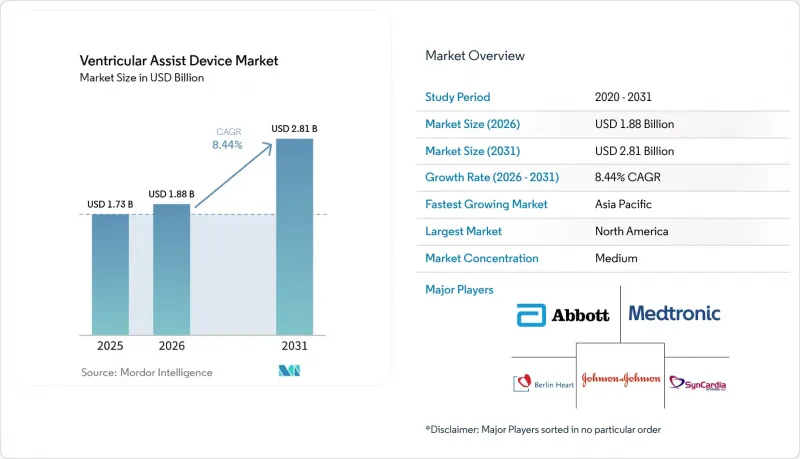
Mordor Intelligence에 의하면, 2026년 심실 보조 장치(VAD) 시장 규모는 18억 8,000만 달러에 달할 것으로 추정됩니다. 2025년 17억 3,000만 달러에서 확대해, 2031년에는 28억 1,000만 달러에 이를 것으로 예측됩니다.
2026년부터 2031년까지의 연평균 성장률(CAGR)은 8.44%를 나타낼 것으로 전망됩니다.
본 보고서에서는 제품 유형(좌심실 보조 장치(LVAD), 우심실 보조 장치(RVAD) 등), 설계(이식형 VAD, 경피적/체외형 VAD 등), 용도/치료법(이식 전 가교 요법(BTT), 최종 치료 등), 지역(북미, 유럽 등)별로 세분화되어 있습니다. 시장 전망은 금액(달러) 기준으로 제시되어 있습니다.
세계의 심실 보조 장치(VAD) 시장 동향 및 인사이트
심장 질환 및 심부전으로 인한 부담 증가
심부전 환자 수는 2025년에는 670만 명의 미국인에 달했으며, 2050년까지 1,140만 명으로 증가할 것으로 전망되어, 기계적 보조 장치가 필요한 환자층이 확대되고 있습니다. 젊은 층과 인종적 소수 집단에서는 발병률 증가 추세가 더욱 두드러지며, 이로 인해 수십 년에 걸쳐 순환 보조가 필요할 가능성이 높은 환자를 대상으로 한 기기 수요로 전환되고 있습니다. 추산에 따르면, 21세기 중반까지 심부전의 누적 비용은 4,200억 달러에 달할 것으로 예상되며, 이에 따라 보험사들은 반복적인 입원보다는 내구성이 뛰어난 기기의 도입을 지원하도록 권장받고 있습니다.
기술의 발전
HeartMate 3와 같은 자기 부상식 펌프는 5년 생존율이 63.3%이며, 기존의 베어링식 시스템에 비해 혈전증 위험이 낮습니다. 소형화된 경피적 펌프는 현재 9 Fr 전달 프로파일을 채택하고 있으며, 500건 이상의 시술에서 판막 통과 성공률 100%를 달성했습니다. 무선 전력 전송에 관한 초기 연구에서는 7미터에 달하는 안전한 에너지 공급이 입증되었으며, 향후 케이블이 필요 없는 완전 이식형 플랫폼의 실현 가능성을 시사하고 있습니다.
장치 및 시술 비용의 고가
시술 비용의 평균은 17만 5,420달러, 총 입원 비용은 19만 3,192달러에 육박하며, 재입원 비용으로 추가로 5만 2,068달러가 소요되기 때문에 비용에 민감한 시장에서 보급이 저해되고 있습니다. 보험 적용 범위의 제한과 막대한 설비 투자 예산이 소규모 의료기관의 도입을 가로막고 있습니다. 이는 배터리 수명이 연장되고 합병증 발생률이 감소함에 따라 비용 대비 효과가 향상되고 있음에도 불구하고입니다.
부문별 분석
좌심실 보조 장치(LVAD)는 2025년 매출의 72.65%를 차지하며, 심실 보조 장치(VAD) 시장에서 가장 큰 점유율을 기록했습니다. 2031년까지의 연평균 성장률(CAGR) 9.08%는 폭넓은 임상 적응증과 장기 생존율에 관한 확고한 데이터를 반영하고 있습니다. 자기 부상 플랫폼을 통해 혈전증 및 펌프 정지율이 감소함에 따라, 좌심실 보조 장치(LVAD) 시장 규모는 꾸준히 확대될 것으로 전망됩니다. 현재 LVAD의 기술 혁신은 무선 전력 공급 및 소형 제어 장치에 초점이 맞추어져 있으며, 이러한 기능 덕분에 완전 인공 심장과 LVAD 간의 격차가 좁혀질 것으로 기대됩니다.
우심실 보조 장치(RVAD)는 ‘고립성 우심부전’이라는 특수한 요구를 충족시키며, 양심실 시스템은 복잡한 양심실 기능 부전에 대응합니다. 한편, Aeson 등의 완전 인공 심장에 대해서는 시범 도입이 진행되고 있습니다. 임상 데이터에 따르면, 단일 LVAD 이식 환자에게서 14년간의 지원 실적이 확인되었으며, 신형 모델이 ‘최종 치료법’으로 활용될 가능성이 부각되고 있습니다.
지역별 분석
북미는 2025년 매출의 42.10%를 차지했으며, 이는 메디케어의 종합적인 보험 적용, 뛰어난 의료 센터 네트워크, 그리고 풍부한 혁신 파이프라인을 반영한 것입니다. 레지스트리 데이터와 치료 결과의 투명성은 계속해서 임상의들의 신뢰를 높이고 있습니다. 이 지역은 FDA의 ‘브레이크스루’ 지정을 받은 새로운 플랫폼의 주요 도입 거점이며, 선구자적 입지를 바탕으로 수익을 증대시키고 있습니다.
유럽에서는 조화로운 규제 체계와 확립된 심부전 네트워크를 바탕으로, 꾸준한 보급이 진행되고 있습니다. 상환 제도 갱신이 늦어 때때로 기기 도입이 지연되기도 하지만, 해당 지역에는 Aeson 완전 인공심장과 같은 획기적인 혁신 기술과 강력한 산학 협력이 존재합니다.
아시아태평양은 연평균 성장률(CAGR) 10.43%를 기록하며 가장 빠르게 성장하고 있습니다. 도시화가 진행되는 경제권과 심혈관 질환 위험 증가로 인해 미충족 수요가 심화되는 한편, 정책 개혁을 통해 의료기기의 보험 적용 범위가 확대되고 있습니다. 그러나 훈련을 받은 인력의 부족과 비용상의 제약으로 인해 지방 도시에서의 보급 속도가 둔화되고 있어, 연수 프로그램과 민관 협력을 통한 자금 조달이 매우 중요해지고 있습니다.
기타 혜택 :
- 엑셀 형식 시장 예측(ME) 시트
- 3개월간의 애널리스트 지원
자주 묻는 질문
목차
제1장 서론
제2장 조사 방법
제3장 주요 요약
제4장 시장 구도
제5장 시장 규모 및 성장 예측
제6장 경쟁 구도
제7장 시장 기회 및 향후 전망
KTH 26.06.29According to Mordor Intelligence, ventricular assist devices market size in 2026 is estimated at USD 1.88 billion, growing from 2025 value of USD 1.73 billion with 2031 projections showing USD 2.81 billion, growing at 8.44% CAGR over 2026-2031.
This report Segments by Product Type (Left Ventricular Assist Device (LVAD), Right Ventricular Assist Device (RVAD) and More), Design (Implantable VAD, Transcutaneous/External VAD and More), Application/ Therapy (Bridge-To-Transplant (BTT), Destination Therapy, and More), and Geography (North America, Europe and More). The Market Forecasts are Provided in Terms of Value (USD).
Global Ventricular Assist Device Market Trends and Insights
Growing burden of cardiac diseases & heart failure
Heart-failure prevalence rose to 6.7 million Americans in 2025 and will climb to 11.4 million by 2050, widening the patient base for mechanical support. Younger cohorts and racial minorities are showing steeper incidence curves, which shifts device demand toward patients likely to need decades of circulatory assistance. Estimates place the cumulative cost of heart failure at USD 420 billion by mid-century, encouraging payers to support durable devices over repeated hospitalizations.
Technological advances
Magnetic levitation pumps such as HeartMate 3 post 63.3% five-year survival and lower thrombosis risk than earlier bearings-based systems. Miniaturised percutaneous pumps now use 9 Fr delivery profiles with 100% valve-crossing success in more than 500 procedures. Early studies on wireless power transfer demonstrate safe energy delivery across seven meters, pointing to future cable-free, fully implantable platforms.
High device and procedure costs
Implantation averages USD 175,420 and total stay costs approach USD 193,192, with a further USD 52,068 for readmissions, frustrating adoption in cost-sensitive markets. Limited insurer coverage and large capital budgets deter smaller centres, even as cost-effectiveness improves with battery longevity and reduced complication rates.
Other drivers and restraints analyzed in the detailed report include:
- Expanding destination therapy amid organ donor shortage
- Ageing population and healthcare spending
- Device-related complications and recalls
For complete list of drivers and restraints, kindly check the Table Of Contents.
Segment Analysis
Left Ventricular Assist Devices command 72.65% of 2025 revenues, the largest slice of the Ventricular Assist Devices market. Their 9.08% CAGR to 2031 reflects broad clinical eligibility and strong data on long-term survival. The Ventricular Assist Devices market size for LVADs is forecast to expand steadily as magnetic levitation platforms reduce thrombosis and pump stoppage rates. LVAD innovation now centres on wireless power and miniature control units, features that will narrow the gap with total artificial hearts.
Right Ventricular Assist Devices fill niche needs in isolated right-side failure, and Biventricular systems address complex bi-ventricle dysfunction, while total artificial hearts such as Aeson progress in pilot roll-outs. Clinical evidence highlights a 14-year support record for a single LVAD recipient, underscoring the destination-therapy potential of new models.
Geography Analysis
North America holds 42.10% of 2025 sales, reflecting robust Medicare coverage, centre-of-excellence networks, and a rich innovation pipeline. Registry data and outcome transparency continue to boost clinician confidence. The region is the primary launch ground for new platforms granted FDA breakthrough designation, enhancing first-mover revenues.
Europe presents steady uptake, leveraging harmonised regulatory frameworks and established heart-failure networks. Adoption is tempered by slower reimbursement updates and occasional device lag, yet the region is home to landmark innovations like the Aeson total artificial heart and strong academic-industry partnerships.
Asia-Pacific is the fastest growing at a 10.43% CAGR. Urbanising economies and rising cardiovascular risk deepen unmet need, while policy reforms widen device reimbursement. However, limited trained personnel and cost constraints slow penetration in secondary cities, making training programmes and public-private financing critical.
- Abbott Laboratories
- Medtronic
- Johnson and Johnson (Abiomed)
- Berlin Heart
- SynCardia Systems
- Jarvik Heart
- BiVACOR
- Calon Cardio-Technology Ltd.
- Carmat
- ReliantHeart Inc.
- Evaheart Inc.
- Supira Medical
- CardioBridge GmbH
- Lepu Medical
- CH Biomedical Inc.
- Corwave
- Windmill Cardiovascular Systems
- VentureMed Group
- Sun Medical Technology Research Corp.
Additional Benefits:
- The market estimate (ME) sheet in Excel format
- 3 months of analyst support
TABLE OF CONTENTS
1 Introduction
- 1.1 Study Assumptions and Market Definition
- 1.2 Scope of the Study
2 Research Methodology
3 Executive Summary
4 Market Landscape
- 4.1 Market Overview
- 4.2 Market Drivers
- 4.2.1 Growing Burden Of Cardiac Diseases & Heart Failure
- 4.2.2 Technological Advances
- 4.2.3 Expanding Destination-Therapy Amid Organ Donor Shortage
- 4.2.4 Rising Aging Population and Healthcare Spending
- 4.2.5 Increased Clinical Trials and New Device Approval
- 4.2.6 Rising Awareness and Adoption of Minimally Invasive and Percutaneous VADs
- 4.3 Market Restraints
- 4.3.1 High Device & Procedure Costs
- 4.3.2 Device-Related Complications Coupled with Product Recall
- 4.3.3 Availability of Alternatives and Evolving Heart Therapies
- 4.3.4 Shortage Of Trained LVAD Coordinators In Emerging Markets
- 4.4 Value / Supply-Chain Analysis
- 4.5 Regulatory Landscape
- 4.6 Technology Outlook
- 4.7 Porter's Five Forces Analysis
- 4.7.1 Bargaining Power of Suppliers
- 4.7.2 Bargaining Power of Buyers
- 4.7.3 Threat of New Entrants
- 4.7.4 Threat of Substitutes
- 4.7.5 Intensity of Competitive Rivalry
5 Market Size and Growth Forecasts (Value-USD)
- 5.1 By Product Type
- 5.1.1 Left Ventricular Assist Device (LVAD)
- 5.1.2 Right Ventricular Assist Device (RVAD)
- 5.1.3 Biventricular Assist Device (BIVAD)
- 5.1.4 Total Artificial Heart (TAH)
- 5.2 By Design
- 5.2.1 Implantable VAD
- 5.2.2 Transcutaneous / External VAD
- 5.2.3 Percutaneous Micro-axial VAD
- 5.3 By Application / Therapy
- 5.3.1 Bridge-to-Transplant (BTT)
- 5.3.2 Destination Therapy (DT)
- 5.3.3 Bridge-to-Recovery (BTR)
- 5.3.4 Bridge-to-Decision
- 5.4 By Geography
- 5.4.1 North America
- 5.4.1.1 United States
- 5.4.1.2 Canada
- 5.4.1.3 Mexico
- 5.4.2 Europe
- 5.4.2.1 Germany
- 5.4.2.2 United Kingdom
- 5.4.2.3 France
- 5.4.2.4 Italy
- 5.4.2.5 Spain
- 5.4.2.6 Rest of Europe
- 5.4.3 Asia-Pacific
- 5.4.3.1 China
- 5.4.3.2 Japan
- 5.4.3.3 India
- 5.4.3.4 Australia
- 5.4.3.5 South Korea
- 5.4.3.6 Rest of Asia-Pacific
- 5.4.4 Middle East and Africa
- 5.4.4.1 GCC
- 5.4.4.2 South Africa
- 5.4.4.3 Rest of Middle East and Africa
- 5.4.5 South America
- 5.4.5.1 Brazil
- 5.4.5.2 Argentina
- 5.4.5.3 Rest of South America
- 5.4.1 North America
6 Competitive Landscape
- 6.1 Market Concentration
- 6.2 Market Share Analysis
- 6.3 Company profiles (includes Global level Overview, Market level overview, Core Segments, Financials as available, Strategic Information, Market Rank/Share for key companies, Products and Services, and Recent Developments)
- 6.3.1 Abbott Laboratories
- 6.3.2 Medtronic plc
- 6.3.3 Johnson and Johnson (Abiomed)
- 6.3.4 Berlin Heart GmbH
- 6.3.5 SynCardia Systems LLC
- 6.3.6 Jarvik Heart Inc.
- 6.3.7 BiVACOR Inc.
- 6.3.8 Calon Cardio-Technology Ltd.
- 6.3.9 CARMAT
- 6.3.10 ReliantHeart Inc.
- 6.3.11 Evaheart Inc.
- 6.3.12 Supira Medical
- 6.3.13 CardioBridge GmbH
- 6.3.14 Lepu Medical Technology
- 6.3.15 CH Biomedical Inc.
- 6.3.16 Corwave
- 6.3.17 Windmill Cardiovascular Systems
- 6.3.18 VentureMed Group
- 6.3.19 Sun Medical Technology Research Corp.
7 Market Opportunities and Future Outlook
- 7.1 White-Space and Unmet-Need Assessment