|
시장보고서
상품코드
2066507
병원 정보 시스템 시장 : 시장 점유율 분석, 업계 동향 및 통계, 성장 예측(2026-2031년)Hospital Information System - Market Share Analysis, Industry Trends & Statistics, Growth Forecasts (2026 - 2031) |
||||||
 Mordor Intelligence
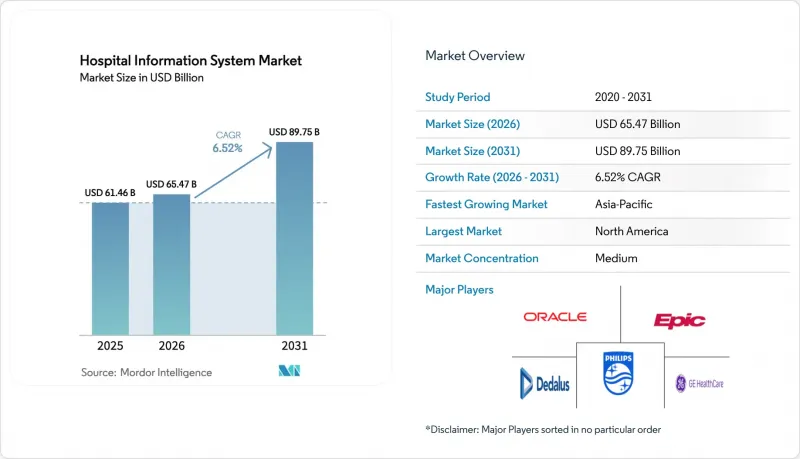
Mordor Intelligence에 의하면, 병원 정보 시스템 시장 규모는 2025년 614억 6,000만 달러로 평가되었고, 2026년에는 654억 7,000만 달러로 추정되고, 2026-2031년 CAGR 6.52%로 성장을 지속할 전망이며, 2031년에는 897억 5,000만 달러에 이를 것으로 예측됩니다.
본 보고서에서는 업계를 제공 형태별(클라우드 기반, 온프레미스형 등), 유형별(임상 정보 시스템, 관리 정보 시스템 등), 구성 요소별(소프트웨어, 서비스, 하드웨어), 최종 사용자별(종합병원, 전문병원 등) 및 지역별로 분류하고 있습니다. 시장 규모 및 전망은 금액(달러)으로 표시되어 있습니다.
세계의 병원 정보 시스템 시장 동향 및 인사이트
AI를 활용한 분석 및 임상 의사결정 지원의 활용 확대
현재 병원에서는 머신러닝 모델을 도입하여 패혈증 감지, 항생제 투여 최적화, 퇴원 준비 상황 예측을 거의 실시간으로 수행하고 있습니다. Epic사는 로드맵에 100개 이상의 AI 기능을 제시하고 있으며, 이는 분석 기능이 핵심 플랫폼에 얼마나 깊이 통합되어 있는지를 보여줍니다. 듀크 헬스(Duke Health)는 GE 헬스케어의 ‘커맨드 센터’ 소프트웨어를 도입한 후, 병상 배정 소요 시간을 단축하고 실질적인 처리 능력 향상을 실현했습니다. 이사회에서는 모델의 설명 가능성에 대한 설명을 요구하는 목소리가 점점 더 커지고 있으며, 거버넌스 팀은 데이터 사이언스자들과 협력하여 지역별 치료 경로를 반영한 알고리즘 조정을 진행하고 있습니다. 이러한 움직임이 주류를 이루면서, AI 기능은 시범 운영 단계에서 표준 요건으로 전환되고 있으며, 병원 정보 시스템 시장에서 이에 대한 지출 규모가 확대되고 있습니다.
신흥 시장의 대규모 병원 인프라 투자
걸프협력회의(GCC) 회원국과 동남아시아의 여러 국가에서는 현재 건설비와 병행하여 디지털 플랫폼에 대한 예산을 편성하고 있으며, 이를 통해 신설되는 3차 의료 센터는 기존의 아키텍처를 뛰어넘어 발전할 수 있게 되었습니다. 아랍에미리트(UAE)의 프로젝트에서는 전자건강기록(EHR), 영상 아카이브 및 지휘 센터의 분석 기능에 막대한 자금이 배정되어 있어, 물리적 수용 능력의 확대와 디지털 성숙도의 향상이 조화를 이루며 진행될 수 있도록 보장되고 있습니다. 다국어 인터페이스를 제공하는 업체는 선구자로서의 우위를 점하고 있습니다. 이러한 추세에 따라 수익원은 급성장하고 있으며, 인프라가 잘 갖춰진 지역으로 이동하고 있어, 아시아태평양은 가장 빠르게 확대되고 있는 병원 정보 시스템 시장으로서의 역할을 강화하고 있습니다.
높은 총 소유 비용
하드웨어, 데이터 이전, 워크플로우 재설계 및 수년에 걸친 유지보수를 포함하면, 종합적인 EHR 도입에는 수억 달러의 비용이 소요될 수 있습니다. 노스웰 헬스 이사회는 중복 검사를 줄이고 지역 주민의 건강 관리를 개선함으로써 경영진이 신뢰할 수 있는 투자 회수 기간을 제시한 데 따라, 12억 달러 규모의 계획을 승인했습니다. 소규모 병원들은 이러한 자본 지출을 감당할 수 있는 재정 기반이 부족하기 때문에 구독 방식이나 공유 서비스 모델로 전환할 수밖에 없는 실정입니다. 따라서 매니지드 서비스의 양도 방식부터 민관 파트너십에 이르기까지, 혁신적인 자금 조달 메커니즘이 주목을 받고 있습니다. 각 벤더사는 고객이 라이프사이클 전반에 걸쳐 가치를 평가하고 있음을 인식하고, 계약에 최적화 서비스를 포함시킴으로써 이에 대응하고 있습니다. 이러한 경제 상황의 변화에 따라, 병원 정보 시스템 업계는 단순한 소프트웨어 도입이 아닌, 측정 가능한 개선에 대해 보상이 지급되는 성과 기반의 가격 체계로 전환되고 있습니다.
부문별 분석
이 서비스는 병원 정보 시스템 시장에서 가장 큰 점유율을 차지하며, 2025년 매출의 45.30%를 차지한 반면, 소프트웨어 부문은 2026-2031년 연평균 성장률(CAGR) 7.6%를 나타낼 것으로 전망됩니다. 복잡한 데이터 변환 프로젝트나 여러 거점에서의 도입은 특히 여러 레거시 플랫폼을 통합하는 의료 시스템 분야에서 컨설팅 서비스 및 매니지드 서비스에 대한 수요를 지속적으로 견인하고 있습니다. 한편, AI 지원 모듈의 인기가 높아지면서, 특히 의사결정 지원 및 앰비언트 다큐멘테이션 분야에서 소프트웨어 라이선스 시장의 성장을 견인하고 있습니다. 에픽(Epic)사가 메이요 클리닉(Mayo Clinic) 및 어브리지(Abridge)사와 제휴하여 간호 업무 흐름을 위한 생성형 AI를 시범 도입하고 있는 사례는 각 벤더들이 가치 실현까지 걸리는 시간을 단축하기 위해 종합적인 서비스 체계를 강화하고 있음을 여실히 보여주고 있습니다. 그 뚜렷한 결과로, 맞춤형 코딩 대신 재사용 가능한 클라우드 네이티브 템플릿이 채택됨에 따라 도입 기간이 단축되고 있습니다. 서비스 계약을 측정 가능한 임상적·재무적 목표와 연계하는 의료기관은 더 신속하게 이익을 실현하는 경향이 있으며, 이로 인해 병원 정보 시스템 업계에서 전문 서비스의 전략적 역할이 더욱 강화되고 있습니다.
2025년 시점에서 온프레미스형 도입이 병원 정보 시스템 시장에서 가장 큰 점유율(추정 54.20%)을 유지했으나, 클라우드 기반 모델은 2031년까지 연평균 성장률(CAGR) 8.55%에 가까운 속도로 확대될 것으로 예측됩니다. 최고기술책임자(CTO)는 확장성과 비즈니스 연속성을 클라우드 도입의 주요 동기로 꼽고 있지만, 지연이나 데이터 주권 등의 이유로 많은 조직이 여전히 핵심 전자건강기록(EHR) 데이터베이스를 온프레미스 서버에 보관하고 있습니다. 선도적인 조직에서는 하이브리드 아키텍처를 채택하여, 분석용 샌드박스를 클라우드에서 호스팅하는 한편, 트랜잭션 부하가 높은 모듈은 전용 데이터센터에 유지하고 있습니다. 퍼블릭 클라우드를 조기에 도입한 조직의 Epic 성공 사례는 운영상의 유연성을 보여주고 있지만, 비용 효율성은 여전히 인스턴스의 적절한 크기 설정에 달려 있습니다. 실무적인 측면에서 볼 때, 프로젝트 로드맵에서 네트워크 대역폭 계획 및 ID·접근 관리는 용도 로직과 마찬가지로 중요해지고 있습니다. 그 결과, 현재 제공 형태를 결정할 때는 회복탄력성, 비용, 데이터 소재지 및 혁신 목표 간의 균형을 맞추기 위해 다방면에 걸친 검토가 필수적입니다.
지역별 분석
북미는 전자의무기록(EHR) 도입 의무화와 넉넉한 예산에 힘입어 2025년에는 병원 정보 시스템 시장에서 41.60%의 점유율을 기록했습니다. Change Healthcare의 사이버 사고를 계기로, 미국의 병원들은 공급업체에 대한 위험 평가를 강화하고, 계약서에 실시간 위협 인텔리전스에 관한 조항을 포함시켰습니다. BMC Digital Health의 조사에 따르면, 미국 시스템의 84%가 AI 예측 모델을 도입하고 있지만, 거버넌스 팀 인력은 여전히 부족한 실정입니다. 따라서 의료 제공업체들은 모델 검증을 위해 관리형 서비스를 요구하고 있으며, 이에 따라 서비스가 잘 갖춰진 병원 정보 시스템 시장이 형성되고 있습니다.
아시아태평양은 의료비 증가와 ‘클라우드 퍼스트’ 정책에 힘입어 2031년까지 연평균 성장률(CAGR) 9.1%라는 가장 높은 성장률을 보일 것으로 전망됩니다. 인도의 연방 의료 예산은 2024년에 두 자릿수 증가를 기록했으며, 태국 보건부는 AI 분류 엔진과 연동되는 원격의료용 키오스크의 시범 운영을 진행하고 있습니다. 싱가포르의 스마트 병동 이니셔티브에서는 IoT를 활용한 생체 신호 추적이 중시되고 있으며, 상호 운용성에 대한 기대가 높아지고 있습니다. 특히 개인정보보호법이 잇달아 제정되는 가운데, 언어 현지화 서비스를 제공하는 업체들에게는 성장의 여지가 넓어지고 있습니다. 이 병원은 기존의 인프라를 뛰어넘는 방식으로, 지역 광대역 환경 구축과 연계된 클라우드 기반 전자건강기록(EHR) 플랫폼을 도입하고 있으며, 이를 통해 병원 정보 시스템 시장에서 아시아태평양의 역할이 강화되고 있습니다.
유럽, 중동 및 아프리카에서는 디지털 성숙도의 격차가 큽니다. 독일의 ‘Krankenhauszukunftsgesetz(KHZG)’ 기금은 병원에 디지털 의약품 관리 인증을 의무화하고 있으며, 이에 따라 공급업체들은 생태계 서비스 확대를 요구받고 있습니다. GCC 국가들에서는 공립 병원의 4분의 3 이상이 이미 EHR을 도입했으며, 사우디아라비아의 ‘비전 2030’에 명시된 원격 진료 목표에 힘입어 이러한 추세는 더욱 가속화되고 있습니다. 데이터 교환 기준에 관한 규제의 조화를 통해 다국적 도입이 용이해지는 한편, 유럽에서 걸프 지역 메가 프로젝트로 인력이 유입됨에 따라 기술 구성의 진화가 가속화되고 있습니다. 전반적으로 볼 때, 이 지역은 여전히 다양성을 지니고 있음에도 불구하고, 병원 정보 시스템 시장에 있어 전략적으로 중요한 무대로 남아 있습니다.
기타 혜택 :
- 엑셀 형식 시장 예측(ME) 시트
- 3개월간의 애널리스트 지원
자주 묻는 질문
목차
제1장 서론
제2장 조사 방법
제3장 주요 요약
제4장 시장 구도
제5장 시장 규모 및 성장 예측
제6장 경쟁 구도
제7장 시장 기회 및 향후 전망
AJY 26.06.24According to Mordor Intelligence, the hospital information system market size is expected to grow from USD 61.46 billion in 2025 to USD 65.47 billion in 2026 and is forecast to reach USD 89.75 billion by 2031 at 6.52% CAGR over 2026-2031.
This report Segments the Industry Into Mode of Delivery (Cloud-Based, On-Premise, and More), Type (Clinical Information Systems, Administrative Information Systems, and More), by Component (Software, Services, and Hardware), by End User (Multi-Specialty Hospitals, Specialty Hospitals, and More), and Geography. The Market Sizes and Forecasts are Provided in Terms of Value (USD).
Global Hospital Information System Market Trends and Insights
Rising Use of AI-Driven Analytics and Clinical Decision Support
Hospitals now embed machine-learning models to flag sepsis, optimise antibiotics and predict discharge readiness in near real time. Epic lists more than 100 AI features on its roadmap, signalling how deeply analytics is being woven into core platforms . Duke Health shortened bed-assignment intervals after implementing GE HealthCare's Command Center Software, demonstrating tangible throughput gains . Boards increasingly demand model-explainability statements, and governance teams work with data scientists to calibrate algorithms that reflect local care pathways. As these practices become mainstream, AI functionality is shifting from pilots to default requirements, enlarging addressable spend in the hospital information system market.
Large-Scale Hospital Infrastructure Investments in Emerging Markets
Gulf Cooperation Council states and multiple Southeast Asian countries now budget digital platforms alongside construction, allowing new tertiary centres to leapfrog legacy architectures. Projects in the United Arab Emirates allocate substantial funds to EHR, imaging archives and command-centre analytics, ensuring that digital maturity grows in lockstep with physical capacity . Vendors providing multilingual interfaces gain first-mover advantage. These dynamics redirect revenue pools toward fast-growing, infrastructure-rich regions, reinforcing Asia-Pacific's role as the quickest-expanding hospital information system market.
High Total Cost of Ownership
Comprehensive EHR deployments can cost hundreds of millions of USD when hardware, data migration, workflow redesign and multi-year maintenance are included. Northwell Health's board approved a USD 1.2 billion initiative after leadership demonstrated a credible payback horizon through reduced duplicative testing and improved population-health management. Smaller hospitals lack the balance sheets to absorb such capital outlays, pushing them toward subscription pricing or shared-services models. Innovative financing mechanisms-ranging from managed-service concessions to public-private partnerships-are therefore gaining traction. Vendors respond by bundling optimisation services within contracts, recognising that clients judge value over the full life cycle. This evolving economics is nudging the Hospital Information System industry toward outcome-based pricing structures that reward measurable improvements rather than mere software installation.
Other drivers and restraints analyzed in the detailed report include:
- Interoperability mandates such as the US ONC Cures Act driving digital consolidation
- AI-powered clinical decision support adoption boosting CIS modules
- Increasing Cybersecurity and Compliance Risks
For complete list of drivers and restraints, kindly check the Table Of Contents.
Segment Analysis
Services accounted for the largest Hospital Information System market share, representing 45.30% of 2025 revenue, while the software component is forecast to record an 7.6% CAGR between 2026 and 2031. Complex data-conversion projects and multi-site rollouts continue to drive demand for consultative and managed services, particularly among health systems consolidating multiple legacy platforms. Meanwhile, the rising popularity of AI-enabled modules is fuelling software licence growth, especially for decision-support and ambient documentation. Epic's partnership with Mayo Clinic and Abridge to pilot generative AI for nursing workflows typifies how vendors are deepening service wrap-arounds to accelerate time-to-value. An observable consequence is that implementation timelines are shortening as repeatable, cloud-native templates replace bespoke coding. Providers that align service engagements to measurable clinical and financial objectives tend to realise faster benefit realisation, reinforcing the strategic role of professional services in the Hospital Information System industry.
On-premise deployments retained the largest hospital information system market size in 2025, with an estimated 54.20% share, yet cloud-based models are projected to expand at close to a 8.55 % CAGR through 2031. Chief technology officers cite scalability and business-continuity features as primary cloud motivators, but many still keep core EHR databases on local servers for latency and sovereignty reasons. Progressive organisations adopt hybrid architectures, hosting analytics sandboxes in the cloud while maintaining high-transaction modules in dedicated data centres. Epic's success stories from early public-cloud adopters demonstrate operational elasticity, though cost efficiencies remain contingent on rigorous instance-rightsizing. A practical implication is that network-bandwidth planning and identity-access management become as critical as application logic in project roadmaps. Consequently, mode-of-delivery decisions now involve multidisciplinary reviews that balance resilience, cost, data-residency and innovation goals.
Geography Analysis
North America recorded a 41.60% hospital information system market share in 2025, buoyed by mandated EHR adoption and sizeable budgets. After the Change Healthcare cyber incident, US hospitals tightened vendor risk assessments and embedded real-time threat-intelligence clauses in contracts. A BMC Digital Health review noted that 84% of US systems deploy AI predictive models, though governance teams remain under-resourced. Providers therefore seek managed services for model validation, fostering a service-rich hospital information system market.
Asia-Pacific is poised for the fastest 9.1% CAGR to 2031, fuelled by rising health expenditure and cloud-first policies. India's federal health budget increased double digits in 2024, and Thailand's ministry pilots tele-medicine kiosks interfacing with AI triage engines. Singapore's smart-ward initiatives emphasise IoT-enabled vital-sign tracking, raising interoperability expectations. Vendors offering language localisation gain headroom, especially as personal-data-protection acts proliferate. Leapfrogging older infrastructure, hospitals adopt cloud EHR platforms that align with regional broadband upgrades, fortifying Asia-Pacific's role in the hospital information system market.
Europe, the Middle East and Africa present a spectrum of digital maturity. Germany's Krankenhauszukunftsgesetz (KHZG) fund compels hospitals to certify digital-medication management, spurring suppliers to expand ecosystem services. GCC nations report more than three-quarters of public hospitals already on EHRs, amplified by Saudi Arabia's Vision 2030 tele-consultation targets. Regulatory convergence on data-interchange standards eases multi-national implementations, while talent flows from Europe to Gulf megaprojects accelerate skill-mix evolution. Collectively, the region remains a heterogeneous but strategically important theatre for the hospital information system market.
- Oracle Health (Cerner)
- Epic Systems
- Dedalus Group
- Allscripts (Altera Digital Health)
- Koninklijke Philips
- GE Healthcare
- Meditech
- Mckesson
- Wipro
- Siemens Healthineers
- Intersystems
- CPSI (Evident & TruBridge)
- NextGen Healthcare
- Integrated Medical Systems
- Optum (Change Healthcare)
- IBM
- eClinicalWorks
- NTT DATA Corporation
- Alcatel-Lucent Enterprise
- Tata Consultancy Services (TCS)
- DXC Technology
- Sectra
- Telstra Health Pty Ltd
- Orion Health Group
- Agfa-Gevaert NV (AGFA HealthCare)
Additional Benefits:
- The market estimate (ME) sheet in Excel format
- 3 months of analyst support
TABLE OF CONTENTS
1 Introduction
- 1.1 Study Assumptions & Market Definition
- 1.2 Scope of the Study
2 Research Methodology
3 Executive Summary
4 Market Landscape
- 4.1 Market Overview
- 4.2 Market Drivers
- 4.2.1 Rising use of AI-driven analytics and clinical decision support
- 4.2.2 Large-scale hospital infrastructure investments in emerging markets
- 4.2.3 Interoperability Mandates such as US ONC Cures Act Driving Digital Consolidation
- 4.2.4 AI-powered Clinical Decision Support Adoption Boosting CIS Modules
- 4.2.5 Growing demand for quality healthcare system
- 4.2.6 Technological advancement in healthcare sector
- 4.3 Market Restraints
- 4.3.1 High total cost of ownership
- 4.3.2 Increasing cybersecurity and compliance risks
- 4.3.3 Physician Resistance due to Workflow Disruption
- 4.3.4 Lack of IT infrastructure in emerging nations
- 4.4 Value Chain Analysis
- 4.5 Regulatory Outlook
- 4.6 Technological Outlook
- 4.7 Porter's Five Forces Analysis
- 4.7.1 Threat of New Entrants
- 4.7.2 Bargaining Power of Buyers
- 4.7.3 Bargaining Power of Suppliers
- 4.7.4 Threat of Substitutes
- 4.7.5 Competitive Rivalry
5 Market Size & Growth Forecasts (Value, USD)
- 5.1 By Component
- 5.1.1 Software
- 5.1.2 Services
- 5.1.3 Hardware
- 5.2 By Mode of Delivery
- 5.2.1 On-premise
- 5.2.2 Cloud-based
- 5.2.3 Hybrid (Hosted)
- 5.3 By Type
- 5.3.1 Clinical Information Systems
- 5.3.1.1 Electronic Health/Medical Records
- 5.3.1.2 Computerized Physician Order Entry
- 5.3.1.3 Laboratory Information System
- 5.3.1.4 Radiology Information System
- 5.3.1.5 Pharmacy Information System
- 5.3.1.6 Picture Archiving & Communication Systems
- 5.3.1.7 Others (ICU, Anesthesia, etc.)
- 5.3.2 Administrative Information Systems
- 5.3.2.1 Patient Registration & Scheduling
- 5.3.2.2 Revenue Cycle Management
- 5.3.2.3 Workforce Management
- 5.3.2.4 Supply Chain & Inventory Management
- 5.3.3 Ancillary Information Systems
- 5.3.1 Clinical Information Systems
- 5.4 By End-user
- 5.4.1 Multi-specialty Hospitals
- 5.4.2 Specialty Hospitals
- 5.4.3 Academic Medical Centers
- 5.5 By Geography
- 5.5.1 North America
- 5.5.1.1 United States
- 5.5.1.2 Canada
- 5.5.1.3 Mexico
- 5.5.2 Europe
- 5.5.2.1 Germany
- 5.5.2.2 United Kingdom
- 5.5.2.3 France
- 5.5.2.4 Italy
- 5.5.2.5 Spain
- 5.5.2.6 Rest of Europe
- 5.5.3 Asia-Pacific
- 5.5.3.1 China
- 5.5.3.2 Japan
- 5.5.3.3 India
- 5.5.3.4 South Korea
- 5.5.3.5 Australia
- 5.5.3.6 Rest of Asia-Pacific
- 5.5.4 Middle East
- 5.5.4.1 GCC
- 5.5.4.2 South Africa
- 5.5.4.3 Rest of Middle East
- 5.5.5 South America
- 5.5.5.1 Brazil
- 5.5.5.2 Argentina
- 5.5.5.3 Rest of South America
- 5.5.1 North America
6 Competitive Landscape
- 6.1 Market Concentration
- 6.2 Strategic Moves
- 6.3 Market Share Analysis
- 6.4 Company Profiles (includes Global-level Overview, Market-level Overview, Core Segments, Financials as available, Strategic Information, Market Rank/Share, Products & Services, Recent Developments)
- 6.4.1 Oracle Health (Cerner)
- 6.4.2 Epic Systems Corporation
- 6.4.3 Dedalus Group
- 6.4.4 Allscripts (Altera Digital Health)
- 6.4.5 Koninklijke Philips NV
- 6.4.6 GE HealthCare
- 6.4.7 MEDITECH
- 6.4.8 McKesson Corporation
- 6.4.9 Wipro Limited
- 6.4.10 Siemens Healthineers AG
- 6.4.11 InterSystems Corporation
- 6.4.12 CPSI (Evident & TruBridge)
- 6.4.13 NextGen Healthcare Inc.
- 6.4.14 Integrated Medical Systems
- 6.4.15 Optum (Change Healthcare)
- 6.4.16 IBM
- 6.4.17 eClinicalWorks
- 6.4.18 NTT DATA Corporation
- 6.4.19 Alcatel-Lucent Enterprise
- 6.4.20 Tata Consultancy Services (TCS)
- 6.4.21 DXC Technology
- 6.4.22 Sectra AB
- 6.4.23 Telstra Health Pty Ltd
- 6.4.24 Orion Health Group
- 6.4.25 Agfa-Gevaert NV (AGFA HealthCare)
7 Market Opportunities & Future Outlook
- 7.1 White-space & Unmet-need Assessment