

|
시장보고서
상품코드
2155013
중증 환자 정보 시스템 : 시장 점유율 분석, 업계 동향과 통계, 성장 예측(2026-2031년)High Acuity Information Systems - Market Share Analysis, Industry Trends & Statistics, Growth Forecasts (2026 - 2031) |
||||||
 Mordor Intelligence
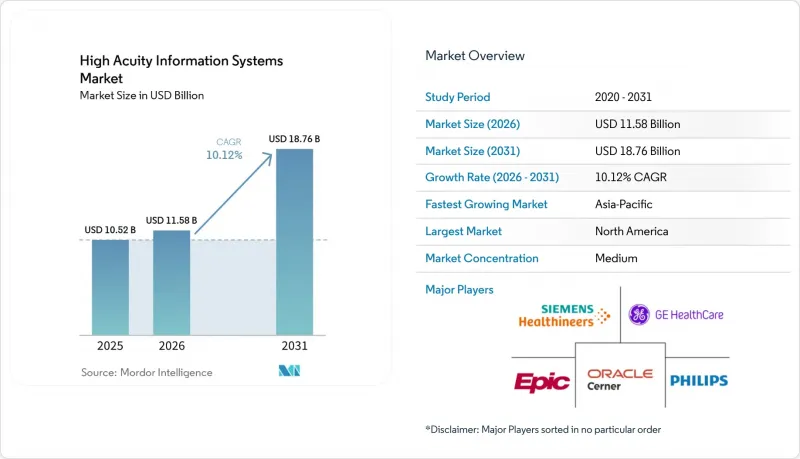
에 따르면 급성기 중증환자 정보시스템 시장 규모는 2025년에 105억 2,000만 달러, 2026년에 115억 8,000만 달러에 달하며, 2031년까지 187억 6,000만 달러에 달할 것으로 예측되고 있으며, 2026-2031년에 CAGR 10.12%로 성장할 것으로 전망되고 있습니다.
글로벌 급성기 중증환자 정보시스템 시장의 동향 및 인사이트
중환자실 입원 증가가 플랫폼 요구 사항을 재정의
중환자 치료에 대한 수요가 증가함에 따라 하이아큐이티 정보 시스템 시장에 요구되는 요건이 변화하고 있습니다. 미국 중환자 의학회(Society of Critical Care Medicine)의 보고에 따르면 미국에서는 매년 500만 건의 ICU 입원이 발생합니다. ICU 환자 입원 일수는 2035년까지 14% 증가할 것으로 예상되며, 이는 전체 입원 환자 수의 5% 증가와 비교했을 때 더 높은 성장률입니다. 중증도가 높아짐에 따라 다수의 환자에 대한 연속 파형, 검사 결과, 투약 데이터 및 병상 옆 기기의 정보를 한 번에 통합할 수 있는 시스템이 요구되고 있습니다. 이를 통해 의료 제공자가 ICU의 물리적 수용 능력을 확대할 수 없는 경우에도 병상 1개당 정보 시스템의 가치가 높아집니다. 중국의 ‘T/CHIA 47-2024’ 스마트 중환자실 규격은 공립 병원 조달시 다중 모드 데이터 통합과 실시간 임상 의사결정 지원을 요구하고 있으며, 이러한 방향성을 지원하고 있습니다.
원격 ICU 도입이 정보 시스템의 수요 사이클을 창출
텔레-ICU 프로그램에는 원격지의 임상의가 시설을 초월하여 이용할 수 있는 데이터 및 알림 계층이 필요합니다. 이러한 요건으로 인해 가상 진료의 확대는 중증도 높은 환자를 위한 정보 시스템 시장의 수요와 직접적으로 연결됩니다. 웨스트 테네시 헬스케어는 2026년 6월, 필립스의 eCareManager 및 hellocare.ai를 활용하여 eICU 프로그램을 127개의 ICU 병상과 17대의 이동식 응급실 카트로 확대했습니다. 원격 팀은 별도의 로컬 워크플로우를 거치지 않고도 생체 신호, 파형, 검사 데이터, 투약 기록에 접근할 수 있어야 합니다. 또한 통합된 커맨드 센터는 의료 시스템이 제휴 시설 전체에 걸쳐 단일 플랫폼을 표준화하도록 촉진합니다. 이를 통해 시스템내 공급업체의 분산이 완화되고, 공급업체에게 기업 계약의 중요성이 높아집니다.
통합의 복잡성이 도입 속도를 저해
병원의 레거시 아키텍처는 중증 환자용 정보 시스템 시장의 도입을 지연시킬 가능성이 있습니다. 대규모 의료 시스템의 경우, 검사, 약제, 방사선, 청구, 병상 관리, 의료기기 시스템에 걸쳐 맞춤형 인터페이스에 의존하는 경우가 많습니다. 플랫폼 전환 시에는 각 연결을 재구축하고 검증해야 할 수 있습니다. 2026년 병원 전환에 관한 조사에서는 계획 시작 전에 20TB가 넘는 레거시 Oracle 데이터를 평가하는 데 3개월이 소요되었다고 보고되었습니다. 이러한 요구 사항으로 인해 기업 플랫폼 도입 일정은 1-3년에 달할 수 있습니다. 이러한 부담은 전담 임상정보학 팀을 보유하지 않은 지역 병원에 특히 큰 과제가 됩니다.
부문 분석
2025년에는 중환자실(ICU)용 정보 시스템이 매출의 42.31%를 차지했습니다. 이 부문은 파형 데이터, 멀티 디바이스 텔레메트리, 투약 기록의 밀도가 가장 높은 병원 환경을 지원합니다. 이러한 임상 워크로드는 지속적인 데이터 수집과 협력적인 의사결정을 목적으로 설계된 시스템의 활용을 촉진합니다. 또한 대규모 도입 기반은 향후 알고리즘 개발을 지원할 종단적 정보도 생성합니다. 이러한 축적된 데이터는 기존 의료 서비스 제공자의 전환 비용을 높이는 요인이 됩니다. 마취 정보 관리 시스템 및 주산기 정보 시스템은 첨단 의료 시스템에서 안정적인 이용이 지속되고 있는 성숙한 카테고리입니다. 외과 정보 시스템은 최소 침습 수술 및 로봇 보조 수술로의 전환에 따른 혜택을 누리고 있습니다. 2026년 중국의 3차 의료 기관에 도입된 Mindray사의 ‘Ruizhi’ 중환자 치료 의사결정 지원 시스템은 단순한 기록 툴에서 AI를 활용한 임상적 권고 사항으로의 전환을 보여줍니다.
응급실 정보 시스템은 2031년까지 연평균 성장률(CAGR) 13.25%로 성장할 것으로 예측됩니다. 이 긴급도가 높은 정보 시스템 시장의 큰 성장 기회는 응급실의 혼잡과 더 신속한 트라이아지 및 환자 흐름 결정에 대한 수요를 반영하고 있습니다. 또한 CMS의 SEP-1 번들에 기반한 패혈증 특정 요건 역시 시기적절한 의사결정 지원에 대한 수요를 부추기고 있습니다. 불필요한 입원을 피하도록 보험사로부터 압력이 가해지고 있는 점도 병원이 조기 임상 평가를 개선해야 하는 또 다른 이유가 되고 있습니다. 2025년에는 외래 수술 센터의 76%가 전자건강기록(EHR)을 도입했습니다. 이를 통해 효과적인 분류 및 퇴원 절차가 필요한 시설의 디지털 대응 능력이 향상되고 있습니다. 또한 여러 의료 환경을 아우르는 기타 제품 유형은 파편화된 포인트 솔루션을 대체하려는 벤더들의 투자를 유치하고 있습니다. 의료 시스템 또한 급성기 의료 워크플로우 전반에 걸쳐 벤더와의 관계를 소수 정예화하고 심화시키는 방향으로 전환하고 있습니다.
2025년에는 ‘소프트웨어 및 서비스’가 매출의 60.24%를 차지하며, 중증 환자용 정보 시스템 시장의 주요 구성 요소가 되었습니다. 이 점유율은 하드웨어 중심의 구매에서 구독형 및 플랫폼 기반 계약으로의 전환을 반영합니다. 소프트웨어를 통한 제공을 통해 벤더는 현장에 직접 개입하지 않고도 새로운 임상 모듈, 규제 대응 패치, 알고리즘 업데이트를 제공할 수 있게 됩니다. 또한 클라우드 네이티브 형식은 여러 거점에 걸친 의료 네트워크 전체에서의 접근도 지원합니다. 2026년 6월, 샌안토니오의 유니버시티 헬스(University Health)는 필립스(Philips)의 ‘기업 모니터링 애즈 어 서비스(Enterprise Monitoring as a Service)’ 모델을 채택했습니다. 이 계약을 통해 모니터링용 하드웨어, 의사결정 지원, 경보 관리, 수명주기 서비스가 다년간의 구독 계약 하에 통합되었습니다. 이러한 계약은 병원의 벤더 관리를 간소화하고, 공급업체에게는 지속적인 서비스 수익의 중요성을 높여줍니다.
하드웨어의 상대적인 역할은 줄어들고 있지만, 병상 간호 및 임상 연결에는 여전히 필수적입니다. 엣지 AI 처리는 클라우드로의 쿼리를 기다릴 수 없는 경보를 지원할 수 있습니다. GE 헬스케어와 NXP는 2026년 1월, 마취 및 신생아 간호를 위한 온디바이스 AI에 관한 협력을 발표했습니다. 이러한 접근 방식을 통해 지연 시간에 민감한 작업에서 중앙 집중식 컴퓨팅에 대한 의존도를 줄일 수 있습니다. 또한 지능형 병상 노드에 대한 새로운 투자 주기도 촉진합니다. 따라서 하드웨어의 수명 주기는 소프트웨어 구독을 대체하는 것이 아니라, 이와 병행하여 기능합니다. 첨단 의료 정보 시스템 업계의 벤더에게는 신뢰할 수 있는 디바이스 연결성과 확장 가능한 소프트웨어 제공이 모두 요구됩니다. 또한 제품 설계에 있어서는 확립된 진료 프로세스를 방해하지 않으면서도 병원이 임상 툴을 업데이트할 수 있도록 해야 합니다.
지역별 분석
북미는 2025년에 매출의 45.61%를 차지하며 여전히 최대 매출 지역으로 자리매김하고 있습니다. 미국에서는 의료 시스템 통합 및 기업 규모의 조달을 통해 지역적 수요를 주도하고 있습니다. 지역 병원을 인수하는 대규모 의료 시스템은 대개 현지 임상 시스템을 통합 플랫폼으로 대체합니다. 이로 인해 여러 거점에 걸쳐 상호 운용 가능한 정보 툴에 대한 수요가 발생하고 있습니다. CMS(미국 의료보험서비스센터)의 상호운용성 프레임워크는 2026년 7월 ‘인증 의료 정보 네트워크(Qualified Health Information Networks)’의 첫 번째 일반 제공 코호트를 등록했습니다. 이 획기적인 사건은 집중 치료 플랫폼과 보험사 간의 FHIR 기반 정보 교환을 촉진하는 것입니다. 캐나다와 멕시코에서는 임상 정보의 현대화를 통해 추가적인 성장이 예상됩니다. 해밀턴 헬스 사이언스(Hamilton Health Sciences)는 2025년 8월, 중환자 치료용 의료기기를 위해 필립스의 ‘Capsule Medical Device Integration’을 자사의 Epic EMR에 통합했습니다.
2025년에는 유럽이 큰 점유율을 차지했으며, 국가별로는 독일이 가장 강력한 입지를 확립했습니다. 병원 디지털화를 위한 자금 지원으로 중환자 치료 워크플로우 전반에 걸친 현대화가 추진되고 있습니다. 프랑스에서는 BOW Medical사가 자사의 ‘Diane’ 플랫폼이 2025년에 450개 이상의 의료기관을 아우른 것으로 보고했습니다. 이 플랫폼은 연간 500만 건의 마취 상담을 관리하며, 1,200개 이상의 ICU 병상을 지원하고 있습니다. 영국에서는 2025년 6월 시판 후 모니터링 개혁을 통해 도입 후 연결형 임상 시스템에 대한 감시가 강화되었습니다. 이에 따라 해당 지역에서 사업을 운영하려는 공급업체에 대한 규정 준수 요건이 높아지고 있습니다. 프랑스의 Alliance SIH는 파편화된 소프트웨어 환경을 해결하기 위해 개방적이고 데이터 중심의 병원 아키텍처를 개발하고 있습니다. 이러한 노력은 임상 부서 간의 상호 운용성 요건을 강화할 가능성이 있습니다.
아시아태평양은 2031년까지 연평균 성장률(CAGR) 12.25%로 성장할 것으로 예측되며, 이는 지역별 성장률 중 가장 높은 수치입니다. 중국은 정책 지원, 국내 기술 공급업체, 그리고 병원 건설을 통해 이 지역의 도입을 주도하고 있습니다. Mindray사의 ‘Ruizhi’ 시스템은 다중 모달 병상 데이터를 활용하여 3차 의료 기관의 임상 권고 사항을 지원하고 있습니다. 2026년 8월, 톈진 하이허 병원, Wining Health 및 톈진 국가 슈퍼컴퓨팅 센터는 ‘Ruizhi’ 중환자 치료 모델과 ICU AI 혁신 거점을 출범시켰습니다. 일본, 한국, 호주에서는 국가 및 지역 차원의 병원 현대화 프로그램을 통해 수요가 확대되고 있습니다. 인도의 3차 의료기관과 민간 의료 체인 역시 전용으로 설계된 임상 정보 시스템에 대한 투자를 추진하고 있습니다. 카타르는 2026년 3월, 공공 및 민간 의료 현장을 아우르는 환자 데이터 교환을 목적으로 한 디지털 헬스 상호운용성 계획을 시작했습니다. 브라질과 콜롬비아는 상호운용 가능한 의료 인프라를 구축하고 있지만, 남미 지역 전체적으로는 여전히 분절된 상태가 지속되고 있습니다.
기타 혜택:
- 엑셀 형식의 시장 예측(ME) 시트
- 3개월간의 애널리스트 지원
자주 묻는 질문
목차
제1장 서론
- 조사 전제조건과 시장 정의
- 조사 범위
제2장 조사 방법
제3장 개요
제4장 시장 구도
- 시장 개요
- 시장 성장 촉진요인
- 시장 성장 억제요인
- 밸류체인 분석
- 규제 상황
- 기술 전망
- Porter's Five Forces 분석
제5장 시장 규모와 성장 예측
- 제품 유형별
- 컴포넌트별
- 배포별
- 최종사용자별
- 지역별
- 북미
- 미국
- 캐나다
- 멕시코
- 유럽
- 독일
- 영국
- 프랑스
- 이탈리아
- 스페인
- 기타 유럽 국가
- 아시아태평양
- 중국
- 일본
- 인도
- 호주
- 한국
- 기타 아시아태평양 국가
- 중동 및 아프리카
- GCC
- 남아프리카공화국
- 기타 중동 및 아프리카 국가
- 남미
- 브라질
- 아르헨티나
- 기타 남미 국가
- 북미
제6장 경쟁 구도
- 시장 집중도
- 시장 점유율 분석
- 기업 개요
- Altera Digital Health
- Baxter International Inc.
- CLEW Medical Ltd.
- Dragerwerk AG and Co. KGaA
- Epic Systems Corporation
- Etiometry Inc.
- GE HealthCare Technologies Inc.
- Getinge AB
- InterSystems Corporation
- Koninklijke Philips N.V.
- Masimo Corporation
- MEDHOST
- MEDITECH
- Merative
- Nihon Kohden Corporation
- Oracle Corporation
- Picis Clinical Solutions, Inc.
- Siemens Healthineers AG
- Surgical Information Systems, LLC
- Wolters Kluwer N.V.
제7장 시장 기회와 향후 전망
KSA 26.10.28According to Mordor Intelligence, the high acuity information systems market size is projected to be USD 10.52 billion in 2025, USD 11.58 billion in 2026, and reach USD 18.76 billion by 2031, growing at a CAGR of 10.12% from 2026 to 2031.
Global High Acuity Information Systems Market Trends and Insights
Rising Critical-Care Admissions Are Redefining Platform Requirements
Critical-care demand is changing the requirements placed on the high acuity information systems market. The Society of Critical Care Medicine reports 5 million ICU admissions each year in the United States. ICU patient-days to rise 14% by 2035, compared with 5% growth in overall inpatient volume. Higher acuity requires systems that can bring together continuous waveforms, laboratory results, medication data, and bedside-device information for many patients at once. This raises the value of information systems on a per-bed basis, even where providers cannot expand physical ICU capacity. China's T/CHIA 47-2024 smart ICU standard supports this direction by calling for multimodal data integration and real-time clinical decision support in public-hospital procurement.
Tele-ICU Deployment Creates An Information Systems Pull Cycle
Tele-ICU programs require a data and alerting layer that remote clinicians can use across facilities. That requirement links virtual-care growth directly to demand in the high acuity information systems market. West Tennessee Healthcare expanded its eICU program to 127 ICU beds and 17 mobile emergency department carts with Philips eCareManager and hellocare.ai in June 2026. Remote teams need access to vital signs, waveforms, laboratory data, and medication records without separate local workflows. A centralized command center also encourages health systems to standardize on one platform across affiliated sites. This can reduce vendor fragmentation within a system and make enterprise contracts more important for suppliers.
Integration Complexity Suppresses Deployment Velocity
Legacy hospital architecture can slow deployment in the high acuity information systems market. Large health systems often rely on customized interfaces across laboratory, pharmacy, radiology, billing, bed management, and medical-device systems. Each connection may need rebuilding and validation during a platform migration. A 2026 hospital migration study reported a 3-month assessment of more than 20 TB of legacy Oracle data before planning began. These requirements can extend implementation schedules to 1-3 years for enterprise platforms. The burden is especially difficult for community hospitals without dedicated clinical informatics teams.
Other drivers and restraints analyzed in the detailed report include:
- Predictive Sepsis And Deterioration Algorithms Are Setting A New Procurement Baseline
- Intensivist Shortages Are Accelerating Platform Adoption
- Alert Fatigue Is Eroding The Business Case For AI-Driven Monitoring
For complete list of drivers and restraints, kindly check the Table Of Contents.
Segment Analysis
Intensive Care Unit Information Systems captured 42.31% of revenue in 2025. The segment serves the hospital environment with the greatest density of waveform feeds, multi-device telemetry, and medication records. This clinical workload supports the use of systems designed for continuous data collection and coordinated decisions. A large installed base also creates longitudinal information that can support future algorithm development. That accumulated data can increase switching costs for established providers. Anesthesia Information Management Systems and Perinatal Information Systems remain mature categories with stable use in developed healthcare systems. Surgical Information Systems benefit from the movement toward minimally invasive and robot-assisted procedures. Mindray's Ruizhi Critical Care Decision Support System, deployed in Chinese tertiary hospitals in 2026, shows the shift from documentation tools toward AI-supported clinical recommendations.
Emergency Department Information Systems are forecast to grow at a CAGR of 13.25% through 2031. This high acuity information systems market size opportunity reflects emergency department crowding and the need for faster triage and patient-flow decisions. Sepsis identification requirements under the CMS SEP-1 bundle also support demand for timely decision support. Payer pressure to avoid unnecessary admissions gives hospitals another reason to improve early clinical assessment. 76% of ambulatory surgical centers had adopted an EHR in 2025. This increases the digital readiness of settings that need effective triage and discharge processes. Other product types that bridge multiple care environments are attracting investment from vendors seeking to replace fragmented point solutions. Health systems are also moving toward fewer and deeper vendor relationships across acute-care workflows.
Software and Services held 60.24% of revenue in 2025, making it the leading component of the high acuity information systems market. The share reflects the move from hardware-led purchasing toward subscriptions and platform-based contracts. Software delivery can allow vendors to provide new clinical modules, regulatory patches, and algorithm updates without on-site intervention. Cloud-native formats also support access across multi-site care networks. Philips was selected by University Health in San Antonio for its Enterprise Monitoring as a Service model in June 2026. The contract combined monitoring hardware, decision support, alarm management, and lifecycle services under a multi-year subscription. Such contracts simplify vendor management for hospitals and make recurring service revenue more important for suppliers.
Hardware has a smaller relative role, but it remains necessary for bedside care and clinical connectivity. Edge AI processing can support alerts that cannot wait for a cloud query. GE HealthCare and NXP presented work on on-device AI for anesthesia and neonatal care in January 2026. This approach can reduce dependence on centralized computing for latency-sensitive tasks. It also supports a new cycle of investment in intelligent bedside nodes. The hardware cycle, therefore, operates alongside software subscriptions rather than replacing them. Vendors in the high acuity information systems industry need both reliable device connectivity and scalable software delivery. Their product design must also allow hospitals to update clinical tools without disrupting established care processes.
Complete Report Scope:
- By Product Type
- Intensive Care Unit Information Systems
- Anesthesia Information Management Systems
- Emergency Department Information Systems
- Perinatal Information Systems
- Surgical Information Systems
- Other Product Types
- By Component
- Software and Services
- Hardware
- By Deployment
- On-Premise
- Cloud-Based
- Edge and Local Deployment
- By End User
- Hospitals
- Academic Medical Centers
- Ambulatory Surgical Centers
- Nursing Care Facilities
- Other End Users
- By Geography
- North America
- United States
- Canada
- Mexico
- Europe
- Germany
- United Kingdom
- France
- Italy
- Spain
- Rest of Europe
- Asia-Pacific
- China
- Japan
- India
- Australia
- South Korea
- Rest of Asia-Pacific
- Middle East and Africa
- GCC
- South Africa
- Rest of Middle East and Africa
- South America
- Brazil
- Argentina
- Rest of South America
- North America
Geography Analysis
North America held 45.61% of revenue in 2025 and remains the largest revenue region. The United States drives regional demand through health-system consolidation and enterprise procurement. Large systems that acquire community hospitals often replace local clinical systems with a unified platform. This creates demand for interoperable information tools across many sites. The CMS Interoperability Framework enrolled its first general-availability cohort of Qualified Health Information Networks in July 2026. This milestone supports FHIR-based exchange between critical-care platforms and payers. Canada and Mexico provide additional growth through clinical information modernization. Hamilton Health Sciences integrated Philips Capsule Medical Device Integration with its Epic EMR for critical-care devices in August 2025.
Europe accounted for a significant share in 2025, with Germany holding the strongest country-level position. Hospital digitalization funding supports modernization across critical-care workflows. In France, BOW Medical reported that its Diane platform covered more than 450 healthcare institutions in 2025. The platform managed 5 million anesthesia consultations each year and supported more than 1,200 ICU beds. The United Kingdom's June 2025 post-market surveillance reforms increased scrutiny of connected clinical systems after launch. This raises compliance expectations for suppliers seeking to operate in the region. France's Alliance SIH is developing an open and data-centered hospital architecture to address fragmented software environments. These initiatives can strengthen interoperability requirements across clinical departments.
Asia-Pacific is forecast to grow at a CAGR of 12.25% through 2031, the fastest rate among geographic regions. China leads regional adoption through policy support, domestic technology suppliers, and hospital construction. Mindray's Ruizhi system uses multimodal bedside data to support clinical recommendations in tertiary hospitals. Tianjin Haihe Hospital, Wining Health, and the National Supercomputing Center Tianjin launched a Ruizhi critical-care model and ICU AI innovation base in August 2026. Japan, South Korea, and Australia add demand through national and regional hospital modernization programs. India's tertiary hospitals and private healthcare chains are also investing in purpose-built clinical information systems. Qatar launched a digital health interoperability plan in March 2026 for patient-data exchange across public and private care settings. Brazil and Colombia are developing interoperable care infrastructure, although South America remains fragmented.
- Altera Digital Health
- Baxter
- CLEW Medical Ltd.
- Dragerwerk AG and Co. KGaA
- Epic Systems
- Etiometry Inc.
- GE HealthCare Technologies Inc.
- Getinge
- Intersystems
- Koninklijke Philips
- Masimo
- Medhost
- Meditech
- Merative
- Nihon Kohden
- Oracle
- Picis Clinical Solutions, Inc.
- Siemens Healthineers
- Surgical Information Systems, LLC
- Wolters Kluwer
Additional Benefits:
- The market estimate (ME) sheet in Excel format
- 3 months of analyst support
TABLE OF CONTENTS
1 Introduction
- 1.1 Study Assumptions and Market Definition
- 1.2 Scope of the Study
2 Research Methodology
3 Executive Summary
4 Market Landscape
- 4.1 Market Overview
- 4.2 Market Drivers
- 4.2.1 Rising Critical-Care Admissions and Patient Acuity
- 4.2.2 Expansion of Tele-ICU and Virtual-Care Models
- 4.2.3 Demand for Predictive Deterioration and Sepsis Detection
- 4.2.4 Intensivist and Critical-Care Workforce Shortages
- 4.2.5 Hospital Investment in Interoperable Digital Infrastructure
- 4.2.6 Device-Derived Data Monetization and Longitudinal Waveform Archives
- 4.3 Market Restraints
- 4.3.1 Integration Complexity Across Legacy Hospital Systems
- 4.3.2 Alert Fatigue and Declining Clinician Trust
- 4.3.3 Cybersecurity, Privacy and Algorithmic-Liability Exposure
- 4.3.4 Uneven Budgets and Limited Local Implementation Capacity
- 4.4 Value Chain Analysis
- 4.5 Regulatory Landscape
- 4.6 Technological Outlook
- 4.7 Porter's Five Forces Analysis
- 4.7.1 Bargaining Power of Suppliers
- 4.7.2 Bargaining Power of Buyers
- 4.7.3 Threat of New Entrants
- 4.7.4 Threat of Substitutes
- 4.7.5 Competitive Rivalry
5 Market Size & Growth Forecasts (Value, USD)
- 5.1 By Product Type
- 5.1.1 Intensive Care Unit Information Systems
- 5.1.2 Anesthesia Information Management Systems
- 5.1.3 Emergency Department Information Systems
- 5.1.4 Perinatal Information Systems
- 5.1.5 Surgical Information Systems
- 5.1.6 Other Product Types
- 5.2 By Component
- 5.2.1 Software and Services
- 5.2.2 Hardware
- 5.3 By Deployment
- 5.3.1 On-Premise
- 5.3.2 Cloud-Based
- 5.3.3 Edge and Local Deployment
- 5.4 By End User
- 5.4.1 Hospitals
- 5.4.2 Academic Medical Centers
- 5.4.3 Ambulatory Surgical Centers
- 5.4.4 Nursing Care Facilities
- 5.4.5 Other End Users
- 5.5 By Geography
- 5.5.1 North America
- 5.5.1.1 United States
- 5.5.1.2 Canada
- 5.5.1.3 Mexico
- 5.5.2 Europe
- 5.5.2.1 Germany
- 5.5.2.2 United Kingdom
- 5.5.2.3 France
- 5.5.2.4 Italy
- 5.5.2.5 Spain
- 5.5.2.6 Rest of Europe
- 5.5.3 Asia-Pacific
- 5.5.3.1 China
- 5.5.3.2 Japan
- 5.5.3.3 India
- 5.5.3.4 Australia
- 5.5.3.5 South Korea
- 5.5.3.6 Rest of Asia-Pacific
- 5.5.4 Middle East and Africa
- 5.5.4.1 GCC
- 5.5.4.2 South Africa
- 5.5.4.3 Rest of Middle East and Africa
- 5.5.5 South America
- 5.5.5.1 Brazil
- 5.5.5.2 Argentina
- 5.5.5.3 Rest of South America
- 5.5.1 North America
6 Competitive Landscape
- 6.1 Market Concentration
- 6.2 Market Share Analysis
- 6.3 Company Profiles (includes Global Level Overview, Market Level Overview, Core Segments, Financials as available, Strategic Information, Market Rank/Share, Products and Services, Recent Developments)
- 6.3.1 Altera Digital Health
- 6.3.2 Baxter International Inc.
- 6.3.3 CLEW Medical Ltd.
- 6.3.4 Dragerwerk AG and Co. KGaA
- 6.3.5 Epic Systems Corporation
- 6.3.6 Etiometry Inc.
- 6.3.7 GE HealthCare Technologies Inc.
- 6.3.8 Getinge AB
- 6.3.9 InterSystems Corporation
- 6.3.10 Koninklijke Philips N.V.
- 6.3.11 Masimo Corporation
- 6.3.12 MEDHOST
- 6.3.13 MEDITECH
- 6.3.14 Merative
- 6.3.15 Nihon Kohden Corporation
- 6.3.16 Oracle Corporation
- 6.3.17 Picis Clinical Solutions, Inc.
- 6.3.18 Siemens Healthineers AG
- 6.3.19 Surgical Information Systems, LLC
- 6.3.20 Wolters Kluwer N.V.
7 Market Opportunities and Future Outlook
- 7.1 White-Space and Unmet-Need Assessment


