

|
시장보고서
상품코드
2066735
아시아태평양의 CLT(Cross Laminated Timber) 시장 : 시장 점유율 분석, 업계 동향 및 통계, 성장 예측(2026-2031년)Asia-Pacific Cross-Laminated Timber - Market Share Analysis, Industry Trends & Statistics, Growth Forecasts (2026 - 2031) |
||||||
 Mordor Intelligence
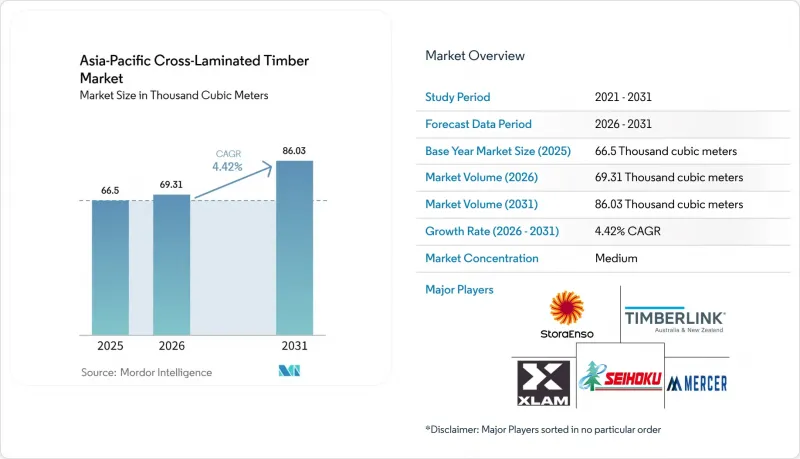
Mordor Intelligence에 의하면, 아시아태평양의 CLT(Cross Laminated Timber) 시장 규모는 2025년 6만 6,500입방미터로 평가되었고, 2026년에는 6만 9,310입방미터로 추정되고, 2031년까지 8만 6,030입방미터에 이를 것으로 예상되며, 2026-2031년 CAGR 4.42%로 성장할 전망입니다.
본 보고서는 유형별(접착 접합형 및 기계적 체결형), 용도별(주거용 및 비주거용), 지역별(중국, 인도, 일본, 한국, 호주 및 뉴질랜드 및 기타 아시아태평양)로 분류되어 있습니다. 시장 규모 및 전망은 수량(입방미터) 단위로 표시되어 있습니다.
아시아태평양의 CLT(Cross Laminated Timber) 시장 동향 및 분석
중국과 인도의 도시 지역에서 중층 건물 건설 붐이 급속히 확산되고 있습니다.
중국과 인도를 합치면 연간 중층 주택 착공 건수의 60% 이상을 차지하고 있으며, 새로운 정책 동향에 따라 그 상당 부분이 현대적인 목조 건축으로 전환되고 있습니다. 장쑤성이 2026년 1월에 발표한 지침에 따르면, 5,000 m²를 초과하는 공공 프로젝트에서 CLT에 대한 평가가 의무화되어 있으며, 이에 따라 해당 성 내에서 연간 8,000-12,000 m³ 수요가 추가로 발생할 것으로 전망됩니다. 인도에서는 고아 주에 인도 최초의 대규모 목조 주택이 건설되었으며, IIT 루크리 캠퍼스의 1억 2,000만 루피(138만 달러) 규모의 연수 센터가 현지 설계 역량을 육성하고 공급망의 기반을 다지고 있습니다. 건설업체들은 CLT가 20-25%에 달하는 경량성을 높이 평가했습니다. 이는 토지가 희소하고 지가가 급등하고 있는 대도시권에서 심층 기초 시공을 최소한으로 줄일 수 있기 때문입니다. 2028년까지 신설된 교육 프로그램을 통해 엔지니어링 인력이 배출됨에 따라, 수요 증가분의 대부분은 2027년 이후에 나타날 것으로 예측됩니다.
일본, 한국, 호주의 친환경 건축 인센티브
CASBEE, G-SEED 및 Green Star 각 인증 제도에서는 환경 제품 선언(EPD)을 통해 검증된 저탄소 함유 자재에 대해 추가 점수가 부여되게 되었습니다. 일본의 2024년 지침에 따르면, 국산 CLT에 대해 최대 10%의 용적률 가산 혜택이 인정되고 있으며, 미쓰이 부동산은 이를 활용하여 2025년 니혼바시 프로젝트에 1층 분량을 추가했습니다. 한국에서는 모든 공공 건축물에 대해 ‘Green 2’ 인증 취득이 의무화되어 있으며, 사실상 환경제품선언서(EPD) 제출이 공급업체 시장 진입 요건이 되고 있습니다. 호주의 청정에너지금융공사(CEFC)는 탄소중립을 목표로 하는 대규모 목조 건축 프로젝트를 위해 3억 호주 달러 규모의 저리 대출 한도를 마련하고, 2026년 1분기까지 42,000 m³의 패널에 대한 보증을 제공할 예정입니다. 이러한 인센티브는 현재 접착제로 접합된 CLT에 특히 중점을 두고 지원되고 있지만, 2031년을 훨씬 넘어서까지 지속될 것이며, 사양 채택률을 지속적으로 높여갈 가능성이 높다고 볼 수 있습니다.
열대 기후에서 습기로 인한 층간 박리 및 곰팡이 발생 위험
습도가 75% 이상으로 지속되면, 라멜라의 수분 함량이 접착제의 허용 범위를 초과하게 됩니다. 말레이시아와 호주 북부에서 실시한 현장 조사 결과, 보호 조치가 취해지지 않은 패널의 8-12%에서 2년 이내에 박리 현상이 확인되었습니다. 인도네시아, 말레이시아, 태국의 34개 추적 조사 대상 프로젝트 중 26%에서는 1년 이내에 곰팡이가 발생하여, CLT의 가격 경쟁력을 상쇄해 버리는 보수 비용이 발생했습니다. 실란 개질 폴리우레탄은 화학적 문제를 해결해 주지만, 여전히 30-40% 더 비싸며, 구조용 인증도 획득하지 못했습니다. 건축 기준에 방습층이 의무화되거나 접착제가 개선될 때까지는 열대 지역의 습도가 CLT의 보급을 저해하는 요인으로 남아 있을 것입니다.
부문별 분석
접착제로 접합된 패널은 연속적인 접착 라인을 통해 높은 전단 강도를 발휘하기 때문에 고층 빌딩의 코어 부분에서 필수적이며, 68.12%의 점유율을 차지했습니다. 빈더홀츠사의 부르크베른하임 제2공장에서는 현재 길이 최대 18m의 CLT 패널을 로트 크기 1로 생산하고 있으며, 이는 접착 시스템이 가격 경쟁력을 유지하기 위한 규모의 경제성을 입증하고 있습니다. 아시아태평양의 CLT(Cross Laminated Timber) 시장에서 접착제 접합 패널은 내진 용도 및 대스팬 용도에서 계속해서 주도적인 위치를 유지할 것으로 예상되지만, 순환형 경제 기준이 엄격해짐에 따라 2031년까지 기계식 접합 방식 시장 점유율이 이를 추월할 전망입니다.
기계식 접합 방식의 적층 목재 시장은 2031년까지 연평균 성장률(CAGR) 7.31%로 확대될 것으로 예상되며, 아시아태평양의 전체 교차 적층 목재 시장 성장률을 상회할 것으로 전망됩니다. 일본과 한국의 평가 시스템에서는 사용 후 해체가 가능한 가역적인 공법에 대해 추가 점수가 부여되기 때문에 이에 대한 수요가 증가하고 있습니다. 2024년 브리티시컬럼비아 대학교가 실시한 시험에서 5층 구조의 기계식 고정 CLT가 접착 패널의 굽힘 강도의 92%에 달하는 것으로 나타났으며, 주거용 바닥재의 성능 격차가 줄어든 것으로 확인되었습니다. 도쿄와 서울의 건설업체들은 지속가능성 부문에서 가점을 확보하기 위해, 저응력 다이어프램에 이미 기계식 고정 CLT를 채택하고 있습니다.
기타 혜택 :
- 엑셀 형식 시장 예측(ME) 시트
- 3개월간의 애널리스트 지원
자주 묻는 질문
목차
제1장 서론
제2장 조사 방법
제3장 주요 요약
제4장 시장 구도
제5장 시장 규모 및 성장 예측
제6장 경쟁 구도
제7장 시장 기회 및 향후 전망
AJY 26.06.30According to Mordor Intelligence, the asia-Pacific cross-Laminated timber market size is expected to increase from 66.5 Thousand cubic meters in 2025 to 69.31 Thousand cubic meters in 2026 and reach 86.03 Thousand cubic meters by 2031, growing at a CAGR of 4.42% over 2026-2031.
This report is Segmented by Type (Adhesive Bonded and Mechanically Fastened), Application (Residential and Non-Residential), and Geography (China, India, Japan, South Korea, Australia and Zealand, and the Rest of Asia-Pacific). The Market Size and Forecasts are Provided in Terms of Volume (Cubic Meters).
Asia-Pacific Cross-Laminated Timber Market Trends and Insights
Rapid Urban Mid-Rise Construction Boom in China and India
China and India together contribute more than 60% of annual mid-rise residential starts, and fresh policy signals are directing a measurable fraction toward modern wood structures. Jiangsu's January 2026 directive obliges public projects above 5,000 m2 to evaluate CLT, adding 8,000-12,000 m3 of yearly demand inside the province. India's first mass-timber residence in Goa and IIT Roorkee's INR 120 million (USD 1.38 million) training center are creating local design capacity and anchoring supply chains. Builders value CLT's 20-25% weight advantage because it limits deep foundations in land-scarce metros where plots command premium prices. With engineering talent graduating from new programs by 2028, most incremental volume is expected to appear from 2027 onward.
Green-Building Incentives Across Japan, South Korea, Australia
CASBEE, G-SEED, and Green Star certifications now award extra points for low-embodied-carbon materials validated by Environmental Product Declarations. Japan's 2024 guidelines grant up to 10% floor-area-ratio bonuses for domestic CLT, which Mitsui Fudosan used to add an additional storey to its 2025 Nihonbashi project. South Korea mandates Green 2 for all public buildings, effectively making Environmental Product Declaration (EPD) documentation a market-entry requirement for suppliers. Australia's Clean Energy Finance Corporation has set aside AUD 300 million in low-interest loans for net-zero mass-timber projects, underwriting 42,000 m3 of panels by Q1 2026. These incentives disproportionately support adhesive-bonded CLT today but are likely to persist well beyond 2031 and continue lifting specification rates.
Moisture-Induced Delamination and Mold Risk in Tropical Climates
Sustained humidity above 75% pushes lamella moisture beyond adhesive tolerance, and field surveys in Malaysia and northern Australia documented delamination in 8-12% of unprotected panels within two years. Mold appeared within one year on 26% of 34 tracked projects across Indonesia, Malaysia, and Thailand, forcing remedial costs that neutralize CLT's price advantage. Silane-modified polyurethane solves the chemistry but is still 30-40% more expensive and remains uncertified for structural use. Until codes mandate vapor control layers or adhesives improve, tropical humidity will remain a drag on adoption.
Other drivers and restraints analyzed in the detailed report include:
- Prefabricated Mass-Timber Modular Demand Post-COVID Logistics Shift
- Hybrid Timber-Steel High-Rise Approvals Unlocking New Volume
- Shortage of CLT-Skilled Labor and Inspection Expertise
For complete list of drivers and restraints, kindly check the Table Of Contents.
Segment Analysis
Adhesive-bonded panels command 68.12% share because continuous glue lines deliver higher shear capacity, critical for tall-building cores. Binderholz's Burgbernheim Plant II now produces lot-size-one CLT panels up to 18 m long, underlining economies of scale that keep bonded systems price-competitive. The Asia-Pacific cross-laminated timber market size for adhesive panels should retain leadership in seismic and long-span applications, yet mechanically fastened formats are on track to reach a higher market share by 2031 as circular-economy standards tighten.
Mechanically fastened laminated timber is forecast to expand at 7.31% CAGR to 2031, outperforming the wider Asia-Pacific cross-laminated timber market. Demand accelerates because Japanese and South Korean rating systems grant extra credits for reversible construction methods that allow post-use disassembly. A University of British Columbia test in 2024 showed five-ply mechanically fastened CLT reached 92% of the bending strength of bonded panels, narrowing performance gaps for residential floors. Builders in Tokyo and Seoul have already substituted mechanically fastened CLT in low-stress diaphragms to secure sustainability bonuses.
List of Companies Covered in this Report:
- AGROP NOVA a.s.
- B&K Structures
- Binderholz GmbH
- Eugen Decker Holzindustrie KG
- HASSLACHER Holding GmbH
- HESS Timber GmbH
- Holmen AB
- KLH Massivholz GmbH
- Mayr-Melnhof Holz Holding AG
- Meiken Lamwood Corp.
- Mercer International Inc.
- Pfeifer Group
- Schilliger Holz AG
- SEIHOKU Corporation
- SIPEUROPE s.r.o.
- SmartLam NA
- Sterling Structural
- Stora Enso
- Structurlam Mass Timber
- Timberlink Australia & New Zealand
- XLam Australia Pty Ltd
Additional Benefits:
- The market estimate (ME) sheet in Excel format
- 3 months of analyst support
TABLE OF CONTENTS
1 Introduction
- 1.1 Study Assumptions and Market Definition
- 1.2 Scope of the Study
2 Research Methodology
3 Executive Summary
4 Market Landscape
- 4.1 Market Overview
- 4.2 Market Drivers
- 4.2.1 Rapid urban mid-rise construction boom in China and India
- 4.2.2 Green-building incentives across Japan, South Korea, Australia
- 4.2.3 Prefabricated mass-timber modular demand post-COVID logistics shift
- 4.2.4 Hybrid timber-steel high-rise approvals unlocking new volume
- 4.2.5 Indigenous bamboo-reinforced CLT RandD in China and South-East Asia
- 4.3 Market Restraints
- 4.3.1 Moisture-induced delamination and mold risk in tropical climates
- 4.3.2 Shortage of CLT-skilled labor and inspection expertise
- 4.3.3 Building-code fragmentation slowing project approvals
- 4.4 Value Chain Analysis
- 4.5 Regulatory Landscape
- 4.6 Porter's Five Forces
- 4.6.1 Bargaining Power of Suppliers
- 4.6.2 Bargaining Power of Consumers
- 4.6.3 Threat of New Entrants
- 4.6.4 Threat of Substitute Products and Services
- 4.6.5 Intensity of Competitive Rivalry
5 Market Size and Growth Forecasts (Volume)
- 5.1 By Type
- 5.1.1 Adhesive Bonded
- 5.1.2 Mechanically Fastened
- 5.2 By Application
- 5.2.1 Residential
- 5.2.2 Non-Residential
- 5.2.2.1 Commercial
- 5.2.2.2 Industrial / Institutional
- 5.2.2.3 Other Applications
- 5.3 By Geography
- 5.3.1 China
- 5.3.2 India
- 5.3.3 Japan
- 5.3.4 South Korea
- 5.3.5 Australia and New Zealand
- 5.3.6 Rest of Asia-Pacific
6 Competitive Landscape
- 6.1 Market Concentration
- 6.2 Strategic Moves
- 6.3 Market Share(%)/Ranking Analysis
- 6.4 Company Profiles (includes Global level Overview, Market level overview, Core Segments, Financials as available, Strategic Information, Products and Services, and Recent Developments)
- 6.4.1 AGROP NOVA a.s.
- 6.4.2 B&K Structures
- 6.4.3 Binderholz GmbH
- 6.4.4 Eugen Decker Holzindustrie KG
- 6.4.5 HASSLACHER Holding GmbH
- 6.4.6 HESS Timber GmbH
- 6.4.7 Holmen AB
- 6.4.8 KLH Massivholz GmbH
- 6.4.9 Mayr-Melnhof Holz Holding AG
- 6.4.10 Meiken Lamwood Corp.
- 6.4.11 Mercer International Inc.
- 6.4.12 Pfeifer Group
- 6.4.13 Schilliger Holz AG
- 6.4.14 SEIHOKU Corporation
- 6.4.15 SIPEUROPE s.r.o.
- 6.4.16 SmartLam NA
- 6.4.17 Sterling Structural
- 6.4.18 Stora Enso
- 6.4.19 Structurlam Mass Timber
- 6.4.20 Timberlink Australia & New Zealand
- 6.4.21 XLam Australia Pty Ltd
7 Market Opportunities and Future Outlook
- 7.1 White-space and Unmet-Need Assessment


