

|
시장보고서
상품코드
2072546
인사 전문 서비스 : 시장 점유율 분석, 업계 동향 및 통계, 성장 예측(2026-2031년)HR Professional Services - Market Share Analysis, Industry Trends & Statistics, Growth Forecasts (2026 - 2031) |
||||||
 Mordor Intelligence
Mordor Intelligence에 의하면, 인사 전문 서비스 시장 규모는 2025년에 837억 5,000만 달러로 평가되었습니다. 2026년 897억 5,000만 달러에서 2031년까지 1,268억 5,000만 달러에 이를 것으로 예상되며, 예측 기간(2026-2031년) CAGR은 7.17%를 나타낼 전망입니다.
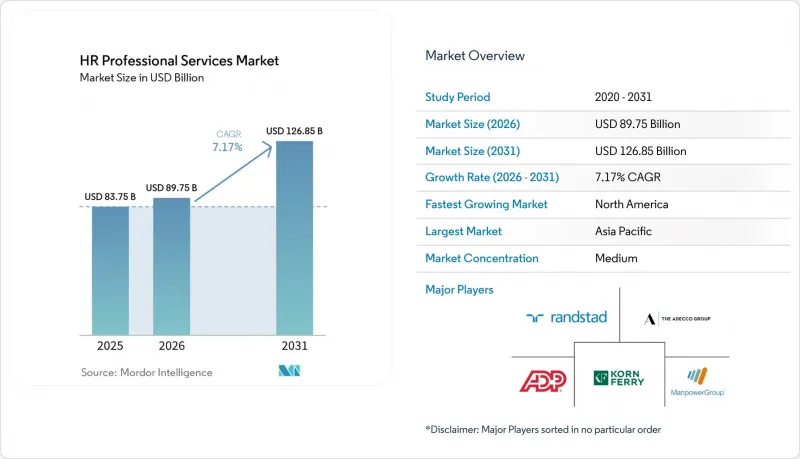
본 보고서는 공급업체 유형(컨설팅 회사, SaaS(Software-as-a-Service) 기업), 기능 유형(채용·인재 확보, 복리후생·청구 관리, 인력 계획·분석, 기타), 최종 사용자 산업(은행, 금융서비스 및 보험(BFSI), 헬스케어, 기타) 및 지역(북미, 기타)별로 분류되어 있습니다. 시장 전망은 금액(달러) 기준으로 제시되어 있습니다.
세계의 인사 전문 서비스 시장 동향 및 인사이트
생성형 AI를 활용한 채용 자동화
생성형 AI는 이력서 분석, 1차 전형, 적성 예측 점수 산정을 자동화함으로써 인재 확보의 경제성을 재정의하고 있으며, 이를 종합함으로써 평균 채용 주기를 3분의 1로 단축하고 있습니다. 조기 도입 기업들은 독자적인 대형 언어 모델용 프롬프트를 지원자 추적 시스템에 통합함으로써, 통합된 지적 재산권(IP)을 보유한 서비스 제공업체에 유리한, 플랫폼에 대한 강한 의존성을 만들어내고 있습니다. AI를 활용한 인재 발굴과 전문가의 면접 지도를 결합한 업체는 첫해의 이직률에서 현저한 개선을 보고했으며, 이 지표는 현재 성과 연동형 요금 체계에 반영되어 있습니다. 북미 규제 당국은 알고리즘의 편향성에 관한 잠정 지침을 발표했으며, 서비스 제공업체들에게 투명성이 높은 모델 감사 추적을 서비스에 반영할 것을 요구하고 있습니다. 그 결과, SaaS 기반의 채용 엔진은 내장된 거버넌스 기능을 통해 고객의 규정 준수 위험을 줄일 수 있기 때문에 가격 면에서 프리미엄을 누리고 있습니다. 경쟁사와의 차별화는 특정 분야에 특화된 훈련 데이터로 전환되고 있으며, 의료, 은행, 공공 부문의 사례가 초기 실증 사례를 주도하고 있습니다. 이러한 엔진이 성숙해짐에 따라, 중견 기업의 구매자들은 기존의 RPO 입찰을 점점 더 기피하게 되었으며, 인사 전문 서비스 시장의 잠재 고객층을 확대하는 플랫폼을 통한 직접 계약이 가속화되고 있습니다.
데이터 기반 급여 계산 오류 예측 도구
세계 급여 계산 서비스의 워크플로우에 통합된 머신러닝 모델은 자금 지급 전에 중복 기록이나 부적절한 세금 코드 적용과 같은 이상 현상을 감지함으로써, 기존에는 오류 1건당 평균 291달러가 소요되던 시정 비용을 대폭 절감하고 있습니다. 예측 정확도는 거래량이 증가함에 따라 향상되기 때문에 소규모 제공업체들은 불리한 입장에 놓이게 되어 대규모 급여 계산 통합 서비스 제공업체에 의한 업계 재편에 대한 관심이 높아지고 있습니다. CFO는 오류 방지 기능을 규정 준수 측면에서의 안전장치로 간주하고 있으며, 이를 통해 배치 처리 계약에 비해 20-25%의 서비스 요금 인상이 정당화되고 있습니다. 통합 API를 통해 감사 로그가 전사적 자원 관리(ERP) 시스템으로 직접 전송되므로, 수동 대조 작업 없이도 SOX 404의 증거 요건을 충족할 수 있습니다. 각 벤더사는 급여 분석 대시보드를 함께 제공하여, 운영 데이터를 전략적인 인건비 인텔리전스로 전환하고 있습니다. 국가별 세제 개혁이 복잡해짐에 따라, 고객들은 계약 기간을 연장하는 경향을 보이며, 규제 주기 전반에 걸쳐 특정 공급업체를 고수하고 있습니다. 이러한 동향은 인사 전문 서비스 시장의 장기적인 이익률을 뒷받침하는 안정성이 높은 지속적인 수익원을 강화하고 있습니다.
데이터 개인정보 보호 및 데이터 소재지에 관한 규정
GDPR(EU 개인정보보호규정)이나 중국의 PIPL 등 전 세계적으로 강화되고 있는 개인정보 보호법에 따라, 서비스 제공업체는 관할 구역별로 인프라를 분리해야 할 의무가 있으며, 이로 인해 운영 비용이 15-20% 증가하여 규모의 경제 효과가 약화되고 있습니다. 끊임없는 규제 변경으로 인해 시스템 재설계가 반복적으로 이루어지고 있으며, 감사 주기는 현재 고객 계약에서 표준적인 관행이 되었습니다. 국경을 넘는 데이터 전송 제한으로 인해 국내에서 암호화 키 관리가 의무화되면서, 기술 아키텍트에게 요구되는 기술 수준이 높아지고 있습니다. 인터넷 서비스 제공업체들은 랜섬웨어 위험에 대응하기 위해 2024년 이후 8-12% 인상된 사이버 보험의 추가 보험료를 부담하고 있습니다. 그 결과, 고객사는 공급업체의 보안 인증을 엄격하게 검토하고, 기본 서비스 계약에 ISO 27001 조항을 포함시키고 있습니다. 종단간 규정 준수를 입증하지 못할 경우, 입찰자는 기업의 RFP(제안 요청서) 최종 후보 목록에서 제외될 가능성이 있으며, 이로 인해 수익 파이프라인이 제한될 수 있습니다. 이러한 압박 요인들이 복합적으로 작용하여 인사 전문 서비스 시장의 단기적인 이익률 확대를 억제하고 있습니다.
부문별 분석
SaaS(Software-as-a-Service) 제공업체는 2031년까지 연평균 성장률(CAGR) 14.67%를 나타낼 것으로 예측되며, 셀프 서비스형 워크플로가 경영진 수준의 지지를 얻음에 따라 제공업체 부문에서 가장 빠른 성장세를 보이고 있습니다. 중견 기업의 구매자들이 수년에 걸친 컨설팅 계약보다 구독형 비즈니스 모델을 점점 더 선호하고 있기 때문에 이러한 플랫폼 내 인사 전문 서비스 시장 규모는 확대되고 있습니다. SaaS 공급업체는 채용 퍼널의 진행 속도, 규정 준수 관련 알림, 결근 동향을 시각화하는 분석 대시보드를 탑재하고 있으며, 이러한 기능을 통해 의사결정 주기가 단축되고 변경 관리 예산도 절감되고 있습니다. 컨설팅 및 자문 기업들은 합병, 규제 대응, 클라우드 도입 후 최적화와 관련된 복잡한 변혁 프로젝트를 통해 2025년에도 여전히 매출 점유율의 37.52%를 차지했습니다. 컨설턴트가 파트너 기업의 SaaS 모듈을 화이트 라벨화하여 자문 수익과 라이선스 재판매를 결합한 하이브리드 서비스 모델이 등장하고 있으며, 이는 고객의 지출 점유율을 지키기 위한 노력입니다. Oracle의 HiredScore 인수와 워크데이의 AI 로드맵은 인재 매칭 알고리즘을 자사 내부로 도입하기 위한 ‘'플랫폼 우선' 간의 경쟁을 부각시키고 있으며, 순수 컨설팅 기업들의 이익률에 압박을 가하고 있습니다.
기존 컨설팅 기업들은 규제 감사에 대비한 준비 및 직원 이직률 개선을 보장하는 성과 기반 SLA를 패키지로 구성하여 대응하고 있으며, 이를 통해 청구 가능한 작업 시간을 넘어 전문 지식을 수익화하고 있습니다. 현재 많은 기업이 벤처 스튜디오를 운영하며, 틈새 시장을 겨냥한 HR 테크 자산을 분사함으로써 협상에서 지적 재산권 측면의 우위를 확보하고 있습니다. 이와 동시에, 주요 SaaS 기업들은 도입 시 발생하는 마찰을 줄이고 사내 서비스 체계를 넘어선 규모 확대를 실현하기 위해 인증된 도입 생태계를 구축하고 있습니다. 이러한 상호의존 관계로 인해 카테고리 간의 경계가 모호해지면서, 교차 판매 계약이 급증하고 있습니다. 따라서 고객사의 조달 팀은 자문 서비스와 SaaS 요금을 묶은 시나리오와 단독 플랫폼 구독을 비교하여 총 소유 비용(TCO)을 면밀히 검토하고 있습니다. 생태계가 성숙해짐에 따라 플랫폼 거버넌스 기준이 확립되었으며, 상호 운용성과 개방형 API가 공급업체 선정의 중요한 기준이 되고 있습니다.
지역별 분석
북미는 기업의 아웃소싱 성숙도가 높고, 인접 서비스 분야를 뒷받침하는 견고한 HR 기술 벤더 생태계의 지지를 받아 2025년에도 매출 점유율 39.45%를 유지하며 선두 자리를 굳건히 지켰습니다. 연방, 주 및 주 차원의 관할 구역에 걸쳐 있는 해당 지역의 규제 다양성은 지역 특화형 규정 준수 자문 서비스에 대한 수요를 지속적으로 뒷받침하고 있습니다. 캐나다에서는 주 고용 관련 법규가 플랫폼 구조의 확충을 주도하며, 평균을 상회하는 성장세를 기록하고 있습니다. 한편, 멕시코에서는 니어쇼어링 열풍에 힘입어 고단가로 제공되는 이중언어 인사 정책 조화 프로젝트가 활발히 진행되고 있습니다. 미국의 서비스 제공업체들은 신흥 마키라도라(수출가공구역)에서 발생하는 급여 계산 업무 수요를 확보하기 위해 남부 국경 지역을 따라 이중언어 서비스 거점을 확대되고 있습니다. HR 테크 스타트업에 대한 벤처 캐피털의 꾸준한 유입이 혁신 주기를 더욱 가속화하여, 서비스 파트너들이 자체 개발한 도구를 관리형 서비스 계약에 포함시킬 수 있게 하고 있습니다.
아시아태평양은 경제 성장과 전자 급여 신고 및 실시간 노동 데이터 보고를 의무화하는 디지털 정부 이니셔티브에 힘입어 연평균 성장률(CAGR) 10.07%를 나타낼 것으로 예측되는 가장 빠르게 성장하는 지역입니다. 인도의 서비스 제공 전통은 비용 중심의 아웃소싱에서 부가가치가 높은 인사 분석 서비스 수출로 진화하고 있으며, 통합된 세계 및 인카운트리형 제공 모델을 필요로 하는 다국적 기업의 본사 프로젝트를 유치하고 있습니다. 중국의 엄격한 데이터 현지화 법은 외국 서비스 제공업체들이 거주 요건을 충족하기 위해 국내 클라우드 인프라를 활용하는 합작 사업 구조를 촉진하고 있습니다. 인력 부족에 시달리는 동남아시아 시장에서는 규정 준수 및 급여 계산 업무의 규모 확대를 위해 외부 서비스 제공업체에 의존하고 있으며, 이는 계약 갱신율이 높은 데 기여하고 있습니다. 호주와 한국에서는 성과 기반 계약이 꾸준히 확산되고 있으며, 공급업체가 명확한 인재 유지율이나 다양성 관련 KPI를 제시할 경우, 프리미엄 가격 책정이 정당화되고 있습니다. 베트남이나 인도네시아 등 신흥 경제국에서는 기존의 On-Premise형 시스템을 뛰어넘어, 유연한 급여 지급을 위해 지역 전자지갑 생태계와 연동하는 ‘'모바일 우선'의 인사 용도이 도입되었습니다.
유럽에서는 GDPR(EU 개인정보보호규정) 준수 비용이 서비스 제공업체의 영업 비용을 15-20% 가량 끌어올리고 있으며, 거시경제의 불확실성으로 인해 기업의 IT 예산이 위축되고 있어 연평균 성장률(CAGR) 전망은 비교적 보수적인 임베디드니다. 그럼에도 불구하고, 노동평의회와의 협상 및 공동결정법에 정통한 전문 공급업체들은 독일과 프랑스에서 장기 계약을 확보하고 있습니다. 영국에서는 브렉시트 이후 EU 노동법규와의 차이로 인해, 양 지역에 걸쳐 사업을 영위하는 기업을 대상으로 한 틈새 자문 수요가 발생하고 있습니다. 베네룩스 국가 및 북유럽의 고객들은 성과 연계형 계약에 대한 관심이 가장 높은데, 이는 분석 기술의 도입이 성숙 단계에 이르렀으며, 측정 가능한 성과를 중시하는 문화를 반영한 것입니다. 남유럽은 높은 실업률과 예산 제약으로 인해 뒤처져 있지만, EU 부흥 기금을 통해 자금을 지원받는 공공 부문 현대화 프로젝트가 점차 주목받고 있습니다. 범유럽적 데이터 메쉬 아키텍처를 운영하는 제공업체는 프라이버시 엔지니어링을 통해 차별화를 꾀하며, 여러 관할 구역에 걸쳐 있는 고객의 규정 준수 부담을 줄이고 있습니다.
기타 혜택 :
- 엑셀 형식 시장 예측(ME) 시트
- 3개월간의 애널리스트 지원
자주 묻는 질문
목차
제1장 서론
제2장 조사 방법
제3장 주요 요약
제4장 시장 구도
제5장 시장 규모 및 성장 예측
제6장 경쟁 구도
제7장 시장 기회 및 향후 전망
KTH 26.07.03According to Mordor Intelligence, the HR professional services market size was valued at USD 83.75 billion in 2025 and estimated to grow from USD 89.75 billion in 2026 to reach USD 126.85 billion by 2031, at a CAGR of 7.17% during the forecast period (2026-2031).
This report is Segmented by Provider Type (Consulting Companies, Software-As-A-Service Companies), Function Type (Recruitment and Talent Acquisition, Benefits and Claims Management, Workforce Planning and Analytics, and Other), End-User Industry (BFSI, Healthcare, and Other), and Geography (North America, and Other). The Market Forecasts are Provided in Terms of Value (USD).
Global HR Professional Services Market Trends and Insights
Gen-AI Powered Recruitment Automation
Generative AI is redefining talent acquisition economics by automating resume parsing, initial screenings, and predictive fit scoring, which collectively shrink average hiring cycles by one-third. Early adopters are layering proprietary large-language-model prompts onto applicant-tracking systems, creating sticky platform dependencies that favor service providers owning integrated IP. Vendors pairing AI sourcing with human interview coaching report notable improvements in first-year retention, a metric now embedded in outcome-based fee schedules. Regulatory bodies in North America have issued preliminary algorithmic bias guidelines, pushing providers to build transparent model-audit trails into their offerings. SaaS-first recruitment engines consequently enjoy a pricing premium because built-in governance reduces client compliance risk. Competitive differentiation is shifting toward domain-specific training data; healthcare, banking, and public sector examples dominate early proof points. As these engines mature, mid-market buyers increasingly bypass traditional RPO bids, accelerating direct platform subscriptions that widen the HR professional services market addressable pool.
Data-Driven Payroll Error-Prediction Tools
Machine-learning models embedded in global payroll service workflows now flag anomalies such as duplicate records or irregular tax code application before funds disburse, slashing remediation costs that historically averaged USD 291 per error. The predictive accuracy rises with transaction volume, which places small providers at a disadvantage and fuels consolidation interest from larger payroll aggregators. CFOs perceive error-avoidance capabilities as compliance insurance, legitimizing 20-25% service fee uplifts compared with batch-processing contracts. Integration APIs feed audit logs directly to enterprise resource planning systems, satisfying SOX 404 evidence requirements without manual reconciliations. Vendors are bundling payroll analytics dashboards, turning operational data into strategic workforce cost intelligence. The complexity of country-specific tax reforms encourages clients to extend contract durations, locking in providers for full regulatory cycles. These dynamics reinforce sticky recurring revenue streams that underpin long-run margins within the HR professional services market.
Data-Privacy & Residency Regulations
Tightening global privacy laws such as GDPR and China's PIPL obligate providers to segment infrastructure by jurisdiction, adding 15-20% to operating costs and diluting scale benefits. Ongoing regulatory churn forces recurrent system redesigns, with audit cycles now standard practice across client contracts. Cross-border data-transfer restrictions compel in-country encryption key management, elevating technical-architect skill requisites. Providers absorb incremental cyber-insurance premiums, which have climbed 8-12% since 2024 in response to ransomware risk . Clients consequently scrutinize vendor security certifications, embedding ISO 27001 clauses into master service agreements. Failure to demonstrate end-to-end compliance can disqualify bidders from enterprise RFP shortlists, limiting revenue pipelines. Cumulatively, these pressures temper near-term margin expansion within the HR professional services market.
Other drivers and restraints analyzed in the detailed report include:
- Hyper-Local Compliance Expertise Demand
- Integration of HR Analytics into ERP Stacks
- Shortage of Multi-Country Payroll Talent
For complete list of drivers and restraints, kindly check the Table Of Contents.
Segment Analysis
Software-as-a-Service suppliers are on track to post a 14.67% CAGR to 2031, reflecting the fastest expansion among provider categories as self-service workflows gain board-level sponsorship. The HR professional services market size for these platforms is widening because mid-market buyers increasingly favor subscription economics over multi-year consulting retainers. SaaS vendors embed analytic dashboards that visualize hiring funnel velocity, compliance alerts, and absenteeism trends, traits that compress decision cycles and shrink change-management budgets. Consulting & Advisory firms still held 37.52% revenue share in 2025 through complex transformation mandates tied to mergers, regulatory remediation, and post-cloud optimization. Hybrid service models are emerging in which consultants white-label partner SaaS modules, blending advisory revenue with license resale in an effort to defend wallet share. Oracle's acquisition of HiredScore and Workday's AI roadmap underscore a platform-first race to internalize talent-matching algorithms, putting margin pressure on pure-play consultancies.
Consulting incumbents counter by packaging outcome-based SLAs that guarantee regulatory audit readiness or retention uplift, thereby monetizing domain expertise beyond billable hours. Many firms now operate venture studios that spin out niche HR tech assets to secure intellectual-property leverage in negotiations. In parallel, SaaS leaders cultivate certified implementation ecosystems to reduce onboarding friction and unlock scale beyond internal service benches. This reciprocal interdependence blurs categorical boundaries, with cross-selling agreements proliferating. Client procurement teams thus weigh total-cost-of-ownership scenarios comparing bundled advisory plus SaaS fees to stand-alone platform subscriptions. As ecosystems mature, platform governance standards emerge, making interoperability and open APIs critical vendor-selection criteria.
Complete Report Scope:
- By Provider Type
- Consulting Companies
- Software-as-a-Service Companies
- By Function Type
- Recruitment And Talent Acquisition
- Benefits And Claims Management
- Workforce Planning and Analytics
- Payroll And Compensation Management
- Other Functions
- By Function Type
- BFSI
- Healthcare
- IT and Telecom
- Manufacturing
- Retail
- Government
- Other Industries
- By Geography
- North America
- United States
- Canada
- Mexico
- South America
- Brazil
- Peru
- Chile
- Argentina
- Rest of South America
- Europe
- United Kingdom
- Germany
- France
- Spain
- Italy
- BENELUX (Belgium, Netherlands, Luxembourg)
- NORDICS (Denmark, Finland, Iceland, Norway, Sweden)
- Rest of Europe
- Asia-Pacific
- India
- China
- Japan
- Australia
- South Korea
- South-East Asia (SG, MY, TH, ID, VN, PH)
- Rest of Asia-Pacific
- Middle East & Africa
- United Arab Emirates
- Saudi Arabia
- South Africa
- Nigeria
- Rest of Middle East & Africa
- North America
Geography Analysis
North America preserved its lead with 39.45% revenue share in 2025 owing to high enterprise outsourcing maturity and a robust ecosystem of HR technology vendors that feed adjacent service streams. The region's regulatory heterogeneity across federal, state, and provincial jurisdictions sustains demand for localized compliance advisory. Canada posts above-average growth as provincial employment codes drive incremental platform configurations, while Mexico's near-shoring boom triggers bilingual HR policy harmonization projects that command premium rates. U.S. providers have expanded bilingual service hubs along the southern border to capture emerging maquiladora payroll volumes. A steady flow of venture capital into HR tech start-ups further fuels innovation cycles, enabling service partners to bundle proprietary tools into managed-service agreements.
Asia-Pacific represents the fastest-growing geography with a projected 10.07% CAGR, propelled by economic expansion and digital-government initiatives that mandate electronic payroll filing and real-time labor data reporting. India's service-delivery heritage is evolving from cost-centric outsourcing to value-added HR analytics exports, drawing multinational headquarters projects that require integrated global-in-country delivery models. China's stringent data-localization laws encourage joint-venture structures wherein foreign providers leverage domestic cloud infrastructure to meet residency requirements. Southeast Asia's talent-scarce markets rely on external providers for compliance and payroll scale, fostering high contract-renewal rates. Australia and South Korea show steady uptake of outcome-based contracts, validating premium pricing when vendors present clear retention or diversity KPIs. Emerging economies such as Vietnam and Indonesia are leapfrogging legacy on-premises systems, adopting mobile-first HR applications that integrate with regional e-wallet ecosystems for flexible pay disbursement.
Europe records a relatively restrained CAGR outlook as GDPR compliance costs add 15-20% to provider operating expenses and macroeconomic uncertainty tempers corporate IT budgets. Nevertheless, specialized vendors fluent in works-council negotiations and co-determination statutes secure long-term engagements in Germany and France. The United Kingdom's post-Brexit divergence from EU labor codes creates niche advisory demand for companies straddling both territories. BENELUX and Nordic clients display the highest appetite for performance-linked contracts, reflecting mature analytics adoption and cultural emphasis on measurable outcomes. Southern Europe lags due to higher unemployment and budget constraints, yet public-sector modernization projects financed by EU recovery funds are emerging. Providers operating pan-European data mesh architectures differentiate on privacy engineering, reducing compliance overhead for multi-jurisdiction clients.
- ADP
- Randstad NV
- Adecco Group
- ManpowerGroup
- Korn Ferry
- IBM
- Accenture
- Paychex
- Ceridian
- Workday
- SAP
- Oracle
- Mercer
- Deloitte
- Willis Towers Watson
- Infosys
- Tata Consultancy Services
- Neeyamo
- SD Worx
- Alight Solutions
Additional Benefits:
- The market estimate (ME) sheet in Excel format
- 3 months of analyst support
TABLE OF CONTENTS
1 Introduction
- 1.1 Study Assumptions & Market Definition
- 1.2 Scope of the Study
2 Research Methodology
3 Executive Summary
4 Market Landscape
- 4.1 Market Overview
- 4.2 Market Drivers
- 4.2.1 Gen-AI powered recruitment automation
- 4.2.2 Data-driven payroll error-prediction tools
- 4.2.3 Hyper-local compliance expertise demand
- 4.2.4 Integration of HR analytics into ERP stacks
- 4.2.5 Cloud migration of legacy HR suites
- 4.2.6 Rise of outcome-based HR service contracts
- 4.3 Market Restraints
- 4.3.1 Data-privacy & residency regulations
- 4.3.2 Shortage of multi-country payroll talent
- 4.3.3 Fragmented labour laws in emerging markets
- 4.3.4 Rising cyber-insurance premiums for HRO firms
- 4.4 Value / Supply-Chain Analysis
- 4.5 Regulatory Landscape
- 4.6 Technological Outlook
- 4.7 Porter's Five Forces
- 4.7.1 Threat of New Entrants
- 4.7.2 Bargaining Power of Suppliers
- 4.7.3 Bargaining Power of Buyers
- 4.7.4 Threat of Substitutes
- 4.7.5 Competitive Rivalry
5 Market Size & Growth Forecasts
- 5.1 By Provider Type
- 5.1.1 Consulting Companies
- 5.1.2 Software-as-a-Service Companies
- 5.2 By Function Type
- 5.2.1 Recruitment And Talent Acquisition
- 5.2.2 Benefits And Claims Management
- 5.2.3 Workforce Planning and Analytics
- 5.2.4 Payroll And Compensation Management
- 5.2.5 Other Functions
- 5.3 By Function Type
- 5.3.1 BFSI
- 5.3.2 Healthcare
- 5.3.3 IT and Telecom
- 5.3.4 Manufacturing
- 5.3.5 Retail
- 5.3.6 Government
- 5.3.7 Other Industries
- 5.4 By Geography
- 5.4.1 North America
- 5.4.1.1 United States
- 5.4.1.2 Canada
- 5.4.1.3 Mexico
- 5.4.2 South America
- 5.4.2.1 Brazil
- 5.4.2.2 Peru
- 5.4.2.3 Chile
- 5.4.2.4 Argentina
- 5.4.2.5 Rest of South America
- 5.4.3 Europe
- 5.4.3.1 United Kingdom
- 5.4.3.2 Germany
- 5.4.3.3 France
- 5.4.3.4 Spain
- 5.4.3.5 Italy
- 5.4.3.6 BENELUX (Belgium, Netherlands, Luxembourg)
- 5.4.3.7 NORDICS (Denmark, Finland, Iceland, Norway, Sweden)
- 5.4.3.8 Rest of Europe
- 5.4.4 Asia-Pacific
- 5.4.4.1 India
- 5.4.4.2 China
- 5.4.4.3 Japan
- 5.4.4.4 Australia
- 5.4.4.5 South Korea
- 5.4.4.6 South-East Asia (SG, MY, TH, ID, VN, PH)
- 5.4.4.7 Rest of Asia-Pacific
- 5.4.5 Middle East & Africa
- 5.4.5.1 United Arab Emirates
- 5.4.5.2 Saudi Arabia
- 5.4.5.3 South Africa
- 5.4.5.4 Nigeria
- 5.4.5.5 Rest of Middle East & Africa
- 5.4.1 North America
6 Competitive Landscape
- 6.1 Market Concentration
- 6.2 Strategic Moves
- 6.3 Market Share Analysis
- 6.4 Company Profiles (includes Global level Overview, Market level overview, Core Segments, Financials as available, Strategic Information, Market Rank/Share for key companies, Products & Services, and Recent Developments)
- 6.4.1 ADP
- 6.4.2 Randstad NV
- 6.4.3 Adecco Group
- 6.4.4 ManpowerGroup
- 6.4.5 Korn Ferry
- 6.4.6 IBM
- 6.4.7 Accenture
- 6.4.8 Paychex
- 6.4.9 Ceridian
- 6.4.10 Workday
- 6.4.11 SAP
- 6.4.12 Oracle
- 6.4.13 Mercer
- 6.4.14 Deloitte
- 6.4.15 Willis Towers Watson
- 6.4.16 Infosys
- 6.4.17 Tata Consultancy Services
- 6.4.18 Neeyamo
- 6.4.19 SD Worx
- 6.4.20 Alight Solutions
7 Market Opportunities & Future Outlook
- 7.1 Embedded payroll-fintech services
- 7.2 AI-driven employee wellness analytics


