
|
시장보고서
상품코드
2072657
중국의 디스크리트 GPU 시장 : 시장 점유율 분석, 업계 동향 및 통계, 성장 예측(2026-2031년)China Discrete GPU - Market Share Analysis, Industry Trends & Statistics, Growth Forecasts (2026 - 2031) |
||||||
 Mordor Intelligence
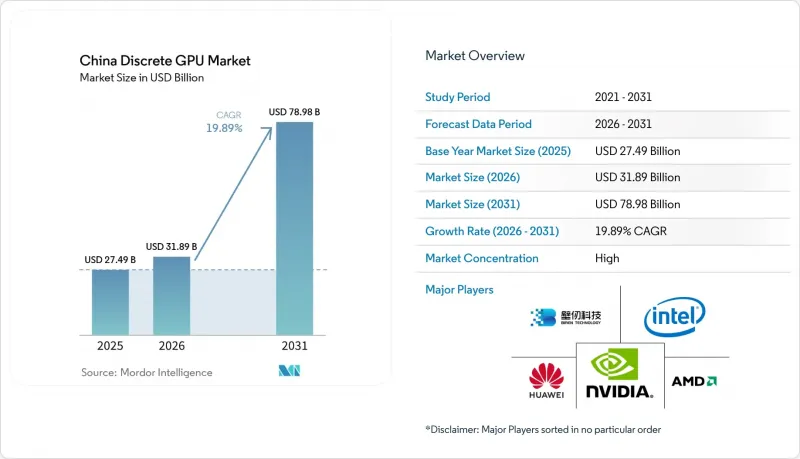
Mordor Intelligence에 의하면, 중국의 디스크리트 GPU 시장 규모는 2025년 274억 9,000만 달러로 평가되었고, 2026년 318억 9,000만 달러로 추정되고, 2031년까지 789억 8,000만 달러로 확대될 것으로 예측되며, 2026-2031년 연평균 복합 성장률(CAGR)은 19.89%를 나타낼 전망입니다.
본 보고서는 디바이스 용도별(모바일 디바이스 및 태블릿, PC 및 워크스테이션, 서버 및 데이터센터용 가속기, 게임기 등), 메모리 유형별(GDDR 기반 GPU 및 HBM 기반 GPU), 성능 수준별(저가형 GPU, 메인스트림 GPU, 고성능 소비자용 GPU, 데이터센터 및 AI 가속기용 GPU)로 분류되어 있습니다. 시장 전망은 금액(달러) 기준으로 제시되어 있습니다.
중국의 디스크리트 GPU 시장 동향 및 인사이트
중국의 하이퍼스케일 데이터센터에서 AI 훈련 및 추론 워크로드에 대한 수요가 급증하고 있습니다.
하이퍼스케일 사업자들은 GPU 조달을 설비 투자의 최우선 과제로 삼았습니다. 알리바바 클라우드는 2025 회계연도에 530억 달러를 투자하여 국내 서버 센터에 10만 대 이상의 가속기를 도입했습니다. 바이트댄스는 같은 해, 자사의 기반 모델인 'Doubao' 훈련에 230억 달러를 배정했으며, 이 프로젝트에는 약 5만 개의 H100급 칩이 필요했습니다. 텐센트는 AI 관련 설비 투자를 두 배로 늘려, 'Hunyuan' 모델링용 새로운 GPU 클러스터를 구축했습니다. 바이두의 'Ernie 4.0' 스택은 OpenAI에 필적하는 성능을 발휘하는 약 2만 개의 디스크리트 GPU를 구축하고 가동을 시작했습니다. 이러한 도입은 수요의 주기성을 완화하고 수출 규제 위험을 줄이기 위해 현지 공급업체와 실리콘 및 소프트웨어의 공동 설계를 촉진하는 수년에 걸친 공급 계약을 기반으로 합니다.
국내 반도체 자급자족 및 GPU 혁신을 위한 정부의 인센티브
중국의 '국가 집적회로 산업 투자 기금 제3기'는 2024년에 3,440억 위안(470억 달러)을 출자하기로 결정했고, GPU 개발을 전략적 분야로 명시했습니다. 같은 해, 국무원의 지시에 따라 2027년까지 정부 및 국영 기업의 전체 IT 조달의 절반을 국산 반도체로 충당해야 할 의무가 부과됨에 따라, 국산 그래픽 프로세서에 대한 확실한 수요가 창출되었습니다. 상하이시는 2025년에 GPU 스타트업 기업에 20억 위안(2억 8,000만 달러)의 직접 보조금을 지원했으며, 이 모델은 선전시와 우한시에서도 채택되었습니다. 공업정보화부는 2030년까지 반도체 자급률 80%라는 목표를 제시하고, 재정 자원을 로드맵의 주요 단계에 더욱 부합하도록 조정하고 있습니다. 인재 유치 정책 덕분에 해외에서 근무하던 3,500명 이상의 엔지니어가 귀국하면서, 첨단 GPU 아키텍처 개발에 필요한 국내 인재 풀이 확대되었습니다.
최첨단 GPU IP 및 HBM 메모리에 대한 접근을 제한하는 미국의 수출 규제
2025년 1월 미국 수출 규제 개정으로 인해, 중국으로 수출되는 GPU의 양방향 전송 속도 및 부동소수점 연산 처리량을 제한하는 성능 상한선이 도입되었습니다(DOC.GOV). 이에 대해 NVIDIA는 H20, L20 및 L2 모델을 출시했습니다. 이 제품들은 H100에 비해 훈련 처리량이 약 3분의 1 수준으로 낮아졌음에도 불구하고, 2025년 데이터센터 매출의 15%를 차지했습니다. AMD의 MI308은 장기간에 걸친 라이선싱 절차를 거친 탓에 2025년 3분기까지 시장에 널리 공급되는 것이 지연되었습니다. 미국이 SK하이닉스와 마이크론에 HBM3 수출을 축소해 줄 것을 요청함에 따라, 중국에 할당된 물량이 약 40% 줄어들면서 공급 압박이 더욱 가중되었습니다. 국내 기업들은 잠정적인 대책으로 GDDR6X 기반의 칩렛 레이아웃을 시험적으로 도입하고 있지만, 이러한 대안들은 전력 소비와 냉각에 드는 오버헤드를 증가시킵니다.
부문별 분석
2025년 중국 디스크리트 GPU 시장에서 서버 및 데이터센터용 가속기는 매출의 39.17%를 차지했으며, 순수 소비자용 그래픽 카드에서 구조적인 전환이 두드러지게 나타났습니다. 이 부문은 알리바바 클라우드, 텐센트, 바이트댄스, 바이두가 수년에 걸쳐 생산 능력을 예약한 덕분에 혜택을 보고 있으며, 이들 기업의 AI 가속기 총 대수는 합쳐서 30만 대 이상으로 확대되었습니다. 이러한 조달 체제를 통해 분기별 수요가 안정화되며, 규정 준수 요건을 충족하면서도 경쟁력 있는 가격 대비 성능을 제공하는 공급업체들이 지원받고 있습니다. 전문가용 시각화 및 워크스테이션용 그래픽 카드는 데이터센터용 칩에는 미치지 못하지만, 창의적인 워크플로우를 통해 수익을 창출하고 있으며, 컨텐츠 스튜디오들이 동영상 편집 및 건축 렌더링에 생성형 AI를 도입함에 따라 2025년 총 매출의 약 12%를 차지하고 있습니다.
게이밍 PC 및 워크스테이션 부문은 출하 대수 측면에서는 여전히 큰 규모를 유지하고 있지만, 평균 판매 가격이 정체 상태에 머물러 있어 매출 성장세가 둔화되고 있습니다. e스포츠 수준의 프레임 속도를 400달러 미만의 가격대에서 구현하는 저가형 국산 GPU에 힘입어, 인터넷 카페와 가정용 애호가들은 계속해서 PC를 교체하고 있습니다. 자동차용 GPU는 작은 규모에서 시작했으나 급속한 성장을 이루고 있습니다. Li Auto, NIO, XPeng이 중앙 집중형 컴퓨팅 박스를 주력 트림에 도입함에 따라, 연간 출하 대수는 2027년까지 200만 대를 넘어설 것으로 예측됩니다. 산업용 비전 및 소매 분석을 다루는 엣지 디바이스는 아직 발전 단계에 있지만 유망한 분야를 형성하고 있으며, 클라우드로의 오프로드를 억제하고 On-Premise에서의 추론 수요를 높이는 데이터 현지화 정책의 뒷받침을 받고 있습니다.
기타 혜택 :
- 엑셀 형식 시장 예측(ME) 시트
- 3개월간의 애널리스트 지원
자주 묻는 질문
목차
제1장 서론
제2장 조사 방법
제3장 주요 요약
제4장 시장 구도
제5장 시장 규모 및 성장 예측
제6장 경쟁 구도
제7장 시장 기회 및 향후 전망
AJY 26.07.03According to Mordor Intelligence, the china discrete GPU market size is projected to expand from USD 27.49 billion in 2025 and USD 31.89 billion in 2026 to USD 78.98 billion by 2031, registering a CAGR of 19.89% between 2026 and 2031.
This report is Segmented by Device Application (Mobile Devices and Tablets, Pcs and Workstations, Servers and Datacenter Accelerators, Gaming Consoles, and More), Memory Type (GDDR-Based GPUs, and HBM-Based GPUs), Performance Tier (Low-Cost GPUs, Mainstream GPUs, High-Performance Consumer GPUs, and Data Center/AI Accelerator GPUs). The Market Forecasts are Provided in Terms of Value (USD).
China Discrete GPU Market Trends and Insights
Surging Demand for AI Training and Inference Workloads in Chinese Hyperscale Datacenters
Hyperscale operators have moved GPU procurement to the top of capital-expenditure priorities. Alibaba Cloud spent USD 53 billion in fiscal 2025 and deployed more than 100,000 accelerators across domestic server halls. ByteDance earmarked USD 23 billion the same year to train its Doubao foundation model, an effort that required roughly 50,000 H100-class chips. Tencent doubled AI-related capex, rolling out new GPU clusters for its Hunyuan model. Baidu's Ernie 4.0 stack came online with about 20,000 discrete GPUs that delivered OpenAI-comparable performance. These deployments follow multi-year supply contracts that dampen demand cyclicality and encourage joint silicon-software co-design with local vendors to mitigate export-control risks.
Government Incentives for Domestic Semiconductor Self-Reliance and GPU Innovation
China's National Integrated Circuit Industry Investment Fund Phase III committed CNY 344 billion (USD 47 billion) in 2024, explicitly listing GPU development as a strategic domain. A State Council directive from the same year mandates that half of all government and state-owned enterprise IT procurement source domestic semiconductors by 2027, creating guaranteed demand for homegrown graphics processors.Shanghai offered CNY 2 billion (USD 280 million) in direct grants to GPU startups during 2025, a model replicated by Shenzhen and Wuhan municipalities. The Ministry of Industry and Information Technology sets an 80% semiconductor self-sufficiency goal by 2030, further aligning fiscal resources with road-map milestones. Talent incentives have attracted more than 3,500 engineers back from overseas positions, enlarging the domestic skills pool required for advanced GPU architecture.
U.S. Export Controls Limiting Access to Cutting-Edge GPU IP and HBM Memory
Revisions to United States export rules in January 2025 introduced performance ceilings that restrict bidirectional transfer rates and floating-point throughput for GPUs bound for China DOC.GOV. NVIDIA responded with H20, L20 and L2 variants that deliver about one-third less training throughput than the H100, yet still consumed 15% of 2025 datacenter revenue. AMD's MI308 navigated a protracted licensing process that delayed broad availability until the third quarter of 2025. Supply pressure intensified after the United States urged SK Hynix and Micron to scale back HBM3 exports, reducing allocations to Chinese buyers by roughly 40%. Domestic firms are experimenting with GDDR6X-based chiplet layouts as stop-gaps, but these alternatives incur higher power draw and cooling overhead.
Other drivers and restraints analyzed in the detailed report include:
- Continuous Growth of PC Gaming and Esports Ecosystem in China
- Rapid Adoption of Discrete GPUs in Automotive ADAS and Autonomous-Driving Platforms
- Fragmentation of CUDA-Alternative Software Ecosystems Hindering Domestic GPU Adoption
For complete list of drivers and restraints, kindly check the Table Of Contents.
Segment Analysis
Servers and datacenter accelerators accounted for 39.17% of 2025 revenue in the China discrete GPU market, underscoring the structural shift away from purely consumer graphics boards. The segment benefits from multi-year capacity reservations by Alibaba Cloud, Tencent, ByteDance, and Baidu, each scaling fleets that now exceed a combined 300,000 AI accelerators. This procurement discipline stabilizes quarterly demand and supports vendors that can satisfy compliance rules while offering competitive price-performance ratios. Professional visualization and workstation cards trail datacenter silicon but still monetize creative workflows, capturing roughly 12% of the 2025 total as content studios embrace generative AI in video editing and architectural rendering.
The gaming PC and workstation category remains large by volume, yet its revenue share is slowing as average selling prices plateau. Gaming cafes and home enthusiasts continue to refresh rigs, helped by lower-tier domestic GPUs that deliver esports-class frame rates at sub-USD 400 price points. Automotive GPUs, though starting from a smaller base, are on a steep climb. Annual shipments are projected to top 2 million units by 2027 as Li Auto, NIO, and XPeng push centralized compute boxes into mainstream trims. Edge devices covering industrial vision and retail analytics form a nascent but promising slice, favored by data-localization policies that discourage cloud offloading and thus raise on-premises inference demand.
Complete Report Scope:
- By Device Application
- Mobile Devices and Tablets
- PCs and Workstations
- Servers and Datacenter Accelerators
- Gaming Consoles and Handhelds
- Automotive / ADAS
- Other Embedded and Edge Devices
- By Memory Type
- GDDR-Based GPUs
- HBM-Based GPUs
- By Performance Tier
- Low-Cost GPUs (less than 100 USD)
- Mainstream GPUs (100 USD to 400 USD)
- High-Performance Consumer GPUs (400 USD to 1,200 USD)
- Data Center / AI Accelerator GPUs (greater than 1,200 USD)
List of Companies Covered in this Report:
- NVIDIA Corporation
- Advanced Micro Devices Inc.
- Intel Corporation
- Huawei Technologies Co. Ltd. (HiSilicon)
- Biren Technology
- Moore Threads Intelligent Technology Co. Ltd.
- Jingjia Microelectronics Co. Ltd.
- Cambricon Technologies Corp. Ltd.
- Zhaoxin Semiconductor Corp. Ltd.
- Hygon Information Technology Co. Ltd.
- Innosilicon Technology Ltd.
- Tianshu Zhixin Semiconductor Co. Ltd.
- VeriSilicon Holdings Co. Ltd.
- Colorful Technology Co. Ltd.
- Galaxy Microsystems Ltd.
- Micro-Star International Co. Ltd.
- ASUSTeK Computer Inc.
- Lenovo Group Ltd.
- Inspur Electronic Information Industry Co. Ltd.
- Giga-Byte Technology Co. Ltd.
Additional Benefits:
- The market estimate (ME) sheet in Excel format
- 3 months of analyst support
TABLE OF CONTENTS
1 INTRODUCTION
- 1.1 Study Assumptions and Market Definition
- 1.2 Scope of the Study
2 RESEARCH METHODOLOGY
3 EXECUTIVE SUMMARY
4 MARKET LANDSCAPE
- 4.1 Market Overview
- 4.2 Market Drivers
- 4.2.1 Surging Demand for AI Training and Inference Workloads in Chinese Hyperscale Datacenters
- 4.2.2 Continuous Growth of PC Gaming and Esports Ecosystem in China
- 4.2.3 Government Incentives for Domestic Semiconductor Self-Reliance and GPU Innovation
- 4.2.4 Rapid Adoption of Discrete GPUs in Automotive ADAS and Autonomous Driving Platforms
- 4.2.5 Rising Demand from Domestic Cloud-Based GPUaaS Providers Targeting SME AI Workloads
- 4.2.6 Expansion of Refurbished GPU Exports Creating Domestic Upgrade Cycle and Price Normalization
- 4.3 Market Restraints
- 4.3.1 U.S. Export Controls Limiting Access to Cutting-Edge GPU IP and HBM Memory
- 4.3.2 Global Semiconductor Supply-Chain Constraints Raising Bill-of-Materials Costs
- 4.3.3 Cooling and Power Infrastructure Limitations in Tier-2 Chinese Datacenters
- 4.3.4 Fragmentation of CUDA-Alternative Software Ecosystems Hindering Domestic GPU Adoption
- 4.4 Industry Value-Chain Analysis
- 4.5 Regulatory Landscape
- 4.6 Technological Outlook
- 4.7 Impact of Macroeconomic Factors on the Market
- 4.8 Porter's Five Forces Analysis
- 4.8.1 Threat of New Entrants
- 4.8.2 Bargaining Power of Suppliers
- 4.8.3 Bargaining Power of Buyers
- 4.8.4 Threat of Substitutes
- 4.8.5 Intensity of Competitive Rivalry
5 MARKET SIZE AND GROWTH FORECASTS (VALUE)
- 5.1 By Device Application
- 5.1.1 Mobile Devices and Tablets
- 5.1.2 PCs and Workstations
- 5.1.3 Servers and Datacenter Accelerators
- 5.1.4 Gaming Consoles and Handhelds
- 5.1.5 Automotive / ADAS
- 5.1.6 Other Embedded and Edge Devices
- 5.2 By Memory Type
- 5.2.1 GDDR-Based GPUs
- 5.2.2 HBM-Based GPUs
- 5.3 By Performance Tier
- 5.3.1 Low-Cost GPUs (less than 100 USD)
- 5.3.2 Mainstream GPUs (100 USD to 400 USD)
- 5.3.3 High-Performance Consumer GPUs (400 USD to 1,200 USD)
- 5.3.4 Data Center / AI Accelerator GPUs (greater than 1,200 USD)
6 COMPETITIVE LANDSCAPE
- 6.1 Market Concentration
- 6.2 Strategic Moves
- 6.3 Market Share Analysis
- 6.4 Company Profiles (includes Global Level Overview, Market Level Overview, Core Segments, Financials as available, Strategic Information, Market Rank/Share, Products and Services, Recent Developments)
- 6.4.1 NVIDIA Corporation
- 6.4.2 Advanced Micro Devices Inc.
- 6.4.3 Intel Corporation
- 6.4.4 Huawei Technologies Co. Ltd. (HiSilicon)
- 6.4.5 Biren Technology
- 6.4.6 Moore Threads Intelligent Technology Co. Ltd.
- 6.4.7 Jingjia Microelectronics Co. Ltd.
- 6.4.8 Cambricon Technologies Corp. Ltd.
- 6.4.9 Zhaoxin Semiconductor Corp. Ltd.
- 6.4.10 Hygon Information Technology Co. Ltd.
- 6.4.11 Innosilicon Technology Ltd.
- 6.4.12 Tianshu Zhixin Semiconductor Co. Ltd.
- 6.4.13 VeriSilicon Holdings Co. Ltd.
- 6.4.14 Colorful Technology Co. Ltd.
- 6.4.15 Galaxy Microsystems Ltd.
- 6.4.16 Micro-Star International Co. Ltd.
- 6.4.17 ASUSTeK Computer Inc.
- 6.4.18 Lenovo Group Ltd.
- 6.4.19 Inspur Electronic Information Industry Co. Ltd.
- 6.4.20 Giga-Byte Technology Co. Ltd.
7 MARKET OPPORTUNITIES & FUTURE OUTLOOK
- 7.1 White-Space and Unmet-Need Assessment