|
시장보고서
상품코드
2072664
아시아태평양의 카톤 보드 시장 : 시장 점유율 분석, 업계 동향 및 통계, 성장 예측(2026-2031년)Asia-Pacific Cartonboard - Market Share Analysis, Industry Trends & Statistics, Growth Forecasts (2026 - 2031) |
||||||
 Mordor Intelligence
Mordor Intelligence에 의하면, 아시아태평양의 카톤 보드 시장 규모는 2025년 429억 4,000만 달러로 평가되었고, 2026년에는 455억 3,000만 달러로 추정되고, 2031년까지 588억 6,000만 달러에 이를 것으로 예상되며, 2026-2031년 CAGR 5.27%로 성장할 전망입니다.
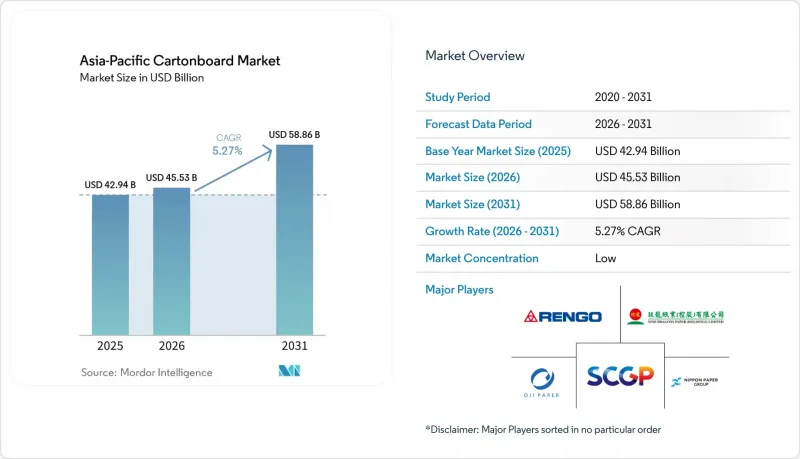
본 보고서는 제품 등급별(솔리드 표백 카톤 보드, 솔리드 미표백 카톤 보드, 접이식 상자용 카톤 보드 등), 포장 형태별(접이식 상자, 액체 포장, 슬리브 및 트레이 등), 최종 사용자 산업별(식품, 음료 등), 지역별(중국, 인도, 일본, 한국, 인도네시아 및 기타 아시아태평양)로 분류되어 있습니다. 시장 전망은 금액(달러) 기준으로 제시되어 있습니다.
아시아태평양의 카톤 보드 시장 동향 및 분석
플라스틱 대체 의무화와 브랜드의 지속가능성 목표
인도의 '플라스틱 폐기물 관리 개정 규칙'은 2026년 4월부터 시행되며, 재활용이 불가능한 포장재에 대해 EPR(생산자 책임) 수수료가 부과되게 되었습니다. 이로 인해 더 많은 제품 카테고리에서 카톤 보드가 연질 필름에 비해 비용 경쟁력을 높이고 있습니다. 중국의 '녹색 포장법'에서는 2027년 말까지 택배 포장재의 75%를 재활용 가능하거나 재사용 가능하도록 하는 것이 의무화되어 있으며, 이에 따라 가공업체와 브랜드 소유주에게는 명확한 규정 준수 일정이 제시되었습니다. 중국의 일부 지역에서는 이미 법 집행이 구체화되고 있으며, 저장성에서는 위반 1건당 5만 위안(7,000달러)의 벌금이 부과되고 있어, 이에 따라 기한이 도래할 때까지 미루지 않고 조달 방침 변경이 앞당겨져 진행되고 있습니다. 각 브랜드 기업의 노력도 이러한 전환을 뒷받침하고 있으며, 유니레버 차이나는 2027년까지 퍼스널케어 제품의 2차 포장재 중 90%를 종이로 전환하여 연간 약 1만 2,000메트르톤의 연질 플라스틱을 감축하겠다는 목표를 세웠습니다. 또한, 한국도 2026년 1월부터 EPR(확대 생산자 책임) 체계를 강화하여, 라벨 없는 포장 및 재생 소재 함유율에 관한 요건을 엄격히 적용했습니다. 이에 따라 아시아태평양의 전체 카톤 보드 시장에서 인쇄가 가능하고 재활용이 가능한 접이식 카톤 보드에 대한 투자가 촉진되고 있습니다.
포장 식품 수요와 소매업의 현대화
인도의 식품 가공 부문은 2025년에 8.7% 성장했으며, 이에 따라 단순한 운송용 포장재가 아닌 접이식 카톤 보드 상자나 코팅 카톤 보드에 의존하는 브랜드 소매용 포장의 기반이 확대되었습니다. 인도, 인도네시아, 베트남에서 일반 소매에서 조직화된 소매로의 전환이 진행되는 가운데, 브랜드 소유주들은 더 뛰어난 진열 효과, 더 선명한 인쇄 품질, 그리고 식품 접촉 관련 규정을 보다 일관되게 준수할 수 있는 제품을 필요로 하고 있으며, 이에 따라 고부가가치 카톤 보드 등급에 대한 수요가 증가하고 있습니다. 이러한 변화는 패키지 디자인에도 영향을 미치고 있습니다. 이는 점점 더 많은 제품이 단순한 2차 포장에서 벗어나, 그래픽, 추적성 요소 및 소매업체별 라벨을 부착할 수 있는 진열에 최적화된 구조화된 카톤 보드 상자로 전환되고 있기 때문입니다. 인도네시아 음료 시장은 2025년에 6.3% 성장했으며, 이에 따라 제품의 외관과 운송 효율을 점점 더 중요시하는 유통 채널에서 브랜드 소매용 포장에 대한 수요가 증가했습니다. 중국에서는 메이투안(Meituan)이 포장재의 80%를 친환경 인증 대상에 포함시키겠다는 목표를 내걸고 있는데, 이는 대규모 디지털 소매 및 음식 배달 플랫폼이 이미 아시아태평양의 카톤 보드 시장에서 조달 기준을 형성하고 있음을 보여줍니다.
버진 펄프와 재생 섬유의 원가 변동
이 지역 전체의 카톤 보드 제조업체들에게 있어, 단기적으로는 여전히 펄프가 이익률에 가장 뚜렷한 압박 요인으로 작용하고 있습니다. 2024년, 활엽수 펄프 가격이 30% 상승하면서, 자체 섬유 시스템을 갖추지 않고 구매한 펄프에 의존하는 제지 공장의 생산 비용이 증가했습니다. 이에 대해 아시아의 제지 공장들은 2025년 초 톤당 31.50달러의 가격 인상으로 대응했는데, 이는 원자재 가격 변동이 가공업체의 조달 및 고객과의 계약에 얼마나 신속하게 파급되는지를 보여줍니다. 조림지 관리 체계나 탄탄한 재생섬유 네트워크를 갖추지 못한 제지 공장은 현물 시장의 변동이나 수입 펄프에 대한 통화 약세의 영향을 더 크게 받기 쉬운 상황에 놓여 있습니다. 중국은 펄프 및 종이의 일체화를 추진함으로써 그 위험의 일부를 완화하고 있지만, 일본과 한국은 여전히 카톤 보드용 섬유 수입에 대한 구조적 의존에 직면해 있으며, 이로 인해 아시아태평양의 카톤 보드 시장에서 비용 예측이 어려워지고 있습니다.
부문별 분석
2025년, 접이식 카톤 보드는 매출 점유율의 33.12%를 차지했으며, 아시아태평양 카톤 보드 시장에서 여전히 가장 큰 비중을 차지하는 제품 등급이었습니다. 이러한 우위는 식품, 화장품, 의약품의 2차 포장 분야에서 폭넓게 사용되고 있다는 점에 기인하며, 이러한 분야에서는 가능한 한 낮은 재료비보다 인쇄 품질, 강성 및 우수한 가공성이 더 중요하게 여겨집니다. 또한, 이 등급은 해당 지역 내에서 널리 구할 수 있다는 장점도 있습니다. 중국, 일본, 인도의 통합 제지 공장 및 가공업체 네트워크 덕분에 주류 용도에 대한 공급이 비교적 안정적이기 때문입니다. 무표백 카톤 보드는 담배나 헬스케어 제품 포장 등 프리미엄 틈새 시장에서 여전히 사용되고 있는 반면, 흰색 뒷면 코팅 칩보드는 일본이나 한국 등 재생 섬유 시스템이 성숙한 시장에서 비용 효율을 중시하는 2차 포장 분야에서 여전히 중요한 역할을 하고 있습니다.
액체 포장용 카톤 보드는 2031년까지 연평균 성장률(CAGR) 5.51%를 기록하며 성장할 것으로 예상되며, 아시아태평양의 카톤 보드 업계에서 가장 두드러진 성장세를 보이는 등급이자 가장 확실한 성장 분야 중 하나입니다. 이러한 성장은 인도와 동남아시아 지역의 새로운 무균 및 냉장 유제품 인프라 구축과 밀접한 관련이 있으며, 현지에서 카톤 생산이 확대됨에 따라 수입 의존도가 낮아지고 공급 유연성이 향상되고 있습니다. 테트라팩이 2026년 2월 아시아의 고속 A3/Speed 라인에 종이 기반 배리어 기술을 도입했고, 한국의 메일 데일리가 세계 최초로 이를 채택한 것은 기판의 혁신이 처리 능력을 희생하지 않으면서도 대상 카톤 보드의 범위를 확대하고 있음을 보여줍니다. 또한, 패스트푸드 및 테이크아웃 업계에서 PFAS가 포함되지 않은 컵과 트레이로의 전환이 진행됨에 따라, 외식 산업용 카톤 보드 수요도 증가하고 있습니다. 표백 처리되지 않은 고체 보드는 특히 표면의 고급스러운 외관보다는 강도와 비용의 균형이 중시되는 분야에서 비중은 작지만 안정적인 시장 점유율을 유지하고 있습니다.
기타 혜택 :
- 엑셀 형식 시장 예측(ME) 시트
- 3개월간의 애널리스트 지원
자주 묻는 질문
목차
제1장 서론
제2장 조사 방법
제3장 주요 요약
제4장 시장 구도
제5장 시장 규모 및 성장 예측
제6장 경쟁 구도
제7장 시장 기회 및 향후 전망
AJY 26.07.03According to Mordor Intelligence, the asia-Pacific cartonboard market size is expected to increase from USD 42.94 billion in 2025 to USD 45.53 billion in 2026 and reach USD 58.86 billion by 2031, growing at a CAGR of 5.27% over 2026-2031.
This report is Segmented by Product Grade (Solid Bleached Board, Solid Unbleached Board, Folding Boxboard, and More), Packaging Format (Folding Cartons, Liquid Packaging, Sleeve and Tray, and More), End-User Industry (Food, Beverage, and More), and Geography (China, India, Japan, South Korea, Indonesia, and Rest of Asia-Pacific). The Market Forecasts are Provided in Terms of Value (USD).
Asia-Pacific Cartonboard Market Trends and Insights
Plastic Substitution Mandates And Brand Sustainability Targets
India's Plastic Waste Management Amendment Rules took effect from April 2026 and attached EPR fees to non-recyclable packaging, which improves cartonboard's cost position against flexible film in more product categories. China's Green Packaging Law requires 75% of express packaging to be recyclable or reusable by end-2027, which gives converters and brand owners a clear compliance timeline. Enforcement has already become more tangible in parts of China, with Zhejiang using penalties of CNY 50,000, USD 7,000, per violation, which pushes procurement changes forward rather than leaving them to the deadline year. Brand commitments are reinforcing the same shift, and Unilever China stated a goal of moving 90% of personal-care secondary packaging to paper by 2027, removing an estimated 12,000 metric tonnes of flexible plastic each year. South Korea also tightened its EPR framework from January 2026 with stronger label-free and recycled-content requirements, which supports investment in printable and recyclable folding boxboard across the Asia-Pacific cartonboard market.
Packaged Food Demand And Retail Modernization
India's food processing sector expanded 8.7% in 2025, which widened the base for branded retail packaging that depends on folding cartons and coated boxboard rather than plain transit formats. As general trade shifts toward organized retail in India, Indonesia, and Vietnam, brand owners need better shelf appearance, clearer print quality, and more consistent food-contact compliance, which raises demand for higher-value board grades. This change also affects pack design, because more products are moving from simple secondary wrapping toward structured, shelf-ready cartons that hold graphics, traceability elements, and retailer-specific labeling. Indonesia's beverage sector expanded 6.3% in 2025, and that added to demand for branded retail packaging in channels that increasingly value presentation and transport efficiency. In China, Meituan targeted 80% of packaging to be eco-certified, which shows that large digital retail and food delivery platforms are already shaping procurement standards in the Asia-Pacific cartonboard market.
Virgin Pulp And Recovered Fiber Cost Volatility
Fiber remains the clearest near-term margin pressure point for cartonboard producers across the region. Hardwood pulp prices recorded 30% inflation during 2024, and that raised production costs for mills that depend on purchased pulp rather than captive fiber systems. Asian mills responded with price hikes of USD 31.50 per tonne for early 2025, which shows how quickly raw material swings pass through to converter procurement and customer contracts. Mills that lack plantation control or deep recovered fiber networks remain more exposed to spot cycles and currency weakness on imported pulp. China is reducing part of that exposure through greater pulp-paper integration, but Japan and South Korea still face a more structural dependence on imported board-grade fiber, which keeps costs less predictable in the Asia-Pacific cartonboard market.
Other drivers and restraints analyzed in the detailed report include:
- Beverage And Dairy Carton Demand In Aseptic And Chilled Formats
- Pharmaceutical And Healthcare Packaging Demand With Traceability And Hygiene Needs
- Competition From Flexible Plastic And Lightweight Alternative Formats
For complete list of drivers and restraints, kindly check the Table Of Contents.
Segment Analysis
Folding boxboard commanded a 33.12% revenue share in 2025 and remained the largest product grade in the Asia-Pacific cartonboard market. Its lead came from its wide use in food, cosmetics, and pharmaceutical secondary packaging, where print quality, stiffness, and good converting behavior matter more than the lowest possible material cost. The grade also benefits from broad regional availability, because integrated mill and converter networks in China, Japan, and India keep supply relatively steady for mainstream applications. Solid bleached board still serves premium niches in tobacco and healthcare packaging, while white-lined chipboard stays relevant in cost-sensitive secondary packs in markets with mature recovered fiber systems such as Japan and South Korea.
Liquid packaging board is projected to grow at 5.51% CAGR through 2031, making it the fastest-growing grade and one of the clearest expansion pockets within the Asia-Pacific cartonboard industry. That rise is tied to new aseptic and chilled dairy infrastructure in India and Southeast Asia, where more local carton production is reducing import dependence and improving supply flexibility. Tetra Pak's February 2026 rollout of paper-based barrier technology on high-speed A3/Speed lines in Asia, with Maeil Dairies in South Korea as the first producer globally to implement it, shows how substrate innovation is widening the addressable board base without giving up throughput. Food service board is also adding incremental demand as quick-service and takeaway formats move toward PFAS-free cups and trays. Solid unbleached board remains a smaller but steady part of the mix, especially where strength and cost balance matter more than premium surface appearance.
Complete Report Scope:
- By Product Grade
- Solid Bleached Board
- Solid Unbleached Board
- Folding Boxboard
- White-Lined Chipboard
- Liquid Packaging Board
- Food Service Board
- By Packaging Format
- Folding Cartons
- Liquid Packaging
- Sleeve and Tray
- Other Packaging Formats (Cups, Foodservice Containers)
- By End-User Industry
- Food
- Beverage
- Pharmaceutical and Healthcare
- Tobacco
- Cosmetics and Toiletries
- Other End-User Industries (Toy, Apparel, Automotive, Household, Electrical, Foodservice)
- By Geography
- China
- India
- Japan
- South Korea
- Indonesia
- Rest of Asia-Pacific
List of Companies Covered in this Report:
- Oji Holdings Corporation
- Nippon Paper Industries Co., Ltd.
- Nine Dragons Paper (Holdings) Limited
- SCG Packaging Public Company Limited
- Rengo Co., Ltd.
- ITC Limited
- JK Paper Limited
- Toyo Seikan Group Holdings, Ltd.
- SIG Group AG
- Tetra Pak International S.A.
- Graphic Packaging Holding Company
- Huhtamaki Oyj
- Smurfit Westrock plc
- Mayr-Melnhof Karton AG
- Stora Enso Oyj
- Metsa Board Corporation
- Billerud Aktiebolag (publ)
- Lee & Man Paper Manufacturing Ltd.
- Greatview Aseptic Packaging Company Limited
- Sonoco Products Company
Additional Benefits:
- The market estimate (ME) sheet in Excel format
- 3 months of analyst support
TABLE OF CONTENTS
1 INTRODUCTION
- 1.1 Study Assumptions and Market Definition
- 1.2 Scope of the Study
2 RESEARCH METHODOLOGY
3 EXECUTIVE SUMMARY
4 MARKET LANDSCAPE
- 4.1 Market Overview
- 4.2 Impact of Macroeconomic Factors on the Market
- 4.3 Market Drivers
- 4.3.1 Plastic Substitution Mandates and Brand Sustainability Targets
- 4.3.2 Packaged Food Demand and Retail Modernization
- 4.3.3 Beverage and Dairy Carton Demand in Aseptic and Chilled Formats
- 4.3.4 Pharmaceutical and Healthcare Packaging Demand With Traceability and Hygiene Needs
- 4.3.5 PFAS-Free and High-Barrier Board Innovation Unlocking Foodservice Conversion
- 4.3.6 Premiumization and Anti-Counterfeit Print Demand in Beauty, Healthcare, and Tobacco Cartons
- 4.4 Market Restraints
- 4.4.1 Virgin Pulp and Recovered Fiber Cost Volatility
- 4.4.2 Competition From Flexible Plastic and Lightweight Alternative Formats
- 4.4.3 Incomplete Collection and Recycling Economics for Multilayer Liquid Cartons
- 4.4.4 Food-Contact Compliance and Barrier-Performance Trade-Offs in Sensitive Uses
- 4.5 Industry Value Chain Analysis
- 4.6 Regulatory Landscape
- 4.7 Technological Outlook
- 4.8 Porter's Five Forces Analysis
- 4.8.1 Threat of New Entrants
- 4.8.2 Bargaining Power of Suppliers
- 4.8.3 Bargaining Power of Buyers
- 4.8.4 Threat of Substitutes
- 4.8.5 Competitive Rivalry
5 MARKET SIZE AND GROWTH FORECASTS (VALUE)
- 5.1 By Product Grade
- 5.1.1 Solid Bleached Board
- 5.1.2 Solid Unbleached Board
- 5.1.3 Folding Boxboard
- 5.1.4 White-Lined Chipboard
- 5.1.5 Liquid Packaging Board
- 5.1.6 Food Service Board
- 5.2 By Packaging Format
- 5.2.1 Folding Cartons
- 5.2.2 Liquid Packaging
- 5.2.3 Sleeve and Tray
- 5.2.4 Other Packaging Formats (Cups, Foodservice Containers)
- 5.3 By End-User Industry
- 5.3.1 Food
- 5.3.2 Beverage
- 5.3.3 Pharmaceutical and Healthcare
- 5.3.4 Tobacco
- 5.3.5 Cosmetics and Toiletries
- 5.3.6 Other End-User Industries (Toy, Apparel, Automotive, Household, Electrical, Foodservice)
- 5.4 By Geography
- 5.4.1 China
- 5.4.2 India
- 5.4.3 Japan
- 5.4.4 South Korea
- 5.4.5 Indonesia
- 5.4.6 Rest of Asia-Pacific
6 COMPETITIVE LANDSCAPE
- 6.1 Market Concentration
- 6.2 Strategic Moves
- 6.3 Market Share Analysis
- 6.4 Company Profiles (includes Global Level Overview, Market Level Overview, Core Segments, Financials as available, Strategic Information, Market Rank/Share, Products and Services, Recent Developments)
- 6.4.1 Oji Holdings Corporation
- 6.4.2 Nippon Paper Industries Co., Ltd.
- 6.4.3 Nine Dragons Paper (Holdings) Limited
- 6.4.4 SCG Packaging Public Company Limited
- 6.4.5 Rengo Co., Ltd.
- 6.4.6 ITC Limited
- 6.4.7 JK Paper Limited
- 6.4.8 Toyo Seikan Group Holdings, Ltd.
- 6.4.9 SIG Group AG
- 6.4.10 Tetra Pak International S.A.
- 6.4.11 Graphic Packaging Holding Company
- 6.4.12 Huhtamaki Oyj
- 6.4.13 Smurfit Westrock plc
- 6.4.14 Mayr-Melnhof Karton AG
- 6.4.15 Stora Enso Oyj
- 6.4.16 Metsa Board Corporation
- 6.4.17 Billerud Aktiebolag (publ)
- 6.4.18 Lee & Man Paper Manufacturing Ltd.
- 6.4.19 Greatview Aseptic Packaging Company Limited
- 6.4.20 Sonoco Products Company
7 MARKET OPPORTUNITIES AND FUTURE OUTLOOK
- 7.1 White-Space and Unmet-Need Assessment