

|
시장보고서
상품코드
2072787
인력 관리 플랫폼 시장 : 시장 점유율 분석, 업계 동향 및 통계, 성장 예측(2026-2031년)Workforce Management Platform - Market Share Analysis, Industry Trends & Statistics, Growth Forecasts (2026 - 2031) |
||||||
 Mordor Intelligence
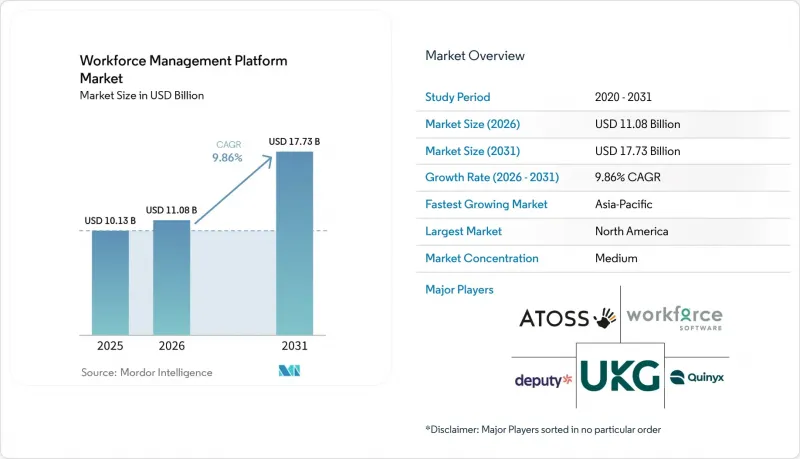
Mordor Intelligence에 의하면, 인력 관리 플랫폼 시장 규모는 2025년에 101억 3,000만 달러로 평가되었고, 2026년 110억 8,000만 달러로 추정되고, 2031년까지 177억 3,000만 달러에 이를 것으로 예측되며, 예측 기간(2026-2031년) CAGR은 9.86%를 나타낼 전망입니다.
본 보고서는 구성 요소별(솔루션 및 서비스), 배포 모델별(클라우드, 온프레미스, 하이브리드), 최종 사용자 기업 규모별(대기업 및 중소기업), 최종 사용자 산업 분야별(은행, 금융서비스 및 보험(BFSI), 소매 및 전자상거래, 헬스케어 및 생명과학 등) 및 지역별로 분류되어 있습니다. 시장 전망치는 금액(달러)으로 표시되어 있습니다.
세계의 인력 관리 플랫폼 시장 동향 및 인사이트
AI를 활용한 예측 및 일정 수립 자동화
인력 관리 플랫폼에서 AI 기반 스케줄링은 단순한 제안 단계를 넘어 실행 단계의 기능으로 진화하고 있습니다. Legion사는 2026년 3월, 자사 플랫폼이 매주 16억 개의 데이터 포인트를 처리하고, 30만 개 이상의 맞춤형 모델을 학습시키며, 주기당 170만 건의 일정 최적화를 완료하는 동시에, 비즈니스 및 직원 일정 수립 기준 준수율 96%를 달성했다고 보고했습니다. UKG사는 'Workforce Operating Platform' 및 'Dynamic Labor Management' 기능을 통해 이 방향으로 사업을 확장했습니다. 이러한 기능들은 수요 변화를 감지하고, 인력을 재배치하며, 급여 계산이 확정되기 전에 문제를 지적합니다. 이러한 진화에 따라 구매와 관련된 논의의 내용도 변화하고 있습니다. 고용주들은 더 이상 근무 일정 수립 속도의 향상에만 초점을 맞추는 것이 아니라, 근무 조정의 질 향상, 예외 사항의 감소, 그리고 직원들의 수용도 제고에 주력하고 있습니다. 또한, 구매자들은 일정이 어떻게 수립되는지, 왜 인력 배치 권장 사항이 변경되는지에 대한 투명성을 요구하게 되면서, 공급업체에 대한 입증 기준도 높아지고 있습니다. 2026년 8월 EU AI법이 시행되고, 고위험 고용 AI에 관한 의무가 도입됨에 따라 이러한 압박은 더욱 거세질 것입니다. 일정 수준에서 감사 가능성, 통제력, 설명 가능성을 입증할 수 있는 공급업체는 인력 관리 플랫폼 시장에서 더 유리한 입지를 차지하게 될 것입니다.
교대 근무 체제에서 노동 규정 준수의 복잡성이 점차 심화되고 있습니다.
시급제 및 교대 근무제 업무 전반에 걸쳐 노동 규제가 점점 더 세분화됨에 따라, 규정 준수는 단순한 지원 기능에서 벗어나 인력 관리 플랫폼 시장의 핵심적인 가치 원천으로 변화하고 있습니다. Paycom은 2026년 4월, 미국의 여러 관할 구역에서 예측형 근무 일정 수립 요건으로 사전 통지 규정, 고용주가 주도하는 근무 일정 변경에 대한 할증 임금 지급 의무, 그리고 폐점 및 개점 근무 교대와 관련된 제한 사항 등이 포함되어 있다고 지적했습니다. 많은 도시와 주에서 사업을 운영하는 고용주들은 현재 중복되는 일련의 규정에 직면해 있으며, 수동으로 일정을 작성하거나 현지 관리자의 판단만으로는 관리가 어려워지고 있습니다. 따라서, 특히 시간제 근로자를 많이 고용하고 있는 소매업체, 의료 서비스 제공업체, 호텔 및 레스토랑 체인의 경우, 규칙 엔진, 예외 추적 및 자동 문서화 기능이 플랫폼 선정에 있어 점점 더 중요해지고 있습니다. 유럽에서도 유사한 추세가 두드러지게 나타나고 있으며, 단체협약의 적용 범위가 75%에 달함에 따라 독일, 프랑스, 베네룩스 시장에서 자동화된 규정 준수 솔루션에 대한 수요가 증가하고 있습니다. 그 결과, 인력 관리 플랫폼 시장에서 규정 준수 자동화는 더 이상 선택적인 업그레이드가 아니라, 구매자에게 있어 직접적인 업무상의 필요 사항으로 인식되고 있습니다.
기존 인사·급여·ERP 시스템과의 통합이 주는 복잡성
통합의 복잡성은 여전히 인력 관리 플랫폼 시장에서 도입 속도를 저해하는 가장 두드러진 요인 중 하나입니다. 독일과 오스트리아에서 ERP와의 연동 비용은 예산을 중시하는 소매업 및 제조업 고객들에게 있어 업그레이드 결정을 계속 미루게 하고 있습니다. 특히, 기존 시스템을 연동하는 데 필요한 노력에 비해 단기적인 투자 회수가 어려울 것으로 예상되는 경우에는 이러한 경향이 두드러집니다. 이 문제는 인력 관리 플랫폼이 인사, 급여, ERP, 재무, 그리고 일부 업계에서는 MES 환경과의 원활한 연동에 의존하고 있기 때문에 매우 중요합니다. 이러한 연동이 단편화되어 있으면, 일정 데이터, 급여 데이터, 규정 준수 기록이 일관되게 연동되지 않아 도입 주기가 길어지고, 사용자의 신뢰를 잃게 됩니다. 이 문제는 기존 시스템이 일상 업무에 깊이 뿌리내리고 있는 대기업이나 공공 부문에서 특히 두드러집니다. 커스텀 커넥터에 의존하는 공급업체는 인증된 통합 솔루션이나 재현 가능한 도입 절차서를 제공할 수 있는 공급업체에 비해 사업 확장 속도가 더딘 상황이 계속되고 있습니다. 따라서 클라우드 도입이 확대되고 있음에도 불구하고, 시스템 통합은 여전히 인력 관리 플랫폼 시장에 큰 걸림돌이 되고 있습니다.
부문별 분석
솔루션이 2025년 매출의 72.34%를 차지했으며, 인력 관리 플랫폼 시장이 여전히 자문 서비스나 개별 도입 작업이 아닌, 주로 핵심 소프트웨어 기능에 의해 지탱되고 있음을 확인할 수 있었습니다. 다양한 솔루션 중에서도 근태 관리는 여전히 핵심적인 위치를 차지하고 있습니다. 이는 인력 관리 플랫폼 시장의 거의 모든 업종에서 급여 계산의 정확성, 법적 문서, 일상적인 관리를 뒷받침하고 있기 때문입니다. 또한, 스케줄링 및 근무표 작성 역시 인건비, 직원 경험, 업무 성과와 가장 밀접하게 관련된 도구이기 때문에 여전히 경쟁이 치열한 분야입니다. 구매자들은 근태, 휴가, 분석, 업무 관리 등 각 분야의 기능 확충을 계속해서 중요하게 여기고 있습니다. 이는 도구들이 분산되어 있으면, 일정 관리, 급여 계산, 규정 준수 등 각 단계 간에 업무 인계가 빈번하게 발생하기 때문입니다. 따라서 고객들이 플랫폼의 어떤 기능이 실제로 중요한지에 대해 더욱 선택적으로 접근하고 있음에도 불구하고, 인력 관리 플랫폼 시장의 솔루션 부문은 여전히 지출의 대부분을 차지하고 있습니다.
인력 관리 플랫폼 시장에서 서비스 부문은 소프트웨어 부문보다 빠르게 성장하고 있으며, 2031년까지의 연평균 성장률(CAGR)은 10.34%로 전망됩니다. 이러한 성장은 도입, AI 설정 및 규칙 관리의 복잡성이 증가한 것을 반영한 것입니다. 서비스 계층은 도입, 모델 튜닝, 지속적인 규정 준수 지원, 그리고 고객이 사내에서 완전히 감당하기 어려운 변경 관리 업무와 점점 더 밀접하게 연결되어 있습니다. UKG는 'Workforce Operating Platform'이라고 밝히며, AI 주도형 오케스트레이션 전략의 확대를 통해 이러한 방향성을 강화하고 있으며, 제품 기능과 내장된 자문 로직, 그리고 관리형 실행 지원을 융합하고 있습니다. 결근·휴가 관리 및 업무 관리의 경우, 클라우드 서비스를 통해 버전 잠금이나 수동 정책 업데이트 없이도 규칙을 지속적으로 업데이트할 수 있기 때문에 여전히 안정적인 수익원으로 자리 잡고 있습니다. 고객들이 더욱 맞춤화된 AI 동작과 업계별 예측 로직을 요구함에 따라, 이 서비스는 인력 관리 플랫폼 시장에서 더욱 중요한 가치 계층으로 자리 잡고 있으며, 일회성 지원 부가 기능에서 플랫폼의 장기적인 성공을 뒷받침하는 핵심 구성 요소로 전환되고 있습니다.
2025년 인력 관리 플랫폼 시장에서 클라우드가 64.27%를 차지했으며, 이는 원격 제공, 지속적인 업데이트, 분산형 액세스가 대부분의 신규 구매 주기에서 여전히 표준적인 도입 패턴임을 보여줍니다. 클라우드 플랫폼이 계속해서 지지를 받고 있는 이유는 분산된 팀 전체에 걸친 배포를 간소화하고, 모바일 사용을 지원하며, 가동 중인 환경에 대한 정책 업데이트를 용이하게 하기 때문입니다. 이는 근무 일정, 근태 관리, 급여 계산 준비, 규정 준수 모니터링 등 모든 요소가 시기적절한 업데이트와 일관된 데이터 흐름에 의존하는 인력 관리 플랫폼 시장에서 중요한 요소입니다. 또한, 클라우드를 위해 네이티브로 구축된 벤더들은 가동 시간, 응답 속도, 탄력적인 확장성에 대한 기대치도 설정하고 있습니다. 이로 인해 클라우드는 인력 관리의 중심적인 위치를 계속 차지하고 있습니다.
하이브리드 모델은 여전히 가장 빠른 성장세를 보이고 있으며, 2026-2031년 연평균 성장률(CAGR) 11.27%를 나타낼 것으로 전망됩니다. 이는 많은 기업이 클라우드의 확장성을 필요로 하지만, 기밀성이 높은 직원 정보나 급여 기록에 대해서는 보다 엄격한 로컬 관리 하에 보관해야 하기 때문입니다. 인력 관리 플랫폼 시장에서 가장 큰 수요가 나타나는 분야는 제조업, 의료, 정부 기관, 그리고 복잡한 데이터 상주 요건을 가진 다국적 기업입니다. 독일의 제조업 및 공공 부문 고객들은 주권, 감사 및 협상상의 요건으로 인해 여전히 온프레미스 환경을 상당 부분 유지하고 있습니다. Legion사는 또한 GDPR(EU 개인정보보호규정)을 준수하는 호스팅 및 지역별 데이터 관리 체계에 대한 대응을 강조하고 있으며, 이는 클라우드의 속도와 규정 준수 관리를 양립시키는 세계 사업 전개에 있어 현재 요구되는 기본 요건을 반영한 것입니다. 그 결과, 인력 관리 플랫폼 시장에서 하이브리드 방식은 더 이상 일시적인 타협안이 아니라, 유연성과 지역별 거버넌스를 모두 추구하는 기업들에게 선호되는 아키텍처로 자리 잡고 있습니다.
지역별 분석
2025년, 북미는 인력 관리 플랫폼 시장 점유율의 39.54%를 차지했으며, 예측 기간 시작 시점에서 가장 큰 기여를 한 지역이 되었습니다. 이러한 위상의 상당 부분은 미국이 주도하고 있으며, 그 배경에는 엄격한 노동 규제, 성숙한 엔터프라이즈 클라우드 환경, 그리고 소매, 호텔 및 관광, 의료, 제조업에 걸쳐 있는 대규모 시간제 근로자층이 복합적으로 작용하고 있습니다. 미국 내 여러 관할 구역에 걸쳐 적용되는 예측형 스케줄링 규칙 덕분에, 여러 사업장을 운영하는 고용주에게 자동화된 규칙 엔진, 사전 통지 관리 및 문서화 기능의 가치는 계속해서 높아지고 있습니다. 캐나다와 멕시코도 이 지역 수요를 뒷받침하고 있습니다. 캐나다의 노사 관계 요건은 노사 협상을 고려한 일정 수립을 중시하는 반면, 멕시코의 산업 기반은 ERP 시스템과 연동된 다중 교대 근무 인력 계획에 대한 수요를 뒷받침하고 있습니다. 따라서 북미는 시장 점유율이 시간이 지남에 따라 축소되더라도, 인력 관리 플랫폼 시장에서 가장 큰 계약 규모를 유지할 가능성이 높다고 볼 수 있습니다.
유럽은 각국의 노동 규제가 세분화되어 있고, 노사 교섭의 대상이 광범위하며, 또한 GDPR(EU 개인정보보호규정)이 다른 많은 지역보다 제품 아키텍처 결정에 더 직접적인 영향을 미치고 있기 때문에 인력 관리 플랫폼 시장에서 구조적으로 중요한 지역으로 자리매김하고 있습니다. 해당 지역은 2025 회계연도에 20년 연속 사상 최고 기록을 달성했으며, 매출액은 1억 8,930만 유로(2억 1,390만 달러)를 기록했습니다. 이는 DACH 시장에서 규정 준수를 중시하는 클라우드 기반 인력 관리 솔루션의 가격 결정력을 반영한 것입니다. 또한 유럽에서는 고용 관련 AI 및 생체 인증 데이터 처리에 대한 감독이 강화되고 있어, 설명 가능성, 법적으로 적법한 동의 체계, 감사에 대응할 수 있는 데이터 처리의 중요성이 커지고 있습니다. 이러한 환경에서는 범용적인 세계 템플릿에 의존하는 공급업체보다, 현지 규정 준수를 깊이 있게 구축해 온 공급업체가 유리합니다. 스칸디나비아를 포함한 유럽의 소규모 시장도, 현지 노동 여건과 현장의 참여가 밀접하게 연결된 분야에서 지역 전문 기업들이 계속해서 경쟁력을 발휘하고 있기 때문에 여전히 중요한 시장으로 남아 있습니다.
아시아태평양은 2026-2031년 연평균 성장률(CAGR) 12.34%를 나타낼 것으로 예측되며, 인력 관리 플랫폼 시장에서 가장 두드러진 성장을 보일 것으로 전망됩니다. 일본에서는 근로 방식 개혁에 따라 초과근무 관리, 휴가 관리, 디지털 근태 관리에 대한 수요가 증가하고 있어, 해당 지역이 주요 성장 요인으로 부상하고 있습니다. Office Station은 45,000개 이상의 기업에 서비스를 제공하고 있으며, 99.7%의 이용 유지율을 유지하고 있는 것으로 보고되고 있습니다. 인도 역시 대형 기술 기업과 확대되는 디지털 사업으로 인해 일정 관리, 인력 배치, 분석, 규정 준수 지원에 대한 수요가 높아짐에 따라, 인력 관리 플랫폼 시장에서 그 중요성이 점점 더 커지고 있습니다. 중국에서는 도시 지역의 노동력 디지털화를 통해 추가적인 수요가 창출되고 있습니다. 그러나 현지 데이터 상주 요건에 대한 기대감으로 인해 하이브리드형 도입이라는 선택지가 계속해서 지지를 받고 있습니다. 남미, 중동 및 아프리카는 여전히 초기 단계 시장이지만, 디지털화가 진행되면서 인력 조정이 이루어지고 있는 소매 및 의료 분야에서는 '클라우드 우선' 및 '모바일 네이티브'의 도입이 점차 확산되고 있습니다. 이러한 경향을 종합해 보면, 인력 관리 플랫폼 시장의 지역별 성장은 단순한 디지털화보다는 각 지역의 노동 규제, 모바일 보급, 데이터 거버넌스가 어떻게 상호작용하는지에 따라 형성되고 있음을 알 수 있습니다.
기타 혜택 :
- 엑셀 형식 시장 예측(ME) 시트
- 3개월간의 애널리스트 지원
자주 묻는 질문
목차
제1장 서론
제2장 조사 방법
제3장 주요 요약
제4장 시장 구도
제5장 시장 규모 및 성장 예측
제6장 경쟁 구도
제7장 시장 기회 및 향후 전망
AJY 26.07.07According to Mordor Intelligence, the workforce management platform market size was valued at USD 10.13 billion in 2025 and estimated to grow from USD 11.08 billion in 2026 to reach USD 17.73 billion by 2031, at a CAGR of 9.86% during the forecast period (2026-2031).
This report is Segmented by Component (Solutions, and Services), Deployment Model (Cloud, On-Premises, and Hybrid), End-User Enterprise Size (Large Enterprises, and Small and Medium-Sized Enterprises), End-User Industry (BFSI, Retail and E-Commerce, Healthcare and Life Sciences, and More), and Geography. The Market Forecasts are Provided in Terms of Value (USD).
Global Workforce Management Platform Market Trends and Insights
AI-Powered Forecasting and Scheduling Automation
AI-led scheduling in workforce management platforms has advanced beyond simple suggestions into execution-level capabilities. Legion reported in March 2026 that its platform processes 1.6 billion data points weekly, trains more than 300,000 custom models, and completes 1.7 million schedule optimizations per cycle while achieving 96% adherence to business and employee scheduling criteria. UKG expanded in this direction with its Workforce Operating Platform and Dynamic Labor Management features, which detect demand changes, redirect labor, and flag issues before payroll is finalized. This evolution changes the buying conversation: employers are no longer focused only on faster schedule creation, but on improving shift quality, reducing exceptions, and increasing employee acceptance. It also raises the bar for vendor proof, since buyers now demand visibility into how schedules are generated and why labor recommendations shift. That pressure will intensify as the EU AI Act introduces high-risk employment AI obligations in August 2026. Vendors that can demonstrate auditability, controls, and explainability at the schedule level are better positioned in the workforce management platform market.
Escalating Labor Compliance Complexity Across Shift-Based Workforces
Labor regulation is becoming more detailed across hourly and shift-based work, shifting compliance from a support feature into a core value driver in the workforce management platform market. Paycom noted in April 2026 that predictive scheduling requirements across multiple US jurisdictions include advance notice rules, premium pay obligations for employer-led schedule changes, and restrictions tied to closing and opening shifts. Employers with operations across many cities and states now face overlapping rule sets that are difficult to manage through manual scheduling or local manager judgment alone. This makes rule engines, exception tracking, and automated documentation increasingly important for platform selection, especially for retailers, healthcare providers, and hospitality chains with large hourly workforces. The same trend is evident in Europe, where collective bargaining agreement coverage reaches 75%, driving demand for automated enforcement across Germany, France, and the Benelux markets. As a result, compliance automation is now seen by buyers as a direct operating need rather than a discretionary upgrade in the workforce management platform market.
Legacy HR, Payroll, and ERP Integration Complexity
Integration complexity remains one of the clearest limits on deployment speed in the workforce management platform market. ERP interconnection costs in Germany and Austria continue to slow upgrade decisions for budget-conscious retail and manufacturing customers, especially when short-term return looks less visible than the effort required to connect older systems. This issue matters because workforce platforms depend on clean connections to HR, payroll, ERP, finance, and, in some sectors, MES environments. When those links are fragmented, schedule data, pay data, and compliance records do not move consistently, which lengthens deployment cycles and weakens user confidence. The problem is especially evident in large enterprises and public-sector settings, where older systems remain deeply embedded in daily operations. Vendors that rely on custom connector work continue to face slower expansion than those that can present certified integrations and repeatable deployment playbooks. That keeps system integration a real drag on the workforce management platform market, even as cloud adoption continues to rise.
Other drivers and restraints analyzed in the detailed report include:
- Cloud and Mobile-First Rollouts for Distributed and Deskless Teams
- Labor Cost Optimization and Overtime Control Imperatives
- High Implementation and Change-Management Burden for Multi-Site Enterprises
For complete list of drivers and restraints, kindly check the Table Of Contents.
Segment Analysis
Solutions accounted for 72.34% of 2025 revenue, confirming that the workforce management platform market still rests primarily on core software functions rather than advisory layers or stand-alone implementation work. Within solutions, time and attendance management remains central because it supports payroll accuracy, legal documentation, and day-to-day control across nearly every vertical in the workforce management platform market. Scheduling and rostering also remain highly contested because those tools sit closest to labor cost, employee experience, and operational output. Buyers continue to favor depth across attendance, leave, analytics, and task management because fragmented tool stacks create too many handoffs between scheduling, pay, and compliance. This is why the solutions side of the workforce management platform market continues to attract most of the spending base, even as customers become more selective about what platform depth actually matters.
Services are expanding faster than software in the workforce management platform market, with a 10.34% CAGR projected through 2031. This growth reflects the rising complexity of deployment, AI configuration, and rule management. The services layer is increasingly tied to implementation, model tuning, ongoing compliance support, and change-management work that customers cannot fully absorb internally. UKG has reinforced this direction with its Workforce Operating Platform and expanding AI-led orchestration strategy, blending product capability with embedded advisory logic and managed execution support. Absence and leave management, along with task management, remain steady contributors because cloud delivery enables ongoing rule updates without version lock or manual policy refreshes. As customers demand more tailored AI behavior and industry-specific forecasting logic, services are becoming a larger value layer inside the workforce management platform market, shifting from a one-time support add-on to a core component of long-term platform success.
Cloud accounted for 64.27% of the workforce management platform market in 2025, indicating that remote delivery, continuous updates, and distributed access remain the standard deployment pattern for most new buying cycles. Cloud platforms continue to appeal because they simplify rollout across dispersed teams, support mobile use, and make it easier to push policy updates into active environments. This matters in the workforce management platform market because scheduling, attendance, payroll preparation, and compliance monitoring all depend on timely updates and consistent data flow. Vendors that built natively for the cloud are also setting expectations for uptime, response speed, and elastic scaling. That keeps the cloud at the center of the workforce.
Hybrid is still the fastest-growing model, with an 11.27% CAGR from 2026 to 2031, because many enterprises need cloud scalability while keeping sensitive workforce or payroll records under tighter local control. The strongest demand is coming from manufacturing, healthcare, government, and multinational organizations with complex data residency needs inside the workforce management platform market. German manufacturing and public sector customers still maintain significant on-premises footprints due to sovereignty, audit, and bargaining requirements. Legion also highlighted support for GDPR-aligned hosting and regional data arrangements, which reflects the baseline now required for global deployments that mix cloud speed with compliance controls. The result is that hybrid is no longer a temporary compromise in the workforce management platform market; it is becoming the preferred architecture for enterprises that want both flexibility and jurisdiction-specific governance.
Complete Report Scope:
- By Component
- Solutions
- Time and Attendance Management
- Workforce Scheduling and Rostering
- Absence and Leave Management
- Workforce Analytics and Reporting
- Task Management
- Services
- Solutions
- By Deployment Model
- Cloud
- On-premises
- Hybrid
- By End-user Enterprise Size
- Large Enterprises
- Small and Medium-sized Enterprises
- By End-user Industry
- BFSI
- Retail and E-commerce
- Healthcare and Life Sciences
- Manufacturing
- IT and Telecom
- Government and Public Sector
- Transportation and Logistics
- Hospitality
- Contact Centers
- Other End-user Industries
- By Geography
- North America
- United States
- Canada
- Mexico
- South America
- Brazil
- Argentina
- Chile
- Rest of South America
- Europe
- Germany
- United Kingdom
- France
- Italy
- Spain
- Rest of Europe
- Asia-Pacific
- China
- India
- Japan
- Australia
- South Korea
- Southeast Asia
- Rest of Asia-Pacific
- Middle East
- Saudi Arabia
- United Arab Emirates
- Turkey
- Israel
- Rest of Middle East
- Africa
- South Africa
- Nigeria
- Rest of Africa
- North America
Geography Analysis
North America held 39.54% of the workforce management platform market share in 2025, which makes it the largest regional contributor at the start of the forecast period. The United States drives most of that position because it combines dense labor regulation, a mature enterprise cloud environment, and a large base of hourly workers across retail, hospitality, healthcare, and manufacturing. Predictive scheduling rules across multiple US jurisdictions continue to raise the value of automated rule engines, advance notice controls, and documentation features for multi-site employers. Canada and Mexico also support regional demand, as Canadian labor relations requirements favor bargaining-aware scheduling, while Mexico's industrial base supports demand for multi-shift workforce planning linked to ERP systems. North America is therefore likely to remain the largest pool of contract value in the workforce management platform market even as its share narrows over time.
Europe remains a structurally important region in the workforce management platform market because national labor rules are fragmented, bargaining coverage is high, and GDPR shapes product architecture decisions more directly than in many other regions. The region reported a 20th consecutive record year in FY2025, with revenue of EUR 189.3 million (USD 213.9 million), which reflects the pricing power of compliance-focused cloud workforce solutions in DACH markets. Europe also faces tighter scrutiny around employment AI and biometric data processing, which is increasing the importance of explainability, lawful consent structures, and audit-ready data handling. That environment favors vendors that have built local compliance depth rather than those that rely on generic global templates. Smaller European markets, including Scandinavia, also remain meaningful because regional specialists continue to compete well where local labor logic and frontline engagement are tightly linked.
Asia-Pacific is projected to expand at a 12.34% CAGR from 2026 to 2031, making it the fastest-growing geography in the workforce management platform market. Japan is a major driver because work-style reform has strengthened demand for overtime control, leave tracking, and digital attendance management. It was reported that Office Station serves more than 45,000 companies and maintains a 99.7% utilization continuity rate. India is also becoming increasingly important in the workforce management platform market as large technology firms and growing digital operations increase demand for scheduling, allocation, analytics, and compliance support. China adds another layer of demand through the digitalization of the urban workforce, but local data-residency expectations continue to support hybrid deployment choices. South America, the Middle East, and Africa remain earlier-stage opportunities, though cloud-first and mobile-native adoption is gaining ground in retail and healthcare settings where labor coordination is becoming more digital. Taken together, these patterns indicate that regional growth in the workforce management platform market is being shaped less by simple digitization and more by how labor rules, mobile adoption, and data governance interact in each geography.
- UKG Inc.
- WorkForce Software, LLC
- ATOSS Software SE
- Deputechnologies Pty Ltd.
- Quinyx AB
- Legion Technologies, Inc.
- ActiveOps plc
- TimeClock Plus, LLC
- 7shifts Employee Scheduling Software Inc.
- SISQUAL Workforce Management, Lda.
- tamigo ApS
- Roubler Australia Pty Ltd.
- Shiftboard, Inc.
- When I Work, Inc.
- Mobilesson Ltd.
- Skedulo Holdings, Inc.
- Assembled, Inc.
- WorkJam Inc.
- SameSystem A/S
- Rota Geek Limited
Additional Benefits:
- The market estimate (ME) sheet in Excel format
- 3 months of analyst support
TABLE OF CONTENTS
1 INTRODUCTION
- 1.1 Study Assumptions and Market Definition
- 1.2 Scope of the Study
2 RESEARCH METHODOLOGY
3 EXECUTIVE SUMMARY
4 MARKET LANDSCAPE
- 4.1 Market Overview
- 4.2 Market Drivers
- 4.2.1 AI-Powered Forecasting and Scheduling Automation
- 4.2.2 Escalating Labor Compliance Complexity Across Shift-Based Workforces
- 4.2.3 Cloud and Mobile-First Rollouts for Distributed and Deskless Teams
- 4.2.4 Labor Cost Optimization and Overtime Control Imperatives
- 4.2.5 Pay Transparency and Pay Equity Reporting Require Defensible Time and Pay Data
- 4.2.6 Predictive Scheduling and Contingent Labor Rules Raise Rule-Engine Value
- 4.3 Market Restraints
- 4.3.1 Legacy HR, Payroll, and ERP Integration Complexity
- 4.3.2 High Implementation and Change-Management Burden for Multi-Site Enterprises
- 4.3.3 Algorithmic Bias, Explainability, and Employee Surveillance Concerns
- 4.3.4 Biometric Privacy, Data Residency, and Cross-Border AI Governance Fragmentation
- 4.4 Industry Value-Chain Analysis
- 4.5 Regulatory Landscape
- 4.6 Technological Outlook
- 4.7 Porter's Five Forces Analysis
- 4.7.1 Threat of New Entrants
- 4.7.2 Bargaining Power of Buyers
- 4.7.3 Bargaining Power of Suppliers
- 4.7.4 Threat of Substitutes
- 4.7.5 Intensity of Competitive Rivalry
5 MARKET SIZE AND GROWTH FORECASTS (VALUE)
- 5.1 By Component
- 5.1.1 Solutions
- 5.1.1.1 Time and Attendance Management
- 5.1.1.2 Workforce Scheduling and Rostering
- 5.1.1.3 Absence and Leave Management
- 5.1.1.4 Workforce Analytics and Reporting
- 5.1.1.5 Task Management
- 5.1.2 Services
- 5.1.1 Solutions
- 5.2 By Deployment Model
- 5.2.1 Cloud
- 5.2.2 On-premises
- 5.2.3 Hybrid
- 5.3 By End-user Enterprise Size
- 5.3.1 Large Enterprises
- 5.3.2 Small and Medium-sized Enterprises
- 5.4 By End-user Industry
- 5.4.1 BFSI
- 5.4.2 Retail and E-commerce
- 5.4.3 Healthcare and Life Sciences
- 5.4.4 Manufacturing
- 5.4.5 IT and Telecom
- 5.4.6 Government and Public Sector
- 5.4.7 Transportation and Logistics
- 5.4.8 Hospitality
- 5.4.9 Contact Centers
- 5.4.10 Other End-user Industries
- 5.5 By Geography
- 5.5.1 North America
- 5.5.1.1 United States
- 5.5.1.2 Canada
- 5.5.1.3 Mexico
- 5.5.2 South America
- 5.5.2.1 Brazil
- 5.5.2.2 Argentina
- 5.5.2.3 Chile
- 5.5.2.4 Rest of South America
- 5.5.3 Europe
- 5.5.3.1 Germany
- 5.5.3.2 United Kingdom
- 5.5.3.3 France
- 5.5.3.4 Italy
- 5.5.3.5 Spain
- 5.5.3.6 Rest of Europe
- 5.5.4 Asia-Pacific
- 5.5.4.1 China
- 5.5.4.2 India
- 5.5.4.3 Japan
- 5.5.4.4 Australia
- 5.5.4.5 South Korea
- 5.5.4.6 Southeast Asia
- 5.5.4.7 Rest of Asia-Pacific
- 5.5.5 Middle East
- 5.5.5.1 Saudi Arabia
- 5.5.5.2 United Arab Emirates
- 5.5.5.3 Turkey
- 5.5.5.4 Israel
- 5.5.5.5 Rest of Middle East
- 5.5.6 Africa
- 5.5.6.1 South Africa
- 5.5.6.2 Nigeria
- 5.5.6.3 Rest of Africa
- 5.5.1 North America
6 COMPETITIVE LANDSCAPE
- 6.1 Market Concentration
- 6.2 Strategic Moves
- 6.3 Market Share Analysis
- 6.4 Company Profiles (includes Global Level Overview, Market Level Overview, Core Segments, Financials as available, Strategic Information, Market Rank/Share, Products and Services, Recent Developments).
- 6.4.1 UKG Inc.
- 6.4.2 WorkForce Software, LLC
- 6.4.3 ATOSS Software SE
- 6.4.4 Deputechnologies Pty Ltd.
- 6.4.5 Quinyx AB
- 6.4.6 Legion Technologies, Inc.
- 6.4.7 ActiveOps plc
- 6.4.8 TimeClock Plus, LLC
- 6.4.9 7shifts Employee Scheduling Software Inc.
- 6.4.10 SISQUAL Workforce Management, Lda.
- 6.4.11 tamigo ApS
- 6.4.12 Roubler Australia Pty Ltd.
- 6.4.13 Shiftboard, Inc.
- 6.4.14 When I Work, Inc.
- 6.4.15 Mobilesson Ltd.
- 6.4.16 Skedulo Holdings, Inc.
- 6.4.17 Assembled, Inc.
- 6.4.18 WorkJam Inc.
- 6.4.19 SameSystem A/S
- 6.4.20 Rota Geek Limited
7 MARKET OPPORTUNITIES AND FUTURE OUTLOOK
- 7.1 White-space and unmet-need assessment


