

|
시장보고서
상품코드
2072795
AI 기반 환자 스케줄링 소프트웨어 시장 : 시장 점유율 분석, 업계 동향 및 통계, 성장 예측(2026-2031년)AI In Patient Scheduling Software - Market Share Analysis, Industry Trends & Statistics, Growth Forecasts (2026 - 2031) |
||||||
 Mordor Intelligence
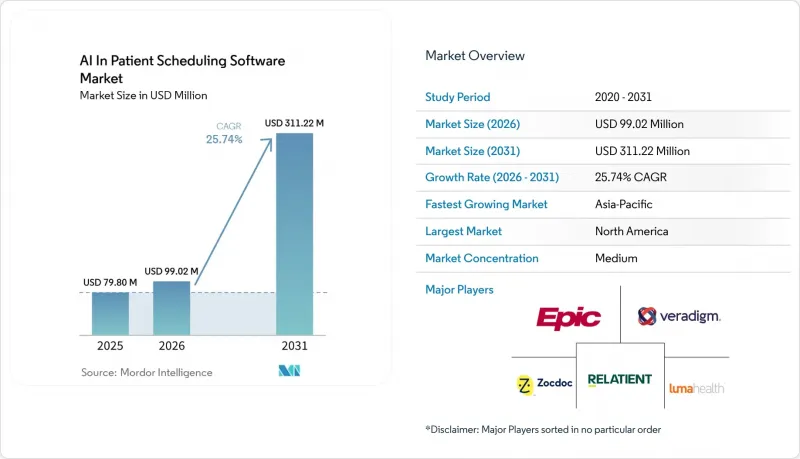
Mordor Intelligence에 의하면, AI 기반 환자 스케줄링 소프트웨어 시장 규모는 2025년 7,980만 달러로 평가되었고, 2026년에는 9,902만 달러로 추정되고, 2026-2031년 CAGR 25.74%로 성장을 지속할 전망이며, 2031년에는 3억 1,122만 달러에 이를 것으로 예측됩니다.
본 보고서는 예약 유형별(외래 예약, 입원 예약, 전문 의료 예약, 기타 예약 유형), 배포 방식별(클라우드 기반 및 온프레미스형), 최종 사용자별(병원, 진료소, 기타 최종 사용자), 지역별(북미, 유럽, 아시아태평양, 중동 및 아프리카, 남미)로 분류되어 있습니다. 시장 전망은 금액(달러) 기준으로 제시되어 있습니다.
세계의 AI 기반 환자 스케줄링 소프트웨어 시장 동향 및 인사이트
관리 업무의 비효율성과 중복 예약 감소의 필요성
관리상 간접비는 여전히 병원 재무팀에게 가장 명확한 비용 절감 대상 중 하나이며, 따라서 AI 기반 환자 스케줄링 소프트웨어 시장은 비용 관리와 밀접한 관련이 있습니다. 2025년에 실시된 24건의 연구를 대상으로 한 체계적 문헌고찰에 따르면, AI를 활용한 관리 도구가 40%의 효율 향상을 달성한 것으로 밝혀졌으며, 또한 병원 운영에서 AI를 통한 자동화는 국가 의료비를 5%에서 10%까지 절감할 가능성이 있다고 지적되고 있습니다. 비용 문제는 단순히 예약 후 무단 불참에 그치지 않습니다. 단 한 건의 중복 예약만 발생해도 청구 오류, 환자의 불만, 의료진의 초과 근무는 물론, 그날 남은 전체 일정에 지연을 초래할 가능성이 있기 때문입니다. Hyro사는 2025년, 의료 시스템의 41%가 인력 부족 문제 해결을 주요 목적 중 하나로 삼아 AI 예약 에이전트를 도입했으며, 이를 통해 매월 평균 264시간의 사무 업무가 줄어든 것으로 나타났습니다고 밝혔습니다. 이러한 운영 방식은 병원에서 외래 진료 네트워크로 점차 확대되고 있습니다. 외래 진료 네트워크에서는 접수팀이 여전히 하루의 대부분을 예약 재조정, 확인 및 대기자 명단에 있는 환자들에게 연락하는 데 할애하고 있습니다. 또한, 이는 예약 가능 좌석을 줄이는 것이 새로운 진료 역량을 추가하는 것보다 더 빠른 투자 회수를 가져오는 환경에서 AI 기반 환자 스케줄링 소프트웨어 분야가 확대되고 있는 이유를 설명해 줍니다.
의료 분야의 디지털 '정문'의 급속한 변화
디지털 프론트 도어의 보급으로 인해 독립형 접근 도구의 역할은 점차 축소되고 있으며, 이에 따라 AI 기반 환자 스케줄링 소프트웨어의 판매 형태도 변화하고 있습니다. 의료 제공업체들은 환자와의 소통, 신원 확인, 문서화, 예약 관리를 개별 시스템이 아닌, 단일하고 연동된 워크플로우를 통해 수행하기를 점점 더 요구하고 있습니다. Amazon Web Services(AWS)는 2026년에 예약 관리, 환자 신원 확인, 임상 문서화를 위해 EHR 시스템과 통합되는 전용으로 설계된 에이전트 기반 AI 솔루션으로 'Amazon Connect Health를 출시했습니다. 또한 AWS는 파트너사인 Netsmart와의 통합을 통해 앰비언트 다큐멘테이션의 도입률이 275% 증가했다고 밝혔습니다. 이는 프론트오피스 업무와 보다 광범위한 임상 워크플로우를 연계하는 제품이 구매자들로부터 높은 평가를 받고 있음을 보여줍니다. 대형 플랫폼 벤더와 하이퍼스케일러가 시장에 진출하는 가운데, AI 기반 환자 스케줄링 소프트웨어 분야의 중소 벤더들은 자사의 입지를 유지하기 위해 더욱 정교한 전문 로직과 더욱 견고한 가격 전략이 필요합니다. 이러한 상황은 매출 성장률만으로는 예측할 수 없을 정도로 빠른 속도로 벤더들의 입지를 변화시키고 있습니다.
임상 부서 간 워크플로우 통합의 복잡성
AI 기반 환자 스케줄링 소프트웨어의 활용은 셀프 서비스 예약 화면을 추가하는 것보다 도입이 훨씬 더 어렵기 때문에 여전히 실용적인 한계에 직면해 있습니다. 『Frontiers in Health Services』지에 게재된 2025년 체계적 문헌고찰에 따르면, HL7 FHIR과 SNOMED CT 표준 간의 의미론적 불일치, 시스템 간 데이터 교환의 제한, 그리고 레거시 EHR 환경에서의 참여 기능의 취약성으로 인해 도입 일정이 당초 계획보다 지연되는 사례가 빈번하게 관찰됩니다. 또한, 각 진료 부서마다 서로 다른 예약 규칙, 의료진의 선호도, 장비에 대한 의존도, 치료 경로가 채택되어 있기 때문에 방사선과, 종양과, 외과, 1차 진료의 모든 분야에 단일한 범용 예약 논리가 적용되는 경우는 거의 없습니다. EHR과 진료 관리 시스템이 혼재된 다중 사이트 시스템에서는 상호 운용성의 격차가 더욱 두드러집니다. 이는 시스템이 추가될 때마다 데이터와 워크플로 로직을 표준화하는 데 필요한 노력이 증가하기 때문입니다. 또한, 스케줄러나 클리닉 관리자에게 오랜 기간 이어져 온 현장의 관행을 바꾸는 자동화된 권장 사항을 신뢰해 달라고 요청할 경우, 직원들의 수용이 늦어질 수도 있습니다. 따라서 AI 기반 환자 스케줄링 소프트웨어의 경우, 순수한 모델의 성능뿐만 아니라 통합의 깊이와 워크플로우 설정 능력을 갖춘 공급업체가 높이 평가되는 추세입니다.
부문별 분석
2025년, 외래 예약 분야는 AI 기반 환자 스케줄링 소프트웨어 시장 점유율의 43.17%를 차지했으며, 부문별 구성에서 가장 큰 수익원이 되었습니다. 외래 진료, 재진료, 전문의에 의한 후속 관리 건수가 많기 때문에 AI 기반 환자 스케줄링 소프트웨어의 이 분야는 자동화에 가장 직접적으로 적합합니다. 외래 진료 기관은 노쇼 예측, 자동 알림, 대기 명단을 통한 환자 확보, 그리고 보험, 진료 가능 시간, 증상의 중증도에 기반한 의사와 환자의 매칭과 같은 기능을 통해 가장 먼저 혜택을 보고 있습니다.
전문 의료 예약 관리 및 응급·긴급 의료 예약 관리는 AI 기반 환자 스케줄링 소프트웨어 활용에 있어 대상 범위는 좁지만, 임상적으로 중요한 이용 사례에 대응하고 있습니다. 이러한 분야가 주목받는 이유는 시기의 오류가 환자 흐름, 치료 조정 및 자원 활용에 있어 후속 단계에서 더 심각한 영향을 미치기 때문입니다. 입원 환자의 일정 관리는 병상 관리, 수술 블록 계획, 그리고 수일에 걸친 입원 기간 동안의 진료팀 조정에 의해 주도되며, 2026-2031년 연평균 성장률(CAGR) 26.9%를 기록하며 가장 빠르게 성장하는 부문이 될 것으로 예측됩니다. 수익 구조는 명확합니다. 수술이 취소되거나 중환자실 병상이 비어 있는 상태는 즉각적으로 눈에 띄는 경제적 손실을 초래하기 때문입니다. 따라서 AI 기반 환자 스케줄링 소프트웨어 시장은 외래 진료 분야에서의 도입에 비해 일반적으로 더 많은 워크플로우 설정이 필요함에도 불구하고, 입원 환경으로 계속해서 확대되고 있습니다.
지역별 분석
2025년, 북미는 AI 기반 환자 스케줄링 소프트웨어 시장 규모의 48.36%를 차지했으며, 도입 실적과 공급업체 활동 양쪽 모두에서 이 지역이 1위를 유지했습니다. 이 지역은 전자건강기록(EHR)의 높은 보급률, 디지털 헬스 분야에 대한 적극적인 투자, 그리고 기업용 시스템 도입을 정당화할 만큼 일정 관리가 복잡한 대규모 다학제 진료 시스템이 존재한다는 점에서 혜택을 보고 있습니다. 캐나다에서는 병원 간 공동 계획 및 수용 능력 관리 도구를 통해 공공 의료 시스템의 측면이 반영되고 있지만, 멕시코는 아직 도입 초기 단계에 있어 광범위한 공공 도입이라기보다는 민간 병원이 주도하는 시범 사업이 주를 이루고 있습니다. 이러한 상황으로 인해, 기술적 준비가 갖춰진 데다 근무 시간 및 예약 슬롯을 회복해야 한다는 강력한 재정적 압박까지 더해지면서, 북미는 AI 기반 환자 스케줄링 소프트웨어 시장의 중심적인 위치를 계속 차지하고 있습니다.
유럽은 의료의 디지털화와 더욱 엄격해진 규정 준수 요건이 결합되어 있어, AI 기반 환자 스케줄링 소프트웨어 시장에서 구조적으로 중요한 지역으로 자리매김하고 있습니다. 영국, 독일, 프랑스가 수요의 핵심을 이루고 있는 반면, 스칸디나비아 및 베네룩스 지역에서는 디지털 헬스 분야에 대한 지출이 활발하며, 워크플로우 자동화에 대한 수용도도 높습니다. 따라서 유럽의 성장은 꾸준하지만, 공급업체 선정에 있어서는 성장 속도가 빠른 상업 시장에 비해 거버넌스, 통합, 조달 프로세스에 대한 고려가 더욱 중시되는 경향이 있습니다.
아시아태평양은 2031년까지 연평균 성장률(CAGR)이 28.31%를 나타낼 것으로 예측되며, AI 기반 환자 스케줄링 소프트웨어 시장에서 가장 빠르게 성장하는 지역이 될 것으로 전망됩니다. 이 지역의 성장을 주도하고 있는 요인은 중국의 병원 디지털화 프로그램, 인도의 1차 의료 인프라 확충, 그리고 일본의 의료 인력 부족 속에서 고령화 사회에 대응해야 한다는 압박감이 커지고 있다는 점입니다. 이러한 상황으로 인해 클라우드 기반 예약 관리, 의료 제공업체 간의 통합적인 조정, 그리고 대규모 프론트오피스 업무 자동화에 대한 수요가 생겨나고 있습니다. 한국과 호주 역시 광범위한 디지털 헬스 프로그램을 통해 기업의 도입을 장려하고 있지만, 중동 및 아프리카는 아직 성숙도가 낮은 단계에 있는 반면, GCC(걸프협력회의) 회원국들의 병원 확장 프로그램에서는 특정 분야에서 기회가 예상됩니다. 남미에서는 도시 지역의 대규모 민간 병원 그룹이 주도적인 역할을 하고 있지만, 구식 IT 시스템과 예산 주기의 제약으로 인해 공공 기관에서의 도입은 여전히 더딘 상황입니다. 이러한 지역별 차이로 인해 AI 기반 환자 스케줄링 소프트웨어의 활용은 전 세계적으로 확대되고 있지만, 가장 빠른 성장이 예상되는 곳은 여전히 디지털화 추진과 의료 제공업체의 수용 능력 부족이 동시에 진행되고 있는 지역에 집중되어 있습니다.
기타 혜택 :
- 엑셀 형식 시장 예측(ME) 시트
- 3개월간의 애널리스트 지원
자주 묻는 질문
목차
제1장 서론
제2장 조사 방법
제3장 주요 요약
제4장 시장 구도
제5장 시장 규모 및 성장 예측
제6장 경쟁 구도
제7장 시장 기회 및 향후 전망
AJY 26.07.07According to Mordor Intelligence, the AI in patient scheduling software market is expected to grow from USD 79.80 million in 2025 to USD 99.02 million in 2026 and is forecasted to reach USD 311.22 million by 2031 at 25.74% CAGR over 2026-2031.
This report is Segmented by Scheduling Type (Outpatient Scheduling, Inpatient Scheduling, Specialty Care Scheduling, and Other Scheduling Types), Deployment Mode (Cloud-Based and On-Premises), End-User (Hospitals, Clinics, Other End-Users), and Geography (North America, Europe, Asia-Pacific, Middle East and Africa, and South America). The Market Forecasts are Provided in Terms of Value (USD).
Global AI In Patient Scheduling Software Market Trends and Insights
Need to Reduce Administrative Inefficiencies and Double Bookings
Administrative overhead remains one of the clearest spending targets for hospital finance teams, and that keeps the AI in patient scheduling software market closely tied to cost control. A 2025 systematic review covering 24 studies found that AI-assisted administrative tools reached efficiency gains of 40%, and it also noted that AI automation in hospital operations could support 5% to 10% savings in national health expenditure. The cost problem is wider than a missed appointment because one double-booked slot can trigger billing errors, patient dissatisfaction, provider overtime, and delays across the rest of the day. Hyro said in 2025 that 41% of health systems adopted AI scheduling agents in part to address staffing shortages, and its deployments offloaded an average of 264 administrative hours each month. That operating logic is widening from hospitals to ambulatory networks where front-desk teams still spend large parts of the day on rescheduling, confirmations, and waitlist calls. It also explains why the AI in patient scheduling software market is expanding in settings where reducing slot leakage produces a faster return than adding new clinical capacity.
Rapid Healthcare Digital Front-Door Transformation
The digital front door is compressing the role of standalone access tools, and that is changing how the AI in patient scheduling software market is being sold. Providers increasingly want patient communication, verification, documentation, and appointment management to work through one connected workflow rather than separate systems. Amazon Web Services launched Amazon Connect Health in 2026 as a purpose-built agentic AI solution that integrates with EHR systems for appointment management, patient verification, and clinical documentation. AWS also said its Netsmart partner integration led to a 275% increase in ambient documentation adoption, which shows that buyers are rewarding products that link front-office activity with the wider clinical workflow. As larger platform vendors and hyperscalers enter the stack, smaller vendors in the AI in patient scheduling software market need deeper specialty logic or stronger pricing discipline to keep their position. This is changing vendor positioning faster than topline growth rates alone would suggest.
Workflow Integration Complexity Across Clinical Departments
The AI in patient scheduling software market still faces a practical limit because deployment is much harder than adding a self-service booking screen. A 2025 systematic review in Frontiers in Health Services found that semantic misalignment across HL7 FHIR and SNOMED CT standards, limited cross-system exchange, and weak engagement features in legacy EHR environments often extend implementation timelines beyond original plans. Clinical departments also work with different scheduling rules, provider preferences, equipment dependencies, and care pathways, so one generic scheduling logic rarely fits all of radiology, oncology, surgery, and primary care. The interoperability gap becomes sharper in multi-site systems that run mixed EHR and practice management stacks, because each added system increases the effort needed to normalize data and workflow logic. Staff adoption can lag as well when schedulers and clinic managers are asked to trust automated recommendations that change long-standing local routines. For that reason, the AI in patient scheduling software market often rewards vendors that bring integration depth and workflow configuration capacity rather than pure model performance alone.
Other drivers and restraints analyzed in the detailed report include:
- Rise of Telehealth and Hybrid Care Coordination
- Patient Self-Scheduling and Real-Time Rescheduling Expectations
- Data Privacy, Security, and AI Governance Burden
For complete list of drivers and restraints, kindly check the Table Of Contents.
Segment Analysis
Outpatient scheduling held 43.17% of AI in patient scheduling software market share in 2025, which made it the largest revenue contributor within the segment mix. The volume of ambulatory visits, repeat encounters, and specialist follow-ups makes this part of the AI in patient scheduling software market the most direct fit for automation. Outpatient providers benefit first from no-show prediction, automated reminders, waitlist recovery, and provider-patient matching based on insurance, availability, and acuity.
Specialty care scheduling and emergency and urgent care scheduling serve narrower but clinically sensitive use cases in the AI in patient scheduling software industry. Those areas command attention because timing errors have higher downstream consequences for patient flow, care coordination, and resource use. Inpatient scheduling is anticipated to be the fastest-growing segment at 26.9% CAGR over 2026-2031, driven by bed management, surgical block planning, and care team coordination across multi-day stays. The revenue logic is clear because a canceled surgery or an idle intensive care bed creates an immediate and visible financial penalty. That is why the AI in patient scheduling software market continues to expand into inpatient environments even though these implementations usually require more workflow configuration than outpatient deployments.
Complete Report Scope:
- By Scheduling Type
- Outpatient Scheduling
- Inpatient Scheduling
- Specialty Care Scheduling
- Emergency and Urgent Care Scheduling
- Other Scheduling Types
- By Deployment Mode
- Cloud-Based
- On-Premises
- By End-User
- Hospitals
- Clinics
- Diagnostic and Imaging Centers
- Ambulatory Surgical Centers
- Other End-Users
- By Geography
- North America
- United States
- Canada
- Mexico
- Europe
- Germany
- United Kingdom
- France
- Italy
- Spain
- Rest of Europe
- Asia-Pacific
- China
- Japan
- India
- Australia
- South Korea
- Rest of Asia-Pacific
- Middle East and Africa
- GCC
- South Africa
- Rest of Middle East and Africa
- South America
- Brazil
- Argentina
- Rest of South America
- North America
Geography Analysis
North America held 48.36% of the AI in patient scheduling software market size in 2025, which kept the region in the lead on both installed base and vendor activity. The region benefits from dense EHR adoption, active digital health investment, and large multi-specialty systems that have enough scheduling complexity to justify enterprise deployment. Canada adds a public system angle through collaborative hospital planning and capacity tools, while Mexico remains earlier in adoption and is still led more by private hospital pilots than broad public deployment. That mix keeps North America central to the AI in patient scheduling software market because it combines technology readiness with strong financial pressure to recover labor hours and appointment capacity.
Europe remains a structurally important region in the AI in patient scheduling software market because it combines healthcare digitization with stricter compliance expectations. The United Kingdom, Germany, and France form the core demand base, while Scandinavia and the Benelux region show strong digital health spending and receptiveness to workflow automation. European growth is therefore steady, but vendor selection tends to be more sensitive to governance, integration, and procurement process than in faster commercial markets.
Asia-Pacific is projected to be the fastest-growing region in the AI in patient scheduling software market with a 28.31% CAGR through 2031. The region is being driven by hospital digitization programs in China, primary care infrastructure buildout in India, and growing pressure in Japan to manage aging populations with constrained clinical labor. These conditions create demand for cloud-based scheduling, centralized provider coordination, and front-office automation at scale. South Korea and Australia also support enterprise adoption through broader digital health programs, while the Middle East and Africa remain earlier in maturity but show targeted opportunity in GCC hospital expansion programs. South America is led by large private hospital groups in urban centers, but public adoption still moves more slowly because legacy IT systems and budget cycles constrain implementation. This regional split means the AI in patient scheduling software market is broadening globally, but the fastest gains are still concentrated where digitization mandates and provider capacity pressure are moving together.
- AdvancedMD
- Assort Health
- Clearwave Corporation
- eClinicalWorks
- Epic Systems
- Hyro
- Kyruus
- LeanTaaS
- Luma Health
- NexHealth
- Notable
- Phreesia, Inc.
- Qualifacts
- Qventus
- Relatient
- ScienceSoft USA
- symplr
- UnityAI, Inc.
- Veradigm
- Voiceoc
- Zocdoc
Additional Benefits:
- The market estimate (ME) sheet in Excel format
- 3 months of analyst support
TABLE OF CONTENTS
1 Introduction
- 1.1 Study Assumptions and Market Definition
- 1.2 Scope of the Study
2 Research Methodology
3 Executive Summary
4 Market Landscape
- 4.1 Market Overview
- 4.2 Market Drivers
- 4.2.1 Need to Reduce Administrative Inefficiencies and Double Bookings
- 4.2.2 Rapid Healthcare Digital Front-Door Transformation
- 4.2.3 Rise of Telehealth and Hybrid Care Coordination
- 4.2.4 Patient Self-Scheduling and Real-Time Rescheduling Expectations
- 4.2.5 Predictive No-Show Reduction and Slot Utilization Gains
- 4.2.6 Underused Appointment Capacity in Multi-Specialty and Multi-Site Networks
- 4.3 Market Restraints
- 4.3.1 Workflow Integration Complexity Across Clinical Departments
- 4.3.2 Data Privacy, Security, and AI Governance Burden
- 4.3.3 Interoperability Gaps Across Legacy EHR and Practice Management Systems
- 4.3.4 Change Management Friction and Staff Adoption Lag
- 4.4 Supply/Value Chain Analysis
- 4.5 Regulatory Landscape
- 4.6 Technological Outlook
- 4.7 Porter's Five Forces Analysis
- 4.7.1 Threat of New Entrants
- 4.7.2 Bargaining Power of Suppliers
- 4.7.3 Bargaining Power of Buyers
- 4.7.4 Threat of Substitutes
- 4.7.5 Competitive Rivalry
5 Market Size & Growth Forecasts (Value, USD)
- 5.1 By Scheduling Type
- 5.1.1 Outpatient Scheduling
- 5.1.2 Inpatient Scheduling
- 5.1.3 Specialty Care Scheduling
- 5.1.4 Emergency and Urgent Care Scheduling
- 5.1.5 Other Scheduling Types
- 5.2 By Deployment Mode
- 5.2.1 Cloud-Based
- 5.2.2 On-Premises
- 5.3 By End-User
- 5.3.1 Hospitals
- 5.3.2 Clinics
- 5.3.3 Diagnostic and Imaging Centers
- 5.3.4 Ambulatory Surgical Centers
- 5.3.5 Other End-Users
- 5.4 By Geography
- 5.4.1 North America
- 5.4.1.1 United States
- 5.4.1.2 Canada
- 5.4.1.3 Mexico
- 5.4.2 Europe
- 5.4.2.1 Germany
- 5.4.2.2 United Kingdom
- 5.4.2.3 France
- 5.4.2.4 Italy
- 5.4.2.5 Spain
- 5.4.2.6 Rest of Europe
- 5.4.3 Asia-Pacific
- 5.4.3.1 China
- 5.4.3.2 Japan
- 5.4.3.3 India
- 5.4.3.4 Australia
- 5.4.3.5 South Korea
- 5.4.3.6 Rest of Asia-Pacific
- 5.4.4 Middle East and Africa
- 5.4.4.1 GCC
- 5.4.4.2 South Africa
- 5.4.4.3 Rest of Middle East and Africa
- 5.4.5 South America
- 5.4.5.1 Brazil
- 5.4.5.2 Argentina
- 5.4.5.3 Rest of South America
- 5.4.1 North America
6 Competitive Landscape
- 6.1 Market Concentration
- 6.2 Market Share Analysis
- 6.3 Company Profiles (includes Global level Overview, Market level overview, Core Segments, Financials as available, Strategic Information, Market Rank/Share for key companies, Products & Services, Recent Developments)
- 6.3.1 AdvancedMD
- 6.3.2 Assort Health
- 6.3.3 Clearwave Corporation
- 6.3.4 eClinicalWorks
- 6.3.5 Epic Systems Corporation
- 6.3.6 Hyro
- 6.3.7 Kyruus
- 6.3.8 LeanTaaS
- 6.3.9 Luma Health
- 6.3.10 NexHealth
- 6.3.11 Notable
- 6.3.12 Phreesia, Inc.
- 6.3.13 Qualifacts
- 6.3.14 Qventus
- 6.3.15 Relatient
- 6.3.16 ScienceSoft USA Corporation
- 6.3.17 symplr
- 6.3.18 UnityAI, Inc.
- 6.3.19 Veradigm LLC
- 6.3.20 Voiceoc
- 6.3.21 Zocdoc
7 Market Opportunities & Future Outlook
- 7.1 White-space & Unmet-need Assessment


