

|
시장보고서
상품코드
2099326
임상 케어 분야 AI : 시장 점유율 분석, 업계 동향 및 통계, 성장 예측(2026-2031년)AI In Clinical Care - Market Share Analysis, Industry Trends & Statistics, Growth Forecasts (2026 - 2031) |
||||||
 Mordor Intelligence
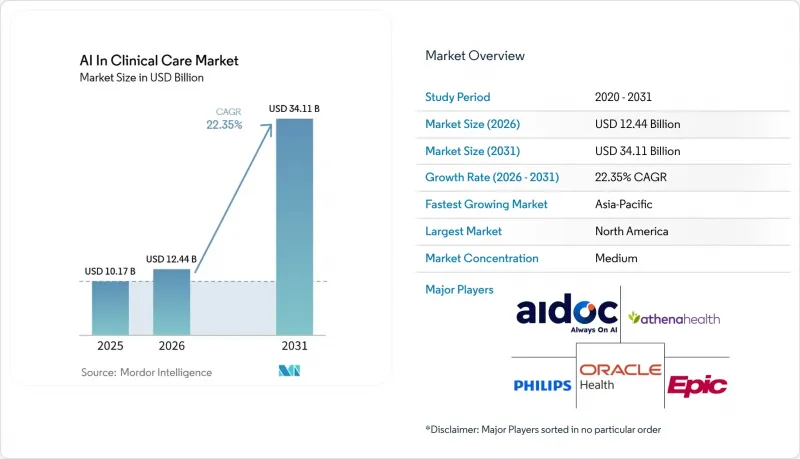
Mordor Intelligence에 의하면, 임상 케어 분야 AI 시장 규모는 2025년 101억 7,000만 달러로 평가되었습니다. 2026년에는 124억 4,000만 달러로 확대되어 2031년까지 341억 1,000만 달러에 이를 것으로 예상되고 2026년부터 2031년에 걸쳐 CAGR 22.35%로 성장할 전망입니다.
본 보고서는 구성 요소(소프트웨어 및 서비스), 배포 방식(클라우드 기반 및 On-Premise형), 주요 AI 모달리티(머신러닝, 자연어 처리 등), 용도(의료 진단 등), 최종 사용자(병원 및 진료소, 연구 기관·학술 기관 등), 지역(북미, 유럽, 아시아태평양 등)별로 분류되어 있습니다. 시장 전망은 금액(달러)으로 표시되어 있습니다.
세계의 임상 케어 분야 AI 시장 동향 및 인사이트
EHR에 통합된 AI 임상 의사결정 지원의 확대
임상 케어 분야 AI 시장은 임상의의 일반적인 EHR 워크플로우 외부에서가 아니라 그 내부에서 작동하는 도구로의 전환으로 인해 혜택을 보고 있습니다. 2026년 『Scientific Reports』지에 게재된 연구에서는 AIDx를 EHR에서 환자의 맥락을 파악하고, 사용자의 기본 환경 내에서 구조화된 권장 사항을 생성하는 로컬로 배포 가능한 시스템으로 설명하고 있습니다. 이는 기술적 성능이 뛰어나더라도 오랫동안 임상 소프트웨어의 실제 활용을 제한해 온 화면 간 전환을 줄인다는 점에서 중요한 의미를 지닙니다. 『Nature Medicine』지에 게재된 실용적인 클러스터 무작위 대조 시험에서도, 1차 진료에서 생성형 AI를 활용한 의사결정 지원이 지침 준수율을 향상시켰음이 밝혀졌으며, 이는 일상적인 진료 현장에서의 보다 광범위한 도입을 뒷받침하는 것입니다. 많은 의료 시스템에서 기술적 과제는 더 이상 주요 장벽이 아니지만, 거버넌스, 교육 및 정책에 대한 인식이 도입 확대에 있어 더 어려운 과제로 대두되고 있습니다. 2026년 시점에서 조직의 공식적인 AI 정책을 인지하고 있는 임상의는 불과 27%에 그치고 있습니다.
앰비언트 임상 문서화를 통한 번아웃 완화
임상 케어 분야 AI 시장은 앰비언트 문서화의 강력한 상업적 근거에 힘입어 성장하고 있습니다. 미국의 6개 의료 시스템을 대상으로 한 다기관 공동 품질 개선 연구에 따르면, 30일 동안 앰비언트 AI 스크라이브를 활용함으로써 임상의의 번아웃 비율이 51.9%에서 38.8%로 감소했을 뿐만 아니라, 인지적 업무 부하와 근무 시간 외 문서 작성 시간도 개선된 것으로 나타났습니다. 매사추세츠 종합병원·브리검(Mass General Brigham)은 2025년 4월까지 이 프로그램의 대상자를 3,000명 이상의 의료 제공업체로 확대했으며, 84일간의 운영 기간 동안 번아웃이 21.2% 절대적으로 감소했다고 보고하여, 이를 통해 의료 시스템에 구체적인 도입 모델이 제시되었습니다. 또한, 2026년 6월 Abridge사가 자사 플랫폼이 진료 기록, 보험사용 워크플로우, 근거 기반 치료를 연계하여 300개 이상의 의료 시스템에 도입되었으며, 연간 1억 건 이상의 임상 대화를 지원하고 있다고 발표함에 따라 상용 모델도 확대되고 있습니다. 이로써 가치 제안은 단순한 기록 지원에서 엔터프라이즈 수준의 임상 인텔리전스로 전환되어, 더 대규모의 계약과 더 심층적인 시스템 통합이 가능해집니다.
데이터 개인정보 보호, 사이버 보안 및 AI 거버넌스의 부담
임상 케어 분야 AI 시장은 모든 도입의 중심에 보호 대상인 의료 데이터가 존재하기 때문에 여전히 큰 신뢰의 부담에 직면해 있습니다. 2025년에는 HHS OCR의 데이터 유출 포털에 게시된 대규모 의료 데이터 유출 사건이 역대 최다인 772건에 달했으며, 병원 구매 담당자들에게 사이버 보안 위험은 여전히 높은 수준을 유지하고 있습니다. 감사 추적, 역할 기반 접근 제어, 지속적인 모니터링을 갖춘 HIPAA 준수 아키텍처를 구축하는 벤더는 규제가 엄격한 환경에서 우위를 점하지만, 이러한 통제 조치는 제품 비용을 상승시키고 조달 주기를 장기화하는 요인이 되기도 합니다. 2026년 시점에서 조직의 AI 정책에 대한 임상의의 인지도는 불과 27%에 그치고 있으므로, 문서상의 형식적인 거버넌스만으로는 문제를 완전히 해결할 수 없습니다. 기반 기술이 갖춰져 있더라도, 기업 차원의 통제와 현장의 행동 사이에 발생하는 이러한 격차가 도입 지연을 초래할 가능성이 있습니다.
부문 분석
2025년에는 소프트웨어가 매출의 72.34%를 차지했으며, 구성 요소별로 볼 때 임상 케어 분야 AI 시장 규모에서 가장 큰 비중을 차지했습니다. 클라우드 업데이트 한 번으로 많은 병원 사용자에게 동시에 배포할 수 있다는 점과, 구독 방식의 가격 책정이 고가의 일괄 구매보다 의료기관의 연간 예산 편성에 적합하다는 점에서 그 규모적 우위는 분명합니다. 이에 따라 대규모 인프라 변경 없이 임상 AI를 도입하고자 하는 병원에게 소프트웨어는 가장 신속한 수단이 되고 있습니다. 임상 케어 분야 AI 업계에서 소프트웨어는 릴리스 주기가 짧다는 장점도 있어, 벤더는 모델과 인터페이스를 지속적으로 개선할 수 있습니다.
서비스 부문은 2031년까지 연평균 성장률(CAGR) 23.56%를 나타낼 것으로 예측되며, 가장 빠르게 성장하는 구성 요소가 되고 있습니다. 도입 범위가 초기 라이선싱을 훨씬 뛰어넘게 되면서, 구매자들은 재훈련, 통합, 감사, 거버넌스 지원을 포함한 관리형 AI 서비스로의 전환을 추진하고 있습니다. 미국 의사협회(AMA)는 2026년에 의사의 75% 이상이 AI를 환자 치료에 대한 이점으로 인식하고 있다고 발표했습니다. 이는 2023년의 65%에서 증가한 수치로, 조직 내 추진자들이 이러한 장기 서비스 계약을 뒷받침하는 요인 중 하나가 되고 있습니다. 이러한 변화는 많은 의료 시스템이 단순히 소프트웨어에 대한 접근 권한뿐만 아니라, 성과 및 모델 성능에 대한 설명 책임을 요구하고 있음을 시사합니다. 실무적인 관점에서 볼 때, 임상 케어 분야 AI 시장이 성숙해짐에 따라 서비스는 공급업체가 이익률을 유지하기 위한 기반이 되고 있습니다.
2025년 매출액 중 클라우드 기반 시스템이 68.43%를 차지했으며, 도입 형태별로는 임상 케어 분야 AI 시장에서 가장 큰 점유율을 기록했습니다. 이러한 선두 위상은 초기 투자 비용이 적고, 도입이 신속하며, 분산형 진료 환경에 쉽게 대응할 수 있다는 점을 반영합니다. 또한, 클라우드를 통한 제공 방식은 지속적인 업데이트, 통합 모니터링, 그리고 여러 거점에 걸친 의료 시스템으로의 확장이라는 제품의 논리와도 부합합니다. 많은 구매자에게 있어 이러한 속도와 비용 관리의 균형 덕분에 클라우드는 임상 케어 분야 AI 시장의 기본 조달 수단으로 자리 잡고 있습니다.
On-Premise 도입은 2031년까지 연평균 성장률(CAGR) 24.91%를 나타낼 것으로 예측되며, 도입 규모는 작지만 가장 빠르게 확대되고 있는 모델입니다. 그 원동력은 도입 규모에만 그치지 않고, 기밀성이 높은 임상 환경에서 데이터 경계, 감독, 규정 준수 워크플로우를 보다 엄격하게 관리할 수 있다는 점에 있습니다. 따라서 거버넌스 요구 사항이 높거나 인프라 규정이 엄격한 경우, 일부 의료 제공업체는 On-Premise 도입에 더 높은 비용을 지불하는 것을 수용하고 있습니다. 따라서 현재 매출 기준으로는 클라우드가 임상 케어 분야 AI 시장 점유율을 여전히 지배하고 있지만, On-Premise형 시스템은 전략적으로 중요한 위치를 차지하고 있습니다. 두 모델 모두에서 유사한 기능을 제공할 수 있는 벤더는 하이브리드형 의료 시스템 계약을 수주하는 데 유리한 입장에 있습니다.
지역별 분석
북미는 2025년 매출의 39.47%를 차지하며, 임상 케어 분야 AI 시장에서 가장 규모가 큰 지역 점유율을 기록했습니다. 이 지역이 주도적인 위치를 차지한 이유는 EHR(전자건강기록)과 연동된 병원 시스템의 도입 기반이 잘 갖춰져 있고, 임상 AI에 관한 규제 체계가 성숙해 있으며, 보험 환급을 위한 노력이 조기에 시작되었기 때문입니다. 2026년 1월 기준으로, 임상 AI 솔루션에는 26개의 CPT 코드가 존재하며, 그 중에는 심혈관 위험 및 당뇨병성 망막병증을 평가하는 도구를 위한 카테고리 I 코드가 3개 포함되어 있습니다. 이러한 코딩 기반은 병원에 대한 지급 및 도입을 위한 보다 명확한 로드맵을 제시함으로써 의료 제공업체의 불확실성을 줄이는 데 도움이 됩니다. 보험 적용 범위 확대도 중요한데, HeartFlow는 2026년 1월 자사의 플라크 분석 도구가 Aetna의 모든 사업 부문에서 보험 적용 대상이 되었다고 발표하며, 또 다른 대형 전국 보험사를 통해 접근성을 확대했습니다.
아시아태평양은 가장 빠르게 성장하는 지역으로, 2031년까지 연평균 성장률(CAGR)이 27.94%를 나타낼 것으로 예측됩니다. 이는 임상 케어 분야 AI 시장이 가장 성숙한 거점 밖에서 얼마나 빠르게 확장되고 있는지를 보여줍니다. 이 지역의 성장은 디지털 헬스 분야에 대한 적극적인 투자, AI를 활용한 의료 서비스 제공에 대한 수용성 증가, 그리고 임상 역량을 확대하려는 실질적인 필요성을 반영하고 있습니다. 또한, 이 지역의 많은 시스템이 기존의 레거시 환경을 개조하는 대신 새로운 디지털 계층을 구축하고 있다는 점도 AI 도입을 뒷받침하고 있습니다. 이로 인해 임상 워크플로우를 현지 상황에 맞게 최적화하고 지역 정책 요건을 충족시킬 수 있는 AI 공급업체에게 시장 기회가 창출되고 있습니다. 그 결과, 아시아태평양은 임상 케어 분야 AI 시장에서 가장 중요한 성장 거점 중 하나로 부상하고 있습니다.
유럽은 독일, 영국, 프랑스가 계속해서 조달 및 검증 활동의 중심이 되고 있기 때문에 임상 케어 분야 AI 시장 규모 측면에서 여전히 중요한 수익원으로 자리 잡고 있습니다. 독일의 KHZG 병원 디지털화 프로그램은 병원 IT 현대화에 43억 유로를 투자하고 있으며, 이는 임상 AI 구매를 위한 확실한 파이프라인을 뒷받침하고 있습니다. 영국의 NHS AI Lab은 영상 진단 및 병리 진단 분야로의 도입을 지속적으로 지원하고 있으며, 이를 통해 벤더들은 공공 의료 시스템에 체계적으로 진입할 수 있는 경로를 확보하고 있습니다. 유럽 이외의 지역에서는 중동 및 아프리카이 각국 정부의 디지털 헬스 투자에 힘입어 소규모 기반에서 지속적으로 확대되고 있는 반면, 남미에서는 디지털 헬스의 현대화 및 가치 기반 의료 모델에 대한 관심이 높아짐에 따라 점차 탄력을 받고 있습니다.
기타 혜택 :
- 엑셀 형식 시장 예측(ME) 시트
- 3개월간의 애널리스트 지원
자주 묻는 질문
목차
제1장 서론
제2장 조사 방법
제3장 주요 요약
제4장 시장 구도
제5장 시장 규모 및 성장 예측
제6장 경쟁 구도
제7장 시장 기회 및 향후 전망
KTH 26.08.10According to Mordor Intelligence, the AI in clinical care market size is expected to increase from USD 10.17 billion in 2025 to USD 12.44 billion in 2026 and reach USD 34.11 billion by 2031, growing at a CAGR of 22.35% over 2026-2031.
This report is Segmented by Component (Software and Services), Deployment Mode (Cloud-Based and On-Premise), Primary AI Modality (Machine Learning, Natural Language Processing, and More), Application (Medical Diagnosis and More), End User (Hospitals & Clinics, Research & Academic Institutes, and More), and Geography (North America, Europe, Asia-Pacific and More). The Market Forecasts are Provided in Value (USD).
Global AI In Clinical Care Market Trends and Insights
Expansion of EHR-Embedded AI Clinical Decision Support
The AI in clinical care market is benefiting from the shift toward tools that work inside the clinician's normal EHR workflow rather than outside it. A 2026 study in Scientific Reports described AIDx as a locally deployable system that retrieves patient context from the EHR and produces structured recommendations inside the user's native environment. That matters because it reduces switching between screens, which has long limited the real use of clinical software even when technical performance was strong. A pragmatic cluster-randomized trial published in Nature Medicine also showed that generative AI-enabled decision support in primary care improved guideline adherence, which supports broader rollout in routine care settings. Technology is no longer the main barrier in many health systems, while governance, training, and policy awareness have become the harder part of scaling adoption, with only 27% of clinicians aware of a formal organizational AI policy in 2026.
Burnout Relief Via Ambient Clinical Documentation
The AI in clinical care market is also being lifted by the strong commercial case for ambient documentation. A multicenter quality improvement study across 6 U.S. health systems found that 30 days of ambient AI scribe use reduced clinician burnout from 51.9% to 38.8%, while also improving cognitive task load and after-hours documentation time. Mass General Brigham expanded its program to more than 3,000 providers by April 2025 and reported a 21.2% absolute reduction in burnout at 84 days, which gave health systems a concrete deployment model. The commercial model is also widening because Abridge said in June 2026 that its platform connected documentation, payer workflows, and evidence-based treatment and was deployed across more than 300 health systems supporting over 100 million annual clinical conversations. This moves the value proposition from narrow scribing into enterprise clinical intelligence, which supports larger contracts and deeper system integration.
Data Privacy, Cybersecurity, and AI Governance Burden
The AI in clinical care market still faces a heavy trust burden because protected health data sits at the center of every deployment. Healthcare data breaches reached a record 772 large incidents listed on the HHS OCR breach portal in 2025, which kept cybersecurity risk high for hospital buyers. Vendors that build HIPAA-ready architectures with audit trails, role-based access, and continuous monitoring hold an advantage in regulated environments, but those controls also raise product cost and lengthen procurement cycles. Formal governance on paper does not fully solve the issue because clinician awareness of organizational AI policy remained only 27% in 2026. This gap between enterprise controls and frontline behavior can slow deployment even when the underlying technology is ready.
Other drivers and restraints analyzed in the detailed report include:
- Need to Cut Diagnostic Errors and Care Variation
- Value-Based Care and Precision-Treatment Economics
- Workflow Integration Friction and Alert-Fatigue Risk
For complete list of drivers and restraints, kindly check the Table Of Contents.
Segment Analysis
Software held 72.34% of revenue in 2025, which made it the largest part of the AI in clinical care market size by component. The scale advantage is clear because one cloud update can reach many hospital users at once, while subscription pricing fits annual provider budgeting better than large one-time purchases. This has made software the fastest route for hospitals that want to adopt clinical AI without a major infrastructure change. In the AI in clinical care industry, software also benefits from shorter release cycles that let vendors improve models and interfaces continuously.
Services are projected to grow at 23.56% CAGR through 2031, which makes them the fastest-growing component. Buyers are moving toward managed AI relationships that include retraining, integration, auditing, and governance support because deployment now extends far beyond initial licensing. The American Medical Association said in 2026 that more than 75% of physicians saw AI as offering a patient-care advantage, up from 65% in 2023, which helps internal champions support these longer service engagements. This shift suggests that many health systems now want accountability for outcomes and model performance, not only access to software. In practical terms, services are becoming the layer that helps vendors defend margins as the AI in clinical care market matures.
Cloud-based systems commanded 68.43% of 2025 revenue and represented the largest share of the AI in clinical care market by deployment mode. Their lead reflects lower upfront capital needs, faster implementation, and easier support for distributed care settings. Cloud delivery also fits the product logic of continuous updates, centralized monitoring, and multi-site health system rollout. For many buyers, that mix of speed and cost control keeps cloud as the default procurement path in the AI in clinical care market.
On-premise deployment is forecast to grow at 24.91% CAGR through 2031, which makes it the fastest-moving model despite its smaller base. The driver is not volume alone, but the tighter control it offers over data perimeters, oversight, and compliance workflows in sensitive clinical environments. This is why some providers accept a premium for on-premise deployment when governance demands are high or infrastructure rules are strict. On-premise systems, therefore, hold a strategically important place even though cloud still dominates the AI in clinical care market share in current revenue terms. Vendors that can deliver similar functionality across both models are better positioned to win hybrid health system contracts.
Complete Report Scope:
- By Component
- Software
- Services
- By Deployment Mode
- Cloud-Based
- On-Premise
- By Primary AI Modality
- Machine Learning
- Natural Language Processing
- Computer Vision
- Generative AI
- By Application
- Medical Diagnosis
- Treatment Planning and Personalization
- Patient Monitoring and Early Warning
- Alerts, Reminders, and Risk Prediction
- Others
- By End User
- Hospitals & Clinics
- Research & Academic Institutes
- Pharmaceutical & Biotechnology Companies
- Others
- By Geography
- North America
- United States
- Canada
- Mexico
- Europe
- Germany
- United Kingdom
- France
- Italy
- Spain
- Rest of Europe
- Asia-Pacific
- China
- India
- Japan
- Australia
- South Korea
- Rest of Asia-Pacific
- Middle East and Africa
- GCC
- South Africa
- Rest of Middle East and Africa
- South America
- Brazil
- Argentina
- Rest of South America
- North America
Geography Analysis
North America held 39.47% of 2025 revenue, which gave it the largest regional position in the AI in clinical care market. The region leads because it has a dense installed base of EHR-connected hospital systems, a mature regulatory path for clinical AI, and early movement on reimbursement. As of January 2026, 26 CPT codes existed for clinical AI solutions, including 3 Category I codes for tools that assess cardiovascular risk and diabetic retinopathy. That coding base helps reduce provider uncertainty because it gives hospitals a clearer route to payment and adoption. Coverage expansion also matters, and HeartFlow said in January 2026 that its Plaque Analysis tool had gained Aetna coverage across all lines of business, extending access through another major national insurer.
Asia-Pacific is the fastest-growing region with a projected 27.94% CAGR through 2031, which shows how quickly the AI in clinical care market is widening outside its most mature bases. The region's growth reflects strong digital health investment, rising openness to AI-enabled care delivery, and a practical need to stretch clinical capacity. Adoption also benefits from the fact that many systems in the region are building new digital layers now rather than modifying older legacy environments. This creates room for AI vendors that can localize clinical workflows and meet regional policy expectations. The result is that Asia-Pacific is becoming one of the most important expansion corridors in the AI in clinical care market.
Europe remains a significant revenue contributor to the AI in clinical care market size because Germany, the United Kingdom, and France continue to anchor procurement and validation activity. Germany's KHZG hospital digitalization program has directed EUR 4.3 billion into hospital IT modernization, which supports a real pipeline for clinical AI buying. The United Kingdom's NHS AI Lab continues to back imaging and pathology deployments, which gives vendors a structured entry path into public system use. Beyond Europe, the Middle East and Africa region is expanding from a smaller base through sovereign digital health investment, while South America is building gradual momentum through digital health modernization and interest in value-based care models.
- Abridge AI, Inc.
- Aidoc Medical Ltd.
- Athenahealth
- Bayesian Health, Inc.
- Epic Systems
- GE HealthCare Technologies Inc.
- HeartFlow, Inc.
- iSchemaView, Inc. (RapidAI)
- Koninklijke Philips
- Logical Images, Inc. (VisualDx)
- Medical Information Technology, Inc. (MEDITECH)
- Merative, L.P.
- Microsoft
- Oracle
- PathAI, Inc.
- Qure.AI Technologies Pvt. Ltd.
- Siemens Healthineers
- Tempus AI, Inc.
- Veradigm
- Viz.AI, Inc.
Additional Benefits:
- The market estimate (ME) sheet in Excel format
- 3 months of analyst support
TABLE OF CONTENTS
1 Introduction
- 1.1 Study Assumptions & Market Definition
- 1.2 Scope of the Study
2 Research Methodology
3 Executive Summary
4 Market Landscape
- 4.1 Market Overview
- 4.2 Market Drivers
- 4.2.1 Expansion of EHR-embedded AI Clinical Decision Support
- 4.2.2 Burnout Relief via Ambient Clinical Documentation
- 4.2.3 Need to Cut Diagnostic Errors and Care Variation
- 4.2.4 Value-based Care and Precision-treatment Economics
- 4.2.5 Deployment of FDA-cleared Imaging and Triage AI in Frontline Care
- 4.2.6 Multilingual Specialty-tuned Clinical AI for Underserved Settings
- 4.3 Market Restraints
- 4.3.1 Data Privacy, Cybersecurity, and AI Governance Burden
- 4.3.2 Workflow Integration Friction and Alert-fatigue Risk
- 4.3.3 Payer Downcoding and Reimbursement Recalibration of AI-Enabled Documentation
- 4.3.4 Model Drift, Monitoring Gaps, and liability exposure
- 4.4 Value / Supply-Chain Analysis
- 4.5 Regulatory Landscape
- 4.6 Technological Outlook
- 4.7 Porter's Five Forces Analysis
- 4.7.1 Threat of New Entrants
- 4.7.2 Bargaining Power of Buyers
- 4.7.3 Bargaining Power of Suppliers
- 4.7.4 Threat of Substitutes
- 4.7.5 Competitive Rivalry
5 Market Size & Growth Forecasts (Value, USD)
- 5.1 By Component
- 5.1.1 Software
- 5.1.2 Services
- 5.2 By Deployment Mode
- 5.2.1 Cloud-Based
- 5.2.2 On-Premise
- 5.3 By Primary AI Modality
- 5.3.1 Machine Learning
- 5.3.2 Natural Language Processing
- 5.3.3 Computer Vision
- 5.3.4 Generative AI
- 5.4 By Application
- 5.4.1 Medical Diagnosis
- 5.4.2 Treatment Planning and Personalization
- 5.4.3 Patient Monitoring and Early Warning
- 5.4.4 Alerts, Reminders, and Risk Prediction
- 5.4.5 Others
- 5.5 By End User
- 5.5.1 Hospitals & Clinics
- 5.5.2 Research & Academic Institutes
- 5.5.3 Pharmaceutical & Biotechnology Companies
- 5.5.4 Others
- 5.6 By Geography
- 5.6.1 North America
- 5.6.1.1 United States
- 5.6.1.2 Canada
- 5.6.1.3 Mexico
- 5.6.2 Europe
- 5.6.2.1 Germany
- 5.6.2.2 United Kingdom
- 5.6.2.3 France
- 5.6.2.4 Italy
- 5.6.2.5 Spain
- 5.6.2.6 Rest of Europe
- 5.6.3 Asia-Pacific
- 5.6.3.1 China
- 5.6.3.2 India
- 5.6.3.3 Japan
- 5.6.3.4 Australia
- 5.6.3.5 South Korea
- 5.6.3.6 Rest of Asia-Pacific
- 5.6.4 Middle East and Africa
- 5.6.4.1 GCC
- 5.6.4.2 South Africa
- 5.6.4.3 Rest of Middle East and Africa
- 5.6.5 South America
- 5.6.5.1 Brazil
- 5.6.5.2 Argentina
- 5.6.5.3 Rest of South America
- 5.6.1 North America
6 Competitive Landscape
- 6.1 Market Concentration
- 6.2 Market Share Analysis
- 6.3 Company Profiles (includes Global Level Overview, Market Level Overview, Core Segments, Financials as Available, Strategic Information, Market Rank/Share for Key Companies, Products & Services, and Recent Developments)
- 6.3.1 Abridge AI, Inc.
- 6.3.2 Aidoc Medical Ltd.
- 6.3.3 athenahealth, Inc.
- 6.3.4 Bayesian Health, Inc.
- 6.3.5 Epic Systems Corporation
- 6.3.6 GE HealthCare Technologies Inc.
- 6.3.7 HeartFlow, Inc.
- 6.3.8 iSchemaView, Inc. (RapidAI)
- 6.3.9 Koninklijke Philips N.V.
- 6.3.10 Logical Images, Inc. (VisualDx)
- 6.3.11 Medical Information Technology, Inc. (MEDITECH)
- 6.3.12 Merative, L.P.
- 6.3.13 Microsoft Corporation
- 6.3.14 Oracle Corporation
- 6.3.15 PathAI, Inc.
- 6.3.16 Qure.ai Technologies Pvt. Ltd.
- 6.3.17 Siemens Healthineers AG
- 6.3.18 Tempus AI, Inc.
- 6.3.19 Veradigm LLC
- 6.3.20 Viz.ai, Inc.
7 Market Opportunities & Future Outlook
- 7.1 White-space & Unmet-need Assessment


