

|
시장보고서
상품코드
2072854
미국의 심부전 POC 및 LOC 기기 시장 : 시장 점유율 분석, 업계 동향 및 통계, 성장 예측(2026-2031년)United States Heart Failure POC and LOC Devices - Market Share Analysis, Industry Trends & Statistics, Growth Forecasts (2026 - 2031) |
||||||
 Mordor Intelligence
Mordor Intelligence에 의하면, 미국의 심부전 POC 및 LOC 기기 시장 규모는 2025년 7,529만 달러로 평가되었고, 2026년 8,402만 달러로 추정되고, 2031년까지 1억 5,297만 달러로 확대될 것으로 예측되며, 2026-2031년 연평균 복합 성장률(CAGR)은 12.73%를 나타낼 전망입니다.
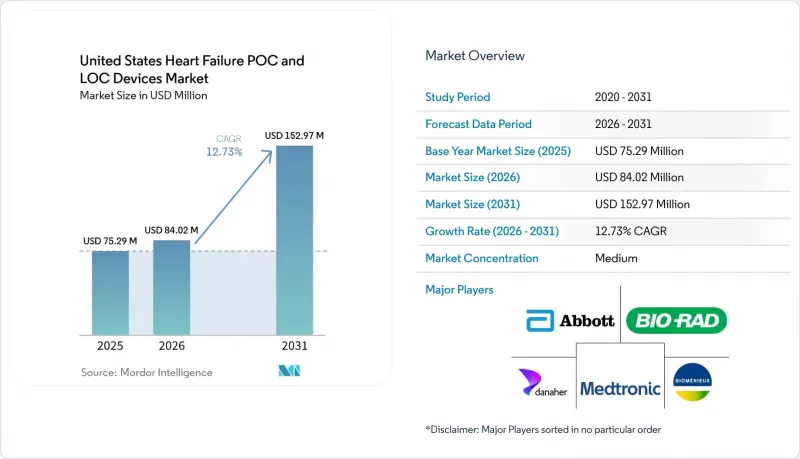
본 보고서는 기기 유형별(POC, LOC), 검사 유형별(단백질체학, 대사체학, 유전체학), 기술별(마이크로플루이딕스, 어레이 기반), 바이오마커별(NT-proBNP/BNP, 트로포닌, 다중 바이오마커 패널), 용도별(급성 심부전 진단, 만성 심부전 모니터링, 위험도 계층화), 최종 사용자별(병원, 전문 의료 센터 등)로 분류되어 있습니다. 시장 전망은 금액(달러) 기준으로 제시되어 있습니다.
미국의 심부전 POC 및 LOC 기기 시장 동향 및 인사이트
환자 거주지 인근에서 실시되는 나트륨 이뇨 펩타이드 검사에 대한 메디케어 적용 범위 확대
2026년 2월 15일부터 시행되는 메디케어 개정판 LCD L34410에서는 BNP 및 NT-proBNP에 관한 파트 A와 파트 B의 적용 범위가 통합되어, 응급실 및 외래 진료 현장에서의 급성 호흡곤란 평가, 중증도 판정, 그리고 위험도 계층화를 위한 보다 명확한 체계가 확립되었습니다. 이러한 변경 사항은 동일한 의료 시스템 구조 하에서 병원 및 외래 진료 시설을 아우르며 운영되는 의료 제공업체들에게 청구상의 모호성을 줄여주기 때문에 심부전 POC 및 LOC 기기 시장에 중요한 의미를 지닙니다. CMS는 환자 근접형 BNP 검사의 보험 급여액을 검사 1회당 24달러로 인상하고, 메디케어 어드밴티지 플랜의 사전 승인 요건을 폐지했습니다. 이를 통해 진료소 및 응급 치료 시설의 수익성이 향상됩니다. 이 조치의 직접적인 혜택을 받는 것은 CLIA 면제 대상인 전혈 BNP 검사 방식입니다. 이는 혈액 제제 처리에 드는 수고를 덜어주고, 중증도가 낮은 시설의 인력 요건을 줄일 수 있기 때문이며, 이러한 특징은 QuidelOrtho Triage BNP 검사와 일치합니다. 이는 미국의 대규모 진료소에 있어 특히 중요한 의미를 지닙니다. 그곳에서는 예전부터 임상적 수요가 존재했으나, 시설마다 보상 기준이 통일되어 있지 않았기 때문입니다. 그 결과, 본격적인 검사실을 갖추지 않고도 심장 질환에 대한 양성 및 음성 판정을 신속하게 내리는 데 지원이 필요한 분산형 검사 시설에 대해 보다 명확한 상업적 방향성이 제시되었습니다.
클리닉 및 응급 진료 시설에서의 CLIA 면제 BNP 검사 분산화
FDA의 검사 면제 목록에 따르면, 선정된 BNP 플랫폼이 CLIA 면제 인증을 획득했으며, 이에 따라 기존 실험실 이외의 장소에서 실시되는 나트륨 이뇨 펩타이드 검사의 인력 배치 및 도입 비용 측면에서 경제성이 달라졌습니다. 이러한 발전은 보다 복잡한 운영에 대응할 수 없는 진료소, 응급 치료 센터, 소매점과 연계된 의료시설에서의 검사를 가능하게 함으로써, 심부전 POC 및 LOC 기기 시장을 견인하고 있습니다. 실질적인 효과로, 1차 진료 의사는 치료 방침을 결정하기 전에 환자를 시간이 많이 소요되는 의뢰 절차로 넘기지 않고, 진료 중에 BNP 검사 결과를 확인할 수 있게 됩니다. 소매점이나 지역 의료 현장에서 손가락 채혈을 통한 BNP 및 NT-proBNP 검사 워크플로는 병원의 조달 절차와는 별개의 경로를 마련하여, 조기 평가를 위한 접근 경로를 확대합니다. 2026년 ICare-FASTER 프리프린트에서는 극소량의 모세혈관 검체를 처리할 수 있는 분석 기술의 발전이 보고되었습니다. 검체량이 적기 때문에 분산형 손가락 채혈 워크플로우를 대규모로 도입하는 것이 현실적으로 가능해지므로, 이는 중요한 점입니다. 따라서, 면제 체계는 규정 준수를 간소화하는 데 그치지 않고, 높은 성능을 유지하면서 조작 과정을 간소화하는 의료기기를 평가함으로써 제품 설계의 우선순위를 정하는 역할도 수행하고 있습니다.
중간 수준의 복잡성 분류가 광범위한 분산형 도입을 제한하고 있습니다.
CLIA 면제 조치는 일부 BNP 측정법에는 도움이 되었지만, 가장 고성능인 NT-proBNP 분석법 중 상당수는 여전히 면제 대상에서 제외되어 있어, 분산형 의료 현장에서 사용되기 위해서는 보다 엄격한 감독이 필요합니다. 이로 인해 심부전 POC(현장 진단) 및 LOC(현장 검사) 기기 시장에서 실용적인 측면에서 불일치가 발생하고 있습니다. 왜냐하면, 접근성 격차가 가장 큰 시설은 대개 중간 정도의 복잡성을 감당할 수 있는 인프라가 부족한 시설과 겹치기 때문입니다. 미국 응급치료센터의 75%는 추가 인력 배치나 규정 준수 관련 투자 없이 이러한 검사를 수행하는 데 필요한 인증 체계를 갖추지 못하고 있으며, 이로 인해 병원 관련 네트워크 외에서의 도입이 직접적으로 제한되고 있습니다. 이러한 장벽은 병원이 소유한 응급 치료 시설의 경우 비교적 대처하기 쉬운 임베디드니다. 왜냐하면 이러한 시설들은 이미 기존의 품질 관리 시스템과 감독 체제 하에서 운영되고 있기 때문입니다. 한편, 독립 체인이나 지역 의료 제공업체들은 인증 기준을 상향 조정할지, 아니면 성능이 낮은 검사 옵션을 수용할지라는 어려운 선택에 직면해 있습니다. 그 결과, 장비의 분석 성능만으로는 예상되는 것보다 광범위한 분산화로의 전환이 더디게 진행되고 있습니다.
부문별 분석
2025년, 심부전 POC 및 LOC 기기 시장에서 POC 기기는 64.23%의 점유율을 차지했습니다. 이는 응급실 및 급성기 의료의 업무 흐름에서 POC 기기가 수년에 걸쳐 확립된 역할을 수행해 왔음을 반영하는 것으로, 해당 분야에서는 BNP 및 트로포닌 검사가 이미 검증된 보험 급여 및 프로토콜 체계에 포함되어 있습니다. 병원들은 일상적인 심장 검사와 관련된 분석 장비, 시약 계약, 직원 교육, EHR(전자건강기록) 연동에 이미 투자한 상태이기 때문에 이러한 시스템을 교체하는 것은 여전히 어렵습니다. Siemens, QuidelOrtho, Radiometer는 이러한 기존 도입 기반의 효과를 누리고 있습니다. 왜냐하면, 기기 교체에는 단순한 제품 교환뿐만 아니라 운영상의 변경이 필요하기 때문입니다. 실제로 POC 부문은 완전한 소형화보다는 속도, 익숙한 조작 방식, 감사에 대응할 수 있는 워크플로우가 중시되는 긴급성이 더 높은 의료 현장에서 여전히 지배적인 위치를 차지하고 있습니다. 따라서, 심부전 POC 및 LOC 기기 업계에서 기기 유형별 구성 비율은 임상적 성능과 기존 병원 운영 방식을 변경하는 데 드는 비용 모두를 반영하고 있습니다.
LOC 기기는 2031년까지 연평균 성장률(CAGR) 13.25%를 나타낼 것으로 예측되며, 심부전 POC 및 LOC 기기 시장에서 가장 빠르게 성장하는 기기 분류가 될 것입니다. 그 주요 장점은 병원의 분석 장비를 즉시 대체하는 것이 아니라, 기존 시스템으로는 충분히 다루지 못했던 진료소, 응급 치료, 퇴원 후 사후 관리, 재택 연계 모니터링과 같은 분야에 진출하는 데 있습니다. 2026년 『네이처(Nature)』지에 발표된 듀얼 모드 다중 광학 센싱에 관한 연구에 따르면, 소형화된 플랫폼이 컴팩트한 형태임에도 불구하고 매우 높은 분석 감도를 실현하고 있는 것으로 나타났으며, 이는 LOC의 확대 가능성을 뒷받침하고 있습니다. 애보트(Abbott)의 i-STAT Alinity 카트리지와 지멘스(Siemens)의 Atellica VTLi는 시판 제품들이 이미 컴팩트한 설계와 임상적으로 허용 가능한 검사 소요 시간 사이의 격차를 해소하고 있음을 보여줍니다. 성능의 동등성이 향상됨에 따라, LOC 디바이스는 우선 신규 시장에서 수요 증가를 이끌어낸 뒤, 예측 기간 후반에는 응급 의료 분야에서 보다 직접적인 경쟁을 펼칠 가능성이 높을 것으로 보입니다.
2025년에는 단백질체학 검사가 검사 유형별 매출의 51.23%를 차지했으며, 심부전 POC 및 LOC 기기 시장에서 가장 큰 검사 부문이 되었습니다. 이는 BNP, NT-proBNP, 트로포닌 검사가 이미 임상적 실적을 쌓았으며, 보험 급여 체계가 마련되어 있고, 다양한 분석 장비와 호환성이 확보되어 있기 때문입니다. 병원, 보험사, 인증 기관은 이미 확립된 기준치와 오랜 임상 사용 실적을 갖춘 검사법에 대해 더 큰 신뢰감을 가지고 있기 때문에 이 부문은 계속해서 수익의 주축을 이루고 있습니다. FDA 승인을 받은 단백질체학 검사는 감사, 이용 현황 검토 및 치료 단계적 강화에 관한 결정을 내릴 때 그 타당성을 입증하는 문서화를 지원하기 때문에 임상 업무에서 특히 가치가 있습니다. 나트륨 이뇨 펩타이드에 관한 풍부한 결과 근거와 새로운 검사 방식의 등장에도 불구하고, 이 부문이 여전히 중심적인 위치를 차지하는 요인이 되고 있습니다. 이러한 이유로, 단백질체학는 중기적으로 심부전 POC 및 LOC 기기 업계의 상업적 중심지로서의 위치를 유지할 가능성이 높다고 볼 수 있습니다.
대사체학 검사는 2031년까지 연평균 성장률(CAGR) 15.97%를 나타낼 것으로 예측되며, 심부전 POC 및 LOC 기기 시장에서 가장 빠르게 성장하는 검사 부문이 될 전망입니다. 2025년 『Scientific Reports』에 발표된 보고서에 따르면, 혈장 내 대사 지표를 통해 심부전의 표현형을 높은 모델 정확도로 구별할 수 있는 것으로 밝혀졌으며, 이에 따라 이 분야는 불과 몇년전과 비교해 더욱 명확한 임상적 역할을 수행하게 되었습니다. 또한, 『International Journal of Molecular Sciences』지는 고혈압 환자에서 HFpEF와 ADMA, TMAO, 아실카르니틴 간의 연관성을 보고했습니다. HFpEF의 경우 지금까지 간편한 확정 진단을 위한 현장 진단 마커가 부족했기 때문에 이 연구 결과는 특히 중요합니다. 이를 통해 대사체학은 진단뿐만 아니라, 기존의 나트륨 이뇨 펩타이드만으로는 충분하지 않은 경우도 있는 아형의 세분화 및 치료 반응 추적 측면에서도 귀중한 수단이 됩니다. 유전체 검사는 여전히 적용 범위가 제한적이며, 주로 학술 기관에 집중되어 있기 때문에 2031년까지는 단백질체학나 대사체학에 비해 상업적 기여도가 낮은 수준을 유지할 것으로 예측됩니다.
기타 혜택 :
- 엑셀 형식 시장 예측(ME) 시트
- 3개월간의 애널리스트 지원
자주 묻는 질문
목차
제1장 서론
제2장 조사 방법
제3장 주요 요약
제4장 시장 구도
제5장 시장 규모 및 성장 예측
제6장 경쟁 구도
제7장 시장 기회 및 향후 전망
AJY 26.07.07According to Mordor Intelligence, the united states heart failure POC and LOC devices market size is projected to expand from USD 75.29 million in 2025 and USD 84.02 million in 2026 to USD 152.97 million by 2031, registering a CAGR of 12.73% between 2026 to 2031.
This report is Segmented by Device Type (POC, LOC), Test Type (Proteomic, Metabolomic, Genomic), Technology (Microfluidics, Array-Based), Biomarker (NT-proBNP/BNP, Troponin, Multi-Biomarker Panels), Application (Acute HF, Chronic HF Monitoring, Risk Stratification), and End User (Hospitals, Specialty Centers, and More). The Market Forecasts are Provided in Terms of Value (USD).
United States Heart Failure POC and LOC Devices Market Trends and Insights
Expanding Medicare Coverage for Near-Patient Natriuretic Peptide Testing
Medicare's revised LCD L34410, effective February 15, 2026, combines Part A and Part B coverage for BNP and NT-proBNP into one clearer framework for acute dyspnea evaluation, severity assessment, and risk stratification in emergency and outpatient settings. That change matters for the heart failure POC and LOC devices market because it reduces billing ambiguity for providers that operate across hospital and outpatient sites under the same health system structure. The CMS raised reimbursement for near-patient BNP testing to USD 24 per test and removed prior authorization requirements for Medicare Advantage plans, which improves the revenue case for physician offices and urgent care use. The direct beneficiary is the CLIA-waived whole blood BNP format because it avoids plasma preparation and lowers staffing needs at lower-acuity sites, a profile that aligns with the QuidelOrtho Triage BNP Test. This is especially relevant for the large physician office-based in the United States, where clinical demand existed before, but reimbursement clarity had remained inconsistent across settings. The result is a sharper commercial path for decentralized testing sites that need fast cardiac rule-in and rule-out support without a full laboratory buildout.
CLIA-Waived Decentralization of BNP Assays in Physician Offices and Urgent Care
The FDA's waived test list shows that selected BNP platforms obtained CLIA-waived status, which changed the staffing and deployment economics for natriuretic peptide testing outside traditional laboratories. That development supports the heart failure POC and LOC devices market because it allows testing in physician offices, urgent care centers, and retail-linked care sites that cannot support higher-complexity operations. The practical impact is that primary care physicians can receive BNP results during the visit instead of sending patients into a slower referral pathway before treatment decisions begin. The fingerstick BNP and NT-proBNP workflows in retail and community settings create a channel outside hospital procurement and widen access points for earlier evaluation. A 2026 ICare-FASTER preprint described analytical advances that support very small capillary sample volumes, which is important because small sample requirements make decentralized fingerstick workflows more realistic at scale. The waiver framework, therefore, does more than simplify compliance; it also shapes product design priorities by rewarding devices that keep performance high while making the operating process simpler.
Moderate-Complexity Classification Limits Broad Decentralized Deployment
CLIA waiver has helped some BNP formats, but many of the strongest-performing NT-proBNP assays still remain outside waived status and require higher oversight before they can be used in decentralized care settings. This creates a practical mismatch in the heart failure POC and LOC devices market because the sites with the biggest access gaps are often the same sites that lack moderate-complexity infrastructure. 75% of U.S. urgent care centers do not have the certification framework needed to run these assays without additional staffing and compliance investment, which directly limits adoption beyond hospital-linked networks. That barrier is more manageable for hospital-owned urgent care sites because they already operate within existing quality systems and oversight arrangements. Independent chains and community providers face a harder choice because they must either upgrade certification or accept lower-performance testing options. The result is a slower move toward broad decentralization than the analytical performance of the devices alone would suggest.
Other drivers and restraints analyzed in the detailed report include:
- Rising Need to Reduce Emergency Department Length of Stay Through Rapid Triage
- Adoption of Connected Multi-Marker Panels for Earlier Heart Failure Risk Stratification
- Reimbursement Friction for Multi-Test Cartridges and Advanced Panel Bundles
For complete list of drivers and restraints, kindly check the Table Of Contents.
Segment Analysis
Point-of-Care devices held 64.23% of the heart failure POC and LOC devices market share in 2025, which reflects their long-established role in emergency departments and acute care workflows, where BNP and troponin testing already fit validated reimbursement and protocol structures. These systems remain difficult to displace because hospitals have already invested in analyzers, reagent agreements, staff training, and EHR connectivity that are tied to routine cardiac testing. Siemens, QuidelOrtho, and Radiometer benefit from this installed base effect because device replacement requires operational change rather than just a product swap. In practice, the point-of-care segment still dominates higher-acuity settings where speed, familiarity, and audit-ready workflows matter more than full miniaturization. The device type mix, therefore, reflects both clinical performance and the cost of changing existing hospital operations within the heart failure POC and LOC devices industry.
Lab-on-Chip devices are projected to expand at a 13.25% CAGR through 2031, which makes them the fastest-growing device class in the heart failure POC and LOC devices market. Their main advantage is not immediate displacement of hospital analyzers, but entry into physician offices, urgent care, discharge follow-up, and home-linked monitoring pathways where legacy systems have a weaker reach. Nature's 2026 study on dual-mode multiplexed optical sensing showed how miniaturized platforms are moving toward very high analytical sensitivity in compact formats, which supports the credibility of LOC expansion. Abbott's i-STAT Alinity cartridge and Siemens' Atellica VTLi show how commercial products are already closing the gap between compact design and clinically acceptable turnaround time. As performance parity improves, LOC devices are more likely to win incremental demand in greenfield settings first and then compete more directly in emergency care later in the forecast period.
Proteomic testing accounted for 51.23% of test-type revenue in 2025, which made it the largest test segment in the heart failure POC and LOC devices market size because BNP, NT-proBNP, and troponin assays already have clinical precedent, reimbursement pathways, and broad analyzer compatibility. This segment remains the revenue anchor because hospitals, payers, and accreditation bodies are more comfortable with assays that already carry established thresholds and long clinical use histories. FDA-cleared proteomic assays are especially valuable in clinical operations because they support defensible documentation during audit, utilization review, and treatment escalation decisions. The depth of outcome evidence behind natriuretic peptides also keeps this segment central even as new test formats arrive. For these reasons, proteomics is likely to remain the commercial core of the heart failure POC and LOC devices industry through the medium term.
Metabolomic testing is projected to grow at a 15.97% CAGR through 2031, making it the fastest-growing test category in the heart failure POC and LOC devices market. Scientific Reports in 2025 showed that plasma metabolic signatures can differentiate heart failure phenotypes with high model accuracy, which gives this segment a clearer clinical role than it had only a few years ago. The International Journal of Molecular Sciences also linked ADMA, TMAO, and acylcarnitines to HFpEF in hypertensive patients, which is especially relevant because HFpEF has lacked a simple confirmatory point-of-care marker. That makes metabolomics valuable not only for diagnosis, but also for subtype refinement and therapy response tracking, where conventional natriuretic peptides may not be enough on their own. Genomic testing remains more limited and is still largely concentrated in academic settings, so its commercial contribution is expected to stay small relative to proteomic and metabolomic formats through 2031.
Complete Report Scope:
- By Device Type
- Point-of-Care Devices
- Lab-on-Chip Devices
- By Test Type
- Proteomic Testing
- Metabolomic Testing
- Genomic Testing
- By Technology
- Microfluidics
- Array-Based Systems
- By Biomarker
- NT-proBNP and BNP
- Troponin
- Multi-Biomarker Panels
- By Application
- Acute Heart Failure Diagnosis in Emergency Settings
- Chronic Heart Failure Monitoring and Therapy Optimization
- Risk Stratification and Readmission Prevention
- By End User
- Hospitals and Clinics
- Specialty Centers
- Homecare and Remote Patient Monitoring Programs
- Primary Care and Urgent Care Centers
List of Companies Covered in this Report:
- Abbott Laboratories
- Beckton Dickinson
- Beckton Dickinson
- Bio-Rad Laboratories
- bioMerieux S.A.
- BIOTRONIK
- Boston Scientific
- Cardinal Health
- Cleveland HeartLab, Inc.
- Danaher
- GE HealthCare Technologies Inc.
- LivaNova
- Medtronic
- Nova Biomedical
- Philips N.V.
- QuidelOrtho
- Radiometer Medical ApS
- Roche
- Siemens Healthineers
- Trinity Biotech plc
Additional Benefits:
- The market estimate (ME) sheet in Excel format
- 3 months of analyst support
TABLE OF CONTENTS
1 Introduction
- 1.1 Study Assumptions & Market Definition
- 1.2 Scope of the Study
2 Research Methodology
3 Executive Summary
4 Market Landscape
- 4.1 Market Overview
- 4.2 Market Drivers
- 4.2.1 Expanding Medicare Coverage for Near-Patient Natriuretic Peptide Testing
- 4.2.2 CLIA-Waived Decentralization of BNP Assays in Physician Offices and Urgent Care
- 4.2.3 Rising Need to Reduce Emergency Department Length of Stay Through Rapid Triage
- 4.2.4 Adoption of Connected Multi-Marker Panels for Earlier Heart Failure Risk Stratification
- 4.2.5 AI-Enabled Interpretation of BNP, NT-proBNP, and Cardiac Biomarker Outputs
- 4.2.6 Fingerstick-Compatible Microfluidic Platforms Extending Testing Beyond Traditional Labs
- 4.3 Market Restraints
- 4.3.1 Moderate-Complexity Classification Limits Broad Decentralized Deployment
- 4.3.2 Reimbursement Friction for Multi-Test Cartridges and Advanced Panel Bundles
- 4.3.3 High Clinical Validation Burden for Novel LOC Biomarker Combinations
- 4.3.4 Installed Base Resistance From Central Laboratory Workflow Preferences
- 4.4 Value / Supply-Chain Analysis
- 4.5 Regulatory Landscape
- 4.6 Technological Outlook
- 4.7 Porter's Five Forces Analysis
- 4.7.1 Threat of New Entrants
- 4.7.2 Bargaining Power of Suppliers
- 4.7.3 Bargaining Power of Buyers
- 4.7.4 Threat of Substitutes
- 4.7.5 Industry Rivalry
5 Market Size & Growth Forecasts
- 5.1 By Device Type
- 5.1.1 Point-of-Care Devices
- 5.1.2 Lab-on-Chip Devices
- 5.2 By Test Type
- 5.2.1 Proteomic Testing
- 5.2.2 Metabolomic Testing
- 5.2.3 Genomic Testing
- 5.3 By Technology
- 5.3.1 Microfluidics
- 5.3.2 Array-Based Systems
- 5.4 By Biomarker
- 5.4.1 NT-proBNP and BNP
- 5.4.2 Troponin
- 5.4.3 Multi-Biomarker Panels
- 5.5 By Application
- 5.5.1 Acute Heart Failure Diagnosis in Emergency Settings
- 5.5.2 Chronic Heart Failure Monitoring and Therapy Optimization
- 5.5.3 Risk Stratification and Readmission Prevention
- 5.6 By End User
- 5.6.1 Hospitals and Clinics
- 5.6.2 Specialty Centers
- 5.6.3 Homecare and Remote Patient Monitoring Programs
- 5.6.4 Primary Care and Urgent Care Centers
6 Competitive Landscape
- 6.1 Market Concentration
- 6.2 Market Share Analysis
- 6.3 Company Profiles (includes Global level Overview, Market-level Overview, Core Segments, Financials, Strategic Information, Market Rank/Share, Products & Services, Recent Developments)
- 6.3.1 Abbott Laboratories
- 6.3.2 Beckman Coulter, Inc.
- 6.3.3 Becton, Dickinson and Company
- 6.3.4 Bio-Rad Laboratories, Inc.
- 6.3.5 bioMerieux S.A.
- 6.3.6 Biotronik SE and Co. KG
- 6.3.7 Boston Scientific Corporation
- 6.3.8 Cardinal Health, Inc.
- 6.3.9 Cleveland HeartLab, Inc.
- 6.3.10 Danaher Corporation
- 6.3.11 GE HealthCare Technologies Inc.
- 6.3.12 LivaNova PLC
- 6.3.13 Medtronic plc
- 6.3.14 Nova Biomedical Corporation
- 6.3.15 Philips N.V.
- 6.3.16 QuidelOrtho Corporation
- 6.3.17 Radiometer Medical ApS
- 6.3.18 Roche Diagnostics
- 6.3.19 Siemens Healthineers AG
- 6.3.20 Trinity Biotech plc
7 Market Opportunities & Future Outlook
- 7.1 White-space & Unmet-need Assessment


