

|
시장보고서
상품코드
2073109
탄소 지능형 원격 근무 및 디지털 워크플레이스 소프트웨어 시장 : 점유율 분석, 업계 동향과 통계, 성장 예측(2026-2031년)Carbon-Intelligent Remote Work and Digital Workplace Software - Market Share Analysis, Industry Trends & Statistics, Growth Forecasts (2026 - 2031) |
||||||
 Mordor Intelligence
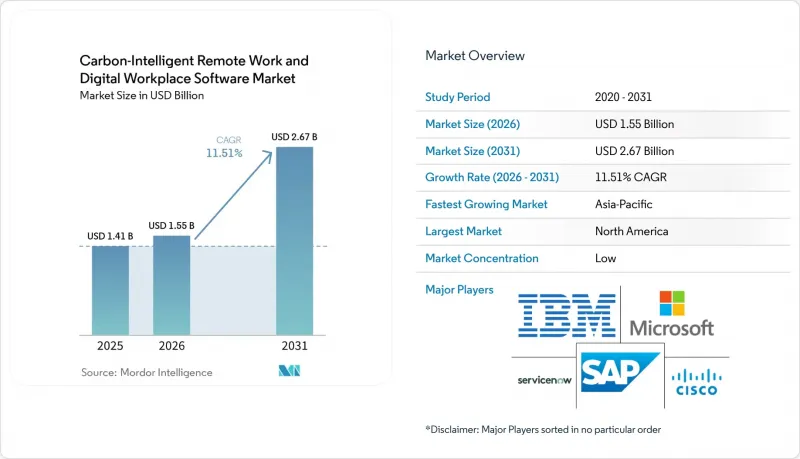
Mordor Intelligence에 의하면, 탄소 지능형 원격 근무 및 디지털 워크플레이스 소프트웨어 시장 규모는 2025년 14억 1,000만 달러, 2026년 15억 5,000만 달러에서 2031년까지 26억 7,000만 달러로 확대한다고 예측되고 있어 2026년부터 2031년까지 연평균 복합 성장률(CAGR)은 11.51%를 나타낼 전망입니다.
본 보고서는 구성 요소(소프트웨어 플랫폼, 서비스), 도입 모델(클라우드 기반, On-Premise형, 하이브리드형), 기업 규모(대기업 등), 용도(협업 및 디지털 워크플레이스 경험 등), 최종 사용자(IT 및 통신 업계 등), 지역별로 분류되어 있습니다. 시장 전망은 금액(달러) 기준으로 제시되어 있습니다.
전 세계 탄소 지능형 원격 근무 및 디지털 워크플레이스 소프트웨어 시장 동향과 인사이트
하이브리드 근무 방식이 점차 정착되고 있습니다.
하이브리드 근무는 탄소 지능형 원격 근무 및 디지털 워크플레이스 소프트웨어 시장의 구조적 성장 동력으로 계속 작용하고 있습니다. 이는 고용주들이 여전히 협업, 출근 계획, 디지털 접근성 및 업무 흐름의 연속성을 보장하기 위한 신뢰할 수 있는 시스템을 필요로 하기 때문입니다. 2026년에는 조직의 62%가 사무실 출근 일수를 일정 횟수로 의무화했는데, 이는 전년의 49%에서 증가한 수치입니다. 한편, 주 3-4일 사무실에 출근하는 직원의 비율은 55%로 상승했습니다. 2026년 4월에 실시된 또 다른 조사에서는 응답자의 62%가 에너지 비용 절감을 위해 재택근무를 늘리는 것이 합리적이라고 생각한 반면, 실제로 그렇게 하고 있는 비율은 고작 20%에 그쳐, 직원들의 의향과 실제 직장 내 행동 사이에 뚜렷한 괴리가 있음을 드러냈습니다. 이러한 괴리가 중요한 이유는 일정, 출퇴근 패턴, 근무지 선택, 에너지 사용량을 단일 운영 기록으로 통합하는 소프트웨어가 없다면, 조직은 하이브리드 근무를 측정 가능한 비용 및 탄소 감축 성과로 연결할 수 없기 때문입니다. 따라서, “탄소 지능형 원격 근무 및 디지털 워크플레이스용 소프트웨어 시장”는 이전 직장 환경의 혼란에 대한 일시적인 대응이 아니라, 수년에 걸친 업무 혁신의 혜택을 누리고 있습니다. 하이브리드 근무 관리와 감사 가능한 탄소 회계를 연계할 수 있는 공급업체는 더 유리한 입장에 있습니다. 이는 구매자들이 직원 관리와 정보 공개 준비를 모두 지원하는 단일 시스템을 점점 더 많이 요구하고 있기 때문입니다.
AI를 활용한 워크플로우 오케스트레이션의 확대
기업들이 독립적인 AI 도구에서 부서 간에 업무를 수행할 수 있는 연동 시스템으로 전환함에 따라, AI 오케스트레이션은 “탄소 지능형 원격 근무 및 디지털 워크플레이스 소프트웨어 시장”에서 가장 뚜렷한 경쟁적 차별화 요소 중 하나로 자리매김하고 있습니다. 2026년 5월, 차세대 오케스트레이션 플랫폼이 발표되었으며, 공통 거버넌스 규칙에 따라 다수의 AI 에이전트를 관리하는 기업을 위한 ‘에이전트 제어 계층”로 규정되었습니다. 또한, 2026년 5월에는 2026년 말 일반 서비스 개시를 목표로 하는 새로운 지속가능성 AI 에이전트도 발표되었습니다. 베타 테스트를 통해 탄소 배출 감축 시나리오의 시뮬레이션 시간이 1일에서 20분으로 단축되었으며, GHS 분류에 따른 수작업 부담이 최대 80% 감소했습니다. 이러한 움직임이 중요하게 여겨지는 이유는 AI 워크플로우 계층이 동일한 소프트웨어 환경 내의 탄소 배출량 측정 및 보고에 도움이 되는 프로세스 로그, 리소스 기록, 운영 신호도 생성하기 때문입니다. “탄소 지능형 원격 근무 및 디지털 워크플레이스 소프트웨어 시장”는 이러한 시너지 효과 덕분에 성장하고 있습니다. 기업은 생산성 향상과 정보 공개 지원이라는 두 가지 측면에서 투자의 정당성을 설명할 수 있기 때문입니다. 오케스트레이션을 직원 관리 기능과 지속가능성 기능의 공유 인프라로 취급하는 벤더는 탄소 관리 도구를 운영 소프트웨어와 분리하여 취급하는 벤더보다 장기적으로 더 견고한 입지를 구축하고 있습니다.
레거시 시스템의 ID 관리 및 협업 스택과의 복잡한 통합
고급 업무 환경 플랫폼은 많은 기존 엔터프라이즈 시스템에 동시에 연결해야 하기 때문에 레거시 시스템의 복잡성은 여전히 “탄소 지능형 원격 근무 및 디지털 워크플레이스 소프트웨어 시장”에서 주요 도입 장벽으로 작용하고 있습니다. 2025년 현대화에 관한 보고서에 따르면, IT 의사결정권자의 35%는 현대화의 주요 제약 요인으로 기술적 부채와 레거시 시스템의 복잡성을 꼽은 반면, 54%는 레거시 워크로드를 클라우드 네이티브 플랫폼과 통합하기 위해 현대화를 추진하고 있다고 응답했습니다. 이 과제는 인프라의 범위를 넘어섭니다. 대기업에서는 여러 ID 제공업체나 구형 디렉터리 환경을 유지하고 있는 경우가 많으며, 이를 최신 업무 환경 도구와 원활하게 연동시키는 것이 어렵기 때문입니다. “탄소 지능형 원격 근무 및 디지털 워크플레이스 소프트웨어 시장”에 미치는 영향이 특히 큰 이유는 이러한 플랫폼들이 서로 다른 접근 모델 하에서 인사 시스템, 시설 관리 시스템, 자산 관리 시스템, 협업 데이터 및 ERP 기록에 대한 접근을 필요로 하는 경우가 많기 때문입니다. 2025년 엔터프라이즈 통합에 관한 조사에서는 레거시 데이터베이스와의 연결 및 데이터 표준의 불일치도 주요 통합 과제로 지적되었으며, 이는 통합형 워크플레이스 및 탄소 보고 도입을 지연시키는 더 광범위한 ‘데이터 마찰”를 반영하고 있습니다. 이러한 부담을 과소평가하는 조직은 도입 주기가 길어지고, 가치 실현이 지연되는 경향이 있습니다. 따라서 통합 아키텍처, 기성 커넥터 및 액세스 설계는 제품의 기능성만큼이나 중요합니다.
부문별 분석
2025년에는 소프트웨어 플랫폼이 매출의 81.13%를 차지해, “탄소 지능형 원격 근무 및 디지털 워크플레이스 소프트웨어 시장”에서 확실한 리드를 확보했습니다. 이러한 집중 경향은 좁은 의미에서의 기능 선호라기보다는 기업의 구매 행동을 반영한 것입니다. 왜냐하면 대다수의 대규모 조직은 전문 도구를 도입하기 전에, 업무 공간 기능을 주요 소프트웨어 환경 내에 통합하는 경향이 있기 때문입니다. 따라서, “탄소 지능형 원격 근무 및 디지털 워크플레이스 소프트웨어 시장”는 협업, 워크플로우, ID 관리 및 사업 전반에 걸친 업무 데이터 마이그레이션을 이미 지원하고 있는 플랫폼을 중심으로 계속해서 사업을 전개하고 있습니다. 이러한 경향은 보다 광범위한 운영 계층을 제공할 수 있는 공급업체에게도 유리하게 작용합니다. 이는 구매자들이 별도의 독립된 환경을 구축하기보다는 기존 엔터프라이즈 시스템에 모듈을 추가하는 것을 선호하기 때문입니다. 이처럼 플랫폼 중심의 구조는 고객이 현재 탄소 보고 요건도 충족하는 업무용 소프트웨어를 선택할 때 여전히 시스템의 연속성, 공동 거버넌스, 그리고 통합에 따른 마찰 완화를 중시하고 있음을 보여줍니다.
또한, 소프트웨어 플랫폼 시장은 2031년까지 연평균 성장률(CAGR) 12.13%로 확대될 것으로 예측되고 있으며, 이는 이 주요 구성 요소가 자체적인 성장으로 인해 둔화되기는커녕 여전히 성장세를 이어가고 있음을 보여줍니다. 지속가능성 에이전트는 그 대표적인 예이며, 이들은 독립형 용도이 아니라 보다 광범위한 엔터프라이즈 플랫폼 내에 탄소 발자국 시뮬레이션, 규제 대응, 라벨링 작업 및 작업장 안전과 관련된 워크플로를 통합하고 있습니다. 배출량 API 역시 이러한 방향성을 뒷받침하고 있으며, 기업과 공급업체가 사용자에게 별도의 인터페이스를 강요하지 않고도 배출량 계산을 기존 워크플로에 직접 통합할 수 있도록 하고 있습니다. 실용적인 관점에서 보면, “탄소 지능형 원격 근무 및 디지털 워크플레이스 소프트웨어 시장”는 조직이 단일 핵심 환경 내에서 배출량 기준선, 일정 이력, 종점 기록을 구축해 나감에 따라 전환 비용이 증가하기 때문에 시간이 지남에 따라 점점 더 플랫폼 중심적인 형태로 변화해 갑니다. 서비스 부문은 대규모 도입 시 여전히 맞춤화, 변경 관리 및 복잡한 통합 지원이 필요하기 때문에 그 중요성을 유지하고 있지만, 그 역할은 주로 소프트웨어의 중심을 바꾸는 것이 아니라 보다 광범위한 플랫폼의 가치를 실현하는 데 있습니다.
2025년에는 클라우드 기반 도입이 매출의 67.14%를 차지해, “탄소 지능형 원격 근무 및 디지털 워크플레이스 소프트웨어 시장”에서 지배적인 제공 모델이 되었습니다. 이러한 우위는 SaaS형 업무 공간 도구의 성숙도와, 거점, 기기, 사업 부문을 아우르는 확장 가능한 접근 방식이 선호되는 경향을 반영하고 있습니다. 또한 클라우드 환경을 통해 벤더는 기존 고객 기반에 대해 업그레이드 지연을 최소화하면서 새로운 AI 기능 출시, 보고서 업데이트 및 워크플레이스 기능 강화를 제공할 수 있습니다. 따라서, “탄소 지능형 원격 근무 및 디지털 워크플레이스 소프트웨어 시장”는 보다 신속한 도입과 거점 간 접근 용이성을 추구하는 조직을 위해, 클라우드를 기본 진입점으로 계속해서 의존하고 있습니다. 이러한 경향은 디지털 협업 제품군이나 클라우드 워크플로 소프트웨어가 이미 일상 업무의 일부가 된 성숙한 기업 시장에서 특히 두드러집니다.
하이브리드 도입은 2031년까지 연평균 성장률(CAGR) 13.43%를 나타낼 것으로 예측되며, 이는 데이터 처리 및 보고서 작성의 정확도가 아키텍처 결정에 있어 영향력을 확대하고 있음을 보여줍니다. CSRD(탄소 지속가능성 보고서 직접)에서는 시장 기반 및 지역 기반의 배출량 보고가 모두 요구되고 있으며, 이로 인해 일부 기업들이 탄소 데이터 처리 및 대조 작업의 일부를 하이브리드 환경에서 유지하도록 유도하고 있다는 점이 지적되고 있습니다. 클라우드 제공업체들의 조사 방식은 이 문제에 대해 반드시 일치하는 것은 아닙니다. 이것이 멀티 클라우드 환경에서 로컬 처리 계층을 유지해야 하는 실질적인 이유입니다. 2026년 클라우드 관련 보고서에 따르면, 응답자의 3명 중 1명 가까이가 비용 최적화와 탄소 배출량 감축을 동등한 우선순위로 여기고 있으며, 유럽 응답자의 47%는 명확한 지속가능성 프로그램을 수립하고 있다고 보고했습니다. 데이터의 보관 장소 및 관리와 관련된 요건이 여전히 엄격한 은행, 국방, 정부 기관 분야에서는 On-Premise 구축이 여전히 중요한 위치를 차지하고 있습니다. 따라서, “탄소 지능형 원격 근무 및 디지털 워크플레이스 소프트웨어 시장”에서는 클라우드 이용이 확대되는 한편, 감사 대응 및 탄소 데이터의 정확성을 뒷받침하는 하이브리드 설계의 여지도 넓어지고 있습니다.
지역별 분석
2025년, 북미는 매출의 39.12%를 차지하며, “탄소 지능형 원격 근무 및 디지털 워크플레이스 소프트웨어 시장”에서 1위를 차지했습니다. 이 지역은 클라우드 네이티브 업무 환경에 대한 조기 투자와, 기업 내 Microsoft 365 및 Google Workspace의 폭넓은 활용으로 인한 혜택을 누렸습니다. 미국은 여전히 가장 큰 국내 시장으로 남아 있습니다. 이는 대기업들이 이미 광범위한 협업 및 워크플로우 환경을 운영하고 있어, 업무에 미치는 영향을 최소화하면서 새로운 탄소 배출량 및 지속가능성 관련 기능을 도입할 수 있기 때문입니다. 마이크로소프트는 2026년 1월, “Sustainability Manager” 내에서 “Product Carbon Footprint”의 일반 서비스를 시작하며, 확립된 기업 소프트웨어 기반 내에서 탄소 배출량 산정 기능을 강화했습니다. 또한, 2026년에 시행될 캘리포니아주의 기후 정보 공개 규정에 따라 배출량 보고, 위험 요인 문서화 및 내부 운영 데이터를 연동할 수 있는 소프트웨어에 대한 실질적인 수요도 확대되었습니다.
2025년, 유럽은 두 번째로 큰 지역 부문이였으며, 시장 내에서 여전히 규제가 가장 강력한 지역으로 남아 있었습니다. 독일 연방통계청은 2026년 4월, 2025년에는 전체 근로자의 약 25%가 적어도 가끔 재택근무를 했다고 발표하며, 공식 보고 요건과 중복되는 재택근무의 규모를 제시했습니다. 프랑스 ADEME(환경·에너지 관리청)이 참여하고 있는 재택근무의 탄소 배출량 관련 노력 또한, 원격 근무를 보다 광범위한 탄소 회계 실무에 어떻게 통합해야 할지에 대한 보다 체계적인 고찰을 뒷받침했습니다. 독일, 영국, 프랑스, 이탈리아, 스페인은 대기업 수요와 기후 관련 정보 공개에 대한 강력한 추세가 맞물리면서, 계속해서 주요 국내 시장으로서의 위상을 유지했습니다. 또한, EU AI법에 따라 제품에 대한 심사가 더욱 엄격해졌으며, 직원에 대한 추론을 포함하는 직장 분석의 경우, 설계 및 문서화 과정에서 더욱 세심한 주의를 기울여야 합니다.
아시아태평양은 2031년까지 연평균 성장률(CAGR) 13.83%를 기록하며 성장할 것으로 예상되며, 시장 규모 전망 측면에서 가장 두드러진 성장을 보일 것으로 전망됩니다. 인도와 중국은 대규모 기업 기반 전반에 걸쳐 기업 소프트웨어에 대한 지출이 확대되고 있어, 절대적 성장에 대한 기여도가 가장 높습니다. 또한 일본과 한국에서도 상장 기업들이 보다 공식적인 ESG 공시에 대한 기대에 부응하기 위해 움직이기 시작하면서 수요가 증가하고 있습니다. JLL은 2026년에 APAC 지역이 사무실 출근률에서 세계 1위를 차지할 것이라고 지적했습니다. 이에 따라 해당 지역은 유럽 및 미국 시장과는 다른 수요 양상을 보이며, 소프트웨어에 대한 수요는 사무실의 에너지 최적화나 엔드포인트의 전력 관리와 밀접하게 연관되어 있는 경우가 많습니다. 남미, 중동 및 아프리카는 여전히 소규모 시장이지만, 브라질과 아랍에미리트(UAE)는 모두 대기업을 대상으로 한 보다 광범위한 지속가능성 공시 체계를 추진하고 있다는 점에서 두드러집니다.
기타 혜택:
- 엑셀 형식 시장 예측(ME) 시트
- 3개월간의 애널리스트 지원
자주 묻는 질문
목차
제1장 서론
제2장 조사 방법
제3장 주요 요약
제4장 시장 구도
제5장 시장 규모와 성장 예측
제6장 경쟁 구도
제7장 시장 기회와 향후 전망
JHS 26.07.09According to Mordor Intelligence, the carbon-Intelligent remote work and Digital Workplace Software Market size is projected to expand from USD 1.41 billion in 2025 and USD 1.55 billion in 2026 to USD 2.67 billion by 2031, registering a CAGR of 11.51% between 2026 and 2031.
This report is Segmented by Component (Software Platform, and Services), Deployment Model (Cloud-Based, On-Premise, and Hybrid), Enterprise Size (Large Enterprises, and More), Application (Collaboration and Digital Workplace Experience, and More), End User (IT and Telecom, and More), and Geography. The Market Forecasts are Provided in Terms of Value (USD).
Global Carbon-Intelligent Remote Work and Digital Workplace Software Market Trends and Insights
Rising Hybrid Work Persistence
Hybrid work remains a structural driver of the Carbon-Intelligent Remote Work and Digital Workplace Software Market, as employers still need a reliable system for collaboration, attendance planning, digital access, and workflow continuity. In 2026, 62% of organizations mandated a fixed number of in-office days, up from 49% a year earlier, while the share of employees attending the office 3 to 4 days per week rose to 55%. Another study in April 2026 found that 62% of respondents considered it sensible to work more from home to reduce energy costs, while only 20% currently do so, highlighting a clear gap between employee preferences and actual workplace behavior. That gap matters because organizations cannot turn hybrid work into measurable cost and carbon outcomes without software that connects schedules, commuting patterns, location choices, and energy use into a single operating record. The Carbon-Intelligent Remote Work and Digital Workplace Software Market is therefore benefiting from a multi-year operating shift rather than a short-lived response to earlier workplace disruption. Vendors that can link hybrid work management with auditable carbon accounting are in a stronger position, as buyers increasingly want a single system to support both employee coordination and disclosure readiness.
Expansion of AI-Powered Workflow Orchestration
AI orchestration is becoming one of the clearest competitive differentiators in the Carbon-Intelligent Remote Work and Digital Workplace Software Market, as enterprises move away from isolated AI tools toward coordinated systems that can execute work across functions. In May 2026, the next generation of an orchestration platform was unveiled and positioned as an agentic control plane for enterprises managing large fleets of AI agents under common governance rules. New sustainability AI agents were also announced in May 2026, targeting general availability by the end of 2026, and beta testing reduced carbon scenario simulation time from 1 day to 20 minutes while cutting manual GHS classification effort by up to 80%. These moves matter because AI workflow layers also generate process logs, resource records, and operational signals that are useful for carbon measurement and reporting within the same software environment. The Carbon-Intelligent Remote Work and Digital Workplace Software Market is gaining from that overlap because enterprises can justify the investment through both productivity gains and disclosure support. Vendors that treat orchestration as shared infrastructure for workforce and sustainability functions are building a stronger long-term position than vendors that keep carbon tools separate from operational software.
Complex Integration With Legacy Identity and Collaboration Stack
Legacy complexity remains a major adoption barrier for the Carbon-Intelligent Remote Work and Digital Workplace Software Market because advanced workplace platforms must connect to many older enterprise systems simultaneously. A 2025 modernization report found that 35% of IT decision-makers cited technical debt and legacy complexity as the main constraint on modernization, while 54% were pursuing modernization to integrate legacy workloads with cloud-native platforms. The challenge is wider than infrastructure because large enterprises often maintain multiple identity providers and older directory environments that are harder to federate cleanly with modern workplace tools. The Carbon-Intelligent Remote Work and Digital Workplace Software Market is affected more sharply because these platforms often need access to HR systems, facilities systems, asset management systems, collaboration data, and ERP records under different access models. Research in 2025 on enterprise integration also identified legacy database connections and inconsistent data standards as key integration issues, reflecting the broader data friction that slows unified workplace and carbon reporting deployments. Organizations that underestimate this burden often face longer implementation cycles and slower value realization, which is why integration architecture, pre-built connectors, and access design matter as much as product functionality.
Other drivers and restraints analyzed in the detailed report include:
- Enterprise Demand for Unified Employee Experience Platforms
- Growing Need for Workplace Carbon Visibility And Optimization
- Data Privacy and Employee Monitoring Concerns
For complete list of drivers and restraints, kindly check the Table Of Contents.
Segment Analysis
Software Platform accounted for 81.13% of revenue in 2025, giving it a clear lead in the Carbon-Intelligent Remote Work and Digital Workplace Software Market share. That concentration reflects enterprise buying behavior more than a narrow feature preference because most large organizations place workplace functions inside a primary software environment before adding specialist tools. The Carbon-Intelligent Remote Work and Digital Workplace Software Market, therefore, remains centered on platforms that already support collaboration, workflows, identity, and the movement of operational data across the business. This pattern also favors vendors that can offer a broader operating layer, as buyers prefer to add modules to existing enterprise systems rather than create another isolated environment. The platform-heavy structure shows that customers still value system continuity, shared governance, and reduced integration friction when choosing workplace software that now also addresses carbon reporting requirements.
Software Platform is also projected to expand at a 12.13% CAGR through 2031, indicating the leading component is still gaining traction rather than slowing under its own weight. Sustainability agents are a good example because they embed footprint simulation, regulatory readiness, labeling tasks, and workplace safety workflows within a broader enterprise platform rather than a standalone application. Emissions APIs support the same direction by allowing enterprises and software vendors to embed emissions calculations directly into existing workflows, rather than forcing users into a separate interface. In practical terms, the Carbon-Intelligent Remote Work and Digital Workplace Software Market becomes increasingly platform-led over time because switching costs rise as organizations build emissions baselines, scheduling histories, and endpoint records within a single core environment. The services segment remains important because large deployments still need customization, change management, and complex integration support, but its role is mainly to enable broader platform value rather than displace the software center of gravity.
Cloud-based deployment accounted for 67.14% of revenue in 2025, making it the dominant delivery model in the Carbon-Intelligent Remote Work and Digital Workplace Software Market. This lead reflects the maturity of software-as-a-service workplace tools and the preference for scalable access across locations, devices, and business units. Cloud environments also help vendors release new AI features, report updates, and introduce workplace enhancements to installed customer bases with fewer upgrade delays. The Carbon-Intelligent Remote Work and Digital Workplace Software Market has therefore continued to rely on the cloud as the default entry point for organizations seeking faster rollouts and easier cross-site access. That position is especially strong in mature enterprise markets where digital collaboration suites and cloud workflow software are already part of daily operations.
Hybrid deployment is projected to grow at a 13.43% CAGR through 2031, indicating that data processing and reporting precision are gaining influence in architectural decisions. It was noted that CSRD requires both market-based and location-based emissions reporting, which has pushed some enterprises to keep part of their carbon data processing or reconciliation in hybrid environments. Cloud provider methodologies have not always aligned equally on this issue, which creates a practical reason to retain local processing layers in multi-cloud environments. A 2026 cloud report found that nearly 1 out of 3 respondents considered cost optimization and carbon emissions reduction equal priorities, while 47% of European respondents reported defined sustainability programs. On-premise deployment still holds a place in banking, defense, and government settings where data residency and control requirements remain strict, so the Carbon-Intelligent Remote Work and Digital Workplace Software Market is expanding cloud usage while also creating more room for hybrid designs that support audit readiness and carbon data accuracy.
Complete Report Scope:
- By Component
- Software Platform
- Services
- By Deployment Model
- Cloud-Based
- On-Premise
- Hybrid
- By Enterprise Size
- Large Enterprises
- Small and Medium Enterprises
- By Application
- Collaboration and Digital Workplace Experience
- Employee Wellbeing and Productivity Analytics
- Workflow Automation and Process Orchestration
- Carbon Intelligence, Tracking and Reporting
- Endpoint Performance and Resource Optimization
- By End User
- IT and Telecom
- BFSI
- Manufacturing
- Energy and Utilities
- Retail and E-Commerce
- Construction and Infrastructure
- Government and Public Sector
- Other End-User Industries
- By Geography
- North America
- United States
- Canada
- Mexico
- South America
- Brazil
- Argentina
- Rest of South America
- Europe
- Germany
- United Kingdom
- France
- Italy
- Spain
- Russia
- Rest of Europe
- Asia-Pacific
- China
- India
- Japan
- South Korea
- Australia
- Rest of Asia-Pacific
- Middle East and Africa
- Middle East
- Saudi Arabia
- United Arab Emirates
- Rest of Middle East
- Africa
- South Africa
- Nigeria
- Rest of Africa
- Middle East
- North America
Geography Analysis
North America accounted for 39.12% of revenue in 2025, making it the leading region in the Carbon-Intelligent Remote Work and Digital Workplace Software Market. The region benefited from early investment in cloud-native workplace platforms and deeper enterprise use of Microsoft 365 and Google Workspace. The United States remained the largest national market because large enterprises already operated broad collaboration and workflow environments that could absorb new carbon and sustainability features with less disruption. Microsoft brought Product Carbon Footprint to general availability in January 2026 within Sustainability Manager, strengthening carbon accounting capability inside an established enterprise software base. California's climate disclosure rules, taking effect in 2026, also expanded the practical need for software that can connect emissions reporting, risk documentation, and internal operating data.
Europe was the second-largest regional segment in 2025, and it remained the most regulation-driven part of the market. Germany's Federal Statistical Office stated in April 2026 that 25% of all employed persons worked from home at least occasionally in 2025, showing the scale of telework that now intersects with formal reporting expectations. France's ADEME-linked telework carbon work also supported more structured thinking about how remote work should be integrated into broader carbon accounting practices. Germany, the United Kingdom, France, Italy, and Spain remained the leading national markets because each combined large enterprise demand with stronger momentum for climate-related disclosures. The EU AI Act also added another layer of product scrutiny, requiring workplace analytics that involve employee inferences to be designed and documented with greater care.
Asia-Pacific is projected to grow at a 13.83% CAGR through 2031, making it the fastest-growing geography in the market size outlook. India and China are providing the largest absolute growth contribution because enterprise software spending is expanding across large business bases. Japan and South Korea are also strengthening demand as listed companies move into more formal ESG disclosure expectations. JLL stated in 2026 that APAC led globally in full in-office attendance rates, giving the region a different demand profile from Western markets, as software needs are often more closely tied to office energy optimization and endpoint power management. South America, the Middle East, and Africa remain smaller markets, but Brazil and the United Arab Emirates stand out because both are advancing broader sustainability disclosure frameworks for large enterprises.
- Microsoft Corporation
- International Business Machines Corporation
- SAP SE
- ServiceNow, Inc.
- Broadcom Inc.
- Citrix Systems, Inc.
- Workiva Inc.
- Schneider Electric SE
- Hewlett Packard Enterprise Company
- Google LLC
- Cisco Systems, Inc.
- Accenture plc
- Eviden
- DXC Technology Company
- Tata Consultancy Services Limited
- Cognizant Technology Solutions Corporation
- Wipro Limited
- Infosys Limited
- Capgemini SE
- Unisys Corporation
Additional Benefits:
- The market estimate (ME) sheet in Excel format
- 3 months of analyst support
TABLE OF CONTENTS
1 INTRODUCTION
- 1.1 Study Assumptions and Market Definition
- 1.2 Scope of the Study
2 RESEARCH METHODOLOGY
3 EXECUTIVE SUMMARY
4 MARKET LANDSCAPE
- 4.1 Market Overview
- 4.2 Market Drivers
- 4.2.1 Rising Hybrid Work Persistence
- 4.2.2 Enterprise Demand for Unified Employee Experience Platforms
- 4.2.3 Expansion of AI-Powered Workflow Orchestration
- 4.2.4 Growing Need for Workplace Carbon Visibility and Optimization
- 4.2.5 Compliance Pressure From Digital Operations Reporting
- 4.2.6 Shift Toward FinOps and Sustainability Convergence
- 4.3 Market Restraints
- 4.3.1 Complex Integration With Legacy Identity and Collaboration Stacks
- 4.3.2 Data Privacy and Employee Monitoring Concerns
- 4.3.3 High Total Cost of Ownership for Advanced Platforms
- 4.3.4 Fragmented Carbon Data and Weak Baseline Quality
- 4.4 Industry Value-Chain Analysis
- 4.5 Regulatory Landscape
- 4.6 Technological Outlook
- 4.7 Impact of Macroeconomic Factors on the Market
- 4.8 Porter's Five Forces Analysis
- 4.8.1 Bargaining Power of Buyers
- 4.8.2 Bargaining Power of Suppliers
- 4.8.3 Threat of New Entrants
- 4.8.4 Threat of Substitutes
- 4.8.5 Intensity of Competitive Rivalry
5 MARKET SIZE AND GROWTH FORECASTS (VALUE)
- 5.1 By Component
- 5.1.1 Software Platform
- 5.1.2 Services
- 5.2 By Deployment Model
- 5.2.1 Cloud-Based
- 5.2.2 On-Premise
- 5.2.3 Hybrid
- 5.3 By Enterprise Size
- 5.3.1 Large Enterprises
- 5.3.2 Small and Medium Enterprises
- 5.4 By Application
- 5.4.1 Collaboration and Digital Workplace Experience
- 5.4.2 Employee Wellbeing and Productivity Analytics
- 5.4.3 Workflow Automation and Process Orchestration
- 5.4.4 Carbon Intelligence, Tracking and Reporting
- 5.4.5 Endpoint Performance and Resource Optimization
- 5.5 By End User
- 5.5.1 IT and Telecom
- 5.5.2 BFSI
- 5.5.3 Manufacturing
- 5.5.4 Energy and Utilities
- 5.5.5 Retail and E-Commerce
- 5.5.6 Construction and Infrastructure
- 5.5.7 Government and Public Sector
- 5.5.8 Other End-User Industries
- 5.6 By Geography
- 5.6.1 North America
- 5.6.1.1 United States
- 5.6.1.2 Canada
- 5.6.1.3 Mexico
- 5.6.2 South America
- 5.6.2.1 Brazil
- 5.6.2.2 Argentina
- 5.6.2.3 Rest of South America
- 5.6.3 Europe
- 5.6.3.1 Germany
- 5.6.3.2 United Kingdom
- 5.6.3.3 France
- 5.6.3.4 Italy
- 5.6.3.5 Spain
- 5.6.3.6 Russia
- 5.6.3.7 Rest of Europe
- 5.6.4 Asia-Pacific
- 5.6.4.1 China
- 5.6.4.2 India
- 5.6.4.3 Japan
- 5.6.4.4 South Korea
- 5.6.4.5 Australia
- 5.6.4.6 Rest of Asia-Pacific
- 5.6.5 Middle East and Africa
- 5.6.5.1 Middle East
- 5.6.5.1.1 Saudi Arabia
- 5.6.5.1.2 United Arab Emirates
- 5.6.5.1.3 Rest of Middle East
- 5.6.5.2 Africa
- 5.6.5.2.1 South Africa
- 5.6.5.2.2 Nigeria
- 5.6.5.2.3 Rest of Africa
- 5.6.5.1 Middle East
- 5.6.1 North America
6 COMPETITIVE LANDSCAPE
- 6.1 Market Concentration
- 6.2 Strategic Moves
- 6.3 Market Share Analysis
- 6.4 Company Profiles (includes Global Level Overview, Market Level Overview, Core Segments, Financials as available, Strategic Information, Market Rank/Share, Products and Services, Recent Developments)
- 6.4.1 Microsoft Corporation
- 6.4.2 International Business Machines Corporation
- 6.4.3 SAP SE
- 6.4.4 ServiceNow, Inc.
- 6.4.5 Broadcom Inc.
- 6.4.6 Citrix Systems, Inc.
- 6.4.7 Workiva Inc.
- 6.4.8 Schneider Electric SE
- 6.4.9 Hewlett Packard Enterprise Company
- 6.4.10 Google LLC
- 6.4.11 Cisco Systems, Inc.
- 6.4.12 Accenture plc
- 6.4.13 Eviden
- 6.4.14 DXC Technology Company
- 6.4.15 Tata Consultancy Services Limited
- 6.4.16 Cognizant Technology Solutions Corporation
- 6.4.17 Wipro Limited
- 6.4.18 Infosys Limited
- 6.4.19 Capgemini SE
- 6.4.20 Unisys Corporation
7 MARKET OPPORTUNITIES AND FUTURE OUTLOOK
- 7.1 White-Space and Unmet-Need Assessment


