|
시장보고서
상품코드
2117524
소매 분야 디지털 워크플레이스 : 시장 점유율 분석, 업계 동향 및 통계, 성장 예측(2026-2031년)Digital Workplace In Retail - Market Share Analysis, Industry Trends & Statistics, Growth Forecasts (2026 - 2031) |
||||||
 Mordor Intelligence
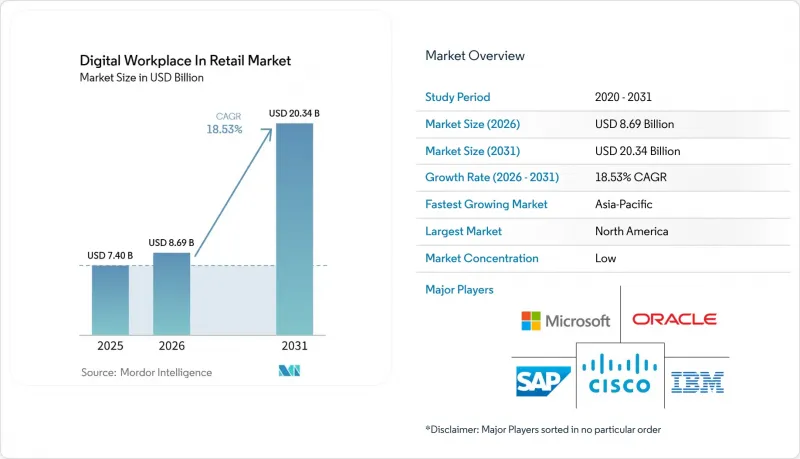
소매 분야 디지털 워크플레이스 시장 규모는 2025년에 74억 달러로 평가되었습니다. 2026년에 86억 9,000만 달러에 달하고, 2031년까지 203억 4,000만 달러에 이를 것으로 예측되며, 2026년부터 2031년에 걸쳐 CAGR 18.53%로 성장할 전망입니다.
본 보고서는 구성 요소(솔루션 (통합 커뮤니케이션 및 협업, 워크플로우 자동화 및 지식 관리, 엔터프라이즈 모빌리티 및 관리 등), 서비스), 도입 형태(클라우드, On-Premise, 하이브리드), 조직 규모(대기업, 중소기업) 및 지역별로 분류되어 있습니다. 시장 전망은 금액(달러) 기준으로 제시되어 있습니다.
세계의 소매 분야 디지털 워크플레이스 시장 동향 및 인사이트
매장 직원 간의 실시간 커뮤니케이션에 대한 수요 증가
소매 분야 디지털 워크플레이스의 보급은 고객 응대 업무 중 매장 내 커뮤니케이션 지연으로 인한 비용 증가를 배경으로 추진되고 있습니다. 현재 매장 직원은 판매 현장을 떠나지 않고도 업무 최신 정보, 서비스 에스컬레이션, 상품 관련 지침에 즉시 접근할 수 있어야 합니다. 직원 수가 많고 이동이 잦으며 장시간 영업 시간 동안 분산되어 있는 경우, 이메일이나 소비자용 메시징 앱만으로는 이러한 요구를 충분히 충족시킬 수 없습니다. Zoom은 2025년 4월, 푸시-투-톡(Push-to-Talk), AI 지원 근무 보고, 근무 교대, 업무 관리, 지식 검색 기능을 하나의 모바일 우선 제품에 통합한 ‘Zoom Workplace for Frontline’을 출시했습니다. 이는 각 벤더들이 소매 분야 디지털 업무 공간을 사무실용 템플릿이 아닌, 데스크리스 업무를 중심으로 재구축하고 있음을 보여줍니다. 또한, 이온 리테일은 2025년 6월부터 390개 매장에 AI가 탑재된 올인원 단말기를 도입하여, 직원이 대화형 AI 인터페이스를 통해 디지털화된 매뉴얼을 실시간으로 검색할 수 있도록 했습니다. 소매 분야 디지털 워크플레이스에서는 음성 기능, 업무 처리, 지식 검색이 직원을 위한 단일 도구로 통합됨으로써 교육이 용이해지고, 매장 네트워크 전체에서 일상적인 사용이 더욱 일관성 있게 이루어지는 이점이 있습니다.
옴니채널 소매 업무의 확대
소매 분야 디지털 워크플레이스가 탄력을 받고 있는 이유는 옴니채널 소매의 보급으로 인해 각 매장 직원이 동일한 근무 시간 내에 관리해야 하는 업무량이 증가하고 있기 때문입니다. 매장 내 구매, 수령 주문, 디지털 프로모션을 동시에 처리하기 위해서는 본사의 계획 데이터와 현장의 실행 간에 실시간 연동이 필요합니다. 맨해튼 어소시에이츠는 2025년 소매 업계 벤치마크 조사에서 직원 간의 협업 능력이 실적 우수 소매업체와 시장 전체를 구분 짓는 더욱 뚜렷한 차별화 요인으로 부상하고 있다고 보고했습니다. NEC는 2025년 5월, 세븐일레븐 재팬이 통합 엔드포인트 관리 기능을 갖춘 모바일 단말기 및 태블릿 단말기 약 30만 대를 도입한다고 발표했습니다. 이는 대형 편의점 운영 기업이 직원의 디지털화를 임의 지출이 아닌 인프라로 인식하고 있음을 보여줍니다. SAP 또한 NRF 2026에서 매장 활동과 기업 계획을 더욱 긴밀하게 연계하는 AI를 활용한 상품 구성 관리, 프로모션 가격 책정 및 소매 데이터 기능을 소개했습니다. 따라서 소매 분야 디지털 워크플레이스는 협업 소프트웨어의 영역을 넘어, 소매업체가 채널의 복잡성을 관리하고 계획과 실행 간의 지연을 최소화하는 데 도움이 되는 운영 계층으로 전환되고 있습니다.
매장 내 기기의 데이터 보안 및 개인정보 보호에 대한 우려
소매 분야 디지털 워크플레이스는 여전히 구매자들의 신중한 시선을 받고 있습니다. 새로운 핸드헬드 단말기, 태블릿, 키오스크, 공유 기기가 추가될 때마다 매장 네트워크 전체에서 보안 조치를 취해야 하는 엔드포인트의 수가 증가하기 때문입니다. 워크플레이스 플랫폼이 매장 운영, 직원 데이터 또는 결제 업무와 밀접하게 연계된 환경과 연동될 경우, 이 문제는 더욱 중요해집니다. 그럴 경우 소매업체는 접근 권한, 기기 정책, 감사 추적에 대해 더욱 강력한 관리가 필요하기 때문입니다. 또한, 규정 준수 요건은 지역에 따라 다르기 때문에 여러 국가나 서로 다른 법적 기준 하에서 사업을 영위하는 소매업체에게 있어 도입은 더욱 어려운 과제가 되고 있습니다. CPA 호주는 2026년 4월, 싱가포르 중소기업의 44%가 2025년에 사이버 보안 사고로 인해 시간적·금전적 손실을 입었다고 보고했습니다. 이는 보안 취약성이 단순한 평판 위험에 그치지 않고, 업무 및 재무에 직접적인 혼란을 초래함을 보여줍니다. 그 결과, 엔터프라이즈급 모바일 기기 관리, 역할 기반 접근 제어, 암호화된 감사 로그는 소매 분야 디지털 업무 환경에 대한 표준 구매 기준이 되었으며, 이러한 기대에 부응하지 못하는 저가형 도구나 소비자용 도구의 도입은 주춤하고 있습니다. 또한 신뢰성, 규정 준수 능력, 그리고 검증된 도입 관리가 후보 선정에 있어 중요한 역할을 하게 됨에 따라, 신규 벤더의 진입 장벽은 높아지고 있습니다.
부문별 분석
이 솔루션은 2025년 소매 분야 디지털 워크플레이스 시장에서 66.38%를 차지했으며, 2031년까지 연평균 성장률(CAGR) 18.93%로 성장할 전망입니다. 이에 따라 커뮤니케이션, 업무, 지식 접근을 통합적으로 지원할 수 있는 소프트웨어 플랫폼이 핵심 구성 요소로 자리매김할 것으로 보입니다. 또한, 2025년 소매 분야 디지털 워크플레이스 시장 규모에서도 해당 솔루션이 66.38%를 차지했습니다. 이는 소매업체들이 매장별로 개별적으로 관리해야 하는 개별 도구보다 미리 통합된 시스템을 여전히 선호하기 때문입니다. 통합형 커뮤니케이션 및 협업 플랫폼은 본사와 매장 팀을 즉시 연결하고, 일상적인 조정상의 격차를 줄일 수 있기 때문에 여전히 가장 일반적인 도입 수단으로 자리 잡고 있습니다. 2025년 4월 Zoom이 현장 업무를 위해 출시한 신규 서비스는 푸시-투-토크(Push-to-Talk) 통신, AI를 활용한 근무표 보고, 업무 관리, 스마트 지식 검색 기능을 데스크리스 업무를 위한 ‘모바일 우선’ 환경에 통합함으로써 이러한 우선순위를 반영한 것입니다. 또한, 소매 업계의 디지털 워크플레이스 시장에서는 소매업체가 이용 사례별로 새로운 시스템을 구매하는 대신, 엔드포인트 관리, 워크플로 자동화, 직원 경험(EX) 기능을 동일한 플랫폼에 추가하는 추세이기 때문에 솔루션에 대한 수요가 증가하고 있습니다.
솔루션 성장의 다음 단계는 소매업체가 더 대규모의 기기 자산, 더 복잡한 업무 워크플로우, 그리고 매장 간 업무 일관성에 대한 높아지는 기대치를 관리하는 데 도움이 되는 도구에서 비롯될 것입니다. NEC가 세븐일레븐 재팬을 위해 구축한 차세대 시스템은 약 30만 대의 모바일 단말기 및 태블릿 단말기와 통합 엔드포인트 관리를 핵심으로 하고 있으며, 대규모 체인 운영자가 체계적인 현장 지원에 얼마나 적극적으로 투자할 준비가 되어 있는지를 보여줍니다. 직원 경험 플랫폼, 워크플로우 자동화 모듈, 지식 관리 계층의 중요성이 높아지고 있습니다. 이는 소매업체가 단순히 직원을 연결하는 데 그치지 않고, 보다 일관된 방식으로 업무를 이끌어갈 수 있는 플랫폼을 원하고 있기 때문입니다. 소매 업계의 디지털 워크플레이스에서 서비스는 여전히 중요합니다. 도입 지원, 운영 관리, 규정 준수 점검 및 맞춤형 워크플로우 설계가 플랫폼이 국가나 매장 형태를 초월하여 적절하게 확장될 수 있는지 여부를 좌우하는 경우가 많기 때문입니다. 따라서 소매 분야 디지털 워크플레이스는 계속해서 솔루션 주도형으로 유지될 것이지만, AI 계층, 워크플로우 업데이트, 거버넌스 요구 사항이 지속적인 플랫폼 관리의 일상화됨에 따라 서비스의 중요성은 계속해서 높아지고 있습니다.
지역별 분석
2025년, 북미는 소매 분야 디지털 워크플레이스 시장의 37.42%를 차지하며 지역별 최대 점유율을 기록했습니다. 북미가 2025년 소매 분야 디지털 워크플레이스 시장 점유율의 37.42%를 차지한 것은 이 지역이 소매 기술에 막대한 투자를 하고 있으며 강력한 클라우드, 디바이스, 통신 인프라를 모두 갖추고 있기 때문입니다. 미국의 소매업체들은 단순한 메시징 도구 도입에 그치지 않고, 매장 계획 수립, 번역, 재고 관리 업무를 실시간으로 지원하는 AI 주도형 실행 계층으로 전환하고 있습니다. 2025년 6월 월마트가 150만 명의 직원을 대상으로 AI 탑재 도구를 도입한 것은 북미의 체인점들이 디지털 워크플레이스 플랫폼을 활용하여 일상적인 매장 운영을 재구축하고 있는 규모가 얼마나 큰지를 보여줍니다. 북미 소매 분야 디지털 워크플레이스의 확산은 소규모 지역이나 네트워크 연결이 불충분한 지역에 비해, 기업 차원의 전개, 기기 관리, AI 통합 및 다중 거점 거버넌스를 보다 원활하게 지원할 수 있는 벤더 기반의 존재도 뒷받침하고 있습니다.
2025년에도 유럽은 2위 지역 시장으로, 독일, 영국, 프랑스, 이탈리아,스페인, 그리고 북유럽 국가들이 수요의 주축을 이루었습니다. 이 지역에서는 AI를 활용한 현장용 도구로의 전환이 착실히 진행되고 있지만, 구매 담당자들은 일반적으로 기능의 신속한 도입 자체보다는 감사 가능한 도입, 직원 데이터 처리, 그리고 정책 관리를 더 중요하게 여기고 있습니다. 마크스 앤 스펜서(Marks & Spencer)의 2026년 Copilot 도입 사례는 유럽의 대형 소매업체가 단순한 AI 트렌드를 따르는 데 그치지 않고, 디지털 업무 환경 도구를 활용하여 관리직의 업무 부담을 줄이고 매장 운영의 질을 향상시키고 있음을 보여주었습니다. 또한, France Num의 2025년 조사 결과에 따르면 유럽의 중소규모 소매 기업들도 소프트웨어 도입에 점점 더 적극적인 태도를 보이고 있으며, 이는 대형 체인을 넘어선 확장을 위한 기반이 넓어지고 있음을 뒷받침합니다.
아시아태평양은 2031년까지 연평균 성장률(CAGR) 19.47%로 확대될 것으로 예측되며, 소매 분야 디지털 워크플레이스에서 가장 빠르게 성장하는 지역 부문으로 자리매김하고 있습니다. 이 지역의 성장은 대규모 현장 직원층, 조직화된 소매 활동의 확대, 적극적인 공공 디지털화 프로그램, 그리고 모바일 우선 도입에 적합한 다양한 매장 형태에 의해 뒷받침되고 있습니다. 일본은 여전히 중요한 참고 사례가 되고 있습니다. 이온 그룹이 2025년 6월부터 390개 매장에 AI가 탑재된 현장용 단말기를 도입한 데 이어, NEC의 세븐일레븐 재팬을 위한 프로젝트에서는 차세대 매장 시스템을 지원하기 위해 약 30만 대의 모바일 단말기 및 태블릿 단말기가 추가로 도입되었기 때문입니다. 동남아시아에서도 조직화된 소매업체들이 급속히 확장되는 매장 네트워크 전반에 걸쳐 일관성을 높이기 위해 통합 커뮤니케이션 및 워크플로우 도구를 도입하고 있어 그 기세가 커지고 있습니다. 2026년 5월 MYDIN이 Lark와 제휴한 사례는 이 지역의 대형 소매업체가 소매 분야 디지털 워크플레이스를 활용하여 국내 전체 매장 네트워크에 걸친 커뮤니케이션, 워크플로우 및 직원 참여도를 통합하고 있음을 보여주는 실례입니다. 남미와 아프리카는 아직 소규모 기반에서 시작되었지만, Shoprite가 3,400개 이상의 매장에 YOOBIC을 도입한 사례는 인프라 환경이 균일하지 않은 상황에서도 모바일 우선 아키텍처가 규모 확대에 대응할 수 있음을 입증했습니다. 중동에서도 사우디아라비아와 아랍에미리트의 주요 소매 그룹을 중심으로 진전이 나타나고 있습니다. 이러한 지역에서는 디지털 경제 추진 프로그램과 높은 스마트폰 보급률 덕분에 현장용 플랫폼 도입을 장기적으로 원활하게 지원할 수 있는 여건이 마련되어 있습니다.
기타 혜택 :
- 엑셀 형식 시장 예측(ME) 시트
- 3개월간의 애널리스트 지원
자주 묻는 질문
목차
제1장 서론
제2장 조사 방법
제3장 개요
제4장 시장 구도
제5장 시장 규모 및 성장 예측
제6장 경쟁 구도
제7장 시장 기회 및 향후 전망
KTH 26.09.02According to Mordor Intelligence, the digital workplace in retail market size is projected to be USD 7.4 billion in 2025, USD 8.69 billion in 2026, and reach USD 20.34 billion by 2031, growing at a CAGR of 18.53% from 2026 to 2031.
This report is Segmented by Component (Solutions [Unified Communication and Collaboration, Workflow Automation and Knowledge Management, Enterprise Mobility and Management, and More], and Services), Deployment Mode (Cloud, On-Premises, and Hybrid), Organization Size (Large Enterprises, and Small and Medium-Sized Enterprises), and Geography. The Market Forecasts are Provided in Terms of Value (USD).
Global Digital Workplace In Retail Market Trends and Insights
Rising Demand For Real-Time Store Associate Communication
The digital workplace in the retail market is being pushed forward by the growing cost of slow store communication during customer-facing activity. Store teams now need instant access to task updates, service escalations, and product guidance without leaving the sales floor. Email and consumer messaging apps do not solve that need well when the workforce is large, mobile, and spread across long operating hours. Zoom launched Zoom Workplace for Frontline in April 2025 with push-to-talk, AI-assisted shift reporting, shift swapping, task management, and knowledge search in one mobile-first product, which shows how vendors are reshaping the digital workplace in the retail market around deskless work rather than office templates. Aeon Retail also deployed AI-equipped all-in-one devices across 390 stores from June 2025 so associates could search digitized manuals through a conversational AI interface in real time. The digital workplace in the retail market benefits when voice, task handling, and knowledge retrieval sit in one associate-facing tool because training becomes easier and daily usage becomes more consistent across store networks.
Expansion of Omnichannel Retail Operations
The digital workplace in the retail market is gaining momentum because omnichannel retail has increased the number of tasks each store associate must manage within the same shift. Fulfilling store purchases, pickup orders, and digital promotions at the same time now requires live coordination between corporate planning data and frontline execution. Manhattan Associates reported in its 2025 retail benchmark work that workforce coordination capability was becoming a more visible differentiator between top-performing retailers and the broader market. NEC announced in May 2025 that Seven-Eleven Japan was deploying around 300,000 mobile and tablet terminals with unified endpoint management, which showed that large convenience operators were treating workforce digitalization as infrastructure rather than optional spend. SAP also used NRF 2026 to show AI-assisted assortment management, promotion pricing, and retail data capabilities that connect store activity more closely to enterprise planning. The digital workplace in the retail market is therefore moving beyond collaboration software and toward an operational layer that helps retailers manage channel complexity with less delay between planning and execution.
Data Security and Privacy Concerns Across Store Devices
The digital workplace in the retail market still faces caution from buyers because every new handheld, tablet, kiosk, and shared device expands the number of endpoints that must be secured across the store network. This matters even more when workplace platforms connect with store operations, workforce data, or environments close to payment activity, because retailers then need stronger controls over access rights, device policies, and audit trails. Compliance needs also vary across regions, making rollouts more challenging for retailers operating across several countries and different legal standards. CPA Australia reported in April 2026 that 44% of small businesses in Singapore lost time or money due to cybersecurity incidents in 2025, which showed how security gaps create direct operational and financial disruption rather than only reputational risk. As a result, enterprise-grade mobile device management, role-based access control, and encrypted audit logging have become standard buying criteria for the digital workplace in the retail market, slowing adoption of lower-cost or consumer-style tools that cannot meet those expectations. This also raises the barrier for new vendors because trust, compliance readiness, and proven deployment controls now play a major role in shortlist decisions.
Other drivers and restraints analyzed in the detailed report include:
- Need for Centralized Knowledge and Task Orchestration
- Workforce Mobility and Frontline Productivity Requirements
- Integration Complexity With Legacy Retail Systems
For complete list of drivers and restraints, kindly check the Table Of Contents.
Segment Analysis
Solutions captured 66.38% of the digital workplace in retail market in 2025 and are projected to expand at an 18.93% CAGR through 2031, which keeps the component mix centered on software platforms that can support communication, tasks, and knowledge access in a unified way. Solutions also accounted for 66.38% of the digital workplace in retail market size in 2025 because retailers continue to prefer pre-integrated systems over separate tools that have to be managed one by one across stores. Unified communication and collaboration platforms remain the most common entry point because they give retailers an immediate way to connect headquarters with store teams and reduce day-to-day coordination gaps. Zoom's April 2025 frontline launch reflected that priority by combining push-to-talk communication, AI-assisted shift reporting, task management, and smart knowledge search in one mobile-first environment for deskless work. The digital workplace in retail market is also pushing solution demand higher as retailers add endpoint management, workflow automation, and employee experience functions to the same platform rather than buying new systems for each use case.
The next layer of solution growth is coming from tools that help retailers manage larger device estates, more complex execution workflows, and higher expectations for operational consistency across stores. NEC's next-generation system for Seven-Eleven Japan, built around around 300,000 mobile and tablet terminals and unified endpoint management, showed how far large-format operators are now willing to invest in structured frontline enablement. Employee experience platforms, workflow automation modules, and knowledge management layers are becoming more important because retailers want platforms that not only connect workers but also guide work in a more consistent way. In the digital workplace in retail industry, services still matter because implementation support, managed operations, compliance checks, and custom workflow design often determine whether a platform scales well across countries and formats. That is why the digital workplace in retail market continues to stay solutions-led while services grow in supporting importance as AI layers, workflow updates, and governance needs become a regular part of ongoing platform management.
Complete Report Scope:
- By Component
- Solutions
- Unified Communication and Collaboration
- Unified Endpoint Management
- Enterprise Mobility and Management
- Employee Experience Platforms and Intranet
- Workflow Automation and Knowledge Management
- Virtual Desktop Infrastructure and Cloud PC
- Services
- Solutions
- By Deployment Mode
- Cloud
- On-premises
- Hybrid
- By Organization Size
- Large Enterprises
- Small and Medium-sized Enterprises
- By Geography
- North America
- United States
- Canada
- Mexico
- South America
- Brazil
- Argentina
- Chile
- Colombia
- Rest of South America
- Europe
- Germany
- United Kingdom
- France
- Italy
- Spain
- Netherlands
- Nordics
- Russia
- Rest of Europe
- Asia-Pacific
- China
- Japan
- India
- South Korea
- Australia and New Zealand
- Southeast Asia
- Rest of Asia-Pacific
- Middle East
- Saudi Arabia
- United Arab Emirates
- Turkey
- Israel
- Rest of Middle East
- Africa
- South Africa
- Egypt
- Nigeria
- Kenya
- Rest of Africa
- North America
Geography Analysis
North America held 37.42% of the digital workplace in retail market in 2025, which made it the largest regional contributor. North America also represented 37.42% of the digital workplace in retail market share in 2025 because the region combines deep retail technology spending with strong cloud, device, and communications infrastructure. U.S. retailers have moved beyond simple deployment of messaging tools and into AI-led execution layers that support store planning, translation, and inventory work in real time. Walmart's June 2025 launch of AI-powered tools for 1.5 million associates showed the scale at which North American chains are using digital workplace platforms to reshape daily store operations. The digital workplace in retail market in North America is also helped by a vendor base that can support enterprise rollout, device management, AI integration, and multi-site governance with less friction than in smaller or less connected regions.
Europe remained the second-largest regional market in 2025, with Germany, the United Kingdom, France, Italy, Spain, and the Nordics anchoring demand. The region is moving steadily toward AI-augmented frontline tools, but buyers usually place more weight on auditable deployment, employee data handling, and policy control than on rapid feature adoption alone. Marks and Spencer's 2026 Copilot rollout showed that large European retailers are using digital workplace tools to reduce manager administration and improve store execution quality rather than to follow a general AI trend. France Num's 2025 findings also showed that smaller commerce businesses in Europe are increasingly comfortable with software adoption, which supports a broader base for expansion beyond large chains.
Asia-Pacific is projected to expand at a 19.47% CAGR through 2031, which makes it the fastest-growing regional segment in the digital workplace in retail market. Growth in the region is being supported by large frontline workforces, rising organized retail activity, active public digitalization programs, and broad variation in store formats that favor mobile-first deployment. Japan remains a major reference point because Aeon Retail deployed AI-equipped frontline devices across 390 stores from June 2025, while NEC's Seven-Eleven Japan project added around 300,000 mobile and tablet terminals to support the next-generation store system. Southeast Asia is also gaining momentum as organized retailers adopt unified communications and workflow tools to improve consistency across fast-growing networks. MYDIN's May 2026 partnership with Lark showed how large regional retailers are using the digital workplace in retail market to unify communications, workflows, and employee engagement across national store estates. South America and Africa are building from a smaller base, but Shoprite's rollout of YOOBIC across more than 3,400 stores demonstrated that mobile-first architectures can still support scale in environments where infrastructure conditions are less even. The Middle East is also moving ahead through large retail groups in Saudi Arabia and the United Arab Emirates, where digital economy programs and high smartphone usage are making frontline platform deployment easier to support over time.
- Microsoft Corporation
- Cisco Systems, Inc.
- IBM Corporation
- Google LLC
- SAP SE
- Oracle Corporation
- VMware, Inc.
- Citrix Systems, Inc.
- HPE Development LP
- Dell Technologies Inc.
- VMware by Broadcom Inc.
- ServiceNow, Inc.
- Slack Technologies, LLC
- Zoom Video Communications, Inc.
- RingCentral, Inc.
- Salesforce, Inc.
- Zebra Technologies Corporation
- Honeywell International Inc.
- Panasonic Holdings Corporation
- Samsung Electronics Co., Ltd.
Additional Benefits:
- The market estimate (ME) sheet in Excel format
- 3 months of analyst support
TABLE OF CONTENTS
1 INTRODUCTION
- 1.1 Study Assumptions and Market Definition
- 1.2 Scope of the Study
2 RESEARCH METHODOLOGY
3 EXECUTIVE SUMMARY
4 MARKET LANDSCAPE
- 4.1 Market Overview
- 4.2 Market Drivers
- 4.2.1 Rising Demand for Real-Time Store Associate Communication
- 4.2.2 Expansion of Omnichannel Retail Operations
- 4.2.3 Need for Centralized Knowledge and Task Orchestration
- 4.2.4 Workforce Mobility and Frontline Productivity Requirements
- 4.2.5 Increased Adoption of Cloud-Based Retail Collaboration Tools
- 4.2.6 Growing Focus on Employee Experience and Retention
- 4.3 Market Restraints
- 4.3.1 Data Security and Privacy Concerns Across Store Devices
- 4.3.2 Integration Complexity With Legacy Retail Systems
- 4.3.3 High Change Management Burden for Store-Level Adoption
- 4.3.4 Uneven Digital Maturity Across Retail Formats and Regions
- 4.4 Industry Value Chain Analysis
- 4.5 Impact of Macroeconomic Factors on the Market
- 4.6 Regulatory Landscape
- 4.7 Technological Outlook
- 4.8 Porter's Five Forces Analysis
- 4.8.1 Bargaining Power of Suppliers
- 4.8.2 Bargaining Power of Buyers
- 4.8.3 Threat of New Entrants
- 4.8.4 Threat of Substitutes
- 4.8.5 Intensity of Competitive Rivalry
5 MARKET SIZE AND GROWTH FORECASTS (VALUE)
- 5.1 By Component
- 5.1.1 Solutions
- 5.1.1.1 Unified Communication and Collaboration
- 5.1.1.2 Unified Endpoint Management
- 5.1.1.3 Enterprise Mobility and Management
- 5.1.1.4 Employee Experience Platforms and Intranet
- 5.1.1.5 Workflow Automation and Knowledge Management
- 5.1.1.6 Virtual Desktop Infrastructure and Cloud PC
- 5.1.2 Services
- 5.1.1 Solutions
- 5.2 By Deployment Mode
- 5.2.1 Cloud
- 5.2.2 On-premises
- 5.2.3 Hybrid
- 5.3 By Organization Size
- 5.3.1 Large Enterprises
- 5.3.2 Small and Medium-sized Enterprises
- 5.4 By Geography
- 5.4.1 North America
- 5.4.1.1 United States
- 5.4.1.2 Canada
- 5.4.1.3 Mexico
- 5.4.2 South America
- 5.4.2.1 Brazil
- 5.4.2.2 Argentina
- 5.4.2.3 Chile
- 5.4.2.4 Colombia
- 5.4.2.5 Rest of South America
- 5.4.3 Europe
- 5.4.3.1 Germany
- 5.4.3.2 United Kingdom
- 5.4.3.3 France
- 5.4.3.4 Italy
- 5.4.3.5 Spain
- 5.4.3.6 Netherlands
- 5.4.3.7 Nordics
- 5.4.3.8 Russia
- 5.4.3.9 Rest of Europe
- 5.4.4 Asia-Pacific
- 5.4.4.1 China
- 5.4.4.2 Japan
- 5.4.4.3 India
- 5.4.4.4 South Korea
- 5.4.4.5 Australia and New Zealand
- 5.4.4.6 Southeast Asia
- 5.4.4.7 Rest of Asia-Pacific
- 5.4.5 Middle East
- 5.4.5.1 Saudi Arabia
- 5.4.5.2 United Arab Emirates
- 5.4.5.3 Turkey
- 5.4.5.4 Israel
- 5.4.5.5 Rest of Middle East
- 5.4.6 Africa
- 5.4.6.1 South Africa
- 5.4.6.2 Egypt
- 5.4.6.3 Nigeria
- 5.4.6.4 Kenya
- 5.4.6.5 Rest of Africa
- 5.4.1 North America
6 COMPETITIVE LANDSCAPE
- 6.1 Market Concentration
- 6.2 Strategic Moves
- 6.3 Market Share Analysis
- 6.4 Company Profiles (includes Global Level Overview, Market Level Overview, Core Segments, Financials as available, Strategic Information, Market Rank/Share, Products and Services, Recent Developments)
- 6.4.1 Microsoft Corporation
- 6.4.2 Cisco Systems, Inc.
- 6.4.3 IBM Corporation
- 6.4.4 Google LLC
- 6.4.5 SAP SE
- 6.4.6 Oracle Corporation
- 6.4.7 VMware, Inc.
- 6.4.8 Citrix Systems, Inc.
- 6.4.9 HPE Development LP
- 6.4.10 Dell Technologies Inc.
- 6.4.11 VMware by Broadcom Inc.
- 6.4.12 ServiceNow, Inc.
- 6.4.13 Slack Technologies, LLC
- 6.4.14 Zoom Video Communications, Inc.
- 6.4.15 RingCentral, Inc.
- 6.4.16 Salesforce, Inc.
- 6.4.17 Zebra Technologies Corporation
- 6.4.18 Honeywell International Inc.
- 6.4.19 Panasonic Holdings Corporation
- 6.4.20 Samsung Electronics Co., Ltd.
7 MARKET OPPORTUNITIES AND FUTURE OUTLOOK
- 7.1 White-Space and Unmet-Need Assessment