

|
시장보고서
상품코드
2073144
디스트리뷰션 및 코어 스위치 시장 : 점유율 분석, 업계 동향과 통계, 성장 예측(2026-2031년)Distribution and Core Switch - Market Share Analysis, Industry Trends & Statistics, Growth Forecasts (2026 - 2031) |
||||||
 Mordor Intelligence
Mordor Intelligence에 의하면, 디스트리뷰션 및 코어 스위치 시장 규모는 2026년 186억 1,000만 달러에서 2031년까지 339억 5,000만 달러로 확대되어 2026년부터 2031년까지 CAGR 12.78%를 나타낼 것으로 예측되고 있습니다.
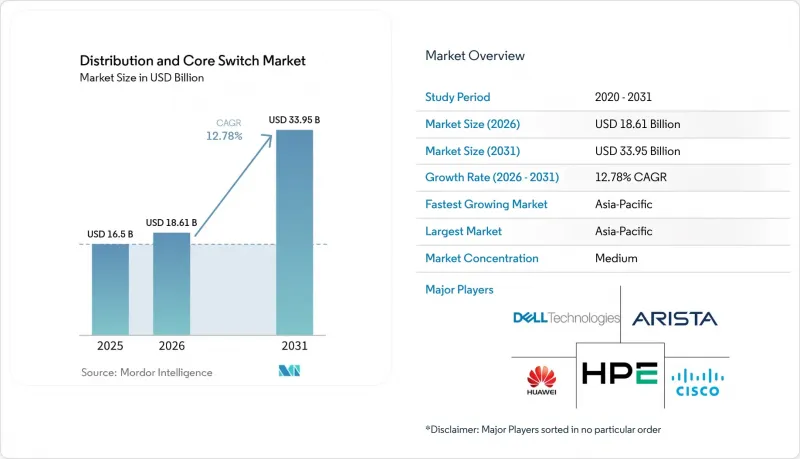
본 보고서는 스위치의 유형(디스트리뷰션 스위치, 코어 스위치), 폼 팩터(고정형 스위치, 모듈형 섀시 스위치, 블레이드 스위치), 포트 속도(1G-10G, 25G-40G, 100G 및 400G 이상), 네트워크 계층(레이어 2 및 레이어 3), 최종 사용자 산업(통신, 데이터센터 등), 그리고 지역별로 분류되어 있습니다. 시장 전망은 금액(달러) 기준으로 제시되어 있습니다.
전 세계 디스트리뷰션 및 코어 스위치 시장 동향 및 인사이트
클라우드 서비스 제공업체들의 하이퍼스케일 시설에 대한 투자 확대
하이퍼스케일 사업자는 수천 대의 스파인 스위치 및 리프 스위치가 필요한 가용성 구역을 운영하고 있으며, 새로 건설되는 캠퍼스에서는 동서 방향 트래픽을 처리하기 위해 12-16대의 코어 섀시와 200-300대의 톱 오브 랙 유닛이 도입되고 있습니다. 구글은 2026년 설비 투자액을 1,750억-1,850억 달러로 제시했으며, 이 예산의 대부분은 800기가비트 패브릭을 통해 GPU 클러스터를 연결하는 AI 인프라에 할당되어 있습니다. 아마존 웹 서비스(Amazon Web Services)는 루이지애나주에 120억 달러를 투자해 새로운 거점을 건설 중이며, 이곳에는 50만 대의 서버가 설치될 예정이며, 각 서버는 듀얼 100기가비트 업링크를 통해 분배 스위치에 연결됩니다. 알리바바 클라우드는 베이징 근교에 3개의 새로운 데이터센터를 건설하여 1 엑사플롭스의 처리 능력을 달성할 계획이며, 이에 따라 멀티테라비트급 핵심 플랫폼에 대한 수요가 더욱 높아지고 있습니다. Equinix와 같은 코로케이션 제공업체의 개조 프로젝트는 테넌트들이 하이브리드 클라우드 워크로드를 위해 400기가비트 연결성을 기대하고 있기 때문에 더 빠른 업데이트 주기를 가져오고 있습니다.
5G 백홀 및 프론트홀 네트워크 확장
무선 액세스 업그레이드에 따라, 무선 헤드와 베이스밴드 유닛 간에 디지털화된 신호를 전송하는 새로운 프론트홀 부문이 형성되면서, 트래픽 패턴이 이더넷 및 패킷·광 통합 장비로 전환되고 있습니다. AT&T는 2025년까지 14,000기의 타워에 광케이블을 연결하고, 각 허브에 집계 스위치를 설치하여 여러 섹터를 다중화했습니다. 버라이즌은 C-밴드의 밀도 향상에 185억 달러를 투자하고, 종단 간 지연 시간을 5밀리초 미만으로 억제하기 위해 모든 링에 저지연 스위치를 설치했습니다. 유럽의 통신 사업자들도 비슷한 전략을 채택하고 있습니다. 도이체 텔레콤은 동기식 이더넷 지원 플랫폼에 170억 유로(181억 달러)를 배정했으며, 오렌지는 시분할 다중화(TDM) 장비의 단계적 폐지를 위해 150억 유로(160억 달러)를 투자하고 있습니다. 이러한 전개에 따라, 향후 200기가비트 및 400기가비트 광 모듈을 지원할 수 있는 모듈형 섀시가 채택되어, 사이트당 트래픽이 10 Gbps를 초과하는 상황에서도 투자 가치를 보호하고 있습니다.
고속 스위치용 ASIC공급망 변동
고성능 스위칭용 반도체는 5nm 및 3nm 공정 노드로 제조되고 있지만, 2027년까지 생산 능력 제약이 지속될 전망입니다. Broadcom의 “Tomahawk 5” 및 “Jericho3-AI”디바이스는 2025년에 리드타임이 6개월 이상으로 늘어나는 상황이 발생하여, Marvell의 “Prestera” 제품군 역시, 각 하이퍼스케일러 기업들이 18개월 치 웨이퍼 슬롯을 선불로 결제했기 때문에 이와 유사한 병목 현상에 직면했습니다. 또한, 코히런트 400기가비트 플러그어블용 인듐 인화물 레이저도 공급 부족에 시달리고 있어, 각 인쇄회로기판 제조업체들은 112 Gbps 직렬 레인에 필요한 엄격한 임피던스 허용 오차 기준을 충족하는 데 어려움을 겪고 있습니다. 여러 통신 사업자들은 시설 개장을 최대 3분기까지 연기하고, 스위치 주문을 미뤘습니다.
부문별 분석
2025년에는 코어 스위치의 매출액이 디스트리뷰션 스위치보다 낮았으나, 2031년까지 연평균 15.45%의 성장률을 기록하며 이를 넘어설 것으로 전망됩니다. 하이퍼스케일 기업의 구매자들이 GPU 클러스터를 포화 상태로 유지하기 위해 51.2 테라비트급 비차단 패브릭을 강력히 요구함에 따라, 프리미엄 섀시에 할당되는 분배 스위치 및 코어 스위치 시장 규모가 확대되고 있습니다. 단일 프레임에서 230.4 Tbps를 구현하는 Arista의 7800R4는 2025년에 AI 백엔드 네트워크의 표준이 된 스파인 스위치가 되었습니다. 코어 구성에서는 모듈성, 이중화된 슈퍼바이저, 그리고 가동 중단 시간 없이 단계적인 확장이 가능한 핫스왑 지원 라인 카드가 중시되고 있습니다. 한편, 디스트리뷰션 플랫폼은 캠퍼스 통합 및 서비스 제공업체의 엣지 환경에서 여전히 필수적이지만, 화이트박스 벤더들의 가격 경쟁으로 인해 수익 증가세가 둔화되고 있습니다. 디스트리뷰션 및 코어 스위치 시장은 현장 업그레이드가 가능한 PHY 메자닌을 통해 400기가비트에서 800기가비트 광 모듈로 전환할 수 있는 섀시로 계속해서 전환되고 있습니다.
이러한 성장은 아키텍처의 변화와도 관련이 있습니다. 리프-스파인-CLOS 패브릭이 3계층 구조를 대체함에 따라, 과거 백본 라우터로 기능하던 장비는 현재 지연 시간이 극히 중요한 스파인 계층이 되었으며, 헤드 오브 라인 블로킹을 일으키지 않으면서 마이크로 버스트를 견뎌내야 합니다. 이 기능을 통해 대용량 버퍼, 컷스루 전송 및 고정밀 텔레메트리를 지원하는 ASIC 파이프라인이 그 장점을 발휘합니다. 프리미엄 섀시의 가격은 50만-80만 달러이며, 출하 대수가 정체되어 있음에도 불구하고 평균 판매 가격을 끌어올려 디스트리뷰션 및 코어 스위치 시장을 활성화시키고 있습니다. Meta와 Google이 공개한 Open Compute Project의 설계에 따라, 코어 도입의 일부가 상용 칩을 채택한 화이트박스로 전환되고 있지만, 기업들은 여전히 오케스트레이션, 분석, 내장형 보안을 포함한 통합형 솔루션에 의존하고 있습니다.
고정형 스위치는 단순성과 낮은 초기 비용 덕분에 2025년에는 53.47%의 시장 점유율을 차지했으나, 컨버지드 인프라의 보급에 따라 블레이드 스위치는 15.20%의 속도로 시장 점유율을 확대되고 있습니다. 네트워크를 컴퓨팅 섀시에 통합함으로써 케이블 배선이 단축되고, 전력 소비가 15% 감소하며, 랙 공간도 절약됩니다. Cisco UCS와 HPE Synergy는 모두 내부 미드플레인 및 백플레인을 채택하여 랙 상단의 혼잡을 줄이고 공기 흐름을 원활하게 하고 있습니다. 하이퍼컨버지드 벤더들은 이 설계를 활용하여, 전문 인력이 없어도 원격 사무실에 설치할 수 있는 턴키 방식의 프라이빗 클라우드 노드를 제공합니다. Dell의 PowerEdge MX는 2025년에 5만 대 이상의 인클로저를 판매하며, 소프트웨어 정의 스토리지와 연동된 통합 패브릭에 대한 수요가 높음을 보여주고 있습니다.
반면, 대규모 기업의 코어 네트워크나 통신 사업자의 집약 네트워크에서는 모듈형 섀시가 여전히 주류를 이루고 있습니다. 이는 현장에서 교체 가능한 카드와 이중화된 슈퍼바이저 덕분에 가동 중지 시간을 거의 제로 수준으로 줄일 수 있기 때문입니다. 기업 캠퍼스의 에지 영역에서는 특히 Wi-Fi 6E나 Wi-Fi 7 액세스 포인트가 멀티 기가비트 속도로 연결되는 경우, 유선 구성이 여전히 주류를 이루고 있습니다. 블레이드 유닛에 탑재되는 분산 스위치 및 코어 스위치 시장 규모는 현재로서는 아직 소규모이지만, 컨테이너 기반 워크로드, 분석, 가상 데스크톱 인프라가 표준화된 스레드로 통합됨에 따라 점차 확대될 것입니다.
지역별 분석
아시아태평양은 2025년에 37.50%의 점유율로 디스트리뷰션 및 코어 스위치 시장을 주도하고, 2031년까지 연평균 성장률(CAGR) 14.40%로 성장할 것으로 전망됩니다. 중국의 국가 컴퓨팅 허브 전략에 따라, 각각 수천 대의 논블로킹 섀시를 도입할 10개의 메가 캠퍼스가 계획되어 있으며, 알리바바 클라우드는 1 엑사플롭스의 AI 성능을 목표로 베이징 지역에 3개의 사이트를 추가하고 있습니다. 텐센트는 데이터센터 확장에 500억 위안(69억 달러)을 배정했으며, 한편 인도의 63억 6,000만 달러 규모의 ‘BharatNet 3단계 "광섬유 프로젝트에서는 25만 곳의 지방 교환국에서 기가비트 대응 집계 기능이 요구되고 있습니다." 한국의 SK텔레콤과 일본의 NTT는 모두 국가 AI 클러스터를 지원하기 위해 400기가비트 패브릭을 확장하고 있으며, 이는 고밀도 스위치에 대한 지속적인 수주를 이끌고 있습니다.
북미에서는 2025년에 2,000억 달러를 넘어선 하이퍼스케일러의 설비 투자를 통해 견실한 수익 기반이 유지되고 있습니다. 구글, AWS, 마이크로소프트, 메타 등 각 기업은 800기가비트 규모의 스파인을 갖춘 새로운 가용성 구역에 각각 자금을 지원하고 있으며, 미국의 광대역 프로그램은 농촌 지역의 통합 인프라 구축을 지원하고 있습니다. 캐나다도 광섬유에 대한 보조금 제도를 통해 이에 발맞추고 있는 반면, 멕시코에서는 개혁을 통해 비록 속도는 완만하지만 경쟁력 있는 통신 사업자들의 네트워크 구축이 촉진되고 있습니다.
유럽에서는 도이체 텔레콤(Deutsche Telekom)의 170억 유로(181억 달러) 및 오렌지(Orange)의 150억 유로(160억 달러) 규모의 현대화 프로그램을 중심으로 꾸준한 확대세가 나타나고 있습니다. 2030년까지 기가비트 통신의 전국적 보급을 목표로 하는 EU의 ‘디지털 디케이드” 구상은 레이어 3 통합에 기반한 광섬유 구축을 촉진하고 있습니다. 또한, 통신 사업자들은 NIS2 지침을 준수해야 하므로, 실시간 위협 감지 기능이 탑재된 스위치에 대한 수요가 증가하고 있습니다.
중동 및 아프리카 및 남미는 시장 점유율이 낮지만, 사우디아라비아의 200억 달러 규모 데이터센터 계획이나 브라질 지방 지역의 5G 네트워크 구축과 같은 메가 프로젝트가 새로운 수주를 가져오고 있습니다. 환율 변동과 공급망의 불안정성이 단기적인 성장을 저해하는 한편, 장기적인 디지털화 노력 덕분에 수주 파이프라인은 활발한 상태를 유지하고 있습니다.
기타 혜택:
- 엑셀 형식 시장 예측(ME) 시트
- 3개월간의 애널리스트 지원
자주 묻는 질문
목차
제1장 서론
제2장 조사 방법
제3장 주요 요약
제4장 시장 구도
제5장 시장 규모와 성장 예측
제6장 경쟁 구도
제7장 시장 기회와 향후 전망
JHS 26.07.07According to Mordor Intelligence, the distribution and core switch market size is expected to increase from USD 18.61 billion in 2026 to USD 33.95 billion by 2031, growing at a CAGR of 12.78% over 2026-2031.
This report is Segmented by Switch Type (Distribution Switches, and Core Switches), Form Factor (Fixed Configuration Switches, Modular Chassis Switches, and Blade Switches), Port Speed (1G-10G, 25G-40G, 100G, and 400G and Above), Network Layer (Layer 2, and Layer 3), End-User Industry (Telecom, Data Centers, and More), and Geography. The Market Forecasts are Provided in Terms of Value (USD).
Global Distribution and Core Switch Market Trends and Insights
Growing Cloud Service Provider Investments in Hyperscale Facilities
Hyperscale operators commission availability zones that require thousands of spine and leaf switches, and every greenfield campus deploys 12-16 core chassis alongside 200-300 top-of-rack units to sustain east-west traffic. Google signaled USD 175 billion-USD 185 billion in 2026 capital outlays, with most of the budget earmarked for AI infrastructure connecting GPU clusters on 800-gigabit fabrics. Amazon Web Services is adding a USD 12 billion Louisiana site that will house 500,000 servers, each attaching to distribution switches through dual 100-gigabit uplinks. Alibaba Cloud is planning three new data centers near Beijing to reach one exaflop of capacity, further lifting demand for multi-terabit core platforms. Retrofit projects at colocation providers such as Equinix add another replacement cycle because tenants expect 400-gigabit connectivity for hybrid-cloud workloads.
Expansion of 5G Backhaul and Fronthaul Networks
Radio access upgrades break out new fronthaul segments that ferry digitized signals between radio heads and baseband units, shifting traffic patterns onto Ethernet and converged packet-optical gear. AT&T extended fiber paths to 14,000 towers in 2025, inserting aggregation switches at each hub to multiplex multiple sectors. Verizon directed USD 18.5 billion toward C-Band densification, placing low-latency switching at every ring to keep end-to-end delay under 5 ms. European operators follow a similar script: Deutsche Telekom allocated EUR 17 billion (USD 18.1 billion) to synchronous Ethernet-ready platforms, and Orange is investing EUR 15 billion (USD 16.0 billion) to sunset time-division multiplexing gear. These rollouts favor modular chassis that accept future 200-gigabit and 400-gigabit optics, protecting investments as traffic per site pushes past 10 Gbps.
Supply Chain Volatility in High-Speed Switch ASICs
Advanced switching silicon is fabricated on 5-nm and 3-nm nodes that remain capacity-constrained through 2027. Broadcom's Tomahawk 5 and Jericho3-AI devices saw lead times stretch beyond six months in 2025, and Marvell's Prestera pipeline faced similar bottlenecks as hyperscalers prepaid wafer slots 18 months ahead. Shortages also hit indium phosphide lasers for coherent 400-gigabit pluggables, while printed-circuit vendors struggle with tight impedance tolerances needed for 112-Gbps serial lanes. Several operators delayed facility openings by up to three quarters, postponing switch orders.
Other drivers and restraints analyzed in the detailed report include:
- Rising Adoption of 400G and 800G Ethernet to Support AI Workloads
- Rapid Growth of Industrial Ethernet in Manufacturing 4.0
- Energy Consumption Concerns of High-Density Switches
For complete list of drivers and restraints, kindly check the Table Of Contents.
Segment Analysis
Core switches captured smaller revenue than distribution switches in 2025 but will outstrip them with 15.45% annual growth through 2031. The distribution and core switch market size allocated to premium chassis is rising because hyperscale buyers insist on 51.2-terabit non-blocking fabrics that keep GPU clusters saturated. Arista's 7800R4, delivering 230.4 Tbps in one frame, became the reference spine for AI back-end networks in 2025. Core configurations favor modularity, redundant supervisors, and hot-swappable line cards that allow incremental scaling without downtime. At the same time, distribution platforms remain indispensable in campus aggregation and service-provider edge roles, but price competition from white-box vendors is muting their revenue trajectory. The distribution and core switch market continues to pivot toward chassis that can migrate from 400-gigabit to 800-gigabit optics via field-upgradeable PHY mezzanines.
Growth is also linked to architectural change. Leaf-spine Clos fabrics replace three-tier hierarchies, so what once acted as a backbone router is now a latency-critical spine layer that must tolerate microbursts without head-of-line blocking. This function rewards ASIC pipelines that support deep buffer, cut-through forwarding, and high-precision telemetry. Premium chassis list between USD 500,000 and USD 800,000, lifting average selling prices and boosting the distribution and core switch market even as unit counts flatten. Open Compute Project designs, published by Meta and Google, are shifting a slice of core deployments to merchant-silicon white boxes, but enterprises still lean on integrated offerings that include orchestration, analytics, and embedded security.
Fixed-configuration switches held 53.47% share in 2025 thanks to simplicity and lower upfront cost, yet blade switches are advancing at 15.20% as converged infrastructure proliferates. Embedding the network into compute chassis shortens cable runs, trims power draw by 15%, and saves rack space. Cisco UCS and HPE Synergy both employ internal midplane backplanes, reducing top-of-rack clutter and easing airflow. Hyperconverged vendors exploit this design to ship turnkey private-cloud nodes that can be installed in remote offices without specialized staff. Dell's PowerEdge MX sold more than 50,000 enclosures in 2025, illustrating appetite for integrated fabrics tied to software-defined storage.
Conversely, modular chassis retain dominance in large enterprise cores and telecom aggregation because field-replaceable cards and redundant supervisors drive downtime toward zero. Fixed configurations still rule at the edge of enterprise campuses, especially where Wi-Fi 6E and Wi-Fi 7 access points attach at multi-gigabit speeds. The distribution and core switch market size attached to blade units remains modest today but will expand as container-based workloads, analytics, and virtual desktop infrastructure converge on standardized sleds.
Complete Report Scope:
- By Switch Type
- Distribution Switches
- Core Switches
- By Form Factor
- Fixed Configuration Switches
- Modular Chassis Switches
- Blade Switches
- By Port Speed
- 1G-10G
- 25G-40G
- 100G
- 400G and Above
- By Network Layer
- Layer 2 Switches
- Layer 3 Switches
- By End-User Industry (Demand Side)
- Telecommunications Service Providers
- Data Centers (Colocation & Hyperscale)
- Enterprises
- Government and Public Sector
- Other End-User Industries
- By Geography
- North America
- United States
- Canada
- Mexico
- Rest of North America
- South America
- Brazil
- Argentina
- Chile
- Rest of South America
- Europe
- Germany
- United Kingdom
- France
- Italy
- Spain
- Russia
- Rest of Europe
- Asia-Pacific
- China
- Japan
- India
- South Korea
- Australia
- Rest of Asia-Pacific
- Middle East
- Saudi Arabia
- United Arab Emirates
- Turkey
- Rest of Middle East
- Africa
- South Africa
- Nigeria
- Egypt
- Rest of Africa
- North America
Geography Analysis
Asia-Pacific led the distribution and core switch market with 37.50% share in 2025 and is projected to expand at a 14.40% CAGR to 2031. China's national computing-hub strategy calls for ten mega campuses that each deploy thousands of non-blocking chassis, and Alibaba Cloud is adding three Beijing-area sites targeting one exaflop of AI performance. Tencent reserved CNY 50 billion (USD 6.9 billion) for data center expansion, while India's USD 6.36 billion BharatNet Phase III fiber project demands gigabit-capable aggregation at 250,000 rural exchanges. South Korea's SK Telecom and Japan's NTT are both scaling 400 Gigabit fabrics to underpin national AI clusters, driving sustained orders for high-density switches.
North America maintains a substantial revenue base due to hyperscaler capital expenditures that topped USD 200 billion in 2025. Google, AWS, Microsoft, and Meta each fund new availability zones with 800 Gigabit spines, and U.S. broadband programs underwrite rural aggregation builds. Canada follows suit with fiber subsidies, whereas Mexico's reforms encourage competitive carrier builds albeit at a slower cadence.
Europe shows steady expansion, anchored by Deutsche Telekom's EUR 17 billion (USD 18.1 billion) and Orange's EUR 15 billion (USD 16.0 billion) modernization programs. The EU Digital Decade mandate for universal gigabit coverage by 2030 stimulates fiber rollouts that hinge on Layer 3 aggregation. Operators must also comply with the NIS2 Directive, spurring demand for switches that embed real-time threat detection.
The Middle East and Africa and South America account for smaller slices, yet mega projects such as Saudi Arabia's USD 20 billion data-center plan and Brazil's rural 5G buildouts introduce fresh orders. Currency volatility and supply-chain variability moderate near-term growth, but long-term digitization agendas keep pipelines active.
- Cisco Systems, Inc.
- Huawei Technologies Co., Ltd.
- Arista Networks, Inc.
- Juniper Networks, Inc.
- Hewlett Packard Enterprise Company
- Extreme Networks, Inc.
- Dell Technologies Inc.
- Nokia Corporation
- NEC Corporation
- Edgecore Networks Corporation
- D-Link Corporation
- TP-Link Technologies Co., Ltd.
- Zyxel Communications Corporation
- Ruijie Networks Co., Ltd.
- H3C Technologies Co., Ltd.
- Allied Telesis Holdings K.K.
- Fortinet, Inc.
- NETGEAR, Inc.
- Avaya LLC
- NVIDIA Corporation
Additional Benefits:
- The market estimate (ME) sheet in Excel format
- 3 months of analyst support
TABLE OF CONTENTS
1 INTRODUCTION
- 1.1 Study Assumptions and Market Definition
- 1.2 Scope of the Study
2 RESEARCH METHODOLOGY
3 EXECUTIVE SUMMARY
4 MARKET LANDSCAPE
- 4.1 Market Overview
- 4.2 Market Drivers
- 4.2.1 Growing Cloud Service Provider Investments in Hyperscale Facilities
- 4.2.2 Expansion of 5G Backhaul and Fronthaul Networks
- 4.2.3 Rising Adoption of 400G and 800G Ethernet to Support AI Workloads
- 4.2.4 Rapid Growth of Industrial Ethernet in Manufacturing 4.0
- 4.2.5 Increased Government Funding for Digital Infrastructure Modernization
- 4.2.6 Emergence of Open Networking and Disaggregated Switching Platforms Driving Cost Efficiency
- 4.3 Market Restraints
- 4.3.1 Supply Chain Volatility in High-Speed Switch ASICs
- 4.3.2 Energy Consumption Concerns of High-Density Switches
- 4.3.3 Escalating Cybersecurity Compliance Costs for Critical Networks
- 4.3.4 Skills Shortage in Managing Software Defined Networks in Emerging Markets
- 4.4 Industry Supply-Chain Analysis
- 4.5 Regulatory Landscape
- 4.6 Technological Outlook
- 4.7 Impact of Macroeconomic Factors on the Market
- 4.8 Porter's Five Forces Analysis
- 4.8.1 Threat of New Entrants
- 4.8.2 Bargaining Power of Suppliers
- 4.8.3 Bargaining Power of Buyers
- 4.8.4 Threat of Substitutes
- 4.8.5 Competitive Rivalry
5 MARKET SIZE AND GROWTH FORECASTS (VALUE)
- 5.1 By Switch Type
- 5.1.1 Distribution Switches
- 5.1.2 Core Switches
- 5.2 By Form Factor
- 5.2.1 Fixed Configuration Switches
- 5.2.2 Modular Chassis Switches
- 5.2.3 Blade Switches
- 5.3 By Port Speed
- 5.3.1 1G-10G
- 5.3.2 25G-40G
- 5.3.3 100G
- 5.3.4 400G and Above
- 5.4 By Network Layer
- 5.4.1 Layer 2 Switches
- 5.4.2 Layer 3 Switches
- 5.5 By End-User Industry (Demand Side)
- 5.5.1 Telecommunications Service Providers
- 5.5.2 Data Centers (Colocation & Hyperscale)
- 5.5.3 Enterprises
- 5.5.4 Government and Public Sector
- 5.5.5 Other End-User Industries
- 5.6 By Geography
- 5.6.1 North America
- 5.6.1.1 United States
- 5.6.1.2 Canada
- 5.6.1.3 Mexico
- 5.6.1.4 Rest of North America
- 5.6.2 South America
- 5.6.2.1 Brazil
- 5.6.2.2 Argentina
- 5.6.2.3 Chile
- 5.6.2.4 Rest of South America
- 5.6.3 Europe
- 5.6.3.1 Germany
- 5.6.3.2 United Kingdom
- 5.6.3.3 France
- 5.6.3.4 Italy
- 5.6.3.5 Spain
- 5.6.3.6 Russia
- 5.6.3.7 Rest of Europe
- 5.6.4 Asia-Pacific
- 5.6.4.1 China
- 5.6.4.2 Japan
- 5.6.4.3 India
- 5.6.4.4 South Korea
- 5.6.4.5 Australia
- 5.6.4.6 Rest of Asia-Pacific
- 5.6.5 Middle East
- 5.6.5.1 Saudi Arabia
- 5.6.5.2 United Arab Emirates
- 5.6.5.3 Turkey
- 5.6.5.4 Rest of Middle East
- 5.6.6 Africa
- 5.6.6.1 South Africa
- 5.6.6.2 Nigeria
- 5.6.6.3 Egypt
- 5.6.6.4 Rest of Africa
- 5.6.1 North America
6 COMPETITIVE LANDSCAPE
- 6.1 Market Concentration
- 6.2 Strategic Moves and Partnerships
- 6.3 Market Share Analysis
- 6.4 Company Profiles (includes Global Level Overview, Market Level Overview, Core Segments, Financials as available, Strategic Information, Market Rank/Share, Products and Services, Recent Developments)
- 6.4.1 Cisco Systems, Inc.
- 6.4.2 Huawei Technologies Co., Ltd.
- 6.4.3 Arista Networks, Inc.
- 6.4.4 Juniper Networks, Inc.
- 6.4.5 Hewlett Packard Enterprise Company
- 6.4.6 Extreme Networks, Inc.
- 6.4.7 Dell Technologies Inc.
- 6.4.8 Nokia Corporation
- 6.4.9 NEC Corporation
- 6.4.10 Edgecore Networks Corporation
- 6.4.11 D-Link Corporation
- 6.4.12 TP-Link Technologies Co., Ltd.
- 6.4.13 Zyxel Communications Corporation
- 6.4.14 Ruijie Networks Co., Ltd.
- 6.4.15 H3C Technologies Co., Ltd.
- 6.4.16 Allied Telesis Holdings K.K.
- 6.4.17 Fortinet, Inc.
- 6.4.18 NETGEAR, Inc.
- 6.4.19 Avaya LLC
- 6.4.20 NVIDIA Corporation
7 MARKET OPPORTUNITIES AND FUTURE OUTLOOK
- 7.1 White-Space and Unmet-Need Assessment


