

|
시장보고서
상품코드
2073162
알츠하이머 치료제 : 시장 점유율 분석, 업계 동향 및 통계, 성장 예측(2026-2031년)Alzheimer´s Therapeutics - Market Share Analysis, Industry Trends & Statistics, Growth Forecasts (2026 - 2031) |
||||||
 Mordor Intelligence
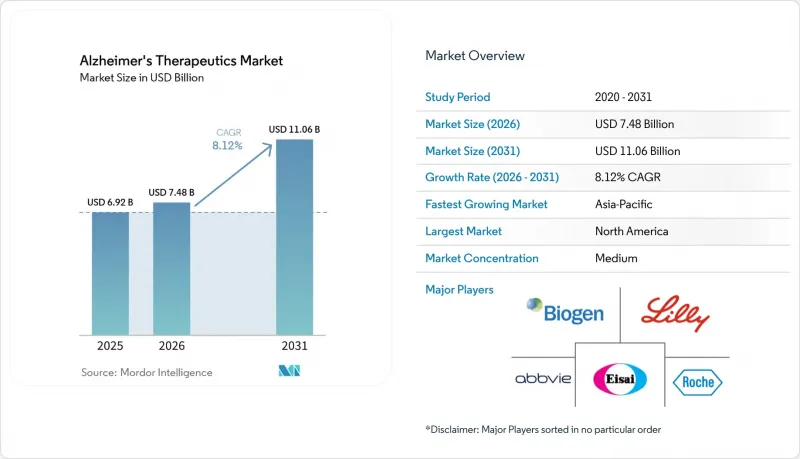
Mordor Intelligence에 의하면, 알츠하이머 치료제 시장 규모는 2025년 69억 2,000만 달러로 평가되었습니다. 2026년 74억 8,000만 달러에서 2031년까지 110억 6,000만 달러로 확대될 것으로 예측되며 2026년부터 2031년까지 연평균 복합 성장률(CAGR)은 8.12%를 나타낼 전망입니다.
본 보고서는 약물 분류별(콜린에스테라제 억제제, NMDA 길항제 등), 치료 유형별(대증요법 및 병태 수정 요법), 투여 경로(경구 투여 등), 유통 채널(병원 약국 등), 환자의 병기(경도 치매 등), 최종 사용자(병원 등), 지역(북미 등)별로 분류되어 있습니다. 예상치는 금액(달러)으로 표시되어 있습니다.
세계의 알츠하이머 치료제 시장 동향 및 인사이트
알츠하이머 유병률 증가와 고령화
알츠하이머는 전체 치매 사례의 60-80%를 차지하며, 성숙한 의료 체계와 신흥 의료 체계 모두에서 인구 고령화에 따라 그 부담이 증가하고 있습니다. 2025년 세계 질병 부담 분석에 따르면, 2050년까지 알츠하이머 및 기타 치매가 1억 9,100만 명에게 영향을 미칠 가능성이 있으며, 특히 동아시아, 남아시아, 사하라 이남 아프리카에서 현저한 증가가 예상됩니다. 미국에서는 2030년까지 모든 베이비붐 세대가 65세 이상이 되며, 새로운 치료법이 보급되는 가운데 가장 큰 규모의 보험 가입 환자층이 발병률 상승기를 맞이하게 될 것입니다. 한편, 현재 치매 환자의 60% 이상은 이미 저·중소득 국가에 집중되어 있으며, 이들 국가에서는 진단 접근성이나 보험 환급 체계가 여전히 충분하지 않습니다. 이는 알츠하이머 치료제 시장에서 질병 부담이 수익 상한선을 훨씬 웃돌고 있음을 의미합니다. 또한, 저비용 경구 투여 경로나 보다 간편한 혈액 검사를 중심으로 한 접근 모델을 구축하는 기업은 정맥 내 투여 중심의 치료 모델로는 효율적으로 대응할 수 없는 수요를 흡수할 수 있음을 보여주고 있습니다.
질환 수정 요법의 보급으로 치료 가능한 환자층이 확대되었습니다.
아밀로이드 치료 분야의 기존 규제 관련 진전에 힘입어, 수년간의 임상적 실망 끝에 알츠하이머 치료제 시장에서 최초로 상업적으로 성공할 수 있는 질환 수정 치료제 카테고리가 탄생했습니다. 2025년 초까지 조사 대상 신경과 전문의의 80%가 환자와 아밀로이드 억제 요법에 대해 논의하고 있다고 보고했으며, 이 요법을 처방하는 신경과 전문의 1인당 평균 환자 수는 전년 대비 5배 가까이 증가했습니다. 이러한 변화는 전문의들의 도입 태도가 “신중"에서 “적극적인 임상 계획"로 전환되었음을 나타냅니다. 또한, 이를 통해 향후 출시될 약물에 대해서도 처음부터 시장을 개척할 필요가 없는 보다 친숙한 치료 경로가 확립될 것입니다. 따라서 알츠하이머의 돌봄 모델은 조기 개입으로 전환되고 있으며, 이에 따라 진단을 받은 환자의 상업적 가치가 확대되고 있습니다. 실무적인 관점에서 볼 때, 알츠하이머 치료제 시장은 신제품의 출시와 적격 환자를 치료하려는 의사의 의욕 고조라는 두 가지 측면을 통해 성장이 가능해졌습니다.
고액의 치료 및 모니터링 비용이 광범위한 접근을 저해하고 있습니다.
알츠하이머 치료제 시장의 접근성 문제는 약가에 그치지 않고, 진단, 모니터링 및 치료 제공에 드는 총비용까지 미칩니다. NICE는 주요 아밀로이드 억제제 2종에 대해 NHS에서의 일상적인 사용을 승인하지 않았습니다. 또한, 다른 수용 능력 분석에 따르면, 잉글랜드가 치료 적격성 평가에서 G7 평균 수준의 진단 체계를 갖추기 위해서는 10년 동안 140억 파운드(188억 달러)가 필요할 것으로 추정됩니다. 미국에서는 CMS가 계속해서 “증거 기반 급여(Coverage with Evidence Development)"라는 체계 하에서 아밀로이드 항체 단일클론 항체에 대한 메디케어의 보험 적용을 등록부 참여와 연계하고 있습니다. 이러한 요건은 이미 자원이 풍부한 치매 프로그램을 운영하지 않는 의료 제공업체들에게 업무 프로세스 및 인력 배치에 대한 부담을 가중시키고 있습니다. 그 결과, 의료 서비스 이용에 격차가 발생하고 있으며, 전문 의료 센터와 가까운 곳에 거주하는 피보험자는 해당 연령대의 일반 환자보다 훨씬 신속하게 치료를 받을 수 있는 상황이 되었습니다. 온라인 약국이 연평균 성장률(CAGR) 11.25%로 성장하고 있기는 하지만, 알츠하이머 치료제 시장에서 비경구적 DMT 치료에 수반되는 막대한 인프라 부담을 이 채널만으로는 해소할 수 없습니다.
부문별 분석
2025년 기준으로, 콜린에스테라제 억제제는 알츠하이머 치료제 시장 점유율의 52.31%를 차지했으며, 이는 오랜 기간에 걸친 처방 실적, 제네릭 의약품의 접근성, 그리고 폭넓은 가격 경쟁력을 반영한 것입니다. NMDA 수용체 길항제는 중등도 및 중증 질환 관리에 있어 여전히 표준 치료법으로 자리 잡고 있어, 두 번째로 큰 시장 점유율을 차지하고 있습니다. 아밀로이드 면역요법은 여전히 수익 기반으로는 규모가 작지만, 치료 조합에 이전보다 더 직접적인 영향을 미치기 시작하고 있습니다. 병용 치료제는 2026년부터 2031년까지 연평균 성장률(CAGR) 10.38%를 나타낼 것으로 예측되며, 이는 해당 부문 내에서 가장 빠른 성장 속도입니다. 알츠하이머 치료제 시장은 새로운 카테고리가 성장세를 보이고 있음에도 불구하고, 수익의 안정성을 확보하기 위해서는 여전히 성숙한 대증요법 약물군에 의존하고 있습니다.
2026년 개발 파이프라인에는 20건의 진행 중인 병용 요법 임상시험이 포함되어 있으며, 이는 전체 진행 중인 임상시험의 11%에 해당합니다. 이는 각 개발사가 여러 작용기전을 결합한 전략을 얼마나 중시하고 있는지를 보여줍니다. Eisai가 진행 중인 E2814와 레카네맙의 병용 임상시험은 현재 진행 중인 이러한 접근 방식의 가장 명확한 사례입니다. 2026년에는 파이프라인에 포함된 모든 약물의 35%가 기존 약물의 용도 변경으로 이루어졌으며, 이로 인해 연구 영역은 기존의 신경약리학의 범위를 넘어 확장되었습니다. 이러한 폭넓은 접근 방식은 타우, 신경염증, 대사 및 관련 경로를 아우르는 보다 광범위한 가치 탐구를 뒷받침하고 있습니다. 다른 치료제 분류도 유용한 깊이를 더해주고 있지만, 알츠하이머 치료제 시장의 단기적인 수익은 여전히 확립된 대증요법 제품과 질병 수정 요법(DMT)의 조기 도입에 집중되어 있습니다.
2025년에는 대증요법이 시장의 62.24%를 차지했으나, 질환 수정 요법(DMT)은 2031년까지 연평균 성장률(CAGR) 10.52%로 확대될 것으로 전망됩니다. 이러한 구성 비율은 알츠하이머 치료제 시장이 현재 수익 창출 측면에서 여전히 오랫동안 자리 잡은 처방약에 의존하고 있음을 보여줍니다. 콜린에스테라제 억제제나 NMDA 길항제는 DMT의 보험 급여 제도가 아직 성숙되지 않은 의료 체계 속에서 여전히 광범위하게 사용되고 있습니다. 질환 수정 요법(DMT)이 더욱 빠르게 확산되고 있는 것은 단순한 증상 관리가 아닌 조기 개입으로 치료 방침을 전환하기 위함입니다. 따라서 치료 과정이 더욱 표준화됨에 따라, 알츠하이머 치료제 시장에서 질병 진행 억제 요법 시장 규모는 시장 전체보다 빠른 속도로 확대될 전망입니다.
2025년에는 신경과 의사들이 환자와 항아밀로이드 치료에 대해 논의하는 데 긍정적인 태도를 보이면서, 임상 현장에서의 도입이 급격히 가속화되었습니다. 이러한 변화는 중요한 의미를 지닙니다. 왜냐하면 DMT의 적용 기준은 말기 증상의 심각도가 아니라, 초기 병리학적 소견이나 기능 단계와 관련되어 있기 때문입니다. 조기에 병세를 파악할 수 있다면 치료 기간을 연장할 수 있으며, 시간이 지남에 따라 치료를 받는 환자 한 명 한 명의 가치를 높일 수 있습니다. 따라서 대증요법은 많은 치료 과정에서 유일한 현실적인 선택지로 남아 있는 것이 아니라, 보완적인 역할로 전환되고 있습니다. 유지 요법이 재택 간호에 점점 더 가까워진다면, 알츠하이머 치료제 시장은 병태 수정 요법 분야에서 간호 환경으로 인한 장벽에 직면할 기회가 줄어들 것입니다.
지역별 분석
2025년, 북미는 알츠하이머 치료제 시장 점유율의 40.24%를 차지하며, 지역별 매출 기준 중 가장 큰 비중을 차지했습니다. 이러한 추세를 주도한 것은 미국으로, 2026년에는 65세 이상의 알츠하이머형 치매 환자가 740만 명에 달하고, 국가의 의료 및 장기 요양 비용은 4,090억 달러에 이를 것으로 예측됩니다. 또한, 이 지역은 보험 적용 범위가 넓을 뿐만 아니라, ‘증거 기반 보험 적용(Coverage with Evidence Development)’ 제도 하에서 항아밀로이드 항체에 대한 명확한 메디케어 적용 경로가 확립되어 있다는 점에서도 혜택을 받고 있습니다. 캐나다와 멕시코의 경우, 전문의 진료를 받기 어렵고 보험 적용 범위도 더 제한적이기 때문에 시장 기회는 여전히 소규모에 그치고 있습니다. 유럽의 상황은 더 복잡합니다. 2025년에 레카네맙이 유럽연합 집행위원회의 승인을 획득한 반면, 도나네맙은 유럽에서 위험-이익 평가 결과가 좋지 않았기 때문입니다.
아시아태평양은 2026년부터 2031년까지 연평균 성장률(CAGR) 11.15%를 나타낼 것으로 예측되며, 알츠하이머 치료제 시장에서 가장 빠르게 성장하는 지역이 될 것입니다. 일본과 중국은 조기 병태 수정 치료제(DMT)의 상용화를 위한 로드맵이 이미 명확히 수립되어 있어, 이러한 확장의 최전선에 위치해 있습니다. 또한, 이 지역에서는 희소한 PET 인프라에 대한 의존도를 낮출 수 있는 혈액 검사를 통한 진단의 역할이 확대되고 있는 점도 긍정적인 요인으로 작용하고 있습니다. 한국, 인도, 호주는 아직 도입 초기 단계에 있지만, 전문의에 대한 접근성 개선과 환자의 조기 발견을 통해 각각 확대될 여지가 있습니다. 아시아태평양의 알츠하이머 치료제 시장은 진단, 모니터링, 보험 급여가 같은 방향으로 움직이기 시작하면 규모가 급속히 확대될 것입니다.
남미, 중동 및 아프리카(MEA)는 알츠하이머 치료제 시장에서 여전히 수익 기여도가 낮으며, 증상 완화용 경구약이 여전히 수요의 대부분을 차지하고 있습니다. 남미에서는 브라질과 아르헨티나가 주도적인 역할을 하고 있는 반면, 중동 및 아프리카에서는 의료 지출과 전문의 체계가 비교적 잘 갖춰져 있어 GCC 국가들이 단기적으로 가장 큰 잠재력을 가지고 있습니다. 전 세계 치매 환자의 60% 이상이 이미 저·중소득 국가에서 발생하고 있지만, DMT 수익의 대부분은 여전히 고소득 국가의 의료 제도에서 창출되고 있습니다. 따라서, 합리적인 가격의 경구용 약물, 보다 광범위한 인식 제고 프로그램, 그리고 간소화된 진단 절차가 2031년까지 이들 지역에서 알츠하이머 치료제 시장이 어느 정도까지 확대될 수 있을지를 결정짓게 될 것입니다.
기타 혜택 :
- 엑셀 형식 시장 예측(ME) 시트
- 3개월간의 애널리스트 지원
자주 묻는 질문
목차
제1장 서론
제2장 조사 방법
제3장 주요 요약
제4장 시장 구도
제5장 시장 규모 및 성장 예측
제6장 경쟁 구도
제7장 시장 기회 및 향후 전망
KTH 26.07.08According to Mordor Intelligence, the alzheimer's therapeutics market size is projected to expand from USD 6.92 billion in 2025 and USD 7.48 billion in 2026 to USD 11.06 billion by 2031, registering a CAGR of 8.12% between 2026 to 2031.
This report is Segmented by Drug Class (Cholinesterase Inhibitors, NMDA Antagonists, and More), Treatment Type (Symptomatic Treatment and Disease Modifying Therapies), Route of Administration (Oral and More), Distribution Channel (Hospital Pharmacies and More), Patient Stage (Mild Dementia and More), End User (Hospitals and More), and Geography (North America and More). Forecasts are in Value (USD).
Global Alzheimer's Therapeutics Market Trends and Insights
Rising Alzheimer's Prevalence and Aging Population
Alzheimer's disease accounts for 60-80% of all dementia cases, and the burden is rising as populations age across both mature and emerging healthcare systems. A 2025 global burden analysis projected that Alzheimer's disease and other dementias could affect 191 million people by 2050, with especially strong growth across East Asia, South Asia, and sub-Saharan Africa. In the United States, all baby boomers will be aged 65 or older by 2030, which places the largest insured patient pool at a point of rising incidence while newer treatments are scaling. At the same time, more than 60% of current dementia cases are already located in lower- and middle-income countries, where diagnostic access and reimbursement remain much weaker. This means the disease burden ceiling is much higher than the revenue ceiling in the Alzheimer's therapeutics market. It also means companies that build lower-cost oral pathways or simpler blood-test-led access models can reach demand that IV-focused treatment models cannot serve efficiently.
Disease-Modifying Therapy Adoption Expands Treatable Patient Pool
Traditional regulatory progress for anti-amyloid therapies has created the first commercially viable disease-modification category in the Alzheimer's therapeutics market, after years of clinical disappointment. By early 2025, 80% of surveyed neurologists reported discussing anti-amyloid therapies with patients, and the average number of patients per prescribing neurologist had increased nearly 5-fold from the prior year. That shift shows that specialist adoption moved from caution to active clinical planning. It also creates a more familiar treatment pathway for future agents that will not need to start from a cold market. The Alzheimer care model is therefore moving toward earlier intervention, which expands the commercial value of diagnosed patients. In practical terms, the Alzheimer's therapeutics market can now grow through both new product entry and deeper physician willingness to treat eligible patients.
High Treatment and Monitoring Cost Limits Broad Access
The access problem in the Alzheimer's therapeutics market extends beyond drug price into the full cost of diagnosis, monitoring, and delivery. NICE rejected both leading anti-amyloid drugs for routine NHS use, and a separate capacity analysis estimated that GBP 14 billion (USD 18.8 billion) would be needed over 10 years to bring England to G7-average diagnostic readiness for treatment eligibility assessment. In the United States, CMS continues to tie Medicare reimbursement for anti-amyloid monoclonal antibodies to registry participation under its Coverage with Evidence Development framework. That requirement adds process and staffing burdens for providers that do not already operate high-resource dementia programs. The result is uneven access, where insured patients close to specialist centers can move much faster than the wider age-eligible population. Even with online pharmacies growing at 11.25% CAGR, that channel cannot remove the high-touch infrastructure burden attached to parenteral DMT care in the Alzheimer's therapeutics market.
Other drivers and restraints analyzed in the detailed report include:
- Biomarker-Led Patient Identification Improves Therapy Eligibility
- Hospital-Based Infusion and Monitoring Infrastructure Supports Premium Therapies
- Safety Monitoring Burden and Adverse Event Risk Restrict Uptake
For complete list of drivers and restraints, kindly check the Table Of Contents.
Segment Analysis
Cholinesterase inhibitors held 52.31% of the Alzheimer's therapeutics market share in 2025, reflecting long prescribing history, generic availability, and broad affordability. NMDA receptor antagonists represented the second-largest position because they remain a standard option in moderate and severe disease management. Amyloid immunotherapies still formed a smaller revenue base, but they have started to influence treatment mix more directly than before. Combination drugs are projected to grow at a 10.38% CAGR from 2026 to 2031, which is the fastest pace within this segmentation. The Alzheimer's therapeutics market still relies on mature symptomatic classes for revenue stability even as newer categories gain traction.
The 2026 development pipeline contained 20 active combination therapy trials, equal to 11% of all active trials, which shows how strongly developers are leaning into multi-mechanism strategies. Eisai's study of E2814 with concurrent lecanemab is the clearest example of this approach now in motion. Repurposed assets accounted for 35% of all pipeline agents in 2026, which widened the field beyond traditional neurology pharmacology. That breadth supports a larger search for value across tau, neuroinflammation, metabolism, and related pathways. Other classes contribute useful depth, but near-term revenue in the Alzheimer's therapeutics market remains concentrated in established symptomatic products and early commercial DMT adoption.
Symptomatic treatments held 62.24% of the market in 2025, while disease-modifying therapies are projected to expand at a 10.52% CAGR through 2031. This split shows that the Alzheimer's therapeutics market still depends on long-established prescriptions for current revenue generation. Cholinesterase inhibitors and NMDA antagonists retain wide reach in systems where DMT reimbursement is not yet mature. Disease-modifying therapies are rising faster because they shift care toward earlier intervention rather than symptom control alone. The Alzheimer's therapeutics market size for disease-modifying therapies is therefore set to expand faster than the overall sector as care pathways become more standardized.
Clinical adoption accelerated sharply in 2025 as neurologists became more willing to discuss anti-amyloid treatment with patients. That change matters because DMT eligibility is tied to early pathology and functional stage rather than late-stage symptom burden. Earlier identification can extend treatment duration and increase the value of each treated patient over time. Symptomatic therapies are therefore shifting into a complementary role instead of remaining the only realistic option in many treatment journeys. If maintenance dosing keeps moving closer to the home, the Alzheimer's therapeutics market should face fewer care setting barriers in disease modification.
Complete Report Scope:
- By Drug Class
- Cholinesterase Inhibitors
- NMDA Receptor Antagonists
- Amyloid Immunotherapies
- Combination Therapies
- Other Drug Classes
- By Type of Treatment
- Symptomatic Treatment
- Disease Modifying Therapies
- By Route of Administration
- Oral
- Injectable
- Transdermal
- By Distribution Channel
- Hospital Pharmacies
- Retail Pharmacies
- Online Pharmacies
- Other Distribution Channels
- By Patient Stage
- Mild Cognitive Impairment
- Mild Dementia
- Moderate Dementia
- Severe Dementia
- By End User
- Hospitals
- Memory Clinics
- Home Care Settings
- Other End Users
- By Geography
- North America
- United States
- Canada
- Mexico
- Europe
- Germany
- United Kingdom
- France
- Italy
- Spain
- Rest of Europe
- Asia-Pacific
- China
- Japan
- India
- Australia
- South Korea
- Rest of Asia-Pacific
- Middle East and Africa
- GCC
- South Africa
- Rest of Middle East and Africa
- South America
- Brazil
- Argentina
- Rest of South America
- North America
Geography Analysis
North America held 40.24% of the Alzheimer's therapeutics market share in 2025, making it the largest regional revenue base. The United States drove this position with 7.4 million people aged 65 and older living with Alzheimer's dementia in 2026, while national health and long-term care costs are projected at USD 409 billion. The region also benefits from broader insurance depth and a defined Medicare pathway for anti-amyloid antibodies under Coverage with Evidence Development. Canada and Mexico remain smaller opportunities because specialist access and reimbursement breadth are more limited. Europe presents a more divided picture because lecanemab secured European Commission approval in 2025 while donanemab faced a less favorable benefit-risk outcome in Europe.
Asia-Pacific is projected to grow at an 11.15% CAGR from 2026 to 2031, which makes it the fastest regional growth zone in the Alzheimer's therapeutics market. Japan and China are positioned at the front of this expansion because they already have clearer paths for early DMT commercialization. The region also benefits from the growing role of blood-based diagnostics, which can reduce dependence on scarce PET infrastructure. South Korea, India, and Australia remain earlier in adoption, yet each has room to expand through better specialist access and earlier patient identification. The Alzheimer's therapeutics market in Asia-Pacific can scale quickly once diagnosis, monitoring, and reimbursement begin to move in the same direction.
South America and the Middle East and Africa remain smaller revenue contributors in the Alzheimer's therapeutics market, and symptomatic oral treatments still account for most demand. Brazil and Argentina lead South American activity, while the GCC countries offer the strongest near-term potential within MEA because healthcare spending and specialist capacity are relatively stronger. More than 60% of global dementia cases already occur in lower- and middle-income countries, yet most DMT revenue still accrues in high-income healthcare systems. Affordable oral drugs, broader awareness programs, and simpler diagnostic pathways will therefore determine how much of the Alzheimer's therapeutics market can open in these regions through 2031.
- Abbvie
- AC Immune SA
- Alector, Inc.
- Alzheon, Inc.
- Anavex Life Sciences Corp.
- Biogen
- Denali Therapeutics
- Eisai
- Eli Lilly and Company
- Roche
- Grifols
- H. Lundbeck
- Johnson & Johnson
- Merck
- Novartis
- Novo Nordisk
- Otsuka
- Takeda Pharmaceuticals
Additional Benefits:
- The market estimate (ME) sheet in Excel format
- 3 months of analyst support
TABLE OF CONTENTS
1 Introduction
- 1.1 Study Assumptions & Market Definition
- 1.2 Scope of the Study
2 Research Methodology
3 Executive Summary
4 Market Landscape
- 4.1 Market Overview
- 4.2 Market Drivers
- 4.2.1 Rising Alzheimer's Prevalence and Aging Population
- 4.2.2 Disease Modifying Therapy Adoption Expands Treatable Patient Pool
- 4.2.3 Biomarker Led Patient Identification Improves Therapy Eligibility
- 4.2.4 Hospital Based Infusion and Monitoring Infrastructure Supports Premium Therapies
- 4.2.5 Payer and Registry Pathways Are Normalizing Real World Evidence Based Access
- 4.2.6 Repurposed Metabolic and Neuroprotective Assets Broaden the Pipeline
- 4.3 Market Restraints
- 4.3.1 High Treatment and Monitoring Cost Limits Broad Access
- 4.3.2 Safety Monitoring Burden and Adverse Event Risk Restrict Uptake
- 4.3.3 Clinical Trial Failure and Attrition Increase Capital Risk
- 4.3.4 Narrow Specialist Capacity Slows Diagnosis to Treatment Conversion
- 4.4 Supply Chain Analysis
- 4.5 Regulatory Landscape
- 4.6 Porter's Five Forces Analysis
- 4.6.1 Bargaining Power of Suppliers
- 4.6.2 Bargaining Power of Buyers
- 4.6.3 Threat of New Entrants
- 4.6.4 Threat of Substitutes
- 4.6.5 Industry Rivalry
5 Market Size & Growth Forecasts (Value, USD)
- 5.1 By Drug Class
- 5.1.1 Cholinesterase Inhibitors
- 5.1.2 NMDA Receptor Antagonists
- 5.1.3 Amyloid Immunotherapies
- 5.1.4 Combination Therapies
- 5.1.5 Other Drug Classes
- 5.2 By Type of Treatment
- 5.2.1 Symptomatic Treatment
- 5.2.2 Disease Modifying Therapies
- 5.3 By Route of Administration
- 5.3.1 Oral
- 5.3.2 Injectable
- 5.3.3 Transdermal
- 5.4 By Distribution Channel
- 5.4.1 Hospital Pharmacies
- 5.4.2 Retail Pharmacies
- 5.4.3 Online Pharmacies
- 5.4.4 Other Distribution Channels
- 5.5 By Patient Stage
- 5.5.1 Mild Cognitive Impairment
- 5.5.2 Mild Dementia
- 5.5.3 Moderate Dementia
- 5.5.4 Severe Dementia
- 5.6 By End User
- 5.6.1 Hospitals
- 5.6.2 Memory Clinics
- 5.6.3 Home Care Settings
- 5.6.4 Other End Users
- 5.7 By Geography
- 5.7.1 North America
- 5.7.1.1 United States
- 5.7.1.2 Canada
- 5.7.1.3 Mexico
- 5.7.2 Europe
- 5.7.2.1 Germany
- 5.7.2.2 United Kingdom
- 5.7.2.3 France
- 5.7.2.4 Italy
- 5.7.2.5 Spain
- 5.7.2.6 Rest of Europe
- 5.7.3 Asia-Pacific
- 5.7.3.1 China
- 5.7.3.2 Japan
- 5.7.3.3 India
- 5.7.3.4 Australia
- 5.7.3.5 South Korea
- 5.7.3.6 Rest of Asia-Pacific
- 5.7.4 Middle East and Africa
- 5.7.4.1 GCC
- 5.7.4.2 South Africa
- 5.7.4.3 Rest of Middle East and Africa
- 5.7.5 South America
- 5.7.5.1 Brazil
- 5.7.5.2 Argentina
- 5.7.5.3 Rest of South America
- 5.7.1 North America
6 Competitive Landscape
- 6.1 Market Concentration
- 6.2 Market Share Analysis
- 6.3 Company Profiles (includes Global Level Overview, Market Level Overview, Core Segments, Financials as available, Strategic Information, Market Rank/Share, Products and Services, Recent Developments)
- 6.3.1 AbbVie Inc.
- 6.3.2 AC Immune SA
- 6.3.3 Alector, Inc.
- 6.3.4 Alzheon, Inc.
- 6.3.5 Anavex Life Sciences Corp.
- 6.3.6 Biogen Inc.
- 6.3.7 Denali Therapeutics Inc.
- 6.3.8 Eisai Co., Ltd.
- 6.3.9 Eli Lilly and Company
- 6.3.10 F. Hoffmann-La Roche Ltd
- 6.3.11 Grifols, S.A.
- 6.3.12 H. Lundbeck A/S
- 6.3.13 Johnson & Johnson
- 6.3.14 Merck & Co., Inc.
- 6.3.15 Novartis AG
- 6.3.16 Novo Nordisk A/S
- 6.3.17 Otsuka Pharmaceutical Co., Ltd.
- 6.3.18 Takeda Pharmaceutical Company Limited
7 Market Opportunities & Future Outlook
- 7.1 White-Space and Unmet-Need Assessment


