

|
시장보고서
상품코드
2073163
알츠하이머병 진단 : 시장 점유율 분석, 업계 동향 및 통계, 성장 예측(2026-2031년)Alzheimer´s Disease Diagnostics - Market Share Analysis, Industry Trends & Statistics, Growth Forecasts (2026 - 2031) |
||||||
 Mordor Intelligence
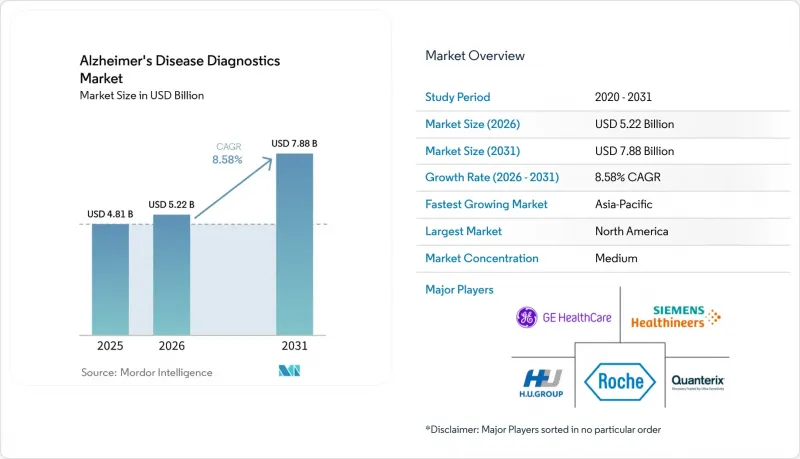
Mordor Intelligence에 의하면, 알츠하이머병 진단 시장 규모는 2025년 48억 1,000만 달러로 평가되었습니다. 2026년에는 52억 2,000만 달러로 확대되어 2031년까지 78억 8,000만 달러에 이를 것으로 예상되며 2026년부터 2031년에 걸쳐 CAGR 8.58%로 성장할 전망입니다.
본 보고서는 진단 기법(바이오마커, 영상 진단, 유전자 검사, 인지 기능 검사), 유형(진단, 선별 검사, 트리아지), 최종 사용자(병원, 진단 검사 기관, 학술 기관, 기타 최종 사용자), 지역(북미, 유럽, 아시아태평양, 중동 및 아프리카, 남미)별로 분류되어 있습니다. 시장 전망은 금액(달러) 기준으로 제시되어 있습니다.
세계의 알츠하이머병 진단 시장 동향 및 인사이트
혈액 기반 바이오마커의 활용 확대
2025년 5월, FDA가 Fujirebio의 ‘Lumipulse G pTau217/B-Amyloid 1-42 Plasma Ratio"를 알츠하이머병과 관련된 아밀로이드 병변을 식별하기 위해 개발된 미국 최초의 혈액 기반 체외 진단제로 승인함에 따라, 알츠하이머병 진단제 시장은 혈액 기반 바이오마커를 중심으로 재편되고 있습니다. 이 승인을 뒷받침하는 다기관 공동 연구에서는 인지 기능 장애가 있는 환자 499명을 대상으로 PET 및 뇌척수액(CSF)의 기준치와 비교한 결과, 91.7%의 양성 예측도와 97.3%의 음성 예측도가 나타났습니다. 이를 통해 임상의들은 기존의 선별 검사 도구가 도달했던 수준보다 확립된 확정 진단법에 훨씬 더 가까운 기준을 확보할 수 있게 되었습니다. 2025년 10월까지, Roche의 “Elecsys pTau181"는 1차 진료를 명확한 목적으로 하는 유일한 FDA 승인 혈액 검사가 되었으며, 이후 Labcorp는 2026년 초까지 미국 전역으로 서비스를 확대하겠다고 약속했습니다. 이로 인해 검사 의뢰의 주도권은 전문 신경과 의사의 범위를 넘어 일반 진료의 업무 흐름으로 옮겨갔습니다.
Quest Diagnostics 역시 약 2,000곳의 환자 서비스 센터로 구성된 네트워크를 통해 Fujirebio의 검사를 제공함으로써 이러한 변화를 뒷받침했습니다. 이로 인해 알츠하이머병 진단 시장에서 참조 검사실 경로는 즉시 규모 면에서 우위를 점하게 되었습니다. 그 후, 알츠하이머병 협회는 2025년에 혈액 기반 바이오마커 검사에 관한 최초의 임상 실무 지침을 발표했습니다. 여기에는 트리아지 및 PET·뇌척수액 검사로의 전환에 관한 임계값 기준이 포함되어 있어, 검사 도입 및 임상 적용에 관한 의사결정 과정에서 실용적인 선별 기준으로 기능하기 시작했습니다. 이러한 프레임워크는 성능과 워크플로우 측면의 기대를 모두 충족하는 검사법으로의 신속한 통합을 촉진하고 있으며, 그로 인해 알츠하이머병 진단 시장에서는 단기적으로 임상적으로 검증된 상용 플랫폼 중 극히 일부 그룹이 우위를 점할 가능성이 높다고 볼 수 있습니다.
기억 클리닉에서 AI를 활용한 영상 진단을 통한 분류
알츠하이머병 진단 시장은 AI를 활용한 영상 진단을 통한 선별 진단을 통해서도 뒷받침되고 있습니다. 이는 기억 클리닉이 모든 환자에 대해 PET 검사를 첫 단계로 삼지 않으면서도, 증가하는 의뢰 환자 수를 처리해야 한다는 압박에 직면해 있기 때문입니다. 『Journal of Medical Internet Research』에 게재된 2026년의 체계적 문헌고찰에서는 66건의 연구가 평가되었으며, 평균 진단 정확도는 92.5%(표준편차 3.8%), 다중 모달리티 융합 아키텍처 전체의 MCI 전환 AUC는 0.922로 보고되었습니다. 이는 검토 대상이 된 근거 기반 연구에서 단일 모달리티의 기준치를 명백히 상회하는 성능을 보여주고 있습니다. TRACE4AD는 이탈리아, 미국, 캐나다의 66개 기관에서 797명의 피험자를 대상으로 한 다기관 공동 검증 연구를 통해 실용적인 임상 사례를 추가했습니다. 이 연구에서는 AI를 활용한 신경심리학적 평가 및 MRI를 통한 병기 분류를 통해, 이미 널리 이용 가능한 구조적 영상을 활용하여 임상적으로 유의미한 정확도로 24개월 후 알츠하이머형 치매로의 진행을 예측했습니다. 그렇다고 해서 알츠하이머병 진단 시장에서 PET의 역할이 사라지는 것은 아닙니다. 왜냐하면, 혈액 검사 결과가 중간 단계인 환자의 경우 여전히 검사의 단계적 확대가 필요하며, 규모는 작지만 진단율이 높은 증례군에서는 확인을 위한 영상 검사가 여전히 중요하기 때문입니다.
Siemens Healthineers는 2026년 4월, Bio-Hermes-002 관찰 연구에 참여하고, 보다 다양한 인종 및 민족 집단에 대응할 수 있도록 Atellica IM 바이오마커 분석법을 제공함으로써 이러한 방향성을 더욱 추진했습니다. 이는 제한된 코호트를 대상으로 학습된 AI 및 바이오마커 모델이 실제 임상 현장에서 충분히 일반화될 수 있을지에 대한 큰 우려를 해소하기 위한 것입니다. 이러한 도구가 진료 처리 능력과 사례 선별 능력을 향상시킴에 따라, 알츠하이머병 진단 시장은 AI가 단순히 기존 검사법을 대체하는 것이 아니라, 각 확정 검사의 양성률을 높이는 모델로 전환되고 있습니다.
고도화된 검사에 대한 보험 급여의 큰 장벽
알츠하이머병 진단 시장은 2025년과 2026년에 임상적 타당성 검증과 규제 당국의 승인이 크게 개선된 후에도 여전히 보험 급여라는 명확한 상업적 장벽에 직면해 있습니다. 2025년 5월 FDA가 Fujirebio의 혈액 검사를 승인한 후, CMS는 당초 검사 1회당 17달러의 환급률을 제안했으나, 자문위원회의 권고안에서는 130달러가 제시되면서, 광범위한 상업 검사실 도입에 있어 임상적 가치와 경제적 실행 가능성 사이에 큰 격차가 발생했습니다. 2026년 1월에는 개별 분석 항목별로 청구 가능한 CPT 코드 82233, 82234 및 84393이 도입되면서 부분적인 개선이 이루어졌습니다. 이를 통해 단일 포괄 요금으로는 달성할 수 없는 훨씬 더 높은 보상 수준을, 다항목 패널 검사를 통해 달성할 가능성이 열렸습니다.
이러한 변화에도 불구하고, 알츠하이머병 진단 시장은 여전히 정책적 불확실성에 직면해 있습니다. 2026년 중반 시점에서 ASAP 법안은 여전히 의회에서 심의 중이었으며, FDA 승인을 받은 모든 혈액 검사 기반 선별 도구에 대해 메디케어 내에서 완전히 확정된 적용 절차가 마련되지 않았기 때문입니다. 이는 진단 분야에만 국한되지 않는 중요한 문제입니다. 왜냐하면 치료의 시행은 적시에 내려지는 확정 진단에 달려 있으며, 보험 지급 절차의 지연은 단순한 검사 자체뿐만 아니라 치료의 전 과정을 지연시킬 가능성이 있기 때문입니다. 임상 검사 요금표나 고도 진단 검사의 지정 절차를 포함한 근본적인 정책 체계는 검사가 그 자체의 가치에 따라 가격이 책정되는지, 아니면 그 임상적 역할을 반영하지 않는 광범위한 검사 코드 체계를 기준으로 가격이 책정되는지를 계속해서 좌우하고 있습니다.
부문별 분석
2025년, 알츠하이머병 진단 시장에서 영상 진단 기술은 38.31%의 점유율을 차지했습니다. PET 및 MRI가 아밀로이드 부하, 구조적 위축 및 환자의 확정 진단을 위한 전문 검사의 기반으로서 계속해서 중요한 역할을 하고 있기 때문에 이 부문은 여전히 1위 자리를 지켰습니다. 알츠하이머병 진단 시장은 여전히 의료 현장에서 사용되는 고부가가치 영상 진단 장비에 크게 의존하고 있습니다. 이는 병원이나 기억장애 클리닉이 신경내과로의 의뢰 절차나 치료 결정 과정에 이미 통합되어 있는 오랫동안 확립된 PET 및 MRI 업무 흐름에 의존하고 있기 때문입니다. 바이오마커는 2026년부터 2031년까지 연평균 성장률(CAGR) 12.38%를 기록하며, 가장 빠르게 성장하고 있는 진단 기술입니다. 이는 혈액 검사가 연구 분야에서 전문 의료 및 1차 진료의 각 채널에서 이루어지는 일상적인 체외 진단 용도로 전환되고 있음을 반영합니다. 이로 인해 알츠하이머병 진단 업계에는 이중 구조가 형성되고 있습니다. 영상 진단은 확정 진단 및 경과 관찰에서 여전히 핵심적인 역할을 수행하는 한편, 바이오마커 검사를 통해 더 조기에, 또한 운영 비용을 절감하며 진단 평가를 받을 수 있는 환자 수가 증가하고 있습니다. 유전자 검사는 현재 임상 현장에서 아직 소규모 분야에 그치고 있지만, 임상의가 항아밀로이드 요법의 치료 적격성을 평가하거나 위험에 대해 설명할 때 ApoE4 유무가 점점 더 중요하게 여겨지고 있기 때문에 그 중요성은 높아지고 있습니다.
GE HealthCare는 2025년 6월, 정량적 아밀로이드 PET 분석 및 항아밀로이드 치료에 대한 환자의 반응 모니터링을 지원하는 ‘ Vizamyl"의 적응증 확대에 대해 FDA의 승인을 획득함으로써, 영상 진단이 단순한 “일대일"라는 형태로 대체될 가능성이 낮은 이유를 설명했습니다. 이러한 움직임에 따라 PET는 치료 모니터링 분야로 그 영역을 확장하고 있으며, 알츠하이머병 진단 시장에서 혈액 검사가 일선 접근성을 넓혀가고 있음에도 불구하고, 영상 진단 기술은 여전히 중요한 역할을 수행하고 있습니다. 인지 기능 평가 검사도 꾸준히 보급되고 있으며, 특히 환자가 바이오마커나 영상 진단을 통한 확정 검사로 넘어가기 전에, 원격 또는 초기 선별 검사를 지원하는 AI 기반 디지털 플랫폼을 통해 이러한 추세가 나타나고 있습니다. 따라서 혈액 검사, 디지털 스크리닝, 영상 진단을 통한 확정 진단, 그리고 유전적 위험도 평가가 서로 독립된 선택지가 아니라 상호 연관된 단계로서 점점 더 널리 활용되고 있기 때문에 많은 실제 임상 상황에서 이러한 방법들 간의 상호작용은 시너지 효과를 가져오고 있습니다. FDA의 510(k) 체계와 EU의 IVDR에 기반한 규제 심사 기준은 새로운 검사법이 임상적 잠재력 단계에서 광범위한 상업적 활용 단계로 전환되는 속도를 계속해서 좌우하고 있습니다. 즉, 시장에서 주도권을 잡는 것은 기술의 성능뿐만 아니라 검증, 승인, 도입에 이르는 실행력에도 좌우된다는 것입니다.
지역별 분석
2025년, 북미는 알츠하이머병 진단 시장의 43.22% 점유율을 차지했으며, FDA의 규제 측면에서의 추진력, 신경과 전문의의 긴밀한 네트워크, 그리고 주요 지역 중 가장 많은 아밀로이드 PET 도입 대수를 바탕으로 지역별 최대 시장 지위를 확립했습니다. 미국은 2025년에 두 가지 서로 다른 혈액 기반 체외 진단 검사가 승인됨에 따라, 알츠하이머병 진단 시장을 지역적으로 주도해 왔습니다. 이로 인해 상업적 신뢰도가 높아졌으며, 검사를 시작할 수 있는 임상 현장의 범위가 확대되었습니다. 2026년 1월부터 시행된, 새로운 분석 대상 물질별 CPT 코드 역시 혈액 기반 검사에 대한 메디케어의 보상을 보다 현실적으로 만들 수 있는 기반을 마련했습니다. 이는 전국적인 접근성 확대에 있어 검사실의 경제성이 매우 중요하기 때문에 큰 의미를 지닙니다. 유럽은 여전히 2위 지역 시장이며, 2026년 5월에 Roche의 “Elecsys pTau217" 및 Fujirebio의 “Lumipulse G pTau217 Plasma"이 분석법이 CE 마크 승인을 받음에 따라, EU 시장 전체에 혈액 바이오마커의 유통 경로가 열렸으며, 개별 국가에서의 출시만으로는 얻을 수 없었던 훨씬 더 광범위한 상업적 확장이 가능해졌습니다. 독일에서는 DEMREG라는 전국 등록 제도가 구조적인 우위를 더욱 공고히 하고 있습니다. 2025년 중반 22개 센터가 적극적으로 피험자를 모집했으며, 이 제도는 IVDR 체계 하에서 현지 기준치의 검증 및 지속적인 성능 평가에 필요한 실세계 데이터 기반을 구축하기 위한 것이었습니다.
아시아태평양은 알츠하이머병 진단 시장에서 가장 빠르게 성장하고 있는 지역으로, 2026년부터 2031년까지 연평균 성장률(CAGR) 12.15%를 나타낼 것으로 전망됩니다. 이러한 성장 속도는 고령 인구 증가, 전문의 진료 접근성의 격차, 그리고 보다 원활한 진단 과정에 대한 강력한 수요를 반영하고 있습니다. 일본은 이러한 지역적 변화 속에서 중요한 거점 역할을 하고 있습니다. 이는 게이오기주쿠 대학과 도쿄 대학이 2025년에 실시한 연구에서 일본인 코호트를 대상으로 한 결과 혈장 내 AB42/40이 AUC 0.937을 달성하여, PET를 통한 육안 판정의 임계치보다 더 조기에 아밀로이드 축적을 검출할 수 있었음이 밝혀졌기 때문입니다. 이러한 증거를 바탕으로, 알츠하이머병 진단 시장에서 일본 내 혈액 바이오마커에 대한 보다 견고한 현지 검증 기반이 확립되었습니다. 또한, 일본 내에서의 상업적 입지 확보와 관련하여, Fujirebio의 모기업 그룹이 규제 관련 절차 및 지역 진출 활동을 통해 지원을 제공합니다. 중국에서는 정책 및 치료 동향에 따라 시장 규모가 확대되고 있습니다. 2024년 1월 레카네마브의 승인으로 인해, 전국적으로 신경내과 전문의를 이용하기 어려운 의료 체계 속에서 동반 진단 능력에 대한 시급한 필요성이 대두되었기 때문입니다. 따라서 아시아태평양 전체에서 알츠하이머병 진단 시장이 성장하고 있는 것은 환자 수가 증가하고 있을 뿐만 아니라, 혈액 검사나 전문의 소개와 연계된 도구가 제한된 3차 의료 기관의 범위를 넘어 접근성을 확대하고자 하는 해당 지역의 요구에 더 부합하기 때문이기도 합니다.
중동 및 아프리카 및 남미는 알츠하이머병 진단 시장에서 여전히 초기 단계에 있는 지역으로, 전문의 인력 부족, 영상 진단 인프라의 취약성, 주요 도시권 외 지역에서의 접근성 부족으로 인해 시장 침투가 제한되고 있습니다. GCC 국가들은 정부 주도의 의료 서비스 확대 프로그램을 통해 중동 및 아프리카의 진단 분야에 대한 투자를 주도하고 있으며, 이에 따라 해당 하위 지역은 향후 도입을 위해 주변 시장의 대부분보다 더 견고한 기반을 갖추고 있습니다. 남미에서는 브라질이 진단 검사 시설 인프라와 신경과 전문의 체계 면에서 다른 국가들을 선도하고 있는 반면, 아르헨티나는 규모는 작지만 여전히 중요한 전문 지식이 집중된 2차 거점 역할을 하고 있습니다. 자원이 부족한 지역에서는 여전히 진단 누락이 광범위하게 발생하고 있기 때문에 두 지역 모두에서 잠재적 수요는 여전히 크며, 이는 의료진 체계, 검사 시설 네트워크 및 의뢰 시스템이 일상적인 임상 활용을 뒷받침할 수 있는 충분한 수준까지 개선된다면, 알츠하이머병 진단 시장이 확대될 여지가 있음을 의미합니다.
기타 혜택 :
- 엑셀 형식 시장 예측(ME) 시트
- 3개월간의 애널리스트 지원
자주 묻는 질문
목차
제1장 서론
제2장 조사 방법
제3장 주요 요약
제4장 시장 구도
제5장 시장 규모 및 성장 예측
제6장 경쟁 구도
제7장 시장 기회 및 향후 전망
KTH 26.07.08According to Mordor Intelligence, the alzheimer's disease diagnostics market size is expected to increase from USD 4.81 billion in 2025 to USD 5.22 billion in 2026 and reach USD 7.88 billion by 2031, growing at a CAGR of 8.58% over 2026-2031.
This report is Segmented by Diagnostic Technique (Biomarkers, Imaging Techniques, Genetic Testing, Cognitive Tests), Type (Diagnosis, Screening, Triage), End User (Hospitals, Diagnostic Laboratories, Academic Institutes, Other End Users), and Geography (North America, Europe, Asia-Pacific, Middle East and Africa, South America). The Market Forecasts are Provided in Terms of Value (USD).
Global Alzheimer's Disease Diagnostics Market Trends and Insights
Rising Adoption of Blood-Based Biomarkers
The Alzheimer's disease diagnostics market is being reshaped by blood-based biomarkers after the FDA cleared Fujirebio's Lumipulse G pTau217/B-Amyloid 1-42 Plasma Ratio in May 2025 as the first blood-based in vitro diagnostic in the United States designed to identify amyloid pathology associated with Alzheimer's disease. The supporting multicenter study covered 499 cognitively impaired patients and showed a 91.7% positive predictive value and a 97.3% negative predictive value against PET and CSF reference standards, which gave clinicians a benchmark that was much closer to established confirmation methods than earlier screening tools had reached. By October 2025, Roche's Elecsys pTau181 became the only FDA-cleared blood test explicitly intended for primary care, and Labcorp then committed to a nationwide rollout in the United States by early 2026, which moved ordering power beyond the specialist neurologist base and into general practice workflows.
Quest Diagnostics reinforced the same shift by making the Fujirebio test available through its network of nearly 2,000 patient service centers, which gave the reference-lab route an immediate scale advantage in the Alzheimer's disease diagnostics market. The Alzheimer's Association then published its first clinical practice guideline for blood-based biomarker tests in 2025, including threshold expectations for triage and for PET or CSF substitution, which began to act as a practical filter for procurement and clinical adoption decisions. That framework supports faster consolidation around the assays that can meet both performance and workflow expectations, which is why the Alzheimer's disease diagnostics market is likely to reward a smaller group of clinically validated commercial platforms over the near term.
AI-Guided Imaging Triage in Memory Clinics
The Alzheimer's disease diagnostics market is also being supported by AI-guided imaging triage, because memory clinics are under pressure to handle larger referral volumes without relying on PET as the first step for every patient. A 2026 systematic review in the Journal of Medical Internet Research evaluated 66 studies and reported average diagnostic accuracy of 92.5%, with a standard deviation of 3.8%, and MCI-conversion AUCs of 0.922 across multimodal fusion architectures, which clearly outperformed single-modality baselines in the reviewed evidence base. TRACE4AD added a practical clinical example in a multicenter validation study that covered 797 subjects across 66 sites in Italy, the United States, and Canada, where AI-assisted neuropsychological and MRI staging predicted 24-month conversion to Alzheimer's dementia with clinically meaningful accuracy using structural imaging that is already widely available. This does not remove the role of PET from the Alzheimer's disease diagnostics market, because patients with intermediate blood-test results still need escalation and confirmatory imaging remains important for a smaller but higher-yield subset of cases.
Siemens Healthineers extended this direction in April 2026 by joining the Bio-Hermes-002 observational study and contributing Atellica IM biomarker assays to work across more diverse racial and ethnic populations, which addresses a major concern around whether AI and biomarker models trained in narrow cohorts can generalize well in real-world use. As these tools improve clinic throughput and case selection, the Alzheimer's disease diagnostics market is moving toward a model where AI improves the yield of each confirmatory test rather than simply replacing established modalities.
High Reimbursement Friction for Advanced Testing
The Alzheimer's disease diagnostics market still faces a clear commercial barrier in reimbursement, even after clinical validation and regulatory approvals improved materially in 2025 and 2026. After the FDA cleared Fujirebio's blood test in May 2025, CMS initially proposed a reimbursement rate of USD 17 per test while an advisory-panel recommendation pointed to USD 130, which created a large gap between clinical value and economic viability for broad commercial laboratory deployment. A partial improvement took effect in January 2026 with the introduction of CPT codes 82233, 82234, and 84393 for individual analyte billing, which opened the possibility for multi-analyte panels to reach materially higher reimbursement levels than a single bundled rate would allow.
Even with that change, the Alzheimer's disease diagnostics market remains exposed to policy uncertainty because the ASAP Act was still pending in Congress as of mid-2026 and no fully settled Medicare pathway had been established for all FDA-approved blood-based screening tools. This matters beyond diagnostics alone, because therapy use depends on timely confirmation and a slow reimbursement environment can delay the whole care pathway rather than only the laboratory test itself. The underlying policy mechanics, including the Clinical Laboratory Fee Schedule and the Advanced Diagnostic Laboratory Test designation process, continue to shape whether a test is priced on its own merits or benchmarked to broader laboratory coding structures that do not reflect its clinical role.
Other drivers and restraints analyzed in the detailed report include:
- Expansion of Pre-Symptomatic Testing Pathways
- Wider Use of Cognitive Screening in Primary Care
- Limited Standardization Across Biomarker Assays
For complete list of drivers and restraints, kindly check the Table Of Contents.
Segment Analysis
Imaging Techniques accounted for 38.31% of the Alzheimer's disease diagnostics market share in 2025, which kept this category in the leading position because PET and MRI still anchor the specialist workup for amyloid burden, structural atrophy, and patient confirmation. The Alzheimer's disease diagnostics market still depends on installed imaging capacity in many high-value settings, since hospitals and memory clinics rely on long-established PET and MRI workflows that are already integrated into neurology referral pathways and treatment decisions. Biomarkers are the fastest-growing diagnostic technique with a 12.38% CAGR from 2026 to 2031, reflecting the shift of blood-based assays from research settings into routine in vitro diagnostic use across specialty care and primary care channels. This creates a dual-track structure in the Alzheimer's disease diagnostics industry, where imaging remains central for confirmation and follow-up while biomarker testing expands the number of patients who can enter diagnostic evaluation earlier and at lower operational cost. Genetic Testing remains a smaller category in current clinical use, yet its relevance is rising because ApoE4 status is becoming more important when clinicians assess treatment eligibility and risk discussions around anti-amyloid therapy.
GE HealthCare showed why imaging is unlikely to be displaced in a simple one-for-one manner when it received FDA approval in June 2025 for an expanded Vizamyl label that supports quantitative amyloid PET analysis and patient response monitoring for anti-amyloid therapy. That move extends PET into treatment monitoring, which gives Imaging Techniques a continuing role even as blood tests broaden first-line access inside the Alzheimer's disease diagnostics market. Cognitive Assessment Tests are also gaining steady traction, especially through AI-enabled digital platforms that support remote or front-end screening before patients move into biomarker or imaging confirmation. The interaction among techniques is therefore additive in many real-world settings, because blood-based testing, digital screening, imaging confirmation, and genetic risk assessment are increasingly being used as linked steps rather than isolated choices. Regulatory filters under the FDA 510(k) framework and the EU IVDR continue to determine how quickly newer assays can move from clinical promise into broad commercial use, which means market leadership depends not only on technology performance but also on execution across validation, clearance, and rollout.
Complete Report Scope:
- By Diagnostic Technique
- Biomarkers
- Imaging Techniques
- Genetic Testing
- Cognitive Assessment Tests
- By Type
- Diagnosis
- Screening
- Triage
- By End User
- Hospitals
- Diagnostic Laboratories
- Academic and Research Institutes
- Other End Users
- By Geography
- North America
- United States
- Canada
- Mexico
- Europe
- Germany
- United Kingdom
- France
- Italy
- Spain
- Rest of Europe
- Asia-Pacific
- China
- Japan
- India
- Australia
- South Korea
- Rest of Asia-Pacific
- Middle East and Africa
- GCC
- South Africa
- Rest of Middle East and Africa
- South America
- Brazil
- Argentina
- Rest of South America
- North America
Geography Analysis
North America held 43.22% of the Alzheimer's disease diagnostics market share in 2025, giving it the largest regional position on the back of FDA regulatory momentum, a dense specialist neurology network, and the highest installed amyloid PET capacity among major regions. The United States has led the Alzheimer's disease diagnostics market regionally because two distinct blood-based in vitro diagnostic tests were cleared during 2025, which expanded commercial confidence and widened the range of clinical settings where testing could begin. Effective January 2026, new analyte-specific CPT codes also improved the route toward more viable Medicare reimbursement for blood-based testing, which matters because laboratory economics are central to scaling national access. Europe remains the second-largest regional block, and the May 2026 CE Mark approvals for Roche's Elecsys pTau217 and Fujirebio's Lumipulse G pTau217 Plasma assay opened the blood-biomarker channel across EU markets with a much broader commercial footprint than isolated country launches would have delivered. Germany adds another structural advantage through DEMREG, a national registry with 22 centers actively recruiting as of mid-2025, because it creates the real-world data base needed for local cutoff validation and ongoing performance assessment under the IVDR framework.
Asia-Pacific is the fastest-growing geography in the Alzheimer's disease diagnostics market, with a 12.15% CAGR projected from 2026 to 2031, and that pace reflects a large aging population, uneven specialist access, and a strong need for lower-friction diagnostic pathways. Japan is a key anchor in this regional shift because a 2025 study from Keio University and the University of Tokyo showed that plasma AB42/40 reached an AUC of 0.937 and detected amyloid accumulation earlier than PET visual reading thresholds in Japanese cohorts. That evidence gives the Alzheimer's disease diagnostics market a stronger local validation base for blood biomarkers in Japan, where domestic commercial positioning is also being supported by Fujirebio's parent group through regulatory steps and regional expansion efforts. China adds scale through policy and treatment dynamics, since lecanemab approval in January 2024 created an immediate need for companion diagnostic capacity in a system where specialist neurology access is still uneven across the country. Across Asia-Pacific, the Alzheimer's disease diagnostics market is therefore growing not only because patient numbers are rising, but also because blood-based and referral-linked tools fit better with the region's need to extend access beyond a narrow set of tertiary centers.
Middle East and Africa and South America remain early-stage territories in the Alzheimer's disease diagnostics market, where penetration is constrained by limited specialist workforces, weaker imaging infrastructure, and lower access outside major urban centers. GCC countries are leading diagnostic investment within the Middle East and Africa through government-backed healthcare expansion programs, which gives that sub-region a stronger foundation than most surrounding markets for future adoption. Brazil leads South America in diagnostic laboratory infrastructure and specialist neurology capacity, while Argentina remains a secondary hub with a smaller but still relevant concentration of expertise. Latent demand remains large across both regions because underdiagnosis is still widespread in lower-resource settings, which means the Alzheimer's disease diagnostics market has room to expand once workforce capacity, laboratory networks, and referral systems improve enough to support regular clinical use.
- Abbott Laboratories
- AC Immune SA
- Alamar Biosciences, Inc.
- Araclon Biotech S.L.
- Bio-Rad Laboratories
- C2N Diagnostics, LLC
- Canon
- Cognetivity Ltd.
- DiaSorin
- Roche
- GE HealthCare Technologies Inc.
- H.U. Group Holdings, Inc. (Fujirebio Holdings, Inc.)
- LabCorp
- Lantheus Holdings, Inc.
- Neurocode
- Quanterix Corporation
- Quest Diagnostics
- Revvity, Inc.
- Siemens Healthineers
- Sysmex
Additional Benefits:
- The market estimate (ME) sheet in Excel format
- 3 months of analyst support
TABLE OF CONTENTS
1 Introduction
- 1.1 Study Assumptions & Market Definition
- 1.2 Scope of the Study
2 Research Methodology
3 Executive Summary
4 Market Landscape
- 4.1 Market Overview
- 4.2 Market Drivers
- 4.2.1 Rising Adoption of Blood-Based Biomarkers
- 4.2.2 AI-Guided Imaging Triage in Memory Clinics
- 4.2.3 Expansion of Pre-Symptomatic Testing Pathways
- 4.2.4 Wider Use of Cognitive Screening in Primary Care
- 4.2.5 Clinical Trial Companion Diagnostics Demand
- 4.2.6 Registry-Driven Case Finding and Referral Optimization
- 4.3 Market Restraints
- 4.3.1 High Reimbursement Friction for Advanced Testing
- 4.3.2 Limited Standardization Across Biomarker Assays
- 4.3.3 Specialist Workforce Bottlenecks for Interpretation
- 4.3.4 Public-Health Stigma and Diagnosis Avoidance
- 4.4 Supply Chain Analysis
- 4.5 Regulatory Landscape
- 4.6 Technological Outlook
- 4.7 Porter's Five Forces Analysis
- 4.7.1 Threat of New Entrants
- 4.7.2 Bargaining Power of Suppliers
- 4.7.3 Bargaining Power of Buyers
- 4.7.4 Threat of Substitutes
- 4.7.5 Industry Rivalry
5 Market Size & Growth Forecasts (Value, USD)
- 5.1 By Diagnostic Technique
- 5.1.1 Biomarkers
- 5.1.2 Imaging Techniques
- 5.1.3 Genetic Testing
- 5.1.4 Cognitive Assessment Tests
- 5.2 By Type
- 5.2.1 Diagnosis
- 5.2.2 Screening
- 5.2.3 Triage
- 5.3 By End User
- 5.3.1 Hospitals
- 5.3.2 Diagnostic Laboratories
- 5.3.3 Academic and Research Institutes
- 5.3.4 Other End Users
- 5.4 By Geography
- 5.4.1 North America
- 5.4.1.1 United States
- 5.4.1.2 Canada
- 5.4.1.3 Mexico
- 5.4.2 Europe
- 5.4.2.1 Germany
- 5.4.2.2 United Kingdom
- 5.4.2.3 France
- 5.4.2.4 Italy
- 5.4.2.5 Spain
- 5.4.2.6 Rest of Europe
- 5.4.3 Asia-Pacific
- 5.4.3.1 China
- 5.4.3.2 Japan
- 5.4.3.3 India
- 5.4.3.4 Australia
- 5.4.3.5 South Korea
- 5.4.3.6 Rest of Asia-Pacific
- 5.4.4 Middle East and Africa
- 5.4.4.1 GCC
- 5.4.4.2 South Africa
- 5.4.4.3 Rest of Middle East and Africa
- 5.4.5 South America
- 5.4.5.1 Brazil
- 5.4.5.2 Argentina
- 5.4.5.3 Rest of South America
- 5.4.1 North America
6 Competitive Landscape
- 6.1 Market Concentration
- 6.2 Market Share Analysis
- 6.3 Company Profiles (includes Global Level Overview, Market Level Overview, Core Segments, Financials as available, Strategic Information, Market Rank/Share, Products and Services, Recent Developments)
- 6.3.1 Abbott Laboratories
- 6.3.2 AC Immune SA
- 6.3.3 Alamar Biosciences, Inc.
- 6.3.4 Araclon Biotech S.L.
- 6.3.5 Bio-Rad Laboratories, Inc.
- 6.3.6 C2N Diagnostics, LLC
- 6.3.7 Canon Inc.
- 6.3.8 Cognetivity Ltd.
- 6.3.9 DiaSorin S.p.A.
- 6.3.10 F. Hoffmann-La Roche Ltd
- 6.3.11 GE HealthCare Technologies Inc.
- 6.3.12 H.U. Group Holdings, Inc. (Fujirebio Holdings, Inc.)
- 6.3.13 Laboratory Corporation of America Holdings
- 6.3.14 Lantheus Holdings, Inc.
- 6.3.15 Neurocode
- 6.3.16 Quanterix Corporation
- 6.3.17 Quest Diagnostics Incorporated
- 6.3.18 Revvity, Inc.
- 6.3.19 Siemens Healthineers AG
- 6.3.20 Sysmex Corporation
7 Market Opportunities & Future Outlook
- 7.1 White-Space and Unmet-Need Assessment


