

|
시장보고서
상품코드
2073521
교육용 로봇 : 시장 점유율 분석, 업계 동향 및 통계, 성장 예측(2026-2031년)Educational Robot - Market Share Analysis, Industry Trends & Statistics, Growth Forecasts (2026 - 2031) |
||||||
 Mordor Intelligence
Mordor Intelligence에 의하면, 교육용 로봇 시장 규모는 2025년 18억 1,000만 달러로 평가되었습니다. 2026년에는 20억 7,000만 달러로 확대되어 2026년부터 2031년에 걸쳐 CAGR 14.67%로 성장을 지속하여, 2031년까지 41억 1,000만 달러에 이를 것으로 예측됩니다.
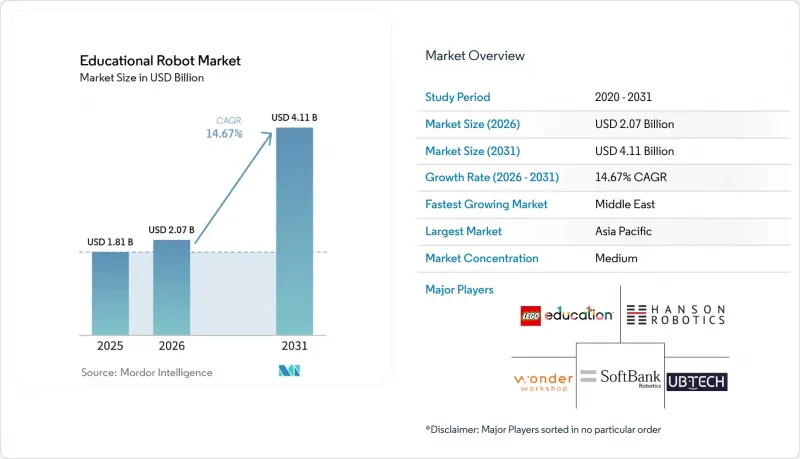
본 보고서는 유형(휴머노이드형 및 비휴머노이드형), 구성 요소(하드웨어, 소프트웨어, 서비스), 교육 단계(유치원, 초등학교, 기타), 학습 모드(코딩 및 STEM, 언어, 기타), 최종 사용자(학교, 대학, 기타), 지역(북미, 남미, 유럽, 아시아태평양, 중동 및 아프리카)별로 분류되어 있습니다. 시장 전망은 금액(달러) 기준으로 제시되어 있습니다.
세계의 교육용 로봇 시장 동향 및 인사이트
유럽 전역의 K-12 학교에서 로봇공학 교육 과정의 필수화
유럽연합 집행위원회의 “2025년 STEM 교육 전략 계획"에서는 모든 가맹국에 대해 2027-28 학년도까지 K-12 핵심 기준에 수학적 사고와 로봇 공학을 포함하도록 의무화하고 있습니다. 현재 각국의 교육부는 CE 규격을 준수하는 하드웨어와 교육 과정 간의 일관성을 보장할 수 있는 ISO 인증을 취득한 공급업체를 우선적으로 선정하여, 수년에 걸친 기본 계약 협상을 진행하고 있습니다. 핀란드는 2025년에 1억 2,000만 유로(1억 3,560만 달러)를 예산으로 편성해 2,400개 초등학교에 설비를 도입한 한편, 독일은 “디지털 팩트 2.0"에 따라 2028년까지 5억 유로(5억 6,500만 달러)를 확보했습니다. 이 지침에 따라 STEM 수업 시간의 최소 10%를 로봇 공학에 할당해야 하므로, 대상 교실 수는 실질적으로 2배로 늘어나게 되며, 장비 교체 수요는 마모나 노후화에 따른 교체 일정이 아니라 교육과정 개정 주기에 맞추어 발생하게 될 것입니다. 이 규정은 구매 권한을 국가 기관으로 이관함으로써 수요 예측을 안정화하고, 공급업체가 현지 언어 컨텐츠 및 장기적인 전문 역량 개발 서비스에 투자하도록 장려하고 있습니다.
북미의 대학 조달을 뒷받침하는 정부 자금 지원 STEM 이니셔티브
미국 국립과학재단(NSF)은 2025년에 RITEL 프로그램을 확대하고, 3년간 8,500만 달러를 지원하겠다고 약속한 한편, 지원금의 40%를 지원이 부족한 교육 기관의 하드웨어 구입에 사용할 것을 규정했습니다. 이전에는 자금 부족으로 도입이 어려웠던 휴머노이드 연구 플랫폼을, 역사적으로 흑인 및 히스패닉계 학생들을 지원해 온 대학들이 이용할 수 있게 되었습니다. 한편, 캐나다의 동종 기관인 NSERC는 15개의 지역 로봇공학 허브를 설립하기 위해 6,000만 캐나다 달러(4,440만 달러)를 지원했습니다. 보조금 수혜 기관은 오픈소스 커리큘럼 모듈을 공개해야 할 의무가 있으며, 이를 통해 후속 도입 기관의 컨텐츠 개발 비용이 절감되고, 당초 보조금 대상 기관 이외의 곳에서도 활용이 가속화됩니다. 이러한 대학들로부터 확보한 동료 심사를 거친 증거 자료는 각 학군의 조달 주기에 반영되어, 위험에 대한 인식을 낮추고, 교육용 로봇 시장의 보급을 비용 곡선을 더욱 하향 조정하고 있습니다.
유럽에서 클라우드 연결형 로봇에 대한 GDPR(EU 개인정보보호규정)에 기반한 데이터 개인정보 보호 규정 준수 비용
GDPR(EU 개인정보보호규정)에 따르면 2,000만 유로(2,322만 달러) 또는 전 세계 매출액의 4%에 해당하는 벌금이 부과될 우려가 있어, 공급업체는 동의 획득 워크플로우 도입, 영향 평가 실시, 그리고 유럽의 각 학군당 5만-15만 유로(5만 6,500-16만 9,500 달러)의 비용이 드는 제3자 감사를 실시해야만 합니다. 학생 1인당 IT 예산이 120유로(135달러) 미만인 학군에서는 이 비용을 충당하는 데 어려움을 겪고 있어, 남유럽 및 동유럽에서의 도입이 주춤하고 있습니다. “프라이버시 바이 디자인" 조항에 따라 처리가 디바이스 측으로 이전된 결과, 엣지 AI 칩의 부품 원가가 30-40% 상승했습니다. 규정을 준수하지 않는 입찰자는 제외됩니다. 이는 프랑스가 2024년에 1,200만 달러 규모의 입찰을 취소한 사례에서도 알 수 있습니다. 역외 적용에 따라 EU 역외에 위치한 공급업체라도 EU 데이터 보호 책임자를 임명해야 하며, 이로 인해 연간 4만-8만 달러의 간접비가 추가되어 500달러 미만의 로봇에 대한 이익률을 압박하고 있습니다.
부문별 분석
휴머노이드 로봇은 2025년에 교육용 로봇 시장의 49.13% 점유율을 차지했으며, 2031년까지 연평균 성장률(CAGR) 15.03%로 성장할 것으로 전망됩니다. 이러한 인간과 유사한 디자인은 눈맞춤, 제스처 인식, 프로크세믹스(공간적 거리 인식)를 지원하며, 이러한 기능들은 특수 교육 및 언어 습득의 틀과 부합하기 때문에 각 부처는 규정 준수를 중시하는 입찰 과정에서 해당 기종을 우선적으로 선정하고 있습니다. 2024년 조사에 따르면, 아이들은 태블릿을 사용할 때보다 휴머노이드형 튜터를 사용할 때 주의 지속 시간이 42% 더 길어졌습니다. NAO와 Yanshee는 교사의 준비 시간을 단축해 주는 커리큘럼 제휴를 통해 시장을 휩쓸고 있습니다.
바퀴가 달린 로버나 모듈형 키트와 같은 비휴머노이드형 플랫폼은 코딩 및 제조업체 스페이스 분야에서 주도적인 위치를 차지하고 있습니다. 이는 학교가 휴머노이드 2대 가격으로 한 학급 분량의 세트를 구입할 수 있기 때문입니다. 내구성이 향상되어 교체 주기가 7년으로 연장됨에 따라, 각 벤더들은 수익을 유지하기 위해 클라우드 컨텐츠를 번들로 제공하기 시작했습니다. 치료용 로봇이 FDA 승인을 획득함에 따라, 보험 적용을 통해 휴머노이드 구매 비용이 임상 예산에 반영되면서, 고가의 사회 학습용 기기와 비용 중심의 STEM 키트 간의 양극화가 더욱 심화되고 있습니다.
2025년 교육용 로봇 시장에서 하드웨어는 58.36%를 차지했으나, 소프트웨어는 연평균 성장률(CAGR) 16.17%를 기록하며 가장 빠르게 성장하고 있습니다. 각 학군은 Google Classroom 및 Canvas와 연동되는 커리큘럼 라이브러리에 대해 학생 1인당 연간 5-15달러를 지불하고 있으며, 이를 통해 교사의 도입 부담이 줄어들고 있습니다. 싱글 사인온(SSO) 의무화는 현재 미국 학군의 62%에서 시행되고 있으며, 기술적 장벽이 되는 한편, 통합이 완료된 후에는 전환 비용도 발생시키고 있습니다.
서보 모터의 내구성이 5만 사이클에 달하고, 학교 측이 교체 주기를 연장함에 따라 하드웨어의 발전 속도는 둔화되고 있습니다. 서비스 수익의 보급률은 여전히 낮은 편이지만, 수년에 걸쳐 교사 연수를 제공하는 업체에 따르면, 20시간 이상의 연수를 이수한 교사들은 로봇을 일상 수업에 접목함으로써 해지율이 25% 낮아지는 것으로 나타났습니다. 장기적인 추세로 볼 때, 하드웨어는 내구성이 뛰어난 엔드포인트 역할을 하고, 분석 및 AI 기반 개인화 엔진이 학습 데이터를 수익화하는 “소프트웨어 정의 교실"가 주류가 될 것으로 예측됩니다.
지역별 분석
아시아태평양은 2025년에 매출의 34.40%를 차지했으며, 20만 개 이상의 초등학교를 대상으로 하는 중국의 전국적인 AI 리터러시 교육 방침에 힘입었습니다. 일본은 120억 엔(8,040만 달러)의 보조금을 지원했으며, 서울에서 실시된 시범 사업에서는 영어 실력이 18% 향상되었습니다. 인도의 “국가 교육 정책"에서는 초등학교 6학년부터 코딩 교육을 추진하고 있지만, 학생 1인당 15-30달러의 IT 예산이라는 제약으로 인해 도입이 지연되고 있습니다. 호주에서는 사립학교로의 편중 현상이 두드러져, 전체 학생의 불과 35%만이 재학 중인 유료 학교에 로봇 키트의 68%가 도입되어 있습니다.
북미는 2025년에 28%의 점유율을 기록했으나, 도입이 포화 상태에 이른 데다 학생 수 감소로 인한 재정적 역풍까지 겹치면서 성장세가 둔화되고 있습니다. NSF(미국 국립과학재단)의 자금 지원을 받는 허브 및 타이틀 I 프로그램을 통해 지원이 부족한 학군에 로봇 도입이 진행되고 있으나, 통관 관련 분쟁으로 인해 멕시코 농촌 지역의 시범 사업은 지연되고 있습니다.
2025년, 유럽의 점유율은 24%를 차지했으며, 향후 도입이 의무화될 교육 과정이 주도적인 역할을 하고 있지만, GDPR(EU 개인정보보호규정)(일반 데이터 보호 규정) 준수에 따른 부담으로 인해 제약을 받고 있습니다. 핀란드와 독일은 초기 투자를 앞당기고 있지만, 남유럽 국가들은 학생 1인당 IT 예산이 120유로(135달러) 미만에 그치는 상황에 고심하고 있습니다.
사우디아라비아와 아랍에미리트(UAE)가 주도하는 중동은 “비전 2030"의 CSR 자금이 도시 지역의 로봇공학 연구소를 지원하고 있어, 지역별 최고 연평균 성장률(CAGR) 17.92%로 성장을 지속하고, 있습니다. 남미는 브라질의 60% 관세와 환율 변동에 어려움을 겪고 있지만, 아르헨티나에서는 2025년에 800세트의 키트가 도입되었습니다. 아프리카의 경우, 농촌 지역 청년들의 디지털 기술 습득률이 9%라는 낮은 수준에 머물러 있는 것이 걸림돌이 되어, 2025년 시점에서도 점유율은 5% 미만에 그쳤습니다.
기타 혜택 :
- 엑셀 형식 시장 예측(ME) 시트
- 3개월간의 애널리스트 지원
자주 묻는 질문
목차
제1장 서론
제2장 조사 방법
제3장 주요 요약
제4장 시장 구도
제5장 시장 규모 및 성장 예측
제6장 경쟁 구도
제7장 시장 기회 및 향후 전망
KTH 26.07.08According to Mordor Intelligence, the educational robot market size is expected to grow from USD 1.81 billion in 2025 to USD 2.07 billion in 2026 and is forecast to reach USD 4.11 billion by 2031 at 14.67% CAGR over 2026-2031.
This report is Segmented by Type (Humanoid, and Non-Humanoid), Component (Hardware, Software, and Services), Education Level (Pre-Primary, Primary, and More), Learning Mode (Coding and STEM, Language, and More), End User (Schools, Universities, and More), and Geography (North America, South America, Europe, Asia-Pacific, Middle East, Africa). The Market Forecasts are Provided in Terms of Value (USD).
Global Educational Robot Market Trends and Insights
Mandatory Robotics Curriculum in K-12 Schools Across Europe
The European Commission's 2025 STEM Education Strategic Plan obliges every member state to weave computational thinking and robotics into core K-12 standards by the 2027-28 academic year. Ministries of education now negotiate multi-year framework contracts, favoring ISO-certified vendors able to guarantee CE-compliant hardware and curriculum alignment. Finland earmarked EUR 120 million (USD 135.6 million) in 2025 to outfit 2,400 primary schools, while Germany reserved EUR 500 million (USD 565 million) through 2028 under Digital Pact 2.0. Because the directive insists robotics account for at least 10% of STEM contact time, the addressable classroom pool effectively doubles, and replacement demand will mirror curriculum-revision cycles rather than wear-and-tear schedules. By shifting purchasing power to national agencies, the rule stabilizes volume forecasts and encourages vendors to invest in local language content and long-term professional-development services.
Government-Funded STEM Initiatives Fueling University Procurement in North America
The U.S. National Science Foundation expanded its RITEL program in 2025, pledging USD 85 million over three years and stipulating that 40% of awards finance hardware for underserved institutions. Historically Black and Hispanic-serving colleges now access humanoid research platforms they previously could not afford, while Canadian counterpart NSERC committed CAD 60 million (USD 44.4 million) to create 15 regional robotics hubs. Grant recipients must publish open-source curriculum modules, trimming content-development costs for later adopters and accelerating usage beyond the initial grantees. Peer-reviewed evidence from these universities feeds district procurement cycles, reducing risk perceptions and moving educational robot market adoption further down the cost curve.
GDPR-Driven Data-Privacy Compliance Costs for Cloud-Connected Robots in Europe
GDPR threatens fines of EUR 20 million (USD 23.22 million) or 4% of global turnover, forcing vendors to implement consent workflows, conduct impact assessments, and conduct third-party audits that cost EUR 50,000-150,000 (USD 56,500-169,500) per European school district. Districts with per-pupil IT budgets below EUR 120 (USD 135) struggle to absorb the outlay, slowing deployments in Southern and Eastern Europe. Privacy-by-design clauses also shift processing to the device, elevating the bill of materials by 30-40% for edge AI chips. Non-compliant bidders are barred, as seen in France's 2024 cancellation of a USD 12 million tender. Extraterritorial reach means even non-EU vendors must appoint EU data officers, adding USD 40,000-80,000 in annual overhead that compresses margins on sub-USD 500 robots.
Other drivers and restraints analyzed in the detailed report include:
- Adoption of AI-Enabled Social Robots for Early-Childhood Language Tutoring in East Asia
- Falling Prices of Education-Grade Servo Motors and Sensors
- High Failure Rates of Battery Packs in Tropical Classrooms
For complete list of drivers and restraints, kindly check the Table Of Contents.
Segment Analysis
Humanoid robots captured 49.13% educational robot market share in 2025 and are projected to expand at a 15.03% CAGR through 2031. Their anthropomorphic design supports eye contact, gesture recognition, and proxemics that align with special-education and language-acquisition frameworks, prompting ministries to favor these units in compliance-driven tenders. A 2024 study showed children sustained attention 42% longer with humanoid tutors than with tablets. NAO and Yanshee dominate through curriculum partnerships that reduce teacher preparation time.
Non-humanoid platforms, including wheeled rovers and modular kits, lead in coding and maker spaces because schools can buy a full classroom set for the price of two humanoids. Improved durability extends replacement cycles to seven years, so vendors now bundle cloud content to maintain revenue. As therapeutic robots earn FDA clearances, insurance reimbursement moves humanoid purchases into clinical budgets, intensifying the bifurcation between premium social-learning devices and cost-focused STEM kits.
Hardware accounted for 58.36% of the educational robot market in 2025, yet software is growing fastest at a 16.17% CAGR. Districts pay USD 5-15 per student annually for curriculum libraries that integrate with Google Classroom and Canvas, reducing onboarding friction for teachers. Single Sign-On mandates, now at 62% of U.S. districts, create technical barriers while imposing switching costs once integrations are complete.
Hardware growth moderates as servos reach 50,000-cycle durability and schools stretch refresh intervals. Services revenue remains under-penetrated, but vendors offering multi-year professional development report 25% lower churn because teachers who log 20+ training hours weave robots into daily instruction. The longer-term trajectory points to software-defined classrooms where hardware functions as a durable endpoint while analytics and AI personalization engines monetize learning data.
Complete Report Scope:
- By Type
- Humanoid
- Non-Humanoid
- By Component
- Hardware
- Software
- Services
- By Education Level
- Pre-Primary (Kindergarten)
- Primary Education
- Secondary Education
- Higher Education
- Special Education
- By Learning Mode / Application
- Coding and STEM
- Language Learning
- AI and Robotics Research
- Special-Needs Therapy
- Telepresence and Remote Instruction
- By End User
- Schools
- Universities and Colleges
- Vocational Institutes
- Ed-Tech Companies
- Special-Education Centers
- Maker Spaces and Robotics Clubs
- By Geography
- North America
- United States
- Canada
- Mexico
- Europe
- Germany
- United Kingdom
- France
- Italy
- Spain
- Russia
- Rest of Europe
- Asia Pacific
- China
- Japan
- India
- South Korea
- ASEAN
- Australia and New Zealand
- Rest of Asia Pacific
- South America
- Brazil
- Argentina
- Rest of South America
- Middle East
- Saudi Arabia
- UAE
- Turkey
- Rest of Middle East
- Africa
- South Africa
- Nigeria
- Rest of Africa
- North America
Geography Analysis
Asia-Pacific generated 34.40% revenue in 2025, buoyed by China's nationwide AI literacy rule that touches 200,000+ primary schools. Japan provided JPY 12 billion (USD 80.4 million) in subsidies, and Seoul's pilots achieved 18% gains in English fluency. India's National Education Policy pushes coding from grade 6, but roll-out lags due to USD 15-30 per-pupil IT budgets. Australia shows private-school skew, with 68% of robotics kits in fee-paying campuses that house only 35% of students.
North America held a 28% share in 2025, yet growth slows as deployment saturation meets fiscal headwinds from shrinking student cohorts. NSF-funded hubs and Title I programs are pushing robots into underserved districts, but customs disputes have delayed Mexico's rural pilots.
Europe accounted for a 24% share in 2025, dominated by the forthcoming curriculum mandate and constrained by GDPR compliance levies. Finland and Germany front-load capital, yet Southern Europe struggles with per-pupil IT budgets under EUR 120 (USD 135).
The Middle East, led by Saudi Arabia and the UAE, logs the highest regional CAGR at 17.92% as Vision 2030 CSR funds sponsor urban robotics labs. South America wrestles with 60% Brazilian tariffs and currency swings, though Argentina deployed 800 kits in 2025. Africa remains below 5% share in 2025, hampered by the 9% baseline of digital-skill readiness among rural youth.
- SoftBank Robotics Corp.
- UBTECH Robotics Inc.
- Hanson Robotics Ltd.
- Lego Education (The Lego Group)
- Wonder Workshop Inc.
- Robotis Co., Ltd.
- VEX Robotics Inc.
- Makeblock Co., Ltd.
- Sphero Inc.
- Modular Robotics (Cubelets)
- Blue Frog Robotics
- Aisoy Robotics
- Sanbot Innovation (Qihan)
- PAL Robotics
- Probotics America
- Robobuilder Co., Ltd.
- Dash Robotics (Kamigami)
- RobotLAB Inc.
- DJI RoboMaster
- Ozobot and Evollve Inc.
- Fischertechnik GmbH
- RoboTerra Inc.
- Roborisen (e-Bo)
- RoboSense (Edu)
Additional Benefits:
- The market estimate (ME) sheet in Excel format
- 3 months of analyst support
TABLE OF CONTENTS
1 INTRODUCTION
- 1.1 Study Assumptions and Market Definition
- 1.2 Scope of the Study
2 RESEARCH METHODOLOGY
3 EXECUTIVE SUMMARY
4 MARKET LANDSCAPE
- 4.1 Market Overview
- 4.2 Market Drivers
- 4.2.1 Adoption of AI-Enabled Social Robots for Early-Childhood Language Tutoring in East Asia
- 4.2.2 Mandatory Robotics Curriculum in K-12 Schools across Europe
- 4.2.3 Government-Funded STEM Initiatives Fueling University Procurement in North America
- 4.2.4 Falling Average Selling Price of Education-Grade Servo Motors and Sensors in China
- 4.2.5 Surge of Remote and Hybrid Learning Driving Telepresence Teaching Robots in North America
- 4.2.6 Corporate CSR Budgets Sponsoring Robotics Labs in Middle East Public Schools
- 4.3 Market Restraints
- 4.3.1 High Failure Rates of Battery Packs During Continuous Classroom Use in Tropical Regions
- 4.3.2 Limited Multilingual Content Libraries for Humanoid Robots in Non-Latin Script Nations
- 4.3.3 GDPR-Driven Data-Privacy Compliance Costs for Cloud-Connected Robots in Europe
- 4.3.4 Shortage of Certified Robotics Instructors in Rural Africa
- 4.4 Industry Value Chain Analysis
- 4.5 Regulatory Outlook
- 4.6 Technological Outlook
- 4.7 Impact of Macroeconomic Factors on the Market
- 4.8 Porter's Five Forces Analysis
- 4.8.1 Threat of New Entrants
- 4.8.2 Bargaining Power of Buyers
- 4.8.3 Bargaining Power of Suppliers
- 4.8.4 Threat of Substitutes
- 4.8.5 Intensity of Competitive Rivalry
- 4.9 Investment Analysis (Funding, M&A, VC Trends)
5 MARKET SIZE AND GROWTH FORECASTS (VALUE)
- 5.1 By Type
- 5.1.1 Humanoid
- 5.1.2 Non-Humanoid
- 5.2 By Component
- 5.2.1 Hardware
- 5.2.2 Software
- 5.2.3 Services
- 5.3 By Education Level
- 5.3.1 Pre-Primary (Kindergarten)
- 5.3.2 Primary Education
- 5.3.3 Secondary Education
- 5.3.4 Higher Education
- 5.3.5 Special Education
- 5.4 By Learning Mode / Application
- 5.4.1 Coding and STEM
- 5.4.2 Language Learning
- 5.4.3 AI and Robotics Research
- 5.4.4 Special-Needs Therapy
- 5.4.5 Telepresence and Remote Instruction
- 5.5 By End User
- 5.5.1 Schools
- 5.5.2 Universities and Colleges
- 5.5.3 Vocational Institutes
- 5.5.4 Ed-Tech Companies
- 5.5.5 Special-Education Centers
- 5.5.6 Maker Spaces and Robotics Clubs
- 5.6 By Geography
- 5.6.1 North America
- 5.6.1.1 United States
- 5.6.1.2 Canada
- 5.6.1.3 Mexico
- 5.6.2 Europe
- 5.6.2.1 Germany
- 5.6.2.2 United Kingdom
- 5.6.2.3 France
- 5.6.2.4 Italy
- 5.6.2.5 Spain
- 5.6.2.6 Russia
- 5.6.2.7 Rest of Europe
- 5.6.3 Asia Pacific
- 5.6.3.1 China
- 5.6.3.2 Japan
- 5.6.3.3 India
- 5.6.3.4 South Korea
- 5.6.3.5 ASEAN
- 5.6.3.6 Australia and New Zealand
- 5.6.3.7 Rest of Asia Pacific
- 5.6.4 South America
- 5.6.4.1 Brazil
- 5.6.4.2 Argentina
- 5.6.4.3 Rest of South America
- 5.6.5 Middle East
- 5.6.5.1 Saudi Arabia
- 5.6.5.2 UAE
- 5.6.5.3 Turkey
- 5.6.5.4 Rest of Middle East
- 5.6.6 Africa
- 5.6.6.1 South Africa
- 5.6.6.2 Nigeria
- 5.6.6.3 Rest of Africa
- 5.6.1 North America
6 COMPETITIVE LANDSCAPE
- 6.1 Market Concentration
- 6.2 Strategic Moves
- 6.3 Market Share Analysis
- 6.4 Company Profiles (includes Global Level Overview, Market Level Overview, Core Segments, Financials as Available, Strategic Information, Market Rank/Share, Products and Services, Recent Developments)
- 6.4.1 SoftBank Robotics Corp.
- 6.4.2 UBTECH Robotics Inc.
- 6.4.3 Hanson Robotics Ltd.
- 6.4.4 Lego Education (The Lego Group)
- 6.4.5 Wonder Workshop Inc.
- 6.4.6 Robotis Co., Ltd.
- 6.4.7 VEX Robotics Inc.
- 6.4.8 Makeblock Co., Ltd.
- 6.4.9 Sphero Inc.
- 6.4.10 Modular Robotics (Cubelets)
- 6.4.11 Blue Frog Robotics
- 6.4.12 Aisoy Robotics
- 6.4.13 Sanbot Innovation (Qihan)
- 6.4.14 PAL Robotics
- 6.4.15 Probotics America
- 6.4.16 Robobuilder Co., Ltd.
- 6.4.17 Dash Robotics (Kamigami)
- 6.4.18 RobotLAB Inc.
- 6.4.19 DJI RoboMaster
- 6.4.20 Ozobot and Evollve Inc.
- 6.4.21 Fischertechnik GmbH
- 6.4.22 RoboTerra Inc.
- 6.4.23 Roborisen (e-Bo)
- 6.4.24 RoboSense (Edu)
7 MARKET OPPORTUNITIES AND FUTURE OUTLOOK
- 7.1 White-Space and Unmet Need Analysis


