

|
시장보고서
상품코드
2098470
자율형 보안 운영 센터(SOC) : 시장 점유율 분석, 업계 동향과 통계, 성장 예측(2026-2031년)Autonomous Security Operations Center (SOC) - Market Share Analysis, Industry Trends & Statistics, Growth Forecasts (2026 - 2031) |
||||||
 Mordor Intelligence
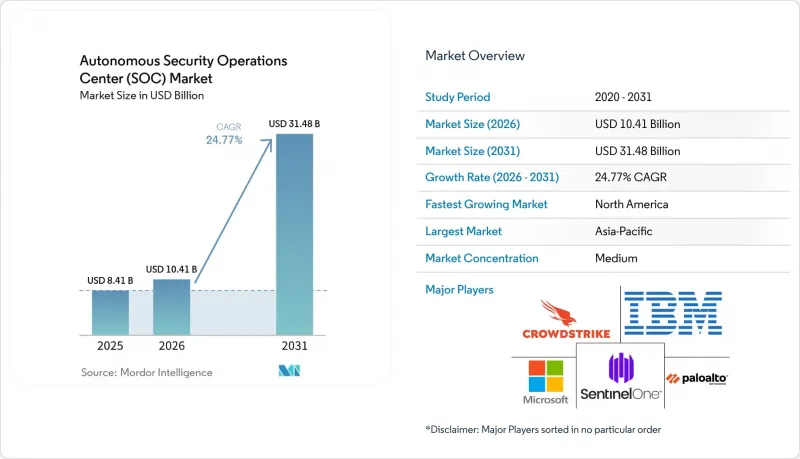
Mordor Intelligence에 의하면, 자율형 보안 운영 센터(SOC) 시장 규모는 2025년 84억 1,000만 달러에서 2026년에는 104억 1,000만 달러로 확대되고, 2026-2031년 CAGR 24.77%로 성장을 지속하여 2031년에는 314억 8,000만 달러에 이를 것으로 예측됩니다.
본 보고서는 구성 요소(플랫폼 및 서비스), 도입 형태(클라우드, On-Premise, 하이브리드), 기업 규모(대기업 및 중소기업), 최종 사용자 산업(정부·공공 행정, 산업 제조, 소매 및 전자상거래 등) 및 지역별로 분류되어 있습니다. 시장 전망은 금액(달러) 기준으로 제시되어 있습니다.
전 세계 자율형 보안 운영 센터(SOC) 시장 동향 및 인사이트
보안 운영 팀 전반에 걸쳐 심화되는 경보 피로
자율형 보안 운영 센터(SOC) 시장은 한 가지 단순한 운영상의 현실로부터 혜택을 받고 있습니다. 바로 많은 보안 팀이 인간 분석가만으로는 더 이상 방대한 양의 경보를 충분히 신속하게 확인할 수 없게 되었습니다는 현실입니다. 시스코는 2025년 보고서에서 SOC 팀의 59%가 과도한 알림에 직면해 있으며, 55%가 오탐 처리에 막대한 시간을 소비하고 있고, 조사 시간의 57%가 데이터 관리 문제에 소요되고 있다고 보고했습니다. 또한 CrowdStrike의 조사에 따르면, 79%의 조직이 자사의 도구가 과도한 경보를 생성하고 있음을 인식하고 있으며, 팀은 트리아지 시간의 77%를 오감지나 우선순위가 낮은 감지 대응에 소비하고 있는 것으로 나타났습니다. Palo Alto Networks는 2025년 사고 대응 업무에서 소셜 엔지니어링에 의한 사고의 13%가 일상적인 알림이 무시되거나 트리아지가 수행되지 않았기 때문에 성공했다고 밝혔습니다. 이러한 운영상의 압박으로 인해 자율형 보안 운영 센터(SOC) 시장은 분석가의 부담을 줄이고, 잡음 속에 묻혀 있는 실제 공격을 놓칠 위험을 낮추는 플랫폼으로 나아가고 있습니다.
전체 위협 감지 워크플로우에 걸친 AI 오케스트레이션 도입 확대
자율형 보안 운영 센터(SOC) 시장은 고정된 자동화 규칙에서 벗어나, 여러 보안 절차를 아우르며 조사, 추론, 실행이 가능한 AI 오케스트레이션으로의 전환을 통해 형성되고 있습니다. 2026년 3월, CrowdStrike와 NVIDIA는 NVIDIA Nemotron 모델과 NeMo Data Designer를 사용한 Agentic MDR 워크로드에서 조사 속도가 5배 향상되고, 트리아지 정확도가 3배 향상되었다고 보고했습니다. 마이크로소프트는 RSA 2026에서 Defender 및 Sentinel의 텔레메트리 전반에 걸쳐 다단계 조사를 수행하고, 감사 가능한 추론 체인을 활용하여 몇 분 만에 중대한 위험을 식별하는 ‘Security Analyst Agent’를 발표했습니다. 이러한 발표는 자율형 보안 운영 센터(SOC) 시장에서의 경쟁이 단순히 프롬프트나 요약 정보를 제공하는 것을 넘어, 여러 AI 주도 작업을 조정할 수 있는 시스템으로 전환되고 있음을 보여줍니다. 또한, 이는 본격적인 위협 조사 데이터를 보유한 벤더와 이와 같은 실제 피드백 루프를 갖추지 못한 벤더 간의 격차를 더욱 벌리는 요인이 되고 있습니다.
모델의 설명 가능성 및 감사 가능성에 대한 우려
자율형 보안 운영 센터(SOC) 시장에서는 자동화된 트리아지 및 대응 조치의 배후에 있는 명확한 추론을 요구하는 구매자들의 주저함이 여전히 존재합니다. EU AI법의 투명성 관련 규정이 2026년 8월부터 시행됨에 따라, 보안 워크플로우에서 사용되는 시스템의 추적 가능성의 중요성이 높아지고 있습니다. CrowdStrike는 ISO 42001 인증 획득 및 설명 책임과 조치가 사용자에 의해 승인되었음을 명시한 제품 설명 등, Charlotte AI의 거버넌스 관련 노력을 통해 이러한 우려의 일부를 해소해 왔습니다. 그럼에도 불구하고, 자율형 보안 운영 센터(SOC) 시장에서는 모델의 성능이 뛰어나더라도 구매자가 확신을 가지고 감사할 수 있는 설명이 자동으로 제공되는 것은 아니라는 사실과 여전히 마주하고 있습니다. 이 문제는 조달 팀이 자율형 시스템에 광범위한 운영 권한을 부여하기 전에 거버넌스 관리에 대한 증거를 요구하는 규제 대상 부문에서 가장 중요한 사안입니다.
부문 분석
2025년에는 플랫폼이 매출의 64.21%를 차지하며 자율형 보안 운영 센터(SOC) 시장에서 가장 큰 구성 요소가 되었습니다. 이러한 우위는 위협 감지, 조사, 대응 및 데이터 관리에서 핵심 운영 계층으로서의 역할에 기인합니다. 또한, 텔레메트리 데이터가 플랫폼 내에 축적되면 해당 데이터가 모델 튜닝을 개선하고 마이그레이션을 어렵게 만들기 때문에 구매자는 이후에도 수년 동안 이러한 시스템을 계속 사용하는 경향이 있습니다. 이러한 고정성으로 인해 계약 금액은 더 높아지며, 플랫폼 벤더는 연결된 엔드포인트, ID, 클라우드, SIEM 기능을 통해 이용을 확대할 여지가 생깁니다.
서비스 부문은 2026-2031년 연평균 성장률(CAGR) 25.81%를 나타낼 것으로 예측되며, 구성 요소 중 가장 빠르게 성장하는 분야가 될 전망입니다. 이러한 성장을 주도하는 것은 사내에 고도의 AI 엔지니어링 팀이나 보안 운영 팀을 구축하지 않고도 자율적인 워크플로우를 실현하고자 하는 조직들입니다. 지능형 자동화와 전문가의 감독을 결합한 에이전트형 MDR 및 SOC 혁신 솔루션이 확대되고 있으며, 고객이 파일럿 단계에서本番 환경으로의 전환을 보다 신속하게 진행할 수 있도록 지원하고 있습니다. 이에 따라 서비스는 표준적인 관리형 SOC 지원의 범위를 넘어, 감지 품질, 대응 속도, 보안 성과에 대해 벤더가 더 많은 책임을 지는 부가가치가 높은 운영 모델로 전환되고 있습니다.
2025년에는 클라우드 배포가 시장의 55.17%를 차지하며, 모든 배포 모델 중 가장 큰 점유율을 기록했습니다. 이러한 선두 위상은 클라우드 기반 제공 방식과 최신 보안 운영 간의 뛰어난 호환성을 반영하며, AI 기반 대응에서는 지속적인 업데이트, 공유된 위협 인텔리전스, 그리고 확장 가능한 컴퓨팅이 중요합니다. 또한 클라우드 플랫폼은 기업이 보안 확보를 점점 더 필요로 하는 워크로드, API 및 ID와도 긴밀하게 연동됩니다. 이러한 이점 덕분에 클라우드는 많은 새로운 자율형 SOC 도입의 출발점이 되고 있습니다. 신속한 도입과 정기적인 모델 개선을 원하는 조직은 인프라 부하가 큰 다른 대안보다 이 도입 경로를 선호하는 경향이 있습니다.
하이브리드 배포는 2026년부터 2031년까지 연평균 성장률(CAGR) 25.92%를 나타낼 것으로 예측되며, 가장 빠르게 성장하는 배포 모델이 될 전망입니다. 이는 기밀 데이터를 사설 환경이나 주권 환경 내에 보관하면서도, 속도와 확장성을 위해 클라우드 기반 AI를 활용해야 하는 조직의 요구를 반영한 것입니다. 하이브리드 모델은 시스템 설계에서 감사 가능성, 설명 가능성 및 인적 감독이 더욱 중요시되는 규제 대상 산업에 특히 적합합니다. 엄격한 현지화 규정이 여전히 적용되고 있는 국방, 정부, 중요 인프라 분야에서는 On-Premise형 모델이 여전히 중요한 역할을 하고 있습니다. 그 결과, 도입 추세는 단일 운영 모델로 완전히 전환되기보다는 다양한 형태가 혼재된 상태가 지속될 것으로 보입니다.
지역별 분석
2025년, 북미는 자율형 보안 운영 센터(SOC) 시장에서 34.18%의 점유율을 차지하며 최대 지역이 되었습니다. 미국은 탄탄한 벤더 기반, 광범위한 엔터프라이즈용 클라우드 도입, 그리고 지속적인 보안 모니터링에 대한 강력한 수요를 모두 갖추고 있어 여전히 핵심 시장으로 자리 잡고 있습니다. 또한, 이 지역은 연방 정부의 막대한 기술 예산과 규제 대상 부문의 엄격한 문서화 및 대응 요건의 혜택을 받고 있습니다. CrowdStrike는 RSA 2026에서 AWS, Anthropic, NVIDIA, OpenAI, Salesforce, Accenture, Deloitte, Kroll, Telefonica Tech 등의 파트너와 함께 ‘Charlotte AI AgentWorks 생태계’를 출범시킴으로써 북미 내 생태계의 강점을 한층 더 강화했습니다.
아시아태평양은 2026년부터 2031년까지 연평균 성장률(CAGR) 26.27%를 나타낼 것으로 예측되며, 자율형 보안 운영 센터(SOC) 시장에서 가장 두드러진 성장을 보일 것으로 전망됩니다. 이 지역 전체의 성장은 급속한 디지털화 진전, 국가 차원의 사이버 활동 증가, 그리고 기업 내 보안 인력 부족과 밀접한 관련이 있으며, 이러한 요인들이 관리형 및 자율형 모델에 대한 수요를 높이고 있습니다. 2025년에 시행된 중국의 ‘네트워크 데이터 보안 관리 조례’는 국가 안보 방침에 부합하는 보안 플랫폼에 대한 국내 투자를 촉진하고 있습니다. 인도 역시 정보 유출 보고 요건 강화 및 공공·민간 시스템을 아우르는 디지털 인프라 확충을 통해 시장 성장에 기여하고 있습니다. 일본, 한국, 호주 및 동남아시아에서는 금융 서비스, 국방 관련 업무, 그리고 기업 보안을 현대화하는 ‘클라우드 퍼스트’이자 지역에 뿌리를 둔 프로그램에 대한 수요가 증가하고 있습니다.
유럽에서는 2025년, 독일, 영국, 프랑스의 기업 보안 시장에 더해 DORA와 NIS2의 시너지 효과에 힘입어 상당한 수익을 기록했습니다. ENISA는 2025년, 모니터링이 자동화되어 지속적 또는 정기적인 간격으로 수행되어야 한다고 밝혔으며, 이는 자율형 보안 운영 센터(SOC) 시장의 플랫폼 구상을 직접적으로 뒷받침하는 것입니다. DORA, NIS2, EU AI법 및 사이버 복원력법이 중첩되면서, 기존에는 특정 시점의 규정 준수 대책에 의존하던 기업의 업그레이드 주기가 단축되고 있습니다. 중동 및 아프리카에서도 사우디아라비아와 아랍에미리트(UAE) 등 국가 주도의 AI 프로그램, 스마트 시티 투자, 중요 인프라 보호 노력을 통해 새로운 기회가 창출되고 있습니다. 남미는 계속해서 신흥 수요원으로 부상하고 있으며, 특히 브라질을 필두로 데이터 보호 집행이 강화됨에 따라 금융 서비스 업계 및 정부 기관의 구매 담당자들로부터 관심이 높아지고 있습니다.
기타 혜택:
- 엑셀 형식 시장 예측(ME) 시트
- 3개월간의 애널리스트 지원
자주 묻는 질문
목차
제1장 서론
제2장 조사 방법
제3장 주요 요약
제4장 시장 구도
제5장 시장 규모와 성장 예측
제6장 경쟁 구도
제7장 시장 기회와 향후 전망
KTH 26.08.06According to Mordor Intelligence, the autonomous Security Operations Center (SOC) market size is expected to grow from USD 8.41 billion in 2025 to USD 10.41 billion in 2026 and is forecast to reach USD 31.48 billion by 2031 at 24.77% CAGR over 2026-2031.
This report is Segmented by Component (Platforms, and Services), Deployment (Cloud, On-Premises, and Hybrid), Enterprise Size (Large Enterprises, and Small and Medium Enterprises), End-User Industry (Government and Public Administration, Industrial Manufacturing, Retail and E-Commerce, and More), and Geography. The Market Forecasts are Provided in Terms of Value (USD).
Global Autonomous Security Operations Center (SOC) Market Trends and Insights
Escalating Alert Fatigue Across Security Operations Teams
The autonomous Security Operations Center (SOC) market is benefiting from a simple operational reality: many security teams can no longer review alert volumes fast enough with human analysts alone. Cisco reported in 2025 that 59% of SOC teams faced too many alerts, 55% spent significant time on false positives, and data management issues accounted for 57% of investigation time. CrowdStrike also found that 79% of organizations believed their tools generated too many alerts, and teams spent 77% of triage time on false positives and low-priority detections. Palo Alto Networks stated that 13% of social engineering incidents in its 2025 incident response work succeeded because routine alerts were ignored or left untriaged. That operating pressure is pushing the autonomous Security Operations Center (SOC) market toward platforms that reduce analyst burden and lower the risk of missing a real attack amid the noise.
Rising Adoption of AI Orchestration Across Threat Detection Workflows
The autonomous Security Operations Center (SOC) market is also being shaped by the shift from fixed automation rules to AI orchestration that can investigate, reason, and act across several security steps. In March 2026, CrowdStrike and NVIDIA reported 5x faster investigations and 3x higher triage accuracy in Agentic MDR workloads using NVIDIA Nemotron models and NeMo Data Designer. Microsoft introduced its Security Analyst Agent at RSA 2026 to perform multi-step investigations across Defender and Sentinel telemetry and surface material risks in minutes with auditable reasoning chains. These launches show that competition in the autonomous Security Operations Center (SOC) market is moving toward systems that can coordinate multiple AI-led tasks rather than simply providing prompts or summaries. They also widen the gap between vendors with serious threat investigation data and those without a similar real-world feedback loop.
Model Explainability And Auditability Concerns
The autonomous Security Operations Center (SOC) market still faces hesitation from buyers who need clear reasoning behind automated triage and response actions. EU AI Act transparency provisions become active from August 2026, which raises the importance of traceability for systems used in security workflows. CrowdStrike has addressed part of this concern through Charlotte AI governance work, including ISO 42001 certification positioning and product claims that answerability and actions are user-authorized. Even so, the autonomous Security Operations Center (SOC) market is still dealing with the fact that strong model performance does not automatically produce explanations that buyers can audit with confidence. This issue matters most in regulated sectors where procurement teams want proof of governance controls before giving autonomous systems broader operating authority.
Other drivers and restraints analyzed in the detailed report include:
- Expanding Cloud and Identity Telemetry Requiring Unified Autonomy
- Regulatory Pressure for Continuous Control Monitoring
- Integration Complexity With Legacy SIEM, SOAR, And EDR Stacks
For complete list of drivers and restraints, kindly check the Table Of Contents.
Segment Analysis
Platforms accounted for 64.21% of revenue in 2025, making them the largest component of the autonomous Security Operations Center (SOC) market. Their lead came from their role as the main operating layer for threat detection, investigation, response, and data management. Buyers also tend to stay with these systems for years after telemetry is stored inside the platform, because the data improves model tuning and makes migration harder. This stickiness supports larger contract values and gives platform vendors room to deepen usage through connected endpoint, identity, cloud, and SIEM capabilities.
Services are projected to grow at a 25.81% CAGR from 2026 to 2031, making them the faster-moving part of the component mix. Growth is being driven by organizations that want autonomous workflows without building deep internal AI engineering or security operations teams. Agentic MDR and SOC transformation offerings are expanding as they combine intelligent automation with expert oversight, helping customers move faster from pilots to production. This shifts services beyond standard managed SOC support and toward higher-value operating models, where vendors take on more responsibility for detection quality, response speed, and security outcomes.
Cloud deployments held 55.17% of the market in 2025, which gave them the largest share across deployment models. Their lead reflects the strong fit between cloud delivery and modern security operations, where continuous updates, shared threat intelligence, and scalable compute are important for AI-based response. Cloud platforms also align closely with the workloads, APIs, and identities that enterprises increasingly need to secure. These advantages make the cloud the starting point for many new autonomous SOC rollouts. Organizations that want quicker implementation and regular model improvement often prefer this deployment path over more infrastructure-heavy alternatives.
Hybrid deployments are projected to grow at a 25.92% CAGR from 2026 to 2031, making them the fastest-growing deployment model. This reflects the needs of organizations that must keep sensitive data in private or sovereign environments while still using cloud-based AI for speed and scale. Hybrid is especially relevant in regulated sectors where auditability, explainability, and human oversight are more important in system design. On-premises models still matter in defense, government, and critical infrastructure settings, where strict localization rules remain in place. As a result, deployment preferences are likely to remain mixed rather than fully shift toward a single operating model.
Complete Report Scope:
- By Component
- Platforms
- AI-Native SOC Platforms
- Autonomous Investigation and Response Platforms
- Agentic Security Operations Platforms
- Services
- Platforms
- By Deployment
- Cloud
- On-Premises
- Hybrid
- By Enterprise Size
- Large Enterprises
- Small and Medium Enterprises
- By End-user Industry
- Government and Public Administration
- Industrial Manufacturing
- Retail and E-Commerce
- Transportation and Logistics
- Energy and Utilities
- Oil and Gas
- IT and Telecommunication
- Media and Entertainment
- Education and Research Institutions
- Healthcare and Life Sciences
- Banking, Financial Services, and Insurance (BFSI)
- By Geography
- North America
- United States
- Canada
- Mexico
- South America
- Brazil
- Argentina
- Rest of South America
- Europe
- Germany
- United Kingdom
- France
- Italy
- Spain
- Russia
- Rest of Europe
- Asia-Pacific
- China
- India
- Japan
- South Korea
- Australia
- Rest of Asia-Pacific
- Middle East and Africa
- Middle East
- Saudi Arabia
- United Arab Emirates
- Rest of Middle East
- Africa
- South Africa
- Nigeria
- Rest of Africa
- Middle East
- North America
Geography Analysis
North America held 34.18% share in 2025, making it the largest region in the autonomous security operations center (SOC) market. The United States remains the core market because it combines a deep vendor base, broad enterprise cloud adoption, and strong demand for continuous security monitoring. The region also benefits from large federal technology budgets and tighter documentation and response requirements in regulated sectors. CrowdStrike reinforced the ecosystem strength in North America when it launched the Charlotte AI AgentWorks Ecosystem at RSA 2026 with partners including AWS, Anthropic, NVIDIA, OpenAI, Salesforce, Accenture, Deloitte, Kroll, and Telefonica Tech.
Asia-Pacific is projected to grow at a 26.27% CAGR from 2026 to 2031, making it the fastest-growing regional market for autonomous Security Operations Centers (SOCs). Growth across the region is tied to rapid digital expansion, rising state-linked cyber activity, and a shortage of in-house security talent, which increases demand for managed and autonomous models. China's Network Data Security Management Regulations, which became effective in 2025, are supporting domestic investment in sovereign-aligned security platforms. India is also contributing through stronger breach reporting expectations and wider digital infrastructure buildout across public and private systems. Japan, South Korea, Australia, and Southeast Asia are seeing increased demand for financial services, defense-related operations, and cloud-first, localized programs that modernize enterprise security.
Europe recorded meaningful revenue in 2025, supported by the German, UK, and French enterprise security markets and by the combined effect of DORA and NIS2. ENISA stated in 2025 that monitoring should be automated and carried out continuously or at periodic intervals, which directly supports the platform logic of the autonomous Security Operations Center (SOC) market. The overlap among DORA, NIS2, the EU AI Act, and the Cyber Resilience Act is compressing the upgrade cycle for enterprises that previously relied on point-in-time compliance practices. The Middle East and Africa are also opening new opportunities through sovereign AI programs, smart city investments, and critical infrastructure protection work in countries such as Saudi Arabia and the United Arab Emirates. South America remains an emerging demand pool, led by Brazil, where stronger data protection enforcement is lifting interest from financial services and government buyers.
- CrowdStrike Holdings, Inc.
- Microsoft Corporation
- Palo Alto Networks, Inc.
- SentinelOne, Inc.
- IBM Corporation
- Google LLC
- Cisco Systems, Inc.
- Fortinet, Inc.
- Check Point Software Technologies Ltd.
- Rapid7, Inc.
- Splunk Inc.
- Elastic N.V.
- Darktrace plc
- Exabeam, Inc.
- Securonix, Inc.
- ReliaQuest, LLC
- Arctic Wolf Networks, Inc.
- Sophos Limited
- Trellix, LLC
- Vectra AI, Inc.
Additional Benefits:
- The market estimate (ME) sheet in Excel format
- 3 months of analyst support
TABLE OF CONTENTS
1 INTRODUCTION
- 1.1 Study Assumptions and Market Definition
- 1.2 Scope of the Study
2 RESEARCH METHODOLOGY
3 EXECUTIVE SUMMARY
4 MARKET LANDSCAPE
- 4.1 Market Overview
- 4.2 Market Drivers
- 4.2.1 Escalating Alert Fatigue Across Security Operations Teams
- 4.2.2 Rising Adoption of AI Orchestration Across Threat Detection Workflows
- 4.2.3 Expanding Cloud and Identity Telemetry Requiring Unified Autonomy
- 4.2.4 Regulatory Pressure For Continuous Control Monitoring
- 4.2.5 Talent Shortages In SOC Analyst Roles
- 4.2.6 Demand For Faster Mean Time To Detect and Respond
- 4.3 Market Restraints
- 4.3.1 Model Explainability And Auditability Concerns
- 4.3.2 Integration Complexity With Legacy SIEM, SOAR, and EDR Stacks
- 4.3.3 High Compute Costs For Agentic AI Workloads
- 4.3.4 Autonomous Action Risk In Mission-Critical Environments
- 4.4 Impact of Macroeconomic Factors on the Market
- 4.5 Industry Value-Chain Analysis
- 4.6 Regulatory Landscape
- 4.7 Technological Outlook
- 4.8 Porter's Five Forces Analysis
- 4.8.1 Bargaining Power of Buyers
- 4.8.2 Bargaining Power of Suppliers
- 4.8.3 Threat of New Entrants
- 4.8.4 Threat of Substitutes
- 4.8.5 Intensity of Competitive Rivalry
5 MARKET SIZE AND GROWTH FORECASTS (VALUE)
- 5.1 By Component
- 5.1.1 Platforms
- 5.1.1.1 AI-Native SOC Platforms
- 5.1.1.2 Autonomous Investigation and Response Platforms
- 5.1.1.3 Agentic Security Operations Platforms
- 5.1.2 Services
- 5.1.1 Platforms
- 5.2 By Deployment
- 5.2.1 Cloud
- 5.2.2 On-Premises
- 5.2.3 Hybrid
- 5.3 By Enterprise Size
- 5.3.1 Large Enterprises
- 5.3.2 Small and Medium Enterprises
- 5.4 By End-user Industry
- 5.4.1 Government and Public Administration
- 5.4.2 Industrial Manufacturing
- 5.4.3 Retail and E-Commerce
- 5.4.4 Transportation and Logistics
- 5.4.5 Energy and Utilities
- 5.4.6 Oil and Gas
- 5.4.7 IT and Telecommunication
- 5.4.8 Media and Entertainment
- 5.4.9 Education and Research Institutions
- 5.4.10 Healthcare and Life Sciences
- 5.4.11 Banking, Financial Services, and Insurance (BFSI)
- 5.5 By Geography
- 5.5.1 North America
- 5.5.1.1 United States
- 5.5.1.2 Canada
- 5.5.1.3 Mexico
- 5.5.2 South America
- 5.5.2.1 Brazil
- 5.5.2.2 Argentina
- 5.5.2.3 Rest of South America
- 5.5.3 Europe
- 5.5.3.1 Germany
- 5.5.3.2 United Kingdom
- 5.5.3.3 France
- 5.5.3.4 Italy
- 5.5.3.5 Spain
- 5.5.3.6 Russia
- 5.5.3.7 Rest of Europe
- 5.5.4 Asia-Pacific
- 5.5.4.1 China
- 5.5.4.2 India
- 5.5.4.3 Japan
- 5.5.4.4 South Korea
- 5.5.4.5 Australia
- 5.5.4.6 Rest of Asia-Pacific
- 5.5.5 Middle East and Africa
- 5.5.5.1 Middle East
- 5.5.5.1.1 Saudi Arabia
- 5.5.5.1.2 United Arab Emirates
- 5.5.5.1.3 Rest of Middle East
- 5.5.5.2 Africa
- 5.5.5.2.1 South Africa
- 5.5.5.2.2 Nigeria
- 5.5.5.2.3 Rest of Africa
- 5.5.5.1 Middle East
- 5.5.1 North America
6 COMPETITIVE LANDSCAPE
- 6.1 Market Concentration
- 6.2 Strategic Moves
- 6.3 Market Share Analysis
- 6.4 Company Profiles (includes Global Level Overview, Market Level Overview, Core Segments, Financials as available, Strategic Information, Market Rank/Share, Products and Services, Recent Developments)
- 6.4.1 CrowdStrike Holdings, Inc.
- 6.4.2 Microsoft Corporation
- 6.4.3 Palo Alto Networks, Inc.
- 6.4.4 SentinelOne, Inc.
- 6.4.5 IBM Corporation
- 6.4.6 Google LLC
- 6.4.7 Cisco Systems, Inc.
- 6.4.8 Fortinet, Inc.
- 6.4.9 Check Point Software Technologies Ltd.
- 6.4.10 Rapid7, Inc.
- 6.4.11 Splunk Inc.
- 6.4.12 Elastic N.V.
- 6.4.13 Darktrace plc
- 6.4.14 Exabeam, Inc.
- 6.4.15 Securonix, Inc.
- 6.4.16 ReliaQuest, LLC
- 6.4.17 Arctic Wolf Networks, Inc.
- 6.4.18 Sophos Limited
- 6.4.19 Trellix, LLC
- 6.4.20 Vectra AI, Inc.
7 MARKET OPPORTUNITIES AND FUTURE OUTLOOK
- 7.1 White-Space and Unmet-Need Assessment


