

|
시장보고서
상품코드
2117631
보안 운영 센터(SOC) 애널리스트 교육 시장 : 점유율 분석, 업계 동향과 통계, 성장 예측(2026-2031년)Security Operations Center (SOC) Analyst Training - Market Share Analysis, Industry Trends & Statistics, Growth Forecasts (2026 - 2031) |
||||||
 Mordor Intelligence
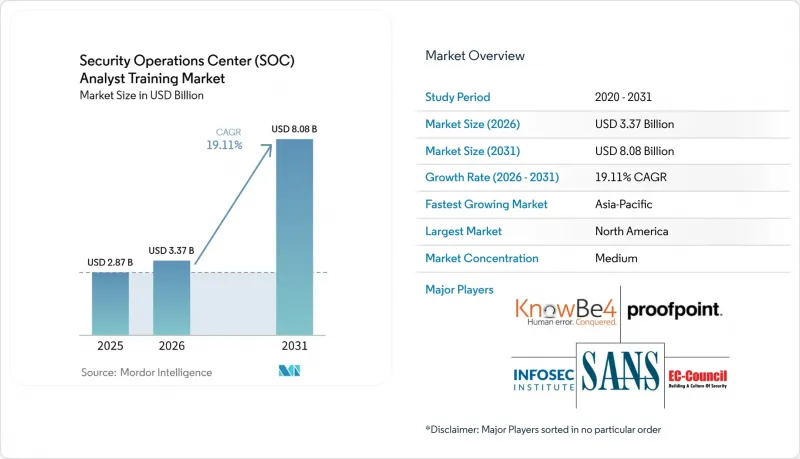
Mordor Intelligence에 의하면, 보안 운영 센터(SOC) 애널리스트 교육 시장 규모는 2025년에 28억 7,000만 달러로 평가되었고 2026년 33억 7,000만 달러에서 2031년까지 80억 8,000만 달러에 이를 것으로 예측되며, 예측 기간(2026-2031년) CAGR은 19.11%를 나타낼 전망입니다.
본 보고서는 교육 형식(자기 주도형 온라인 학습 등), 제공 내용(인증 프로그램, 맞춤형 기업 교육 등), 기업 규모(대기업, 중소기업), 최종 사용자 산업(IT 및 통신, 에너지·유틸리티 등) 및 지역별로 분류되어 있습니다. 시장 전망은 금액(달러) 기준으로 제시되어 있습니다.
세계 보안 운영 센터(SOC) 애널리스트 교육 시장 동향 및 인사이트
AI를 활용한 위협 시뮬레이션에 대한 수요 증가
보안 운영 센터(SOC) 애널리스트 교육 시장은 정적인 교육 과정 내용과 실제 환경에서 급속히 진화하는 AI 기반 공격 행동 간의 격차 확대에 대응하고 있습니다. ISC²의 조사에 따르면, 보안 책임자의 47%가 현재 교육을 통해 대응해야 할 가장 시급한 역량으로 AI를 꼽았습니다. 같은 조사에서 응답자의 28%가 이미 에이전트형 AI를 자사 팀의 ‘차세대 기술 영역’으로 인식하고 있는 것으로도 밝혀졌습니다. SANS의 보고서에 따르면, 74%의 조직이 AI가 이미 SOC 팀의 규모와 역할 구성에 영향을 미치고 있다고 응답한 반면, 종합적인 AI 보안 교육을 제공하는 곳은 38%에 불과한 것으로 나타났습니다. 또한, 포티넷의 조사에 따르면, 60%의 조직이 AI 전문 인력을 확보하는 것을 가장 큰 채용 과제로 꼽고 있으며, 이로 인해 구매자들은 적응형 시뮬레이션 및 AI 대응 실습 환경으로 눈을 돌리고 있습니다.
규정 준수를 주도하는 애널리스트 양성 프로그램
보안 운영 센터(SOC) 애널리스트 교육 시장은 교육이 역할별로 특화되고, 문서화되며, 효과적일 것을 요구하는 규정 준수 프로그램으로부터 꾸준한 지지를 얻고 있습니다. NIS2는 2024년 10월부터 EU 회원국 대부분에서 시행되었으며, DORA는 2025년 1월 17일부터 직접 적용이 시작되었습니다. DORA 제13조 제6항에서는 특권적인 ICT 접근 권한을 가진 인력에 대한 실전 훈련을 포함하여, 직무 책임에 상응하는 상세한 교육이 요구되고 있습니다. 또한, ENISA가 2025년 6월에 발표한 지침에서는 사이버 보안 교육을 12가지 필수 관리 영역 중 하나로 규정하고, 기록을 보관한 후 그 유효성을 평가할 것을 요구하고 있습니다. SANS 및 GIAC의 인력에 관한 보고서에 따르면, 규제가 채용 및 교육 결정에 영향을 미치는 조직의 비율은 2025년 40%에서 2026년 95%로 상승하여, 규정 준수가 이 시장에서 가장 명확한 수요 요인 중 하나가 되고 있습니다.
재량적 교육비에 대한 예산적 압박
보안 운영 센터(SOC) 애널리스트 교육 시장은 여전히 예산 제약에 직면해 있습니다. 많은 조직이 애널리스트 양성을 여전히 재량적 지출로 취급하고 있기 때문입니다. SANS와 GIAC의 2026년 보고서에 따르면, 36%의 조직에서 예산 제약이 기술 격차를 해소하는 데 있어 주요 장애물로 작용하는 것으로 나타났습니다. 또한, 같은 조사에서는 예산 제약과 시간 제약이 겹치면서 57%의 조직에 영향을 미치고 있는 것으로 나타났습니다. 팀의 부담도 증가하고 있어, 61%의 조직이 지난 2년 동안 스트레스가 증가했다고 보고했으며, 체계적인 학습 시간을 확보할 여지가 줄어들고 있습니다. NIS2 및 DORA의 도입으로 인해 이러한 압박은 점차 완화될 것입니다. 훈련 부족이 기록될 경우, 규정 준수 비용이 훈련 자체의 비용을 초과할 가능성이 있기 때문입니다.
부문 분석
2025년, 강사 주도형 가상 학습은 보안 운영 센터(SOC) 애널리스트 교육 시장 점유율의 31.42%를 차지하며, 기록이 남는 실시간 교육의 주력 형식이 되었습니다. 이 형식은 동기식 전달을 통해 자기 주도형 수료만 하는 경우보다 출석률과 참여 기록이 확실해지기 때문에 규정 준수 요건에 적합합니다. 또한 강사가 로그 해석이나 대응 절차를 실시간으로 수정할 수 있어 SOC 업무에도 적합합니다. 자기 주도형 온라인 학습은 기초적인 준비나 보다 용이한 접근이 필요한 전 세계에 흩어져 있는 수강생 그룹에게 여전히 중요한 역할을 하고 있습니다.
블렌디드 러닝은 2031년까지 연평균 성장률(CAGR) 22.83%를 나타낼 것으로 예측되며, 보안 운영 센터(SOC) 애널리스트 교육 시장에서 가장 빠르게 확대될 교육 형식이 될 전망입니다. 구매자들은 이 모델을 활용하여 라이브 세션의 구조와 온디맨드 실습의 규모 및 반복 가능성을 결합하고 있습니다. 대면 학습은 기밀성이 높은 정부 기관, 하드웨어를 많이 사용하는 운영 기술(OT) 과정, 그리고 컨텐츠의 기밀성으로 인해 온라인 제공이 제한되는 프로그램에서 여전히 중요한 역할을 하고 있습니다. ISC2의 2026년 조사 결과에 따르면, AI는 현재의 최우선 과제이자 미래 수요의 주요 촉진요인이며, 이는 혼합형 학습 방식을 뒷받침합니다. 혼합형 학습은 공식적인 교육과 시나리오 반복 연습을 모두 지원할 수 있기 때문입니다.
2025년, 인증 프로그램은 28.41%의 점유율을 차지하며 보안 운영 센터(SOC) 애널리스트 교육 시장에서 가장 큰 제공 범주가 되었습니다. 이러한 위상은 앞으로도 견조하게 유지될 것으로 전망됩니다. 64%의 조직에서 인증 자격이 여전히 채용 시 가장 중요한 지표로 꼽히고 있으며, 이는 기술 평가(49%)나 학력(17%)을 상회하기 때문입니다. EC-Council은 ‘공인 SOC 애널리스트’ 커리큘럼을 개편하고, AI를 활용한 로그 분석, SIEM 및 SOAR 기반의 자동화 워크플로우, 위협 헌터 대상 과정을 추가함으로써 이러한 수요를 더욱 부추겼습니다. 또한, NIS2 및 DORA에 따라 이사회와 고위 경영진을 대상으로 한 교육에 대한 기대가 높아짐에 따라, 인식 제고 세미나와 경영진 브리핑도 거버넌스 측면에서 중요한 역할을 하고 있습니다.
사이버 레인지 및 실습 랩 프로그램은 2031년까지 연평균 성장률(CAGR) 24.16%를 나타낼 것으로 예측되며, 보안 운영 센터(SOC) 애널리스트 교육 시장에서 가장 빠르게 성장하는 서비스가 되고 있습니다. Cyberbit의 조사에 따르면, 주니어급 SOC 직책의 75%에서 실무 경험이 명시적으로 요구되고 있으며, 이로 인해 시뮬레이션을 많이 활용하는 교육이 초급 및 중급 채용 파이프라인 단계에서 강한 수요를 모으고 있습니다. 자사 고유의 도구, 워크플로우, 사고 대응 매뉴얼에 맞춘 교육 컨텐츠가 필요한 기업에게는 맞춤형 기업 교육, 워크숍, 부트캠프가 여전히 중요합니다. 이러한 구성으로 볼 때, 구매자들은 공식 자격 인증을 유지하면서도 애널리스트가 일상 업무에 즉시 투입될 수 있도록 돕는 실용적인 교육에 대한 지출을 늘리고 있는 것으로 나타납니다.
지역별 분석
2025년, 북미는 보안 운영 센터(SOC) 애널리스트 교육 시장 점유율의 34.62%를 차지하며 최대 지역 시장으로서의 위상을 유지했습니다. 미국은 대기업과 공공기관이 보다 체계적인 SOC 역할 정의와 정기적인 교육 주기를 유지하고 있기 때문에 여전히 주요 수요 거점으로 자리 잡고 있습니다. 현직 SOC 실무자 444명과 CISO(최고정보보안책임자) 69명을 대상으로 실시한 ‘2026년 SANS SOC 조사’에 따르면, 인재 유지를 위한 필요성에 대한 경영진과 실무자의 견해에는 27포인트의 차이가 있는 것으로 나타났습니다. 이러한 차이는 중요한 의미를 지닙니다. 왜냐하면 측정 가능한 대응 능력 향상을 입증할 수 있는 벤더일수록 이 분야에서 예산 승인을 얻기 쉬운 입장에 있기 때문입니다.
아시아태평양은 2031년까지 연평균 성장률(CAGR) 23.48%를 나타낼 것으로 예측되며, 보안 운영 센터(SOC) 애널리스트 교육 시장에서 가장 빠르게 성장하는 지역이 될 전망입니다. 이 지역의 성장은 단일한 지역적 경향이라기보다는 각국별 다양한 수요 요인에 의해 형성되고 있습니다. 인도에서는 디지털 결제 및 핀테크 활동의 확대에 따라 체계적인 애널리스트의 역량 향상이 요구되면서 수요가 더욱 증가하고 있습니다. 일본과 한국에서도 사이버 보안 실무와 첨단 산업 운영 간의 연계가 강화됨에 따라 수요가 확대되고 있습니다. 싱가포르의 IMDA는 2026년 5월, Grab 및 RSM Stone Forest IT와 제휴하여 12,000개 중소기업을 대상으로 AI 및 사이버 보안 역량 향상을 지원하고 있으며, 이는 보다 광범위한 역량 구축에 대한 공공 지원이 이루어지고 있음을 보여줍니다.
유럽은 NIS2 및 DORA에 따라 교육이 감사 가능한 규정 준수 의무가 되었기 때문에 보안 운영 센터(SOC) 애널리스트 교육 시장에서 여전히 규모가 크고 구조적으로 중요한 지역으로 남아 있습니다. 중요 사업체의 경우, NIS2에 따른 벌금은 1,000만 유로(1,130만 달러) 또는 연간 매출의 2%에 달할 수 있어, 이로 인해 이사회 차원에서 교육 실적이 더욱 중요해지고 있습니다. ENISA가 2025년 6월에 발표한 지침에 따르면, 효과 기록이 수반되는 역할별 정기 교육이 의무화되어 있으며, 이는 독일, 영국, 프랑스에서의 지속적인 수요를 뒷받침하고 있습니다. 남미, 중동 및 아프리카는 아직 발전 중인 유망 지역이며, 남미에서는 브라질이 현재 수요를 주도하고 있고, 사우디아라비아와 UAE는 보다 광범위한 디지털 보안 및 기술 향상 이니셔티브를 통해 지역 전체의 성장세를 강화하고 있습니다.
기타 혜택:
- 엑셀 형식 시장 예측(ME) 시트
- 3개월간의 애널리스트 지원
자주 묻는 질문
목차
제1장 서론
제2장 조사 방법
제3장 개요
제4장 시장 구도
제5장 시장 규모와 성장 예측
제6장 경쟁 구도
제7장 시장 기회와 향후 전망
JHS 26.09.01According to Mordor Intelligence, the security operations center (SOC) analyst training market size was valued at USD 2.87 billion in 2025 and estimated to grow from USD 3.37 billion in 2026 to reach USD 8.08 billion by 2031, at a CAGR of 19.11% during the forecast period (2026-2031).
This report is Segmented by Training Format (Self-Paced Online Learning, and More), Offering (Certification Programs, Customized Corporate Training, More), Enterprise Size (Large Enterprises, and Small and Medium Enterprises), End-User Industry (IT and Telecommunication, Energy and Utilities, and More), and Geography. The Market Forecasts are Provided in Terms of Value (USD).
Global Security Operations Center (SOC) Analyst Training Market Trends and Insights
Rising AI-Driven Threat Simulation Demand
The Security Operations Center (SOC) analyst training market is responding to a growing mismatch between static course content and rapidly evolving AI-enabled attack behavior in real-world environments. ISC2 found that 47% of security leaders identified AI as the most pressing competency now being addressed through training. The same research showed that 28% of respondents already view agentic AI as the next skill frontier for their teams. SANS reported that 74% of organizations say AI is already affecting SOC team size and role composition, but only 38% provide comprehensive AI security training. Fortinet also found that 60% of organizations cite AI-specific experience as their top recruiting challenge, which is pushing buyers toward adaptive simulations and AI-aware lab environments.
Compliance-Led Analyst Readiness Programs
The Security Operations Center (SOC) analyst training market is gaining steady support from compliance programs that now expect training to be role-specific, documented, and effective. NIS2 became enforceable across most EU member states from October 2024, and DORA came into direct application on January 17, 2025. DORA Article 13(6) requires training depth that matches job responsibility, including hands-on drills for personnel with privileged ICT access. ENISA's June 2025 guidance also treated cybersecurity training as 1 of 12 mandatory control domains and required effectiveness assessment with maintained records. The SANS and GIAC workforce report showed that the share of organizations in which regulation affects hiring and training decisions rose from 40% in 2025 to 95% in 2026, making compliance one of the clearest demand triggers in this market.
Budget Pressure on Discretionary Training Spend
The Security Operations Center (SOC) analyst training market still faces budget constraints, as many organizations continue to treat analyst development as discretionary spending. The SANS and GIAC 2026 report found that budget constraints are the main obstacle to closing skills gaps for 36% of organizations. The same research also showed that budget limitations and time constraints together affect 57% of organizations. Team strain is rising as well, with 61% reporting higher stress over the prior 2 years, which leaves less room for structured learning time. NIS2 and DORA should reduce this pressure over time, as documented training gaps can cost more in compliance than the training itself.
Other drivers and restraints analyzed in the detailed report include:
- Persistent Security Skills Shortage in SOC Teams
- Shift to Role-Based, Scenario-Based Learning
- Limited Hands-On Lab Fidelity For Advanced Scenarios
For complete list of drivers and restraints, kindly check the Table Of Contents.
Segment Analysis
Instructor-Led Virtual Learning held 31.42% of the Security Operations Center (SOC) analyst training market share in 2025, making it the anchor format for documented, live instruction. This format fits compliance expectations because synchronous delivery creates stronger attendance and participation records than self-paced completion alone. It also suits SOC work because instructors can correct log interpretation and response steps in real time. Self-Paced Online Learning still serves an important role for foundational preparation and for globally distributed cohorts that need easier access.
Blended Learning is projected to grow at a 22.83% CAGR through 2031, making it the fastest-expanding training format in the Security Operations Center (SOC) analyst training market. Buyers are using this model to combine the structure of live sessions with the scale and repeatability of on-demand labs. Classroom Learning remains relevant in classified government settings, hardware-heavy operational technology courses, and programs where content sensitivity limits virtual delivery. ISC2's 2026 findings on AI as both the top current priority and the main future demand driver support this format, because blended delivery can handle both formal instruction and repeated scenario refresh.
Certification Programs held a 28.41% share in 2025, making them the largest offering category in the Security Operations Center (SOC) analyst training market. That position remains durable because certifications are still the top hiring signal at 64% of organizations, ahead of skills assessments at 49% and academic degrees at 17%. EC-Council reinforced that demand by upgrading its Certified SOC Analyst curriculum to include AI-powered log analysis, SIEM- and SOAR-based automation workflows, and threat-hunter tracks. Awareness seminars and executive briefings also play a governance role, as board and senior management training expectations have increased under NIS2 and DORA.
Cyber Range and Hands-on Lab Programs are projected to grow at a 24.16% CAGR through 2031, making them the fastest-growing offerings in the Security Operations Center (SOC) analyst training market. Cyberbit found that 75% of junior SOC roles explicitly require hands-on experience, which gives simulation-heavy training a strong pull at the entry and mid-level pipeline stages. Customized Corporate Training, Workshops, and Bootcamps remain important for enterprises that need course content aligned with their own tools, workflows, and incident playbooks. The mix shows that buyers are keeping formal credentials in place while increasing spend on applied practice that is easier to connect to day-to-day analyst readiness.
Complete Report Scope:
- By Training Format
- Self-Paced Online Learning
- Instructor-Led Virtual Learning
- Classroom Learning
- Blended Learning
- By Offering
- Certification Programs
- Customized Corporate Training
- Workshops and Bootcamps
- Awareness Seminars and Executive Briefings
- Cyber Range and Hands-on Lab Programs
- By Enterprise Size
- Large Enterprises
- Small and Medium Enterprises
- By End-user Industry
- IT and Telecommunication
- BFSI
- Healthcare and Life Sciences
- Retail and E-Commerce
- Industrial Manufacturing
- Education and Research Institutions
- Media and Entertainment
- Government and Administration
- Energy and Utilities
- Other End-user Industries
- By Geography
- North America
- United States
- Canada
- Mexico
- South America
- Brazil
- Argentina
- Rest of South America
- Europe
- Germany
- United Kingdom
- France
- Russia
- Spain
- Rest of Europe
- Asia-Pacific
- China
- Japan
- India
- South Korea
- Southeast Asia
- Rest of Asia-Pacific
- Middle East and Africa
- Middle East
- Saudi Arabia
- United Arab Emirates
- Rest of Middle East
- Africa
- South Africa
- Nigeria
- Rest of Africa
- Middle East
- North America
Geography Analysis
North America held 34.62% of the Security Operations Center (SOC) analyst training market share in 2025, maintaining its position as the largest regional market. The United States remained the core demand center because large enterprises and public institutions maintain more formal SOC role definitions and recurring training cycles. The 2026 SANS SOC Survey, based on 444 active SOC practitioners and 69 CISOs, found a 27-point gap between management and practitioner views on retention needs. That gap matters because vendors that can show measurable readiness gains are better placed to win budget approval in the region.
Asia-Pacific is projected to grow at a 23.48% CAGR through 2031, making it the fastest-growing region in the Security Operations Center (SOC) analyst training market. Growth in the region is being shaped by different national demand drivers rather than by a single regional pattern. India is seeing stronger demand as digital payments and fintech activity widen the need for structured analyst readiness. Japan and South Korea are also adding demand through closer alignment between cybersecurity practice and advanced industrial operations. Singapore's IMDA partnered with Grab and RSM Stone Forest IT in May 2026 to uplift 12,000 SMEs in AI and cybersecurity, demonstrating public support for broader capability-building.
Europe remains a deep and structurally important region in the Security Operations Center (SOC) analyst training market, as NIS2 and DORA have made training an auditable compliance obligation. For essential entities, NIS2 penalties can reach EUR 10 million (USD 11.3 million) or 2% of annual turnover, which raises the board-level importance of training evidence. ENISA's June 2025 guidance requires scheduled, role-specific training with effectiveness records, which supports sustained demand in Germany, the United Kingdom, and France. South America, the Middle East, and Africa are earlier-stage opportunity zones, with Brazil leading current South American demand and Saudi Arabia and the UAE strengthening regional momentum through broader digital security and skills initiatives.
- SANS Institute
- EC-Council
- Infosec Institute
- Offensive Security, LLC
- Cybrary, Inc.
- Immersive Labs Limited
- KnowBe4, Inc.
- Proofpoint, Inc.
- Cofense, Inc.
- SoSafe GmbH
- Terranova Security Inc.
- Mimecast Limited
- Hoxhunt Oy
- NINJIO, Inc.
- Security Journey, Inc.
- Security Innovation, Inc.
- Inspired eLearning, LLC
- Global Learning Systems, LLC
- Barracuda Networks, Inc.
- Pluralsight, LLC
Additional Benefits:
- The market estimate (ME) sheet in Excel format
- 3 months of analyst support
TABLE OF CONTENTS
1 INTRODUCTION
- 1.1 Study Assumptions and Market Definition
- 1.2 Scope of the Study
2 RESEARCH METHODOLOGY
3 EXECUTIVE SUMMARY
4 MARKET LANDSCAPE
- 4.1 Market Overview
- 4.2 Market Drivers
- 4.2.1 Rising AI-Driven Threat Simulation Demand
- 4.2.2 Compliance-Led Analyst Readiness Programs
- 4.2.3 Persistent Security Skills Shortage in SOC Teams
- 4.2.4 Shift to Role-Based, Scenario-Based Learning
- 4.2.5 Growth of Hybrid and Virtual Lab Delivery
- 4.2.6 Procurement Preference for Measurable Training Outcomes
- 4.3 Market Restraints
- 4.3.1 Budget Pressure on Discretionary Training Spend
- 4.3.2 Limited Hands-On Lab Fidelity for Advanced Scenarios
- 4.3.3 Low Completion Rates in Multi-Module Training Programs
- 4.3.4 Difficulty Proving ROI Beyond Awareness Metrics
- 4.4 Impact of Macroeconomic Factors on the Market
- 4.5 Industry Value-Chain Analysis
- 4.6 Technology Outlook
- 4.7 Regulatory Landscape
- 4.8 Porter's Five Forces Analysis
- 4.8.1 Threat of New Entrants
- 4.8.2 Bargaining Power of Suppliers
- 4.8.3 Bargaining Power of Buyers
- 4.8.4 Threat of Substitutes
- 4.8.5 Intensity of Competitive Rivalry
5 MARKET SIZE AND GROWTH FORECASTS (VALUE)
- 5.1 By Training Format
- 5.1.1 Self-Paced Online Learning
- 5.1.2 Instructor-Led Virtual Learning
- 5.1.3 Classroom Learning
- 5.1.4 Blended Learning
- 5.2 By Offering
- 5.2.1 Certification Programs
- 5.2.2 Customized Corporate Training
- 5.2.3 Workshops and Bootcamps
- 5.2.4 Awareness Seminars and Executive Briefings
- 5.2.5 Cyber Range and Hands-on Lab Programs
- 5.3 By Enterprise Size
- 5.3.1 Large Enterprises
- 5.3.2 Small and Medium Enterprises
- 5.4 By End-user Industry
- 5.4.1 IT and Telecommunication
- 5.4.2 BFSI
- 5.4.3 Healthcare and Life Sciences
- 5.4.4 Retail and E-Commerce
- 5.4.5 Industrial Manufacturing
- 5.4.6 Education and Research Institutions
- 5.4.7 Media and Entertainment
- 5.4.8 Government and Administration
- 5.4.9 Energy and Utilities
- 5.4.10 Other End-user Industries
- 5.5 By Geography
- 5.5.1 North America
- 5.5.1.1 United States
- 5.5.1.2 Canada
- 5.5.1.3 Mexico
- 5.5.2 South America
- 5.5.2.1 Brazil
- 5.5.2.2 Argentina
- 5.5.2.3 Rest of South America
- 5.5.3 Europe
- 5.5.3.1 Germany
- 5.5.3.2 United Kingdom
- 5.5.3.3 France
- 5.5.3.4 Russia
- 5.5.3.5 Spain
- 5.5.3.6 Rest of Europe
- 5.5.4 Asia-Pacific
- 5.5.4.1 China
- 5.5.4.2 Japan
- 5.5.4.3 India
- 5.5.4.4 South Korea
- 5.5.4.5 Southeast Asia
- 5.5.4.6 Rest of Asia-Pacific
- 5.5.5 Middle East and Africa
- 5.5.5.1 Middle East
- 5.5.5.1.1 Saudi Arabia
- 5.5.5.1.2 United Arab Emirates
- 5.5.5.1.3 Rest of Middle East
- 5.5.5.2 Africa
- 5.5.5.2.1 South Africa
- 5.5.5.2.2 Nigeria
- 5.5.5.2.3 Rest of Africa
- 5.5.5.1 Middle East
- 5.5.1 North America
6 COMPETITIVE LANDSCAPE
- 6.1 Market Concentration
- 6.2 Strategic Moves
- 6.3 Market Share Analysis
- 6.4 Company Profiles (includes Global Level Overview, Market Level Overview, Core Segments, Financials as available, Strategic Information, Market Rank/Share, Products and Services, Recent Developments)
- 6.4.1 SANS Institute
- 6.4.2 EC-Council
- 6.4.3 Infosec Institute
- 6.4.4 Offensive Security, LLC
- 6.4.5 Cybrary, Inc.
- 6.4.6 Immersive Labs Limited
- 6.4.7 KnowBe4, Inc.
- 6.4.8 Proofpoint, Inc.
- 6.4.9 Cofense, Inc.
- 6.4.10 SoSafe GmbH
- 6.4.11 Terranova Security Inc.
- 6.4.12 Mimecast Limited
- 6.4.13 Hoxhunt Oy
- 6.4.14 NINJIO, Inc.
- 6.4.15 Security Journey, Inc.
- 6.4.16 Security Innovation, Inc.
- 6.4.17 Inspired eLearning, LLC
- 6.4.18 Global Learning Systems, LLC
- 6.4.19 Barracuda Networks, Inc.
- 6.4.20 Pluralsight, LLC
7 MARKET OPPORTUNITIES AND FUTURE OUTLOOK
- 7.1 White-Space and Unmet-Need Assessment


