
|
시장보고서
상품코드
2098518
베트남의 디지털 워크플레이스 시장 : 시장 점유율 분석, 업계 동향 및 통계, 성장 예측(2026-2031년)Vietnam Digital Workplace - Market Share Analysis, Industry Trends & Statistics, Growth Forecasts (2026 - 2031) |
||||||
 Mordor Intelligence
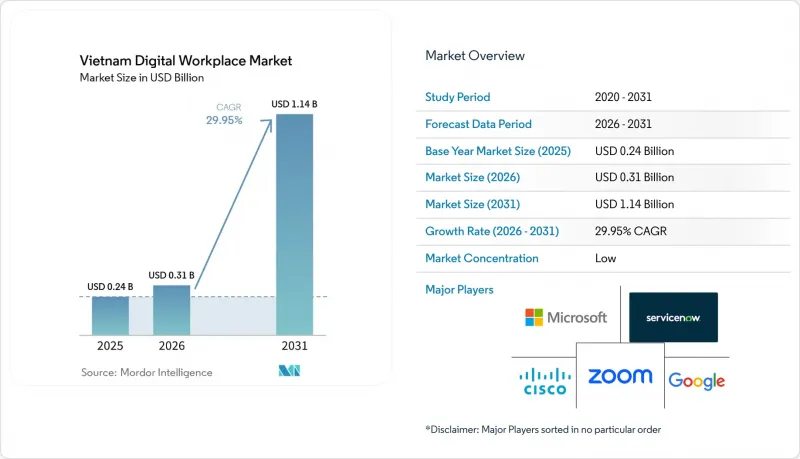
Mordor Intelligence에 의하면, 베트남의 디지털 워크플레이스 시장 규모는 2025년에 2억 4,000만 달러로 평가되었고, 2031년까지 11억 4,000만 달러에 이를 것으로 예측되며, 2026-2031년 CAGR 29.95%로 성장할 전망입니다.
본 보고서는 컴포넌트별(솔루션 및 서비스), 배포 방식별(클라우드, 온프레미스, 하이브리드), 조직 규모별(대기업 및 중소기업), 최종 사용자 산업별(IT 및 통신, 은행, 금융서비스 및 보험(BFSI), 의료, 제조, 소매, 정부 및 공공 부문, 에너지 및 유틸리티 등)로 분류되어 있습니다. 시장 전망은 금액(달러) 기준으로 제시되어 있습니다.
베트남의 디지털 워크플레이스 시장 동향 및 인사이트
호치민시 및 하노이 기업의 급속한 디지털화
호치민시와 하노이는 베트남 내에서 가장 많은 비즈니스 활동이 집중되어 있어, 베트남 디지털 워크플레이스 시장에서 기업의 디지털 워크플레이스 현대화 속도를 지속적으로 주도하고 있습니다. 이 두 도시를 합치면 베트남 전체 기업의 50% 이상이 입지해 있으며, 소프트웨어 도입, 조달 규모, 시스템 통합 심화 측면에서 다른 지역을 확실히 앞서고 있습니다. 또한, 2025년 베트남 e-비즈니스 지수에서도 하노이가 74.7점, 호치민시가 73.5점을 기록하며, 베트남의 다른 지역에 비해 디지털 비즈니스 운영에 대한 준비 태세가 더욱 잘 갖춰져 있음을 보여주고 있습니다. 이러한 정책 추진은 하노이시 과학기술국이 마이크로소프트 베트남과 공동으로 공공 부문의 Microsoft 365 및 Copilot 도입에 초점을 맞춘 2025년 워크숍을 공동 주최함으로써 더욱 구체적인 형태를 띠게 되었습니다. 이 두 도시가 기업 기준을 계속해서 제시함에 따라, 인근 산업 거점에서는 국내외 모기업으로부터 유사한 업무 환경 아키텍처를 구축하라는 더 강한 압력이 가해질 것으로 예측됩니다.
지식 집약형 부문에서의 하이브리드 근무 정착
하이브리드 근무는 현재 베트남의 디지털 업무 환경 시장에서 정착된 운영 모델이 되었으며, 특히 디지털 협업에 의존하는 기술, 금융, 마케팅, 미디어 직종에서 두드러집니다. 맨파워그룹(ManpowerGroup)의 2026년 고용 전망에 따르면, 베트남에서는 채용 의지가 강해 고용주의 63%가 인력 증원을 계획하고 있으며, 이는 협업, 커뮤니케이션, 직원 경험 도구에 대한 수요가 지속되고 있음을 뒷받침합니다. Reeracoen과 Rakuten Insight가 2026년에 실시한 조사에 따르면, 베트남 근로자의 74%가 하이브리드 근무를 희망하는 반면, 실제로 이를 이용하고 있는 비율은 51%에 그쳐, 고용주가 해결해야 할 유연성 측면에서 큰 격차가 남아 있음이 밝혀졌습니다. 『Humanities and Social Sciences Communications』지에 게재된 조사에 따르면, 베트남의 외국계 기업과 국내 기업은 하이브리드 근무 관리 방식이 서로 다르며, 이는 디지털 워크플레이스 플랫폼 내 거버넌스, 워크플로우, 정책 관리 기능에 대한 수요가 다양함을 시사합니다. 이러한 추세로 인해 베트남의 디지털 워크플레이스 시장은 도입 확대뿐만 아니라, 직원의 기대와 현지 조직 내에서 현재 이용 가능한 도구 간의 격차에 계속해서 영향을 받고 있습니다.
디지털 워크플레이스 혁신 및 관리 도구에 대한 기술 격차
많은 조직이 플랫폼 도입은 신속하게 진행할 수 있지만, 그 관리 및 최적화가 뒤따르지 못하고 있어 기술 격차는 여전히 베트남 디지털 워크플레이스 시장에 명백한 걸림돌이 되고 있습니다. 이러한 압박은 하노이와 호치민시 이외의 지역에서 특히 심하며, 이 두 주요 대도시권에 비해 전문 관리자, 디지털 워크플레이스 아키텍트, 통합 담당자를 확보하기가 여전히 어려운 상황입니다. 이 때문에 많은 도입 사례에서 외부 서비스 파트너에 대한 의존도가 높아져 비용이 증가할 뿐만 아니라, 예산이 제한된 기업의 경우 도입이 지연될 가능성도 있습니다. 정부는 2026-2030년 진행될 중소기업 대상 디지털 전환 프로젝트에서 이 문제를 인식하고 있습니다. 이 프로젝트는 30만 개 기업을 지원하고, 디지털 및 AI 도입을 위한 최소 500명의 전문 컨설턴트로 구성된 네트워크를 구축하는 것을 목표로 하고 있습니다. 사내 역량이 보다 고르게 확산되기 전까지는 베트남의 디지털 워크플레이스 시장에서 대도시 기업과 지방 도입 기업 간에 활용도 측면에서 편차가 나타날 가능성이 높습니다.
부문 분석
CAGR은 연평균 성장률(Compound Annual Growth Rate)을 의미합니다. 또한, 기업들이 동일한 환경 내에서 검색 기능, 업무 할당, 사내 컨텐츠 접근성 개선을 요구함에 따라 워크플로우 자동화 및 지식 관리 도구에 대한 수요도 계속해서 견조했습니다. 마이크로소프트 베트남의 '2025년 업무 동향 지수'에 따르면, 베트남 조직의 65%가 이미 AI 에이전트를 활용하여 특정 워크플로를 완전히 자동화하고 있으며, 이는 세계 평균인 46%를 상회합니다. 이 사실은 디지털 워크플레이스 제품군 내 자동화 계층에 대한 수요가 지속되고 있음을 뒷받침합니다. 이에 따라 베트남의 디지털 워크플레이스 시장은 커뮤니케이션, 디바이스 제어, 워크플로우 지원을 단일 운영 계층으로 통합할 수 있는 솔루션을 중심으로 계속 발전하고 있습니다.
서비스 매출 점유율은 여전히 소규모였으나, 도입, 통합 및 관리형 지원이 구매 후 고객이 얻는 장기적 가치의 크기를 좌우하는 경우가 많기 때문에 베트남 디지털 워크플레이스 업계에서 전략적인 역할을 수행했습니다. 베트남의 디지털 워크플레이스 시장에서는 일회성 소프트웨어 프로젝트를 사용자 유지율 및 시스템 성능과 연계된 지속적인 지원 관계로 전환할 수 있는 기업이 계속해서 높은 평가를 받았습니다. 2025년 9월 1일 Meta가 ‘Workplace’ 서비스를 종료함에 따라, 사내 커뮤니케이션 측면에서 직접적인 전환이 필요하게 되었습니다. 이에 대응하여 FPT는 8만 5,000명의 직원을 대상으로 독자적인 인트라넷 플랫폼 ‘FPT Place’를 출시했습니다. 2026년 1월에는 Kingsoft Office와 FPT가 WPS 365의 베트남 현지화 및 기업용 디지털 워크플레이스 제공 확대에 관한 계약을 체결했습니다. 이러한 움직임은 서비스 주도형 현지화가 왜 베트남 디지털 워크플레이스 시장에서 여전히 중요한 요소이며, 왜 서비스 계층이 향후 솔루션 선택을 좌우할 수 있는지를 보여줍니다.
2025년 기준, 베트남 디지털 워크플레이스 시장 규모의 70.27%를 클라우드가 차지했으며, 2031년까지 연평균 성장률(CAGR) 30.29%를 나타낼 것으로 예측됩니다. 이에 따라 클라우드는 여전히 가장 크고 가장 빠르게 확장되는 도입 형태로 자리매김할 것입니다. 이는 분산된 직원을 지원하고, 업데이트가 용이하며, 인프라 관리 부담이 적은 호스팅형 플랫폼으로 베트남의 디지털 워크플레이스 시장이 명확하게 전환되고 있음을 반영합니다. 다국적 기업들은 이러한 추세를 더욱 가속화하고 있습니다. 이들 중 다수는 이미 지역별 사업체 간에 디지털 워크플레이스 도구를 표준화해 놓았으며, 베트남 팀도 동일한 환경에서 업무를 수행하기를 원하기 때문입니다. 정책 측면에서도 클라우드 도입이 뒷받침되고 있으며, 국가 차원의 클라우드 추진 방침에 따라 공공 부문에서의 이용과 민간 부문의 폭넓은 참여가 모두 장려되고 있습니다. 그 결과, 베트남의 디지털 워크플레이스 시장에서는 많은 대기업에서 클라우드가 ‘선호되는 선택지’에서 ‘기본 아키텍처’로 전환되고 있습니다.
베트남의 디지털 워크플레이스 시장에서 데이터 유출이나 장기간에 걸친 인프라 변경에 대해 신중한 태도를 고수하는 부처, 국영 기관 및 기타 사용자에게는 온프레미스 구축이 여전히 중요한 위치를 차지하고 있습니다. 또한, 많은 조직이 모든 것을 한꺼번에 교체하기보다는 기존 시스템과 새로운 클라우드 협업 계층을 연동해야 할 필요가 있기 때문에 하이브리드 구성도 여전히 중요하게 여겨지고 있습니다. 2025년 『Humanities and Social Sciences Communications』 저널에 발표된 연구에 따르면, 베트남 기업에서 완전한 클라우드 전환의 주요 장벽으로 보안 우려와 통합 문제가 지적되었습니다. 이 조사 결과는 클라우드가 전반적인 성장을 주도하고 있음에도 불구하고, 베트남의 디지털 워크플레이스 업계가 여전히 혼합 도입 모델을 지지하고 있는 이유를 설명하는 데 도움이 됩니다. 또한, 전환과 공존을 모두 관리할 수 있는 공급업체는 단일 도입 경로에 초점을 맞춘 벤더보다 계속해서 유리한 입장에 있을 것으로 시사됩니다.
기타 혜택 :
- 엑셀 형식 시장 예측(ME) 시트
- 3개월간의 애널리스트 지원
자주 묻는 질문
목차
제1장 서론
제2장 조사 방법
제3장 주요 요약
제4장 시장 구도
제5장 시장 규모 및 성장 예측
제6장 경쟁 구도
제7장 시장 기회 및 향후 전망
AJY 26.08.07According to Mordor Intelligence, the Vietnam digital workplace market size was valued at USD 0.24 billion in 2025 and is projected to reach USD 1.14 billion by 2031, growing at a CAGR of 29.95% during 2026-2031.
This report is Segmented by Component (Solutions, and Services), Deployment Mode (Cloud, On-Premises, and Hybrid), Organization Size (Large Enterprises, and Small and Medium-Sized Enterprises), End-User Industry (IT and Telecommunications, BFSI, Healthcare, Manufacturing, Retail, Government and Public Sector, Energy and Utilities, and More). The Market Forecasts are Provided in Terms of Value (USD).
Vietnam Digital Workplace Market Trends and Insights
Rapid Enterprise Digitization in Ho Chi Minh City and Hanoi
Ho Chi Minh City and Hanoi continue to set the pace for enterprise workplace modernization in the Vietnam digital workplace market because they contain the country's largest concentration of business activity. Together, these 2 cities housed more than 50% of Vietnam's enterprises, which gives them a clear lead in software adoption, procurement scale, and systems integration depth. They also led the 2025 Vietnam eBusiness Index, with Hanoi scoring 74.7 points and Ho Chi Minh City scoring 73.5 points, which shows stronger readiness for digital business operations than the rest of the country. The policy push became more concrete when Hanoi's Department of Science and Technology co-hosted a 2025 workshop with Microsoft Vietnam focused on Microsoft 365 and Copilot adoption in the public sector. As these 2 cities keep setting enterprise standards, nearby industrial centers are likely to face stronger pressure from domestic and foreign parent organizations to follow the same workplace architecture.
Hybrid Work Normalization Across Knowledge-Heavy Sectors
Hybrid work is now a lasting operating model in the Vietnam digital workplace market, especially across technology, finance, marketing, and media roles that rely on digital coordination. ManpowerGroup's 2026 employment outlook showed strong hiring intent in Vietnam, with 63% of employers planning to increase headcount, which supports continued demand for collaboration, communication, and employee experience tools. A 2026 study by Reeracoen and Rakuten Insight found that 74% of Vietnamese workers wanted hybrid arrangements while only 51% had access, leaving a large flexibility gap for employers to address. Research published in Humanities and Social Sciences Communications also found that foreign-owned and domestic firms in Vietnam manage hybrid work differently, which points to varied demand for governance, workflow, and policy-management features inside workplace platforms. This pattern keeps the Vietnam digital workplace market tied not only to hiring growth but also to the gap between worker expectations and the tools currently available inside local organizations.
Skills Gaps in Workplace Transformation and Admin Tooling
Skills gaps remain a clear brake on the Vietnam digital workplace market because many organizations can buy platforms faster than they can manage or optimize them. The pressure is strongest outside Hanoi and Ho Chi Minh City, where specialist administrators, workplace architects, and integration staff remain less available than in the 2 major metro areas. This makes many deployments more dependent on outside service partners, which raises costs and can slow adoption in firms with tighter budgets. The government acknowledged the issue in its 2026-2030 SME digital transformation project, which aims to support 300,000 firms and build a network of at least 500 professional consultants for digital and AI adoption. Until internal skills become more evenly distributed, the Vietnam digital workplace market is likely to see uneven usage depth between large-city enterprises and provincial adopters.
Other drivers and restraints analyzed in the detailed report include:
- Cloud-First Workplace Modernization by Multinationals and Large Local Firms
- Rising Security and Compliance Pressure for Managed Endpoints and Identity Control
- Integration Friction With Legacy ERP, HR, and Document Systems
For complete list of drivers and restraints, kindly check the Table Of Contents.
Segment Analysis
Solutions captured 73.43% of the Vietnam digital workplace market share in 2025 and is projected to grow at 30.12% CAGR through 2031, which showed a clear enterprise preference for integrated platforms instead of fragmented point tools. In the Vietnam digital workplace market, unified communication and collaboration and unified endpoint management drew the broadest deployments because buyers wanted fewer vendors and lower administrative complexity. Demand also remained strong for workflow automation and knowledge management tools as enterprises looked for better search, task routing, and internal content access inside the same environment. Microsoft Vietnam's 2025 Work Trend Index said that 65% of Vietnamese organizations were already using AI agents to fully automate specific workflows, compared with 46% globally, which supports continued demand for automation layers inside workplace suites This kept the Vietnam digital workplace market centered on solutions that can combine communication, device control, and workflow support in one operating layer.
Services remained smaller in revenue share, but they played a strategic role in the Vietnam digital workplace industry because implementation, integration, and managed support often determined how much long-term value a client received after purchase. The Vietnam digital workplace market continued to reward firms that could turn one-time software projects into recurring support relationships tied to user adoption and system performance. Meta's shutdown of Workplace on September 1, 2025 created a direct migration event in internal communications, and FPT responded by launching its own intranet platform, FPT Place, for its 85,000-member workforce. In January 2026, Kingsoft Office and FPT also signed an agreement to localize WPS 365 for Vietnam and expand enterprise workplace delivery. These moves show why service-led localization remains an important part of the Vietnam digital workplace market and why the services layer can shape future solution choice.
Cloud held 70.27% of the Vietnam digital workplace market size in 2025 and is projected to grow at a 30.29% CAGR through 2031, which keeps it as the largest and fastest-expanding deployment mode. This reflects a clear shift in the Vietnam digital workplace market toward hosted platforms that support distributed workforces, easier updates, and lower infrastructure management needs. Multinational companies have reinforced this direction because many of them have already standardized workplace tools across regional entities and want Vietnam teams to operate in the same environment. The policy backdrop also supports cloud adoption, with the national cloud agenda encouraging both public-sector use and broader private-sector participation. As a result, the Vietnam digital workplace market is seeing cloud move from a preferred option to a default architecture for many large organizations.
On-premises deployments still matter in the Vietnam digital workplace market for ministries, state-linked institutions, and other users that remain cautious about data exposure and long-standing infrastructure change. Hybrid setups also retain importance because many organizations still need to connect older systems with newer cloud collaboration layers rather than replace everything at once. A 2025 study in Humanities and Social Sciences Communications identified security concerns and integration challenges as major barriers to full cloud migration among Vietnamese enterprises. That finding helps explain why the Vietnam digital workplace industry continues to support mixed deployment models even while cloud leads overall growth. It also suggests that suppliers able to manage both migration and coexistence should remain better positioned than vendors focused on a single deployment path.
Complete Report Scope:
- By Component
- Solutions
- Unified Communication and Collaboration
- Unified Endpoint Management
- Enterprise Mobility and Management
- Employee Experience Platforms and Intranet
- Workflow Automation and Knowledge Management
- Virtual Desktop Infrastructure and Cloud PC
- Services
- Solutions
- By Deployment Mode
- Cloud
- On-premises
- Hybrid
- By Organization Size
- Large Enterprises
- Small and Medium-sized Enterprises
- By End-user Industry
- Information Technology and Telecommunications
- Banking, Financial Services, and Insurance
- Healthcare
- Manufacturing
- Retail
- Government and Public Sector
- Education
- Energy and Utilities
- Legal and Professional Services
- Other End-user Industries
List of Companies Covered in this Report:
- Microsoft Corporation
- Cisco Systems, Inc.
- Zoom Communications, Inc.
- Google LLC
- ServiceNow
- VMware, Inc.
- Citrix Systems, Inc.
- HCL Technologies Limited
- Accenture plc
- Capgemini SE
- Fujitsu Limited
- Nutanix
- Unisys Corporation
- NTT DATA Group Corporation
- DXC Technology Company
- IBM Corporation
- Dell Technologies Inc.
- Lenovo Group Limited
- Zoho Corporation Pvt. Ltd.
- Viettel Group
- FPT Corporation
- CMC Corporation
Additional Benefits:
- The market estimate (ME) sheet in Excel format
- 3 months of analyst support
TABLE OF CONTENTS
1 INTRODUCTION
- 1.1 Study Assumptions and Market Definition
- 1.2 Scope of the Study
2 RESEARCH METHODOLOGY
3 EXECUTIVE SUMMARY
4 MARKET LANDSCAPE
- 4.1 Market Overview
- 4.2 Market Drivers
- 4.2.1 Rapid Enterprise Digitization in Ho Chi Minh City and Hanoi
- 4.2.2 Hybrid Work Normalization Across Knowledge-Heavy Sectors
- 4.2.3 Cloud-First Workplace Modernization by Multinationals and Large Local Firms
- 4.2.4 Rising Security and Compliance Pressure for Managed Endpoints and Identity Control
- 4.2.5 AI-Enabled Productivity, Search, and Automation Inside Collaboration Suites
- 4.2.6 Rising Demand for Virtual Desktops and Secure Remote Access in Regulated Roles
- 4.3 Market Restraints
- 4.3.1 Skills Gaps in Workplace Transformation and Admin Tooling
- 4.3.2 Integration Friction With Legacy ERP, HR, and Document Systems
- 4.3.3 Cost Sensitivity Among SMEs for Multi-Vendor Digital Workplace Stacks
- 4.3.4 Data Residency, Sovereignty, and Procurement Complexity for Foreign Vendors
- 4.4 Industry Value Chain Analysis
- 4.5 Impact of Macroeconomic Factors on the Market
- 4.6 Regulatory Landscape
- 4.7 Technological Outlook
- 4.8 Porter's Five Forces Analysis
- 4.8.1 Bargaining Power of Buyers
- 4.8.2 Bargaining Power of Suppliers
- 4.8.3 Threat of New Entrants
- 4.8.4 Threat of Substitutes
- 4.8.5 Industry Rivalry
5 MARKET SIZE AND GROWTH FORECASTS (VALUE)
- 5.1 By Component
- 5.1.1 Solutions
- 5.1.1.1 Unified Communication and Collaboration
- 5.1.1.2 Unified Endpoint Management
- 5.1.1.3 Enterprise Mobility and Management
- 5.1.1.4 Employee Experience Platforms and Intranet
- 5.1.1.5 Workflow Automation and Knowledge Management
- 5.1.1.6 Virtual Desktop Infrastructure and Cloud PC
- 5.1.2 Services
- 5.1.1 Solutions
- 5.2 By Deployment Mode
- 5.2.1 Cloud
- 5.2.2 On-premises
- 5.2.3 Hybrid
- 5.3 By Organization Size
- 5.3.1 Large Enterprises
- 5.3.2 Small and Medium-sized Enterprises
- 5.4 By End-user Industry
- 5.4.1 Information Technology and Telecommunications
- 5.4.2 Banking, Financial Services, and Insurance
- 5.4.3 Healthcare
- 5.4.4 Manufacturing
- 5.4.5 Retail
- 5.4.6 Government and Public Sector
- 5.4.7 Education
- 5.4.8 Energy and Utilities
- 5.4.9 Legal and Professional Services
- 5.4.10 Other End-user Industries
6 COMPETITIVE LANDSCAPE
- 6.1 Market Concentration
- 6.2 Strategic Moves
- 6.3 Market Share Analysis
- 6.4 Company Profiles (includes Global Level Overview, Market Level Overview, Core Segments, Financials as available, Strategic Information, Market Rank/Share, Products and Services, Recent Developments)
- 6.4.1 Microsoft Corporation
- 6.4.2 Cisco Systems, Inc.
- 6.4.3 Zoom Communications, Inc.
- 6.4.4 Google LLC
- 6.4.5 ServiceNow
- 6.4.6 VMware, Inc.
- 6.4.7 Citrix Systems, Inc.
- 6.4.8 HCL Technologies Limited
- 6.4.9 Accenture plc
- 6.4.10 Capgemini SE
- 6.4.11 Fujitsu Limited
- 6.4.12 Nutanix
- 6.4.13 Unisys Corporation
- 6.4.14 NTT DATA Group Corporation
- 6.4.15 DXC Technology Company
- 6.4.16 IBM Corporation
- 6.4.17 Dell Technologies Inc.
- 6.4.18 Lenovo Group Limited
- 6.4.19 Zoho Corporation Pvt. Ltd.
- 6.4.20 Viettel Group
- 6.4.21 FPT Corporation
- 6.4.22 CMC Corporation
7 MARKET OPPORTUNITIES AND FUTURE OUTLOOK
- 7.1 White-space and Unmet-Need Assessment