

|
시장보고서
상품코드
2099082
미국의 의료 물류 시장 : 시장 점유율 분석, 업계 동향 및 통계, 성장 예측(2026-2031년)United States Healthcare Logistics - Market Share Analysis, Industry Trends & Statistics, Growth Forecasts (2026 - 2031) |
||||||
 Mordor Intelligence
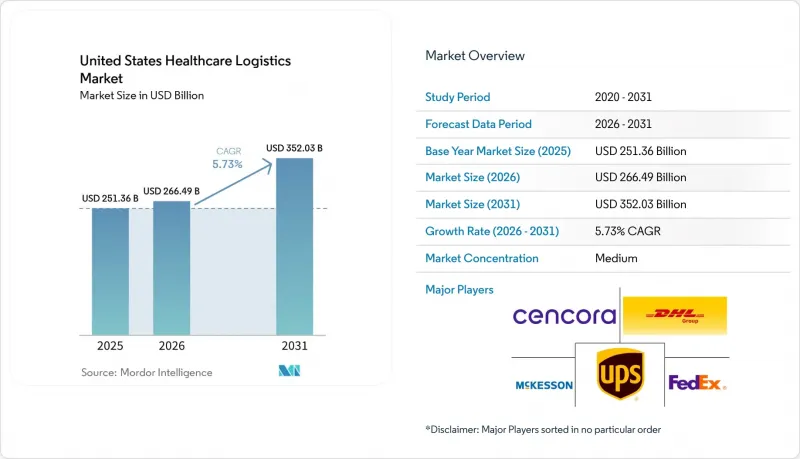
Mordor Intelligence에 의하면, 미국의 의료 물류 시장 규모는 2025년에 2,513억 6,000만 달러로 평가되었고, 2026년 2,664억 9,000만 달러에서 2031년까지 3,520억 3,000만 달러에 이를 것으로 예측되며, 예측 기간(2026-2031년) CAGR은 5.73%를 나타낼 전망입니다.
이러한 성장을 주도하는 요인은 전문 의약품, 세포 및 유전자 치료, 그리고 분산형 의료 서비스 제공이며, 이들이 시장 전반에 걸쳐 콜드체인 용량, 라스트 마일 배송, 그리고 더욱 엄격한 보관 이력 관리로 지출이 이동하는 결과를 가져오고 있습니다. 본 보고서는 물류 기능별(운송, 창고 및 유통, 기타), 온도 유형별(온도 관리형, 비온도 관리형), 제품 유형별(의약품, 기타), 배송지별(국내, 국제), 최종 사용자별(제약 제조업체, 기타), 지역별로 분류되어 있습니다. 시장 전망은 금액(달러) 기준으로 제시되어 있습니다.
미국의 의료 물류 시장 동향 및 인사이트
환자에게 직접 배송을 수행하는 전문 약국의 풀필먼트 성장
환자에게 직접 배송하는 방식은 전문 의약품 분야에서 신흥 채널에서 주류 운영 모델로 전환되었습니다. 치료법의 다양화에 따라 기존 도매 유통 방식으로는 대응하기 어려운 취급, 보험 급여, 환자 지원에 대한 수요가 증가하고 있습니다. 보험사 및 약국 혜택 관리 회사는 고가의 생물학적 제제, GLP-1 제제 및 항암제를 점점 더 많이 통신 판매나 허브 앤 스포크 방식의 풀필먼트로 전환하고 있습니다. 이러한 변화로 인해 물류 제공업체는 온도 관리, 배송 일정 조정, 복약 순응도 지원, 간호사와의 협력을 단일 업무 흐름 내에서 관리해야 할 필요가 생겼습니다. 배송과 서비스의 가시화를 결합하지 못하는 업체들은 통합형 전문 약국이나 환자 직배송 전용으로 구축된 플랫폼에 밀려 미국 의료 물류 시장에서의 입지를 점차 잃어가고 있습니다.
세포 및 유전자 치료용 콜드체인 경로의 확대
FDA 규제 대상인 세포 및 유전자 치료 제품은 이제 확립된 상용 제품이 되었으며, 이에 따라 미국 의료 물류 시장의 배송 경로 설계, 포장 및 예외 관리가 변화하고 있습니다. 각자 가정 치료는 채취부터 제조, 극저온 운송, 그리고 최종 투여에 이르기까지 ‘신원 추적 체인(chain-of-identity)’의 흐름을 따르기 때문에 물류 프로세스는 치료 경로의 일부가 됩니다. 이러한 구조상, 일부 치료법의 경우 -150°C 이하의 극저온 관리, 이중화된 에너지 공급을 갖춘 보관 시설, 그리고 감사 가능한 보관 이력 기록이 요구됩니다. 제조 분야에 대한 투자로 인해, 특히 북동부 및 펜실베이니아주의 기존 바이오의약품 클러스터 주변에서 미래의 물류 파이프라인이 점차 확충되고 있습니다. 높은 자본 진입 장벽으로 인해, 미국 의료 물류 시장의 이 분야는 이미 검증된 극저온 네트워크를 운영하고 있는 사업자를 중심으로 집중되어 있습니다.
시간적 제약이 엄격한 육상 화물 운송 분야의 운전기사 부족
육상 화물 운송 시장은 2026년에 접어들며 운전기사 부족이 심화되고 있으며, 이는 미국 의료 물류 시장에 있어 중대한 제약 요인으로 작용하고 있습니다. 이러한 부족 상황은 비거주지 상업용 운전기사의 자격 요건에 영향을 미치는 규정 변경으로 인해 단기간에 5만 명의 운전기사가 현역에서 이탈했음을 보여줍니다. 또한, 트럭 운전사 전체의 부족 규모는 약 8만 2,000명에 달할 것으로 추정되며, 의약품 보충 및 라스트 마일 운송의 대부분을 여전히 육상 운송이 담당하고 있기 때문에 의료 화물은 영향을 받기 쉬운 상황에 놓여 있습니다. 이러한 압박은 장기, 혈액 제제, 세포 치료제 및 응급 의약품 배송에서 특히 심각합니다. 이러한 화물은 운송 유연성이 거의 없거나 아예 없기 때문입니다. 냉장 운송 및 정시 배송 운송 능력이逼迫하는 가운데, 여전히 의료 등급의 서비스를 제공할 수 있는 운송업체는 가격 결정력을 높이고 있습니다.
부문 분석
2025년 기준, 미국의 의료 물류 시장에서 운송 부문의 점유율은 54.50%를 차지한 반면, 창고 및 유통 부문은 2031년까지 연평균 성장률(CAGR) 7.49%로 확대될 것으로 예측됩니다. 이러한 압도적인 점유율은 의약품 유통에서 육상, 항공 및 복합 일괄 운송이 수행하는 핵심적인 역할을 반영하며, 이 분야에서는 배송 시기와 규정을 준수하는 취급이 여전히 필수적인 서비스 요건으로 남아 있습니다. 항공 화물은 극저온 요법이나 긴급을 요하는 생물학적 제제가 검증된 운송 경로와 엄격하게 관리되는 인계에 의존하고 있기 때문에 네트워크의 프리미엄 분야를 담당하고 있습니다. 한편, 도로 네트워크는 제조업체, 유통업체, 병원, 약국 및 지역 배송 거점을 전국 규모로 연결하고 있어 여전히 미국 의료 물류 업계의 운송량 기반을 담당하고 있습니다. 이로 인해 서비스 구성이 더욱 전문화되어 가는 가운데에서도 운송은 계약 가치의 중심에 계속 자리 잡고 있습니다.
제조업체들이 보관, 주문 처리, 온도 관리를 단일 공급업체 아래 통합하는 아웃소싱 모델로 전환함에 따라, 창고 및 유통 사업의 성장이 가속화되고 있습니다. 이러한 변화는 분산형 의료의 부상과 밀접한 관련이 있습니다. 재택 치료나 재택 급성기 치료 프로그램에서는 환자나 치료팀과 가까운 곳에 재고를 배치해야 하기 때문입니다. 또한, 공급업체가 핵심인 보관 업무에 더해 키트 구성, 라벨 부착, 보냉 포장, 역물류까지 담당하게 됨에 따라 부가가치 영역도 확대되고 있습니다. 규제 대상 의약품은 인증을 받지 않은 환경에서는 쉽게 운송할 수 없기 때문에 GDP 및 cGMP를 준수하는 거점을 보유한 공급업체는 구조적인 우위를 유지하고 있습니다. 시간이 지남에 따라, 이로 인해 미국 의료 물류 시장에서의 경쟁적 위상은 기본적인 운송망의 광범위함에서 통합된 창고 기능과 검증된 운영 규율로 점차 전환되고 있습니다.
2025년 시점에서 미국 의료 물류 시장 규모의 82.14%를 비온도 관리 물류가 차지했으나, 온도 관리 물류는 2031년까지 연평균 성장률(CAGR) 7.63%를 나타낼 것으로 예측됩니다. 대량의 의약품, 의료기기, 의료용품은 능동적인 온도 관리 없이도 운송할 수 있기 때문에 상온 물류가 여전히 주류를 차지하고 있습니다. 이러한 광범위한 상온 물류 기반은 전국적인 확장과 비용 효율성을 뒷받침하며, 일상적인 재고 보충 및 광범위한 의료용품 유통에 필수적입니다. 하지만 새로운 치료법으로 인해 냉장, 냉동, 초저온 취급의 중요성이 높아짐에 따라 그 구성 비율은 서서히 변화하고 있습니다. 이에 따라 미국 의료 물류 시장에서는 모니터링, 인증 포장, 그리고 더욱 엄격한 예외 관리에 대한 투자가 진행되고 있습니다.
2℃-8℃의 냉장 온도대는 냉장 의약품의 대부분을 차지하고 있는 반면, 냉동 온도대는 mRNA 백신 및 특정 생물학적 제제에 대응하며, 더 낮은 온도의 초저온 온도대는 첨단 치료제의 유통을 뒷받침하고 있습니다. 또한, 냉매 관련 규제가 2026년 신규 냉장 시설 건설의 경제성에 영향을 미치고 있어, 네트워크 확장을 위한 계획에 새로운 변수가 추가되고 있습니다. 동시에, 검증된 콜드체인 운송 능력은 서비스 재현이 어렵고, 자본 집약적이며, 규정 준수에 대한 고려가 필요하기 때문에 계속해서 프리미엄 가격을 유지하고 있습니다. 또한, 콜드체인 운임은 상온 운송에 비해 150%에서 200%까지 비쌀 수 있으며, 이는 두 서비스 간의 가격 차이가 얼마나 큰지를 보여줍니다. 이러한 격차의 확대는 온도 관리형 운송 역량이 미국 의료 물류 업계에서 앞으로도 가장 가치가 높은 분야 중 하나로 남을 것임을 시사합니다.
기타 혜택 :
- 엑셀 형식 시장 예측(ME) 시트
- 3개월간의 애널리스트 지원
자주 묻는 질문
목차
제1장 서론
제2장 조사 방법
제3장 주요 요약
제4장 시장 구도
제5장 시장 규모 및 성장 예측(금액, 2026-2031년)
제6장 경쟁 구도
제7장 시장 기회 및 향후 전망
AJY 26.08.07According to Mordor Intelligence, the United States healthcare logistics market size was valued at USD 251.36 billion in 2025 and is estimated to grow from USD 266.49 billion in 2026 to reach USD 352.03 billion by 2031, at a CAGR of 5.73% during the forecast period (2026-2031).
Growth is being shaped by specialty pharmaceuticals, cell and gene therapies, and decentralized care delivery, which are shifting spending toward cold chain capacity, last-mile execution, and stronger chain-of-custody controls across the market. This report is Segmented by Logistics Function (Transportation, Warehousing & Distribution, and More), by Temperature Type (Temperature Controlled, Non-Temperature Controlled), by Product Type (Pharmaceuticals, and More), by Destination (Domestic, International), by End User (Pharmaceutical Manufacturers, and More), and by Geography. The Market Forecasts are Provided in Terms of Value (USD).
United States Healthcare Logistics Market Trends and Insights
Growth of Direct-to-Patient Specialty Pharmacy Fulfillment
Direct-to-patient fulfillment has moved from an emerging channel to a mainstream operating model for specialty pharmaceuticals. A larger therapy mix now carries handling, reimbursement, and patient support needs that do not fit well with traditional wholesale distribution. Payers and pharmacy benefit managers are redirecting more high-cost biologics, GLP-1 products, and oncology treatments toward mail-order and hub-and-spoke fulfillment. That shift requires logistics providers to manage temperature assurance, delivery scheduling, adherence support, and nurse coordination in one operating flow. Providers that cannot combine delivery with service visibility are losing ground in the United States healthcare logistics market to integrated specialty pharmacy and purpose-built direct-to-patient platforms.
Expansion of Cell and Gene Therapy Cold Chain Lanes
FDA-regulated cellular and gene therapy products are now established commercial products, and that is changing lane design, packaging, and exception management in the United States healthcare logistics market. Each autologous treatment follows a chain-of-identity flow from collection to manufacturing to cryogenic shipment to final infusion, so the logistics process becomes part of the treatment pathway. This structure requires cryogenic handling at or below -150 °C for some therapies, energy-redundant storage, and auditable chain-of-custody records. Manufacturing investment is filling future logistics pipelines, especially near established biopharma clusters in the Northeast and Pennsylvania. The high capital threshold is concentrating this part of the United States healthcare logistics market among operators that already run validated cryogenic networks.
Driver Shortages in Time-Critical Road Freight
The road freight market entered 2026 with a tighter driver base, which is a meaningful constraint on the United States healthcare logistics market. The shortage states that a rule change affecting non-domiciled commercial driver eligibility removed 50,000 drivers from active service in the near term. It also states that the broader truck driver shortfall stood at around 82,000 drivers, leaving healthcare freight exposed because road transport still handles the bulk of pharmaceutical replenishment and last-mile movement. That pressure is particularly serious for organs, blood products, cell therapies, and urgent pharmaceutical deliveries, as those shipments offer little or no transit flexibility. Carriers that can still provide healthcare-grade service are gaining pricing power as reefer and time-critical capacity tighten.
Other drivers and restraints analyzed in the detailed report include:
- Rising Serialization, Track-and-Trace, and Chain-of-Custody Demands
- Growth of Hospital-at-Home and Home Infusion Delivery Models
- High Cost of Ultra-Low Temperature Infrastructure
For complete list of drivers and restraints, kindly check the Table Of Contents.
Segment Analysis
Transportation held 54.50% of the United States healthcare logistics market share in 2025, while warehousing and distribution is forecast to advance at 7.49% CAGR through 2031. That leading share reflects the central role of road, air, and intermodal movement in pharmaceutical distribution, where timing and compliant handling remain critical service requirements. Air freight serves the premium end of the network because cryogenic therapies and urgent biologics depend on validated lanes and tightly managed handoffs. Road networks still carry the volume base of the United States healthcare logistics industry because they connect manufacturers, distributors, hospitals, pharmacies, and regional distribution points at national scale. This keeps transportation at the center of contract value even as the service mix becomes more specialized.
Warehousing and distribution is growing faster because manufacturers are moving toward outsourced models that combine storage, fulfillment, and temperature management under one provider. That change is tied to the rise of distributed care because home-based therapy and acute-care-at-home programs need inventory positioned closer to patients and care teams. The value-added layer is also expanding as providers take on kitting, labeling, cold packing, and reverse logistics alongside core storage. Providers with GDP and cGMP compliant sites are holding a structural advantage because regulated pharmaceutical products cannot easily be moved through non-certified environments. Over time, this is shifting competitive positioning within the United States healthcare logistics market from basic transport reach toward integrated warehousing capability and validated operating discipline.
Non-temperature-controlled logistics accounted for 82.14% of the United States healthcare logistics market size in 2025, while temperature-controlled logistics are projected to grow at 7.63% CAGR through 2031. Ambient flows remain dominant because a large volume of pharmaceuticals, devices, and healthcare supplies can move without active temperature control. This wide ambient base supports national scale and cost efficiency, making it essential for routine replenishment and broad healthcare distribution. Even so, the mix is slowly shifting because new therapies are placing greater weight on refrigerated, frozen, and deep-frozen handling. That is moving investment toward monitoring, qualified packaging, and tighter exception management in the United States healthcare logistics market.
The chilled 2 °C to 8 °C range serves much of the refrigerated pharmaceutical base, while frozen ranges support mRNA vaccines and selected biologics, and deeper frozen ranges support advanced therapy flows. Also, refrigerant regulations are affecting construction economics for new cold storage facilities in 2026, adding another planning variable to network expansion. At the same time, validated cold-chain capacity continues to command a premium because the service is harder to replicate, more capital-intensive, and more compliance-sensitive. This also states that cold-chain rates can run 150% to 200% above ambient alternatives, which shows how sharply pricing separates the two service tiers. That widening gap suggests that temperature-controlled capacity will remain one of the strongest value pools in the United States healthcare logistics industry.
Complete Report Scope:
- By Logistics Function
- Transportation
- Road
- Air
- Sea and Inland Waterways
- Rail
- Warehousing and Distribution
- Value-added Services and Others
- Transportation
- By Temperature Type
- Temperature Controlled
- Chilled (0-5 °C)
- Frozen (-18-0 °C)
- Ambient
- Deep-Frozen / Ultra-Low (less than -20 °C)
- Non-Temperature Controlled
- Temperature Controlled
- By Product Type
- Pharmaceuticals
- Prescription and Specialty Drugs
- OTC Drugs
- Biopharmaceuticals (Biologics and Biosimilars)
- Vaccines
- Clinical Trial Materials
- Cell and Gene Therapies
- Medical Devices
- Veterinary Medicine
- Blood, Plasma and Blood Components
- Diagnostic and Laboratory Products
- Organs and Human Tissues
- Others
- Pharmaceuticals
- By Destination
- Domestics
- International
- By End User
- Pharmaceutical Manufacturers
- Biopharmaceutical Manufacturers
- Hospitals and Clinics
- Hospitals and Retail Pharmacies
- Healthcare Distributors and Wholesalers
- Others
- By Region
- Northeast
- Southeast
- Midwest
- Southwest
- West
List of Companies Covered in this Report:
- United Parcel Service of America, Inc. (UPS)
- DHL Group
- FedEx
- McKesson Corporation
- Cencora
- Cardinal Health
- Kuehne+Nagel
- GEODIS
- CMA CGM Group (Including CEVA Logistics)
- Lineage, Inc.
- Americold
- DSV A/S (Including DB Schenker)
- Nippon Express Holdings
- Ryder System, Inc.
- C.H. Robinson Worldwide, Inc.
- Expeditors International of Washington, Inc.
- AIT Worldwide Logistics, Inc.
- World Courier
- Medline Industries
- Owens and Minor
- Henry Schein
Additional Benefits:
- The market estimate (ME) sheet in Excel format
- 3 months of analyst support
TABLE OF CONTENTS
1 Introduction
- 1.1 Study Assumptions and Market Definition
- 1.2 Scope of the Study
2 Research Methodology
3 Executive Summary
4 Market Landscape
- 4.1 Market Overview and Role of Logistics in Healthcare
- 4.2 Healthcare Spending Trends
- 4.3 Market Drivers
- 4.3.1 Growth of Direct-to-Patient Specialty Pharmacy Fulfillment
- 4.3.2 Expansion of Cell and Gene Therapy Cold Chain Lanes
- 4.3.3 Rising Serialization, Track-and-Trace, and Chain-of-Custody Demands
- 4.3.4 Adoption of Predictive Control Towers and IoT Monitoring
- 4.3.5 Growth of Hospital-at-Home and Home Infusion Delivery Models
- 4.3.6 Sustainability Pressure on Temperature-Controlled Packaging and Transport
- 4.4 Market Restraints
- 4.4.1 Driver Shortages in Time-Critical Road Freight
- 4.4.2 High Cost of Ultra-Low Temperature Infrastructure
- 4.4.3 Refrigeration Failure and Excursion Liability Risk
- 4.4.4 Fragmented Compliance Across Multi-State and Cross-Border Flows
- 4.5 Regulatory Framework
- 4.6 Value Chain and Distribution Channel Architecture Analysis
- 4.7 Technology Innovations Outlook
- 4.8 Porter's Five Forces Analysis
- 4.8.1 Threat of New Entrants
- 4.8.2 Bargaining Power of Suppliers
- 4.8.3 Bargaining Power of Buyers
- 4.8.4 Threat of Substitutes
- 4.8.5 Rivalry Among Competitors
- 4.9 Evolution of Healthcare Logistics Requirements
- 4.10 Impact of Geo-Political Events on Supply Chain Shifts
5 Market Size and Growth Forecasts (Value, 2026-2031)
- 5.1 By Logistics Function
- 5.1.1 Transportation
- 5.1.1.1 Road
- 5.1.1.2 Air
- 5.1.1.3 Sea and Inland Waterways
- 5.1.1.4 Rail
- 5.1.2 Warehousing and Distribution
- 5.1.3 Value-added Services and Others
- 5.1.1 Transportation
- 5.2 By Temperature Type
- 5.2.1 Temperature Controlled
- 5.2.1.1 Chilled (0-5 °C)
- 5.2.1.2 Frozen (-18-0 °C)
- 5.2.1.3 Ambient
- 5.2.1.4 Deep-Frozen / Ultra-Low (less than -20 °C)
- 5.2.2 Non-Temperature Controlled
- 5.2.1 Temperature Controlled
- 5.3 By Product Type
- 5.3.1 Pharmaceuticals
- 5.3.1.1 Prescription and Specialty Drugs
- 5.3.1.2 OTC Drugs
- 5.3.2 Biopharmaceuticals (Biologics and Biosimilars)
- 5.3.3 Vaccines
- 5.3.4 Clinical Trial Materials
- 5.3.5 Cell and Gene Therapies
- 5.3.6 Medical Devices
- 5.3.7 Veterinary Medicine
- 5.3.8 Blood, Plasma and Blood Components
- 5.3.9 Diagnostic and Laboratory Products
- 5.3.10 Organs and Human Tissues
- 5.3.11 Others
- 5.3.1 Pharmaceuticals
- 5.4 By Destination
- 5.4.1 Domestics
- 5.4.2 International
- 5.5 By End User
- 5.5.1 Pharmaceutical Manufacturers
- 5.5.2 Biopharmaceutical Manufacturers
- 5.5.3 Hospitals and Clinics
- 5.5.4 Hospitals and Retail Pharmacies
- 5.5.5 Healthcare Distributors and Wholesalers
- 5.5.6 Others
- 5.6 By Region
- 5.6.1 Northeast
- 5.6.2 Southeast
- 5.6.3 Midwest
- 5.6.4 Southwest
- 5.6.5 West
6 Competitive Landscape
- 6.1 Market Concentration
- 6.2 Key Strategic Moves
- 6.3 Market Share Analysis
- 6.4 Company Profiles (Includes Global Level Overview, Market Level Overview, Core Segments, Financials as Available, Strategic Information, Market Rank/Share for Key Companies, Products and Services, and Recent Developments)
- 6.4.1 United Parcel Service of America, Inc. (UPS)
- 6.4.2 DHL Group
- 6.4.3 FedEx
- 6.4.4 McKesson Corporation
- 6.4.5 Cencora
- 6.4.6 Cardinal Health
- 6.4.7 Kuehne+Nagel
- 6.4.8 GEODIS
- 6.4.9 CMA CGM Group (Including CEVA Logistics)
- 6.4.10 Lineage, Inc.
- 6.4.11 Americold
- 6.4.12 DSV A/S (Including DB Schenker)
- 6.4.13 Nippon Express Holdings
- 6.4.14 Ryder System, Inc.
- 6.4.15 C.H. Robinson Worldwide, Inc.
- 6.4.16 Expeditors International of Washington, Inc.
- 6.4.17 AIT Worldwide Logistics, Inc.
- 6.4.18 World Courier
- 6.4.19 Medline Industries
- 6.4.20 Owens and Minor
- 6.4.21 Henry Schein
7 Market Opportunities and Future Outlook
- 7.1 White-space and Unmet-Need Assessment


