

|
시장보고서
상품코드
2099298
AI 팩토리 인프라 : 시장 점유율 분석, 업계 동향 및 통계, 성장 예측(2026-2031년)AI Factory Infrastructure - Market Share Analysis, Industry Trends & Statistics, Growth Forecasts (2026 - 2031) |
||||||
 Mordor Intelligence
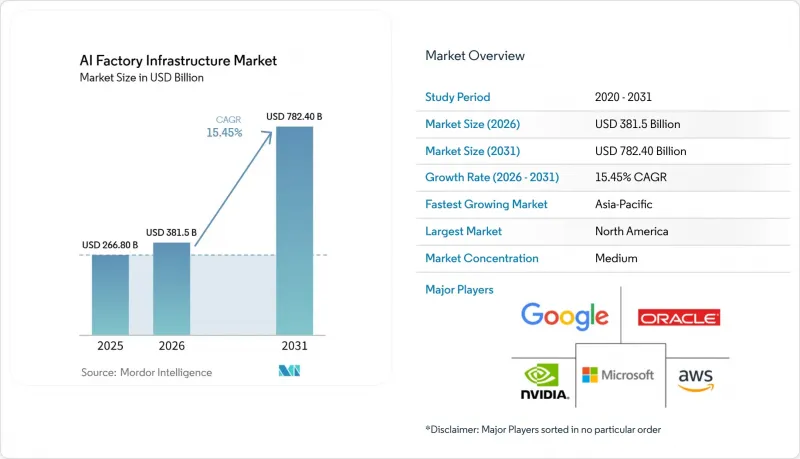
Mordor Intelligence에 의하면, AI 팩토리 인프라 시장 규모는 2025년 2,668억 달러로 평가되었습니다. 2026년에는 3,815억 달러로 확대되어 2026년부터 2031년에 걸쳐 CAGR 15.45%로 성장을 지속하여, 2031년에는 7,824억 달러에 이를 것으로 예측됩니다.
본 보고서는 구성 요소(컴퓨팅 인프라 등), 배포 모델(클라우드 기반 AI 팩토리, On-Premise형 AI 팩토리 등), 인프라 유형(AI 서버 클러스터 등), 용도(생성형 AI 및 대규모 언어 모델 훈련 등), 최종 사용자(하이퍼스케일러 및 클라우드 제공업체 등), 지역별로 분류되어 있습니다. 시장 전망은 금액(달러) 기준으로 제시되어 있습니다.
세계의 AI 팩토리 인프라 시장 동향 및 인사이트
하이퍼스케일 AI 인프라의 급속한 확대
하이퍼스케일러의 설비 투자는 조달, 건설, 공급 계획의 전 영역에 걸쳐 AI 팩토리 인프라 시장을 재편할 수준에 도달했습니다. 아마존은 2025 회계연도 설비 투자액으로 1,283억 달러를, 알파벳은 914억 달러를 보고했습니다. 이에 따라 두 회사의 2025년 총 지출액은 2,190억 달러를 넘어섰으며, 2026년 계획 수립에 있어 높은 기준이 설정되었습니다. 메타(Meta) 역시 2026 회계연도 인프라 설비 투자로 1,150억-1,350억 달러를 계상하고 있어, 주요 기업들이 AI 용량을 단순한 프로그램이 아닌 핵심 투자 항목으로 자리매김하고 있음을 보여주었습니다. 마이크로소프트의 2026 회계연도 1분기 실적 보고서에 따르면, Azure 매출은 40% 증가한 반면, 지능형 클라우드의 수익원가는 43% 증가하여, AI 인프라의 규모 확대가 운영 요건을 얼마나 급속도로 끌어올리고 있는지를 보여줍니다. 엔비디아(NVIDIA)는 2026 회계연도 10-K 보고서에서 데이터센터의 가용성, 에너지, 자본이 AI 인프라 구축에 있어 계속해서 중요한 요소가 될 것이라고 밝혔으며, 이는 하이퍼스케일러의 도입 속도가 공급망 전체에 어떤 영향을 미치고 있는지를 여실히 보여줍니다. 이러한 추세로 인해 AI 팩토리 인프라 시장 전반에서 시스템 통합, 네트워크 패브릭, 냉각 시스템, 전원 장비에 대한 수요가 증가하고 있습니다. 이는 새로운 시설이 건설될 때마다 GPU 계층을 훨씬 뛰어넘는 지출이 고정되기 때문입니다.
생성형 AI 및 대규모 언어 모델(LLM) 훈련 수요 증가
생성형 AI와 LLM 훈련은 여전히 AI 팩토리 인프라 시장의 주요 동력으로 작용하고 있습니다. 이는 대규모 훈련에는 여전히 최고 밀도의 컴퓨팅 환경이 필요하기 때문입니다. 또한, AI 팩토리 인프라 시장이 확대되고 있는 배경에는 추론 능력이 훈련 능력을 대체하는 것이 아니라, 병행하여 구축되고 있다는 점도 있습니다. 배포된 AI 서비스에는 최첨단 훈련 클러스터와는 다른 저지연 추론 시스템이 필요하며, 이로 인해 사업자가 구축해야 하는 인프라의 범위가 넓어지고 있습니다. Google Cloud의 Virgo 네트워크 설계는 단일 패브릭 내에서 13만 4,000개의 칩을 연결하고, 최대 47페타비트/초의 논블로킹 바이섹션 대역폭을 실현함으로써 이러한 요구 사항의 규모를 보여주었습니다. AI 팩토리 인프라 시장의 용도 구성도 이러한 변화를 반영하고 있으며, 2025년에는 생성형 AI와 LLM 훈련이 주도적 역할을 했으며, 2031년까지는 AI 추론과 배포가 가장 빠른 성장을 보일 것으로 예측됩니다. 이러한 조합으로 인해 스택의 단일 계층에 투자가 집중되는 것이 아니라, 연산 노드, 고속 스위칭, 스토리지 처리량 및 열 제어에 대한 병행적인 수요가 뒷받침되고 있습니다.
컴퓨팅, 전원, 냉각 시스템에 대한 막대한 설비 투자
AI 팩토리 인프라 시장은 최신 GPU 시스템을 기반으로 한 실제 운영 환경을 구축하는 데 드는 비용으로 인해 여전히 제약을 받고 있습니다. 구매자들은 컴퓨팅 비용뿐만 아니라 액체 냉각 루프, 대용량 전원 시스템, UPS 업그레이드, 네트워크 계층, 그리고 랙 밀도에 따라 확장되는 제어 소프트웨어에도 자금을 투자하고 있습니다. 슈나이더 일렉트릭의 엔지니어링 지침에 따르면, 통합된 전원 및 냉각 아키텍처가 고밀도 AI 시설에 있어 이제 핵심 요건이 되었음이 명확히 드러나며, 이는 하드웨어의 본격적인 도입이 시작되기도 전부터 프로젝트 예산을 끌어올리고 있습니다. 마이크로소프트의 2026 회계연도 1분기 실적 보고서에 따르면, ‘지능형 클라우드’ 부문의 매출 총이익률이 300 베이시스 포인트 하락했는데, 이는 AI 인프라 확장 비용에 직접 기인한 것입니다. 이는 대규모 사업자조차도 용량 확대에 따라 재정적 압박에 직면하고 있음을 보여줍니다. 이러한 비용 구조로 인해 AI 팩토리 인프라 시장에서 일부 조직은 처음부터 새로 구축하는 대신, 관리형 AI 클라우드 용량이나 소규모 랙 스케일 도입으로 방향을 전환하고 있습니다. 또한, 실제 가동까지 걸리는 시간이 예산에 직접적인 영향을 미치게 되면서, 도입 기간을 단축하거나 통합의 복잡성을 줄일 수 있는 벤더의 가치가 높아지고 있습니다.
부문 분석
2025년, AI 팩토리 인프라 시장에서 컴퓨팅 인프라는 71.53%의 점유율을 차지했습니다. 이는 모든 대규모 도입 주기에서 GPU 조달이 중심적인 역할을 하고 있음을 반영한 것입니다. 이러한 우위는 H100, Blackwell, Vera Rubin을 포함한 NVIDIA 플랫폼의 세대 교대에 기인하며, 이로 인해 하이퍼스케일러와 전문 AI 클라우드 사업자 모두에서 컴퓨팅이 자본 배분의 최우선 과제로 계속해서 자리 잡고 있습니다. NVIDIA는 2026년 4월, Vera Rubin이 본격적인 양산 단계에 접어들었음을 확인했습니다. 시스템 빌더로는 Dell Technologies, HPE, Lenovo 및 Super Micro Computer가 참여하고 있습니다. 스토리지 인프라와 관리 소프트웨어는 여전히 중요하며, 구매자가 고밀도 클러스터를 경제적으로 구현하기 위해서는 지속적인 처리량, 워크로드 스케줄링, 그리고 GPU 활용도 향상이 필요하기 때문입니다.
네트워크 인프라는 2031년까지 연평균 성장률(CAGR) 16.18%를 나타낼 것으로 예측되며, AI 팩토리 인프라 시장에서 가장 두드러진 성장을 보일 것으로 전망됩니다. 네트워크 관련 지출이 증가하는 배경에는 스위치 계층에서 병목 현상을 일으키지 않으면서 더 대규모의 GPU 패브릭 간에 데이터를 전송해야 할 필요성이 있습니다. NVIDIA의 Vera Rubin 플랫폼에는 Spectrum-X 이더넷 옵션이 포함되어 있으며, 이는 개방형 이더넷 아키텍처가 랙 스케일 AI 시스템 설계에서 점점 더 중요한 요소가 되고 있음을 보여줍니다. 또한 클러스터 규모가 확대됨에 따라 저지연과 뛰어난 전력 효율의 중요성이 점점 더 커지고 있어, 코패키지드 옵틱스도 논의의 대상이 되고 있습니다. 이로 인해 AI 팩토리 인프라 시장에서 벤더 간의 경쟁 환경은 더욱 확대되고 있습니다. 성능 평가 기준이 가속기 계층에만 국한되지 않고 컴퓨팅, 스위칭, 패브릭 설계, 시스템 통합 전반에 걸쳐 이루어지게 되었기 때문입니다.
2025년에는 클라우드 기반 AI 팩토리가 AI 팩토리 인프라 시장에서 65.36%의 점유율을 차지했으며, 이는 AWS, Microsoft Azure, Google Cloud의 구축 속도와 규모를 반영한 것입니다. 하이퍼스케일러가 대규모 훈련 및 추론 워크로드를 단기간에 지원할 수 있는 가동 용량의 대부분을 관리하고 있기 때문에 퍼블릭 클라우드는 여전히 중심적인 위치를 차지하고 있습니다. 반면, 퍼블릭 클라우드로는 완전히 제공할 수 없는 기밀성이 높은 컴퓨팅, 국가 차원의 데이터 관리, 혹은 저지연 추론을 필요로 하는 조직에게는 On-Premise AI 팩토리가 여전히 중요한 역할을 하고 있습니다. 유럽연합 집행위원회, 영국, 캐나다는 각각 2026년에 정책의 초점을 ‘주권 컴퓨팅’으로 전환하며, 규제 환경 하에서 국내 관리형 인프라의 필요성을 뒷받침했습니다.
하이브리드 AI 팩토리는 2031년까지 연평균 성장률(CAGR) 16.53%를 나타낼 것으로 예측되며, AI 팩토리 인프라 시장에서 가장 빠르게 성장하는 도입 모델이 되고 있습니다. 당초 클라우드 전용 전략을 채택했던 조직들도 현재는 버스트 용량과 비용 변동, 데이터 마이그레이션 제한, 지연 시간 요구 사항 간의 균형을 맞추려 하고 있습니다. 이러한 변화에 따라 GPU 용량을 낭비하지 않으면서 클라우드, On-Premise, 리전, 엣지 환경에 워크로드를 배치할 수 있는 오케스트레이션 소프트웨어에 대한 수요가 증가하고 있습니다. 2026년 4월에 출시된 ‘HPE AI Grid’는 여러 사이트에 걸쳐 있는 AI 팩토리와 분산형 추론 클러스터를 연동함으로써 이러한 요구 사항을 직접 충족시켰습니다. 또한 하이브리드화의 도입은 AI 팩토리 인프라 시장에서의 관련 지출도 확대시키고 있습니다. 이는 컴퓨팅이 집중형이 아닌 분산형으로 전환됨에 따라 네트워크 패브릭, 스토리지 조정 및 정책 제어의 중요성이 높아지기 때문입니다.
지역별 분석
2025년, 북미는 AI 팩토리 인프라 시장 점유율의 62.35%를 차지했으며, 이는 하이퍼스케일러의 지출 및 가동 중인 데이터센터 용량 측면에서 해당 지역이 주도적인 위치를 차지하고 있음을 반영합니다. 아마존과 알파벳은 2025년에 총 2,190억 달러 이상의 설비 투자를 보고했으며, 이를 통해 북미는 AI 팩토리 인프라 시장의 중심적 위치를 유지하는 동시에 신규 프로젝트 확대에 있어 우위를 더욱 공고히 하고 있습니다. 또한, 이 지역에는 OEM, 클라우드 사업자, 전문 건설업체, 전력·냉각 벤더로 구성된 긴밀한 생태계가 존재하여, 대규모 프로젝트를 설계부터 도입까지 신속하게 진행할 수 있다는 장점도 있습니다. 캐나다는 국내 고성능 AI 인프라 구축을 위해 최대 10억 캐나다 달러(7억 3,000만 달러)를 투자하는 ‘소버린 컴퓨트 프로그램’을 추진하고 있어, 지원 거점으로서의 입지를 확립해 가고 있습니다. 전력 공급 접근성은 여전히 단기적인 주요 제약 요인으로 남아 있으며, 사전에 송전망 용량을 확보한 사업자는 가격, 납기, 확장 옵션 측면에서 우위를 유지할 가능성이 높을 것으로 보입니다.
아시아태평양은 2031년까지 연평균 성장률(CAGR) 16.91%를 나타낼 것으로 예측되며, AI 팩토리 인프라 시장에서 가장 두드러진 성장을 보이는 지역입니다. 이러한 성장은 일본, 인도, 동남아시아의 국가 차원 컴퓨팅 우선 정책과 중국의 자국 자금에 의한 AI 인프라 확장에 힘입은 것입니다. 또한, 이 지역에서는 AI 등급 데이터센터 설계에 대한 관심이 높아지고 있으며, 조달 결정에 있어 효율성, 열 관리 및 현지 제어가 점점 더 중요해지고 있습니다. 따라서 현재 규모 면에서는 북미가 여전히 주도적인 입지를 차지하고 있지만, 아시아태평양은 AI 팩토리 인프라 시장의 다음 성장 단계에서도 중심적인 위치를 계속 차지할 것입니다.
유럽, 남미, 중동 및 아프리카는 현재 규모는 작지만, 각각 AI 팩토리 인프라 시장에서 전략적으로 중요한 위치를 차지하고 있습니다. 유럽에서는 강화되는 국가 주도의 컴퓨팅 추진 의지와 전력망 및 인허가 절차의 지연 사이에서 균형을 맞추려 하고 있으며, 유럽집행위원회가 2026년 6월에 발표할 예정인 ‘기술 주권 패키지’는 국내 도입 및 클라우드 주권 인증을 뒷받침할 것으로 기대됩니다. 또한 영국도 ‘AI 하드웨어 계획’ 및 ‘AI 성장 구역’에 대한 지원을 통해 국가 계획에서 AI 인프라의 중요성을 높이고 있습니다. 중동 및 아프리카, 특히 UAE와 사우디아라비아는 풍부한 전력 공급과 데이터센터의 우수한 경제성으로 주목받고 있지만, 남미는 여전히 발전의 초기 단계에 있으며 브라질의 주요 도시 시장에 집중되어 있습니다.
기타 혜택 :
- 엑셀 형식 시장 예측(ME) 시트
- 3개월간의 애널리스트 지원
자주 묻는 질문
목차
제1장 서론
제2장 조사 방법
제3장 주요 요약
제4장 시장 구도
제5장 시장 규모 및 성장 예측
제6장 경쟁 구도
제7장 시장 기회 및 향후 전망
KTH 26.08.10According to Mordor Intelligence, the AI factory infrastructure market size is expected to grow from USD 266.8 billion in 2025 to USD 381.5 billion in 2026 and is forecast to reach USD 782.4 billion by 2031 at 15.45% CAGR over 2026-2031.
This report is Segmented by Component (Compute Infrastructure, and More), Deployment (Cloud-Based AI Factories, On-Premise AI Factories, and More), Infrastructure Type (AI Server Clusters, and More), Application (Generative AI and Large Language Model Training, and More), End User (Hyperscalers and Cloud Providers, and More), and Geography. The Market Forecasts are Provided in Terms of Value (USD).
Global AI Factory Infrastructure Market Trends and Insights
Rapid Expansion of Hyperscale AI Buildouts
Hyperscaler capital spending has moved to a level that is reshaping the AI factory infrastructure market across procurement, construction, and supply planning. Amazon reported USD 128.3 billion in capital expenditure for FY2025, while Alphabet reported USD 91.4 billion, pushing their combined 2025 spending above USD 219 billion and setting a high baseline for 2026 planning. Meta also committed USD 115 billion to USD 135 billion in 2026 infrastructure capex, which showed that large operators are treating AI capacity as a core investment line rather than a discretionary program. Microsoft's Q1 FY2026 filing showed Azure revenue grew 40%, while Intelligent Cloud cost of revenue grew 43%, indicating how quickly AI infrastructure scale is pushing operating requirements higher. NVIDIA stated in its FY2026 10-K that data center availability, energy, and capital remain key factors for AI infrastructure buildout, which underlines how hyperscaler deployment pace is shaping the wider supply chain. This pattern is driving demand for system integration, networking fabrics, cooling systems, and power equipment across the AI factory infrastructure market, as each new build locks in spending far beyond the GPU layer.
Rising Generative AI And Large Language Model Training Demand
Generative AI and LLM training remain a major driver of the AI factory infrastructure market, as large-scale training still requires the highest-density compute environments. The AI factory infrastructure market is also expanding because inference capacity is being built alongside training capacity, rather than replacing it. Deployed AI services require low-latency inference systems that differ from frontier training clusters, widening the infrastructure surface area operators must provision. Google Cloud's Virgo network design showed the scale of this requirement by linking 134,000 chips with up to 47 petabits per second of non-blocking bisectional bandwidth in a single fabric. The application mix inside the AI factory infrastructure market reflects the same shift, with generative AI and LLM training leading in 2025 and AI inference and deployment posting the fastest forecast growth through 2031. This combination supports parallel demand for compute nodes, high-speed switching, storage throughput, and thermal control, rather than concentrating spending in a single layer of the stack.
High Capex for Compute, Power, and Cooling Systems
The AI factory infrastructure market remains constrained by the cost of building production-ready environments around modern GPU systems. Buyers are not only paying for compute, but also funding liquid-cooling loops, higher-capacity power systems, UPS upgrades, networking layers, and control software that scale with rack density. Schneider Electric's engineering guidance made clear that an integrated power and cooling architecture is now a core requirement for high-density AI facilities, pushing project budgets upward even before full hardware deployment begins. Microsoft's Q1 FY2026 filing showed a 300-basis-point decline in Intelligent Cloud gross margin, tied directly to AI infrastructure scaling costs, indicating that even large operators are under financial pressure as capacity expands. This cost profile is steering some organizations toward managed AI cloud capacity or smaller rack-scale deployments instead of greenfield builds across the AI factory infrastructure market. It is also increasing the value of vendors that can shorten deployment time or reduce integration complexity because time-to-production now has a direct budget effect.
Other drivers and restraints analyzed in the detailed report include:
- Shift Toward AI-Native Data Center Architectures
- Enterprise Preference for Hybrid AI Deployment Models
- Grid Interconnection Delays and Power Availability Constraints
For complete list of drivers and restraints, kindly check the Table Of Contents.
Segment Analysis
Compute infrastructure held 71.53% of the AI factory infrastructure market share in 2025, which reflected the central role of GPU procurement in every large deployment cycle. That lead was tied to successive NVIDIA platform generations, including H100, Blackwell, and Vera Rubin, which kept compute at the front of capital allocation for both hyperscalers and specialist AI cloud operators. NVIDIA confirmed in April 2026 that Vera Rubin moved into full production, with Dell Technologies, HPE, Lenovo, and Super Micro Computer serving as system builders. Storage infrastructure and management software still matter because buyers need sustained throughput, workload scheduling, and tighter GPU utilization to make dense clusters economically viable.
Networking infrastructure is projected to grow at a 16.18% CAGR through 2031, making it the fastest-growing component of the AI factory infrastructure market. The rise of networking spend reflects the need to move data across larger GPU fabrics without creating bottlenecks at the switch layer. NVIDIA's Vera Rubin platform includes Spectrum-X Ethernet options, which shows that open Ethernet architectures are becoming a more visible part of rack-scale AI system design. Co-packaged optics are also entering the discussion because lower latency and better power efficiency become more valuable as cluster sizes expand. This is creating a wider vendor field in the AI factory infrastructure market because performance is now being judged across compute, switching, fabric design, and system integration rather than at the accelerator layer alone.
Cloud-based AI factories held a 65.36% share of the AI factory infrastructure market in 2025, reflecting the build pace and scale of AWS, Microsoft Azure, and Google Cloud. Public cloud remains central because hyperscalers control much of the commissioned capacity that can support large training and inference workloads at short notice. At the same time, on-premises AI factories remain relevant for organizations that need classified compute, national data control, or low-latency inference that the public cloud cannot fully provide. The European Commission, the United Kingdom, and Canada each moved policy attention toward sovereign compute in 2026, which supported the case for domestically controlled infrastructure in regulated environments.
Hybrid AI factories are projected to grow at a 16.53% CAGR through 2031, which makes them the fastest-growing deployment model in the AI factory infrastructure market. Organizations that began with cloud-only strategies are now balancing burst capacity against cost volatility, data movement limits, and latency requirements. That shift is widening demand for orchestration software that can place workloads across cloud, on-premise, regional, and edge environments without wasting GPU capacity. HPE AI Grid, launched in April 2026, directly addressed this requirement by linking AI factories and distributed inference clusters across multiple sites. Hybrid adoption also strengthens adjacent spending in the AI factory infrastructure market because network fabrics, storage coordination, and policy controls become more important when compute is distributed instead of centralized.
Complete Report Scope:
- By Component
- Compute Infrastructure
- Networking Infrastructure
- Storage Infrastructure
- Infrastructure Management Software
- Other Components
- By Deployment Model
- Cloud-Based AI Factories
- On-Premise AI Factories
- Hybrid AI Factories
- By Infrastructure Type
- AI Server Clusters
- Integrated AI Pod / Rack-Scale Systems
- Large-Scale AI Superclusters
- Custom AI Clusters
- By Application
- Generative AI and Large Language Model Training
- AI Inference and Deployment
- Autonomous Systems Development
- Scientific and Research Computing
- Digital Twin and Industrial AI
- Healthcare and Drug Discovery AI
- By End User
- Hyperscalers and Cloud Providers
- Enterprises
- Research and Academic Institutions
- Healthcare and Life Sciences Organizations
- BFSI Companies
- Industrial and Manufacturing Companies
- Government and Defense Organizations
- By Geography
- North America
- United States
- Canada
- Mexico
- Europe
- Germany
- United Kingdom
- France
- Italy
- Rest of Europe
- Asia-Pacific
- China
- Japan
- South Korea
- India
- Southeast Asia
- Rest of Asia-Pacific
- South America
- Middle East and Africa
- North America
Geography Analysis
North America held 62.35% of the AI factory infrastructure market share in 2025, which reflected the region's lead in hyperscaler spending and commissioned data center capacity. Amazon and Alphabet together reported more than USD 219 billion in capital expenditure in 2025, keeping North America at the center of the AI factory infrastructure market and reinforcing their advantage in scaling new projects. The region also benefits from a dense ecosystem of OEMs, cloud operators, specialized builders, and power and cooling vendors that can quickly move large projects from design to deployment. Canada is becoming a supporting node because its sovereign compute program committed up to CAD 1 billion (USD 730 million) for domestic high-performance AI infrastructure. Power access remains the main near-term limit, meaning operators with pre-secured grid capacity are likely to retain an advantage in pricing, delivery timing, and expansion options.
Asia-Pacific is projected to grow at a 16.91% CAGR through 2031, which makes it the fastest-growing geography in the AI factory infrastructure market. Growth is being supported by sovereign compute priorities in Japan, India, Southeast Asia, and by China's domestically funded expansion of AI infrastructure. The region is also seeing more interest in AI-grade data center design, where efficiency, thermal management, and localized control are becoming more important in procurement decisions. This keeps Asia-Pacific central to the next growth phase of the AI factory infrastructure market, even though North America still leads in current scale.
Europe, South America, and the Middle East and Africa remain smaller in current scale, but each has strategic importance in the AI factory infrastructure market. Europe is balancing stronger sovereign compute ambitions against grid and permitting delays, while the European Commission's June 2026 technology sovereignty package is expected to support domestic deployment and cloud sovereignty certification. The United Kingdom has also elevated AI infrastructure in national planning through its AI Hardware Plan and its support for AI Growth Zones. The Middle East and Africa, especially the UAE and Saudi Arabia, are attracting interest because of available power and favorable data center economics, while South America remains earlier in development and more concentrated in Brazil's primary urban markets.
- NVIDIA Corporation
- Amazon Web Services, Inc.
- Microsoft Corporation
- Google LLC
- Oracle Corporation
- Advanced Micro Devices, Inc.
- Intel Corporation
- Dell Technologies Inc.
- Hewlett Packard Enterprise Development LP
- Super Micro Computer, Inc.
- Lenovo Group Limited
- Cisco Systems, Inc.
- CoreWeave, Inc.
- Lambda Labs, Inc.
- Alibaba Cloud
- Tencent Holdings Limited
- Vertiv Group Corp.
- Schneider Electric SE
Additional Benefits:
- The market estimate (ME) sheet in Excel format
- 3 months of analyst support
TABLE OF CONTENTS
1 INTRODUCTION
- 1.1 Study Assumptions and Market Definition
- 1.2 Scope of the Study
2 RESEARCH METHODOLOGY
3 EXECUTIVE SUMMARY
4 MARKET LANDSCAPE
- 4.1 Market Overview
- 4.2 Market Drivers
- 4.2.1 Rapid Expansion of Hyperscale AI Buildouts
- 4.2.2 Rising Generative AI and Large Language Model Training Demand
- 4.2.3 Shift Toward AI-Native Data Center Architectures
- 4.2.4 Enterprise Preference for Hybrid AI Deployment Models
- 4.2.5 Power-Density Engineering as a Competitive Differentiator
- 4.2.6 Localized AI Sovereignty and Onshore Compute Mandates
- 4.3 Market Restraints
- 4.3.1 High Capex for Compute, Power, and Cooling Systems
- 4.3.2 Grid Interconnection Delays and Power Availability Constraints
- 4.3.3 Semiconductor and High-Density Hardware Supply Bottlenecks
- 4.3.4 Scarcity of AI Infrastructure Engineering Talent
- 4.4 Industry Value Chain Analysis
- 4.5 Technological Outlook
- 4.6 Impact of Macroeconomic Factors on the Market
- 4.7 Porter's Five Forces Analysis
- 4.7.1 Bargaining Power of Suppliers
- 4.7.2 Bargaining Power of Buyers
- 4.7.3 Threat of New Entrants
- 4.7.4 Threat of Substitutes
- 4.7.5 Industry Rivalry
5 MARKET SIZE AND GROWTH FORECASTS (VALUE)
- 5.1 By Component
- 5.1.1 Compute Infrastructure
- 5.1.2 Networking Infrastructure
- 5.1.3 Storage Infrastructure
- 5.1.4 Infrastructure Management Software
- 5.1.5 Other Components
- 5.2 By Deployment Model
- 5.2.1 Cloud-Based AI Factories
- 5.2.2 On-Premise AI Factories
- 5.2.3 Hybrid AI Factories
- 5.3 By Infrastructure Type
- 5.3.1 AI Server Clusters
- 5.3.2 Integrated AI Pod / Rack-Scale Systems
- 5.3.3 Large-Scale AI Superclusters
- 5.3.4 Custom AI Clusters
- 5.4 By Application
- 5.4.1 Generative AI and Large Language Model Training
- 5.4.2 AI Inference and Deployment
- 5.4.3 Autonomous Systems Development
- 5.4.4 Scientific and Research Computing
- 5.4.5 Digital Twin and Industrial AI
- 5.4.6 Healthcare and Drug Discovery AI
- 5.5 By End User
- 5.5.1 Hyperscalers and Cloud Providers
- 5.5.2 Enterprises
- 5.5.3 Research and Academic Institutions
- 5.5.4 Healthcare and Life Sciences Organizations
- 5.5.5 BFSI Companies
- 5.5.6 Industrial and Manufacturing Companies
- 5.5.7 Government and Defense Organizations
- 5.6 By Geography
- 5.6.1 North America
- 5.6.1.1 United States
- 5.6.1.2 Canada
- 5.6.1.3 Mexico
- 5.6.2 Europe
- 5.6.2.1 Germany
- 5.6.2.2 United Kingdom
- 5.6.2.3 France
- 5.6.2.4 Italy
- 5.6.2.5 Rest of Europe
- 5.6.3 Asia-Pacific
- 5.6.3.1 China
- 5.6.3.2 Japan
- 5.6.3.3 South Korea
- 5.6.3.4 India
- 5.6.3.5 Southeast Asia
- 5.6.3.6 Rest of Asia-Pacific
- 5.6.4 South America
- 5.6.5 Middle East and Africa
- 5.6.1 North America
6 COMPETITIVE LANDSCAPE
- 6.1 Market Concentration
- 6.2 Strategic Moves
- 6.3 Vendor Positioning Analysis
- 6.4 Company Profiles (includes Global Level Overview, Market Level Overview, Core Segments, Financials as available, Strategic Information, Market Rank/Share, Products and Services, Recent Developments)
- 6.4.1 NVIDIA Corporation
- 6.4.2 Amazon Web Services, Inc.
- 6.4.3 Microsoft Corporation
- 6.4.4 Google LLC
- 6.4.5 Oracle Corporation
- 6.4.6 Advanced Micro Devices, Inc.
- 6.4.7 Intel Corporation
- 6.4.8 Dell Technologies Inc.
- 6.4.9 Hewlett Packard Enterprise Development LP
- 6.4.10 Super Micro Computer, Inc.
- 6.4.11 Lenovo Group Limited
- 6.4.12 Cisco Systems, Inc.
- 6.4.13 CoreWeave, Inc.
- 6.4.14 Lambda Labs, Inc.
- 6.4.15 Alibaba Cloud
- 6.4.16 Tencent Holdings Limited
- 6.4.17 Vertiv Group Corp.
- 6.4.18 Schneider Electric SE
7 MARKET OPPORTUNITIES AND FUTURE OUTLOOK
- 7.1 White-Space and Unmet-Need Assessment


