

|
시장보고서
상품코드
2118189
OTT 클라우드 인프라 시장 : 시장 점유율 분석, 업계 동향 및 통계, 성장 예측(2026-2031년)OTT Cloud Infrastructure - Market Share Analysis, Industry Trends & Statistics, Growth Forecasts (2026 - 2031) |
||||||
 Mordor Intelligence
Mordor Intelligence에 의하면, OTT 클라우드 인프라 시장 규모는 2025년에 125억 3,000만 달러로 평가되었고, 2026년 145억 2,000만 달러에서 2031년까지 285억 7,000만 달러에 이를 것으로 추정되며, 예측 기간(2026-2031년) CAGR은 14.49%를 나타낼 전망입니다.
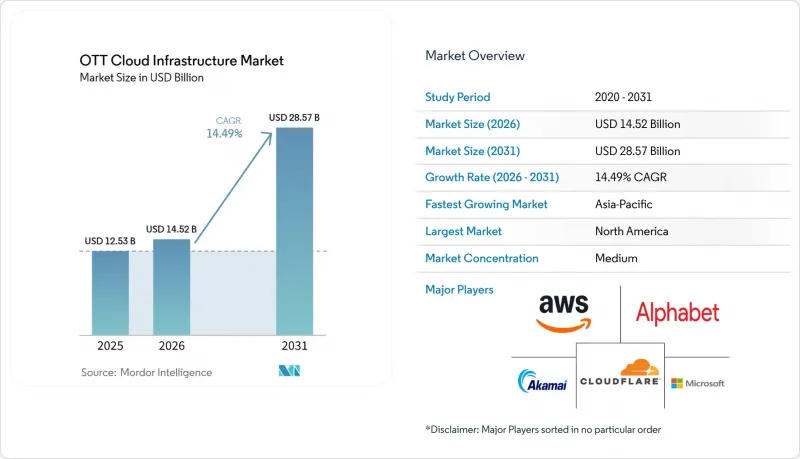
본 보고서는 인프라 계층별(클라우드 컴퓨팅 인프라, 클라우드 스토리지 및 오리진 인프라, 클라우드 네트워킹 및 CDN 인프라 등), 도입 모델별(퍼블릭 클라우드, 프라이빗 클라우드, 하이브리드 클라우드), 스트리밍 형식별(라이브 스트리밍, 온디맨드 스트리밍, 하이브리드 스트리밍), 그리고 지역별로 분류되어 있습니다. 시장 전망은 금액(달러) 기준으로 제시되어 있습니다.
세계의 OTT 클라우드 인프라 시장 동향 및 인사이트
이벤트 기반 스트리밍의 피크 수요에 대응하는 클라우드 네이티브 확장성
라이브 이벤트에서는 평균 시청자 수요와 피크 시간대 수요 사이에 큰 차이가 발생하기 때문에 클라우드의 자동 스케일링이 OTT 클라우드 인프라 시장을 뒷받침하고 있습니다. 사업자는 코어 컴퓨팅, 머신러닝 워크로드, 라스트 마일 전송을 서로 다른 공급자에게 할당하는 멀티 클라우드 설계를 채택할 수 있습니다. 이러한 접근 방식은 트래픽이 증가하기 전에 용량을 확보해야 하는 전국 규모의 이벤트에서 중요해지고 있습니다. 예측형 자동 스케일링은 과거 트래픽 패턴을 활용하여, 혼잡이 발생한 후에 대응하는 것이 아니라 혼잡이 발생하기 전에 대규모 시청자를 위해 리소스를 프로비저닝합니다. 주요 클라우드 공급업체들은 저지연 및 고가용성이 필요한 워크로드를 지원하기 위해 기반 용량을 지속적으로 확장하고 있습니다. 장기 사용량 계약을 통해 대형 방송사는 주요 이벤트 전에 유리한 가격 조건을 확보할 수 있지만, 소규모 사업자는 온디맨드 요금에 계속 좌우될 가능성이 있습니다.
저지연 스포츠 생중계 및 인터랙티브 스트리밍 수요 증가
스포츠 생중계로 인해 지연 시간이 극히 짧은 전송 시스템에 대한 수요가 증가하고 있습니다. 저지연 HLS 및 저지연 CMAF는 라이브 이벤트와 시청자가 수신하는 스트림 간의 시간차를 줄여줍니다. 전송에 지연이 발생하면 시청자가 실제 상황이 발생한 후에야 장면을 보게 되어, 인터랙티브 기능이나 라이브 베팅 서비스의 가치가 떨어질 수 있습니다. 스포츠 중계권 비용 상승 또한 사업자들이 인코딩 효율, 전송 라우팅 및 자원 활용을 개선하도록 촉진하고 있습니다. 하모닉(Harmonic)은 2026년 4월, 방송 사업자가 이중화와 방송급 신뢰성을 확보하면서 AI 용도를 라이브 워크플로우에 통합할 수 있도록 지원하는 ‘AI 오케스트레이션 서비스’를 출시했습니다. OTT(Over-the-Top) 클라우드 인프라 시장은 스포츠, 뉴스, 인터랙티브 이벤트의 각 라이브 세션에서 지속적인 처리 및 전송 능력이 요구됨에 따라 혜택을 보고 있습니다.
대역폭, 이그레스, 트랜스코딩 비용 부담 증가
이그레스 요금 설정은 OTT 클라우드 인프라 시장의 경제성을 저해하는 핵심 제약 요인으로 남아 있습니다. 클라우드 제공업체는 인터넷 전송에 대해 데이터 양에 따라 요금을 부과하기 때문에 지역을 초월하여 수억 명의 동시 시청자를 지원하는 서비스의 경우 막대한 정기 청구액이 발생할 가능성이 있습니다. 주요 플랫폼 기업들은 1기가바이트당 클라우드 이그레스 계약에 대한 의존도를 낮추기 위해 자체 전송 네트워크에 대한 투자를 추진하고 있습니다. 트랜스코딩은 언어, 해상도 계층 및 시청 권한에 따른 스트림 변형마다 추가 처리가 필요하기 때문에 비용 증가로 이어집니다. 아카마이는 2026년 투자자용 자료에서 하드웨어, 전력 및 인프라 비용의 상승을 지적했으며, 이는 CDN 가격 책정에 압박을 가할 가능성이 있습니다. 타이틀별 인코딩은 개별 자산의 복잡성에 따라 비트레이트 계층을 조정함으로써 전송량을 줄일 수 있지만, 소규모 방송국에는 부족한 경향이 있는 엔지니어링 리소스가 필요합니다.
부문 분석
2025년 시점에서 클라우드 컴퓨팅 인프라는 38.49%의 점유율을 차지했으며, 다운스트림 미디어 기능을 위한 핵심 가상 머신 및 컨테이너 계층을 제공했습니다. ‘미디어 처리 및 워크플로우 인프라’는 2026-2031년 연평균 성장률(CAGR) 14.91%로 확대될 것으로 예측됩니다. 자동 인코딩, 현지화, 서버 측 광고 삽입, AI 기반 처리 등이 이러한 수요를 견인하고 있습니다. 구독형 및 광고 지원형 서비스 플랜의 보급에 따라, 단일 자산에 대해 광고 없는 버전과 광고가 포함된 버전의 스트림을 개별적으로 준비해야 할 가능성이 있습니다. 이로 인해 카탈로그 내 각 타이틀에 대한 처리 요구 사항이 높아져 OTT 클라우드 인프라 시장을 뒷받침하게 됩니다.
클라우드 네트워킹 및 CDN 인프라는 컨텐츠 오리진과 시청자 사이를 연결하는 경로를 제공하는 한편, 클라우드 스토리지 및 오리진 인프라는 소스 자산을 보관하고 라이브 서비스를 위한 지속적인 피드 수집을 지원합니다. 이러한 성장은 압축 기술의 향상과 타이틀별 인코딩을 통해 억제되고 있으며, 이를 통해 시청자 1시간당 필요한 대역폭과 스토리지를 줄일 수 있습니다. 사업자가 서비스 품질을 실시간으로 모니터링함에 따라 가시성, 분석 및 측정 인프라의 중요성이 높아지고 있습니다. Akamai와 MediaMelon은 2026년 4월에 제휴를 맺고, SmartSight의 QoE(경험 품질) 분석 기능을 4,400개 이상의 Akamai 엣지 위치에 도입했습니다. 이 서비스는 네트워크 상태, 기업 성능, 시청자 경험을 단일 운영 뷰로 통합하는 시스템에 대한 수요 증가를 반영합니다.
지역별 분석
2025년, 북미는 OTT 클라우드 인프라 시장 점유율의 43.61%를 차지했습니다. 이 지역에는 컨텐츠 권리자, OTT 플랫폼, 클라우드 서비스, CDN 거점이 밀집해 있으며, 성장의 원동력은 신규 플랫폼의 출시라기보다는 라이브 스포츠, 광고 지원형 요금제, 그리고 카탈로그 처리를 위한 기술적 업그레이드에 기인합니다. 폭스(Fox)는 2026년 4월, AWS를 우선 AI 클라우드 제공업체로 지정하고, AWS Elemental의 미디어 서비스와 AI 기능을 결합하여 하이라이트 영상 및 소셜 동영상 재포맷에 활용하고 있습니다. 텔레노르(Telenor)는 2026년 2월, AWS와 Scalstrm이 제공하는 북유럽 전역을 커버하는 TV 플랫폼 운영을 시작했으며, Direct Connect, 대규모 스토리지, 클라우드 네이티브 오리진 기능을 활용하고 있습니다.
아시아태평양은 2026-2031년 연평균 성장률(CAGR) 15.22%로 확대될 것으로 예측되며, OTT 클라우드 인프라 시장에서 가장 눈부신 성장을 보일 것으로 전망됩니다. 인도, 한국, 일본은 모바일 중심의 이용 형태, 스포츠 서비스, 그리고 사용자 1인당 지출액이 높은 점을 통해 이러한 성장을 뒷받침하고 있습니다. 인도의 크리켓 대회에서는 대규모 동시 시청자 수의 피크에 대응할 수 있는 멀티 클라우드 구축이 요구되고 있습니다. 인도의 ‘2025년 디지털 개인 데이터 보호 규정’에서는 사업자가 클라우드 인프라를 설계할 때 가입자의 개인정보를 현지에서 처리하는 방안을 검토할 것을 요구하고 있습니다. 중국의 YD/T 7033-2026 규격은 5G 코어 네트워크의 멀티캐스트 및 브로드캐스트 기능 강화에 관한 기술 요건을 규정하고 있으며, 이로 인해 대규모 시청 이벤트 시 CDN 수요가 감소할 가능성이 있습니다.
남미에서는 2026년 2분기에 FAST 시청 시간이 190% 증가하여, OTT(Over-The-Top) 클라우드 인프라 시장에서 광고 관련 처리 및 전송 용량에 대한 수요가 높아지고 있습니다. 이 지역에서는 FAST 서비스 도입이 진행되고 있으며, 북미에서 일반적인 구독 수익 수준에는 미치지 못하지만 처리 및 CDN 수요를 창출하고 있습니다. 유럽에서는 지역 내 클라우드 거점 이용을 우선시하는 데이터 주권 요건이 부과되어 있어, 방송 제작 워크로드에서 퍼블릭 하이퍼스케일러의 이용이 둔화될 가능성이 있습니다. 유럽연합 집행위원회는 2026년, 일반 데이터 보호 규정(GDPR(EU 개인정보보호규정))을 준수하는 보호 조치를 포함하는 주권형 클라우드 컴퓨팅 서비스 프레임워크를 제안했습니다. 중동, 특히 사우디아라비아와 아랍에미리트(UAE)에서는 프리미엄 스트리밍에 대한 수요와 국내 데이터 보관 요건이 맞물려 있는 반면, 아프리카의 발전은 모바일 광대역의 보급 범위와 보다 저렴한 기기의 보급에 좌우됩니다.
기타 혜택 :
- 엑셀 형식 시장 예측(ME) 시트
- 3개월간의 애널리스트 지원
자주 묻는 질문
목차
제1장 서론
제2장 조사 방법
제3장 개요
제4장 시장 구도
제5장 시장 규모 및 성장 예측
제6장 경쟁 구도
제7장 시장 기회 및 향후 전망
AJY 26.09.01According to Mordor Intelligence, the OTT cloud infrastructure market size was valued at USD 12.53 billion in 2025 and estimated to grow from USD 14.52 billion in 2026 to reach USD 28.57 billion by 2031, at a CAGR of 14.49% during the forecast period (2026-2031).
This report is Segmented by Infrastructure Layer (Cloud Compute Infrastructure, Cloud Storage and Origin Infrastructure, Cloud Networking and CDN Infrastructure, and More), Deployment Model (Public Cloud, Private Cloud, and Hybrid Cloud), Streaming Format (Live Streaming, On-Demand Streaming, and Hybrid Streaming), and Geography. The Market Forecasts are Provided in Terms of Value (USD).
Global OTT Cloud Infrastructure Market Trends and Insights
Cloud-Native Elasticity for Event-Driven Streaming Peaks
Cloud auto-scaling supports the OTT cloud infrastructure market because live events create a wide gap between average and peak viewer demand. Operators can use multi-cloud designs that assign core compute, machine-learning workloads, and last-mile delivery to different providers. This approach has become important for national-scale events, where capacity must be ready before traffic rises. Predictive autoscaling uses historical traffic patterns to provision resources for large audiences before congestion occurs, rather than responding after congestion begins. Large cloud providers are continuing to expand their underlying capacity, supporting workloads that require low latency and high availability. Long-term volume commitments can give larger broadcasters better pricing before major events, while smaller operators may remain exposed to on-demand rates.
Rising Low-Latency Live Sports and Interactive Streaming Demand
Live sports are increasing the demand for delivery systems with very low delay. Low-Latency HLS and Low-Latency CMAF are narrowing the gap between a live event and the stream viewers receive. Delayed feeds can weaken the value of interactive features and live wagering services when viewers see action after it has occurred. Rising sports rights costs are also encouraging operators to improve encoding efficiency, delivery routing, and resource use. Harmonic launched an AI Orchestration Service in April 2026 to help broadcasters integrate AI applications into live workflows with redundancy and broadcast-grade reliability. The over-the-top (OTT) cloud infrastructure market benefits from the need for continuous processing and delivery capacity during each live session for sports, news, and interactive events.
Escalating Bandwidth, Egress, and Transcoding Cost Burden
Egress pricing remains a central constraint on the economics of the OTT cloud infrastructure market. Cloud providers charge for internet delivery by data volume, which can result in large recurring bills for services supporting hundreds of millions of concurrent viewers across regions. Large platforms are investing in their own delivery networks to reduce reliance on per-gigabyte cloud egress contracts. Transcoding increases costs because each language, resolution ladder, and entitlement-aware stream variant requires more processing. Akamai cited higher hardware, power, and infrastructure costs in its 2026 investor materials, which may place pressure on CDN pricing. Per-title encoding can reduce delivery volume by matching bitrate ladders to the complexity of individual assets, but it requires engineering resources that smaller broadcasters may not have.
Other drivers and restraints analyzed in the detailed report include:
- AI-Based Video Workflow Automation and Localization
- Expansion of Edge Compute, Open Caching, and Multi-CDN Delivery
- Fragmented Device, Codec, DRM, and Player Compatibility
For complete list of drivers and restraints, kindly check the Table Of Contents.
Segment Analysis
Cloud Compute Infrastructure held 38.49% in 2025 and provided the core virtual machine and container layer for downstream media functions. Media Processing and Workflow Infrastructure is projected to expand at a 14.91% CAGR from 2026 to 2031. Automated encoding, localization, server-side ad insertion, and AI-supported processing are increasing its demand. The wider use of subscription and ad-supported tiers means that a single asset may need separate clean and ad-supported stream variants. This raises processing requirements for each title in the catalog and supports the OTT cloud infrastructure market.
Cloud Networking and CDN Infrastructure provide the path between content origins and audiences, while Cloud Storage and Origin Infrastructure retain source assets and support continuous feed ingest for live services. Their growth is moderated by improved compression and per-title encoding, which can reduce the bandwidth and storage required per viewer-hour. Observability, Analytics, and Measurement Infrastructure is gaining importance as operators monitor service quality in real time. Akamai and MediaMelon partnered in April 2026 to bring SmartSight quality-of-experience analytics to more than 4,400 Akamai edge locations. The service reflects growing demand for systems that connect network health, player performance, and viewer experience into a single operating view.
Complete Report Scope:
- By Infrastructure Layer
- Cloud Compute Infrastructure
- Cloud Storage and Origin Infrastructure
- Cloud Networking and CDN Infrastructure
- Media Processing and Workflow Infrastructure
- Observability, Analytics, and Measurement Infrastructure
- By Deployment Model
- Public Cloud
- Private Cloud
- Hybrid Cloud
- By Streaming Format
- Live Streaming
- On-Demand Streaming
- Hybrid Streaming
- By Geography
- North America
- United States
- Canada
- Mexico
- South America
- Brazil
- Argentina
- Rest of South America
- Europe
- United Kingdom
- Germany
- France
- Italy
- Spain
- Russia
- Rest of Europe
- Asia-Pacific
- China
- India
- Japan
- South Korea
- Australia
- Southeast Asia
- Rest of Asia-Pacific
- Middle East
- United Arab Emirates
- Saudi Arabia
- Turkey
- Rest of Middle East
- Africa
- South Africa
- Nigeria
- Egypt
- Rest of Africa
- North America
Geography Analysis
North America held 43.61% of the OTT cloud infrastructure market in 2025. The region has a dense concentration of content rights owners, OTT platforms, cloud services, and CDN locations, and growth is driven more by technical upgrades for live sports, advertising-supported tiers, and catalog processing than by first-time platform launches. Fox named AWS its preferred AI cloud provider in April 2026, combining AWS Elemental media services with AI functions for highlights and social video reformatting. Telenor went live with a pan-Nordic TV platform enabled by AWS and Scalstrm in February 2026, using Direct Connect, large-scale storage, and cloud-native origin capabilities.
Asia-Pacific is projected to expand at a 15.22% CAGR from 2026 to 2031, making it the fastest-growing geographic area in the OTT cloud infrastructure market. India, South Korea, and Japan support this expansion through mobile-focused consumption, sports services, and higher per-user spending. Cricket events in India have required multi-cloud deployments capable of handling major concurrent audience peaks. India's Digital Personal Data Protection Rules, 2025, require operators to consider local handling of subscriber personal information when designing cloud infrastructure. China's YD/T 7033-2026 standard sets technical requirements for 5G core network multicast and broadcast enhancements, which could reduce CDN demand during mass-viewing events.
South America recorded 190% growth in FAST viewing hours in Q2 2026, increasing demand for advertising-related processing and delivery capacity in the over-the-top (OTT) cloud infrastructure market. The region is gaining importance through the adoption of FAST services, which creates processing and CDN demand without the subscription revenue levels common in North America. Europe faces data sovereignty requirements that favor regional cloud locations and can slow the use of public hyperscalers for broadcast production workloads. The European Commission proposed a sovereign cloud computing services framework in 2026 with safeguards aligned with the General Data Protection Regulation. The Middle East, particularly Saudi Arabia and the UAE, combines premium streaming demand with in-country data requirements, while Africa's development depends on mobile broadband reach and more affordable devices.
- Amazon Web Services, Inc.
- Microsoft Corporation
- Alphabet Inc.
- Akamai Technologies, Inc.
- Cloudflare, Inc.
- Fastly, Inc.
- International Business Machines Corporation
- Oracle Corporation
- Cisco Systems, Inc.
- Alibaba Cloud Intelligence Pte. Ltd.
- Tencent Cloud Computing (Beijing) Co., Ltd.
- Comcast Technology Solutions, LLC
- Tata Communications Limited
- NTT Data Corporation
- MediaKind Group Limited
- Ateme S.A.
- Synamedia Limited
- Brightcove Inc.
- Kaltura, Inc.
- Bitmovin Inc.
- Wowza Media Systems, LLC
- Broadpeak S.A.
Additional Benefits:
- The market estimate (ME) sheet in Excel format
- 3 months of analyst support
TABLE OF CONTENTS
1 INTRODUCTION
- 1.1 Study Assumptions and Market Definition
- 1.2 Scope of the Study
2 RESEARCH METHODOLOGY
3 EXECUTIVE SUMMARY
4 MARKET LANDSCAPE
- 4.1 Market Overview
- 4.2 Market Drivers
- 4.2.1 Cloud-Native Elasticity for Event-Driven Streaming Peaks
- 4.2.2 Rising Low-Latency Live Sports and Interactive Streaming Demand
- 4.2.3 AI-Based Video Workflow Automation and Localization
- 4.2.4 Expansion of Edge Compute, Open Caching, and Multi-CDN Delivery
- 4.2.5 Ad-Supported and Hybrid Monetization Expanding Processing Volumes
- 4.2.6 5G, Multicast, and Broadcast-Streaming Convergence
- 4.3 Market Restraints
- 4.3.1 Escalating Bandwidth, Egress, and Transcoding Cost Burden
- 4.3.2 Fragmented Device, Codec, DRM, and Player Compatibility
- 4.3.3 Privacy, Content Rights, and Data Residency Constraints
- 4.3.4 Peak-Time Quality-of-Service Instability in Emerging Networks
- 4.4 Industry Value-Chain Analysis
- 4.5 Impact of Macroeconomic Factors on the Market
- 4.6 Regulatory Landscape
- 4.7 Technological Outlook
- 4.8 Porter's Five Forces Analysis
- 4.8.1 Bargaining Power of Suppliers
- 4.8.2 Bargaining Power of Buyers
- 4.8.3 Threat of New Entrants
- 4.8.4 Threat of Substitutes
- 4.8.5 Intensity of Competitive Rivalry
5 MARKET SIZE AND GROWTH FORECASTS (VALUE)
- 5.1 By Infrastructure Layer
- 5.1.1 Cloud Compute Infrastructure
- 5.1.2 Cloud Storage and Origin Infrastructure
- 5.1.3 Cloud Networking and CDN Infrastructure
- 5.1.4 Media Processing and Workflow Infrastructure
- 5.1.5 Observability, Analytics, and Measurement Infrastructure
- 5.2 By Deployment Model
- 5.2.1 Public Cloud
- 5.2.2 Private Cloud
- 5.2.3 Hybrid Cloud
- 5.3 By Streaming Format
- 5.3.1 Live Streaming
- 5.3.2 On-Demand Streaming
- 5.3.3 Hybrid Streaming
- 5.4 By Geography
- 5.4.1 North America
- 5.4.1.1 United States
- 5.4.1.2 Canada
- 5.4.1.3 Mexico
- 5.4.2 South America
- 5.4.2.1 Brazil
- 5.4.2.2 Argentina
- 5.4.2.3 Rest of South America
- 5.4.3 Europe
- 5.4.3.1 United Kingdom
- 5.4.3.2 Germany
- 5.4.3.3 France
- 5.4.3.4 Italy
- 5.4.3.5 Spain
- 5.4.3.6 Russia
- 5.4.3.7 Rest of Europe
- 5.4.4 Asia-Pacific
- 5.4.4.1 China
- 5.4.4.2 India
- 5.4.4.3 Japan
- 5.4.4.4 South Korea
- 5.4.4.5 Australia
- 5.4.4.6 Southeast Asia
- 5.4.4.7 Rest of Asia-Pacific
- 5.4.5 Middle East
- 5.4.5.1 United Arab Emirates
- 5.4.5.2 Saudi Arabia
- 5.4.5.3 Turkey
- 5.4.5.4 Rest of Middle East
- 5.4.6 Africa
- 5.4.6.1 South Africa
- 5.4.6.2 Nigeria
- 5.4.6.3 Egypt
- 5.4.6.4 Rest of Africa
- 5.4.1 North America
6 COMPETITIVE LANDSCAPE
- 6.1 Market Concentration
- 6.2 Strategic Moves
- 6.3 Market Share Analysis
- 6.4 Company Profiles (includes Global Level Overview, Market Level Overview, Core Segments, Financials as available, Strategic Information, Market Rank/Share, Products and Services, Recent Developments)
- 6.4.1 Amazon Web Services, Inc.
- 6.4.2 Microsoft Corporation
- 6.4.3 Alphabet Inc.
- 6.4.4 Akamai Technologies, Inc.
- 6.4.5 Cloudflare, Inc.
- 6.4.6 Fastly, Inc.
- 6.4.7 International Business Machines Corporation
- 6.4.8 Oracle Corporation
- 6.4.9 Cisco Systems, Inc.
- 6.4.10 Alibaba Cloud Intelligence Pte. Ltd.
- 6.4.11 Tencent Cloud Computing (Beijing) Co., Ltd.
- 6.4.12 Comcast Technology Solutions, LLC
- 6.4.13 Tata Communications Limited
- 6.4.14 NTT Data Corporation
- 6.4.15 MediaKind Group Limited
- 6.4.16 Ateme S.A.
- 6.4.17 Synamedia Limited
- 6.4.18 Brightcove Inc.
- 6.4.19 Kaltura, Inc.
- 6.4.20 Bitmovin Inc.
- 6.4.21 Wowza Media Systems, LLC
- 6.4.22 Broadpeak S.A.
7 MARKET OPPORTUNITIES AND FUTURE OUTLOOK
- 7.1 White-Space and Unmet-Need Assessment


