

|
시장보고서
상품코드
2099333
의료보험자 네트워크 관리 : 시장 점유율 분석, 업계 동향 및 통계, 성장 예측(2026-2031년)Healthcare Payer Network Management - Market Share Analysis, Industry Trends & Statistics, Growth Forecasts (2026 - 2031) |
||||||
 Mordor Intelligence
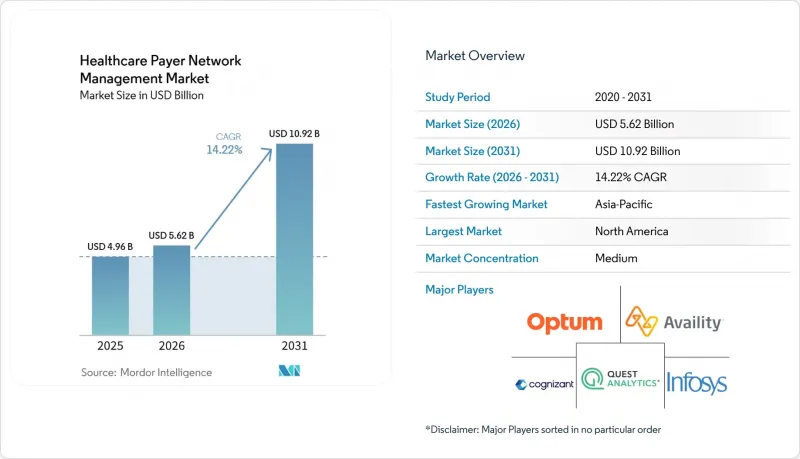
Mordor Intelligence에 의하면, 의료보험자 네트워크 관리 시장은 2025년 49억 6,000만 달러로 평가되었습니다. 2026년에는 56억 2,000만 달러로 확대되어 2031년까지 109억 2,000만 달러에 이를 것으로 예상되고 2026년부터 2031년에 걸쳐 CAGR 14.22%로 성장할 전망입니다.
본 보고서는 구성 요소(플랫폼 및 소프트웨어, 서비스), 배포 방식(클라우드 기반, On-Premise형), 용도(의료 제공업체 네트워크 설계 및 최적화, 계약 관리, 기타 용도), 최종 사용자(공적 의료보험, 민간 의료보험), 지역(북미, 유럽, 기타)별로 분류되어 있습니다. 시장 전망은 금액(달러)으로 표시되어 있습니다.
세계의 의료보험자 네트워크 관리 시장 동향 및 인사이트
비용 절감 및 부정 방지 위한 AI 도입
의료보험자가 이용 관리, 제공업체와의 계약, 그리고 관련 네트워크 운영 전반에 걸쳐 관리 업무 부담을 줄이고 의사 결정 속도를 높이려 함에 따라, AI는 시범 단계에서 보다 광범위한 도입으로 전환되고 있습니다. Innovaccer는 2026년 5월, 조사 대상 의료 보험 플랜의 최고 경영진(C-suite) 중 75%가 향후 3-5년 이내에 AI에 1,000만 달러 이상을 투자할 계획이라고 보고했으며, 이는 투자 계획이 더 이상 제한적인 실험 단계를 넘어섰음을 보여줍니다. 동 조사에 따르면, 건강보험 플랜의 80% 가까이가 사내 개발보다 벤더가 구축한 AI를 선호하는 것으로 나타났습니다. 이는 보험사의 워크플로우에는 여전히 외부 전문 지식이나 분야에 특화된 도입 지원이 필요하다는 견해를 뒷받침합니다. 또한, 플랜의 86%가 아직 AI를 완전히 가동하지 못하고 있으며, 46%가 상호운용성 격차를 주요 장벽으로 꼽고 있는 것으로 밝혀졌습니다. 이는 AI를 통한 성과가 더 나은 데이터 교환과 더 정확한 의료 제공업체 정보의 흐름과 직결되어 있음을 보여줍니다. 의료보험자 네트워크 관리 시장에서 이러한 연관성으로 인해, 업스트림 데이터가 정확하고 이용 가능한 경우에만 네트워크 워크플로우를 자동화할 수 있는 플랫폼 및 서비스 모델에 대한 지출이 촉진되고 있습니다. 따라서 의료보험자 네트워크 관리 시장은 AI 예산뿐만 아니라, 해당 예산을 보험사의 일상 업무 환경에서 활용할 수 있도록 하는 데 필요한 운영상의 노력에서도 혜택을 받고 있습니다.
가치 기반 의료로의 전환 및 상환 최적화
가치 기반 의료의 확산으로 인해 네트워크 관리의 범위가 확대되고 있습니다. 이는 지불자가 더 광범위한 계약 기반 전반에 걸쳐 의료 제공업체의 성과, 공유 절감 논리, 품질 지표 및 귀속 규칙을 추적해야 할 필요성이 대두되었기 때문입니다. Interwell Health는 2025년 보고서에서 의료 제공업체 조직의 3분의 2가 가치 기반 의료 프로그램 참여를 확대하고 있으며, 그 대다수가 참여를 통해 수익이 흑자로 전환될 것으로 기대하고 있다고 보고했습니다. 이로 인해 보험사에게는 계약 관리 및 분석 지원을 강화해야 한다는 압박이 더욱 가중되고 있습니다. 이러한 변화는 의료보험자 네트워크 관리 시장에서도 중요한 의미를 지닙니다. 네트워크 관리 팀은 수동적인 계약 관리 도구나 파편화된 의료 제공업체 기록만으로는 복잡한 상환 구조를 더 이상 관리할 수 없게 되었기 때문입니다. 대체 지불 모델은 의료 지불의 최소 45%를 차지하고 있으며, 이 정도 규모가 되면 파편화된 업무 프로세스를 유지하기가 점점 더 어려워집니다. 이 비율이 증가함에 따라 의료보험자 네트워크 관리 시장에서는 통합된 의료 제공업체 데이터 관리에 대한 수요가 높아지고 있습니다. 이는 불충분한 귀속 데이터가 지급 계산을 왜곡하고 분쟁을 야기할 가능성이 있기 때문입니다. 따라서 계약, 분석 및 의료 제공업체 데이터의 워크플로를 통합하는 벤더는 의료보험자 네트워크 관리 시장에서 보험사의 구매 기준 변화에 더 적절하게 대응할 수 있다고 할 수 있습니다.
레거시 핵심 관리 시스템 통합 시 발생하는 마찰
레거시 핵심 관리 시스템은 청구, 가입 관리, 네트워크 데이터 및 지급 로직 전반에 걸쳐 있기 때문에 지급 기관의 현대화를 가로막는 가장 큰 장벽 중 하나로 남아 있습니다. 의료보험자 네트워크 관리 시장에서 이는 주변 아키텍처가 안정적인 통합이나 워크플로우 오케스트레이션을 지원하지 못할 경우, 설령 설계가 뛰어난 네트워크 플랫폼이라 하더라도 제대로 작동하기 어렵다는 것을 의미합니다. 특정 영역의 변경이 지급 규칙, 자격 심사, 혹은 하류 청구 처리에 지장을 초래할 가능성이 있으므로 모듈별 교체는 어렵습니다. CMS의 상호 운용성 요건으로 인해 대응을 지연할 경우 발생하는 비용이 증가하고 있습니다. 이는 많은 구형 환경이 필요한 FHIR 기반 API 기능을 기본적으로 지원하지 않기 때문입니다. 그 결과, 의료보험자 네트워크 관리 시장에서는 두 가지 속도로 진행되는 투자 패턴이 관찰됩니다. 즉, 전국 규모의 대형 보험 플랜은 신속하게 움직이는 반면, 중견 시장이나 정부 계열 보험 플랜은 많은 경우 더 완만한 속도로 현대화를 추진하고 있습니다. 이러한 준비 상황의 불균형은 벤더의 판매 주기를 장기화시키고 있으며, 의료보험자 네트워크 관리 시장에서 기능의 폭과 더불어 구현의 깊이도 중요해지고 있습니다.
부문 분석
2025년 시점에서 플랫폼 및 소프트웨어는 의료보험자 네트워크 관리 시장 점유율의 58.32%를 차지했으나, 서비스 부문은 2031년까지 연평균 성장률(CAGR) 15.48%로 확대될 것으로 예측됩니다. 보험사 조직은 여전히 자격 인증, 디렉토리 유지 관리, 계약 수명주기 관리 및 제공업체 성과 추적을 위한 핵심 시스템을 필요로 하기 때문에 소프트웨어가 여전히 가장 큰 구성 요소로 남아 있습니다. 이러한 플랫폼은 규정 준수 활동의 주요 운영 계층으로도 기능하며, 지급 기관의 규모에 따라 도입 시기가 다르더라도 소프트웨어 수요를 유지하는 데 기여하고 있습니다. 의료보험자 네트워크 관리 시장에서 구매자가 의료 제공업체의 기록, 계약 조건, 워크플로 규칙을 일원적으로 관리할 수 있는 거점을 원할 경우, 소프트웨어에 대한 지출은 특히 견조합니다. 서비스 부문의 성장이 빠른 이유는 가치 기반 의료, API 지원, 의료 제공업체 데이터 정리와 같은 이니셔티브로 인해 지속적인 업무가 발생하고 있으며, 많은 지불 기관 팀은 이를 단독으로 관리할 규모가 없기 때문입니다.
서비스 분야에서는 도입 지원, 운영 관리 및 분석 자문 서비스가 모두 확대되고 있으며, 그 배경에는 각각 다른 운영상의 이유가 있습니다. 2027년 1월 지급자 간 API 도입 기한과 관련된 단기적인 규정 준수 프로젝트로 인해, 다음 주기 동안 도입 수요는 높은 수준을 유지할 것으로 전망됩니다. 또한, 매니지드 서비스 모델도 의료보험자 네트워크 관리 시장에서 지지를 얻고 있습니다. 이는 보험 플랜이 반복적인 수작업을 보다 구조화된 운영 모델로 전환하는 데 도움이 되기 때문입니다. 또한, 보험사는 제공업체의 데이터 정책, 계약 설계, 워크플로우 자동화를 단일 운영 접근 방식으로 통합하기 위한 지원이 필요한 경우가 많기 때문에 자문 업무도 계속해서 중요시되고 있습니다. 따라서 부문 구성은 계속해서 플랫폼이 중심이 될 전망이지만, 의료보험자 네트워크 관리 시장에서 가장 빠른 성장을 이룰 것은 소프트웨어와 실무 실행력을 겸비한 벤더가 될 것입니다.
2025년 기준, 클라우드 기반 도입은 의료보험자 네트워크 관리 시장 규모의 63.74%를 차지했으며, 2031년까지 연평균 성장률(CAGR) 16.02%를 나타낼 것으로 예측됩니다. 보험사 네트워크의 워크플로는 현재 빈번한 데이터 교환, 신속한 업데이트, 그리고 의료 제공업체, 청구, 승인 기능에 걸친 광범위한 통합에 의존하고 있기 때문에 클라우드는 계속해서 주요 모델로 자리 잡고 있습니다. 따라서 의료보험자 네트워크 관리 시장에서 도입 방식의 선택은 기술적 결정인 동시에 규정 준수상의 결정이기도 합니다. 또한, 구매 기업들은 클라우드 전환을 활용하여 업그레이드 지연을 단축하고, 연결된 전체 워크플로우에서 제공업체 네트워크 변경 사항이 반영되는 속도를 높이고 있습니다.
Cotiviti는 2025년 3월 Edifecs 인수를 완료했으며, 이를 통해 FHIR 기반 연결성을 보다 신속하게 지원하는 상호 운용성이 추가되었습니다. 이 거래는 의료보험자 네트워크 관리 시장의 벤더들이 사내 개발 주기로는 불가능한 속도로 아키텍처의 격차를 메우기 위해 인수를 활용하고 있음을 보여줍니다. On-Premise 배포는 정부가 관리하는 환경이나 엄격한 데이터 현지화 요건을 가진 대규모 조직에서 여전히 중요성을 유지하고 있습니다. 예측 기간 동안 운영상의 이점이 규정 준수 대응 시기, 플랫폼 확장성 및 자동화의 신속한 배포와 연계됨에 따라 클라우드의 우위는 계속해서 확대될 것으로 전망됩니다.
지역별 분석
2025년, 북미는 세계 시장 점유율의 41.68%를 차지하며 의료보험자 네트워크 관리 시장에서 최대의 입지를 확립했습니다. 미국이 이러한 선두를 달리고 있는 이유는 민간 보험, 메디케어, 메디케이드 각 플랜이 밀접하게 혼재되어 있으며, 각 사업 분야에서 의료 제공업체 네트워크 거래가 대량으로 발생하고 있기 때문입니다. 현재 CMS(미국 의료보험 및 의료보조 서비스 센터)는 상호운용성 및 사전 승인 API와 관련된 2027년 1월 1일 마감일을 통해 단기적인 지출 속도를 결정하고 있습니다. 또한, 디렉토리의 정확성과 예상치 못한 청구에 대한 규정 준수 대응 역시 해당 지역 전체 지불자의 투자 계획에서 의료 제공업체 데이터, 자격 인증 및 워크플로우 현대화를 중요한 과제로 자리매김하고 있습니다. 캐나다와 멕시코는 의료보험자 네트워크 관리 시장에서 여전히 규모는 작지만, 청구 처리 현대화 및 의료 제공업체 데이터 업그레이드를 통해 새로운 플랫폼과 서비스의 단계적 도입이 진행되고 있습니다.
유럽은 2025년에 지역별 규모에서 2위를 차지했으며, 해당 지역의 의료보험자 네트워크 관리 시장은 보험사의 디지털화, 데이터 교환 개혁, 그리고 의료 정보 인프라에 대한 정책적 관심 강화를 통해 발전했습니다. 독일 법정 건강보험 연맹도 2025년에 AI를 활용한 부정 행위 감지 강화와 보다 광범위한 데이터 거버넌스 개혁을 요구하고 있으며, 이는 보험사 측의 데이터 도구 및 워크플로우 현대화에 대한 지속적인 관심을 뒷받침하고 있습니다. 이 지역 전체에서 의료보험자 네트워크 관리 시장은 상호 운용성 노력과 개인정보 보호 요건에 의해 형성되고 있으며, 이는 보험사들이 의료 기관 및 가입자와의 데이터 교환 일관성을 높일 것을 촉구하고 있습니다. 이러한 요인들이 결합되어 네트워크 효율성과 더욱 엄격한 거버넌스 요건 간의 균형을 맞출 수 있는 플랫폼에 대한 수요가 지속될 전망입니다.
아시아태평양은 2031년까지 연평균 성장률(CAGR) 17.23%를 나타낼 것으로 예측되며, 의료보험자 네트워크 관리 시장에서 가장 빠르게 확대될 지역이 될 전망입니다. 일본 디지털청은 ‘공공 의료 허브’ 대상 지자체 수를 2024년 말 기준 183개에서 2026년 5월 10일까지 604개로 확대했습니다. 이를 통해 해당 플랫폼은 전국적인 커버리지에 가까워졌으며, 연계된 보험사 워크플로우를 위한 더욱 견고한 기반이 마련되었습니다. 중국 국가의료보장국의 보고에 따르면, 기본 의료보험 가입률은 인구의 95%를 초과합니다. 이에 따라 매니지드 케어 활동이 더욱 복잡해지는 가운데, 보험금 청구 및 네트워크 인프라에 대한 장기적인 수요가 뒷받침되고 있습니다. 남미, 중동 및 아프리카는 현재 규모는 작지만, 보충 보험 개혁 및 의료 시스템의 광범위한 현대화를 통해 의료보험자 네트워크 관리 시장 공급업체들에게 더 명확한 진입 경로가 열리고 있습니다.
기타 혜택 :
- 엑셀 형식 시장 예측(ME) 시트
- 3개월간의 애널리스트 지원
자주 묻는 질문
목차
제1장 서론
제2장 조사 방법
제3장 주요 요약
제4장 시장 구도
제5장 시장 규모 및 성장 예측
제6장 경쟁 구도
제7장 시장 기회 및 향후 전망
KTH 26.08.10According to Mordor Intelligence, the healthcare payer network management market is expected to increase from USD 4.96 billion in 2025 to USD 5.62 billion in 2026 and reach USD 10.92 billion by 2031, growing at a CAGR of 14.22% over 2026-2031.
This report is Segmented by Component (Platform and Software, Services), Deployment Mode (Cloud-Based, On-Premises), Application (Provider Network Design and Optimization, Contract Management, and Other Applications), End-User (Public Health Insurance, Private Health Insurance), and Geography (North America, Europe, and Others). The Market Forecasts are Provided in Terms of Value (USD).
Global Healthcare Payer Network Management Market Trends and Insights
Adoption of AI for Cost Containment and Fraud Prevention
AI is moving from pilot work to broader deployment, as payers try to reduce administrative effort and improve the speed of decisions across utilization management, provider contracting, and related network operations. Innovaccer reported in May 2026 that 75% of surveyed health plan C-suite executives plan to spend more than USD 10 million on AI within 3 to 5 years, which shows that investment plans are now moving beyond limited experimentation. The same survey showed that nearly 80% of health plans prefer vendor-built AI over in-house development, which supports the view that payer workflows still need outside expertise and domain-specific implementation support. It also found that 86% of plans are not yet fully operationalizing AI and that 46% cite interoperability gaps as the main barrier, which ties AI returns directly to better data exchange and cleaner provider information flows. In the healthcare payer network management market, that connection is directing spending toward platforms and service models that can automate network workflows only when upstream data is accurate and accessible. The healthcare payer network management market is therefore benefiting not only from AI budgets, but also from the operational work needed to make those budgets usable in day-to-day payer environments.
Shift Toward Value-Based Care and Reimbursement Optimization
Value-based care is expanding the scope of network management, because payers now have to track provider performance, shared-savings logic, quality metrics, and attribution rules across a wider contract base. Interwell Health reported in 2025 that 2-thirds of provider organizations increased participation in value-based care programs, and most expected a positive revenue shift from that participation, which increases pressure on payers to strengthen contracting and analytics support.The same shift matters in the healthcare payer network management market because network teams can no longer manage complex reimbursement structures with manual contracting tools and disconnected provider records. Alternative payment models account for at least 45% of healthcare payments, which is a scale at which fragmented operational processes become harder to sustain. As this mix grows, the healthcare payer network management market sees stronger demand for integrated provider data management, because weak attribution data can distort payment calculations and create disputes. Vendors that combine contracting, analytics, and provider data workflows are therefore better aligned with how payer buying criteria are changing in the healthcare payer network management market.
Legacy Core Administrative System Integration Friction
Legacy core administrative systems remain one of the hardest barriers in payer modernization, because they sit across claims, enrollment, network data, and payment logic at the same time. In the healthcare payer network management market, this means that even a well-designed network platform can struggle if the surrounding architecture cannot support stable integration and workflow orchestration. Module-by-module replacement is difficult, because a change in one area can disrupt payment rules, eligibility handling, or downstream claims processing. CMS interoperability requirements now raise the cost of delay, since many older environments do not support the required FHIR-based API capabilities in a native way. The result in the healthcare payer network management market is a two-speed investment pattern, where large national plans move faster while mid-market and government-sponsored plans often modernize more gradually. That uneven readiness also lengthens vendor sales cycles and makes implementation depth just as important as feature breadth in the healthcare payer network management market.
Other drivers and restraints analyzed in the detailed report include:
- Cross-Payer API Connectivity for Credentialing and Contracting
- Expansion of Virtual-First and Hybrid Provider Networks
- Provider Data Fragmentation Across Multiple Sources
For complete list of drivers and restraints, kindly check the Table Of Contents.
Segment Analysis
Platform and software held 58.32% of the healthcare payer network management market share in 2025, while services are projected to expand at a 15.48% CAGR through 2031. Software remained the largest component because payer organizations still need core systems for credentialing, directory maintenance, contract life cycle management, and provider performance tracking. Those platforms also act as the main operating layer for compliance activity, which helps preserve software demand even when implementation timing varies by payer size. In the healthcare payer network management market, software spending is especially durable where buyers want one control point for provider records, contract terms, and workflow rules. Services are growing faster because value-based care, API readiness, and provider data cleanup create ongoing work that many payer teams do not have the scale to manage alone.
Within the services category, implementation support, managed operations, and analytics advisory are all expanding, but they are doing so for different operational reasons. Near-term compliance projects tied to the January 2027 payer-to-payer API deadline should keep implementation demand elevated through the next cycle. Managed service models are also gaining favor in the healthcare payer network management market because they help plans convert recurring manual work into more structured operating models. Advisory work continues to matter as well, since payers often need help connecting provider data policy, contract design, and workflow automation into one operating approach. The segment mix should therefore remain platform heavy, but the fastest momentum in the healthcare payer network management market should continue to sit with vendors that combine software and hands-on execution.
Cloud-based deployment accounted for 63.74% share of the healthcare payer network management market size in 2025 and is projected to grow at a 16.02% CAGR through 2031. Cloud remained the leading model because payer network workflows now depend on frequent data exchange, faster updates, and broader integration across provider, claims, and authorization functions. In the healthcare payer network management market, deployment choice is therefore becoming a compliance decision as much as a technology decision. Buyers are also using cloud migration to reduce upgrade lag and improve the speed at which provider network changes appear across connected workflows.
Cotiviti completed its acquisition of Edifecs in March 2025, and that move added interoperability capability that supports faster FHIR-based connectivity. The deal shows how vendors in the healthcare payer network management market are using acquisitions to close architecture gaps more quickly than internal development cycles would allow. On-premises deployments still retain relevance in government-administered settings and large organizations with strict data localization needs. Over the forecast period, cloud should keep widening its lead because the operational benefit is now linked to compliance timing, platform extensibility, and faster automation rollout.
Complete Report Scope:
- By Component
- Platform and Software
- Services
- By Deployment Mode
- Cloud-Based
- On-Premises
- By Application
- Provider Network Design and Optimization
- Contract Management
- Provider Data Management and Credentialing
- Claims and Reimbursement Management
- Other Applications
- By End-User
- Public Health Insurance
- Private Health Insurance
- By Geography
- North America
- United States
- Canada
- Mexico
- Europe
- Germany
- United Kingdom
- France
- Italy
- Spain
- Rest of Europe
- Asia-Pacific
- China
- Japan
- India
- Australia
- South Korea
- Rest of Asia-Pacific
- Middle East and Africa
- GCC
- South Africa
- Rest of Middle East and Africa
- South America
- Brazil
- Argentina
- Rest of South America
- North America
Geography Analysis
North America held 41.68% of global share in 2025, giving the region the largest position in the healthcare payer network management market. The United States drives that lead because it has a dense mix of commercial, Medicare, and Medicaid plans, and each line of business generates a high volume of provider network transactions. CMS now sets the near-term spending pace through the January 1, 2027 deadlines for interoperability and prior authorization APIs. Directory accuracy and surprise billing compliance also keep provider data, credentialing, and workflow modernization high on payer investment plans across the region. Canada and Mexico remain smaller within the healthcare payer network management market, but claims modernization and provider data upgrades are supporting gradual adoption of newer platforms and services.
Europe held the second-largest regional position in 2025, and the healthcare payer network management market there is advancing through payer digitization, data exchange reform, and stronger policy attention to health information infrastructure. Germany's statutory health insurance federation also called for stronger AI-based fraud detection and broader data governance reform in 2025, which supports continued interest in payer-side data tools and workflow modernization. Across the wider region, the healthcare payer network management market is being shaped by interoperability initiatives and privacy requirements that push payers toward more consistent provider and member data exchange. That combination should sustain demand for platforms that can balance network efficiency with stricter governance requirements.
Asia-Pacific is projected to grow at a 17.23% CAGR through 2031, making it the fastest-expanding geography in the healthcare payer network management market. Japan's Digital Agency expanded the Public Medical Hub from 183 municipalities at the end of 2024 to 604 municipalities by May 10, 2026, bringing the platform close to nationwide coverage and creating a stronger base for connected payer workflows. China's National Healthcare Security Administration reported that basic medical insurance coverage exceeds 95% of the population, which supports long-term demand for claims and network infrastructure as managed care activity becomes more complex. South America and the Middle East and Africa remain smaller today, but supplementary insurance reform and broader health system modernization are creating clearer entry paths for vendors in the healthcare payer network management market.
- Availity, LLC
- Cedar Gate Technologies
- CitiusTech
- Cognizant
- Cotiviti, Inc.
- Gainwell Technologies LLC
- HealthEdge Software, Inc.
- IBM
- Infosys
- Innovaccer
- LexisNexis Risk Solutions Inc.
- Mphasis
- Optum
- Oracle
- Quest Analytics LLC
- Salesforce, Inc.
- SS and C Technologies Holdings, Inc.
- Symplr
- Verisys Corporation
- Wipro
- Zelis Healthcare, LLC
Additional Benefits:
- The market estimate (ME) sheet in Excel format
- 3 months of analyst support
TABLE OF CONTENTS
1 Introduction
- 1.1 Study Assumptions and Market Definition
- 1.2 Scope of the Study
2 Research Methodology
3 Executive Summary
4 Market Landscape
- 4.1 Market Overview
- 4.2 Market Drivers
- 4.2.1 Adoption of AI for Cost Containment and Fraud Prevention
- 4.2.2 Need for Provider Directory Accuracy and Compliance Automation
- 4.2.3 Shift Toward Value-Based Care and Reimbursement Optimization
- 4.2.4 Growing Demand for Real-Time Provider Data Governance
- 4.2.5 Expansion of Virtual-First and Hybrid Provider Networks
- 4.2.6 Cross-Payer API Connectivity for Credentialing and Contracting
- 4.3 Market Restraints
- 4.3.1 Legacy Core Administrative System Integration Friction
- 4.3.2 Provider Data Fragmentation Across Multiple Sources
- 4.3.3 Cybersecurity and Privacy Exposure in Shared Network Data Flows
- 4.3.4 High Change-Management Burden for Manual Operations Teams
- 4.4 Value Chain Analysis
- 4.5 Regulatory Landscape
- 4.6 Technological Outlook
- 4.7 Porter's Five Forces Analysis
- 4.7.1 Threat of New Entrants
- 4.7.2 Bargaining Power of Suppliers
- 4.7.3 Bargaining Power of Buyers
- 4.7.4 Threat of Substitutes
- 4.7.5 Competitive Rivalry
5 Market Size & Growth Forecasts (Value, USD)
- 5.1 By Component
- 5.1.1 Platform and Software
- 5.1.2 Services
- 5.2 By Deployment Mode
- 5.2.1 Cloud-Based
- 5.2.2 On-Premises
- 5.3 By Application
- 5.3.1 Provider Network Design and Optimization
- 5.3.2 Contract Management
- 5.3.3 Provider Data Management and Credentialing
- 5.3.4 Claims and Reimbursement Management
- 5.3.5 Other Applications
- 5.4 By End-User
- 5.4.1 Public Health Insurance
- 5.4.2 Private Health Insurance
- 5.5 By Geography
- 5.5.1 North America
- 5.5.1.1 United States
- 5.5.1.2 Canada
- 5.5.1.3 Mexico
- 5.5.2 Europe
- 5.5.2.1 Germany
- 5.5.2.2 United Kingdom
- 5.5.2.3 France
- 5.5.2.4 Italy
- 5.5.2.5 Spain
- 5.5.2.6 Rest of Europe
- 5.5.3 Asia-Pacific
- 5.5.3.1 China
- 5.5.3.2 Japan
- 5.5.3.3 India
- 5.5.3.4 Australia
- 5.5.3.5 South Korea
- 5.5.3.6 Rest of Asia-Pacific
- 5.5.4 Middle East and Africa
- 5.5.4.1 GCC
- 5.5.4.2 South Africa
- 5.5.4.3 Rest of Middle East and Africa
- 5.5.5 South America
- 5.5.5.1 Brazil
- 5.5.5.2 Argentina
- 5.5.5.3 Rest of South America
- 5.5.1 North America
6 Competitive Landscape
- 6.1 Market Concentration
- 6.2 Market Share Analysis
- 6.3 Company Profiles (includes Global level Overview, Market level overview, Core Segments, Financials as available, Strategic Information, Market Rank/Share for key companies, Products & Services, Recent Developments)
- 6.3.1 Availity, LLC
- 6.3.2 Cedar Gate Technologies
- 6.3.3 CitiusTech Inc.
- 6.3.4 Cognizant
- 6.3.5 Cotiviti, Inc.
- 6.3.6 Gainwell Technologies LLC
- 6.3.7 HealthEdge Software, Inc.
- 6.3.8 IBM
- 6.3.9 Infosys Limited
- 6.3.10 Innovaccer Inc.
- 6.3.11 LexisNexis Risk Solutions Inc.
- 6.3.12 Mphasis Limited
- 6.3.13 Optum Inc.
- 6.3.14 Oracle
- 6.3.15 Quest Analytics LLC
- 6.3.16 Salesforce, Inc.
- 6.3.17 SS and C Technologies Holdings, Inc.
- 6.3.18 Symplr
- 6.3.19 Verisys Corporation
- 6.3.20 Wipro Limited
- 6.3.21 Zelis Healthcare, LLC
7 Market Opportunities & Future Outlook
- 7.1 White-space & Unmet-need Assessment


