

|
시장보고서
상품코드
2099792
환자 경험 기술 : 시장 점유율 분석, 업계 동향 및 통계, 성장 예측(2026-2031년)Patient Experience Technology - Market Share Analysis, Industry Trends & Statistics, Growth Forecasts (2026 - 2031) |
||||||
 Mordor Intelligence
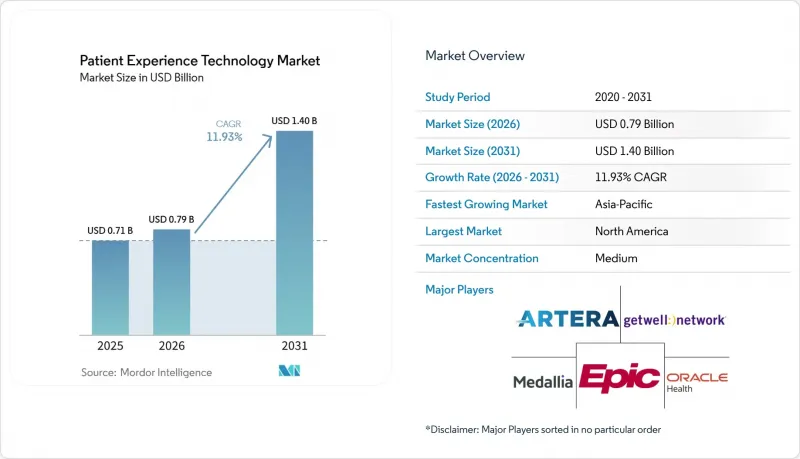
Mordor Intelligence에 의하면, 환자 경험 기술 시장 규모는 2025년에 7억 1,000만 달러로 평가되었습니다. 2026년 7억 9,000만 달러, 2031년 14억 달러에 이를 것으로 예측되며, 2026년부터 2031년에 걸쳐 CAGR 11.93%로 성장할 전망입니다.
본 보고서는 솔루션 유형별(환자 포털 등), 배포 방식별(클라우드 기반 솔루션 등), 기술별(인공지능 및 머신러닝 등), 용도별(환자와의 커뮤니케이션 및 참여 유도 등), 최종 사용자별(병원 및 의료 시스템 등), 지역별(북미 등)로 분류되어 있습니다. 시장 전망은 금액(달러) 기준으로 제시되어 있습니다.
세계의 환자 경험 기술 시장 동향 및 인사이트
디지털을 통한 환자 접근 및 셀프 서비스 워크플로우에 대한 수요 증가
현재 환자들은 예약, 경과 관찰, 메시지 교환, 진료 기록 열람과 같은 업무의 상당 부분을 디지털 채널을 통해 스스로 처리할 수 있게 되었으며, 이에 따라 의료 제공업체들은 셀프 서비스 도구를 중심으로 의료 접근 체계를 재구축할 수밖에 없게 되었습니다. 2,000개 이상의 병원과 4만 7,000개의 진료소를 대상으로 한 2026년 6월 조사에 따르면, 2020년부터 2025년 사이에 포털을 통한 메시지 수는 153% 증가한 반면, 같은 기간 전화 건수는 6% 감소했습니다. 또한, 같은 조사에서는 1억 4,000만 명의 활성 Epic 사용자 중 30%가 2025년 1분기에 의료 종사자에게 포털 메시지를 보냈다고 지적하고 있으며, 이는 메시징이 틈새 선택지가 아니라 일상적인 진료 활동의 일부로 얼마나 빠르게 정착했는지를 보여줍니다. 환자 경험 기술 시장에서 이러한 행동의 변화는 디지털 트래픽이 대면 진료를 완전히 대체한 것은 아니지만, 진료 간 업무량이 증가하고 있음을 의미합니다. 연방 정부의 데이터 교환 노력도 이러한 추세를 뒷받침하고 있으며, TEFCA를 통한 데이터 교환 건수는 2026년 2월까지 5억 건을 돌파했습니다. 이를 통해 환자 데이터의 이식성이 향상되어, 시스템 전반에 걸쳐 디지털 접근에 대한 기대에 더 쉽게 부응할 수 있게 되었습니다.
환자 경험 점수와 연계된 가치 기반 의료 인센티브
지불 제도 설계로 인해 병원이 환자 경험 기술 도입을 미루는 것은 점점 더 어려워지고 있습니다. 환자 만족도 성과가 보상에 직접적인 영향을 미치기 때문입니다. CMS는 계속해서 메디케어 입원 기본 지급액의 2%를 유보하고, 해당 자금을 ‘병원 가치 기반 구매 프로그램(Hospital Value-Based Purchasing Program)’을 통해 재분배하고 있으며, 이를 통해 HCAHPS 결과가 재무 성과와 연계되고 있습니다. 2025 회계연도 IPPS 최종 규정에서는 2027 회계연도부터 2029 회계연도에 걸친 HCAHPS 채점 방식의 개정도 확정되었으며, 업데이트된 설문조사가 2030 회계연도 프로그램 연도부터 VBP에 통합될 것임이 확인되었습니다. 이러한 다년간에 걸친 규정 준수 전환 과정으로 인해 환자 경험 기술 시장의 구매 주기가 단축되고 있습니다. 이는 의료 제공업체들이 개정된 평가 제도가 완전히 정착되기 전에 피드백, 커뮤니케이션 및 서비스 복구 도구의 업그레이드를 진행하고 있기 때문입니다. 이와 유사한 지불 논리는 대규모 입원 환자 중심 병원의 범위를 넘어 확산되고 있으며, 이로 인해 지불자나 계약 관계를 유지하기 위해 측정 가능한 환자 참여 성과를 점점 더 필요로 하는 외래 의료 기관 및 소규모 의료시설 수요가 촉진되고 있습니다.
분산된 임상 시스템 전반에 걸친 높은 통합 비용
많은 의료 기관에서는 여전히 여러 예약 관리, 청구, 전자의무기록(EHR), 포털 및 신원 확인 시스템을 병행하여 사용하고 있어, 도입 과정이 단순한 소프트웨어 구매보다 더 복잡해지고 있습니다. 통합의 부담은 API에만 국한되지 않습니다. 새로운 플랫폼을 원활하게 운영하려면 의료 기관은 환자 정보의 일관성 확보, 동의 관리, 워크플로우 매핑, 거버넌스 규칙 정비도 필요로 하기 때문입니다. 환자 경험 기술 시장에서 주요 임상 시스템과 인증된 또는 성숙한 연동 기능을 갖춘 벤더는 도입 시 마찰을 줄이고 가치 실현까지의 시간을 단축할 수 있으므로 실질적인 우위를 점하고 있습니다. 이 문제는 라이선스 비용은 감당할 수 있어도 본격적인 도입에 수반되는 광범위한 기술적 작업에는 대응하지 못할 가능성이 있는 중규모 의료기관에게 특히 중요합니다. 그 결과, 환자 경험 기술 시장의 총 소유 비용은 구독 가격과 종종 크게 차이를 보이게 되며, 이는 일부 구매 결정을 지연시키고 생태계와의 적합성이 높은 벤더에게 유리하게 작용합니다.
부문 분석
2025년 기준, 환자 포털은 환자 경험 기술 시장 점유율의 32.47%를 차지했으나, 디지털 프론트도어 플랫폼은 2031년까지 12.89%라는 가장 높은 시장 규모 성장률을 나타낼 것으로 예측됩니다. 포털은 많은 환자가 검사 결과, 처방전 갱신, 예약 세부 정보 및 보안 메시징을 확인하는 공간으로 이미 자리 잡았기 때문에 여전히 중심적인 역할을 수행하고 있습니다. 확고한 도입 기반이 있다는 것은 특히 새로운 도구가 익숙한 인터페이스를 통해 예약, 접수, 메시징 기능을 확장할 수 있는 경우, 의료 기관이 포털을 완전히 대체하기보다는 포털을 기반으로 기능을 확장하는 경향이 강하다는 것을 의미합니다. 환자 경험 기술 시장에서 이는 구매자의 관심이 보다 광범위한 프론트엔드 통합으로 이동하고 있는 상황에서도, 성숙한 포털 제품으로부터 안정적인 수익을 뒷받침하는 요인이 되고 있습니다. 디지털 프론트도어 플랫폼의 성장은 환자에게 작업마다 서로 다른 시스템 사이를 이동하도록 요구하기보다는 파편화된 접근 기능을 하나의 소비자용 레이어로 통합해야 할 필요성에서 비롯됩니다.
환자 커뮤니케이션 플랫폼과 예약 관리 도구의 중요성이 높아지고 있는 것은 의료 기관이 환자가 클리닉에 도착한 후에야 대응하는 것이 아니라, 실시간으로 온디맨드 방식으로 대응해야 하기 때문입니다. 포털 이용량 증가와 진료 간격 동안의 참여로 광범위하게 전환됨에 따라, 요청 라우팅, 예약 확인, 환자를 적절한 치료 수준으로 유도할 수 있는 통합 워크플로우의 가치가 높아지고 있습니다. 따라서 환자 경험 기술 시장에서는 메시징, 내비게이션, 알림, 접근 관리를 단일 운영 레이어에서 연동할 수 있는 벤더가 높이 평가받고 있습니다. 그 이유는 간단명료합니다. 단편화된 단일 기능 도구는 인수인계 시 공백을 초래하는 반면, 통합된 접근 플랫폼은 환자와 직원 양측의 부담을 경감시키기 때문입니다. 향후 솔루션 간의 경쟁은 개별 기능 그 자체보다는 각 플랫폼이 의료에 대한 모든 접근 경로를 얼마나 원활하게 관리할 수 있는지에 초점이 맞추어질 것입니다.
2025년에는 환자 경험 기술 시장 규모의 62.58%를 클라우드 기반 솔루션이 차지했으나, On-Premise형 솔루션은 2031년까지 연평균 성장률(CAGR) 13.61%로 확대될 것으로 예측됩니다. 의료 제공업체들은 초기 인프라 투자 비용이 적게 들고, 업데이트 주기가 빠르며, 메시징, 일정 관리, 아웃리치 수요가 급증했을 때 확장이 용이하다는 점을 중요하게 여기기 때문에 클라우드는 여전히 주요 도입 형태로 자리 잡고 있습니다. 이러한 장점은 환자 경험 기술 시장의 일상적인 현실과 부합합니다. 이 시장에서는 상호작용량이 급격히 변동할 가능성이 있으며, 인터페이스 업데이트가 환자 만족도에 큰 영향을 미치기 때문입니다. 또한, 클라우드 도입은 병원, 진료소, 제휴 의사 그룹 전체에 걸쳐 공통된 커뮤니케이션 계층을 구축하고자 하는 다중 거점 조직의 요구에도 부응하고 있습니다. 많은 의료 제공업체에게 클라우드 모델은 현장에서 긴 업그레이드 주기를 유발하지 않으면서도 새로운 기능을 배포할 수 있는 가장 간단한 수단이 되고 있습니다.
On-Premise 도입의 성장세가 여전히 견조한 이유는 일부 의료 시스템 및 공중보건 환경에서 데이터 저장 장소, 인프라의 직접 관리, 그리고 엄격한 내부 거버넌스가 여전히 최우선 과제로 여겨지기 때문입니다. 독일의 전자 환자 기록은 2025년 1월에 옵트아웃 방식으로 전환되었는데, 이는 데이터 처리 규정에 세심한 주의를 기울이면서도 국가 정책이 디지털 참여를 추진하고 있는 현실을 반영합니다. 이러한 긴장 관계로 인해 퍼블릭 클라우드 사용이 제한되거나 정치적으로 민감한 분야에서는 환자 경험 기술 시장에 On-Premise 도입의 여지가 남아 있습니다. 또한, 여전히 레거시 로컬 임상 시스템에 의존하면서도 최상위 계층에는 클라우드 네이티브 환자용 도구를 도입하고자 하는 의료 기관의 경우, 하이브리드 모델도 여전히 타당합니다. 즉, 경쟁은 한 모델이 다른 모델을 대체하는 것보다는 각 구매자의 규제 및 운영 특성에 맞추어 아키텍처를 최적화하는 데 있다고 할 수 있습니다.
지역별 분석
2025년, 북미는 환자 경험 기술 시장의 40.36% 점유율을 차지했습니다. 이 지역이 주도적인 위치를 차지하고 있는 이유는 미국이 병원에 대한 환급금의 일부를 환자 경험 성과와 직접 연계하고 있기 때문이며, 이로 인해 참여 기술은 수익 보호 및 서비스 개선의 우선순위와 밀접하게 연관되어 있습니다. 또한, 연방 정부의 상호운용성 정책도 운영 기준을 높이고 있습니다. HTI-4 최종 규정에 따라 벤더 생태계 전반에 걸친 데이터 접근 및 교환을 지원하는 FHIR 기반 API 인증 기준이 확립되었기 때문입니다. 이로 인해 북미의 환자 경험 기술 시장은 다른 많은 지역에 비해 더욱 견고한 기술적 기반을 갖추고 있습니다. 대규모 의료 제공업체 시스템과 외래 진료 네트워크 또한 예약, 접수, 커뮤니케이션, 환자 피드백 도구에 대한 견고한 수요 기반을 형성하고 있습니다.
유럽은 정책 및 디지털 헬스 현대화를 통해 의료 제공업체들이 환자 접근성 개선과 의료 기록 연계를 지속적으로 추진하고 있어 여전히 중요한 성장 지역으로 남아 있습니다. 독일의 전자 환자 기록은 2025년 1월부터 옵트아웃 방식으로 전환되며, 이는 디지털 참여 확대를 위한 중요한 정책적 진전입니다. 또한, WHO 유럽 사무소의 보고서에 따르면, EU 회원국의 63%가 환자 참여를 위해 AI 챗봇을 활용하고 있으며, 이는 환자 대상 자동화가 더 이상 시범 프로그램의 범위를 벗어나고 있음을 보여줍니다. 환자 경험 기술 시장에서 유럽은 공공 부문의 강력한 수요, 더욱 엄격한 거버넌스에 대한 기대, 그리고 국가별 도입 속도의 차이 등 다양한 요소가 공존하고 있습니다. 이로 인해 대규모 플랫폼과 각국 고유의 도입 모델 모두에게 활약의 기회가 열리고 있습니다.
아시아태평양은 2031년까지 환자 경험 기술 시장 규모에서 16.58%라는 가장 빠른 성장률을 나타낼 것으로 예측됩니다. 이 지역은 대규모 공공 디지털 헬스 프로그램, 환자 수 증가, 그리고 모바일 우선 접근 모델에 대한 수요 증가의 혜택을 받고 있습니다. 또한, 아시아태평양의 의료 제공업체들은 도입의 다양한 단계를 거치고 있어, 기본적인 디지털 접근 단계부터 보다 고도화된 AI를 활용한 환자 참여에 이르기까지 폭넓은 기회가 창출되고 있습니다. 환자 경험 기술 시장에서 국가별 성숙도와 조달 패턴은 크게 다르지만, 이러한 상황 속에서도 아시아태평양은 여전히 가장 뚜렷한 고성장 지역으로서의 위상을 유지하고 있습니다.
기타 혜택 :
- 엑셀 형식 시장 예측(ME) 시트
- 3개월간의 애널리스트 지원
자주 묻는 질문
목차
제1장 서론
제2장 조사 방법
제3장 주요 요약
제4장 시장 구도
제5장 시장 규모 및 성장 예측
제6장 경쟁 구도
제7장 시장 기회 및 향후 전망
KTH 26.08.10According to Mordor Intelligence, the patient experience technology market size is projected to be USD 0.71 billion in 2025, USD 0.79 billion in 2026, and reach USD 1.40 billion by 2031, growing at a CAGR of 11.93% from 2026 to 2031.
This report is Segmented by Solution Type (Patient Portals, and More), Deployment Mode (Cloud-Based Solutions, and More), Technology (Artificial Intelligence and Machine Learning, and More), Application (Patient Communication and Engagement, and More), End User (Hospitals and Health Systems, and More), and Geography (North America, and More). The Market Forecasts are Provided in Terms of Value (USD).
Global Patient Experience Technology Market Trends and Insights
Rising Demand for Digital Patient Access and Self-Service Workflows
Patients are now initiating a larger share of scheduling, follow-up, messaging, and records access through digital channels, and that is forcing providers to rebuild the access layer of care around self-service tools. A June 2026 study covering more than 2,000 hospitals and 47,000 clinics showed that portal messages increased 153% between 2020 and 2025, while phone calls fell 6% over the same period. The same study also noted that 30% of 140 million active Epic users sent a portal message to a clinician in the first quarter of 2025, which shows how quickly messaging has become part of routine care activity rather than a niche option. For the patient experience technology market, that behavior shift means digital traffic is not replacing every in-person encounter, but it is increasing the amount of work that happens between visits. Federal data exchange efforts are reinforcing this direction because TEFCA had surpassed 500 million exchanged records by February 2026, which supports more portable patient data and makes digital access expectations easier to meet across systems.
Value-Based Care Incentives Linked to Patient Experience Scores
Payment design is making patient experience technology harder for hospitals to delay because patient satisfaction performance affects reimbursement in a direct way. CMS continues to withhold 2% of base Medicare inpatient payments and redistribute that pool through the Hospital Value-Based Purchasing Program, which keeps HCAHPS results tied to financial performance. The FY 2025 IPPS Final Rule also finalized modified HCAHPS scoring for FY 2027 through FY 2029 and confirmed that the updated survey will be integrated into VBP from the FY 2030 program year. That multi-year compliance path is compressing buying cycles in the patient experience technology market because providers are upgrading feedback, communication, and service recovery tools before the updated scoring regime becomes fully embedded. The same payment logic is widening beyond large inpatient hospitals, which supports demand from ambulatory providers and smaller care sites that increasingly need measurable patient engagement performance to support payer and contract relationships.
High Integration Cost Across Fragmented Clinical Systems
Many providers still operate across multiple scheduling, billing, EHR, portal, and identity systems, and that makes deployment more complex than a simple software purchase. The integration burden is not limited to APIs because health systems also need patient identity alignment, consent controls, workflow mapping, and governance rules before a new platform can operate smoothly. In the patient experience technology market, vendors with certified or mature connections into major clinical systems have a practical advantage because they reduce implementation friction and shorten time to value. This issue is especially important for mid-sized providers that may be able to afford licensing costs but not the broader technical work that sits behind a full rollout. As a result, total ownership cost in the patient experience technology market often diverges sharply from subscription pricing, which slows some buying decisions and favors vendors with stronger ecosystem fit.
Other drivers and restraints analyzed in the detailed report include:
- Expansion of AI-Enabled Patient Interaction and Triage
- Rising Need to Reduce Contact-Center Dependency in Health Systems
- Data Privacy, Consent Management, and Cybersecurity Exposure
For complete list of drivers and restraints, kindly check the Table Of Contents.
Segment Analysis
Patient portals held 32.47% of the patient experience technology market share in 2025, while digital front door platforms are projected to post the fastest patient experience technology market size growth at 12.89% through 2031. Portals remain central because they already sit at the point where many patients look for test results, prescription refills, appointment details, and secure messaging. The strong installed base also means providers are more willing to expand around portals than replace them outright, especially when new tools can extend scheduling, intake, and messaging through familiar interfaces. In the patient experience technology market, that supports steady revenue from mature portal products even as buyer attention shifts toward broader front-end orchestration. The growth of digital front door platforms comes from the need to pull fragmented access functions into one consumer-facing layer rather than asking patients to move across separate systems for each task.
Patient communication platforms and appointment scheduling tools are gaining weight because providers now need to act on demand in real time instead of only responding after a patient reaches the clinic. Rising portal volume and the broader move toward between-visit engagement have increased the value of a unified workflow that can route requests, confirm appointments, and guide patients to the right level of care. That is why the patient experience technology market is rewarding vendors that can connect messaging, navigation, reminders, and access management in a single operating layer. The logic is straightforward because fragmented point tools create handoff gaps, while integrated access platforms reduce friction for both patients and staff. Over time, solution competition is likely to center less on standalone features and more on how well each platform manages the full entry path into care.
Cloud-based solutions accounted for 62.58% of the patient experience technology market size in 2025, while on-premise solutions are forecast to expand at a 13.61% CAGR through 2031. Cloud remains the leading deployment mode because providers value lower upfront infrastructure needs, faster update cycles, and easier scaling during spikes in messaging, scheduling, and outreach demand. Those benefits fit the day-to-day reality of the patient experience technology market, where interaction volumes can change quickly and where interface updates matter to patient satisfaction. Cloud deployment also supports multi-site organizations that want one common communication layer across hospitals, clinics, and affiliated physician groups. For many providers, the cloud model is the simplest path to rolling out new features without creating long local upgrade cycles.
On-premise growth remains strong because some health systems and public health environments still place a high priority on data residency, direct infrastructure control, and strict internal governance. Germany's electronic patient record moved to an opt-out model in January 2025, which reflects how national policy is pushing digital engagement forward while keeping close attention on data handling rules. That tension keeps room open in the patient experience technology market for on-premise deployments where public cloud use is constrained or politically sensitive. Hybrid models also continue to make sense for providers that still rely on legacy local clinical systems but want cloud-native patient-facing tools at the outer layer. This means deployment competition is less about one model replacing another and more about matching architecture to the regulatory and operational profile of each buyer.
Complete Report Scope:
- By Solution Type
- Patient Portals
- Digital Front Door Platforms
- Patient Communication Platforms
- Appointment Scheduling and Access Management Solutions
- Others
- By Deployment Mode
- Cloud-Based Solutions
- On-Premise Solutions
- Hybrid Solutions
- By Technology
- Artificial Intelligence and Machine Learning
- Cloud Computing
- Data Analytics and Experience Analytics
- Others
- By Application
- Patient Communication and Engagement
- Appointment Management
- Patient Satisfaction Measurement
- Care Coordination and Navigation
- Others
- By End User
- Hospitals and Health Systems
- Clinics and Physician Practices
- Diagnostic and Specialty Care Centers
- Others
- By Geography
- North America
- United States
- Canada
- Mexico
- Europe
- Germany
- United Kingdom
- France
- Italy
- Spain
- Rest of Europe
- Asia-Pacific
- China
- India
- Japan
- Australia
- South Korea
- Rest of Asia-Pacific
- Middle East and Africa
- GCC
- South Africa
- Rest of Middle East and Africa
- South America
- Brazil
- Argentina
- Rest of South America
- North America
Geography Analysis
North America held 40.36% of the patient experience technology market share in 2025. The region leads because the United States directly ties part of hospital reimbursement to patient experience performance, which keeps engagement technology close to revenue protection and service improvement priorities. Federal interoperability policy is also raising the operating baseline because the HTI-4 Final Rule established FHIR-based API certification criteria that support data access and exchange across the vendor ecosystem. This gives the patient experience technology market a stronger technical foundation in North America than in many other regions. Large provider systems and ambulatory networks also create a deep demand base for scheduling, intake, communication, and patient feedback tools.
Europe remains an important growth region because policy and digital health modernization continue to push providers toward better patient access and more connected records. Germany's electronic patient record moved to an opt-out approach in January 2025, which marks a meaningful policy step toward broader digital participation. WHO Europe also reported that 63% of EU member states use AI chatbots for patient engagement, which shows that patient-facing automation is no longer confined to pilot programs. For the patient experience technology market, Europe offers a mix of strong public-sector demand, tighter governance expectations, and varied national implementation speeds. That creates room for both scaled platforms and country-specific deployment models.
Asia-Pacific is forecast to record the fastest patient experience technology market size growth at 16.58% through 2031. The region is benefiting from large-scale public digital health programs, rising patient volumes, and stronger demand for mobile-first access models. Providers across Asia-Pacific are also moving through different stages of adoption, which creates opportunities ranging from basic digital access layers to more advanced AI-enabled engagement. In the patient experience technology market, this keeps Asia-Pacific as the clearest high-growth geography even though maturity levels and procurement patterns differ widely across countries.
- Artera
- Avaamo Inc.
- CipherHealth, Inc.
- Epic Systems
- GetWellNetwork, Inc.
- Kyruus Health, Inc.
- Luma Health, Inc.
- Medallia, Inc.
- NRC Health
- Oracle Health
- Phreesia, Inc.
- Press Ganey Associates, LLC
- Qualtrics International Inc.
- Relatient, Inc.
- Sogolytics
- Solutionreach, Inc.
- Uniguest
- Vital Interaction, Inc.
- Well Health Technologies Corp.
Additional Benefits:
- The market estimate (ME) sheet in Excel format
- 3 months of analyst support
TABLE OF CONTENTS
1 Introduction
- 1.1 Study Assumptions and Market Definition
- 1.2 Scope of the Study
2 Research Methodology
3 Executive Summary
4 Market Landscape
- 4.1 Market Overview
- 4.2 Market Drivers
- 4.2.1 Rising Demand for Digital Patient Access and Self-Service Workflows
- 4.2.2 Value-Based Care Incentives Linked to Patient Experience Scores
- 4.2.3 Expansion of AI-Enabled Patient Interaction and Triage
- 4.2.4 Rising Need to Reduce Contact-Center Dependency in Health Systems
- 4.2.5 Growth of Closed-Loop Feedback Across Care Journeys
- 4.2.6 Interoperability Pressure from EHR and Portal Consolidation
- 4.3 Market Restraints
- 4.3.1 High Integration Cost Across Fragmented Clinical Systems
- 4.3.2 Data Privacy, Consent Management, and Cybersecurity Exposure
- 4.3.3 Workflow Adoption Resistance among Clinicians and Front-Desk Staff
- 4.3.4 Limited ROI Visibility for Smaller Provider Organizations
- 4.4 Value and Supply Chain Analysis
- 4.5 Regulatory Landscape
- 4.6 Technological Outlook
- 4.7 Porter's Five Forces Analysis
- 4.7.1 Threat of New Entrants
- 4.7.2 Bargaining Power of Buyers
- 4.7.3 Bargaining Power of Suppliers
- 4.7.4 Threat of Substitutes
- 4.7.5 Competitive Rivalry
5 Market Size and Growth Forecasts
- 5.1 By Solution Type
- 5.1.1 Patient Portals
- 5.1.2 Digital Front Door Platforms
- 5.1.3 Patient Communication Platforms
- 5.1.4 Appointment Scheduling and Access Management Solutions
- 5.1.5 Others
- 5.2 By Deployment Mode
- 5.2.1 Cloud-Based Solutions
- 5.2.2 On-Premise Solutions
- 5.2.3 Hybrid Solutions
- 5.3 By Technology
- 5.3.1 Artificial Intelligence and Machine Learning
- 5.3.2 Cloud Computing
- 5.3.3 Data Analytics and Experience Analytics
- 5.3.4 Others
- 5.4 By Application
- 5.4.1 Patient Communication and Engagement
- 5.4.2 Appointment Management
- 5.4.3 Patient Satisfaction Measurement
- 5.4.4 Care Coordination and Navigation
- 5.4.5 Others
- 5.5 By End User
- 5.5.1 Hospitals and Health Systems
- 5.5.2 Clinics and Physician Practices
- 5.5.3 Diagnostic and Specialty Care Centers
- 5.5.4 Others
- 5.6 By Geography
- 5.6.1 North America
- 5.6.1.1 United States
- 5.6.1.2 Canada
- 5.6.1.3 Mexico
- 5.6.2 Europe
- 5.6.2.1 Germany
- 5.6.2.2 United Kingdom
- 5.6.2.3 France
- 5.6.2.4 Italy
- 5.6.2.5 Spain
- 5.6.2.6 Rest of Europe
- 5.6.3 Asia-Pacific
- 5.6.3.1 China
- 5.6.3.2 India
- 5.6.3.3 Japan
- 5.6.3.4 Australia
- 5.6.3.5 South Korea
- 5.6.3.6 Rest of Asia-Pacific
- 5.6.4 Middle East and Africa
- 5.6.4.1 GCC
- 5.6.4.2 South Africa
- 5.6.4.3 Rest of Middle East and Africa
- 5.6.5 South America
- 5.6.5.1 Brazil
- 5.6.5.2 Argentina
- 5.6.5.3 Rest of South America
- 5.6.1 North America
6 Competitive Landscape
- 6.1 Market Concentration
- 6.2 Market Share Analysis
- 6.3 Company Profiles (includes Global Level Overview, Market Level Overview, Core Segments, Financials as available, Strategic Information, Market Rank/Share, Products and Services, Recent Developments)
- 6.3.1 Artera
- 6.3.2 Avaamo Inc.
- 6.3.3 CipherHealth, Inc.
- 6.3.4 Epic Systems Corporation
- 6.3.5 GetWellNetwork, Inc.
- 6.3.6 Kyruus Health, Inc.
- 6.3.7 Luma Health, Inc.
- 6.3.8 Medallia, Inc.
- 6.3.9 NRC Health
- 6.3.10 Oracle Health
- 6.3.11 Phreesia, Inc.
- 6.3.12 Press Ganey Associates, LLC
- 6.3.13 Qualtrics International Inc.
- 6.3.14 Relatient, Inc.
- 6.3.15 Sogolytics
- 6.3.16 Solutionreach, Inc.
- 6.3.17 Uniguest
- 6.3.18 Vital Interaction, Inc.
- 6.3.19 Well Health Technologies Corp.
7 Market Opportunities and Future Outlook
- 7.1 White-Space and Unmet-Need Assessment


