

|
시장보고서
상품코드
2099834
인도의 특수 오일 물류 시장 : 시장 점유율 분석, 업계 동향 및 통계, 성장 예측(2026-2031년)India Specialty Oil Logistics - Market Share Analysis, Industry Trends & Statistics, Growth Forecasts (2026 - 2031) |
||||||
 Mordor Intelligence
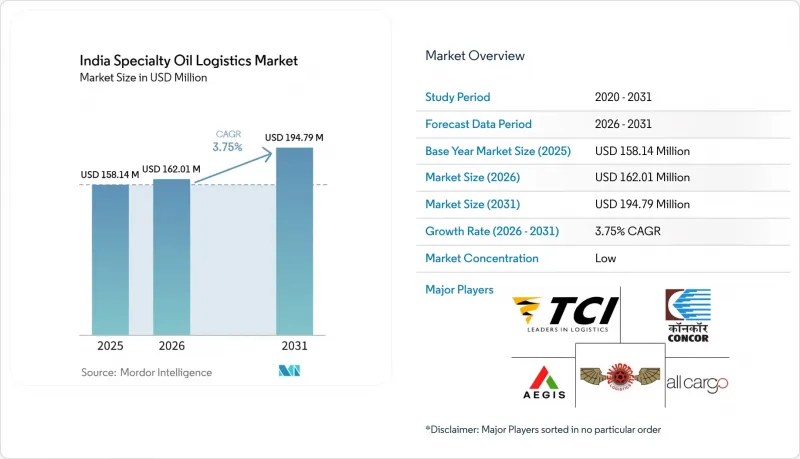
Mordor Intelligence에 의하면, 인도의 특수 오일 물류 시장 규모는 2025년 1억 5,814만 달러로 평가되었고, 2026년에는 1억 6,201만 달러로 확대될 것으로 추정되고, 2031년까지 1억 9,479만 달러에 이를 것으로 예상되며, 2026-2031년 CAGR 3.75%로 성장할 전망입니다.
인도의 특수 오일 물류 시장은 견조한 기초 수요에 힘입어 성장하고 있습니다. 이는 2025년 인도의 윤활유 및 특수 유체 소비량이 전년 대비 9.40% 증가한 483만 톤에 달한 반면, 기유 수입량이 전년 대비 11.00% 증가한 300만 톤을 넘어섰기 때문입니다. 본 보고서는 서비스 유형별(운송, 창고 보관 등), 제품 카테고리별(변압기유·절연유, 화이트 오일·공정유 등), 취급·출하 형태별(벌크 액체, IBC 컨테이너 등), 그리고 최종 이용 산업별(자동차 및 운송, 철강·금속 가공 등)로 분류되어 있습니다. 시장 예측은 금액(달러) 및 수량으로 제시되어 있습니다.
인도 특수 오일 물류 시장 동향 및 인사이트
산업용 윤활유 및 특수 유체 수요가 수량 증가를 뒷받침하고 있습니다.
2025년, 인도의 윤활유 소비량은 전년 대비 9.40% 증가한 483만 톤에 달했으며, 이러한 수량 증가로 인해 인도 특수 유체 물류 시장의 서비스 제공업체가 활용할 수 있는 화물 및 보관 기반이 직접적으로 확대되었습니다. 완성된 윤활유 및 특수 유체의 생산량이 증가하면 OEM, 산업 플랜트, 작업장, 소매 채널로의 출하량도 증가합니다. 또한, 자동차용 윤활유가 전기차 보급으로 인한 압박에 직면하는 반면, 산업용 및 특수 유체의 비중이 높아짐에 따라 제품 구성도 변화하고 있습니다. 이러한 변화가 중요한 이유는 금속 가공유, 변압기유, 식품·의약품 등급 오일에는 더 엄격한 취급 기준, 더 청결한 설비, 그리고 더 철저한 서류 관리가 요구되기 때문입니다. 카스트롤 인디아의 2025년도 매출액은 사상 최고치인 5,722 카롤 루피(6억 3,684만 달러)에 달했으며, 그 유통 네트워크는 15만 곳의 판매 거점을 아우르고 있어, 판매 채널의 확대가 인도 특수 오일 물류 시장 전체에서 지속적인 물류 수요를 견인하고 있음을 여실히 보여주고 있습니다.
기유 수입 의존도가 항구에서 내륙으로 이어지는 회랑에서 지속적인 수요를 창출하고 있습니다.
인도의 특수 오일 물류 시장은 주요 기유, 특히 변압기유 및 절연유에 사용되는 나프텐계 등급 수요를 국내 생산으로 완전히 충당할 수 없기 때문에 수입 주도형 물류에 계속 의존하고 있습니다. 2025년 기유 수입량은 300만 톤을 넘어섰으며, 이에 따라 주요 수입 회랑 전역에서 액체 벌크 화물의 수취, 탱크 저장 및 내륙으로의 출하가 활발히 이루어졌습니다. 한국공급량은 132만 2,161톤이었으나, 말레이시아의 선적량이 급증함에 따라 인도 특수 오일 물류 시장에서 서해안 항구의 중요성이 더욱 높아졌습니다. 이러한 수입 패턴에 따라 두 가지 실용적인 내륙 물류 시스템이 형성되었습니다. 하나는 칸드라를 중심으로 북부 및 서부의 블렌딩 거점으로 도로 탱크로리를 통해 배송하는 시스템이고, 다른 하나는 JNPT 및 나바 셰바를 중심으로 복합 운송 가능성이 더 높은 시스템입니다. 비록 국내에서 새로운 윤활유 생산 능력이 가동되기 시작하더라도, 인도의 특수 오일 물류 시장에서는 새로운 복합 시설, 하류 유통업체 및 산업용 고객 사이에서 새로운 단거리 운송이 계속해서 발생할 것입니다.
수입 베이스 오일과 운임의 변동이 공급망 전체의 이익률에 압박을 가하고 있습니다.
인도의 특수 오일 물류 시장은 밸류체인의 상당 부분이 해상 운송을 통한 베이스 오일 도착에 의존하고 있기 때문에 수입 원료 및 운임 변동의 영향을 지속적으로 받고 있습니다. 수입 비용과 운임이 동시에 상승하면 도착 비용이 급격히 증가하며, 그 압박은 저장, 육상 운송 및 배송 일정에도 파급됩니다. 많은 국내 운송 계약이 일정 기간 고정되어 있어 신속하게 가격 조정을 할 수 없기 때문에 이는 중요한 문제가 됩니다. 2026년에는 걸프 분쟁으로 인한 항로 변경이 자와할랄 네루 항구의 혼잡을 초래하여, 항만·해운·수로부는 액체 벌크 수입업체들과 긴급 회의를 개최할 수밖에 없었습니다. 그 결과, 수입이 집중되는 시기에는 인도의 특수 석유 물류 시장 전체에서 이익률 관리가 엄격해져 계획의 확실성이 떨어지게 되었습니다.
부문 분석
2025년, 인도의 특수 석유 물류 시장에서 운송 부문은 70.72%의 점유율을 차지했으며, 이는 이 부문이 여전히 항만, 공장, 터미널 및 최종 사용자 간의 물리적 이동에 얼마나 크게 의존하고 있는지를 보여줍니다. 인도의 특수 석유 물류 시장은 역사적으로 벌크 운송의 경제성에 의해 형성되어 왔기 때문에 운송은 여전히 대부분의 고객 계약의 기반을 이루고 있습니다. 탱크로리, 간선 운송 계획, 그리고 항구에서 공장으로의 이송이 여전히 물류 비용의 대부분을 차지하고 있습니다. 기유 수입, 내륙에서의 블렌딩, 하류 부문으로의 배송이 시장의 운영 리듬을 계속해서 결정하고 있기 때문에 이러한 추세가 사라질 가능성은 낮을 것으로 보입니다.
그러나 부가가치 서비스는 핵심 운송 부문보다 빠르게 성장하고 있으며, 2031년까지 연평균 성장률(CAGR) 5.24%로 확대될 것으로 예측됩니다. 이는 인도 특수 석유 물류 시장에서 고객의 선호도 변화를 반영한 것으로, 많은 고객에게 단순한 화물 운송만으로는 더 이상 충분하지 않게 되었습니다. 제약, 퍼스널케어 및 특수 산업 분야의 사용자들로부터 단일 워크플로우 내에서의 재고 관리, 재포장, 라벨 재부착, 품질별 분류 및 주문에 따른 키트 구성에 대한 요구가 점점 더 높아지고 있습니다. 창고 보관 및 유통은 수입 수령부터 최종 출하까지를 연결하는 핵심 계층으로서의 역할을 유지하고 있으며, 사업자들은 서비스 범위를 넓히기 위해 이러한 자산을 확충하고 있습니다. Aegis Logistics의 JNPA 터미널 확장은 현재의 처리량을 뒷받침할 뿐만 아니라, 미래 수요를 대비해 액체 저장 시설이 건설되고 있음을 보여줍니다. 그 결과, 인도의 특수 오일 물류 시장은 자산만을 중시하는 모델에서 고객 유지율 향상과 톤당 수익 증가로 이어지는 보다 통합된 서비스 모델로 점차 전환되고 있습니다.
2025년 기준으로 변압기용 오일 및 절연유는 인도 특수 오일 물류 시장 규모의 40.57%를 차지했으며, 다른 제품군을 크게 앞지르며 최대 제품 카테고리로 자리매김했습니다. 이러한 주도적 지위는 인도 전역의 송전망 투자 및 변압기 도입 속도와 밀접한 관련이 있습니다. 『이코노믹 타임즈』의 보도에 따르면, 인도의 송전 부문은 2032년까지 9조 루피 규모의 설비 투자를 받을 전망이며, 이는 해당 제품 부문에 견고한 수요 기반을 마련해 주고 있습니다. 또한 『파워 라인 매거진』은 인도가 2027 회계연도까지 776,330 MVA의 변압기 용량을 증설해야 한다고 지적하고 있으며, 이는 수입 거점, 혼합 거점, 변압기 제조업체 및 프로젝트 현장 간의 절연유 지속적인 이동을 뒷받침하고 있습니다.
화이트 오일 및 공정 오일은 가장 빠르게 성장하는 제품 부문으로, 2026-2031년 연평균 성장률(CAGR) 5.01%를 나타낼 것으로 전망됩니다. 인도의 특수 오일 산업에서 이러한 성장은 의약품 및 퍼스널케어 제품 생산 확대에 힘입고 있습니다. 이러한 분야에서는 표준 벌크 유체 공급망보다 제품의 순도 및 취급상의 엄격성이 더욱 중요시됩니다. APAR Industries는 자사 브랜드 ‘POWEROIL PEARL’을 통해 의약품 및 식품 등급의 화이트 오일을 공급하며 125개국 이상에 수출하고 있는데, 이는 수입 조달의 필요성과 엄격하게 관리되는 출하 체계의 중요성을 여실히 보여줍니다. 또한 마하라슈트라주, 타밀나두주 및 광범위한 자동차 산업 벨트 전역에 걸친 기계 가공 클러스터에서는 금속 가공용 및 공정용 유체도 여전히 중요한 역할을 하고 있습니다. 조사에 따르면, 자동차용 금속 성형 부문은 빠른 속도로 발전하고 있으며, 이는 산업용 오일 및 유체의 안정적인 유통을 뒷받침하고 있습니다. 이러한 추세를 종합해 보면, 인도의 특수 유체 시장은 현재 그리드링크 오일이 주도하고 있는 반면, 향후 성장에 있어서는 고부가가치의 화이트 오일 및 공정 오일의 유통이 점점 더 중요해지고 있음을 알 수 있습니다.
기타 혜택 :
- 엑셀 형식 시장 예측(ME) 시트
- 3개월간의 애널리스트 지원
자주 묻는 질문
목차
제1장 서론
제2장 조사 방법
제3장 주요 요약
제4장 시장 구도
제5장 시장 규모 및 성장 예측
제6장 경쟁 구도
제7장 시장 기회 및 향후 전망
AJY 26.08.11According to Mordor Intelligence, the India specialty oil logistics market size is expected to increase from USD 158.14 million in 2025 to USD 162.01 million in 2026 and reach USD 194.79 million by 2031, growing at a CAGR of 3.75% over 2026-2031.
The India specialty oil logistics market is being supported by steady underlying demand, since India's lubricant and specialty fluid consumption reached 4.83 million tons in 2025, up 9.40% year over year, while base oil imports exceeded 3.00 million tons, up 11.00% from the prior year. This report is Segmented by Service Type (Transportation, Warehousing, and More), by Product Category (Transformer and Insulating Oils, White Oils and Process Oils, and More), by Handling/Shipment Format (Bulk Liquid, Ibcs, and More), and by End-Use Industry (Automotive & Transportation, Steel and Metal Machining, and More). The Market Forecasts are Provided in Value (USD) and Volume.
India Specialty Oil Logistics Market Trends and Insights
Industrial Lubricant and Specialty Fluid Demand Underpins Volume Growth
India's lubricant consumption reached 4.83 million tons in 2025, up 9.40% year over year, and that volume increase directly widened the freight and storage base available to service providers in the India specialty oil logistics market. More finished lubricant and specialty fluid output means more shipments to OEMs, industrial plants, workshops, and retail channels. The product mix is also shifting, as industrial and specialty fluids are gaining weight even as automotive lubricants face pressure from the adoption of electric vehicles. That shift matters because metalworking fluids, transformer oils, and food and pharma grade oils need tighter handling standards, cleaner equipment, and stronger documentation. Castrol India's FY2025 revenue reached a record INR 5,722 crores (USD 636.84 million), and its distribution network covered 150,000 outlets, underscoring how broader channel reach drives recurring logistics demand across India's specialty oil logistics market.
Base-Oil Import Dependence Generates Sustained Port-to-Inland Corridor Demand
The India specialty oil logistics market continues to depend on import-led movement because domestic production does not fully cover demand for key base oils, especially naphthenic grades used in transformer and insulating oils. Base oil imports crossed 3.00 million tons in 2025, which kept liquid bulk reception, tank storage, and inland dispatch active across the main import corridors. South Korea supplied 1,322,161 tons, while Malaysia's shipments rose sharply, which reinforced the importance of west coast ports in the India specialty oil logistics market. This import pattern creates two practical inland systems, one centered on Kandla for road tanker dispatch to northern and western blending hubs, and another centered on JNPT and Nhava Sheva with stronger multimodal potential. Even if new domestic lube capacity comes online, the India specialty oil logistics market will still see fresh short-haul movement between new complexes, downstream distributors, and industrial customers.
Imported Base-Oil and Freight Volatility Creates Margin Pressure Throughout the Chain
The India specialty oil logistics market remains exposed to imported feedstock and freight volatility because so much of the value chain depends on seaborne base oil arrivals. When import costs and freight rates rise together, landed costs move up quickly and the pressure spreads to storage, road movement, and delivery scheduling. This matters because many domestic haulage contracts are fixed for a period and cannot be repriced quickly. In 2026, Gulf conflict rerouting contributed to congestion at Jawaharlal Nehru Port and forced the Ministry of Ports, Shipping, and Waterways to hold an emergency session with liquid bulk importers. The result is tighter margin management and less planning certainty across the India specialty oil logistics market during import-heavy periods.
Other drivers and restraints analyzed in the detailed report include:
- Compliant Storage and Handling Needs Rising for High-Value Specialty Fluids
- Used-Oil EPR Formalizes Reverse Logistics Networks
- Fragmented Tanker Ecosystem Caps Network Standardization
For complete list of drivers and restraints, kindly check the Table Of Contents.
Segment Analysis
Transportation held 70.72% of the India specialty oil logistics market share in 2025, which shows how strongly the sector still depends on physical movement between ports, plants, terminals, and end users. The India specialty oil logistics market has historically been shaped by bulk movement economics, so transportation remains the base layer of most customer contracts. Road tankers, line-haul planning, and port-to-plant transfer still absorb the largest part of logistics spend. That pattern is unlikely to disappear, because base oil imports, inland blending, and downstream delivery continue to define the operating rhythm of the market.
Value-added services, however, are growing faster than the core transport layer and are forecast to expand at a 5.24% CAGR through 2031. This reflects a change in customer preference inside the India specialty oil logistics market, where simple freight execution is no longer enough for many accounts. Pharmaceutical, personal care, and specialty industrial users increasingly request inventory management, repacking, relabeling, quality segregation, and order-specific kitting within a single workflow. Warehousing and distribution remain the middle layer that connects import receipt with final dispatch, and operators are scaling those assets to improve service depth. Aegis Logistics' terminal expansion at JNPA shows that liquid storage is being built ahead of future demand, not just to support current throughput. As a result, the India specialty oil logistics market is gradually shifting from an asset-only model toward a more integrated service model with better customer retention and higher revenue per ton.
Transformer and insulating oils accounted for 40.57% of the India specialty oil logistics market size in 2025, making them the largest product category by a wide margin. This leadership is closely tied to the pace of grid investment and transformer deployment across India. The Economic Times reported that India's power transmission sector is set to receive INR 9.00 trillion in capex through 2032, giving this product segment a strong demand base. Power Line Magazine also noted that India must add 776,330 MVA of transformer capacity by FY2027, which supports continued movement of insulating oils between import points, blending locations, transformer manufacturers, and project sites.
White oils and process oils are the fastest-growing product segment, with a 5.01% CAGR projected for 2026-2031. In the India specialty oil industry, this growth is being supported by rising pharmaceutical and personal care manufacturing, where product purity and handling discipline matter more than in standard bulk fluid chains. APAR Industries supplies pharmaceutical- and food-grade white oils under its POWEROIL PEARL brand and exports to more than 125 countries, underscoring the need for inbound sourcing and tightly managed outbound dispatch. Metalworking and process fluids also remain important in machining clusters across Maharashtra, Tamil Nadu, and the broader automotive belt. According to research, the automotive metal forming sector is advancing in a fast pace, which supports stable movement of industrial oils and fluids. Taken together, these patterns show that the India specialty oil logistics market is led by grid-linked oils today, while higher-value white oil and process oil flows are becoming more important to future growth.
Complete Report Scope:
- By Service Type
- Transportation
- Road
- Full-Truck-Load (FTL)
- Less than-Truck-Load (LTL)
- Rail
- Multimodal Transport
- Road
- Warehousing and Distribution
- Value-added Services (Inventory management, Repacking, Relabeling, and Kitting etc.)
- Transportation
- By Product Category
- Transformer and insulating oils
- White oils and process oils
- Metalworking and process fluids
- Other Product Categories
- By Handling / Shipment Format
- Bulk liquid
- Intermediate Bulk Containers (IBCs)
- Drums
- Small Retail and Commercial (Bottles and Jerry Cans, Stand-up Pouches, Pails, Kegs, etc.)
- By End-use Industry
- Automotive and Transportation
- Heavy Equipment, Mining and Construction
- Steel and Metal Machining
- Energy/Power Generation
- Rubber and Tire Manufacturing
- Personal Care and Pharmaceuticals
- Food and Beverage Processing
- Aerospace and Defense
- Other End-user Industries
List of Companies Covered in this Report:
- 20Cube Logistics Pte. Ltd.
- Aegis Logistics Ltd.
- Allcargo Logistics Limited
- CJ Darcl Logistics Limited
- DHL Group
- DSV A/S
- Express Roadways Private Limited
- K D Supply Chain Solutions Pvt. Ltd.
- Kuehne+Nagel
- Mahindra Logistics, Ltd.
- MTI Logistics
- Nippon Express Holdings
- Om Logistics Limited
- Safexpress Private Limited
- Siddhartha Logistics Co. Pvt. Ltd.
- Toll Holdings Limited
- Transport Corporation of India Limited
- V Power Logistics
- Varuna Group
- VRL Logistics Limited
Additional Benefits:
- The market estimate (ME) sheet in Excel format
- 3 months of analyst support
TABLE OF CONTENTS
1 Introduction
- 1.1 Study Assumptions and Market Definition
- 1.2 Scope of the Study
2 Research Methodology
3 Executive Summary
4 Market Landscape
- 4.1 Market Overview
- 4.2 Market Drivers
- 4.2.1 Industrial Lubricant and Specialty Fluid Demand Expansion
- 4.2.2 Base-Oil Import Dependence Sustaining Port-to-Inland Bulk Movements
- 4.2.3 Compliant Storage and Handling Needs Rising for High-Value Specialty Fluids
- 4.2.4 Used-Oil EPR Formalizing Reverse Logistics Networks
- 4.2.5 DFC-Led Multimodal Corridors Improving Inland Liquid Movement Economics
- 4.2.6 Expansion of OEM-Approved and Premium Branded Lubricant Distribution Networks
- 4.3 Market Restraints
- 4.3.1 Imported Base-Oil and Freight Volatility Pressuring Logistics Costs
- 4.3.2 Fragmented Tanker Ecosystem Limiting Network Standardization
- 4.3.3 Hazardous-Waste Compliance Burden Slowing Informal Channel Conversion
- 4.3.4 Port and Terminal Congestion During Import Surges
- 4.4 Value / Supply-Chain Analysis
- 4.5 Regulatory Landscape
- 4.6 Technological Outlook
- 4.7 Porter's Five Forces Analysis
- 4.7.1 Threat of new entrants
- 4.7.2 Bargaining power of suppliers
- 4.7.3 Bargaining power of buyers
- 4.7.4 Threat of substitutes
- 4.7.5 Competitive rivalry
- 4.8 Impact of Geopolitical Events on the Market
5 Market Size and Growth Forecasts (Value and Volume)
- 5.1 By Service Type
- 5.1.1 Transportation
- 5.1.1.1 Road
- 5.1.1.1.1 Full-Truck-Load (FTL)
- 5.1.1.1.2 Less than-Truck-Load (LTL)
- 5.1.1.2 Rail
- 5.1.1.3 Multimodal Transport
- 5.1.1.1 Road
- 5.1.2 Warehousing and Distribution
- 5.1.3 Value-added Services (Inventory management, Repacking, Relabeling, and Kitting etc.)
- 5.1.1 Transportation
- 5.2 By Product Category
- 5.2.1 Transformer and insulating oils
- 5.2.2 White oils and process oils
- 5.2.3 Metalworking and process fluids
- 5.2.4 Other Product Categories
- 5.3 By Handling / Shipment Format
- 5.3.1 Bulk liquid
- 5.3.2 Intermediate Bulk Containers (IBCs)
- 5.3.3 Drums
- 5.3.4 Small Retail and Commercial (Bottles and Jerry Cans, Stand-up Pouches, Pails, Kegs, etc.)
- 5.4 By End-use Industry
- 5.4.1 Automotive and Transportation
- 5.4.2 Heavy Equipment, Mining and Construction
- 5.4.3 Steel and Metal Machining
- 5.4.4 Energy/Power Generation
- 5.4.5 Rubber and Tire Manufacturing
- 5.4.6 Personal Care and Pharmaceuticals
- 5.4.7 Food and Beverage Processing
- 5.4.8 Aerospace and Defense
- 5.4.9 Other End-user Industries
6 Competitive Landscape
- 6.1 Market Concentration
- 6.2 Strategic Moves
- 6.3 Market Share Analysis
- 6.4 Company Profiles (Includes Global Level Overview, Market Level Overview, Core Segments, Financials as Available, Strategic Information, Market Rank/Share for Key Companies, Products and Services, and Recent Developments)
- 6.4.1 20Cube Logistics Pte. Ltd.
- 6.4.2 Aegis Logistics Ltd.
- 6.4.3 Allcargo Logistics Limited
- 6.4.4 CJ Darcl Logistics Limited
- 6.4.5 DHL Group
- 6.4.6 DSV A/S
- 6.4.7 Express Roadways Private Limited
- 6.4.8 K D Supply Chain Solutions Pvt. Ltd.
- 6.4.9 Kuehne+Nagel
- 6.4.10 Mahindra Logistics, Ltd.
- 6.4.11 MTI Logistics
- 6.4.12 Nippon Express Holdings
- 6.4.13 Om Logistics Limited
- 6.4.14 Safexpress Private Limited
- 6.4.15 Siddhartha Logistics Co. Pvt. Ltd.
- 6.4.16 Toll Holdings Limited
- 6.4.17 Transport Corporation of India Limited
- 6.4.18 V Power Logistics
- 6.4.19 Varuna Group
- 6.4.20 VRL Logistics Limited
7 Market Opportunities and Future Outlook
- 7.1 White-space and unmet-need assessment


