
|
시장보고서
상품코드
2099889
OTT 어린이 컨텐츠 시장 : 시장 점유율 분석, 업계 동향 및 통계, 성장 예측(2026-2031년)OTT Kids Content - Market Share Analysis, Industry Trends & Statistics, Growth Forecasts (2026 - 2031) |
||||||
 Mordor Intelligence
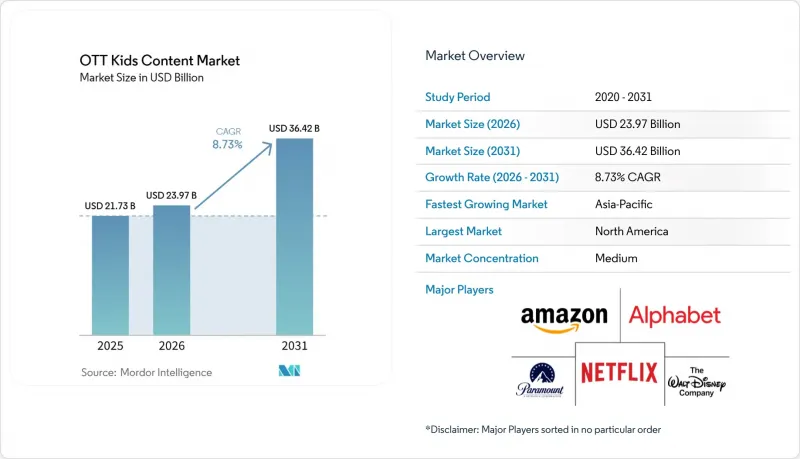
Mordor Intelligence에 의하면, OTT 어린이 컨텐츠 시장 규모는 2025년 217억 3,000만 달러로 평가되었고, 2026년 239억 7,000만 달러에서 2031년까지 364억 2,000만 달러로 확대될 것으로 예측되며, 2026-2031년 연평균 복합 성장률(CAGR)은 8.73%를 나타낼 전망입니다.
본 보고서는 수익화 모델별(SVOD, AVOD, TVOD, 하이브리드, 프리미엄), 장르별(애니메이션 및 만화, 교육 및 학습, 인터랙티브 및 게이미피케이션 컨텐츠 등), 기기 유형별(스마트폰 및 태블릿, 스마트 TV, 노트북 및 데스크톱 PC 등), 그리고 지역별(북미, 남미, 유럽, 아시아태평양 등)로 분류되어 있습니다. 시장 전망은 금액(달러) 기준으로 제시되어 있습니다.
세계의 OTT 어린이 컨텐츠 시장 동향 및 인사이트
안전하고 엄선된 어린이용 스트리밍에 대한 보호자 수요 증가
디지털 안전에 대한 보호자의 우려는 OTT 어린이 컨텐츠 시장에서 가장 뚜렷한 수요 신호 중 하나입니다. 2026년 Lingokids가 실시한 조사에 따르면, 조사 대상인 미국 보호자의 98%가 어린 자녀에게 매일 스크린 타임을 허용하고 있는 반면, 87.7%는 컨텐츠의 안전성을 가장 큰 우려 사항으로 꼽았으며, 84.6%는 어느 정도 ‘스크린 타임에 대한 죄책감’을 느끼고 있는 것으로 나타났습니다. 이러한 추세에 따라 각 가정은 컨텐츠 선정, 프로파일 관리, 시청 환경이 더 예측하기 쉽다고 느껴지는 서비스로 눈을 돌리고 있습니다. 따라서 OTT 어린이 컨텐츠 시장에서는 신뢰성을 인터페이스 깊숙한 곳에 숨겨진 추가 설정이 아닌, 제품의 일부로 제시하는 플랫폼이 높이 평가받고 있습니다. 전용 어린이 서비스나 신중하게 관리되는 키즈 존은 보호자가 그러한 환경에서의 반복 시청을 더 기꺼이 허용하게 하므로, 사용자 유지 기반이 더욱 견고합니다. 이로 인해, 특히 보호자가 폐쇄형 라이브러리와 개방형 동영상 플랫폼을 비교할 때, 안전성과 컨텐츠의 엄선 여부가 직접적인 상업적 우위로 작용합니다.
전체 가구에서 교육용 스트리밍 이용 증가
부모들이 오락을 완전히 대체하지 않으면서도 학습을 지원하는 미디어를 찾음에 따라, 교육 컨텐츠 시청은 OTT 어린이 컨텐츠 시장에서 더 큰 역할을 담당하게 되었습니다. Lingokids는 2026년 보고서에서 조사 대상 부모의 64.8%가 컨텐츠 우선순위 상위 3개 항목에 교육이나 기술 향상을 꼽았다고 밝혔습니다. 이러한 추세는 어린이용 컨텐츠 라이브러리의 설계 방식을 변화시키고 있습니다. 왜냐하면 부모들은 이제 노래, 이야기, 게임, 캐릭터 주도형 활동이 학습 목적을 달성해 주기를 기대하고 있기 때문입니다. 아이들이 자발적으로 컨텐츠에 참여하고 적극적으로 활동에 임하게 되면서, 교육용 앱과 오락용 앱의 경계는 모호해지고 있습니다. OTT 어린이 컨텐츠 시장에서는 친근한 캐릭터를 활용해 읽기·쓰기 능력, 언어 능력, 사회성 발달을 촉진하는 컨텐츠를 제공하는 보다 융합적인 형식이 부상하고 있습니다. 이러한 변화로 인해 수동적인 에피소드 시청에만 의존하는 것이 아니라, 교육 과정으로서의 가치와 반복해서 즐길 수 있는 놀이 패턴을 결합할 수 있는 플랫폼이 지지를 얻고 있습니다.
어린이용 오리지널 컨텐츠의 높은 제작 및 현지화 비용
제작 비용에 대한 압박은 OTT 어린이 컨텐츠 시장의 확장을 가로막는 가장 중요한 제약 요소 중 하나입니다. 고품질 애니메이션, 특히 전 세계 배급을 목표로 하는 시리즈 작품은 수익이 실현되기까지 막대한 예산, 긴 개발 주기, 그리고 지속적인 창작 투자가 필요합니다. 플랫폼이 프로그램을 다국어로 현지화할 경우, 더빙, 대본 수정, 문화적 적응 등이 모두 비용 증가로 이어지기 때문에 비용 압박은 더욱 커집니다. 따라서 OTT용 어린이 컨텐츠 시장에서는 이러한 비용을 상품화, 라이선싱 및 여러 배포 창구에 분산할 수 있는 기업이 더 유리합니다. 소규모 제작사나 특정 지역에 특화된 전문 기업은 오리지널 컨텐츠를 강화해야 하는 한편, 세계 진출 비용을 감당할 만한 규모를 갖추지 못해 더 험난한 길을 걷게 될 것입니다. 이러한 비용 격차로 인해 아동용 지적재산권을 보유한 대기업의 입지는 더욱 공고해질 것입니다.
부문 분석
2025년, SVOD는 부문 매출의 46.17%를 차지했으며, OTT 어린이 컨텐츠 시장에서 가장 큰 점유율을 기록했습니다. 이러한 선두 위상은 광고 없는 시청 환경, 안정적인 컨텐츠 큐레이션, 그리고 어린이를 위한 예측 가능한 시청 규칙에 대한 가정의 선호도를 반영하고 있습니다. 많은 가정에서 구독료 지불은 부적절한 광고 노출 감소, 컨텐츠 탐색에 따른 위험 경감, 그리고 더욱 강력한 자녀 보호 기능과의 상충 관계로 인식되고 있습니다. 이로 인해 소비자들이 오락비를 더욱 엄격하게 재검토하는 상황에서도 구독층은 견고한 기반을 유지하고 있습니다. 또한, OTT 어린이 컨텐츠 업계에서 SVOD의 점유율은 아이들이 익숙한 컨텐츠를 반복해서 시청하는 경향이라는 사실로부터도 혜택을 받고 있으며, 이는 성인의 일회성 시청보다 고객 유지율 향상에 기여하고 있습니다.
프리미엄은 가장 빠르게 성장하는 수익화 부문이며, 이 부문 내 OTT 어린이 컨텐츠 시장 규모는 2031년까지 연평균 성장률(CAGR) 9.57%로 확대될 것으로 예측됩니다. 이 모델의 매력은 기존의 광고 주도형 동영상과 달리, 무료 접근을 통해 도달 범위를 확대한 후, 유료 가구를 대상으로 풍부한 라이브러리, 추가 기능 또는 광고 없는 시청 경험을 제공한다는 점에 있습니다. 이러한 접근 방식은 가격에 민감한 국가에서 효과적입니다. 이러한 국가에서는 가족들이 처음부터 월정액 구독에 가입하는 것을 주저하는 경향이 있습니다. OTT 어린이 컨텐츠 시장에서 프리미엄 모델은 특히 플랫폼이 이미 캐릭터 인지도를 확립한 경우, 컨텐츠 발견과 유료 전환을 연결하는 가교 역할도 합니다. 기업이 컨텐츠 발견을 외부 플랫폼에 전적으로 맡기는 대신, 개방적인 접근과 세심한 큐레이션을 결합할 수 있다면 이 모델의 효과는 더욱 높아질 것입니다.
지역별 분석
2025년, 북미는 OTT 어린이 컨텐츠 시장 점유율의 38.69%를 차지했으며, 지역별로는 가장 큰 기여를 한 지역이 되었습니다. 이 지역은 유료 스트리밍에 대한 가구의 깊은 친숙도, 폭넓은 프랜차이즈 인지도, 그리고 가족 내 구독 서비스 병행에 대한 높은 수용성이라는 장점을 가지고 있습니다. 또한, 전 세계 플랫폼 사업자의 견고한 기반, 확립된 어린이용 브랜드, 그리고 성숙한 디지털 결제 행동도 갖추고 있습니다. 이러한 조건들이 프리미엄 가격 책정을 뒷받침하며, 보다 광범위한 스트리밍 번들에서 어린이 프로그램을 중요한 고객 유지 도구로 삼고 있습니다. 따라서 북미 OTT 어린이 컨텐츠 시장은 단순한 신규 가구 확보보다는 참여도의 깊이와 컨텐츠의 질에 의해 주도되고 있습니다.
유럽은 공영 방송의 오랜 전통과 현지에서 신뢰받는 어린이용 컨텐츠에 힘입어, OTT 어린이용 컨텐츠 시장에서 여전히 2위 지역 부문을 유지하고 있습니다. 이 지역은 확립된 세계 플랫폼과 각국 고유의 시청 습관, 그리고 현지 언어로 제공되기를 바라는 더 강한 기대가 결합되어 있다는 점에서 북미와 다릅니다. 따라서 어린이 프로그램에서는 더빙, 문화적 적합성, 공공 서비스의 신뢰성이 중요시되고 있습니다. WildBrain은 2025년 7월, 세서미 워크숍(Sesame Workshop)의 대리 업무를 북유럽 시장으로 확대하며, 전문적인 어린이용 지적 재산권이 해당 지역에서 계속해서 투자를 유치하고 있음을 보여주었습니다.
아시아태평양은 가장 빠르게 성장하는 지역이며, 이 지역의 OTT용 어린이 컨텐츠 시장 규모는 2031년까지 연평균 성장률(CAGR) 10.56%로 확대될 것으로 예측됩니다. 이러한 성장을 주도하는 요인은 방대한 디지털 사용자 수, 스트리밍의 보급 확대, 그리고 동일한 국내 시장 내에서 여러 주요 언어로 된 컨텐츠에 대한 수요입니다. OTT용 어린이 컨텐츠 시장은 특히 인도에서 호황을 누리고 있으며, 시장 규모, 가격 민감도, 언어의 다양성으로 인해 각 플랫폼 기업들은 유연한 컨텐츠 및 제품 전략을 추진하고 있습니다. JioStar는 2026년 2월, JioHotstar를 위한 대화형 스트리밍 인터페이스를 출시했습니다. 이는 해당 지역의 사업자들이 제품 혁신을 활용하여 방대한 라이브러리 전반에 걸쳐 컨텐츠 발견성을 높이고 있음을 보여줍니다. 또한, 아시아태평양은 어린이용 지적 재산권의 강력한 수출 잠재력으로부터도 혜택을 받고 있으며, 특히 스튜디오가 지역 및 전 세계 시청자들에게 널리 수용되는 포맷을 구축하고 있는 분야에서 이러한 경향이 두드러집니다.
기타 혜택 :
- 엑셀 형식 시장 예측(ME) 시트
- 3개월간의 애널리스트 지원
자주 묻는 질문
목차
제1장 서론
제2장 조사 방법
제3장 주요 요약
제4장 시장 구도
제5장 시장 규모 및 성장 예측
제6장 경쟁 구도
제7장 시장 기회 및 향후 전망
AJY 26.08.07According to Mordor Intelligence, the OTT kids content market size is projected to expand from USD 21.73 billion in 2025 and USD 23.97 billion in 2026 to USD 36.42 billion by 2031, registering a CAGR of 8.73% between 2026 and 2031.
This report is Segmented by Monetization Model (SVOD, AVOD, TVOD, Hybrid, and Freemium), Genre (Animation and Cartoons, Educational and Learning, Interactive and Gamified Content, and More), Device Type (Smartphones and Tablets, Smart TVs, Laptops and Desktops, and More), and Geography (North America, South America, Europe, Asia-Pacific, and More). The Market Forecasts are Provided in Terms of Value (USD).
Global OTT Kids Content Market Trends and Insights
Rising Parental Demand for Safe, Curated Kids Streaming
Parental concern around digital safety has become one of the clearest demand signals in the OTT kids content market. A 2026 Lingokids survey found that 98% of U.S. parents surveyed allowed daily screen time for young children, while 87.7% ranked content safety as their top concern, and 84.6% reported some degree of screen time guilt. That pattern is pushing households toward services where content selection, profile controls, and viewing environments feel more predictable. The OTT kids content market is, therefore, rewarding platforms that present trust as part of the product, not as an extra setting hidden in the interface. Dedicated children's services and carefully managed kids zones have a stronger basis for retention because parents are more willing to permit repeat viewing in those environments. This makes safety and curation a direct commercial advantage, especially when parents compare closed libraries with open video platforms.
Rising Educational Streaming Consumption Across Households
Educational viewing is taking a larger role in the OTT kids content market as parents look for media that supports learning without fully replacing entertainment. Lingokids reported in 2026 that 64.8% of surveyed parents placed educational or skill-building value among their top 3 content priorities. That preference is changing how children's libraries are designed because parents now expect songs, stories, games, and character-led activities to serve a learning purpose. The line between educational and entertainment apps is becoming less rigid when children engage with content independently and complete activities willingly. The OTT kids' content market is responding with more blended formats that use familiar characters to deliver literacy, language, and social development content. This shift supports platforms that can combine curriculum value with repeatable play patterns rather than relying only on passive episode viewing.
High Content Production and Localization Costs for Kids Originals
Production cost pressure is one of the most important limits on expansion in the OTT kids content market. Premium animation, especially series built for global release, requires large budgets, long development cycles, and steady creative investment before returns are visible. Cost pressure rises further when platforms localize shows into many languages because dubbing, scripting changes, and cultural adaptation all add expense. The OTT kids content market is, therefore, easier for companies that can spread those costs across merchandise, licensing, and multiple distribution windows. Smaller producers and regional specialists face a harder path when they need depth of original content but lack the scale to absorb the costs of global rollout. This cost divide is likely to strengthen the position of large owners of children's intellectual property.
Other drivers and restraints analyzed in the detailed report include:
- Accelerating Connected TV and Tablet Penetration in Family Homes
- Platform Differentiation Through Franchised Kids IP and Exclusive Originals
- Tightened Child Safety, Privacy, and Advertising Compliance
For complete list of drivers and restraints, kindly check the Table Of Contents.
Segment Analysis
SVOD captured 46.17% of segment revenue in 2025, giving it the largest position in the OTT kids content market. That lead reflects a household preference for ad-free access, stable curation, and predictable viewing rules for children. In many families, subscription payments are seen as a trade-off for lower exposure to unsuitable ads, reduced discovery risk, and stronger parental controls. This gives the subscription tier a strong foundation even when consumers review entertainment spending more closely. The SVOD portion of the OTT kids content industry also benefits from the fact that children often rewatch familiar content, which supports retention better than one-time adult viewing.
Freemium is the fastest-growing monetization segment, with the OTT kids content market size for this segment projected to expand at a 9.57% CAGR through 2031. Its appeal is different from classic advertising-led video because the model uses free access to build reach, then reserves deeper libraries, extra features, or ad-free experiences for paying households. That approach is useful in price-sensitive countries where families may hesitate to commit to a full monthly subscription at the outset. In the OTT kids content market, freemium also works as a bridge between discovery and paid conversion, especially when a platform already has strong character recognition. The model becomes more effective when companies can combine open access with careful curation rather than leaving discovery entirely to external platforms.
Complete Report Scope:
- By Monetization Model
- SVOD
- AVOD
- TVOD
- Hybrid
- Freemium
- By Genre
- Animation and Cartoons
- Educational and Learning
- Interactive and Gamified Content
- Other Genres
- By Device Type
- Smartphones and Tablets
- Smart TVs
- Laptops and Desktops
- Other Device Types
- By Geography
- North America
- United States
- Canada
- Mexico
- South America
- Brazil
- Argentina
- Chile
- Rest of South America
- Europe
- Germany
- United Kingdom
- France
- Italy
- Spain
- Rest of Europe
- Asia-Pacific
- China
- Japan
- India
- South Korea
- Australia
- Rest of Asia-Pacific
- Middle East
- Saudi Arabia
- United Arab Emirates
- Qatar
- Rest of Middle East
- Africa
- South Africa
- Egypt
- Nigeria
- Rest of Africa
- North America
Geography Analysis
North America held 38.69% of the OTT kids content market share in 2025, making it the largest regional contributor. The region benefits from deep household familiarity with paid streaming, broad franchise awareness, and high acceptance of subscription stacking within families. It also has a strong base of global platform operators, established children's brands, and mature digital payment behavior. These conditions support premium pricing and make children's programming a meaningful retention tool within broader streaming bundles. The OTT kids content market in North America is therefore driven more by engagement depth and content quality than by first-time household acquisition alone.
Europe remained the second-largest regional segment in the OTT kids content market, supported by a long tradition of public broadcasting and locally trusted children's content. The region differs from North America because it combines established global platforms with country-specific viewing habits and stronger local language expectations. That raises the importance of dubbing, cultural fit, and public service credibility in children's programming. WildBrain expanded its Sesame Workshop representation into the Nordic markets in July 2025, showing that specialist children's intellectual property continues to attract investment in the region.
Asia-Pacific is the fastest-growing region, with the OTT kids content market size in the region projected to rise at a 10.56% CAGR through 2031. Growth is being led by large digital populations, rising streaming acceptance, and the need for content in several major languages within the same national markets. The OTT kids content market is especially dynamic in India, where scale, price sensitivity, and language diversity push platforms toward flexible content and product strategies. JioStar launched a conversational streaming interface for JioHotstar in February 2026, showing how operators in the region are using product innovation to improve content discovery across large libraries. Asia-Pacific also benefits from strong export potential in children's intellectual property, especially where studios build formats that can travel across regional and global audiences.
- The Walt Disney Company
- Netflix, Inc.
- Alphabet Inc.
- Amazon.com, Inc.
- Paramount Skydance Corporation
- Warner Bros. Discovery, Inc.
- Apple Inc.
- British Broadcasting Corporation
- Comcast Corporation
- JioStar India Private Limited
- WildBrain Ltd.
- Moonbug Entertainment Ltd.
- Sandbox Group
- A Parent Media Co. Inc.
- Da Vinci Media GmbH
- Sesame Workshop
- Toon Goggles, Inc.
- Public Broadcasting Service
- Kartoon Studios, Inc.
- Fox Corporation
Additional Benefits:
- The market estimate (ME) sheet in Excel format
- 3 months of analyst support
TABLE OF CONTENTS
1 INTRODUCTION
- 1.1 Study Assumptions and Market Definition
- 1.2 Scope of the Study
2 RESEARCH METHODOLOGY
3 EXECUTIVE SUMMARY
4 MARKET LANDSCAPE
- 4.1 Market Overview
- 4.2 Market Drivers
- 4.2.1 Rising Parental Demand for Safe, Curated Kids Streaming
- 4.2.2 Rising Educational Streaming Consumption Across Households
- 4.2.3 Accelerating Connected TV and Tablet Penetration in Family Homes
- 4.2.4 Platform Differentiation Through Franchised Kids IP and Exclusive Originals
- 4.2.5 Growth of Ad-Supported and Freemium Kids Monetization Models
- 4.2.6 Expansion of Localization and Regional Language Kids Libraries
- 4.3 Market Restraints
- 4.3.1 High Content Production and Localization Costs for Kids Originals
- 4.3.2 Tightened Child Safety, Privacy, and Advertising Compliance
- 4.3.3 Discoverability Friction in Fragmented Streaming Environments
- 4.3.4 Revenue Leakage From Platform Substitution and Free-Content Competition
- 4.4 Industry Value Chain Analysis
- 4.5 Regulatory Landscape
- 4.6 Technological Outlook
- 4.7 Impact of Macroeconomic Factors on the Market
- 4.8 Porter's Five Forces Analysis
- 4.8.1 Bargaining Power of Buyers
- 4.8.2 Bargaining Power of Suppliers
- 4.8.3 Threat of New Entrants
- 4.8.4 Threat of Substitutes
- 4.8.5 Intensity of Competitive Rivalry
5 MARKET SIZE AND GROWTH FORECASTS (VALUE)
- 5.1 By Monetization Model
- 5.1.1 SVOD
- 5.1.2 AVOD
- 5.1.3 TVOD
- 5.1.4 Hybrid
- 5.1.5 Freemium
- 5.2 By Genre
- 5.2.1 Animation and Cartoons
- 5.2.2 Educational and Learning
- 5.2.3 Interactive and Gamified Content
- 5.2.4 Other Genres
- 5.3 By Device Type
- 5.3.1 Smartphones and Tablets
- 5.3.2 Smart TVs
- 5.3.3 Laptops and Desktops
- 5.3.4 Other Device Types
- 5.4 By Geography
- 5.4.1 North America
- 5.4.1.1 United States
- 5.4.1.2 Canada
- 5.4.1.3 Mexico
- 5.4.2 South America
- 5.4.2.1 Brazil
- 5.4.2.2 Argentina
- 5.4.2.3 Chile
- 5.4.2.4 Rest of South America
- 5.4.3 Europe
- 5.4.3.1 Germany
- 5.4.3.2 United Kingdom
- 5.4.3.3 France
- 5.4.3.4 Italy
- 5.4.3.5 Spain
- 5.4.3.6 Rest of Europe
- 5.4.4 Asia-Pacific
- 5.4.4.1 China
- 5.4.4.2 Japan
- 5.4.4.3 India
- 5.4.4.4 South Korea
- 5.4.4.5 Australia
- 5.4.4.6 Rest of Asia-Pacific
- 5.4.5 Middle East
- 5.4.5.1 Saudi Arabia
- 5.4.5.2 United Arab Emirates
- 5.4.5.3 Qatar
- 5.4.5.4 Rest of Middle East
- 5.4.6 Africa
- 5.4.6.1 South Africa
- 5.4.6.2 Egypt
- 5.4.6.3 Nigeria
- 5.4.6.4 Rest of Africa
- 5.4.1 North America
6 COMPETITIVE LANDSCAPE
- 6.1 Market Concentration
- 6.2 Strategic Moves
- 6.3 Vendor Positioning Analysis
- 6.4 Company Profiles (includes Global Level Overview, Market Level Overview, Core Segments, Financials as available, Strategic Information, Market Rank/Share, Products and Services, Recent Developments)
- 6.4.1 The Walt Disney Company
- 6.4.2 Netflix, Inc.
- 6.4.3 Alphabet Inc.
- 6.4.4 Amazon.com, Inc.
- 6.4.5 Paramount Skydance Corporation
- 6.4.6 Warner Bros. Discovery, Inc.
- 6.4.7 Apple Inc.
- 6.4.8 British Broadcasting Corporation
- 6.4.9 Comcast Corporation
- 6.4.10 JioStar India Private Limited
- 6.4.11 WildBrain Ltd.
- 6.4.12 Moonbug Entertainment Ltd.
- 6.4.13 Sandbox Group
- 6.4.14 A Parent Media Co. Inc.
- 6.4.15 Da Vinci Media GmbH
- 6.4.16 Sesame Workshop
- 6.4.17 Toon Goggles, Inc.
- 6.4.18 Public Broadcasting Service
- 6.4.19 Kartoon Studios, Inc.
- 6.4.20 Fox Corporation
7 MARKET OPPORTUNITIES AND FUTURE OUTLOOK
- 7.1 White-Space and Unmet-Need Assessment