

|
시장보고서
상품코드
2099955
AI 기반 의료기기 소프트웨어(SaMD) 시장 : 시장 점유율 분석, 업계 동향 및 통계, 성장 예측(2026-2031년)AI-Enabled Software As A Medical Device (SaMD) - Market Share Analysis, Industry Trends & Statistics, Growth Forecasts (2026 - 2031) |
||||||
 Mordor Intelligence
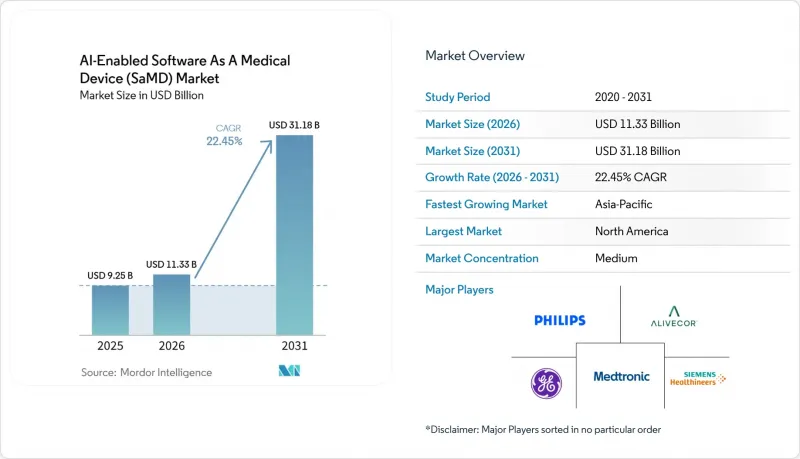
AI 기반 의료기기 소프트웨어(SaMD) 시장 규모는 2025년 92억 5,000만 달러로 평가되었고, 2026년에는 113억 3,000만 달러로 확대될 것으로 추정되고, 2026-2031년 CAGR 22.45%로 성장을 지속할 전망이며, 2031년에는 311억 8,000만 달러에 이를 것으로 예측됩니다.
본 보고서는 소프트웨어 유형별(진단, 치료, 모니터링, CDS, 워크플로우), 임상 전문 분야별(방사선과, 순환기내과, 신경과, 기타), 최종 사용자별(병원, 외래 진료, 진단실험실, 재택치료, 전문 클리닉), 도입 형태별(클라우드, 온프레미스, 엣지 지원/하이브리드), 지역별(북미, 유럽, 아시아태평양, 기타)로 분류되어 있습니다. 시장 예측은 금액(달러)으로 표시되어 있습니다.
세계의 AI 기반 의료기기 소프트웨어(SaMD) 시장 동향 및 인사이트
AI 기반 의료기기 소프트웨어(SaMD)에 대한 FDA 및 세계 각국의 규제 명확화 진전
규제 명확화는 AI 기반 의료기기 소프트웨어(SaMD) 시장의 상용화를 오랫동안 형성해 온 요소이며, 2025-2026년 뚜렷한 개선이 나타났습니다. 2025년 1월 FDA가 발표한 지침 초안에서는 3가지 주요 시장 진입 경로 모두에서 고정 알고리즘 및 지속 학습 알고리즘에 대한 신청 요건이 명확해졌습니다. 2026년 2월 품질 관리 시스템 규정의 업데이트를 통해 FDA의 요건은 ISO 13485:2016과 더욱 밀접하게 부합하게 되었습니다. 또한, 2024년 12월에 최종 확정된 FDA의 PCCP 프레임워크를 통해 향후 알고리즘 변경에 대한 사전 승인이 가능해졌습니다. 유럽에서는 MDCG 2025-6을 통해 AI법(AI Act)의 의무 사항이 MDR 및 IVDR의 품질 시스템과 어떻게 연관되는지가 명확해졌으며, 이는 기업이 통합된 규정 준수 문서를 준비하는 데 도움이 되고 있습니다.
진단 워크플로우 자동화에 대한 병원 수요
의료 기관 수요는 AI를 활용한 의료기기용 소프트웨어(SaMD) 시장의 주요 원동력으로 계속 작용해 왔습니다. 이는 의료 기관이 전문의 인력이 비례하여 증가하지 않는 상황에서 영상 진단 및 진단 업무의 부담 증가에 직면했기 때문입니다. 특히 방사선과나 기타 데이터 처리량이 많은 전문 분야에서는 사례 수가 전문가의 대응 능력을 초과하는 속도로 증가하고 있어 인력 부족이 두드러졌습니다. Aidoc이 약 2,000개 병원에 도입되었고, 2026년 4월에 1억 5,000만 달러 규모의 시리즈 E 자금 조달을 완료한 것은 개별 단일 질환용 도구보다 광범위한 진단 지원 플랫폼에 대한 병원 측의 관심이 높아지고 있음을 보여줍니다. 이러한 수요는 영상 진단 시스템 및 워크플로우 인프라에 AI를 통합하는 움직임도 촉진했습니다.
다양한 환자 집단에서의 임상 검증 부담
규제 당국과 의료 제공업체가 하위 집단별 성능 및 데이터 출처를 더욱 중시하게 됨에 따라, 다양한 집단을 대상으로 한 임상 검증은 AI 기반 의료기기 소프트웨어(SaMD) 시장의 주요 제약 요인으로 남아 있습니다. FDA가 2025년 1월에 발표한 지침 초안에서는 향후 신청 시 하위 집단에 걸친 인구통계학적 포괄성 및 알고리즘의 동작에 대해 더욱 엄격한 심사가 이루어질 것임이 명확히 제시되었습니다. 이로 인해 개발자의 부담이 증가하고 있습니다. 연구에서는 연령, 인종, 질병 부담, 기기 설치 환경이 서로 다른 환자 그룹 전체에 걸쳐 신뢰할 수 있는 성능을 입증해야 하기 때문입니다. 다중 적응증 제품의 경우, 이로 인해 증거 구축 기간이 12-18개월 연장되고, 본격적인 상용화까지 필요한 자본이 증가할 가능성이 있습니다. Qure.AI의 광범위한 도입 실적은 강력한 검증 전략의 가치를 입증하는 한편, 소규모 벤더가 이 모델을 대규모로 재현하기 어렵다는 점도 부각시키고 있습니다.
부문 분석
2025년, 진단용 SaMD는 방사선과, 순환기내과, 안과에서의 강력한 도입에 힘입어 AI 기반 의료기기 소프트웨어(SaMD) 시장 점유율의 38.55%를 차지했습니다. 이미지를 많이 사용하는 워크플로우, 명확하게 정의된 참조 기준, 방대한 디지털 데이터 양, 그리고 보다 명확한 승인 절차가 결합되어 이 부문은 치료에 중점을 둔 많은 워크플로우보다 조기에 상용화를 실현했습니다. 치료용 SaMD는 가장 빠르게 성장하는 소프트웨어 유형으로, AI 기반 의료기기 소프트웨어(SaMD) 시장에서 이 부문의 규모는 2031년까지 연평균 성장률(CAGR) 25.93%로 확대될 것으로 예측됩니다.
디지털 테라퓨틱스, 적응형 신경 조절 및 치료 계획 도구는 진단 해석에 그치지 않고 청구 가능한 치료 경로에 영향을 미침으로써 성장을 주도했습니다. 또한, 의료 제공업체가 웨어러블 기기에서 입력된 데이터, 종단적 데이터 및 전자건강기록(EHR)과 연동된 위험 모델을 결합하여 환자를 더 조기에 식별하고 장기적으로 관리하게 됨에 따라, 모니터링용 SaMD의 규모도 확대되었습니다. AI가 탑재된 의료기기용 소프트웨어(SaMD) 시장은 주로 사례 판독 및 플래그 지정 기능을 수행하는 소프트웨어에서 치료 및 후속 조치 의사결정을 지원하는 솔루션으로 전환되었습니다.
2025년에는 방사선과 및 영상진단 분야가 매출의 42.22%를 차지하며, AI 기반 의료기기 소프트웨어(SaMD) 시장에서 가장 큰 전문 분야로서의 위상을 유지했습니다. 이 전문 분야는 높은 검사 건수, 확립된 디지털 인프라, 그리고 AI 탑재 도구의 광범위한 도입 기반이라는 이점을 누렸습니다. 주요 영상 진단 벤더들은 AI를 단순한 별도 판매용 애드온으로 제공하는 대신, 장치 포트폴리오에 소프트웨어를 통합함으로써 이러한 입지를 강화했습니다.
GE 헬스케어가 2026년 3월 ‘Photonova Spectra’에 대해, Philips가 같은 달 ‘Verida Spectral CT’에 대해 각각 FDA 승인을 획득한 것은 영상진단 기기의 교체 주기가 AI 기반 임상 워크플로우의 유통 채널이 되고 있음을 보여줍니다. 병리학은 가장 빠르게 성장하는 전문 분야이며, 의료기기용 AI 탑재 소프트웨어(SaMD) 시장에서 이 부문의 규모는 2031년까지 연평균 성장률(CAGR) 24.67%로 확대될 것으로 예측됩니다. 전체 슬라이드 이미징의 활용 확대, 기반 모델의 강화, 그리고 영상·분자·임상 신호를 결합한 종양학 워크플로가 이러한 성장세를 뒷받침했습니다.
지역별 분석
북미는 2025년 AI 기반 의료기기 소프트웨어(SaMD) 시장 점유율의 41.56%를 차지하며, 상업화가 가장 진전된 지역이 되었습니다. 병원의 디지털화 진전, 활발한 규제 대응 프로세스, 그리고 AI 탑재 제품에 대한 보다 이용하기 쉬운 지불 시스템이 이러한 선도적 지위를 뒷받침했습니다. 2026년 4월 CMS 및 FDA가 발표한 'RAPID Coverage Pathway'는 대상인 획기적 의료기기(Breakthrough Device) 제품에 대해 승인부터 메디케어 전국 적용까지의 간극을 좁힘으로써 상용화 여건을 개선했습니다.
유럽은 AI 기반 의료용 소프트웨어(SaMD) 시장에서 두 번째로 큰 규모를 자랑하는 지역 블록입니다. 그 성장 궤적은 단일 승인 제도라기보다는 MDR, IVDR 및 AI법(AI Act)의 상호작용에 의해 형성되고 있습니다. MDCG 2025-6은 AI법의 의무 사항이 기존의 의료기기 품질 프로세스와 어떻게 연계되는지를 명확히 하여, 제조업체가 통합된 문서 패키지를 작성하고 중복되는 규정 준수 업무를 줄이는 데 기여했습니다. 2026년 5월 ‘디지털 옴니버스’에 관한 정치적 합의 역시 규제의 전반적인 방향을 바꾸지 않으면서, AI가 내장된 의료기기에 대한 의무 사항을 이행할 수 있도록 제조업체에 추가적인 준비 기간을 부여했습니다. 독일, 영국, 프랑스가 여전히 주요 시장인 반면, 이탈리아, 스페인 및 기타 유럽 국가에서는 디지털화 프로그램과 디지털 헬스 분야에 대한 자금 지원으로 AI 소프트웨어를 도입할 수 있는 병원 기반이 확대되며 시장이 성장하고 있습니다.
아시아태평양은 AI 기반 의료기기 소프트웨어(SaMD) 시장에서 가장 빠른 성장이 전망되는 지역 부문이며, 2031년까지 연평균 성장률(CAGR)은 25.56%로 예측됩니다. 진단 담당자 인력 부족, 영상 진단 인프라 확충, 그리고 대규모의 다양한 환자 데이터 세트가 도입과 모델 개발을 뒷받침하며 성장을 주도하고 있습니다. 인도에서는 Qure.AI가 수백 곳의 공공 의료 기관에 도입되어 3,900만 건 이상의 환자 스캔 이미지를 분석했을 뿐만 아니라, 2026년 1월에는 게이츠 재단으로부터 보조금을 받아 자원이 부족한 환경을 위한 AI 기반 현장 진료용 초음파 장치 개발이 진행되고 있습니다. 또한 일본에서는 2026년에 Impakt Health사의 원격 모니터링 플랫폼이 클래스 II SaMD 인증을 획득하여, 규제 측면에서의 수용이 더욱 확대되고 있음이 확인되었습니다.
기타 혜택 :
- 엑셀 형식 시장 예측(ME) 시트
- 3개월간의 애널리스트 지원
자주 묻는 질문
목차
제1장 서론
제2장 조사 방법
제3장 주요 요약
제4장 시장 구도
제5장 시장 규모 및 성장 예측
제6장 경쟁 구도
제7장 시장 기회 및 향후 전망
AJY 26.08.11According to Mordor Intelligence, the AI-Enabled software as a medical device market size is expected to grow from USD 9.25 billion in 2025 to USD 11.33 billion in 2026 and is forecast to reach USD 31.18 billion by 2031 at 22.45% CAGR over 2026-2031.
This report is Segmented by Software Type (Diagnostic, Therapeutic, Monitoring, CDS, Workflow), Clinical Specialty (Radiology, Cardiology, Neurology, Pand More), End User (Hospitals, Ambulatory Care, Diagnostic Labs, Home Healthcare, Specialty Clinics), Deployment (Cloud, On-Premises, Edge-Enabled/Hybrid), and Geography (North America, Europe, Asia-Pacific, and More). The Market Forecasts are in Value (USD).
Global AI-Enabled Software As A Medical Device (SaMD) Market Trends and Insights
Rising FDA and Global Regulatory Clarity for AI-Enabled SaMD
Regulatory clarity has long shaped commercialization in the AI-enabled software as a medical device (SaMD) market, and the 2025 to 2026 period marked a clear improvement. The FDA's January 2025 draft guidance clarified submission expectations for locked and continuously learning algorithms across all three major marketing pathways. The February 2026 Quality Management System Regulation update aligned FDA requirements more closely with ISO 13485:2016, while the FDA's PCCP framework, finalized in December 2024, enabled pre-authorized future algorithm changes. In Europe, MDCG 2025-6 clarified how AI Act obligations interact with MDR and IVDR quality systems, helping companies prepare unified compliance files.
Hospital Demand for Diagnostic Workflow Automation
Hospital demand remained a major driver for the AI-enabled software as a medical device (SaMD) market, as providers faced rising imaging and diagnostic workloads without proportional growth in specialist staffing. Workforce shortages were especially relevant in radiology and other data-heavy specialties where case volumes increased faster than expert capacity. Aidoc's deployment across nearly 2,000 hospitals and its USD 150 million Series E financing in April 2026 showed stronger hospital interest in broad diagnostic augmentation platforms rather than isolated single-condition tools. This demand also supported AI integration into imaging systems and workflow infrastructure.
Clinical Validation Burden Across Diverse Populations
Clinical validation across diverse populations remains a key constraint in the AI-enabled software as a medical device (SaMD) market, as regulators and providers place greater emphasis on subgroup performance and data provenance. The FDA's January 2025 draft guidance made it clear that future submissions would face closer scrutiny on demographic coverage and algorithm behavior across subpopulations. This increases the burden on developers, as studies must demonstrate reliable performance across patient groups that differ by age, ethnicity, disease burden, and equipment setting. For multi-indication products, this can extend evidence-building timelines by 12 to 18 months and increase the capital required before broad commercialization. Qure.AI's wide deployment footprint demonstrates the value of a strong validation strategy, while highlighting the difficulty smaller vendors face in replicating this model at scale.
Other drivers and restraints analyzed in the detailed report include:
- Expansion of Evidence-Generating Real-World Data and Registry Programs
- Higher Reimbursement Interest for AI-Assisted Triage and Diagnosis
- Cybersecurity, Data Integrity, and Model Drift Risks
For complete list of drivers and restraints, kindly check the Table Of Contents.
Segment Analysis
Diagnostic SaMD held 38.55% of the AI-enabled software as a medical device (SaMD) market share in 2025, supported by strong adoption in radiology, cardiology, and ophthalmology. Image-rich workflows, defined reference standards, high digital volumes, and clearer approval pathways helped the segment commercialize earlier than many treatment-focused workflows. Therapeutic SaMD was the fastest-growing software type, with this portion of the AI-enabled software as a medical device (SaMD) market size projected to expand at a 25.93% CAGR through 2031.
Digital therapeutics, adaptive neuromodulation, and treatment planning tools drove growth by influencing billable care pathways beyond diagnostic interpretation. Monitoring SaMD also gained scale as providers combined wearable inputs, longitudinal data, and EHR-linked risk models to identify patients earlier and manage them over time. The AI-enabled software as a medical device (SaMD) market shifted from software that mainly read or flagged cases toward solutions that supported treatment and follow-up decisions.
Radiology and imaging commanded 42.22% of revenue in 2025, maintaining the largest specialty position in the AI-enabled software as a medical device (SaMD) market. The specialty benefited from high procedure volumes, established digital infrastructure, and a deep installed base of AI-enabled tools. Large imaging vendors strengthened this position by embedding software into device portfolios rather than offering AI only as a separate add-on.
GE HealthCare's March 2026 FDA clearance for Photonova Spectra and Philips' March 2026 FDA clearance for Verida Spectral CT showed how imaging refresh cycles became distribution channels for AI-enabled clinical workflows. Pathology was the fastest-growing specialty, with this segment of the AI-enabled software as a medical device (SaMD) market size projected to rise at a 24.67% CAGR through 2031. Wider whole-slide imaging use, stronger foundation models, and oncology workflows combining image, molecular, and clinical signals supported this momentum.
Complete Report Scope:
- By Software Type
- Diagnostic SaMD
- Therapeutic SaMD
- Monitoring SaMD
- Clinical Decision Support SaMD
- Workflow and Administrative SaMD
- By Clinical Specialty
- Radiology and Imaging
- Cardiology
- Neurology
- Pathology
- Ophthalmology
- Oncology
- Others
- By End User
- Hospitals
- Ambulatory Care Centers
- Diagnostic Laboratories
- Home Healthcare Settings
- Specialty Clinics
- By Deployment Mode
- Cloud-Based
- On-Premises
- Edge-Enabled and Hybrid
- By Geography
- North America
- United States
- Canada
- Mexico
- Europe
- Germany
- United Kingdom
- France
- Italy
- Spain
- Rest of Europe
- Asia-Pacific
- China
- India
- Japan
- Australia
- South Korea
- Rest of Asia-Pacific
- Middle East and Africa
- GCC
- South Africa
- Rest of Middle East and Africa
- South America
- Brazil
- Argentina
- Rest of South America
- North America
Geography Analysis
North America held 41.56% of the AI-enabled software as a medical device (SaMD) market share in 2025, making it the most advanced commercial region. Strong hospital digitization, an active regulatory pathway, and a more accessible payment system for AI-enabled products supported its leadership. The RAPID Coverage Pathway, announced by CMS and the FDA in April 2026, improved commercialization conditions by narrowing the gap between authorization and Medicare national coverage for eligible Breakthrough Device products.
Europe is the second-largest regional bloc in the AI-enabled software as a medical device (SaMD) market. Its growth trajectory is being shaped by the interaction between the MDR, IVDR, and the AI Act, rather than by a single approval system. MDCG 2025-6 clarified how AI Act obligations mapped onto existing device quality processes, helping manufacturers create unified documentation packages and reduce duplicate compliance work. The May 2026 Digital Omnibus political agreement also gave manufacturers more preparation time for AI-embedded medical device obligations without changing the broader regulatory direction. Germany, the United Kingdom, and France remain the leading markets, while Italy, Spain, and other European countries are expanding as digitization programs and digital health funding increase the hospital base capable of deploying AI software.
Asia-Pacific is the fastest-growing regional segment in the AI-enabled software as a medical device (SaMD) market, with a projected CAGR of 25.56% through 2031. Diagnostic workforce shortages, expanding imaging infrastructure, and large, varied patient datasets are driving growth by supporting deployment and model development. India stood out as Qure.AI deployed across hundreds of public-sector sites, analyzed more than 39 million patient scans, and received a Gates Foundation grant in January 2026 to build AI-powered point-of-care ultrasound for low-resource environments. Japan's 2026 Class II SaMD certification for Impakt Health's remote monitoring platform showed broader regulatory acceptance.
- Abbott Laboratories
- Aidoc Medical Ltd.
- AliveCor
- Boston Scientific
- Butterfly Network, Inc.
- Caption Health, Inc.
- Captis AI, Inc.
- Clinical Body Area Network, Inc.
- GE HealthCare Technologies Inc.
- HeartFlow, Inc.
- Intuitive Surgical, Inc.
- iRhythm Technologies
- Koninklijke Philips
- Medtronic
- Nanox Imaging
- Paige.AI, Inc.
- Qure.AI Technologies Private Limited
- Siemens Healthineers
- Tempus AI, Inc.
- Viz.AI, Inc.
Additional Benefits:
- The market estimate (ME) sheet in Excel format
- 3 months of analyst support
TABLE OF CONTENTS
1 INTRODUCTION
- 1.1 Study Assumptions and Market Definition
- 1.2 Scope of the Study
2 RESEARCH METHODOLOGY
3 EXECUTIVE SUMMARY
4 MARKET LANDSCAPE
- 4.1 Market Overview
- 4.2 Market Drivers
- 4.2.1 Rising FDA and Global Regulatory Clarity for AI-Enabled Device Software Functions
- 4.2.2 Hospital Demand for Diagnostic Workflow Automation and Clinician Productivity
- 4.2.3 Expansion of Evidence-Generating Real-World Data and Cloud-Connected Monitoring
- 4.2.4 Higher Reimbursement Interest for AI-Assisted Triage and Decision Support
- 4.2.5 Edge AI and On-Device Inference Lower Latency for Time-Critical Clinical Use Cases
- 4.2.6 AI-First SaMD Designed for Narrow Clinical Workflows Reduces Validation Scope
- 4.3 Market Restraints
- 4.3.1 Clinical Validation Burden Across Diverse Populations and Sites
- 4.3.2 Cybersecurity, Data Integrity, and Model Drift Risks
- 4.3.3 Liability Ambiguity for AI-Influenced Clinical Decisions
- 4.3.4 Integration Friction With Legacy PACS, EHR, and Hospital IT Stacks
- 4.4 Value/Supply Chain Analysis
- 4.5 Regulatory Landscape
- 4.6 Technological Outlook
- 4.7 Porter's Five Forces Analysis
- 4.7.1 Bargaining Power of Suppliers
- 4.7.2 Bargaining Power of Buyers
- 4.7.3 Threat of New Entrants
- 4.7.4 Threat of Substitutes
- 4.7.5 Competitive Rivalry
5 MARKET SIZE AND GROWTH FORECASTS (VALUE, USD)
- 5.1 By Software Type
- 5.1.1 Diagnostic SaMD
- 5.1.2 Therapeutic SaMD
- 5.1.3 Monitoring SaMD
- 5.1.4 Clinical Decision Support SaMD
- 5.1.5 Workflow and Administrative SaMD
- 5.2 By Clinical Specialty
- 5.2.1 Radiology and Imaging
- 5.2.2 Cardiology
- 5.2.3 Neurology
- 5.2.4 Pathology
- 5.2.5 Ophthalmology
- 5.2.6 Oncology
- 5.2.7 Others
- 5.3 By End User
- 5.3.1 Hospitals
- 5.3.2 Ambulatory Care Centers
- 5.3.3 Diagnostic Laboratories
- 5.3.4 Home Healthcare Settings
- 5.3.5 Specialty Clinics
- 5.4 By Deployment Mode
- 5.4.1 Cloud-Based
- 5.4.2 On-Premises
- 5.4.3 Edge-Enabled and Hybrid
- 5.5 By Geography
- 5.5.1 North America
- 5.5.1.1 United States
- 5.5.1.2 Canada
- 5.5.1.3 Mexico
- 5.5.2 Europe
- 5.5.2.1 Germany
- 5.5.2.2 United Kingdom
- 5.5.2.3 France
- 5.5.2.4 Italy
- 5.5.2.5 Spain
- 5.5.2.6 Rest of Europe
- 5.5.3 Asia-Pacific
- 5.5.3.1 China
- 5.5.3.2 India
- 5.5.3.3 Japan
- 5.5.3.4 Australia
- 5.5.3.5 South Korea
- 5.5.3.6 Rest of Asia-Pacific
- 5.5.4 Middle East and Africa
- 5.5.4.1 GCC
- 5.5.4.2 South Africa
- 5.5.4.3 Rest of Middle East and Africa
- 5.5.5 South America
- 5.5.5.1 Brazil
- 5.5.5.2 Argentina
- 5.5.5.3 Rest of South America
- 5.5.1 North America
6 COMPETITIVE LANDSCAPE
- 6.1 Market Concentration
- 6.2 Market Share Analysis
- 6.3 Company Profiles (includes Global Level Overview, Market Level Overview, Core Segments, Financials as available, Strategic Information, Market Rank/Share, Products and Services, Recent Developments)
- 6.3.1 Abbott Laboratories
- 6.3.2 Aidoc Medical Ltd.
- 6.3.3 AliveCor, Inc.
- 6.3.4 Boston Scientific Corporation
- 6.3.5 Butterfly Network, Inc.
- 6.3.6 Caption Health, Inc.
- 6.3.7 Captis AI, Inc.
- 6.3.8 Clinical Body Area Network, Inc.
- 6.3.9 GE HealthCare Technologies Inc.
- 6.3.10 HeartFlow, Inc.
- 6.3.11 Intuitive Surgical, Inc.
- 6.3.12 iRhythm Technologies, Inc.
- 6.3.13 Koninklijke Philips N.V.
- 6.3.14 Medtronic plc
- 6.3.15 Nanox Imaging Ltd.
- 6.3.16 Paige.AI, Inc.
- 6.3.17 Qure.ai Technologies Private Limited
- 6.3.18 Siemens Healthineers AG
- 6.3.19 Tempus AI, Inc.
- 6.3.20 Viz.ai, Inc.
7 MARKET OPPORTUNITIES AND FUTURE OUTLOOK
- 7.1 White-Space and Unmet-Need Assessment


