

|
시장보고서
상품코드
2100003
항공우주 및 방위용 수동 전자부품 시장 : 점유율 분석, 업계 동향 및 통계, 성장 예측(2026-2031년)Passive Electronic Components in Aerospace And Defense Industry - Market Share Analysis, Industry Trends & Statistics, Growth Forecasts (2026 - 2031) |
||||||
 Mordor Intelligence
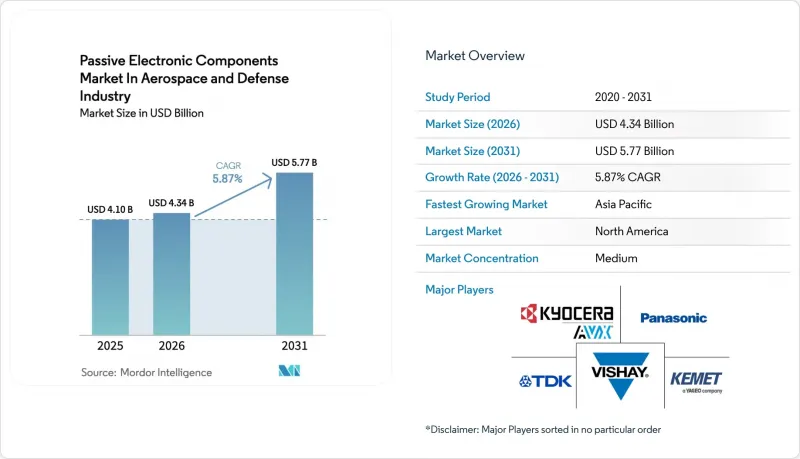
Mordor Intelligence에 의하면, 항공우주 및 방위용 수동 전자부품 시장 규모는 2025년에 41억 달러로 평가되었고 2026년 43억 4,000만 달러에서 2031년까지 57억 7,000만 달러에 이를 것으로 예측되며, 예측 기간(2026-2031년) CAGR은 5.87%를 나타낼 전망입니다.
본 보고서는 제품 유형(커패시터, 인덕터 등), 플랫폼(고정익기, 회전익기 등), 최종 용도(항공전자, 통신, 배전 등) 및 지역(북미, 남미, 유럽, 아시아태평양 등)별로 분류되어 있습니다. 시장 전망은 금액(달러) 기준으로 제시되어 있습니다.
항공우주 및 방위 산업용 수동 전자부품 시장 동향과 전망
'모어 일렉트릭(More Electric)' 항공기 아키텍처의 채택 확대
각 항공기 제조업체들은 유압 및 공압 시스템을 전동 서브시스템으로 대체하고 있으며, 이러한 변화로 인해 차세대 플랫폼 전반에 걸쳐 전력 밀도와 열 부하가 증가하고 있습니다. 콜린스 에어로스페이스(Collins Aerospace)는 '클린 어비에이션 스위치(Clean Aviation SWITCH)' 프로그램의 일환으로 메가와트급 배전 프로토타입을 실증 시험하여, 전례 없는 수준의 전기적 스트레스 하에서 부품의 작동을 검증했습니다. GE 에어로스페이스가 개발한 실리콘 카바이드 기반 파워 스테이지는 기존 실리콘 소자에 비해 약 3배 높은 전력 밀도와 3%의 효율 향상을 실현했으며, 이에 따라 커패시터, 저항기, 자기 부품 분야에서도 동등한 진전이 촉진되고 있습니다. 에어버스와 도시바는 2MW급 초전도 추진 시스템의 개념 개발을 위해 제휴하고 있으며, 이는 극저온에 대응하는 수동 부품에 대한 미래 수요를 시사합니다. 정격 전압이 kV급으로 상승함에 따라, 손실 탄젠트가 낮고 기생 인덕턴스가 최소화 된 유전체 재료가 전략적으로 중요해지고 있습니다. 자체 세라믹 배합 기술과 독자적인 박막 기술을 보유한 공급업체들은 민간 및 군용 항공기 제조 분야에서 새롭게 생겨나는 설계 기회를 확보할 준비를 갖추고 있습니다.
방위용 전자 장비 현대화 예산 증가
미국 육군은 2025 회계연도에 통신 및 전자 장비 조달에 86억 달러를 편성했습니다. 이 예산 항목은 무선, 센서, 사격 통제 하위 시스템 분야의 수동 부품 수요를 간접적으로 확대시키는 것입니다. 유럽에서도 유사한 투자 추세가 나타나고 있으며, 레이더 업그레이드 및 대드론용 전자전 시스템에 중점을 두고 있습니다. BAE 시스템즈는 브래들리 A4 차량을 디지털화된 전자 장비로 현대화하는 계약을 4억 4,000만 달러 이상에 수주했으며, 이에 따라 MIL-PRF 및 DO-160 인증을 충족하는 고신뢰성 수동 부품에 대한 수요가 견인되고 있습니다. 방위 분야의 주요 제조업체들은 신호 처리 체인에 인공지능(AI)을 통합하고 있으며, 이에 따라 커패시터와 인덕터에 대해 더 엄격한 전압 허용 오차와 더 넓은 작동 온도 범위가 요구되고 있습니다. 프로그램 일정은 대개 상용 제품의 수명 주기보다 길기 때문에 장기 공급 계약이나 노후화 관리 서비스를 제공하는 공급업체가 우위를 점하고 있습니다. 개방형 시스템 아키텍처가 보급됨에 따라 호환성 요구 사항이 높아지면서, 여러 규격에 부합하고 실적 호환성이 있는 수동 소자의 중요성이 커지고 있습니다.
탄탈륨 및 팔라듐 가격 변동
탄탈륨과 팔라듐공급은 여전히 소수의 채굴국에 집중되어 있어, 항공우주 산업공급망은 가격 급등 및 수출 규제 위험에 노출되어 있습니다. 미국 정부감사원(GAO) 보고서에 따르면, 국방부는 탄탈륨 수요의 100%를 수입에 의존하고 있어, 임무에 필수적인 커패시터의 취약성이 더욱 커지고 있습니다. 현물 시장의 가격 급등으로 인해, 수년 전에 체결된 고정 가격 계약을 이행해야 하는 부품 제조업체의 이익률은 압박을 받고 있습니다. 산화 니오브나 고전압 다층 세라믹 등의 대체 유전체가 검토되고 있으나, 인증 절차에 시간이 걸리기 때문에 광범위한 도입은 지연되고 있습니다. 이에 대응하여 각 제조업체는 전략적 비축량을 확보하고 대륙을 아우르는 이중 조달 체제를 구축함으로써 대처하고 있습니다. 금융 헤지 상품은 일정한 완화 효과를 가져오지만, 사전 통지가 거의 없는 상태에서 수출 금지 조치가 발효될 경우 납품 리스크를 경감할 수는 없습니다.
부문 분석
커패시터는 2025년에 수동 전자부품 시장에서 57.34%의 점유율을 차지하며, 연평균 성장률(CAGR) 7.68%를 기록할 전망입니다. 이는 에너지 저장, 전력 조정 및 전자기 간섭(EMI) 억제 분야에서 커패시터가 수행하는 핵심적인 역할을 반영한 것입니다. 탄탈 및 대용량 다층 세라믹 커패시터는 MIL-STD-704F에서 규정된 홀드업 시간을 충족하는 데 도움이 되며, 발전기의 과도 현상이 발생하는 동안에도 항공 전자 장비에 대한 전력 공급을 유지합니다. 이 제품 카테고리는 전기화가 더욱 진전된 항공기에 도입된 메가와트급 전압 레일의 혜택을 받고 있으며, 폴리프로필렌 및 불소계 유전체를 활용한 필름 설계를 통해 고온 환경에서도 낮은 손실 계수를 실현하고 있습니다. 인덕터와 저항기는 성숙한 수요 곡선을 보이고 있지만, RF 프런트엔드가 고주파화되는 추세에 따라 여전히 한 자릿수 중반대의 성장률을 유지하고 있습니다. 소형화 노력을 통해 넓은 온도 변동 범위에서도 신뢰성을 유지하면서 부품의 실적를 0402 사이즈 이하로 축소하고 있습니다.
수동 전자부품 시장에서는 더욱 엄격한 공차와 더 높은 내전압이 요구되고 있으며, 이에 따라 박막 증착, 포토리소그래피 및 자율형 광학 검사에 대한 투자가 진행되고 있습니다. 분말 금속의 분무 성형과 세라믹 테이프 캐스팅을 수직 통합한 공급업체는 원자재 부족 시에도 안정적인 공급을 확보할 수 있습니다. 한편, 인쇄 회로 기판에 직접 형성되는 이식형 수동 부품에 대한 관심이 높아지면서 위성 및 무인 항공기(UAV)의 경량화가 추진되고 있습니다. 이러한 부품의 채택 여부는 IPC-6012 인증 주기 및 기판 조립 시 재작업 요건을 충족할 수 있는지 여부에 달려 있습니다. 이러한 양극단의 요구에 대응하기 위해 각 벤더사는 현재 필름 소자와 세라믹 소자를 결합한 하이브리드 커패시터 모듈을 제공하며, 리플 내성과 부피 효율을 최적화하고 있습니다.
지역별 분석
북미는 견조한 국방 예산과 성숙한 상업용 항공우주 공급망에 힘입어 2025년 수동 전자부품 시장에서 33.05%의 점유율을 차지했습니다. 'CHIPS and Science Act'에 따라 자금을 지원받는 정부 프로그램은 갈륨 및 희토류의 국내 가공을 목표로 하고 있으나, GAO(정부감사원)는 실질적인 생산 능력이 2030년 이전에는 실현되지 않을 것이라고 경고하고 있습니다. 보잉, 록히드 마틴, 레이시온과 같은 대형 주계약업체들은 공급업체의 회복탄력성을 중시하며, 북미에 중복 생산 거점을 유지하는 부품 제조업체들과 다년 계약을 체결하고 있습니다. 정책적 인센티브로 인해 웨이퍼 레벨 커패시터 제조의 국내 복귀가 촉진되고 있지만, 자본 집약도가 높기 때문에 신규 공장 건설 진척은 더딘 상태입니다. ITAR 및 DFARS의 사이버 보안 조항을 포함한 수출 규정 준수 제도는 관리상의 부담을 초래하고 있으며, 방위 계약에 정통한 기존 기업들에게 유리한 조건을 제공합니다.
아시아태평양은 항공기 보유 대수 증가와 각국의 독자적인 방위 프로젝트에 힘입어 2031년까지 연평균 성장률(CAGR) 7.86%로 가장 높은 성장률을 나타낼 것으로 예측됩니다. 중국, 일본, 한국, 인도는 저궤도(LEO) 및 정지궤도(GEO) 위성 군집에 막대한 투자를 하고 있어, 내방사선성 수동 부품에 대한 수요를 비약적으로 높이고 있습니다. 동남아시아 전역에 걸쳐 있는 전자기기 제조 클러스터는 다층 세라믹 커패시터 및 권선 인덕터에 대해 비용 경쟁력 있는 조립 서비스를 제공합니다. 그러나 이 지역은 코발트, 탄탈륨, 팔라듐 수입에 구조적으로 의존하고 있어 가격 책정이 외부 충격에 노출되어 있습니다. 각 OEM 기업들은 이에 대응하여 현지 연구개발 센터를 확대하고, 지역의 항공기용 규제에 맞춘 설계 맞춤화를 추진하고 있습니다. 전략적 비축 및 소재 대체 프로그램을 통해 지정학적 요인으로 인한 공급 차질에 대한 단기적 영향을 완화하고 있습니다.
유럽은 선진적인 민간 항공우주 프로그램과 NATO 회원국의 국방 현대화 덕분에 수동 전자부품 시장에서 견고한 입지를 유지하고 있습니다. 환경 관련 법규로 인해 기존 화학 물질에서 RoHS 준수 대체품으로의 전환이 가속화되고 있으며, 무연 솔더 합금 및 무할로겐 적층 기판의 혁신이 촉진되고 있습니다. '클린 항공 합작 사업(Clean Aviation Joint Undertaking)' 하의 협력 체계를 통해 전동화 실증 기기에 대한 위험 분담이 가능해졌습니다. 프랑스, 독일, 영국의 위성 주계약업체들은 우주용 수동 부품에 대해 유럽산 제품 사용을 계약상 의무화하고 있어, 이를 통해 현지 공급망이 보호되고 있습니다. 중동 및 아프리카에서는 수요가 아직 초기 단계이지만, 각국의 방위 조달 패키지에 기술 이전 조항이 점점 더 많이 규정되고 있어, 현지 조립 및 시험 업무에 대한 투자를 주저하지 않는 적격 공급업체에게는 장기적인 기회가 창출되고 있습니다.
기타 혜택:
- 엑셀 형식 시장 예측(ME) 시트
- 3개월간의 애널리스트 지원
자주 묻는 질문
목차
제1장 서론
제2장 조사 방법
제3장 주요 요약
제4장 시장 구도
제5장 시장 규모와 성장 예측
제6장 경쟁 구도
제7장 시장 기회와 향후 전망
JHS 26.08.11According to Mordor Intelligence, the passive electronic components market size in the aerospace and defense industry was valued at USD 4.1 billion in 2025 and estimated to grow from USD 4.34 billion in 2026 to reach USD 5.77 billion by 2031, at a CAGR of 5.87% during the forecast period (2026-2031).
This report is Segmented by Product Type (Capacitors, Inductors, and More), Platform (Fixed-Wing Aircraft, Rotary-Wing Aircraft, and More), End-Use Application (Avionics, Communications, Power Distribution, and More), and Geography (North America, South America, Europe, Asia-Pacific, and More). The Market Forecasts are Provided in Terms of Value (USD).
Insights and Trends of Passive Electronic Components Market in Aerospace And Defense Industry
Increasing Adoption of More-Electric Aircraft Architectures
Airframe primes are replacing hydraulics and pneumatics with electrically driven subsystems, a shift that intensifies power densities and thermal loads across next-generation platforms. Collins Aerospace has field-tested megawatt-class distribution prototypes under the Clean Aviation SWITCH program, validating component operation at unprecedented electrical stress levels.Silicon carbide-based power stages developed by GE Aerospace deliver roughly 3 X higher power density and 3% efficiency gains versus legacy silicon devices, prompting matching advances in capacitors, resistors, and magnetic components. Airbus and Toshiba have partnered on superconducting 2 MW propulsion concepts, signaling future demand for cryogenic-compatible passives. As voltage ratings rise toward the kV class, dielectric materials with low loss tangents and minimal parasitic inductance gain strategic importance. Suppliers with in-house ceramic formulation and proprietary foil technologies position themselves to capture emerging design slots across commercial and military aircraft builds.
Rising Defense Electronics Modernization Budgets
The U.S. Army earmarked USD 8.6 billion in FY 2025 for communications and electronics procurement, a budget line that indirectly scales passive component volumes across radio, sensor, and fire-control subsystems. Similar investment patterns in Europe focus on radar upgrades and counter-drone electronic warfare suites. BAE Systems received contracts exceeding USD 440 million to modernize Bradley A4 vehicles with digitized electronics, driving demand for high-reliability passives that meet MIL-PRF and DO-160 qualifications. Defense primes are layering artificial intelligence into signal-processing chains, prompting tighter voltage tolerances and wider operating temperature windows for supporting capacitors and inductors. Program schedules often outlast commercial product life cycles, so vendors with long-term supply agreements and obsolescence management services maintain an edge. As open-systems architectures proliferate, interchangeability requirements elevate the importance of footprint-compatible passive devices qualified to multiple standards.
Volatility in Tantalum and Palladium Prices
Tantalum and palladium supply remains concentrated in a handful of mining nations, exposing aerospace supply chains to price spikes and export restrictions. The U.S. Government Accountability Office reported that the Department of Defense relies on imports for 100% of its tantalum needs, amplifying vulnerability for mission-critical capacitors. Spot market surges compress margins for component makers that must honor fixed-price contracts awarded years earlier. Alternate dielectrics such as niobium oxide and high-voltage multilayer ceramic variants are under evaluation, yet qualification timelines delay their broad rollout. Manufacturers have responded by stockpiling strategic reserves and establishing dual-sourcing frameworks across continents. Financial hedging products provide partial relief but cannot mitigate delivery risk when export bans take effect with minimal notice.
Other drivers and restraints analyzed in the detailed report include:
- Expansion of LEO Satellite Constellations
- Shift to Wide-Bandgap (GaN/SiC) Power Electronics
- Geopolitical Supply-Chain Disruptions
For complete list of drivers and restraints, kindly check the Table Of Contents.
Segment Analysis
Capacitors held a 57.34% share of the passive electronic components market in 2025 and are on track for an 7.68% CAGR, reflecting their central role in energy storage, power conditioning, and electromagnetic interference suppression. Tantalum and high-capacitance multilayer ceramics help satisfy hold-up times dictated by MIL-STD-704F, ensuring avionics remain powered during generator transients. This product class benefits from megawatt-class voltage rails introduced in more-electric aircraft, where film designs with polypropylene or fluorinated dielectrics deliver low dissipation factors at elevated temperatures. Inductors and resistors follow with mature demand curves but still post mid-single-digit growth as RF front-ends migrate toward higher frequencies. Miniaturization efforts push component footprints below 0402 sizes while maintaining reliability under wide temperature swings.
The passive electronic components market demands tighter tolerance and higher voltage ratings, prompting investments in thin-film deposition, photo-lithography, and autonomous optical inspection. Suppliers that vertically integrate powdered metal atomization and ceramic tape casting gain supply assurance during raw-material shortages. Meanwhile, interest in embedded passives fabricated directly into printed circuit boards offers weight savings for satellites and UAVs. Adoption hinges on IPC-6012 qualification cycles and the ability to meet rework requirements during board assembly. Addressing both ends of the spectrum, vendors now offer hybrid capacitor modules that combine film and ceramic elements to optimize ripple handling and volumetric efficiency.
Complete Report Scope:
- By Product Type
- Capacitors
- Inductors
- Resistors
- Other Passive Component Product Types (Transformers, Crystals)
- By Platform
- Fixed-wing Aircraft
- Rotary-wing Aircraft
- Unmanned Aerial Vehicles (UAVs)
- Spacecraft and Satellites
- Missiles and Guided Weapons
- By End-Use Application
- Avionics
- Communications and Navigation
- Power Distribution and Conditioning
- Electronic Warfare and Radar
- Thermal Management
- By Geography
- North America
- United States
- Canada
- Mexico
- South America
- Brazil
- Argentina
- Rest of South America
- Europe
- Germany
- United Kingdom
- France
- Italy
- Spain
- Russia
- Rest of Europe
- Asia-Pacific
- China
- Japan
- India
- South Korea
- South-East Asia
- Rest of Asia-Pacific
- Middle East and Africa
- Middle East
- Saudi Arabia
- United Arab Emirates
- Rest of Middle East
- Africa
- South Africa
- Egypt
- Rest of Africa
- Middle East
- North America
Geography Analysis
North America commanded a 33.05% share of the passive electronic components market in 2025, buoyed by strong defense budgets and a mature commercial aerospace supply chain. Government programs funded under the CHIPS and Science Act target domestic processing of gallium and rare earths, yet the GAO cautions that meaningful capacity will not arrive before 2030. Leading primes such as Boeing, Lockheed Martin, and Raytheon emphasize supplier resilience, awarding multiyear agreements to component makers that maintain redundant North American manufacturing sites. Policy incentives encourage the reshoring of wafer-level capacitor fabrication, though high capital intensity slows greenfield progress. Export compliance regimes, including ITAR and DFARS cybersecurity clauses, introduce administrative overhead, favoring incumbents versed in defense contracting.
Asia-Pacific is forecast to log the highest 7.86% CAGR through 2031, propelled by rising aircraft fleet counts and indigenous defense projects. China, Japan, South Korea, and India invest heavily in LEO and GEO satellite constellations, multiplying demand for radiation-hardened passives. Electronics manufacturing clusters across Southeast Asia provide cost-competitive assembly for multilayer ceramic capacitors and wire-wound inductors. However, the region's structural reliance on imported cobalt, tantalum, and palladium exposes pricing to external shocks. OEMs respond by expanding local research and development centers to customize designs for regional airworthiness regulations. Strategic stockpiling and material substitution programs mitigate near-term exposure to geopolitical supply disruptions.
Europe maintains solid participation in the passive electronic components market thanks to advanced civil aerospace programs and defense modernization across NATO members. Environmental legislation accelerates the replacement of legacy chemistries with RoHS-compliant alternatives, fostering innovation in lead-free solder alloys and halogen-free laminates. Collaborative frameworks under the Clean Aviation Joint Undertaking allow shared risk on electrification demonstrators. Satellite prime contractors in France, Germany, and the United Kingdom contractually mandate European content for space-grade passives, safeguarding local supply chains. While the Middle East and Africa show nascent volumes, sovereign defense procurement packages increasingly stipulate technology-transfer clauses, presenting long-term opportunities for qualified suppliers willing to invest in local assembly and test operations.
- TDK Corporation
- Vishay Intertechnology Inc.
- KYOCERA AVX Components Corporation
- KEMET Corporation (Yageo Group)
- Panasonic Holdings Corporation
- Murata Manufacturing Co., Ltd.
- Samsung Electro-Mechanics Co., Ltd.
- Taiyo Yuden Co., Ltd.
- WIMA GmbH & Co. KG
- Cornell Dubilier Electronics, Inc.
- API Delevan Inc. (Regal Rexnord)
- Bourns, Inc.
- TE Connectivity Ltd.
- Eaton Corporation plc
- TT Electronics plc
- Ohmite Manufacturing Company, LLC
- Honeywell International Inc.
- Exxelia Group SAS
- Smiths Interconnect Inc.
- Littelfuse, Inc.
- Johanson Dielectrics, Inc.
- NIC Components Corp.
- Delta Electronics, Inc.
- Lelon Electronics Corporation
- Knowles Precision Devices (Knowles Corp.)
Additional Benefits:
- The market estimate (ME) sheet in Excel format
- 3 months of analyst support
TABLE OF CONTENTS
1 INTRODUCTION
- 1.1 Study Assumptions and Market Definition
- 1.2 Scope of the Study
2 RESEARCH METHODOLOGY
3 EXECUTIVE SUMMARY
4 MARKET LANDSCAPE
- 4.1 Market Overview
- 4.2 Market Drivers
- 4.2.1 Increasing adoption of "More-Electric" aircraft architectures
- 4.2.2 Rising defense electronics modernization budgets
- 4.2.3 Expansion of LEO satellite constellations
- 4.2.4 Shift to wide-bandgap (GaN/SiC) power electronics
- 4.2.5 Additive manufacturing of custom RF passives
- 4.2.6 NATO STANAG-4736 RoHS-like mandates
- 4.3 Market Restraints
- 4.3.1 Volatility in tantalum and palladium prices
- 4.3.2 Geopolitical supply-chain disruptions
- 4.3.3 Qualification bottlenecks for 3-D-printed passives
- 4.3.4 Stricter cube-sat out-gassing limits on polymer films
- 4.4 Industry Supply Chain Analysis
- 4.5 Impact of Macroeconomic Factors
- 4.6 Technological Outlook
- 4.7 Porter's Five Forces Analysis
- 4.7.1 Threat of New Entrants
- 4.7.2 Bargaining Power of Buyers
- 4.7.3 Bargaining Power of Suppliers
- 4.7.4 Threat of Substitute Products
- 4.7.5 Intensity of Competitive Rivalry
5 MARKET SIZE AND GROWTH FORECASTS (VALUE)
- 5.1 By Product Type
- 5.1.1 Capacitors
- 5.1.2 Inductors
- 5.1.3 Resistors
- 5.1.4 Other Passive Component Product Types (Transformers, Crystals)
- 5.2 By Platform
- 5.2.1 Fixed-wing Aircraft
- 5.2.2 Rotary-wing Aircraft
- 5.2.3 Unmanned Aerial Vehicles (UAVs)
- 5.2.4 Spacecraft and Satellites
- 5.2.5 Missiles and Guided Weapons
- 5.3 By End-Use Application
- 5.3.1 Avionics
- 5.3.2 Communications and Navigation
- 5.3.3 Power Distribution and Conditioning
- 5.3.4 Electronic Warfare and Radar
- 5.3.5 Thermal Management
- 5.4 By Geography
- 5.4.1 North America
- 5.4.1.1 United States
- 5.4.1.2 Canada
- 5.4.1.3 Mexico
- 5.4.2 South America
- 5.4.2.1 Brazil
- 5.4.2.2 Argentina
- 5.4.2.3 Rest of South America
- 5.4.3 Europe
- 5.4.3.1 Germany
- 5.4.3.2 United Kingdom
- 5.4.3.3 France
- 5.4.3.4 Italy
- 5.4.3.5 Spain
- 5.4.3.6 Russia
- 5.4.3.7 Rest of Europe
- 5.4.4 Asia-Pacific
- 5.4.4.1 China
- 5.4.4.2 Japan
- 5.4.4.3 India
- 5.4.4.4 South Korea
- 5.4.4.5 South-East Asia
- 5.4.4.6 Rest of Asia-Pacific
- 5.4.5 Middle East and Africa
- 5.4.5.1 Middle East
- 5.4.5.1.1 Saudi Arabia
- 5.4.5.1.2 United Arab Emirates
- 5.4.5.1.3 Rest of Middle East
- 5.4.5.2 Africa
- 5.4.5.2.1 South Africa
- 5.4.5.2.2 Egypt
- 5.4.5.2.3 Rest of Africa
- 5.4.5.1 Middle East
- 5.4.1 North America
6 COMPETITIVE LANDSCAPE
- 6.1 Market Concentration
- 6.2 Strategic Moves
- 6.3 Market Share Analysis
- 6.4 Company Profiles (includes Global level Overview, Market level overview, Core Segments, Financials as available, Strategic Information, Market Rank/Share for key companies, Products and Services, and Recent Developments)
- 6.4.1 TDK Corporation
- 6.4.2 Vishay Intertechnology Inc.
- 6.4.3 KYOCERA AVX Components Corporation
- 6.4.4 KEMET Corporation (Yageo Group)
- 6.4.5 Panasonic Holdings Corporation
- 6.4.6 Murata Manufacturing Co., Ltd.
- 6.4.7 Samsung Electro-Mechanics Co., Ltd.
- 6.4.8 Taiyo Yuden Co., Ltd.
- 6.4.9 WIMA GmbH & Co. KG
- 6.4.10 Cornell Dubilier Electronics, Inc.
- 6.4.11 API Delevan Inc. (Regal Rexnord)
- 6.4.12 Bourns, Inc.
- 6.4.13 TE Connectivity Ltd.
- 6.4.14 Eaton Corporation plc
- 6.4.15 TT Electronics plc
- 6.4.16 Ohmite Manufacturing Company, LLC
- 6.4.17 Honeywell International Inc.
- 6.4.18 Exxelia Group SAS
- 6.4.19 Smiths Interconnect Inc.
- 6.4.20 Littelfuse, Inc.
- 6.4.21 Johanson Dielectrics, Inc.
- 6.4.22 NIC Components Corp.
- 6.4.23 Delta Electronics, Inc.
- 6.4.24 Lelon Electronics Corporation
- 6.4.25 Knowles Precision Devices (Knowles Corp.)
7 MARKET OPPORTUNITIES AND FUTURE OUTLOOK
- 7.1 White-space and Unmet-Need Assessment


