

|
시장보고서
상품코드
2116643
능동 및 수동 전자 소자 시장 : 점유율 분석, 업계 동향과 통계, 성장 예측(2026-2031년)Active And Passive Electronic Components - Market Share Analysis, Industry Trends & Statistics, Growth Forecasts (2026 - 2031) |
||||||
 Mordor Intelligence
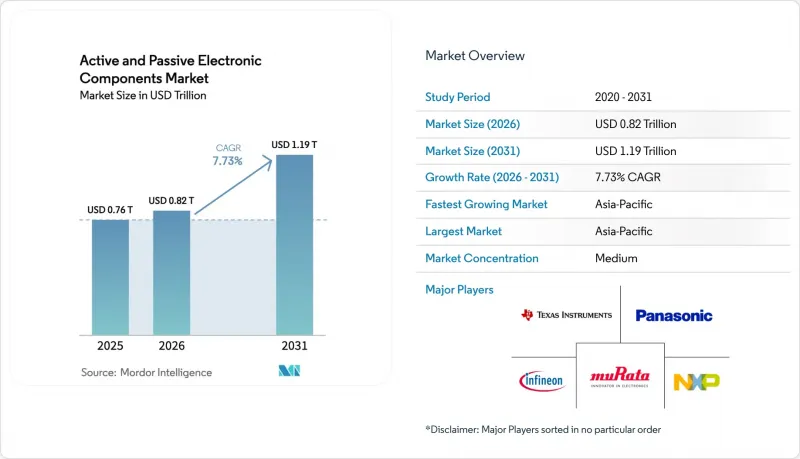
Mordor Intelligence에 의하면, 능동 및 수동 전자 소자 시장 규모는 2025년에 7,600억 달러, 2026년에 8,200억 달러가 되고, 2031년까지 1조 1,900억 달러에 이를 것으로 예측되며, 2026-2031년까지 CAGR 7.73%로 성장할 전망입니다.
본 보고서는 부품(능동 부품, 수동 부품), 실장 기술(스루홀 기술, 표면실장기술, 칩 스케일 패키지, 3D 집적 패키징), 소재(실리콘, 갈륨 비소, 실리콘 카바이드, 기타), 최종 사용자 산업(자동차, 가전·컴퓨팅,산업, 통신, 기타), 지역별로 분류되어 있습니다. 시장 예측은 금액(달러) 기준으로 제시되어 있습니다.
전 세계 능동 및 수동 전자 소자 시장 동향과 인사이트
5G 인프라 도입 가속화
5G 매크로셀용 무선 주파수 프런트엔드 모듈의 경우, 3.5GHz 이상에서 실리콘 수평형 트랜지스터의 효율이 20% 이상 저하되므로 질화갈륨(GaN) 파워 앰프에 대한 의존도가 높아지고 있습니다. 중국은 2024년까지 368만 기의 5G 기지국을 구축하고, 2027년까지 450만 기를 목표로 하고 있어, GaN-on-SiC 디스크리트 트랜지스터와 모노리식 마이크로파 집적 회로(MMIC)에 대한 수요를 뒷받침하고 있습니다. 미국과 유럽의 mm파 대역 주파수 경매를 통해 24-29GHz 대역이 개방되고, 안테나 어레이의 소자 수가 4배로 증가함에 따라 무선 유닛당 수동 부품 사용량이 증가하고 있습니다. 에릭슨(Ericsson)은 GaN 다이 공급 부족과 유기 기판 부족으로 인해 무선 유닛 1대당 부품 원가가 전년 대비 18% 증가했다고 보고했습니다. Open-RAN 아키텍처는 조달처를 분산시켜 인터페이스 부품 수요를 높이는 동시에 상호 운용성 위험을 증가시키고 있습니다. 리드 타임을 단축하기 위해 통신 장비 제조업체들은 GaN 에피택시 및 모듈 조립을 동일한 거점으로 집약하고 있으며, 이는 자동차용 파워 일렉트로닉스에서 채택되고 있는 공급망 전략을 반영한 것입니다.
자동차용 전자기기(EV, ADAS)의 급증
반도체산업협회(SIA)에 따르면, 2025년에는 배터리식 전기차(BEV)가 전 세계 경차 판매 대수의 17%를 차지하게 될 것이며, 각 플랫폼에는 2,000-3,000달러 상당의 반도체가 탑재되는 반면, 내연기관 차량에서는 600달러에 그치고 있습니다. 실리콘 카바이드(SiC) MOSFET는 충전 시간을 45분에서 18분으로 단축하는 800V 배터리 팩을 뒷받침하고 있으며, 이로 인해 OEM의 와이드 밴드갭 기판에 대한 수요가 증가하고 있습니다. 인피니언 테크놀로지스(Infineon Technologies)는 2025 회계연도에 자동차 부문에서 23%의 성장을 기록했으나, 150mm 웨이퍼 공급 병목 현상이 출하량을 억제했다고 지적했습니다. 첨단 운전자 보조 시스템(ADAS)은 하루에 4TB의 데이터를 생성하기 때문에 높은 처리량을 가진 도메인 컨트롤러와 -40°C-150°C의 정격 온도를 가진 세라믹 커패시터가 필요합니다. 2024년부터 자동 긴급 제동을 의무화하는 유럽 규제에 따라 차량 1대당 ADAS 탑재량이 기준으로 정해졌으며, 이를 바탕으로 수년에 걸친 공급 계약이 체결되고 있습니다.
희토류 금속 공급망의 지속적인 변동
중국은 정제 갈륨 생산량의 70%, 게르마늄의 60%를 장악하고 있으며, 2023년 8월의 수출 허가 규제로 인해 비소 갈륨과 질화 갈륨의 에피택시용 공급이 부족해졌습니다. 갈륨 가격은 2023년 7월부터 2024년 3월 사이에 28% 상승했으며, 중국 이외의 파운드리 업체들은 15-20%의 추가 비용을 지불하고 대체 공급원을 확보해야만 했습니다. 미국 지질조사국(USGS)에 따르면, 게르마늄 공급 부족으로 인해 2024년에는 중국 이외 지역공급량이 35% 감소했습니다. 서방 국가 정부는 국내 가공에 보조금을 지급하고 있지만, 환경 허가 절차로 인해 신규 생산 능력이 충분한 규모에 도달하는 것은 적어도 2027년 이후가 될 전망이며, 향후 몇 년간 공급 취약성이 지속될 것으로 보입니다.
부문 분석
능동형 소자로 인한 능동 및 수동 전자 소자 시장 규모는 2031년까지 연평균 성장률(CAGR) 8.24%로 확대될 것으로 예측되며, 시장 전체를 상회하는 성장이 예상됩니다. 48V 마일드 하이브리드 차량 및 800V 배터리식 전기차용 능동형 전력 관리 IC는 게이트 드라이버, 전류 센서, 보호 로직을 통합하여 기판 면적을 40% 줄이면서도 전자기 호환성(EMC)을 향상시키고 있습니다. 질화갈륨(GaN) 고전자이동도 트랜지스터(HEMT)는 AI 서버의 전원 장치에서 1MHz를 초과하는 주파수로 스위칭을 수행하여, 수냉식 랙에 요구되는 3kW/L의 전력 밀도를 실현하고 있습니다.
가전 시장에서는 수동 부품이 여전히 가치의 대부분을 차지하고 있으며, 2025년에는 57.12%의 점유율을 유지할 전망이지만, 공급 리스크가 높아지고 있습니다. 2024년 다층 세라믹 커패시터공급 부족으로 인해 자동차 제조업체들은 총 정전용량을 줄인 배터리 관리 시스템을 재설계할 수밖에 없었습니다. Murata Manufacturing과 TDK는 2025년에 X7R 및 C0G의 생산 능력을 15% 확대했으나, 100µF를 초과하는 0201 커패시터의 수율은 여전히 75% 미만에 머물고 있습니다. 산업 재편은 계속되어, Yageo가 Chilisin을 인수함으로써 안정적인 공급을 보장하고 10-15%의 프리미엄 가격을 책정할 수 있는 수직 통합형 수동 부품 그룹이 탄생했습니다.
2025년에는 픽 앤 플레이스 자동화 기술이 성숙해진 덕분에 표면 실장 솔루션이 능동 및 수동 전자 소자 시장에서 63.06%의 점유율을 유지했습니다. 그러나 칩렛 프레임워크를 통해 설계 위험이 감소함에 따라, 3D 집적 패키징은 2031년까지 연평균 성장률(CAGR) 8.88%를 나타낼 것으로 예측됩니다. 인텔(Intel)의 ‘Foveros’와 TSMC의 ‘시스템 온 인티그레이티드 칩(SoIC)’ 플랫폼은 10마이크로미터 피치로 다이를 본딩하여, 인터포저 기반 2.5D 대체 기술에 비해 레이턴시를 30% 줄였습니다.
스루홀 기술은 여전히 기계적 충격이 큰 항공우주 및 산업용 제어 부문에서 사용되고 있지만, IPC-6012 클래스 3 기판에서는 구형 핀에 필적하는 견고성을 갖춘 0.4mm 피치의 BGA가 인증받게 되었습니다. 높이 0.5mm 이하의 칩 스케일 패키지는 웨어러블 기기에서 널리 채택되고 있지만, 열적 제약으로 인해 소비 전력이 500mW로 제한되어 있어 프로세서에의 채택은 제한적입니다. 와이어 본딩에서 플립 칩 범핑으로의 전환으로 인해 전기적 성능은 향상되었으나, 습기에 대한 민감도가 높아졌으며 조립 사이클 시간이 최대 6시간 길어졌습니다.
지역별 분석
2025년, 아시아태평양은 능동 및 수동 전자 소자 시장의 46.14%를 차지했습니다. 이는 중국의 조립 부문에서의 우위, 한국의 메모리 부문에서의 리더십, 대만의 파운드리 생태계에 힘입은 결과입니다. 그러나 단일 지역에 대한 과도한 의존은 다양화를 촉진하는 요인이 되었습니다. 아랍에미리트(UAE)는 무바달라를 통해 2024년에 세계파운드리(GlobalFoundries)의 잔여 지분을 인수하고, 22nm 자동차용 생산 능력을 확충하기 위해 100억 달러를 투자하겠다고 약속함으로써 UAE를 지역 제조 거점으로 자리매김했습니다. 사우디아라비아의 공공투자기금(PIF)은 2025년에 Arm과 공동으로 반도체 설계 센터를 설립할 예정이며, 이는 중동의 성장을 연평균 성장률(CAGR) 8.35%로 견인하기 위한 전략의 일환입니다.
북미와 유럽은 보조금 프로그램에 의존하고 있지만, 제조 장비 납품 지연과 숙련된 인력 부족으로 인해 첫 웨이퍼 생산 개시는 2027-2028년으로 연기되었습니다. 중국은 EUV 장비에 대한 미국의 수출 규제를 받아 2024년에 트레일링 엣지 생산 능력을 35% 확대할 예정이며, 28-40nm의 자동차 및 산업용 노드를 대상으로 하고 있습니다. 일본의 회복은 TSMC의 구마모토 공장과 Rapidus 및 IBM의 2nm 공정 제휴에 달려 있으며, 그 성패는 인재 확보와 현지에서 생산된 화학 물질공급에 좌우됩니다.
남미와 아프리카는 여전히 발전 단계에 있으며, 전원 및 조명 등 복잡도가 낮은 조립 제품에 중점을 두고 있습니다. 인도의 전자기기 수탁제조 서비스는 스마트폰 조립에 대한 우대 조치로 인해 2025년에 22% 성장했으나, 웨이퍼 제조 공장 프로젝트는 현재도 건설 중이며 2026년 하반기까지는 생산을 시작하지 못할 전망입니다.
기타 혜택
- 엑셀 형식 시장 예측(ME) 시트
- 3개월간의 애널리스트 지원
자주 묻는 질문
목차
제1장 서론
제2장 조사 방법
제3장 개요
제4장 시장 구도
제5장 시장 규모와 성장 예측
제6장 경쟁 구도
제7장 시장 기회와 향후 전망
JHS 26.09.01According to Mordor Intelligence, the active and passive electronic components market size is projected to be USD 0.76 trillion in 2025, USD 0.82 trillion in 2026, and reach USD 1.19 trillion by 2031, growing at a CAGR of 7.73% from 2026 to 2031.
This report is Segmented by Component (Active, and Passive), Mounting Technology (Through-Hole, Surface-Mount, Chip-Scale, and 3D Integrated), Material (Silicon, Gallium Arsenide, Silicon Carbide, and More), End-User Industry (Automotive, Consumer Electronics and Computing, Industrial, Communications, and More), and Geography. The Market Forecasts are Provided in Terms of Value (USD).
Global Active And Passive Electronic Components Market Trends and Insights
Accelerated Adoption of 5G Infrastructure
Radio-frequency front-end modules for 5G macro cells increasingly rely on gallium-nitride power amplifiers above 3.5 GHz where silicon lateral transistors lose more than 20% efficiency. China deployed 3.68 million 5G base stations by 2024 and targets 4.5 million by 2027, sustaining demand for GaN-on-SiC discrete transistors and monolithic microwave integrated circuits. Millimeter-wave spectrum auctions in the United States and Europe opened 24-29 GHz bands and quadrupled antenna-array element counts, inflating passive-component content per radio unit. Ericsson reported an 18% year-over-year increase in radio-unit bill-of-materials costs because of GaN die tightness and organic-substrate shortages. Open-RAN architectures fragment procurement, raising interface-component demand and interoperability risk. To compress lead times, telecom equipment manufacturers colocate GaN epitaxy and module assembly, mirroring the supply-chain strategies adopted in automotive power electronics.
Surge in Automotive Electronics (EVs, ADAS)
Battery-electric vehicles reached 17% of global light-vehicle sales in 2025, and each platform embeds USD 2,000-USD 3,000 worth of semiconductors versus USD 600 in internal-combustion vehicles, according to the Semiconductor Industry Association. Silicon-carbide MOSFETs support 800-V battery packs that cut charging time from 45 minutes to 18 minutes, elevating OEM demand for wide-bandgap substrates. Infineon Technologies posted 23% automotive-segment growth in fiscal 2025 but cited 150-mm wafer bottlenecks that capped shipments. Advanced driver-assistance systems generate 4 TB of data daily, necessitating high-throughput domain controllers and ceramic capacitors rated from -40 °C to 150 °C. European regulations mandating automated emergency braking from 2024 embed a baseline ADAS content per vehicle, anchoring multi-year supply agreements.
Persistent Supply Chain Volatility of Rare-Earth Metals
China controls 70% of refined gallium and 60% of germanium output, and August 2023 export licensing tightened supplies for gallium-arsenide and gallium-nitride epitaxy. Gallium prices climbed 28% between July 2023 and March 2024, forcing non-Chinese foundries to qualify alternative sources at a 15-20% cost premium. Germanium shortages cut non-Chinese supply by 35% in 2024, according to the U.S. Geological Survey. Western governments are subsidizing domestic processing, but environmental permitting means new capacity will not reach scale until at least 2027, leaving a multi-year vulnerability window.
Other drivers and restraints analyzed in the detailed report include:
- Rapid Expansion of Data Centers and Cloud Workloads
- Government Incentives for On-Shore Semiconductor Manufacturing
- Rising IP-Related Litigation and Licensing Costs
For complete list of drivers and restraints, kindly check the Table Of Contents.
Segment Analysis
The active and passive electronic components market size attributed to active devices is forecast to rise at an 8.24% CAGR through 2031, outstripping the broader market. Active power-management ICs for 48-V mild-hybrid and 800-V battery-electric vehicles integrate gate drivers, current sensors, and protection logic, shrinking board area by 40% while enhancing electromagnetic compatibility. Gallium-nitride high-electron-mobility transistors switch above 1 MHz in AI server power supplies, enabling 3 kW L-1 densities that liquid-cooling racks require.
Passive devices still dominate value in consumer electronics, holding a 57.12% share in 2025, but supply risk is growing. Multi-layer ceramic capacitor shortages in 2024 forced automotive OEMs to redesign battery-management systems with lower capacitance totals. Murata and TDK lifted X7R and C0G capacity by 15% in 2025, though yield on 0201 capacitors above 100 µF remains below 75%. Consolidation continued when Yageo acquired Chilisin, creating a vertically integrated passive group that can command premiums of 10-15% for assured supply.
Surface-mount solutions retained a 63.06% slice of the active and passive electronic components market in 2025 thanks to mature pick-and-place automation. However, 3D integrated packaging is expected to post an 8.88% CAGR through 2031 as chiplet frameworks lower design risk. Intel's Foveros and TSMC's system-on-integrated-chips platforms bond dies at 10 µm pitch, cutting latency by 30% compared with interposer-based 2.5D alternatives.
Through-hole technology lingers in aerospace and industrial controls where mechanical shock remains high, but IPC-6012 Class 3 boards now qualify 0.4 mm-pitch BGAs that approach the robustness of old-style pins. Chip-scale packages under 0.5 mm height are popular in wearables, yet thermal constraints limit power to 500 mW, restricting adoption for processors. The migration from wire bonding to flip-chip bumping improved electrical performance but added moisture sensitivity, increasing assembly cycle time by up to six hours.
Complete Report Scope:
- By Component
- Active Components
- Passive Components
- By Mounting Technology
- Through-Hole Technology
- Surface-Mount Technology
- Chip-Scale Package
- 3D Integrated Packaging
- By Material
- Silicon
- Gallium Arsenide
- Silicon Carbide
- Gallium Nitride
- Other Materials
- By End-User Industry
- Automotive
- Consumer Electronics and Computing
- Industrial
- Communications
- Medical
- Aerospace and Defense
- Energy and Utilities
- By Geography
- North America
- United States
- Canada
- Mexico
- Europe
- United Kingdom
- Germany
- France
- Italy
- Rest of Europe
- Asia-Pacific
- China
- Japan
- India
- South Korea
- Rest of Asia
- Middle East
- Israel
- Saudi Arabia
- United Arab Emirates
- Turkey
- Rest of Middle East
- Africa
- South Africa
- Egypt
- Rest of Africa
- South America
- Brazil
- Argentina
- Rest of South America
- North America
Geography Analysis
Asia Pacific captured 46.14% of the active and passive electronic components market in 2025, driven by China's assembly dominance, South Korea's memory leadership, and Taiwan's foundry ecosystem. Yet over-reliance on a single region triggered diversification. The United Arab Emirates, through Mubadala, bought the remaining GlobalFoundries stake in 2024 and pledged USD 10 billion to add 22-nm automotive capacity, positioning the UAE as a regional fabrication hub. Saudi Arabia's Public Investment Fund formed a semiconductor design center with Arm in 2025, part of a strategy that propels Middle East growth at an 8.35% CAGR.
North America and Europe rely on subsidy programs, but tool delivery and skilled-labour shortages have pushed first-wafer milestones into 2027-2028. China accelerated trailing-edge capacity by 35% in 2024 after U.S. export controls on EUV tools, targeting automotive and industrial nodes at 28-40 nm. Japan's rebound hinges on TSMC's Kumamoto fab and Rapidus's 2-nm partnership with IBM; success depends on talent pipelines and localized chemicals.
South America and Africa remain nascent, focusing on low-complexity assemblies like power supplies and lighting. India's electronics-manufacturing services expanded 22% in 2025 under smartphone-assembly incentives, yet wafer-fab projects remain under construction and will not yield output until late 2026.
- Infineon Technologies AG
- NXP Semiconductors NV
- Texas Instruments Inc.
- Panasonic Corporation
- Murata Manufacturing Co. Ltd.
- Eaton Corporation
- TE Connectivity Ltd.
- Honeywell International Inc.
- Toshiba Corporation
- Vishay Intertechnology Inc.
- YAGEO Corporation
- TDK Corporation
- KEMET Corporation
- AVX Corporation
- Lelon Electronics Corporation
- Taiyo Yuden Co. Ltd.
- STMicroelectronics NV
- Analog Devices, Inc.
- Broadcom Inc.
- Samsung Electronics Co. Ltd.
- Omron Corporation
Additional Benefits:
- The market estimate (ME) sheet in Excel format
- 3 months of analyst support
TABLE OF CONTENTS
1 INTRODUCTION
- 1.1 Study Assumptions and Market Definition
- 1.2 Scope of the Study
2 RESEARCH METHODOLOGY
3 EXECUTIVE SUMMARY
4 MARKET LANDSCAPE
- 4.1 Market Overview
- 4.2 Market Drivers
- 4.2.1 Accelerated Adoption of 5G Infrastructure
- 4.2.2 Shrinking Form-Factor Requirements in Wearables and IoT Devices
- 4.2.3 Surge in Automotive Electronics (EVs, ADAS)
- 4.2.4 Rapid Expansion of Data Centers and Cloud Workloads
- 4.2.5 Government Incentives for On-Shore Semiconductor Manufacturing
- 4.2.6 Emerging Demand for Quantum-Ready Cryogenic Components
- 4.3 Market Restraints
- 4.3.1 Persistent Supply Chain Volatility of Rare-Earth Metals
- 4.3.2 Rising IP-Related Litigation and Licensing Costs
- 4.3.3 Environmental Compliance Costs for Lead-Free Soldering
- 4.3.4 Skills Gap in Advanced Packaging Technologies
- 4.4 Industry Value-Chain Analysis
- 4.5 Impact of Macroeconomic Factors on the Market
- 4.6 Regulatory Landscape
- 4.7 Technological Outlook
- 4.8 Porter's Five Forces Analysis
- 4.8.1 Bargaining Power of Suppliers
- 4.8.2 Bargaining Power of Consumers
- 4.8.3 Threat of New Entrants
- 4.8.4 Intensity of Competitive Rivalry
- 4.8.5 Threat of Substitutes
5 MARKET SIZE AND GROWTH FORECASTS (VALUE)
- 5.1 By Component
- 5.1.1 Active Components
- 5.1.2 Passive Components
- 5.2 By Mounting Technology
- 5.2.1 Through-Hole Technology
- 5.2.2 Surface-Mount Technology
- 5.2.3 Chip-Scale Package
- 5.2.4 3D Integrated Packaging
- 5.3 By Material
- 5.3.1 Silicon
- 5.3.2 Gallium Arsenide
- 5.3.3 Silicon Carbide
- 5.3.4 Gallium Nitride
- 5.3.5 Other Materials
- 5.4 By End-User Industry
- 5.4.1 Automotive
- 5.4.2 Consumer Electronics and Computing
- 5.4.3 Industrial
- 5.4.4 Communications
- 5.4.5 Medical
- 5.4.6 Aerospace and Defense
- 5.4.7 Energy and Utilities
- 5.5 By Geography
- 5.5.1 North America
- 5.5.1.1 United States
- 5.5.1.2 Canada
- 5.5.1.3 Mexico
- 5.5.2 Europe
- 5.5.2.1 United Kingdom
- 5.5.2.2 Germany
- 5.5.2.3 France
- 5.5.2.4 Italy
- 5.5.2.5 Rest of Europe
- 5.5.3 Asia-Pacific
- 5.5.3.1 China
- 5.5.3.2 Japan
- 5.5.3.3 India
- 5.5.3.4 South Korea
- 5.5.3.5 Rest of Asia
- 5.5.4 Middle East
- 5.5.4.1 Israel
- 5.5.4.2 Saudi Arabia
- 5.5.4.3 United Arab Emirates
- 5.5.4.4 Turkey
- 5.5.4.5 Rest of Middle East
- 5.5.5 Africa
- 5.5.5.1 South Africa
- 5.5.5.2 Egypt
- 5.5.5.3 Rest of Africa
- 5.5.6 South America
- 5.5.6.1 Brazil
- 5.5.6.2 Argentina
- 5.5.6.3 Rest of South America
- 5.5.1 North America
6 COMPETITIVE LANDSCAPE
- 6.1 Market Concentration
- 6.2 Strategic Moves
- 6.3 Market Share Analysis
- 6.4 Company Profiles (includes Global level Overview, Market level overview, Core Segments, Financials as available, Strategic Information, Market Rank/Share for key companies, Products and Services, and Recent Developments)
- 6.4.1 Infineon Technologies AG
- 6.4.2 NXP Semiconductors NV
- 6.4.3 Texas Instruments Inc.
- 6.4.4 Panasonic Corporation
- 6.4.5 Murata Manufacturing Co. Ltd.
- 6.4.6 Eaton Corporation
- 6.4.7 TE Connectivity Ltd.
- 6.4.8 Honeywell International Inc.
- 6.4.9 Toshiba Corporation
- 6.4.10 Vishay Intertechnology Inc.
- 6.4.11 YAGEO Corporation
- 6.4.12 TDK Corporation
- 6.4.13 KEMET Corporation
- 6.4.14 AVX Corporation
- 6.4.15 Lelon Electronics Corporation
- 6.4.16 Taiyo Yuden Co. Ltd.
- 6.4.17 STMicroelectronics NV
- 6.4.18 Analog Devices, Inc.
- 6.4.19 Broadcom Inc.
- 6.4.20 Samsung Electronics Co. Ltd.
- 6.4.21 Omron Corporation
7 MARKET OPPORTUNITIES AND FUTURE OUTLOOK
- 7.1 White-Space and Unmet-Need Assessment


