

|
시장보고서
상품코드
2100552
학교용 전사적 자원 관리(ERP) 시장 : 점유율 분석, 업계 동향 및 통계, 성장 예측(2026-2031년)Enterprise Resource Planning in Schools - Market Share Analysis, Industry Trends & Statistics, Growth Forecasts (2026 - 2031) |
||||||
 Mordor Intelligence
학교용 전사적 자원 관리(ERP) 시장 규모는 2025년 756억 4,000만 달러에서 2026년에는 843억 5,000만 달러로 확대되어 2026년부터 2031년까지 CAGR 11.52%로 성장을 지속하여, 2031년에는 1,455억 4,000만 달러에 이를 것으로 예측됩니다.
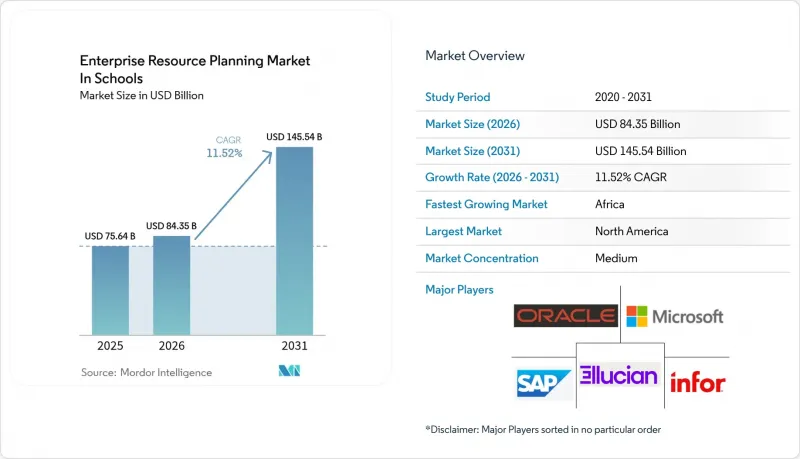
본 보고서는 도입 형태(On-Premise, 클라우드, 하이브리드), 기능(관리, 급여 계산 등), 학교 수준(유치원, 초등학교 등), 교육 기관 규모(소규모 학교, 중규모 학교, 대규모 학교) 및 지역(북미, 유럽 등)별로 분류되어 있습니다. 시장 전망은 금액(달러) 기준으로 제시되어 있습니다.
학교용 전사적 자원 관리(ERP) 시장 인사이트 및 동향
학교 운영 전반에 걸친 일관된 데이터 가용성을 통한 신속한 의사 결정
통합된 데이터 저장소를 통해 의사 결정까지의 리드 타임이 수주에서 수시간으로 단축되었으며, 재무위원회는 사후 감사를 수행하는 대신 회계 연도 도중에 각 프로그램 간 자금을 재배정할 수 있게 되었습니다. 2024년 미국 학군에 도입된 Oracle Cloud ERP를 통해 수작업 대조 작업이 불필요해짐에 따라 예산 수정 주기가 40% 단축되었습니다. SAP S/4HANA Education에 내장된 예측 대시보드는 회계 분기가 종료되기 전에 예산 초과를 경고하여, 조달 팀이 재량 지출을 동결하고 회계 연도 말 적자를 피할 수 있게 했습니다. 여러 캠퍼스를 보유한 중·대규모 학군에서는 사이트 간 통합으로 인해 기존에 대응이 지연되던 문제를 해결하여 가장 큰 이점을 얻고 있습니다.
실시간 데이터 분석 도입
Dynamics 365와 Power BI의 연동을 통해 원시 거래 로그가 예측 대시보드로 변환되면서, 아침 버스를 놓친 학생의 퇴학 위험이 30% 높아진다는 상관관계가 밝혀졌습니다. 이러한 추세를 반영하여 일부 학군에서는 통학 노선 변경이나 급식실 운영 시간 연장을 시행했습니다. 애널리틱스를 통해 ERP가 단순한 규정 준수 관리 도구에서 전략적 계획 수립 엔진으로 진화하는 가운데, 교육위원회는 현재 라이브 세션 중에 새 학년 개설이나 위성 캠퍼스 폐쇄와 같은 ‘비상 시나리오’를 시뮬레이션하고 있습니다. ISO 27001 프레임워크는 의무 사항은 아니지만, 학부모들이 분석 파이프라인 내 익명화 증거를 요구함에 따라 RFP 체크리스트에 점점 더 자주 포함되고 있습니다.
비즈니스 요구에 따른 맞춤화가 어렵습니다.
기성 회계 계정표 템플릿은 기존 급여 계산 주기나 지역별 보고 코드와 상충되는 경우가 많습니다. 2024년 학교 네트워킹 컨소시엄(Consortium for School Networking)의 조사에 따르면, 필요한 맞춤화로 인해 지원 보증이 무효화되어 42%의 학군이 시범 도입을 중단한 것으로 나타났습니다. 업그레이드할 때마다 자체 개발한 코드가 손상될 위험이 있습니다. 타일러 테크놀로지스(Tyler Technologies)는 현재 노코드 워크플로우 빌더를 제공하고 있지만, 소규모 행정 사무실의 경우 교육이 여전히 장벽으로 작용하고 있습니다.
부문 분석
하이브리드 모델은 연평균 성장률(CAGR) 15.85%로 가장 빠르게 성장하고 있는 도입 옵션입니다. 반면, 2025년에 기록된 학교용 클라우드 ERP 시장 점유율은 62.45%였습니다. 하이브리드 솔루션은 기밀성이 높은 학생 식별 정보를 로컬 서버에 보관하면서 익명화된 데이터를 클라우드 분석으로 전송함으로써, 확장성을 희생하지 않고도 독일 및 일본의 데이터 주권 관련 법률을 준수하고 있습니다. 영국에서는 현재 기록을 오프프레미스로 이전하기 전에 데이터 보호 영향 평가를 의무화하고 있어, 각 학군은 핵심 SIS를 On-Premise에 보관하면서 보고서 작성 워크로드를 클라우드로 이전해야 하는 상황에 놓여 있습니다. 마이크로소프트의 ‘Azure Stack for Education’을 활용하면 Dynamics 365의 구성 요소를 로컬에서 실행하면서 메타데이터를 클라우드로 동기화할 수 있어, 하이브리드 도입이 최종 형태임을 입증합니다.
하이브리드 생태계는 장애 위험도 줄여줍니다. 연결이 끊어져도 On-Premise에서의 트랜잭션 처리는 계속됩니다. Infor CloudSuite Education은 재무 데이터를 클라우드 기반 수송 관리 대시보드로 전송하기 위한 암호화된 API를 제공하며, 이는 벤더가 개인정보 보호 관점에서 워크로드를 어떻게 분할하고 있는지를 보여줍니다. 미국의 대규모 학군에서는 여전히 On-Premise 도입을 선호하고 있지만, 서버 교체 주기가 다가옴에 따라 예산 면에서 면밀한 검토에 직면하고 있는 반면, 데이터센터 인력이 부족한 소규모 학교에서는 순수 클라우드 도입이 주류를 이루고 있습니다.
수송 관리 소프트웨어 시장은 2031년까지 연평균 15.35%의 성장이 예상되며, 2025년 학교용 ERP 시장에서 관리 부문이 24.10%의 점유율을 차지했음에도 불구하고 다른 모든 기능을 능가하는 성장률을 보이고 있습니다. 이를 이끄는 원동력은 GPS를 활용한 경로 최적화입니다. 이를 통해 즉시 연료비 절감 효과가 나타날 뿐만 아니라, 학부모들이 요구하는 버스 실시간 추적 수요도 충족됩니다. 타일러 테크놀로지스(Tyler Technologies)는 연료비를 총계정원장(GL)에 직접 반영함으로써, 재무 팀이 학생 1인당 교통비를 산출하고 통합이 가능한 경로를 파악할 수 있도록 하고 있습니다.
급여 계산 및 재무 모듈은 이미 널리 보급되어 있으며, 업그레이드를 통해 얻을 수 있는 이익이 기존 투자에 비해 미미하기 때문에 그 발전 속도는 완만합니다. PowerSchool의 통합형 플랫폼 ‘Kinjo’는 수업 계획과 구매 흐름을 연동하여 교과서 발주가 강의 계획서의 일정과 일치하도록 합니다. 시설 관리 및 급식 서비스 모듈은 여전히 틈새 시장이지만, 학군이 에너지 관리나 식당 이용자 수 파악을 위해 IoT 센서를 연동하고, ERP의 분석 기능을 활용하여 메뉴 수요를 예측하게 되면 성장이 기대됩니다.
지역별 분석
아프리카는 케냐에서 매일 모바일 출석 보고를 의무화한 조치와, 남아프리카공화국의 스타트업 기업이 성과 중심형 교육 템플릿과 ERP를 결합한 솔루션을 제공함에 힘입어 연평균 성장률(CAGR) 16.20%로 전 세계 성장을 주도하고 있습니다. 원조 기관은 검증된 디지털 기록을 조건으로 보조금을 지급하고 있기 때문에 학교 측은 데스크톱 단말기를 넘어 오프라인에서 작동하고 나중에 다시 동기화할 수 있는 모바일·클라우드 솔루션을 도입하고 있습니다. 이 지역의 조달 사이클에서는 현지 통화로 청구되는 종량제 요금 모델을 제공하는 벤더가 유리하며, 이를 통해 지방 학군의 환율 위험을 헤지할 수 있습니다.
북미는 2025년 학교용 ERP 시장에서 33.65%의 점유율을 차지했으나, 대부분의 학군에서 이미 핵심 재무 모듈이 가동 중이기 때문에 시장 확대는 정체 상태에 있습니다. 현재의 성장은 GASB의 리스 규정 및 On-Premise형 지원 계약 종료에 따른 시스템 갱신 계약에 기인합니다. 각 벤더는 장시간의 다운타임을 발생시키지 않고 과거 데이터를 클라우드상의 원장으로 이전하는 ‘마이그레이션 액셀러레이터’를 통해 차별화를 꾀하고 있습니다.
유럽에서는 하이브리드 아키텍처로의 전환이 진행되고 있습니다. 영국에서는 데이터 보호 영향 평가가 의무화되어 있으며, 독일에서는 국경을 넘는 백업이 제한되고 있습니다. 프랑스의 전국 교육 포털에서는 API를 통한 데이터 제공이 의무화되어 있어, 학교들은 인증된 커넥터를 갖춘 제품군 도입을 강요받고 있습니다. 인도는 국가 포털과 연동된 클라우드 ERP에 대해 막대한 보조금을 지급하는 반면, 중국은 데이터 주권을 이유로 로컬 클라우드 또는 On-Premise 도입을 중시하고 있습니다. 일본과 호주는 상호 운용성 기준을 공표했으며, 오픈 API가 필수 조건으로 자리 잡고 있습니다. 라틴아메리카 도시 지역의 사립학교는 중산층 가정을 유치하기 위해 학부모용 포털을 도입하고 있는 반면, 공립학교 시스템에서는 예산이 허용하는 범위 내에서 단계적으로 모듈을 도입하고 있습니다. 걸프 연안 국가들에서는 ‘스마트 캠퍼스’ 프로그램 하에 ERP와 IoT 센서를 통합하고 있으며, 지역 입찰을 목표로 하는 벤더에 대한 기능적 기대가 높아지고 있습니다.
기타 혜택:
- 엑셀 형식 시장 예측(ME) 시트
- 3개월간의 애널리스트 지원
자주 묻는 질문
목차
제1장 서론
제2장 조사 방법
제3장 주요 요약
제4장 시장 구도
제5장 시장 규모와 성장 예측
제6장 경쟁 구도
제7장 시장 기회와 향후 전망
JHS 26.08.11According to Mordor Intelligence, the enterprise resource planning market size in schools market size is expected to grow from USD 75.64 billion in 2025 to USD 84.35 billion in 2026 and is forecast to reach USD 145.54 billion by 2031 at 11.52% CAGR over 2026-2031.
This report is Segmented by Deployment (On-Premise, Cloud, and Hybrid), Function (Administration, Payroll, and More), School Level (Pre-Primary, Primary, and More), Institution Size (Small Schools, Medium Schools, and Large Schools), and Geography (North America, Europe, and More). The Market Forecasts are Provided in Terms of Value (USD).
Insights and Trends of Enterprise Resource Planning Market in Schools
Consistent Data Availability Across the School Business for Faster Decision Making
Unified data repositories are shrinking decision lead times from weeks to hours, enabling finance committees to shift cash among programs mid-year rather than conduct retrospective audits. Oracle Cloud ERP deployments in U.S. districts during 2024 trimmed budget-revision cycles by 40% once manual reconciliation disappeared. Predictive dashboards embedded in SAP S/4HANA Education flagged overruns before the fiscal quarter ended, letting purchasing teams freeze discretionary spend and avert year-end deficits. Medium and large districts with multiple campuses accrue the greatest gains because cross-site consolidation has historically delayed action.
Real-Time Data Analytics Adoption
Power BI integration with Dynamics 365 turns raw transaction logs into predictive dashboards that expose correlations such as the 30% higher dropout risk for students who miss morning buses, a pattern that pushed several districts to reroute transport and extend cafeteria hours. With analytics moving ERP from compliance ledger to strategic planning engine, boards now run what-if scenarios for opening new grade levels or closing satellite campuses during live sessions. ISO 27001 frameworks, while not mandated, increasingly appear on RFP checklists as parents demand evidence of anonymization in analytics pipelines.
Difficulties in Customization According to Business Needs
Off-the-shelf chart-of-accounts templates often clash with existing payroll cycles or local reporting codes. A 2024 Consortium for School Networking study showed 42% of districts halting pilots because required customizations voided support warranties. Each upgrade risks breaking bespoke code. Tyler Technologies now offers a no-code workflow builder, yet training remains a hurdle for small offices.
Other drivers and restraints analyzed in the detailed report include:
- Increasing Use of Education Software in Academics
- Emergence of Hybrid Learning Models Accelerating Integrated ERP Demand
- High Initial Implementation Costs
For complete list of drivers and restraints, kindly check the Table Of Contents.
Segment Analysis
Hybrid models represent the fastest-growing deployment option at a 15.85% CAGR, compared with the 62.45% cloud enterprise resource planning market in schools market share recorded in 2025. Hybrid solutions keep sensitive student identifiers on local servers while pushing anonymized data to cloud analytics, satisfying sovereignty laws in Germany and Japan without sacrificing scalability. The United Kingdom now demands data-protection impact assessments before any records move off-premise, pushing districts to store core SIS on-site and shift reporting workloads to the cloud. Microsoft's Azure Stack for Education allows Dynamics 365 components to run locally while syncing metadata to the cloud, reinforcing the end-state nature of hybrid deployments.
Hybrid ecosystems also lower failure risk; if connectivity drops, onsite transaction processing continues. Infor CloudSuite Education offers encrypted APIs to shuttle finance entries to cloud-based transportation dashboards, illustrating how vendors partition workloads along privacy lines. On-premise installations, still favored by large U.S. districts, face budget scrutiny as server refresh cycles approach, whereas pure-cloud adoption dominates small schools that lack data-center talent.
Transportation software is forecast to advance 15.35% yearly through 2031, outpacing all other functions even though administration held a 24.10% enterprise resource planning market in schools market share in 2025. The catalyst lies in GPS-based route optimization, which shows immediate fuel savings and satisfies parent demand for live bus tracking. Tyler Technologies integrates fuel costs directly into GL accounts, letting finance teams calculate per-student transportation expenses and identify routes eligible for consolidation.
Payroll and finance modules, though already widespread, evolve slowly because upgrades deliver marginal gains relative to sunk investments. PowerSchool's unified Kinjo platform blends lesson plans with purchasing flows so that textbook requisitions align with syllabus timelines. Facilities and food-service modules remain niche but grow when districts link IoT sensors for energy management or cafeteria counts, using ERP analytics to forecast menu demand.
Complete Report Scope:
- By Deployment
- On-Premise
- Cloud
- Hybrid
- By Function
- Administration
- Payroll
- Academics
- Finance
- Transportation
- Procurement and Inventory
- Other Functions
- By School Level
- Pre-Primary
- Primary
- Secondary
- Higher Secondary
- By Institution Size
- Small Schools (<500 Students)
- Medium Schools (500-2000 Students)
- Large Schools (>2000 Students)
- By Geography
- North America
- United States
- Canada
- Mexico
- South America
- Brazil
- Argentina
- Rest of South America
- Europe
- United Kingdom
- Germany
- France
- Spain
- Italy
- Rest of Europe
- Asia-Pacific
- China
- India
- Japan
- Australia
- South Korea
- Rest of Asia-Pacific
- Middle East and Africa
- Middle East
- Saudi Arabia
- United Arab Emirates
- Turkey
- Rest of Middle East
- Africa
- South Africa
- Kenya
- Rest of Africa
- Middle East
- North America
Geography Analysis
Africa leads global growth with a 16.20% CAGR, propelled by Kenya's mandate for daily mobile attendance submissions and South African startups bundling ERP with outcome-based education templates. Donor agencies funnel grants contingent on verified digital records, prompting schools to leapfrog desktops and adopt mobile-cloud solutions that work offline and resync later. The region's procurement cycles favor vendors offering pay-as-you-go models denominated in local currencies, hedging FX risk for rural districts.
North America held a 33.65% enterprise resource planning market in schools market share in 2025, but expansion has plateaued as most districts already run core finance modules. Growth now stems from replacement deals, driven by GASB lease rules and the sunset of on-premise support contracts. Vendors differentiate via migration accelerators that port historical data into cloud-hosted ledgers without extended downtime.
Europe converges on hybrid architectures; the United Kingdom demands data-protection impact assessments, and Germany restricts cross-border backups. France's national education portal mandates API submissions, pushing schools toward suites with certified connectors. India showers grants on cloud ERP linked to its national portal, while China leans on local-cloud or on-premise deployments, citing data sovereignty. Japan and Australia publish interoperability standards, making open APIs table stakes. Latin America's urban private schools deploy parent-facing portals to attract middle-class families, whereas public systems adopt modules incrementally as budgets allow. Gulf states bundle ERP with IoT sensors under "smart campus" programs, raising functionality expectations for vendors seeking regional tenders.
- SAP SE
- Oracle Corporation
- Microsoft Corporation
- Infor Inc.
- Ellucian Company L.P.
- Blackbaud, Inc.
- Tyler Technologies, Inc.
- PowerSchool Holdings, Inc.
- Workday, Inc.
- Unit4 N.V.
- Harris School Solutions (N. Harris Computer Corporation)
- Tata Consultancy Services Limited
- Serosoft Solutions Pvt. Ltd.
- Foradian Technologies Pvt. Ltd.
- Focus School Software, LLC
- EduSys Pvt. Ltd.
- Kuali, Inc.
- SchoolTime Software Solutions Pvt. Ltd.
- OpenEduCat Inc.
- Infinite Campus
Additional Benefits:
- The market estimate (ME) sheet in Excel format
- 3 months of analyst support
TABLE OF CONTENTS
1 INTRODUCTION
- 1.1 Study Assumptions and Market Definition
- 1.2 Scope of the Study
2 RESEARCH METHODOLOGY
3 EXECUTIVE SUMMARY
4 MARKET LANDSCAPE
- 4.1 Market Overview
- 4.2 Market Drivers
- 4.2.1 Consistent Data Availability Across the School Business for Faster Decision Making
- 4.2.2 Real-Time Data Analytics Adoption
- 4.2.3 Increasing Use of Education Software in Academics
- 4.2.4 Emergence of Hybrid Learning Models Accelerating Integrated ERP Demand
- 4.2.5 Government Mandates for Transparent School Financial Reporting
- 4.2.6 Proliferation of API-Based Microservices Enabling Modular ERP Upgrades
- 4.3 Market Restraints
- 4.3.1 Difficulties in Customization According to Business Needs
- 4.3.2 High Initial Implementation Costs
- 4.3.3 Data Privacy and Compliance Concerns in Student Information Systems
- 4.3.4 Shortage of ERP-Literate Administrative Staff in K-12 Schools
- 4.4 Impact of Macroeconomic Factors on the Market
- 4.5 Industry Value Chain Analysis
- 4.6 Regulatory Landscape
- 4.7 Porter's Five Forces Analysis
- 4.7.1 Bargaining Power of Suppliers
- 4.7.2 Bargaining Power of Buyers/Consumers
- 4.7.3 Threat of New Entrants
- 4.7.4 Threat of Substitute Products
- 4.7.5 Intensity of Competitive Rivalry
- 4.8 Technological Outlook
5 MARKET SIZE AND GROWTH FORECASTS (VALUE)
- 5.1 By Deployment
- 5.1.1 On-Premise
- 5.1.2 Cloud
- 5.1.3 Hybrid
- 5.2 By Function
- 5.2.1 Administration
- 5.2.2 Payroll
- 5.2.3 Academics
- 5.2.4 Finance
- 5.2.5 Transportation
- 5.2.6 Procurement and Inventory
- 5.2.7 Other Functions
- 5.3 By School Level
- 5.3.1 Pre-Primary
- 5.3.2 Primary
- 5.3.3 Secondary
- 5.3.4 Higher Secondary
- 5.4 By Institution Size
- 5.4.1 Small Schools (<500 Students)
- 5.4.2 Medium Schools (500-2000 Students)
- 5.4.3 Large Schools (>2000 Students)
- 5.5 By Geography
- 5.5.1 North America
- 5.5.1.1 United States
- 5.5.1.2 Canada
- 5.5.1.3 Mexico
- 5.5.2 South America
- 5.5.2.1 Brazil
- 5.5.2.2 Argentina
- 5.5.2.3 Rest of South America
- 5.5.3 Europe
- 5.5.3.1 United Kingdom
- 5.5.3.2 Germany
- 5.5.3.3 France
- 5.5.3.4 Spain
- 5.5.3.5 Italy
- 5.5.3.6 Rest of Europe
- 5.5.4 Asia-Pacific
- 5.5.4.1 China
- 5.5.4.2 India
- 5.5.4.3 Japan
- 5.5.4.4 Australia
- 5.5.4.5 South Korea
- 5.5.4.6 Rest of Asia-Pacific
- 5.5.5 Middle East and Africa
- 5.5.5.1 Middle East
- 5.5.5.1.1 Saudi Arabia
- 5.5.5.1.2 United Arab Emirates
- 5.5.5.1.3 Turkey
- 5.5.5.1.4 Rest of Middle East
- 5.5.5.2 Africa
- 5.5.5.2.1 South Africa
- 5.5.5.2.2 Kenya
- 5.5.5.2.3 Rest of Africa
- 5.5.5.1 Middle East
- 5.5.1 North America
6 COMPETITIVE LANDSCAPE
- 6.1 Market Concentration
- 6.2 Strategic Moves
- 6.3 Market Share Analysis
- 6.4 Company Profiles (includes Global Level Overview, Market Level Overview, Core Segments, Financials as Available, Strategic Information, Market Rank/Share for Key Companies, Products and Services, and Recent Developments)
- 6.4.1 SAP SE
- 6.4.2 Oracle Corporation
- 6.4.3 Microsoft Corporation
- 6.4.4 Infor Inc.
- 6.4.5 Ellucian Company L.P.
- 6.4.6 Blackbaud, Inc.
- 6.4.7 Tyler Technologies, Inc.
- 6.4.8 PowerSchool Holdings, Inc.
- 6.4.9 Workday, Inc.
- 6.4.10 Unit4 N.V.
- 6.4.11 Harris School Solutions (N. Harris Computer Corporation)
- 6.4.12 Tata Consultancy Services Limited
- 6.4.13 Serosoft Solutions Pvt. Ltd.
- 6.4.14 Foradian Technologies Pvt. Ltd.
- 6.4.15 Focus School Software, LLC
- 6.4.16 EduSys Pvt. Ltd.
- 6.4.17 Kuali, Inc.
- 6.4.18 SchoolTime Software Solutions Pvt. Ltd.
- 6.4.19 OpenEduCat Inc.
- 6.4.20 Infinite Campus
7 MARKET OPPORTUNITIES AND FUTURE OUTLOOK
- 7.1 White-Space and Unmet-Need Assessment


