

|
시장보고서
상품코드
2118234
정부 기관 컨텐츠 관리(ECM) 시장 : 시장 점유율 분석, 업계 동향 및 통계, 성장 예측(2026-2031년)Government Enterprise Content Management (ECM) - Market Share Analysis, Industry Trends & Statistics, Growth Forecasts (2026 - 2031) |
||||||
 Mordor Intelligence
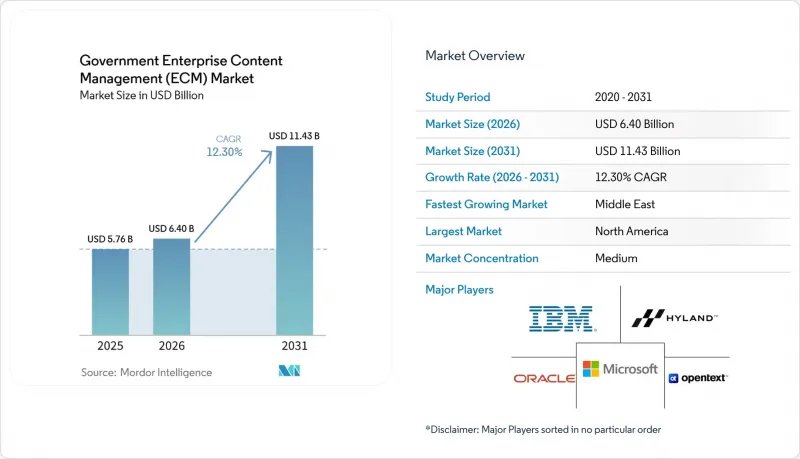
Mordor Intelligence에 의하면, 정부 기관 컨텐츠 관리(ECM) 시장 규모는 2025년에 57억 6,000만 달러로 평가되었고, 2026-2031년 CAGR 12.30%로 추정되고, 2031년에는 114억 3,000만 달러에 이를 것으로 예측됩니다.
본 보고서는 솔루션 유형별(문서 관리, 기록 관리, 워크플로우 및 비즈니스 프로세스 관리, 디지털 자산 관리, 웹 컨텐츠 관리 등), 배포 방식별(온프레미스, 클라우드, 하이브리드), 기업 규모별(중소기업, 대기업) 및 지역별로 분류되어 있습니다. 시장 전망은 금액(달러)으로 제시되어 있습니다.
세계의 정부 기관 컨텐츠 관리(ECM) 시장 동향 및 인사이트
규제 준수 의무가 컨텐츠 거버넌스 기준을 재정의
규제 의무는 기록 관리를 일회성 소프트웨어 프로젝트가 아닌 지속적인 운영상의 필요성으로 전환시키기 때문에 정부 기관 컨텐츠 관리(ECM) 시장에서 여전히 가장 지속적인 수요 동력으로 작용하고 있습니다. NARA는 2026년 연방 보고 주기를 시작하며, 각 기관에 해당 주기 내에 ‘기록 관리 자체 평가’, ‘연방 전자 기록 및 이메일 관리 보고서’, 그리고 ‘기록 관리 담당 고위 기관 직원 연례 보고서’를 제출할 것을 의무화했습니다. 또한 NARA의 2024년 연방 기록 보고서에 따르면, 44%의 기관이 5테라바이트 미만의 영구적인 이메일 및 전자 기록을 보유하고 있는 반면, 5개 기관은 100페타바이트 이상을 보유하고 있어 컨텐츠 플랫폼이 관리해야 하는 규모의 차이가 뚜렷이 드러나고 있습니다. 이러한 의무로 인해 규정 준수를 충족하는 저장소 도입을 미루는 것은 점점 더 어려워지고 있습니다. 왜냐하면 이를 갖추지 못한 기관은 감사 지적, 법적 위험, 그리고 시정에 막대한 비용이 드는 기록 이관 지연에 직면하게 되기 때문입니다. 유럽에서도 유사한 추세가 나타나고 있으며, 전자 인증 및 신뢰 서비스에 관한 요건으로 인해 정부 기관은 인증된 기록이나 법적으로 인정된 디지털 서명을 처리할 수 있는 시스템에 집중할 수밖에 없는 상황에 놓여 있습니다.
정부 비정형 데이터 양 증가가 레거시 아키텍처에 부담을 주고 있습니다.
정부 기관 컨텐츠 관리(ECM) 시장도 비정형 정부 데이터의 양과 복잡성 덕분에 혜택을 보고 있습니다. 현재 이러한 데이터는 스캔된 문서에 그치지 않고 이메일, 동영상, 채팅, 사건 기록까지 확대되고 있습니다. 2026년, 미국 정부 기관 관계자는 디지털 기록의 처리량이 급격히 증가하고 있다고 밝혔습니다. 국무부는 향후 몇 년 동안 외교 공전의 기밀 해제 작업량이 5배로 증가할 것으로 예측하고 있으며, FDIC(연방예금보험공사)는 자동 분류와 라이프사이클 관리가 필요한 비정형 컨텐츠가 대폭 증가하고 있다고 설명했습니다. 240개 이상의 정부 기관을 대상으로 한 2025년 벤치마크 조사에 따르면, 정보 공개 청구에 관련된 평균 파일 크기는 2018년 이후 438% 증가했으며, 동영상 파일만 해도 173% 증가한 것으로 나타났습니다. 이러한 부담은 고르게 분산되어 있지 않습니다. AI 프로그램을 적극적으로 추진하고 있는 기관에서는 훈련 코퍼스,추론 로그, 감사 추적 기록도 생성되고 있으며, 이들이 거버넌스 대상 컨텐츠에 새로운 계층을 더하고 있기 때문입니다. 영국의 AI 인사이트 프레임워크에서는 비정형 데이터 관리가 효과적인 운영과 설명 책임에 필수적이라고 명시하고 있으며, 이와 유사한 거버넌스의 필요성이 미국 이외의 지역으로도 확산되고 있음을 보여줍니다.
보안 및 개인정보 보호 우려로 인해 클라우드 ECM 도입이 복잡해지고 있습니다.
정부 기관이 원칙적으로 클라우드를 통한 현대화를 지지하고 있음에도 불구하고, 보안 및 개인정보 보호에 대한 우려가 정부 기관 컨텐츠 관리(ECM) 시장의 성장을 여전히 둔화시키고 있습니다. NARA(국립공문서기록관리청) 감사총감실이 실시한 2025년 감사 결과, ERA 2.0은 대규모 데이터 세트를 처리할 기술적 역량이 부족하며, 파일 크기 및 보안 설정 제한으로 인해 등록된 비기밀 기록 71테라바이트가 시스템 외부에 저장되어 있는 것으로 밝혀졌습니다. 또한, 2025년 1월 CISA가 발표한 제로 트러스트 아키텍처 관련 지침에서는 컨텐츠 거버넌스를 신원 기반 접근 제어, 지속적인 검증, 그리고 모든 트랜잭션에 대한 변조 방지 기능을 갖춘 감사 로그가 필요한 엔터프라이즈 보안 과제로 규정했습니다. 모바일 액세스는 현장 직원과 원격 근무자에게 규정 준수상의 새로운 과제가 되기 때문에 정부 기관은 ECM을 고정된 사무실 환경 밖으로 확대하기 전에 추가적인 통제 조치를 취해야 하는 경우가 많습니다. 정부 기관이 이러한 보안 요구 사항을 조기에 명확히 하지 않을 경우, 조달에 시간이 오래 걸리고 도입 후 시정 조치에 드는 비용도 높아집니다.
부문 분석
2025년, 기록 관리는 정부 기관 컨텐츠 관리(ECM) 시장 점유율의 26.44%를 차지했으며, 이 부문에서 가장 큰 솔루션 유형이 되었습니다. 이 부문이 선두를 유지하는 이유는 기록 보관, 정보공개법(FOIA) 준수, 소송 보류 및 감사 추적 요건이 연방, 주 및 지방 기관 모두에게 여전히 기본적인 업무상의 요구 사항이기 때문입니다. 이러한 규정 준수의 중요성으로 인해, 기관이 예산 압박에 직면해 있더라도 기록 관리는 관련 도구에 비해 도입을 미루기 어렵습니다. 문서 관리, 워크플로우 및 비즈니스 프로세스 관리는 허가 절차, 보조금, 계약, 서비스 제공의 디지털화가 모두 관리된 보관 장소와 연계된 구조화된 라우팅에 의존하고 있기 때문에 계속해서 큰 비중을 차지하고 있습니다.
케이스 관리는 2031년까지 연평균 성장률(CAGR) 12.67%를 나타낼 것으로 예측되며, 정부 기관 컨텐츠 관리(ECM) 시장에서 가장 빠르게 성장하는 솔루션 분야가 될 전망입니다. 수요가 확대되고 있는 배경에는 시민 대상 업무 전반에 걸쳐 각 기관에서 급여, 법 집행, 허가 처리, 사법 워크플로우를 보다 구조화된 형태로 처리해야 할 필요성이 대두되고 있기 때문입니다. ECOWAS(서아프리카 국가 경제 공동체) 사법 재판소는 2026년 6월에 전자 사건 관리 시스템을 도입했습니다. 이는 공공 기관이 대규모의 안전한 전자 파일 관리, 문서 처리 및 온라인 심리로 전환하고 있음을 보여주는 사례입니다. 웹 컨텐츠 관리, 디지털 자산 관리 및 기타 전문 도구의 규모는 여전히 작지만, 각 기관이 플랫폼을 통합하고 AI를 활용한 워크플로우를 거버넌스가 적용된 기록과 연계함에 따라 이러한 도구들은 핵심 ECM과 점점 더 밀접하게 연결되고 있습니다.
지역별 분석
2025년, 북미는 정부 기관 컨텐츠 관리(ECM) 시장 점유율의 40.28%를 차지하며 가장 규모가 큰 지역 클러스터가 되었습니다. 이 지역의 우위는 미국 연방 정부의 기록 관리 의무 규모, 기관 수의 많음, 그리고 승인된 클라우드 및 AI 솔루션을 제공하는 벤더 증가에 기인합니다. 2025년 연방 정부의 AI 이용 사례 조사에서는 56개 기관이 대상으로 선정되었으며, 각 기관이 거버넌스가 적용된 컨텐츠 계층에 의존하는 AI 도구를 이미 얼마나 광범위하게 활용하고 있는지가 드러났습니다. 캘리포니아주는 70개 이상의 부서와 2,700명 이상의 직원이 참여한 시범 프로젝트를 거쳐, 2026년 6월 생성형 AI 플랫폼 ‘Poppy’를 주 전역으로 확대했습니다. 이는 안전한 컨텐츠 관리에 대한 주 차원 수요가 확대되고 있음을 시사합니다. 또한 Oracle은 2026년 3월, 미국 연방 정부 기관을 대상으로 ‘AI 데이터 플랫폼’을 출시하며, 북미가 보안을 중시하는 고부가가치 컨텐츠 플랫폼에 대한 투자에서 가장 활발한 지역임을 입증했습니다.
유럽은 정부 기관 컨텐츠 관리(ECM) 시장에서 2위의 규모를 자랑하며, 여전히 엄격한 디지털 ID 및 시민 데이터 관련 요건의 영향을 받고 있습니다. 이 지역의 공공 기관들은 컨텐츠 관리에 관한 의사결정을 인증된 기록 처리, 개인정보 관리, 그리고 주권적인 디지털 인프라 구축을 위한 노력과 지속적으로 연계하고 있습니다. 프랑스의 부처 간 웹 컨텐츠 관리 접근 방식은 여러 부처의 통합이 공공 부문 ECM 시장에 큰 기회를 창출할 가능성을 보여줍니다. 독일, 영국, 프랑스는 계속해서 지역 내 조달을 주도하고 있는 반면, 동유럽 회원국들은 EU의 광범위한 디지털 서비스 목표에 부합하도록 디지털화를 추진하고 있습니다.
정부 기관 컨텐츠 관리(ECM) 시장 규모 측면에서 중동 부문은 2031년까지 연평균 성장률(CAGR) 12.96%를 나타낼 것으로 예측되며, 이는 지역 시장 중 가장 빠르게 성장하는 시장이 될 것입니다. 아랍에미리트(UAE)에서는 2026년 5월, 세무 감사, 조달, 고객 서비스, 기술 지원 각 분야에서 UAE 최초의 에이전틱 AI 도구의 첫 번째 버전이 정부 기관에서 운영을 시작했습니다. 이로 인해 거버넌스가 적용된 컨텐츠와 감사 추적 기록에 대한 안정적인 수요가 발생하고 있습니다. 아시아태평양도 일본의 전자 행정 문서 관리 시스템 개편 및 정부 활용을 위한 AI 대응 컨텐츠 데이터 정비와 같은 프로그램을 통해 성장세를 보이고 있습니다. 남미 및 아프리카는 정부 기관 컨텐츠 관리(ECM) 시장에서 여전히 점유율은 작지만, 디지털 정부 전략의 진전에 따라 도입 범위가 가장 성숙한 지역을 넘어 확대되고 있는 것으로 나타났습니다.
기타 혜택 :
- 엑셀 형식 시장 예측(ME) 시트
- 3개월간의 애널리스트 지원
자주 묻는 질문
목차
제1장 서론
제2장 조사 방법
제3장 주요 요약
제4장 시장 구도
제5장 시장 규모 및 성장 예측
제6장 경쟁 구도
제7장 시장 기회 및 향후 전망
AJY 26.09.03According to Mordor Intelligence, the government enterprise content management (ECM) market size was valued at USD 5.76 billion in 2025 and is forecast to reach USD 11.43 billion by 2031 at a CAGR of 12.30% from 2026 to 2031.
This report is Segmented by Solution Type (Document Management, Records Management, Workflow and Business Process Management, Digital Asset Management, Web Content Management, and More), Deployment Mode (On-Premises, Cloud, and Hybrid), Enterprise Size (Small and Medium Enterprises, and Large Enterprises), and Geography. The Market Forecasts are Provided in Terms of Value (USD).
Global Government Enterprise Content Management (ECM) Market Trends and Insights
Regulatory Compliance Mandates Redefine Content Governance Standards
Regulatory obligations remain the most durable demand driver in the Government Enterprise Content Management (ECM) market because they turn records control into a recurring operating need rather than a one-time software project. NARA opened the 2026 federal reporting cycle and required agencies to submit the Records Management Self-Assessment, the Federal Electronic Records and Email Management Report, and the Senior Agency Official for Records Management Annual Report in the same cycle. NARA's 2024 federal records report also showed that 44% of agencies held less than 5 terabytes of permanent email and electronic records, while 5 agencies held more than 100 petabytes, which highlights the scale differences that content platforms must manage. These obligations make compliant repositories harder to postpone because agencies without them face audit findings, legal exposure, and transfer backlogs that are costly to correct. The same pattern is evident in Europe, where electronic identification and trust service requirements keep government bodies focused on systems capable of processing authenticated records and legally recognized digital signatures.
Growth in Government Unstructured Data Volumes Strains Legacy Architectures
The Government Enterprise Content Management (ECM) market is also benefiting from the volume and complexity of unstructured government data, which now extends well beyond scanned documents to email, video, chat, and case records. U.S. agency officials said in 2026 that digital records workloads are rising rapidly, with the State Department expecting its cable declassification workload to grow fivefold in the coming years, and the FDIC describing a massive rise in unstructured content that requires automated categorization and lifecycle control. A 2025 benchmark covering more than 240 agencies found that the average file size tied to public records requests had grown 438% since 2018, and that video files alone were up 173%. The pressure is not evenly spread because agencies with active AI programs are also creating training corpora, inference logs, and audit trails that add new layers of governed content. The United Kingdom's AI insights framework described unstructured data management as vital to effective operations and accountability, indicating that the same governance need extends beyond the United States.
Security and Privacy Concerns Complicate Cloud ECM Adoption
Security and privacy concerns continue to slow the Government Enterprise Content Management (ECM) market, even as agencies support cloud modernization in principle. A 2025 audit by NARA's Office of Inspector General found that ERA 2.0 lacked the technical capability to ingest large datasets and that 71 terabytes of accessioned unclassified records were stored outside the system due to file-size and security configuration limits. CISA's zero-trust architecture guidance, issued in January 2025, also framed content governance as an enterprise security issue that requires identity-based access controls, continuous validation, and tamper-evident audit logs for every transaction. Mobile access adds another compliance layer for field staff and remote workers, so agencies often need additional controls before they can extend ECM beyond fixed office environments. When agencies do not map these security requirements early, procurement takes longer, and post-deployment remediation becomes more expensive.
Other drivers and restraints analyzed in the detailed report include:
- Shift to Cloud-Native ECM Deployments Unlocks Operational Scale
- AI-Driven Content Intelligence and Hyper-Automation Redefine Workflow Efficiency
- Legacy Repository Modernization Complexity Lengthens Procurement and Deployment Cycles
For complete list of drivers and restraints, kindly check the Table Of Contents.
Segment Analysis
Records management held 26.44% of the Government Enterprise Content Management (ECM) market share in 2025, making it the largest solution type in the category. The segment stayed in front because records retention, FOIA response, litigation hold, and audit trail requirements remain basic operating needs for federal, state, and local agencies. That compliance weight makes records management harder to delay than adjacent tools, even when agencies are under budget pressure. Document management, workflow, and business process management continue to capture meaningful spending because digitized permitting, grants, contracting, and service delivery all depend on structured routing tied to controlled storage.
Case management is projected to grow at a 12.67% CAGR through 2031, making it the fastest-growing solution area in the Government Enterprise Content Management (ECM) market. Demand is expanding because agencies need more structured handling of benefits, enforcement, permit processing, and judicial workflows across citizen-facing operations. The ECOWAS Community Court of Justice launched an electronic case management system in June 2026, which showed how public bodies are moving toward secure digital filing, document handling, and virtual hearings at scale. Web content management, digital asset management, and other specialized tools remain smaller, yet they are increasingly being pulled closer to core ECM as agencies consolidate platforms and connect AI-enabled workflows to governed records.
Complete Report Scope:
- By Solution Type
- Document Management
- Records Management
- Workflow and Business Process Management
- Case Management
- Digital Asset Management
- Web Content Management
- Other Solutions
- By Deployment Mode
- On-Premises
- Cloud
- Hybrid
- By Enterprise Size
- Small and Medium Enterprises
- Large Enterprises
- By Geography
- North America
- United States
- Canada
- Mexico
- South America
- Brazil
- Argentina
- Rest of South America
- Europe
- United Kingdom
- Germany
- France
- Rest of Europe
- Asia Pacific
- China
- Japan
- India
- South Korea
- Australia
- Rest of Asia Pacific
- Middle East
- United Arab Emirates
- Saudi Arabia
- Rest of Middle East
- Africa
- South Africa
- Kenya
- Rest of Africa
- North America
Geography Analysis
North America held 40.28% of the the Government Enterprise Content Management (ECM) market share in 2025, making it the largest regional cluster. The region's lead comes from the scale of U.S. federal records obligations, the size of its agency base, and the growing bench of vendors with approved cloud and AI offerings. The 2025 federal AI use case inventory covered 56 agencies and showed how widely agencies are already applying AI tools that depend on governed content layers. California expanded its Poppy generative AI platform statewide in June 2026 after a pilot that involved more than 70 departments and more than 2,700 employees, which points to broader state-level demand for secure content controls. Oracle also launched its AI Data Platform for U.S. federal agencies in March 2026, reinforcing North America as the most active zone for premium, security-led content platform spending.
Europe ranked as the second-largest region in the Government Enterprise Content Management (ECM) market and remains shaped by strict digital identity and citizen data requirements. Public bodies across the region continue to tie content management decisions to authenticated records handling, privacy control, and the push for sovereign digital infrastructure. France's shared web content management approach across ministries shows how multi-ministry consolidation can create large public sector ECM opportunities. Germany, the United Kingdom, and France continue to lead regional procurement, while Eastern European member states are advancing digitization in line with broader EU digital service goals.
The Middle East segment of the Government Enterprise Content Management (ECM) market size is projected to grow at 12.96% CAGR through 2031, which makes it the fastest-growing regional market. The UAE's first batch of agentic AI tools entered government use in May 2026 across tax audits, procurement, customer service, and technical support, which creates steady demand for governed content and audit trails. Asia Pacific is also building momentum through programs such as Japan's renewed electronic administrative document management system and its AI-ready content data buildout for government use. South America and Africa remain smaller positions in the Government Enterprise Content Management (ECM) market, yet digital government strategies show that adoption is widening beyond the most mature regions.
- Microsoft Corporation
- OpenText Corporation
- IBM Corporation
- Oracle Corporation
- Hyland Software, Inc.
- Adobe Inc.
- Box, Inc.
- M-Files Corporation
- Laserfiche, Inc.
- DocuWare GmbH
- SAP SE
- Xerox Corporation
- Newgen Software Technologies Limited
- SER Group GmbH
- Fabasoft AG
- Alfresco Software, Inc.
- KnowledgeLake, Inc.
- iManage LLC
- Egnyte, Inc.
- Everteam Global Services
Additional Benefits:
- The market estimate (ME) sheet in Excel format
- 3 months of analyst support
TABLE OF CONTENTS
1 INTRODUCTION
- 1.1 Study Assumptions and Market Definition
- 1.2 Scope of the Study
2 RESEARCH METHODOLOGY
3 EXECUTIVE SUMMARY
4 MARKET LANDSCAPE
- 4.1 Market Overview
- 4.2 Market Drivers
- 4.2.1 Regulatory Compliance Mandates for Content Lifecycle Governance
- 4.2.2 Explosion of Government Unstructured Data Volumes
- 4.2.3 Accelerated Shift to Cloud-Native ECM Deployments
- 4.2.4 AI-Driven Content Intelligence and Hyper-Automation
- 4.2.5 Citizen-Service Workflow Standardization Across Agencies
- 4.2.6 Zero-Trust Content Security and Auditability Requirements
- 4.3 Market Restraints
- 4.3.1 Security and Privacy Concerns in Cloud and Mobile ECM
- 4.3.2 Cross-Border Data Residency and Sovereignty Constraints
- 4.3.3 Legacy Repository Modernization Complexity in Public Agencies
- 4.3.4 Procurement Friction from Multi-Agency Integration and Validation Cycles
- 4.4 Industry Value Chain Analysis
- 4.5 Impact of Macroeconomic Factors on the Market
- 4.6 Regulatory Landscape
- 4.7 Technological Outlook
- 4.8 Porter's Five Forces Analysis
- 4.8.1 Bargaining Power of Suppliers
- 4.8.2 Bargaining Power of Buyers
- 4.8.3 Threat of New Entrants
- 4.8.4 Threat of Substitutes
- 4.8.5 Competitive Rivalry
5 MARKET SIZE AND GROWTH FORECASTS (VALUE)
- 5.1 By Solution Type
- 5.1.1 Document Management
- 5.1.2 Records Management
- 5.1.3 Workflow and Business Process Management
- 5.1.4 Case Management
- 5.1.5 Digital Asset Management
- 5.1.6 Web Content Management
- 5.1.7 Other Solutions
- 5.2 By Deployment Mode
- 5.2.1 On-Premises
- 5.2.2 Cloud
- 5.2.3 Hybrid
- 5.3 By Enterprise Size
- 5.3.1 Small and Medium Enterprises
- 5.3.2 Large Enterprises
- 5.4 By Geography
- 5.4.1 North America
- 5.4.1.1 United States
- 5.4.1.2 Canada
- 5.4.1.3 Mexico
- 5.4.2 South America
- 5.4.2.1 Brazil
- 5.4.2.2 Argentina
- 5.4.2.3 Rest of South America
- 5.4.3 Europe
- 5.4.3.1 United Kingdom
- 5.4.3.2 Germany
- 5.4.3.3 France
- 5.4.3.4 Rest of Europe
- 5.4.4 Asia Pacific
- 5.4.4.1 China
- 5.4.4.2 Japan
- 5.4.4.3 India
- 5.4.4.4 South Korea
- 5.4.4.5 Australia
- 5.4.4.6 Rest of Asia Pacific
- 5.4.5 Middle East
- 5.4.5.1 United Arab Emirates
- 5.4.5.2 Saudi Arabia
- 5.4.5.3 Rest of Middle East
- 5.4.6 Africa
- 5.4.6.1 South Africa
- 5.4.6.2 Kenya
- 5.4.6.3 Rest of Africa
- 5.4.1 North America
6 COMPETITIVE LANDSCAPE
- 6.1 Market Concentration
- 6.2 Strategic Moves
- 6.3 Market Share Analysis
- 6.4 Company Profiles (includes Global Level Overview, Market Level Overview, Core Segments, Financials as available, Strategic Information, Market Rank/Share, Products and Services, Recent Developments)
- 6.4.1 Microsoft Corporation
- 6.4.2 OpenText Corporation
- 6.4.3 IBM Corporation
- 6.4.4 Oracle Corporation
- 6.4.5 Hyland Software, Inc.
- 6.4.6 Adobe Inc.
- 6.4.7 Box, Inc.
- 6.4.8 M-Files Corporation
- 6.4.9 Laserfiche, Inc.
- 6.4.10 DocuWare GmbH
- 6.4.11 SAP SE
- 6.4.12 Xerox Corporation
- 6.4.13 Newgen Software Technologies Limited
- 6.4.14 SER Group GmbH
- 6.4.15 Fabasoft AG
- 6.4.16 Alfresco Software, Inc.
- 6.4.17 KnowledgeLake, Inc.
- 6.4.18 iManage LLC
- 6.4.19 Egnyte, Inc.
- 6.4.20 Everteam Global Services
7 MARKET OPPORTUNITIES AND FUTURE OUTLOOK
- 7.1 White-Space and Unmet-Need Assessment


