

|
시장보고서
상품코드
2100576
BYOD 시장 : 점유율 분석, 업계 동향 및 통계, 성장 예측(2026-2031년)BYOD - Market Share Analysis, Industry Trends & Statistics, Growth Forecasts (2026 - 2031) |
||||||
 Mordor Intelligence
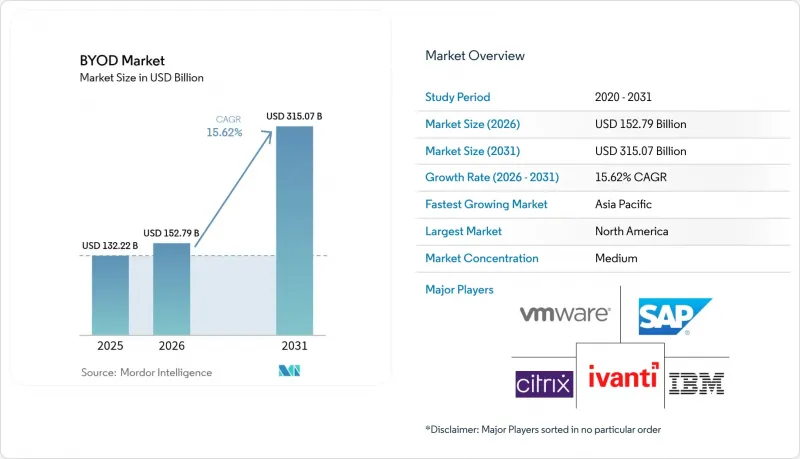
Mordor Intelligence에 의하면, BYOD 시장 규모는 2025년에 1,322억 2,000만 달러로 평가되었고 2026년 1,527억 9,000만 달러에서 2031년까지 3,150억 7,000만 달러에 이를 것으로 예측되며, 예측 기간(2026-2031년) CAGR은 15.62%를 나타낼 전망입니다.
본 보고서는 배포 방식(On-Premise·클라우드), 기기 유형(스마트폰, 태블릿 등), 보안 솔루션(모바일 기기 관리(MDM), 통합 엔드포인트 관리(UEM) 등), 조직 규모(대기업, 중소기업(SME)), 최종 사용자 업종(IT 및 통신, 의료, 기타), 지역별로 분류되어 있습니다. 시장 전망은 금액(달러) 기준으로 제시되어 있습니다.
전 세계 BYOD 시장 동향과 인사이트
5G 지원 스마트 기기의 보급이 기업 내 도입을 가속화
아시아태평양 7개국에서 상용 5G 독립형(SA) 네트워크가 도입됨에 따라, 저지연 공장 자동화, 거의 실시간에 가까운 원격 의료, 영상을 많이 활용하는 현장 서비스 업무 등이 가능해졌으며, 이 모든 것이 직원 소유의 엔드포인트에서 원활하게 작동하고 있습니다. GSMA의 예측에 따르면, 2030년까지 5G는 아시아태평양 경제에 약 1,300억 달러를 기여할 것으로 예상되며, 그 대부분은 통합 엔드포인트 관리에 의존하는 스마트 팩토리 및 스마트 그리드 용도과 관련되어 있습니다. 이러한 데이터 집약적 작업으로 인해 대역폭을 최적화하고, 기밀성이 높은 트래픽을 자동으로 분류하며, 현장에서 규정 준수를 철저히 이행하는 AI 기반 정책 오케스트레이션의 필요성이 더욱 높아지고 있습니다. 따라서 프라이빗 5G 네트워크를 도입하는 기업들은 무선 환경을 고려한 정책 설정과 행동 분석을 결합한 UEM 솔루션의 도입을 의무화하고 있습니다. 동시에, 기기 제조업체들은 전용 AI 추론 엔진을 탑재하고 있어, 이를 통해 위협 감지 및 데이터 유출 방지를 로컬에서 수행할 수 있게 되었습니다. 이를 통해 클라우드로의 데이터 전송 비용이 절감되며, 개인정보는 엣지 디바이스 상에 보관됩니다.
하이브리드 근무 정책의 정착이 UEM 투자를 촉진
현재 미국 및 유럽의 다국적 기업 중 3분의 2가 하이브리드 근무를 영구적인 운영 모델로 공식적으로 정하고 있습니다. 이러한 변화로 인해 IT 팀은 기업 네트워크 경계를 훨씬 넘어선 곳에 위치한, 관리 대상 외의 노트북, 태블릿, 스마트폰을 모니터링할 수밖에 없게 되었습니다. 2024년에는 클라우드 네이티브 Intune 테넌트 수가 두 자릿수 성장률을 기록했는데, 이러한 추세를 뒷받침하는 것은 첫 로그인 전에 보안 기준, 인증서, 용도 세트를 푸시하는 제로 터치 프로비저닝입니다. Kusto Query Language를 활용한 실시간 분석을 통해 보안 팀은 몇 초 만에 여러 기기에 걸친 텔레메트리 정보를 확보할 수 있습니다. AI를 활용한 코파일럿 기능은 이상 현상의 우선순위를 지정하고 즉각적인 시정 조치를 권장함으로써, 사용자가 가정용 광대역 인터넷을 통해 접속하는 경우에도 사고 대응 주기를 단축합니다. 그 결과, 헬프데스크 문의 건수가 눈에 띄게 감소하고 평균 복구 시간(MTTR)도 단축되어, 엔드포인트 운영을 효율화하라는 CIO의 요청을 뒷받침하고 있습니다.
관리되지 않는 엔드포인트와 관련된 사이버 보험료 인상
랜섬웨어로 인한 보험금 청구가 급증하는 가운데, 보험사는 모바일 기기의 보안 상태를 엄격하게 심사하고 있습니다. 엔드포인트 가시성이 부족한 조직의 경우, 보험료가 최대 20% 인상될 가능성이 있습니다. 보험사는 보험 계약을 체결하기 전에 지속적인 모니터링, 정책 기반 암호화, 검증 가능한 백업 절차에 대한 증명을 점점 더 요구하고 있습니다. 이에 대응하여 각 벤더사는 머신 러닝을 활용한 이상 감지 기능과 모바일, 데스크톱, 가상 머신을 아우르는 통합 보고 기능을 도입하고 있습니다. 자동화된 플레이북을 통해 고위험 기기를 격리하거나 초기화함으로써, 위험 완화에 대한 보험 수리적 증거가 생성됩니다. 규정 준수 대시보드에서 증명 보고서를 보험사에 직접 내보낼 수 있으므로, 수작업에 따른 행정 업무가 줄어들고 계약 갱신 성과가 향상됩니다.
부문 분석
클라우드 부문은 2025년 BYOD 시장 점유율의 63.05%를 차지하며, 연평균 성장률(CAGR) 16.55%로 확대될 것으로 예측됩니다. 조직들은 직원 소유의 스마트폰, 태블릿, 노트북 전반에 걸쳐 실시간 분석, 자동 복구, 정책 상속 기능을 제공하는 SaaS형 UEM 플랫폼으로 워크로드를 이전하고 있습니다. On-Premise 도입은 에어갭이 확보된 정부 연구소나 특정 방위 시설에서 여전히 이루어지고 있지만, 설비 투자, 업그레이드 빈도, 숙련된 인력 확보와 같은 요건들이 추가적인 확장을 저해하고 있습니다.
클라우드 네이티브 생태계는 지속적인 기능 제공, 내장형 SOC 통합, 직무 분리를 용이하게 하는 세밀한 역할 기반 접근 제어를 제공합니다. 마이크로소프트의 'Advanced Analytics' 모듈은 디바이스의 규정 준수 동향을 가시화하고, 조건부 액세스 규칙을 자동으로 제안함으로써 몇 시간 이내에 제로 트러스트 체제를 강화합니다. 규정 준수 툴킷은 설정을 ISO 27001 및 HIPAA 체크포인트와 대조하여, 필요 시 즉시 감사에 대응할 수 있는 결과물을 생성합니다. 이러한 이점들이 도입 부문의 우위를 뒷받침하며, BYOD 시장의 장기적인 성장 궤도를 강화하고 있습니다.
스마트폰, 태블릿, 노트북은 여전히 일상적인 생산성의 핵심이지만, 웨어러블 기기나 XR 헤드셋도 규제 대상 워크플로우에 빠르게 도입되고 있습니다. 병원에서는 핸즈프리로 환자 차트를 확인할 수 있는 스마트글래스의 시범 도입이 진행되고 있으며, 공장에서는 재고 확인을 효율화하기 위해 손목 착용형 스캐너가 채택되고 있습니다. 현재로서는 BYOD 시장 점유율에서 두 자릿수를 넘는 웨어러블 카테고리는 존재하지 않지만, 그 성장률은 클라우드 도입에 이어 두 번째로 높습니다. UEM 플랫폼은 현재 센서, 카메라, 공간 컴퓨팅 인터페이스에 대한 정책 기반 관리를 지원하며, 이는 제로 트러스트 프레임워크 내에 포함되어야 하는 지속적으로 확장되는 보안 경계를 반영합니다.
Windows, Android, iOS, macOS, Vision-OS를 아우르는 플랫폼은 기기 간 문제 해결 및 소프트웨어 배포의 필요성을 부각시키고 있습니다. 실시간 패치 적용 조정, 원격 정지, 선택적 데이터 분할을 통해 직원이 기기를 전환하더라도 정보 흐름에 대한 규정 준수가 유지됩니다. 스페이스 컴퓨팅이 성숙해짐에 따라, 시야 데이터를 분류하고 규제 대상 환경 내에서의 스크린샷을 제한하는 API 후크가 확대될 것으로 예측됩니다.
지역별 분석
북미의 BYOD 시장 점유율 38.10%는 제로 트러스트 요건의 조기 도입과 광범위한 클라우드 인프라에 기인합니다. 금융 서비스 및 의료 기관은 지속적인 규정 준수 증명을 필요로 하며, 이는 모든 기기 세션을 검사하는 분석 주도형 UEM 플랫폼의 보급을 촉진하고 있습니다. NIST 800-207을 참조하는 연방 정부의 지침에 따라 제로 트러스트는 기준으로 더욱 제도화되고 있으며, 중견 기업조차도 레거시 MDM을 업그레이드할 수밖에 없는 상황입니다.
아시아태평양은 성장의 원동력이며, 연평균 성장률(CAGR) 16.02%로 확대되고 있습니다. GSMA는 5G를 활용한 엔터프라이즈 용도를 배경으로, 이 지역의 모바일 경제가 2030년까지 1조 달러를 넘어설 것으로 예측했습니다. 싱가포르의 ‘스마트 네이션’ 프로그램과 호주의 사이버 복원력 정책은 인근 시장에도 파급 효과를 미치는 벤치마크가 되고 있습니다. 다양한 데이터 주권 규제를 고려할 때, 현지화된 데이터센터와 다국어 지원을 갖춘 벤더가 우위를 점하고 있습니다.
유럽에서는 GDPR(EU 개인정보보호규정)에 따른 개인정보 보호 요건이 원동력이 되어 꾸준한 성장세를 유지하고 있습니다. 직원 대표 위원회가 기기 검사 권한을 제한하는 경우가 많기 때문에 개인 데이터를 존중하는 앱 중심의 관리 및 선택적 데이터 삭제 기능에 대한 수요가 증가하고 있습니다. 중동 및 아프리카는 시장 점유율 면에서는 뒤처져 있지만, 각국 정부가 공공 서비스의 디지털화와 5G 커버리지 확대를 추진함에 따라 관심이 높아지고 있습니다. 어느 지역에서든 해당 지역에 맞춘 규정 준수 툴킷과 국내 데이터 상주 요건은 여전히 중요한 판매 포인트로 작용하고 있습니다.
기타 혜택:
- 엑셀 형식 시장 예측(ME) 시트
- 3개월간의 애널리스트 지원
자주 묻는 질문
목차
제1장 서론
제2장 조사 방법
제3장 주요 요약
제4장 시장 구도
제5장 시장 규모와 성장 예측
제6장 경쟁 구도
제7장 시장 기회와 향후 전망
JHS 26.08.11According to Mordor Intelligence, the BYOD market size was valued at USD 132.22 billion in 2025 and estimated to grow from USD 152.79 billion in 2026 to reach USD 315.07 billion by 2031, at a CAGR of 15.62% during the forecast period (2026-2031).
This report is Segmented by Deployment (On-Premises and Cloud), Device Type (Smartphones, Tablets, and More), Security Solution (Mobile Device Management (MDM), Unified Endpoint Management (UEM), and More), Organization Size (Large Enterprises, and Small and Mid-Sized Enterprises (SMEs)), End-User Vertical (IT and Telecom, Healthcare, and More), and Geography. The Market Forecasts are Provided in Terms of Value (USD).
Global BYOD Market Trends and Insights
Proliferation of 5G-Enabled Smart Devices Accelerates Enterprise Adoption
Commercial 5G standalone installations across seven APAC nations are enabling low-latency factory automation, near-real-time telemedicine, and video-rich field-service workflows, all of which run smoothly on employee-owned endpoints. The GSMA projects that 5G will inject almost USD 130 billion into the APAC economy by 2030, much of it tied to smart-factory and smart-grid applications that rely on unified endpoint management. These data-heavy tasks magnify the need for AI-backed policy orchestration that optimizes bandwidth, automatically classifies sensitive traffic, and enforces compliance on the fly. Enterprises adopting private 5G networks are therefore mandating UEM solutions that combine radio-aware policy setting with behavioral analytics. Device makers are simultaneously embedding dedicated AI inference engines, allowing threat detection and data-loss prevention to run locally, which lowers cloud egress costs and keeps personal information on the edge device.
Hybrid-Work Policies Becoming Permanent Drive UEM Investment
Two-thirds of U.S. and European multinationals have now codified hybrid work as a permanent operating model. That shift forces IT teams to supervise unmanaged laptops, tablets, and phones far outside the corporate network perimeter. Cloud-native Intune tenants grew by double digits in 2024, a trend propelled by zero-touch provisioning that pushes security baselines, certificates, and application sets before the first login. Real-time analytics using Kusto Query Language provide security teams with cross-device telemetry in seconds. AI-supported copilot features triage anomalies and recommend immediate mitigation steps, shortening incident response cycles even when users connect from residential broadband. The outcome is a measurable reduction in help-desk tickets and lower mean-time-to-repair, supporting CIO mandates for leaner endpoint operations.
Rising Cyber-Insurance Premiums Linked to Unmanaged Endpoints
Underwriters are scrutinizing mobile-device hygiene as ransomware claims spike. Organizations with insufficient endpoint visibility face premium hikes of up to 20%. Insurers increasingly require proof of continuous monitoring, policy-based encryption, and verifiable backup routines before binding coverage. Vendors respond by embedding machine-learning anomaly detection and unified reporting across mobile, desktop, and virtual machines. Automated playbooks isolate or wipe high-risk devices, creating actuarial evidence of risk mitigation. Compliance dashboards export attestation reports directly to insurers, reducing manual paperwork and improving renewal outcomes.
Other drivers and restraints analyzed in the detailed report include:
- Cloud-Native UEM Replacing Legacy MDM Systems
- Zero-Trust Security Mandates in Regulated Sectors
- Employee Privacy Pushback on Intrusive Agents
For complete list of drivers and restraints, kindly check the Table Of Contents.
Segment Analysis
The cloud segment accounted for 63.05% of BYOD market share in 2025 and is projected to expand at a 16.55% CAGR. Organizations are migrating workloads to SaaS UEM platforms that provide real-time analytics, automated remediation, and policy inheritance across employee-owned smartphones, tablets, and laptops. On-premise implementations persist in air-gapped government labs and certain defense installations, yet capital expense, upgrade cadence, and skilled-labor requirements hamper fresh expansion.
Cloud-native ecosystems offer continuous feature delivery, built-in SOC integrations, and granular role-based access controls that ease separation of duties. Microsoft's Advanced Analytics module surfaces device compliance trends and auto-suggests conditional-access rules, tightening zero-trust postures within hours. Compliance toolkits map configurations to ISO 27001 and HIPAA checkpoints, producing audit-friendly artifacts on demand. These benefits underpin the deployment segment's dominance and reinforce the long-term trajectory of the BYOD market.
Phones, tablets, and laptops remain the day-to-day productivity core, but wearables and XR headsets are rapidly entering regulated workflows. Hospitals pilot smart glasses for hands-free patient chart retrieval, while factories adopt wrist-worn scanners to streamline inventory checks. Although no single wearable category yet exceeds double-digit BYOD market share, growth is second only to cloud deployment adoption. UEM platforms now support policy-based management of sensors, cameras, and spatial-computing interfaces, reflecting a widening perimeter that must still fit within zero-trust frameworks.
Platform coverage across Windows, Android, iOS, macOS, and vision-OS underscores the requirement for cross-device troubleshooting and software distribution. Real-time patch orchestration, remote freezing, and selective data sharding keep information flows compliant even as employees toggle between devices. As spatial computing matures, expect expanded API hooks that classify visual-field data and restrict screen capture inside regulated environments.
Complete Report Scope:
- By Deployment
- On-Premises
- Cloud
- By Device Type
- Smartphones
- Tablets
- Laptops
- Wearables and Other Endpoints
- By Security Solution
- Mobile Device Management (MDM)
- Unified Endpoint Management (UEM)
- Mobile Application Management (MAM)
- Identity and Access Management (IAM)
- By Organization Size
- Large Enterprises
- Small and Mid-Sized Enterprises (SMEs)
- By End-User Vertical
- IT and Telecom
- Healthcare
- Government and Public Sector
- Retail
- BFSI
- Manufacturing and Automotive
- Other End-User Verticals
- By Geography
- North America
- South America
- Europe
- Asia Pacific
- Middle East and Africa
Geography Analysis
North America's 38.10% BYOD market share stems from early adoption of zero-trust mandates and extensive cloud infrastructure. Financial-services and healthcare entities require continuous compliance evidence, fueling uptake of analytics-driven UEM platforms that inspect every device session. Federal directives referencing NIST 800-207 have further institutionalized zero-trust as a baseline, compelling even mid-market firms to upgrade legacy MDM.
Asia Pacific is the growth engine, advancing at a 16.02% CAGR. GSMA projects the regional mobile economy to surpass USD 1 trillion by 2030 on the back of 5G-enabled enterprise applications. Singapore's Smart Nation program and Australia's cyber-resilience policies set benchmarks that ripple across neighboring markets. Vendors with localized data centers and multilingual support command an advantage, given diverse sovereignty rules.
Europe maintains steady momentum driven by GDPR-driven privacy requirements. Works councils often limit device inspection rights, spurring demand for app-centric management and selective-wipe features that respect personal data. The Middle East and Africa trail in share yet exhibit growing interest as governments digitize public services and expand 5G coverage. Across regions, tailored compliance toolkits and in-country data residency remain pivotal selling points.
- VMware, Inc.
- Microsoft Corporation
- IBM Corporation
- Cisco Systems, Inc.
- Citrix Systems, Inc.
- BlackBerry Limited
- Samsung Electronics Co., Ltd.
- Apple Inc.
- Alphabet Inc. (Google LLC)
- Oracle Corporation
- Hewlett Packard Enterprise Company
- Nokia Corporation (Alcatel-Lucent Enterprise)
- Ivanti, Inc. (MobileIron)
- SAP SE
- Verizon Communications Inc.
- ATandT Inc.
- Check Point Software Technologies Ltd.
- Sophos Group plc
- SOTI Inc.
- Jamf Holding Corp.
- Zoho Corp. Pvt. Ltd. (ManageEngine)
- Hexnode (Mitsogo Inc.)
- Hypori Inc.
- Broadcom Inc. (post-acquisition assets)
- 42Gears Mobility Systems Pvt. Ltd.
- Scalefusion (ProMobi Technologies)
- AirDroid (Sand Studio)
Additional Benefits:
- The market estimate (ME) sheet in Excel format
- 3 months of analyst support
TABLE OF CONTENTS
1 INTRODUCTION
- 1.1 Study Assumptions and Market Definition
- 1.2 Scope of the Study
2 RESEARCH METHODOLOGY
3 EXECUTIVE SUMMARY
4 MARKET LANDSCAPE
- 4.1 Market Overview
- 4.2 Market Drivers
- 4.2.1 Proliferation of 5G-enabled smart devices
- 4.2.2 Hybrid-work policies becoming permanent
- 4.2.3 Cloud-native UEM replacing legacy MDM
- 4.2.4 Zero-trust security mandates in regulated sectors
- 4.2.5 Cost-containment pressure in IT budgets (device CAPEX off-load)
- 4.2.6 Edge-AI on personal devices enabling secure offline workflows
- 4.3 Market Restraints
- 4.3.1 Rising cyber-insurance premiums linked to unmanaged endpoints
- 4.3.2 Employee privacy pushback on intrusive agents
- 4.3.3 Fragmentation of OS/firmware versions in emerging markets
- 4.3.4 Looming vendor consolidation post-Broadcom-VMware deal
- 4.4 Regulatory Landscape
- 4.5 Technological Outlook
- 4.6 Porter's Five Forces Analysis
- 4.6.1 Threat of New Entrants
- 4.6.2 Bargaining Power of Buyers/Consumers
- 4.6.3 Bargaining Power of Suppliers
- 4.6.4 Threat of Substitute Products
- 4.6.5 Intensity of Competitive Rivalry
- 4.7 Impact of Macroeconomic Factors on the Market
- 4.8 Investment Analysis
5 MARKET SIZE AND GROWTH FORECASTS (VALUE)
- 5.1 By Deployment
- 5.1.1 On-Premises
- 5.1.2 Cloud
- 5.2 By Device Type
- 5.2.1 Smartphones
- 5.2.2 Tablets
- 5.2.3 Laptops
- 5.2.4 Wearables and Other Endpoints
- 5.3 By Security Solution
- 5.3.1 Mobile Device Management (MDM)
- 5.3.2 Unified Endpoint Management (UEM)
- 5.3.3 Mobile Application Management (MAM)
- 5.3.4 Identity and Access Management (IAM)
- 5.4 By Organization Size
- 5.4.1 Large Enterprises
- 5.4.2 Small and Mid-Sized Enterprises (SMEs)
- 5.5 By End-User Vertical
- 5.5.1 IT and Telecom
- 5.5.2 Healthcare
- 5.5.3 Government and Public Sector
- 5.5.4 Retail
- 5.5.5 BFSI
- 5.5.6 Manufacturing and Automotive
- 5.5.7 Other End-User Verticals
- 5.6 By Geography
- 5.6.1 North America
- 5.6.2 South America
- 5.6.3 Europe
- 5.6.4 Asia Pacific
- 5.6.5 Middle East and Africa
6 COMPETITIVE LANDSCAPE
- 6.1 Market Concentration
- 6.2 Strategic Moves
- 6.3 Market Share Analysis
- 6.4 Company Profiles (includes Global-level Overview, Market-level Overview, Core Segments, Financials as available, Strategic Information, Market Rank/Share for key companies, Products and Services, and Recent Developments)
- 6.4.1 VMware, Inc.
- 6.4.2 Microsoft Corporation
- 6.4.3 IBM Corporation
- 6.4.4 Cisco Systems, Inc.
- 6.4.5 Citrix Systems, Inc.
- 6.4.6 BlackBerry Limited
- 6.4.7 Samsung Electronics Co., Ltd.
- 6.4.8 Apple Inc.
- 6.4.9 Alphabet Inc. (Google LLC)
- 6.4.10 Oracle Corporation
- 6.4.11 Hewlett Packard Enterprise Company
- 6.4.12 Nokia Corporation (Alcatel-Lucent Enterprise)
- 6.4.13 Ivanti, Inc. (MobileIron)
- 6.4.14 SAP SE
- 6.4.15 Verizon Communications Inc.
- 6.4.16 ATandT Inc.
- 6.4.17 Check Point Software Technologies Ltd.
- 6.4.18 Sophos Group plc
- 6.4.19 SOTI Inc.
- 6.4.20 Jamf Holding Corp.
- 6.4.21 Zoho Corp. Pvt. Ltd. (ManageEngine)
- 6.4.22 Hexnode (Mitsogo Inc.)
- 6.4.23 Hypori Inc.
- 6.4.24 Broadcom Inc. (post-acquisition assets)
- 6.4.25 42Gears Mobility Systems Pvt. Ltd.
- 6.4.26 Scalefusion (ProMobi Technologies)
- 6.4.27 AirDroid (Sand Studio)
7 MARKET OPPORTUNITIES AND FUTURE OUTLOOK
- 7.1 White-space and Unmet-need Assessment


