|
시장보고서
상품코드
2100592
견착식 무기 시장 : 점유율 분석, 업계 동향 및 통계, 성장 예측(2026-2031년)Shoulder-fired Weapons - Market Share Analysis, Industry Trends & Statistics, Growth Forecasts (2026 - 2031) |
||||||
 Mordor Intelligence
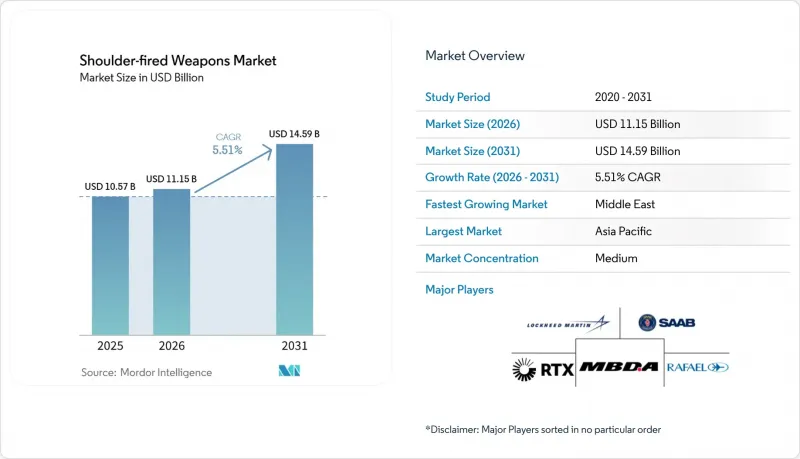
견착식 무기 시장 규모는 2025년 105억 7,000만 달러에서 2026년에는 111억 5,000만 달러로 확대되어 2026년부터 2031년까지 CAGR 5.51%로 성장을 지속하여, 2031년에는 145억 9,000만 달러에 이를 것으로 예측됩니다.
본 보고서는 기술별(유도식 및 비유도식), 무기 유형별(무반동포 등), 사거리별(단거리, 중거리, 장거리), 발사체별(발사기/배관, 발사체/미사일, 사격 통제·조준 시스템), 최종 사용자(육군, 해군, 공군, 특수작전부대 등), 지역(북미, 유럽 등)별로 분류되어 있습니다. 시장 전망은 금액(달러) 기준으로 제시되어 있습니다.
세계 견착식 무기 시장 동향과 인사이트
격화되는 비대칭 전쟁이 휴대용 대전차 무기 수요를 견인
비정규군, 도시 지역의 민병대, 그리고 소규모 원정 분대는 좁은 골목이나 험준한 계곡 속에서 주력 전차와 대치할 기회가 늘어나고 있습니다. 2024년 이후, 차세대 대전차 미사일의 전 세계 조달량은 37% 증가했습니다. 이는 사브(Saab)사가 NLAW 생산량을 4배로 확대하고, 록히드 마틴(Lockheed Martin)사가 자벨린(Javelin)의 출하량을 2.5배로 늘린 데 힘입은 결과입니다. 프로그래밍 가능한 탠덤 탄두, 최소 사거리가 단축된 신관, 그리고 소프트 발사 모터 덕분에 보병 부대는 후방으로 향하는 폭발의 영향을 받지 않고 반응 장갑을 무력화할 수 있습니다. 따라서 견착식 무기 시장은 중장비 부대보다 보병에 의존하는 모든 전선에서 혜택을 보고 있습니다.
세계 각지의 영토 분쟁이 촉진하는 국방 현대화 프로그램의 가속화
주권에 대한 우려가 고조됨에 따라, 각국 의회는 신속한 대응이 가능한 화력 확보를 위해 더 대규모의 자본 예산을 배정하고 있습니다. 2023년 아시아태평양의 국방비는 4,110억 달러에 달했으며, 일본은 2025년 납품을 목표로 칼 구스타프 발사기 300기를 조달했고, 인도는 휴대용 대전차 유도 미사일(ATGM) 개발을 완료했습니다. 북유럽에서도 유사한 추세가 나타나고 있으며, 핀란드와 스웨덴은 북극권 여단의 재편을 추진하고 있습니다. 또한, 걸프 지역에서는 경량 발사 장치가 다층적인 미사일 방어망을 보완하고 있습니다. 장기적인 산업 계획에서는 시커 생산과 국내 최종 조립을 일체화한 노력이 이루어지고 있으며, 이를 통해 전자기기 제조업체가 견착식 무기 시장에 진입하는 한편, 공급망은 최종 사용자와 가까운 곳에 자리 잡고 있습니다.
엄격한 ITAR 및 MTCR 수출 규제가 시장 진입을 제한
미국의 ‘군수품 목록(MUL)’ 및 ‘미사일 기술 통제 체제(MTCR)’는 견착식 미사일 및 탐색기용 전자기기의 이전을 제한하고 있습니다. 수출업체는 최종 사용자 증명서를 취득해야 하므로 리드타임이 길어지고 규정 준수 비용이 증가합니다. NATO에 가입하지 않은 구매자는 종종 중국 공급업체로 전환하거나 더 단순한 무반동포를 선택하기 때문에 견착식 무기 시장의 기준 성장률이 0.7퍼센트 포인트 하락하고 있습니다.
부문 분석
2025년, 유도식 무기는 72억 7,000만 달러의 매출을 기록하며 견착식 무기 시장의 68.74%를 차지했습니다. 과거에는 대형 미사일에만 탑재되던 소형 영상식 탐색기 및 관성 항법 칩의 통합으로 인해, 보병은 반격 사정거리 밖에서 이동하는 장갑차를 격파할 수 있게 되었습니다. 비유도식 시스템 부문의 견착식 무기 시장 규모는 연평균 성장률(CAGR) 7.64%로 성장할 전망입니다. 한국의 ‘레이볼트’ 블록 업그레이드는 광섬유 데이터 링크와 5km 사거리를 실현하는 모터를 융합하고 있어, 국산 연구개발이 기술 격차를 얼마나 좁혀가고 있는지를 보여주고 있습니다. 정밀도보다 비용이 우선시되는 상황에서는 비유도 로켓에 대한 수요가 여전히 뿌리 깊습니다. 그러나 새로운 소프트 발사 설계와 프로그래밍 가능한 신관 덕분에 유도탄은 좁은 시가지 골목에서도 안전하게 운용할 수 있고, 반응 장갑에 대해서도 더 효과적이기 때문에 비유도 로켓 시장 점유율은 해마다 줄어들고 있습니다.
병사가 착용하는 열화상 조준기의 채택 확대에 따라 조달 동향은 더욱 유도형 무기로 기울고 있습니다. 클라우드 기반 훈련 지원 도구를 통해 조작원의 자격 취득 기간이 수개월에서 수일로 단축되어, 징집된 병사라도 최초 배치 기간 중에 고도의 미사일을 효과적으로 발사할 수 있게 되었습니다. 생산량 증가와 단가 하락에 따라 이러한 전환은 가속화되고 있습니다. 전반적으로 경쟁적 차별화 요소는 추진 장치에서 소프트웨어 정의 시커로 이동하고 있으며, 이는 소규모 전기광학 기업들에게 견착식 무기 시장에 진입할 수 있는 좋은 기회가 되고 있습니다.
ATGM 발사 장치는 견착식 무기 시장 점유율의 35.07%를 차지하고 있습니다. 그 지속적인 매력은 우크라이나 사례에서 볼 수 있듯이, 장갑 부대에 대한 입증된 살상력에서 비롯됩니다. 이 부문에서는 지속적인 블록 업그레이드가 진행 중이며, 제이벌린(Javelin)의 경량 CLU 및 개량형 탄두가 2025년까지 미군 부대에 배치될 예정입니다(breakingdefense.com). 2025년에는 규모가 축소되겠지만, MANPADS는 8.41%라는 부문 최고 수준의 연평균 성장률(CAGR)을 나타낼 전망입니다. 이는 드론에 의한 위협과 전방 기지 주변에서 비용 대비 효과가 높은 돔형 방어 시스템에 대한 필요성에 힘입은 것입니다. 에스토니아의 대규모 ‘피오룬(Piorun)’ 프레임워크 계약은 유럽 내 최신 견착식 대공 무기에 대한 수요가 높음을 여실히 보여주고 있습니다.
무반동포는 조약을 위반하지 않으면서도 구조물 공격 능력을 부여하는 신형 탄약의 등장으로 다시 주목받고 있습니다. 미 육군의 1,600만 달러 규모 ‘칼 구스타프 M4’ 발주는 이러한 추세를 뒷받침합니다. RPG 및 SLAW 부문은 예산이 제한된 부대에서 여전히 중요성을 유지하고 있지만, 보다 정교한 시스템에 비해 상대적인 성장률은 하락하고 있습니다. 따라서 견착식 무기 시장은 단일 발사기 제품군 내에서 다목적 탄두, 모듈식 발사관, 전자 신관 프로그래밍 등의 방향으로 기울고 있습니다.
지역별 분석
아시아태평양은 33억 9,000만 달러의 매출을 창출하여 2025년 전 세계 매출의 32.12%를 차지하고 있으며, 견착식 무기 시장에서 여전히 가장 규모가 큰 지역 점유율을 유지하고 있습니다. 남중국해와 히말라야 국경 지역의 영토 분쟁으로 인해 각국 정부는 보병에게 신뢰할 수 있는 대장갑 억제력을 갖추도록 압박받고 있습니다. 일본의 2025년 칼 구스타프 발주는 40년 이상 전에 배치된 장비의 현대화를 목적으로 하고 있습니다. 필리핀은 그레이존에서의 침입을 저지하기 위해 브라모스 연안 발사 미사일을 통합하는 한편, 자벨린 도입을 모색하고 있습니다. 주야간 촬영 기능과 상부 공격 능력을 갖춘 인도의 MPATGM 시험 비행은 국내 공급망의 성숙도를 시사합니다. 이러한 동향은 휴대형 정밀 무기에 대한 지속적인 수요를 보여주며, 지역 내 공동 생산 계약의 파이프라인을 뒷받침하고 있습니다.
북미에서는 수요가 견조하면서도 지속적으로 변화하고 있습니다. 우크라이나에 대한 대규모 이전 이후, 미국은 ‘자벨린’, ‘스팅어’ 및 발사관식 시스템을 규정된 즉각 대응 수준까지 회복해야 하며, 이것이 록히드 마틴, RTX, 노스롭 그루먼과의 다년 계약의 기반이 되고 있습니다. 2025년에는 신형 경량 ‘자벨린’ 발사기가 배치되어 북극권 부대의 한랭지 신뢰성이 향상될 것입니다. 캐나다는 NATO의 탄약 호환성 목표에 부합하기 위해 칼 구스타프의 보유 수량을 증강할 계획입니다. 그 결과, 북미의 견착식 무기 시장은 보충과 현대화 양면에서 혜택을 보고 있습니다.
2024년 2월 이후, 유럽 시장 상황은 가장 크게 변화했습니다. NATO 회원국들은 분쟁 초기에 재고를 소진한 후, 긴급 작전 요건을 발표했습니다. 사브(Saab)사는 이에 대응해 NLAW의 생산량을 확대했고, 라인메탈(Rheinmetall)사는 MBDA사와 제휴하여 레이저식 대드론 포드를 개발함으로써 다층적인 방어 생태계 구축을 시사하고 있습니다. 영국의 ‘자벨린(Javelin)’ 후속 프로그램에서는 전차의 능동 방어 시스템을 무력화할 수 있는 차세대 탄두 도입을 목표로 하고 있습니다. 폴란드는 ‘자벨린’을 추가 조달하는 한편, 공급 리스크를 헤지하기 위해 국산 ATGM ‘필라트’의 개발을 추진하고 있습니다. 이처럼 유럽은 대량 구매자일 뿐만 아니라, 기술의 인큐베이터로서의 역할도 수행하고 있습니다.
중동 및 아프리카의 견착식 무기 시장은 2031년까지 연평균 성장률(CAGR) 9.21%로 성장할 전망입니다. 이스라엘이 ‘아이언 돔’, ‘데이비드 슬링’, ‘아이언 빔’을 위해 체결한 52억 달러 규모의 포괄 계약은 해당 지역이 다층적 방공 체제에 대한 투자에 적극적임을 보여줍니다. 튀르키예의 로케잔(Roketsan)사는 미사일 ‘카라오크(Karaok)’의 50m ‘급강하’ 요격 능력을 입증함으로써 국내 기술 혁신 역량을 증명하는 동시에, 걸프 국가들에 대한 수출 제안을 뒷받침했습니다. 아프리카 수요는 다양합니다. 기존 공급업체들이 수출 규제로 인한 지연에 직면한 반면, 중국 기업들은 서아프리카에 쇼룸을 개설하고 장갑차와 QN-202 발사기를 세트로 판매하고 있습니다. 이러한 동향은 남부 지역의 지속적인 성장을 시사합니다.
라틴아메리카는 시장 규모는 작지만, 국경 긴장과 범죄 대책 작전을 배경으로 때때로 수요가 급증하는 경향이 보입니다. 칠레는 산악 보병 부대를 대상으로 ‘스파이크 SR’ 탄약의 평가를 진행 중이며, 브라질 육군은 ‘아스트로스 II’ 다연장 로켓 시스템(MLRS)을 ‘아라크란’ 일회용 대구조물 발사 장치로 보완하고 있습니다. 예산 제약으로 인해 대규모 조달에는 제동이 걸려 있지만, 장비 합리화 계획에 따라 비축되어 있는 구형 로켓 추진 유탄(RPG)이 보다 새로운 무반동포로 대체될 가능성이 있습니다.
기타 혜택:
- 엑셀 형식 시장 예측(ME) 시트
- 3개월간의 애널리스트 지원
자주 묻는 질문
목차
제1장 서론
제2장 조사 방법
제3장 주요 요약
제4장 시장 구도
제5장 시장 규모와 성장 예측
제6장 경쟁 구도
제7장 시장 기회와 향후 전망
JHS 26.08.11According to Mordor Intelligence, the shoulder-fired weapons market size is expected to grow from USD 10.57 billion in 2025 to USD 11.15 billion in 2026 and is forecast to reach USD 14.59 billion by 2031 at 5.51% CAGR over 2026-2031.
This report is Segmented by Technology (Guided and Unguided), Weapon Type (Recoilless Rifles, and More), Range (Short, Medium, and Long), Projectile (Launcher/Tube, Projectile/Missile, and Fire-Control and Sighting Systems), End-User (Army, Navy, Air Force, Special Operations Forces, and More) and Geography (North America, Europe, and More). The Market Forecasts are Provided in Terms of Value (USD).
Global Shoulder-fired Weapons Market Trends and Insights
Intensifying Asymmetric Warfare Driving Demand for Portable Anti-Armor
Irregular forces, urban militias, and small expeditionary platoons increasingly face main battle tanks inside narrow streets and rugged valleys. Since 2024, global acquisitions of next-generation anti-tank missiles rose 37%, spearheaded by Saab's fourfold boost to NLAW output and Lockheed Martin's 2.5-times increase in Javelin shipments. Programmable tandem warheads, reduced minimum-range fuzes, and soft-launch motors allow dismounted squads to defeat reactive armor without exposing themselves to backblast. The shoulder-fired weapons market, therefore, benefits from every frontline that relies on infantry over heavy formations.
Accelerated Defense Modernization Programs Driven by Territorial Disputes Worldwide
Rising sovereignty concerns move parliaments to allocate larger capital budgets for quick-reaction firepower. Asia-Pacific defense outlays climbed to USD 411 billion in 2023, with Japan procuring 300 Carl-Gustaf launchers for 2025 delivery and India perfecting its man-portable ATGM. Similar trajectories appear in Northern Europe, where Finland and Sweden revamp Arctic brigades, and in the Gulf, where lightweight launchers complement layered missile shields. Long-term industrial plans bundle seeker production with domestic final assembly, pulling electronics firms into the shoulder-fired weapons market while anchoring supply chains close to end-users.
Stringent ITAR and MTCR Export Controls Limiting Market Access
The US Munitions List and the Missile Technology Control Regime restrict the transfer of shoulder-launched missiles and seeker electronics. Exporters must secure end-user certificates, delay lead times, and raise compliance costs. Buyers not aligned with NATO often shift toward suppliers in China or opt for simpler recoilless rifles, shaving 0.7 percentage points from baseline growth in the shoulder-fired weapons market.
Other drivers and restraints analyzed in the detailed report include:
- Geopolitical Conflicts Triggering Rapid Replenishment of Depleted Shoulder-Launched Inventories
- Rising Need for Cost-Effective MANPADS in Global Counter-UAV Missions
- Rising Anti-Armor Drone Swarms Reducing Demand for Short-Range ATGMs
For complete list of drivers and restraints, kindly check the Table Of Contents.
Segment Analysis
Guided solutions generated USD 7.27 billion in revenue during 2025, representing 68.74% of the shoulder-fired weapons market. Integration of compact imaging seekers and inertial navigation chips, once exclusive to larger missiles, allows infantry to defeat moving armor from outside return-fire range. The shoulder-fired weapons market size for unguided systems will grow at a 7.64% CAGR trajectory. South Korea's Raybolt block upgrade blends a fiber-optic data-link with a motor capable of 5 km standoffs, showing how indigenous R&D narrows technology gaps. Unguided rockets still appeal where cost trumps accuracy. Yet, their share shrinks yearly because new soft-launch designs and programmable fuzes make guided rounds safer in tight urban alleys and better against reactive armor.
Rising adoption of soldier-worn thermal sights has further tilted procurement toward guided profiles. Cloud-based training aides now shorten operator qualification to days, not months, enabling conscripts to fire advanced missiles effectively during their first deployment cycles. The switchover accelerates as production volumes rise and unit prices fall. Overall, competitive differentiation moves from propulsion hardware to software-defined seekers, supplying fertile ground for smaller electro-optics firms to enter the shoulder-fired weapons market.
ATGM launchers represented 35.07% of the shoulder-fired weapons market share. Their sustained appeal stems from proven lethality against armored columns, as in Ukraine. The category receives continuous block upgrades: Javelin's lightweight CLU and warhead refresh land in US formations by 2025, breakingdefense.com. Though smaller in 2025, MANPADS will post the highest segment CAGR of 8.41%, buoyed by drone threats and the need for cost-effective dome defenses around forward bases. Estonia's large Piorun framework deal underlines European appetite for modern shoulder-fired air-defense tools.
Recoilless rifles enjoy renewed interest because new rounds give them anti-structure punch without breaching treaties. The US Army's USD 16 million Carl-Gustaf M4 order validates this trend. RPGs and SLAW categories maintain relevance in budget-constrained forces but lose relative growth to smarter systems. The shoulder-fired weapons market, therefore, tilts toward multi-mission payloads, modular launch tubes, and electronic fuze programming within a single family of launchers.
Complete Report Scope:
- By Technology
- Guided
- Unguided
- By Weapon Type
- Man-Portable Air Defense Systems (MANPADS)
- Rocket-Propelled Grenade Launchers (RPGs)
- Anti-Tank Guided Missile (ATGM) Launchers
- Recoilless Rifles
- Shoulder-Launched Assault Weapons (SLAWs)
- By Range
- Short ( Less than 500 m)
- Medium (500 m to 2 km)
- Long (Greater than 2 km)
- By Projectile
- Launcher/Tube
- Projectile/Missile
- Fire-Control and Sighting Systems
- By End-User
- Army
- Navy
- Air Force
- Special Operations Forces
- Homeland Security and Law Enforcement
- By Geography
- North America
- United States
- Canada
- Mexico
- South America
- Brazil
- Rest of South America
- Europe
- United Kingdom
- Germany
- Russia
- Rest of Europe
- Asia-Pacific
- China
- India
- Japan
- South Korea
- Rest of Asia-Pacific
- Middle East and Africa
- Middle East
- Israel
- Saudi Arabia
- Rest of Middle East
- Africa
- South Africa
- Rest of Africa
- Middle East
- North America
Geography Analysis
Asia-Pacific generated USD 3.39 billion, equal to 32.12% of 2025 global revenue, and remains the largest regional slice of the shoulder-fired weapons market. Territorial disputes in the South China Sea and the Himalayan frontier push governments to equip infantry with credible anti-armor deterrents. Japan's 2025 Carl-Gustaf order modernizes an inventory fielded over four decades ago. The Philippines seeks Javelins while integrating BrahMos shore-based missiles to discourage gray-zone incursions. India's MPATGM test flights, featuring day/night imaging and top-attack profiles, signal a maturing domestic supply chain. These events suggest a durable requirement for portable precision weapons and sustain a pipeline of regional co-production deals.
North America maintains a strong but evolving demand. After large transfers to Ukraine, the United States must restore Javelin, Stinger, and tube-launched systems to mandated readiness levels, underpinning multi-year contracts with Lockheed Martin, RTX, and Northrop Grumman. A new Javelin lightweight launcher enters service in 2025, improving cold-weather reliability for Arctic units. Canada plans to augment its Carl-Gustaf holdings to align with NATO munition interchangeability goals. Consequently, the shoulder-fired weapons market in North America benefits from both replenishment and modernization.
Europe's market complexion shifted the most after February 2024. NATO states emptied inventories early in the conflict, then issued urgent operational requirements. Saab reacted by scaling NLAW output; Rheinmetall partnered with MBDA to develop laser counter-drone pods, hinting at a layered defense ecosystem. The UK's replacement program for Javelin seeks a next-generation round to bypass tank active-protection systems. Poland procured additional Javelins and pursues its home-grown Pirat ATGM to hedge supply risk. Europe, therefore, acts as both a volume buyer and a technology incubator.
The Middle East and Africa shoulder-fired weapons market will rise at a 9.21% CAGR to 2031. Israel's USD 5.2 billion umbrella contract for Iron Dome, David's Sling, and Iron Beam underscores regional willingness to invest in layered air defense. Turkey's Roketsan demonstrated the Karaok missile's 50 m "dive" kill profile, proving domestic innovation capacity and supporting export pitches to Gulf clients. African demand is varied: while established suppliers face export-control delays, Chinese firms establish showrooms in West Africa, bundling armored vehicles with QN-202 launchers. These dynamics suggest sustained growth on the southern arc.
Latin America represents a smaller opportunity but shows episodic spikes, driven by border tensions and anti-crime operations. Chile evaluated Spike SR rounds for mountain infantry, while Brazil's army complements its Astros II MLRS with Alacran disposable anti-structure launchers. Budget headwinds temper large acquisitions, yet fleet rationalization plans could convert stockpiled legacy RPGs to newer recoilless rifles.
- Saab AB
- Lockheed Martin Corporation
- RTX Corporation
- MBDA
- BAE Systems plc
- General Dynamics Corporation
- Rafael Advanced Defense Systems Ltd.
- Rheinmetall AG
- Roketsan A.S.
- Bharat Dynamics Ltd.
- AirTronic USA LLC
- Northrop Grumman Corporation
- Kongsberg Gruppen ASA
- China North Industries Group Corp. Ltd. (NORINCO)
- Israel Aerospace Industries Ltd.
- Nexter KNDS Group
- Denel SOC Ltd.
- Nammo AS
Additional Benefits:
- The market estimate (ME) sheet in Excel format
- 3 months of analyst support
TABLE OF CONTENTS
1 INTRODUCTION
- 1.1 Study Assumptions and Market Definition
- 1.2 Scope of the Study
2 RESEARCH METHODOLOGY
3 EXECUTIVE SUMMARY
4 MARKET LANDSCAPE
- 4.1 Market Overview
- 4.2 Market Drivers
- 4.2.1 Intensifying asymmetric warfare demand for portable anti-armor solutions
- 4.2.2 Accelerated defense modernization amid territorial disputes
- 4.2.3 Geopolitical conflicts prompting rapid inventory replenishment
- 4.2.4 Rising need for cost-effective MANPADS for counter-UAV missions
- 4.2.5 Global expansion of special forces requiring lightweight multi-role launchers
- 4.2.6 Industrial localization policies leading to indigenous launcher production
- 4.3 Market Restraints
- 4.3.1 Stringent ITAR and MTCR export controls limiting market access
- 4.3.2 Rising anti-armor drone swarms reducing demand for short-range ATGMs
- 4.3.3 High back-blast and collateral risk curbing urban RPG deployment
- 4.3.4 Budget shifts to precision-guided munitions reducing unguided launcher buys
- 4.4 Value Chain Analysis
- 4.5 Regulatory Outlook
- 4.6 Technological Outlook
- 4.7 Porter's Five Forces Analysis
- 4.7.1 Threat of New Entrants
- 4.7.2 Bargaining Power of Buyers/Consumers
- 4.7.3 Bargaining Power of Suppliers
- 4.7.4 Threat of Substitute Products
- 4.7.5 Intensity of Competitive Rivalry
5 MARKET SIZE AND GROWTH FORECASTS (VALUE)
- 5.1 By Technology
- 5.1.1 Guided
- 5.1.2 Unguided
- 5.2 By Weapon Type
- 5.2.1 Man-Portable Air Defense Systems (MANPADS)
- 5.2.2 Rocket-Propelled Grenade Launchers (RPGs)
- 5.2.3 Anti-Tank Guided Missile (ATGM) Launchers
- 5.2.4 Recoilless Rifles
- 5.2.5 Shoulder-Launched Assault Weapons (SLAWs)
- 5.3 By Range
- 5.3.1 Short ( Less than 500 m)
- 5.3.2 Medium (500 m to 2 km)
- 5.3.3 Long (Greater than 2 km)
- 5.4 By Projectile
- 5.4.1 Launcher/Tube
- 5.4.2 Projectile/Missile
- 5.4.3 Fire-Control and Sighting Systems
- 5.5 By End-User
- 5.5.1 Army
- 5.5.2 Navy
- 5.5.3 Air Force
- 5.5.4 Special Operations Forces
- 5.5.5 Homeland Security and Law Enforcement
- 5.6 By Geography
- 5.6.1 North America
- 5.6.1.1 United States
- 5.6.1.2 Canada
- 5.6.1.3 Mexico
- 5.6.2 South America
- 5.6.2.1 Brazil
- 5.6.2.2 Rest of South America
- 5.6.3 Europe
- 5.6.3.1 United Kingdom
- 5.6.3.2 Germany
- 5.6.3.3 Russia
- 5.6.3.4 Rest of Europe
- 5.6.4 Asia-Pacific
- 5.6.4.1 China
- 5.6.4.2 India
- 5.6.4.3 Japan
- 5.6.4.4 South Korea
- 5.6.4.5 Rest of Asia-Pacific
- 5.6.5 Middle East and Africa
- 5.6.5.1 Middle East
- 5.6.5.1.1 Israel
- 5.6.5.1.2 Saudi Arabia
- 5.6.5.1.3 Rest of Middle East
- 5.6.5.2 Africa
- 5.6.5.2.1 South Africa
- 5.6.5.2.2 Rest of Africa
- 5.6.5.1 Middle East
- 5.6.1 North America
6 COMPETITIVE LANDSCAPE
- 6.1 Market Concentration
- 6.2 Strategic Moves
- 6.3 Market Share Analysis
- 6.4 Company Profiles {(includes Global level Overview, Market level overview, Core Segments, Financials as available, Strategic Information, Market Rank/Share for key companies, Products and Services, and Recent Developments)}
- 6.4.1 Saab AB
- 6.4.2 Lockheed Martin Corporation
- 6.4.3 RTX Corporation
- 6.4.4 MBDA
- 6.4.5 BAE Systems plc
- 6.4.6 General Dynamics Corporation
- 6.4.7 Rafael Advanced Defense Systems Ltd.
- 6.4.8 Rheinmetall AG
- 6.4.9 Roketsan A.S.
- 6.4.10 Bharat Dynamics Ltd.
- 6.4.11 AirTronic USA LLC
- 6.4.12 Northrop Grumman Corporation
- 6.4.13 Kongsberg Gruppen ASA
- 6.4.14 China North Industries Group Corp. Ltd. (NORINCO)
- 6.4.15 Israel Aerospace Industries Ltd.
- 6.4.16 Nexter KNDS Group
- 6.4.17 Denel SOC Ltd.
- 6.4.18 Nammo AS
7 MARKET OPPORTUNITIES AND FUTURE OUTLOOK
- 7.1 White-space and Unmet-Need Assessment