

|
시장보고서
상품코드
2100600
ITSM 시장 : 점유율 분석, 업계 동향 및 통계, 성장 예측(2026-2031년)ITSM - Market Share Analysis, Industry Trends & Statistics, Growth Forecasts (2026 - 2031) |
||||||
 Mordor Intelligence
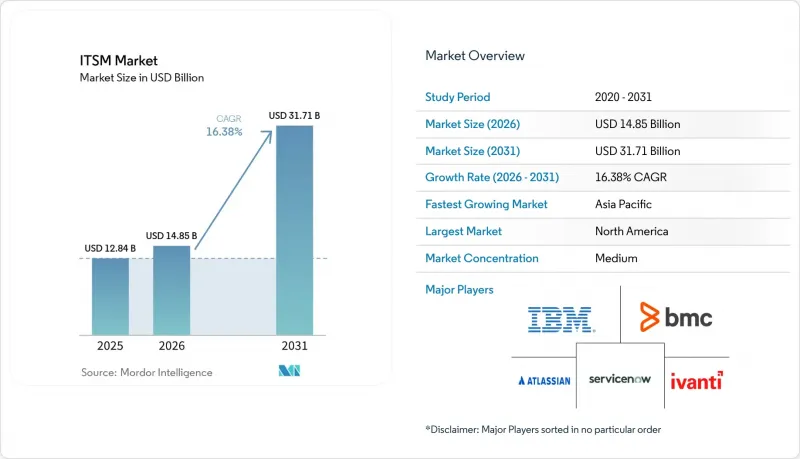
ITSM 시장 규모는 2025년 128억 4,000만 달러에서 2026년에는 148억 5,000만 달러로 확대되어 2031년까지 317억 1,000만 달러에 이를 것으로 예상되고 있어 2026년부터 2031년까지 CAGR 16.38%로 성장할 전망입니다.
본 보고서는 구성 요소(솔루션 및 서비스), 도입 형태(클라우드, On-Premise, 하이브리드), 용도(서비스 데스크 및 인시던트 관리, 자산 및 구성 관리 등), 최종 사용자 산업(은행, 금융서비스 및 보험(BFSI), 제조업, 정부·공공 부문 등), 기업 규모(대기업 및 중소기업), 그리고 지역별로 분류되어 있습니다. 시장 전망은 금액(달러) 기준으로 제시되어 있습니다.
세계 ITSM 시장 동향 및 인사이트
AI를 활용한 서비스 자동화 및 AIOps 통합
ITSM 시장에서 AI는 지원 보조 역할에서 워크플로우의 직접적인 실행으로 전환되고 있습니다. 각 벤더는 현재 기존의 보조 시스템보다 수동 개입을 최소화하면서 서비스 데스크 케이스를 해결하고, 인시던트를 관리하며, 직원의 워크플로우를 지원하는 자율형 에이전트를 도입하고 있습니다. 또한 Freshworks는 Agent Studio, MCP Gateway, xLA 지원을 통해 AI 기반 서비스 제공을 확대하고 있으며, 이는 자동화가 단순한 옵션 기능이 아니라 플랫폼 설계의 일부가 되어가고 있음을 보여줍니다. 이러한 도구가 성숙해짐에 따라 ITSM 시장은 티켓 처리의 신속화에서 보다 선제적인 감지, 라우팅 및 시정 조치로 전환되고 있습니다. 특히 인시던트 데이터, 워크플로우, 지식 자산이 동일한 플랫폼에 통합되어 있는 경우, 이러한 경향은 더욱 두드러집니다. 이로 인해 플랫폼 통합이 더욱 중요해지고 있습니다. 왜냐하면 고립된 AI 도구에는 기업 관리를 위해 구축된 통합 시스템과 같은 워크플로우의 맥락이나 거버넌스의 깊이가 부족하기 때문입니다.
클라우드 네이티브 ITSM 플랫폼으로의 전환
클라우드 네이티브 설계는 더 신속한 릴리스, 손쉬운 확장성, 협업, ID 관리, DevOps 시스템과의 폭넓은 통합을 지원하기 때문에 ITSM 시장에서 여전히 강력한 성장 요인으로 작용하고 있습니다. 벤더는 On-Premise 배포보다 SaaS 환경을 더 자주 업데이트할 수 있으므로, AI 기능, 워크플로우 템플릿, 규정 준수 도구가 더 빠른 속도로 프로덕션 환경에 지속적으로 도입되고 있습니다. 이러한 차이는 중요합니다. 구매자들이 초기 도입 옵션뿐만 아니라, 구매 후 유용한 기능을 얼마나 신속하게 이용할 수 있는지에 대해서도 플랫폼을 비교하는 경향이 강해지고 있기 때문입니다. 또한, 클라우드 모델은 구독형 지출 패턴에 적합하고 고객의 인프라 관리 업무를 경감시켜 주기 때문에 대기업부터 중소규모 조직에 이르기까지 도입이 촉진되고 있습니다. 규제 대상 사용자가 일부 사설 인프라를 유지하고 있는 경우에도, 하이브리드 모델은 여전히 클라우드 주도형 오케스트레이션과 서비스 설계에 의존하고 있기 때문에 ITSM 시장은 계속해서 혜택을 보고 있습니다.
레거시 시스템 마이그레이션에 수반되는 복잡성과 높은 전환 비용
대규모 도입 환경에는 수년에 걸친 워크플로우 맞춤화, CMDB 구조 변경 및 서비스 이력이 수반되는 경우가 많기 때문에 마이그레이션은 여전히 ITSM 시장에서 실질적인 장벽으로 남아 있습니다. 이러한 복잡성은 특히 변경 승인, 자산 간의 관계, 감사 기록이 플랫폼에 밀접하게 통합된 규제 대상 환경에서 벤더 전환 비용을 높입니다. IBM과 ServiceNow는 2026년 제휴에 관한 최신 정보에서 레거시 현대화와 AI 지원 데이터를 기업의 공통 과제로 제시했습니다. 이는 도구나 프로세스의 조정 없이 구형 환경을 현대화하는 것이 얼마나 어려운지를 반영합니다. BMC 역시 2026년 Helix 릴리스에서 CMDB 및 제품군 수준의 기능 강화를 지속했습니다. 이는 엔터프라이즈 서비스 관리에서 구성 데이터와 플랫폼 구조가 여전히 운영상 큰 비중을 차지하고 있음을 강조하는 것입니다. 이 때문에 ITSM 시장 전반에서 계약 갱신 결정은 신중한 양상을 띠고 있습니다. 구매자는 기능 향상과 운영 차질, 재교육, 데이터 마이그레이션의 위험을 저울질해야 하기 때문입니다.
부문 분석
2025년, 솔루션 부문은 ITSM 시장 점유율의 62.61%를 차지했습니다. 이는 프로젝트 중심의 도입에서 지속적인 플랫폼 구독으로의 전환을 반영한 것입니다. 이러한 선두 위상은 구매자들이 도입에 필요한 컨설팅 작업보다 소프트웨어 계층 자체를 점점 더 중시하고 있음을 보여줍니다. ITSM 시장에서 클라우드 기반 제공은 도입 주기를 단축시키고, 지출의 중점을 라이선싱, 워크플로우 모듈, AI 지원 애드온으로 전환시켰습니다. ‘솔루션’ 부문은 2031년까지 높은 연평균 성장률(CAGR)을 보일 것으로 예측되며, 벤더들이 자동화, 지식 관리, 규정 준수 기능을 더 많이 판매함에 따라 이 부문은 가치 창출의 중심이 될 것입니다. 이러한 성장은 고객이 주요 업그레이드 사이의 긴 간격보다는 지속적인 제품 개선을 기대하게 된 경향도 반영하고 있습니다.
서비스 부문은 2031년까지 연평균 성장률(CAGR) 18.01%로 확대될 것으로 예측됩니다. 대규모 구매 기업들은 복잡한 환경을 안정적으로 유지하기 위해 도입 지원, 통합 작업, 관리 운영 및 교육을 지속적으로 필요로 하기 때문에 서비스 부문은 중요한 위치를 차지하고 있습니다. 조직이 레거시 도구에서 전환하거나, IT의 범위를 넘어서는 워크플로우를 확장하거나, 하이브리드 인프라를 단일 운영 모델로 통합할 때 이러한 서비스에 대한 수요가 높아집니다. ITSM 업계에서 서비스는 사내 프로세스 구축이 미흡한 고객도 지원하고 있습니다. 특히 AI 기능을 도입할 때는 배포 전에 신중한 거버넌스와 데이터 정제가 필요하기 때문입니다. 또한 매니지드 서비스나 고정 범위의 마이그레이션 패키지를 통해 중견 기업 구매자에게는 현대화에 따른 부담이 경감되므로, 서비스의 구성도 변화하고 있습니다. 그럼에도 불구하고, ITSM 시장의 수익 균형은 계속해서 솔루션 쪽으로 이동하고 있습니다. 이는 플랫폼에서 얻을 수 있는 지속적인 가치가 일회성 도입 작업보다 더 빠르게 확대되고 있기 때문입니다.
2025년에는 ITSM 시장 규모 중 클라우드 도입이 59.62%를 차지하며, SaaS가 새로운 플랫폼 구매 시 기본 선택지가 되고 있는 것으로 확인되었습니다. 클라우드 부문은 2031년까지 연평균 성장률(CAGR) 18.21%로 확대될 것으로 예측되며, ITSM 시장 전체에서 다른 도입 모델을 계속해서 앞지를 전망입니다. 구매자가 클라우드를 선호하는 이유는 인프라 오버헤드를 줄이고, 사용자의 유연한 증가에 대응할 수 있을 뿐만 아니라, 벤더가 고객 주도형 업그레이드 주기에 얽매이지 않고 새로운 기능을 제공할 수 있다는 점에 있습니다. 2026년에는 AI 에이전트, 가시성 통합, 자동화 템플릿이 급속히 변화하고 있으며, 고객은 이러한 업데이트가 출시되는 즉시 활용하고자 하므로 이 점은 더욱 중요해질 것입니다. 또한 클라우드는 구독형 지출 모델에도 적합하여, 과거 예산상의 이유로 도입을 미루었던 조직에게도 엔터프라이즈급 ITSM이 더욱 접근하기 쉬워지고 있습니다.
On-Premise 방식은 데이터 보관 장소나 보안 정책으로 인해 SaaS를 완전히 활용하기 어려운 정부 기관, 중앙은행, 국방 기관 등의 분야에서는 여전히 중요한 위치를 차지하고 있습니다. 이러한 조직들도 서비스 관리가 필요하지만, 대부분의 경우 엄격하게 관리되는 인프라를 통해 더 긴 릴리스 주기로 도입하고 있습니다. 그 결과, 하이브리드 모델이 부상하고 있습니다. 이 모델을 통해 기업은 대량의 서비스 데스크 워크플로를 클라우드로 배치하면서도, 기밀성이 높은 변경 데이터나 구성 데이터를 사설 시스템에 보관할 수 있기 때문입니다. 이를 통해 ITSM 시장은 모든 고객에게 완전한 전환을 강요하지 않으면서도, 혁신에 대한 접근성과 관리 요구 사항 간의 균형을 유지할 수 있습니다. 또한 장기적으로는 하이브리드 환경에서 여러 기술 계층에 걸친 안정적인 프로세스 제어가 필요하기 때문에 강력한 오케스트레이션 및 정책 관리 기능을 갖춘 벤더에 대한 수요도 증가하고 있습니다.
지역별 분석
2025년, 북미는 ITSM 시장 규모의 38.02%를 차지하며 지역별 1위를 유지했습니다. 이 지역은 클라우드 성숙도가 높고 서비스 관리 관행이 정착되어 있을 뿐만 아니라, 주요 벤더와 대기업 구매자가 집중되어 있다는 장점이 있습니다. 미국은 금융 서비스, 기술, 헬스케어 분야의 각 조직이 ITSM 시장 전체에서 거버넌스가 확립된 디지털 운영에 대한 투자를 지속함에 따라 계속해서 주요 수익원이 되었습니다. 캐나다는 공공 부문의 디지털화와 기업의 현대화를 통해 수요를 뒷받침했으며, 멕시코는 니어쇼어링과 관련된 인프라 확장 및 프로세스 제어에 대한 수요 증가의 혜택을 받았습니다. 유럽은 성숙한 기업 환경 내 제조업, 금융 서비스, 통신 업계 수요에 힘입어 계속해서 2위 지역 시장을 차지했습니다.
아시아태평양은 2031년까지 연평균 성장률(CAGR) 19.90%로 확대될 것으로 예측되며, ITSM 시장에서 가장 빠르게 성장하는 지역이 될 것입니다. 인도는 주요 견인차 역할을 하고 있으며, 국내 클라우드 도입, 데이터 현지화 요건, 아웃소싱 기반의 규모가 공식적인 서비스 관리 기능에 대한 투자를 지속적으로 뒷받침하고 있습니다. 중국에서는 프로세스의 일관성과 운영 감독이 여전히 중요시되는 제조업 및 은행업 분야의 대기업 도입에 힘입어 시장 규모가 확대되고 있습니다. 일본에서도 조직이 복잡한 기술 자산 전반에 걸친 서비스 품질을 관리하기 위해 자동화 및 체계화된 IT 운영에 대한 투자를 확대하고 있어 성장을 뒷받침하고 있습니다. 동남아시아 전역에서는 많은 구매자가 On-Premise 환경을 교체하는 데 긴 주기를 거치는 대신, 직접 ‘클라우드 퍼스트’ 플랫폼으로 전환하고 있어 신규 도입이 ITSM 시장을 뒷받침하고 있습니다.
남미는 시장 규모 면에서는 여전히 작지만, 브라질과 아르헨티나에서는 금융 서비스 및 정부 기관의 현대화 사업을 통해 지역 전체 수요의 상당 부분을 지속적으로 창출하고 있습니다. 이러한 구매 기업들은 광범위한 디지털화 프로그램의 일환으로 공식적인 서비스 관리를 도입하는 경우가 많으며, 이것이 꾸준하고 선택적인 성장을 뒷받침하고 있습니다. 중동에서는 사우디아라비아와 아랍에미리트(UAE)의 국가 차원 디지털 전환(DX) 전략이 뒷받침되고 있으며, 공공 부문 및 통신 분야에 대한 투자를 통해 프로세스 주도형 서비스 운영이 확대되고 있습니다. 아프리카에서는 도입이 아직 초기 단계이지만, 남아프리카공화국, 나이지리아, 이집트의 경우 기존 기업 환경에서 볼 수 있는 레거시 시스템의 부담이 없어 현행 플랫폼을 그대로 도입할 수 있으므로, ‘클라우드 퍼스트’를 통한 성장 여지가 있습니다.
기타 혜택:
- 엑셀 형식 시장 예측(ME) 시트
- 3개월간의 애널리스트 지원
자주 묻는 질문
목차
제1장 서론
제2장 조사 방법
제3장 주요 요약
제4장 시장 구도
제5장 시장 규모와 성장 예측
제6장 경쟁 구도
제7장 시장 기회와 향후 전망
JHS 26.08.11According to Mordor Intelligence, the iT service management market size is expected to increase from USD 12.84 billion in 2025 to USD 14.85 billion in 2026 and reach USD 31.71 billion by 2031, growing at a CAGR of 16.38% over 2026-2031.
This report is Segmented by Component (Solutions and Services), Deployment (Cloud, On-Premise, and Hybrid), Application (Service Desk and Incident Management, Asset and Configuration Management, and More), End-User Industry (BFSI, Manufacturing, Government and Public Sector, and More), Enterprise Size (Large Enterprises, and SME), and Geography. The Market Forecasts are Provided in Terms of Value (USD).
Global ITSM Market Trends and Insights
AI-Driven Service Automation And AIops Integration
AI is moving from support assistance into direct workflow execution across the IT service management market. Vendors now position autonomous agents to resolve service desk cases, manage incidents, and support employee workflows with less manual intervention than earlier copilots allowed. Freshworks also expanded AI service delivery with Agent Studio, MCP Gateway, and xLA support, which shows that automation is becoming part of platform design rather than an optional feature layer. As these tools mature, the IT service management market is shifting from faster ticket handling toward more proactive detection, routing, and remediation, especially where incident data, workflows, and knowledge assets sit on the same platform. That makes platform consolidation more valuable because isolated AI tools do not carry the same workflow context or governance depth as integrated systems built for enterprise control.
Shift To Cloud-Native ITSM Platforms
Cloud-native design remains a strong growth force in the IT service management market because it supports faster releases, easier scaling, and broader integration with collaboration, identity, and DevOps systems. Vendors can update SaaS environments more frequently than on-premise deployments, which keeps AI features, workflow templates, and compliance tools moving into production at a quicker pace. This difference matters because buyers increasingly compare platforms on how quickly useful functions arrive after purchase, not only on initial deployment choice. The cloud model also fits subscription spending patterns and reduces infrastructure management work for customers, which improves adoption across both large enterprises and smaller organizations. Even where regulated users retain some private infrastructure, the IT service management market continues to benefit because hybrid models still depend on cloud-led orchestration and service design.
Legacy Migration Complexity And High Switching Cost
Migration remains a real barrier in the IT service management market because large deployments often carry years of workflow customization, CMDB structure changes, and service history. That complexity raises the cost of vendor switching, especially in regulated environments where change approval, asset relationships, and audit records are tightly embedded in the platform. IBM and ServiceNow framed legacy modernization and AI-ready data as a joint enterprise problem in their 2026 collaboration update, which reflects how difficult older environments are to modernize without coordinated tooling and process work. BMC also continued CMDB and suite-level enhancements in its 2026 Helix releases, which underlines the operational weight that configuration data and platform structure still carry in enterprise service management. This keeps renewal decisions cautious across the IT service management market, because buyers must weigh feature gains against operational disruption, retraining, and data transition risk.
Other drivers and restraints analyzed in the detailed report include:
- Unified Management For Hybrid And Multicloud Estates
- Low-Code And No-Code Orchestration For Citizen ITSM
- Shortage Of Skilled ITSM And ITOM Professionals
For complete list of drivers and restraints, kindly check the Table Of Contents.
Segment Analysis
The Solutions segment held 62.61% of the IT service management market share in 2025, which reflected the shift from project-heavy deployments toward recurring platform subscriptions. This lead shows that buyers increasingly value the software layer itself, rather than the consulting effort required to install it. In the IT service management market, cloud delivery has shortened deployment cycles and moved more spending toward licensing, workflow modules, and AI-enabled add-ons. Solutions are projected to show a significant CAGR through 2031, which keeps this segment at the center of value capture as vendors sell more automation, knowledge, and compliance functions. That growth also reflects the way customers now expect ongoing product improvement rather than long gaps between major upgrades.
Services are projected to expand at a 18.01% CAGR through 2031. The Services segment matters because large buyers continue to need implementation support, integration work, managed administration, and training to keep complex environments stable. Demand for these services rises when organizations migrate from legacy tools, extend workflows beyond IT, or bring hybrid infrastructure into a single operating model. In the IT service management industry, services also support customers that lack in-house process depth, especially when AI capabilities require careful governance and data cleanup before deployment. The service mix is changing as well, because managed services and fixed-scope migration packages reduce the perceived burden of modernization for mid-market buyers. Even so, the revenue balance in the IT service management market keeps moving toward solutions because recurring platform value is growing faster than one-time deployment work.
Cloud deployment accounted for 59.62% share of the IT service management market size in 2025, which confirmed that SaaS has become the default choice for new platform buying. The cloud segment is projected to expand at a 18.21% CAGR through 2031, which keeps it ahead of other deployment models across the IT service management market. Buyers favor cloud because it reduces infrastructure overhead, supports elastic user growth, and allows vendors to deliver new capabilities without customer-led upgrade cycles. This matters more in 2026 because AI agents, observability links, and automation templates are changing fast, and customers want access to those updates as they are released. Cloud also fits subscription spending models, which has made enterprise-grade ITSM more reachable for organizations that once delayed adoption for budget reasons.
On-premise remains relevant in government, central banking, defense, and other settings where data location and security policy limit full SaaS use. These organizations still need service management, but they often buy it through tightly controlled infrastructure and longer release cycles. Hybrid models are therefore gaining ground because they let enterprises place high-volume service desk workflows in the cloud while retaining sensitive change and configuration data on private systems. This keeps the IT service management market balanced between innovation access and control requirements rather than forcing a full switch in every account. Over time, hybrid demand also supports vendors with strong orchestration and policy management, because mixed environments need stable process control across several technology layers.
Complete Report Scope:
- By Component
- Solutions
- Services
- By Deployment
- Cloud
- On-Premise
- Hybrid
- By Application
- Service Desk and Incident Management
- Asset and Configuration Management
- Change and Release Management
- Service Request Management
- Knowledge Management
- Other ITSM Applications
- By End-User Industry
- BFSI
- Manufacturing
- Government and Public Sector
- IT and Telecommunications
- Retail and E-Commerce
- Healthcare
- Travel and Hospitality
- Other End-User Industries
- By Enterprise Size
- Large Enterprises
- Small and Mid-Size Enterprises (SME)
- By Geography
- North America
- United States
- Canada
- Mexico
- South America
- Brazil
- Argentina
- Rest of South America
- Europe
- Germany
- United Kingdom
- France
- Russia
- Spain
- Rest of Europe
- Asia-Pacific
- China
- Japan
- India
- South Korea
- Southeast Asia
- Rest of Asia-Pacific
- Middle East and Africa
- Middle East
- Saudi Arabia
- United Arab Emirates
- Turkey
- Rest of Middle East
- Africa
- South Africa
- Nigeria
- Egypt
- Rest of Africa
- Middle East
- North America
Geography Analysis
North America held 38.02% of the IT service management market size in 2025, which kept it in the leading regional position. The region benefits from high cloud maturity, established service management practices, and a concentrated presence of major vendors and large enterprise buyers. The United States remained the main revenue center because financial services, technology, and healthcare organizations continued to invest in governed digital operations across the IT service management market. Canada supported demand through public sector digitization and enterprise modernization, while Mexico benefited from nearshoring-related infrastructure expansion and a growing need for process control. Europe remained the second-largest regional market, supported by manufacturing, financial services, and telecommunications demand across mature enterprise environments.
Asia-Pacific is projected to expand at a 19.90% CAGR through 2031, which makes it the fastest-growing region in the IT service management market. India is a major driver because domestic cloud adoption, data localization requirements, and the scale of the outsourcing base continue to push investment in formal service management capabilities. China adds volume through large enterprise deployments in manufacturing and banking, where process consistency and operational oversight remain important. Japan also supports growth as organizations invest more in automation and structured IT operations to manage service quality across complex technology estates. Across Southeast Asia, greenfield adoption supports the IT service management market because many buyers move directly to cloud-first platforms instead of carrying long on-premise replacement cycles.
South America remains smaller in value, but Brazil and Argentina continue to generate most regional demand through modernization work in financial services and government. These buyers often adopt formal service management as part of broader digitization programs, which supports steady but selective growth. The Middle East gains support from national digital transformation agendas in Saudi Arabia and the UAE, where public sector and telecom investments are expanding process-led service operations. Africa is still earlier in adoption, but South Africa, Nigeria, and Egypt present room for cloud-first growth because they can adopt current platforms without the same legacy burden seen in older enterprise environments.
- ServiceNow, Inc.
- IBM Corporation
- BMC Software, Inc.
- Atlassian Corporation Plc
- Ivanti, Inc.
- Freshworks Inc.
- ManageEngine, a division of Zoho Corporation Pvt. Ltd.
- Broadcom Inc.
- Open Text Corporation
- Micro Focus International plc
- ASG Technologies Group, Inc.
- SysAid Technologies Ltd.
- Cherwell Software, LLC
- TOPdesk B.V.
- Hornbill Service Management Ltd.
- SymphonyAI Summit
- EasyVista S.A.
- SolarWinds Corporation
- Atlassian Corporation Plc
- Axelos Limited
Additional Benefits:
- The market estimate (ME) sheet in Excel format
- 3 months of analyst support
TABLE OF CONTENTS
1 INTRODUCTION
- 1.1 Study Assumptions and Market Definition
- 1.2 Scope of the Study
2 RESEARCH METHODOLOGY
3 EXECUTIVE SUMMARY
4 MARKET LANDSCAPE
- 4.1 Market Overview
- 4.2 Market Drivers
- 4.2.1 Shift to Cloud-Native ITSM Platforms
- 4.2.2 AI Driven Service Automation and AIOps Integration
- 4.2.3 Unified Management for Hybrid and Multicloud Estates
- 4.2.4 Low Code and No Code Orchestration for Citizen ITSM
- 4.2.5 FinOps and GreenOps Reporting Embedded in ITSM
- 4.2.6 Edge Computing and 5G Operations Onboarding to ITSM
- 4.3 Market Restraints
- 4.3.1 Legacy Migration Complexity and High Switching Cost
- 4.3.2 Shortage of Skilled ITSM and ITOM Professionals
- 4.3.3 Emerging AI Governance and Data Residency Regulations
- 4.3.4 Rising Observability Data Costs Causing Tool Sprawl
- 4.4 Industry Value Chain Analysis
- 4.5 Impact of Macroeconomic Factors
- 4.6 Regulatory Landscape
- 4.7 Technological Outlook
- 4.8 Porter's Five Forces Analysis
- 4.8.1 Bargaining Power of Suppliers
- 4.8.2 Bargaining Power of Buyers
- 4.8.3 Threat of New Entrants
- 4.8.4 Threat of Substitutes
- 4.8.5 Intensity of Competitive Rivalry
5 MARKET SIZE AND GROWTH FORECASTS
- 5.1 By Component
- 5.1.1 Solutions
- 5.1.2 Services
- 5.2 By Deployment
- 5.2.1 Cloud
- 5.2.2 On-Premise
- 5.2.3 Hybrid
- 5.3 By Application
- 5.3.1 Service Desk and Incident Management
- 5.3.2 Asset and Configuration Management
- 5.3.3 Change and Release Management
- 5.3.4 Service Request Management
- 5.3.5 Knowledge Management
- 5.3.6 Other ITSM Applications
- 5.4 By End-User Industry
- 5.4.1 BFSI
- 5.4.2 Manufacturing
- 5.4.3 Government and Public Sector
- 5.4.4 IT and Telecommunications
- 5.4.5 Retail and E-Commerce
- 5.4.6 Healthcare
- 5.4.7 Travel and Hospitality
- 5.4.8 Other End-User Industries
- 5.5 By Enterprise Size
- 5.5.1 Large Enterprises
- 5.5.2 Small and Mid-Size Enterprises (SME)
- 5.6 By Geography
- 5.6.1 North America
- 5.6.1.1 United States
- 5.6.1.2 Canada
- 5.6.1.3 Mexico
- 5.6.2 South America
- 5.6.2.1 Brazil
- 5.6.2.2 Argentina
- 5.6.2.3 Rest of South America
- 5.6.3 Europe
- 5.6.3.1 Germany
- 5.6.3.2 United Kingdom
- 5.6.3.3 France
- 5.6.3.4 Russia
- 5.6.3.5 Spain
- 5.6.3.6 Rest of Europe
- 5.6.4 Asia-Pacific
- 5.6.4.1 China
- 5.6.4.2 Japan
- 5.6.4.3 India
- 5.6.4.4 South Korea
- 5.6.4.5 Southeast Asia
- 5.6.4.6 Rest of Asia-Pacific
- 5.6.5 Middle East and Africa
- 5.6.5.1 Middle East
- 5.6.5.1.1 Saudi Arabia
- 5.6.5.1.2 United Arab Emirates
- 5.6.5.1.3 Turkey
- 5.6.5.1.4 Rest of Middle East
- 5.6.5.2 Africa
- 5.6.5.2.1 South Africa
- 5.6.5.2.2 Nigeria
- 5.6.5.2.3 Egypt
- 5.6.5.2.4 Rest of Africa
- 5.6.5.1 Middle East
- 5.6.1 North America
6 COMPETITIVE LANDSCAPE
- 6.1 Market Concentration
- 6.2 Strategic Moves
- 6.3 Market Share Analysis
- 6.4 Company Profiles (includes Global Level Overview, Market Level Overview, Core Segments, Financials as available, Strategic Information, Market Rank/Share, Products and Services, Recent Developments)
- 6.4.1 ServiceNow, Inc.
- 6.4.2 IBM Corporation
- 6.4.3 BMC Software, Inc.
- 6.4.4 Atlassian Corporation Plc
- 6.4.5 Ivanti, Inc.
- 6.4.6 Freshworks Inc.
- 6.4.7 ManageEngine, a division of Zoho Corporation Pvt. Ltd.
- 6.4.8 Broadcom Inc.
- 6.4.9 Open Text Corporation
- 6.4.10 Micro Focus International plc
- 6.4.11 ASG Technologies Group, Inc.
- 6.4.12 SysAid Technologies Ltd.
- 6.4.13 Cherwell Software, LLC
- 6.4.14 TOPdesk B.V.
- 6.4.15 Hornbill Service Management Ltd.
- 6.4.16 SymphonyAI Summit
- 6.4.17 EasyVista S.A.
- 6.4.18 SolarWinds Corporation
- 6.4.19 Atlassian Corporation Plc
- 6.4.20 Axelos Limited
7 MARKET OPPORTUNITIES AND FUTURE OUTLOOK
- 7.1 White-space and Unmet-Need Assessment


