

|
시장보고서
상품코드
2117638
ASEAN의 ITSM : 시장 점유율 분석, 업계 동향 및 통계, 성장 예측(2026-2035년)ASEAN ITSM - Market Share Analysis, Industry Trends & Statistics, Growth Forecasts (2026 - 2035) |
||||||
 Mordor Intelligence
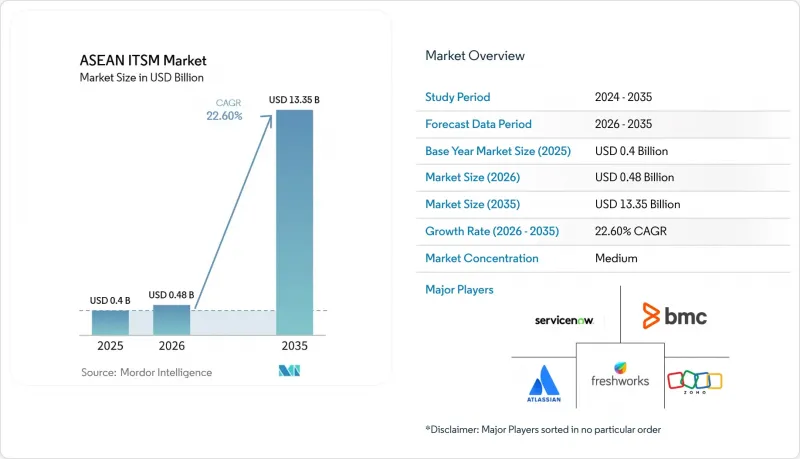
Mordor Intelligence에 의하면, ASEAN의 ITSM 시장 규모는 2025년 4억 달러로 평가되었습니다. 2026년에는 4억 8,000만 달러로 확대되어 2035년까지 133억 5,000만 달러에 이를 것으로 예측되며, 2026-2035년에 걸쳐 CAGR 22.60%로 성장할 전망입니다.
본 보고서는 구성 요소(솔루션, 서비스), 배포 방식(클라우드, On-Premise, 하이브리드), 용도(서비스 데스크, 자산 및 구성 관리, 기타), 최종 사용자 산업(은행, 금융서비스 및 보험(BFSI), 제조업, 기타), 기업 규모(대기업, 중소기업)별로 분류되어 있습니다. 시장 예측은 금액(달러)으로 표시되어 있습니다.
ASEAN의 ITSM 시장 동향 및 인사이트
‘클라우드 퍼스트’를 중심으로 한 IT 운영 현대화의 진전
ASEAN ITSM 시장의 많은 조직은 구식 On-Premise형 도구를 업그레이드하는 대신, 본격적인 서비스 관리 프로그램의 출발점으로 클라우드 도입을 선택하고 있습니다. VietinBank는 2025년, 약 4,000명의 직원을 대상으로 Jira와 Confluence 환경을 클라우드로 이전했습니다. 이는 규제 대상 기관조차도 새로운 서비스 환경에서 확장성과 지속성을 우선시하고 있음을 보여줍니다. 정부 주도의 디지털 현대화도 이러한 전환을 뒷받침하고 있습니다. 국가 서비스 플랫폼에는 보다 신속하고 표준화된 지원 시스템이 필요하기 때문입니다. 싱가포르 정부기술청(GTA)도 정부 상용 클라우드 환경 내에서 Jira Service Management를 도입하여, 클라우드에 최적화된 서비스 운영이 공공 디지털 인프라에 어떻게 통합되고 있는지를 보여주고 있습니다. 2025년 아세안(ASEAN) 디지털 전환 시장은 1,020억 7,000만 달러로 평가되었고, 연평균 성장률(CAGR) 23.68%로 성장할 것으로 전망되어, ITSM 플랫폼 도입을 위한 유리한 기반을 마련하고 있습니다.
AI를 활용한 셀프 서비스 및 지식 기반 문제 해결에 대한 수요 증가
AI를 활용한 셀프 서비스는 ASEAN의 ITSM 시장 전반에서 그 중요성이 커지고 있습니다. 이는 지원 팀이 인력 증가에 미치지 못하는 상황에서 더 많은 요청을 처리해야 하는 압박에 직면하고 있기 때문입니다. Freshworks는 2026년에 IT 티켓의 47%가 업무 시간 외에 접수되고 있다고 보고했으며, 이는 기업들이 자동화된 지원 및 연중무휴 24시간 서비스 경험에 투자하고 있는 이유를 여실히 보여줍니다. 태국의 한 주요 은행은 AI 네이티브 ITSM 플랫폼을 도입하여 서비스 요청의 65%를 자동화함으로써, 자회사 전체의 고객 만족도를 60% 향상시키고 해결 시간을 50% 단축했습니다. 이러한 운영 모델은 지식 관리의 견고한 전망을 뒷받침하며, 지식 관리는 2031년까지 연평균 성장률(CAGR) 22.99%를 기록하며 ASEAN의 ITSM 시장에서 가장 빠르게 성장하는 용도로 자리매김하고 있습니다. 또한, Freshworks는 2026년 5월 Freshservice에서 ‘AI Agent Studio’를 출시했습니다. 이를 통해 기업은 노코드 방식으로 서비스 자동화를 Microsoft Teams, Slack, Workday, Rippling 등의 도구로 확장할 수 있게 되었습니다.
브라운필드 IT 환경에서의 레거시 시스템 통합의 복잡성
레거시 시스템 통합은 ASEAN의 ITSM 시장에서 여전히 가장 큰 운영상의 장벽으로 남아 있으며, 특히 구식 핵심 시스템에 의존하는 대규모 조직에서 두드러집니다. ‘아세안 혁신 비즈니스 플랫폼(ASEAN Innovation Business Platform)’의 조사에 따르면, 54.4%의 조직이 기존 시스템과의 통합을 주요 도입 장벽으로 꼽았으며, 이는 워크플로가 완전히 도입되기 전에 현대화 프로그램의 진척이 더뎌지는 일이 얼마나 빈번하게 발생하는지를 보여줍니다. 비슷한 문제는 소규모 도입 기업에서도 나타납니다. EasyVista와 OTRS Group의 보고서에 따르면, 말레이시아 중소기업의 66%가 ITSM과 IT 자산 관리 간의 격차를 메우기 위해 여전히 수작업이나 스프레드시트에 의존하고 있다고 합니다. 또한 Bank Central Asia는 일상 업무의 지속을 위해 오랫동안 가동되어 온 시스템에 의존하고 있는 기술 부서와 사업 부문의 이해관계자간의 조정이 현대화 과정에서 과제라고 밝혔습니다. 이로 인해 도입 주기가 장기화되고 업그레이드의 복잡성이 증가함에 따라, 단계적인 전환 지원이 ASEAN의 ITSM 시장에서 벤더의 포지셔닝을 결정하는 핵심 요소로 부상하고 있습니다.
부문별 분석
2025년 시점에서 솔루션은 ASEAN의 ITSM 시장 규모의 65.22%를 차지했으나, 서비스 부문은 2031년까지 연평균 성장률(CAGR) 23.01%를 나타낼 것으로 예측됩니다. 이러한 구성은 ‘플랫폼 우선’이라는 구매 패턴을 반영한 것으로, 기업들은 우선 핵심 모듈을 도입한 후, 워크플로가 보다 체계화되면 파트너의 지원을 추가해 나가는 경향을 보이고 있습니다. ASEAN의 ITSM 시장에서 싱가포르나 말레이시아의 대규모 구매 기업들은 동일한 도입 주기 내에서 인시던트, 자산, 변경 프로세스를 포괄하는 다중 모듈 구매부터 시작하는 경향이 있습니다. 이러한 경향으로 인해, 특히 거버넌스나 보고 요건이 이미 충분히 확립된 경우, 소프트웨어 플랫폼이 초기 투자의 상당 부분을 차지하기 쉬워지고 있습니다. 성장 추이를 살펴보면, ASEAN의 ITSM 시장 전체에서 도입이 심화됨에 따라 서비스 수익의 중요성이 높아지고 있음을 알 수 있습니다.
많은 조직이 설정, 교육, 업그레이드 계획, 일상적인 운영 관리에 있어 여전히 외부 지원을 필요로 하고 있기 때문에 서비스 분야는 더욱 빠르게 확대되고 있습니다. HPT 베트남은 2026년 4월, SMOne 및 ManageEngine과 양해각서를 체결하여 ITSM 및 IT 운영 관리 솔루션 제공을 확대했습니다. 이는 플랫폼 도입을 중심으로 서비스 생태계가 구축되고 있음을 여실히 보여줍니다. 또한, 2026년 5월 코그니잔트가 JG 서밋과 체결한 ServiceNow 관련 계약 역시, 도입 및 매니지드 서비스가 플랫폼 현대화 프로그램과 점점 더 세트로 제공되고 있음을 보여줍니다. 실제로 ASEAN의 ITSM 시장의 구매자들은 워크플로우 설계, 통합, 운영 거버넌스를 고려할 때 라이선스 비용이 지출 구성의 일부에 불과하다는 점을 점차 인식하고 있습니다. 이에 따라 ASEAN의 ITSM 시장에서 서비스 부문은 보조적인 역할에서 벗어나 보다 지속적인 수익원으로 자리매김하고 있습니다.
클라우드는 2025년 ASEAN ITSM 시장 규모의 69.32%를 차지했으며, 2031년까지 연평균 성장률(CAGR) 24.42%로 확대될 것으로 예측됩니다. 가장 규모가 크고 가장 빠르게 성장하는 배포 모델이라는 이 이중적 위상은 많은 초기 구매자들이 On-Premise 평가를 생략하고 직접 클라우드 환경으로 전환하고 있음을 보여줍니다. ASEAN의 ITSM 시장에서는 여러 산업 및 각국 시장에서 그린필드 도입이 여전히 일반적이기 때문에 이 모델이 특히 수용되기 쉬운 상황입니다. 싱가포르 정부의 클라우드 환경에서는 이미 Jira Service Management가 공유 디지털 지원 업무에 통합되어 있어, 규제 대상 이용 사례에서 클라우드 기반 서비스 모델에 대한 신뢰를 강화하고 있습니다. VietinBank가 약 4,000명의 직원을 대상으로 Jira와 Confluence를 마이그레이션한 사례도, 규모나 규제가 반드시 ASEAN의 ITSM 시장의 클라우드 도입에 걸림돌이 되는 것은 아니라는 견해를 뒷받침하고 있습니다.
On-Premise 및 하이브리드 모델은 현지 인프라 관리가 기술적 선호가 아닌 규정 준수 요건으로 취급되는 상황에서 여전히 중요한 위치를 차지하고 있습니다. 인도네시아와 베트남, 일부 정부 기관 및 금융 서비스 부문에서는 데이터 처리 규정에 따라 도입의 유연성이 제한될 가능성이 있으므로, 여전히 On-Premise 또는 하이브리드 환경을 유지하고 있습니다. 하이브리드 모델은 공통 서비스 계층을 확보하면서도 특정 자회사 시스템을 별도의 업그레이드 주기로 운영하고자 하는 대규모 그룹에게도 실용적입니다. 이로 인해 ASEAN의 ITSM 시장 내에서는 소규모 ‘클라우드 우선’ 구매자와 규제 대상 대기업 간의 도입 경로가 달라지는 등 수요 경향이 더욱 양극화되고 있습니다. 따라서 신속한 클라우드 배포와 관리형 하이브리드 거버넌스를 모두 지원하는 벤더는 ASEAN의 ITSM 시장 전체에서 더욱 견고한 입지를 확보하고 있습니다.
기타 혜택
- 엑셀 형식 시장 예측(ME) 시트
- 3개월간의 애널리스트 지원
자주 묻는 질문
목차
제1장 서론
제2장 조사 방법
제3장 개요
제4장 시장 구도
제5장 시장 규모 및 성장 예측
제6장 경쟁 구도
제7장 시장 기회 및 향후 전망
KTH 26.09.02According to Mordor Intelligence, the ASEAN ITSM market size is expected to increase from USD 0.4 billion in 2025 to USD 0.48 billion in 2026 and reach USD 13.35 billion by 2035, growing at a CAGR of 22.60% over 2026-2035.
This report is Segmented by Component (Solutions, Services), Deployment (Cloud, On-Premises, Hybrid), Application (Service Desk and Incident Management, Asset and Configuration Management, and More), End-User Industry (BFSI, Manufacturing, and More), and Enterprise Size (Large Enterprises, Small and Medium Enterprises). The Market Forecasts are Provided in Terms of Value (USD).
ASEAN ITSM Market Trends and Insights
Rising Cloud-First IT Operations Modernization
Many organizations across the ASEAN ITSM market are choosing cloud deployment as the starting point for formal service management programs instead of upgrading older on-premises tools. VietinBank moved its Jira and Confluence environments to cloud in 2025 for nearly 4,000 personnel, showing that even regulated institutions are prioritizing scalability and continuity in new service environments. Government-led digital modernization is also reinforcing this shift because national service platforms need more responsive and standardized support systems. Singapore Government Technology Agency has also used Jira Service Management within its Government Commercial Cloud environment, which shows how cloud-aligned service operations are being embedded into public digital infrastructure. The broader digital transformation backdrop remains supportive, as the ASEAN digital transformation market was estimated at USD 102.07 billion in 2025 and was projected to grow at a 23.68% CAGR, creating a favorable base for ITSM platform adoption.
Escalating Demand For AI-Assisted Self-Service And Knowledge Deflection
AI-assisted self-service is gaining importance across the ASEAN ITSM market because support teams are under pressure to manage more requests without matching staff growth. Freshworks stated in 2026 that 47% of IT tickets are submitted after business hours, which highlights why enterprises are investing in automated support and always-on service experiences. A leading Thai bank used an AI-native ITSM platform and automated 65% of service requests, improved customer satisfaction by 60%, and cut resolution times by 50% across subsidiaries. That operating model supports the strong outlook for Knowledge Management, which is the fastest-growing application segment in the ASEAN ITSM market at a 22.99% CAGR through 2031. Freshworks also launched AI Agent Studio in Freshservice in May 2026, giving enterprises a no-code way to extend service automation into tools such as Microsoft Teams, Slack, Workday, and Rippling.
Legacy System Integration Complexity In Brownfield IT Environments
Legacy integration remains the strongest operational barrier for the ASEAN ITSM market, especially in large organizations that depend on older core systems. The ASEAN Innovation Business Platform found that 54.4% of organizations identified integration with existing systems as the main implementation barrier, which shows how often modernization programs slow before full workflow adoption begins. The same issue is visible in smaller buyers, where EasyVista and OTRS Group reported that 66% of Malaysian SMBs still relied on manual work or spreadsheets to bridge ITSM and IT asset management gaps. Bank Central Asia also described modernization as a coordination challenge between technology and business stakeholders who rely on long-running systems for daily continuity. This keeps implementation cycles longer, raises upgrade complexity, and makes phased migration support a central part of vendor positioning across the ASEAN ITSM market.
Other drivers and restraints analyzed in the detailed report include:
- Expanding Digital Service Desk Standardization Across Enterprises
- Growing Need For Cross-Functional Enterprise Service Management
- Data Residency And Sovereignty Concerns For Cloud Deployments
For complete list of drivers and restraints, kindly check the Table Of Contents.
Segment Analysis
Solutions accounted for 65.22% of the ASEAN ITSM market size in 2025, while Services is projected to grow at a 23.01% CAGR through 2031. That mix reflects a platform-first buying pattern, in which enterprises begin with core modules and then add partner support once workflows become more formalized. In the ASEAN ITSM market, larger buyers in Singapore and Malaysia have tended to start with multi-module purchases that cover incidents, assets, and change processes in the same rollout cycle. This behavior has helped software platforms capture the larger initial spend, especially where governance and reporting requirements are already well established. Even so, the growth profile shows that service revenue is becoming more important as implementation depth increases across the ASEAN ITSM market.
Services are expanding faster because many organizations still need outside support for configuration, training, upgrade planning, and daily administration. HPT Vietnam signed a memorandum of understanding with SMOne and ManageEngine in April 2026 to expand the delivery of ITSM and IT operations management solutions, underscoring how service ecosystems are being built around platform adoption. Cognizant's May 2026 ServiceNow engagement with JG Summit also illustrates how implementation and managed services are increasingly bundled with platform modernization programs. In practice, buyers in the ASEAN ITSM market are learning that license cost is only one part of the spending profile once workflow design, integrations, and operating governance are considered. That is why the Services segment is moving from a supporting role toward a more recurring commercial layer within the ASEAN ITSM market.
Cloud held 69.32% of the ASEAN ITSM market size in 2025 and is projected to advance at a 24.42% CAGR through 2031. This dual position as both the largest and fastest-growing deployment model shows that many first-time buyers are skipping on-premises evaluation and moving directly to cloud environments. The ASEAN ITSM market has been especially receptive to this model because greenfield adoption remains common across several industries and national markets. Singapore's government cloud environment has already embedded Jira Service Management into shared digital support operations, which reinforces confidence in cloud-based service models for regulated use cases. VietinBank's migration of Jira and Confluence for nearly 4,000 employees also supports the view that scale and regulation do not automatically prevent cloud adoption in the ASEAN ITSM market.
On-premises and hybrid models still remain relevant where local infrastructure control is treated as a compliance requirement rather than a technical preference. Indonesia, Vietnam, and parts of government and financial services continue to keep localized or mixed environments because data handling rules can narrow deployment flexibility. Hybrid models are also practical for large groups that want a common service layer while keeping certain subsidiary systems on separate upgrade cycles. This is creating a more divided demand profile inside the ASEAN ITSM market, where smaller cloud-first buyers and larger regulated enterprises do not follow the same deployment path. Vendors that support both rapid cloud rollout and controlled hybrid governance are therefore in a stronger position across the ASEAN ITSM market.
Complete Report Scope:
- By Component
- Solutions
- Services
- By Deployment
- Cloud
- On-Premises
- Hybrid
- By Application
- Service Desk
- Asset and Configuration Management
- Change and Release Management
- Service Request Management
- Knowledge Management
- Other ITSM Applications
- By End-User Industry
- BFSI
- Manufacturing
- Government and Public Sector
- IT and Telecom
- Retail and E-Commerce
- Healthcare
- Travel and Hospitality
- Other End-User Industries
- By Enterprise Size
- Large Enterprises
- Small and Medium Enterprises
- By Geography
- Singapore
- Indonesia
- Malaysia
- Thailand
- Vietnam
- Philippines
- Rest of ASEAN
List of Companies Covered in this Report:
- ServiceNow, Inc.
- Atlassian Corporation Plc
- BMC Software, Inc.
- Freshworks Inc.
- Zoho Corporation Pvt. Ltd.
- Ivanti, Inc.
- Broadcom Inc.
- Open Text Corporation
- IBM Corporation
- Microsoft Corporation
- ManageEngine, a Division of Zoho Corporation Pvt. Ltd.
- Fujitsu Limited
- Tata Consultancy Services Limited
- Wipro Limited
- HCLTech Limited
- DXC Technology Company
- SysAid Technologies Ltd.
- SolarWinds Corporation
- EasyVista, Inc.
- TOPdesk B.V.
Additional Benefits:
- The market estimate (ME) sheet in Excel format
- 3 months of analyst support
TABLE OF CONTENTS
1 INTRODUCTION
- 1.1 Study Assumptions and Market Definition
- 1.2 Scope of the Study
2 RESEARCH METHODOLOGY
3 EXECUTIVE SUMMARY
4 MARKET LANDSCAPE
- 4.1 Market Overview
- 4.2 Market Drivers
- 4.2.1 Rising Cloud-First IT Operations Modernization
- 4.2.2 Expanding Digital Service Desk Standardization Across Enterprises
- 4.2.3 Growing Need for Cross-Functional Enterprise Service Management
- 4.2.4 Increasing Regulatory Pressure for Auditable IT Change Control
- 4.2.5 Rapid Tool Sprawl Requiring Unified Workflow Orchestration
- 4.2.6 Escalating Demand for AI-Assisted Self-Service and Knowledge Deflection
- 4.3 Market Restraints
- 4.3.1 Legacy System Integration Complexity in Brownfield IT Environments
- 4.3.2 Skilled ITSM Administration Gap Across Mid-Market Buyers
- 4.3.3 Data Residency and Sovereignty Concerns for Cloud Deployments
- 4.3.4 Low Process Maturity in Smaller Organizations Slowing Standardization
- 4.4 Industry Value Chain Analysis
- 4.5 Impact of Macroeconomic Factors on the Market
- 4.6 Regulatory Landscape
- 4.7 Technological Outlook
- 4.8 Porter's Five Forces Analysis
- 4.8.1 Threat of New Entrants
- 4.8.2 Bargaining Power of Buyers
- 4.8.3 Bargaining Power of Suppliers
- 4.8.4 Threat of Substitutes
- 4.8.5 Competitive Rivalry
5 MARKET SIZE AND GROWTH FORECASTS (VALUE)
- 5.1 By Component
- 5.1.1 Solutions
- 5.1.2 Services
- 5.2 By Deployment
- 5.2.1 Cloud
- 5.2.2 On-Premises
- 5.2.3 Hybrid
- 5.3 By Application
- 5.3.1 Service Desk
- 5.3.2 Asset and Configuration Management
- 5.3.3 Change and Release Management
- 5.3.4 Service Request Management
- 5.3.5 Knowledge Management
- 5.3.6 Other ITSM Applications
- 5.4 By End-User Industry
- 5.4.1 BFSI
- 5.4.2 Manufacturing
- 5.4.3 Government and Public Sector
- 5.4.4 IT and Telecom
- 5.4.5 Retail and E-Commerce
- 5.4.6 Healthcare
- 5.4.7 Travel and Hospitality
- 5.4.8 Other End-User Industries
- 5.5 By Enterprise Size
- 5.5.1 Large Enterprises
- 5.5.2 Small and Medium Enterprises
- 5.6 By Geography
- 5.6.1 Singapore
- 5.6.2 Indonesia
- 5.6.3 Malaysia
- 5.6.4 Thailand
- 5.6.5 Vietnam
- 5.6.6 Philippines
- 5.6.7 Rest of ASEAN
6 COMPETITIVE LANDSCAPE
- 6.1 Market Concentration
- 6.2 Strategic Moves
- 6.3 Market Share Analysis
- 6.4 Company Profiles (includes Global Level Overview, Market Level Overview, Core Segments, Financials as available, Strategic Information, Market Rank/Share, Products and Services, Recent Developments)
- 6.4.1 ServiceNow, Inc.
- 6.4.2 Atlassian Corporation Plc
- 6.4.3 BMC Software, Inc.
- 6.4.4 Freshworks Inc.
- 6.4.5 Zoho Corporation Pvt. Ltd.
- 6.4.6 Ivanti, Inc.
- 6.4.7 Broadcom Inc.
- 6.4.8 Open Text Corporation
- 6.4.9 IBM Corporation
- 6.4.10 Microsoft Corporation
- 6.4.11 ManageEngine, a Division of Zoho Corporation Pvt. Ltd.
- 6.4.12 Fujitsu Limited
- 6.4.13 Tata Consultancy Services Limited
- 6.4.14 Wipro Limited
- 6.4.15 HCLTech Limited
- 6.4.16 DXC Technology Company
- 6.4.17 SysAid Technologies Ltd.
- 6.4.18 SolarWinds Corporation
- 6.4.19 EasyVista, Inc.
- 6.4.20 TOPdesk B.V.
7 MARKET OPPORTUNITIES AND FUTURE OUTLOOK
- 7.1 White-Space and Unmet-Need Assessment


