

|
시장보고서
상품코드
2100656
자동차 산업 빅데이터 시장 : 점유율 분석, 업계 동향 및 통계, 성장 예측(2026-2031년)Big Data In Automotive Industry - Market Share Analysis, Industry Trends & Statistics, Growth Forecasts (2026 - 2031) |
||||||
 Mordor Intelligence
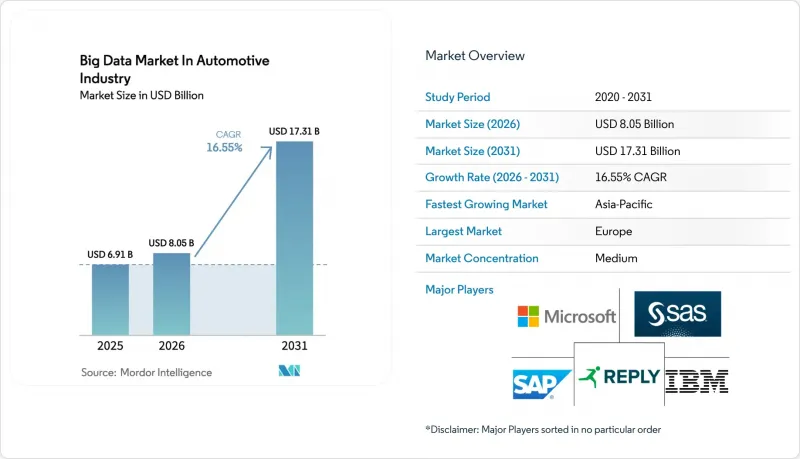
Mordor Intelligence에 의하면, 자동차 산업 빅데이터 시장 2026년 시장 규모는 80억 5,000만 달러로 추정되고 있어 2025년 69억 1,000만 달러에서 확대해, 2031년에는 173억 1,000만 달러에 이를 것으로 예측됩니다.
2026년부터 2031년까지의 연평균 성장률(CAGR)은 16.55%를 나타낼 전망입니다.
본 보고서는 용도(제품 개발, 공급망 및 제조, OEM 보증 및 애프터서비스/딜러 등), 데이터 소스(파워트레인 및 CAN 버스 로그 등), 모델(On-Premise 및 클라우드/엣지 클라우드), 최종 사용자(OEM, Tier 1 공급업체 등), 그리고 지역별로 분류되어 있습니다. 상기 모든 부문에 대해 시장 규모 및 전망은 금액(달러) 단위로 제시되어 있습니다.
자동차 산업 빅데이터 시장에 대한 인사이트 및 동향
차량에서 생성되는 데이터의 수익화를 위한 노력 확대
자동차 제조업체들은 텔레매틱스 데이터를 활용한 디지털 구독 모델로 수익 모델을 전환하고 있습니다. 포드 프로(Ford Pro)는 2024년 2분기 170억 달러의 매출에 대해 26억 달러의 EBIT를 기록했습니다. 이는 가동 시간 최적화를 위해 차량 데이터(플릿 데이터)를 활용하는 60만 건의 유료 소프트웨어 구독이 주도한 결과입니다. 구독 서비스는 2030년까지 커넥티드카 1대당 연간 최대 310달러의 수익을 창출하여 이익률 향상에 기여할 가능성이 있습니다. 현재 마켓플레이스 플랫폼을 통해 각 OEM사는 보험사, 지자체, 에너지 공급 사업자에게 데이터 세트 라이선스를 부여할 수 있게 되었습니다. 따라서 자동차 산업 빅데이터 시장은 원시 센서 로그를 판매 가능한 인사이트로 변환하는 분석 엔진을 중심으로 전개되고 있습니다. 확장성은 지연 없이 테라바이트 규모의 데이터를 수집할 수 있는 하이퍼스케일 파트너십에 달려 있습니다.
커넥티드카 및 소프트웨어 정의 차량(SDV) 도입 대수 증가
세계 커넥티드카 보유 대수는 2027년에 3억 6,700만 대에 달할 것으로 예측되며, 이는 2023년 대비 91% 급증하는 수치입니다. 일본에서는 자율주행차를 위해 25개의 일반 도로를 정비하고 있으며, 2035년까지 판매 대수의 100%를 전기차로 만드는 것을 목표로 하고 있습니다. 이러한 규제로 인해 실시간 데이터 서비스의 대상이 되는 차량군이 확대되고 있습니다. 또한, 소프트웨어 중심의 아키텍처 덕분에 지속적인 무선(OTA)을 통한 기능 업그레이드가 가능해져 지속적인 수익 확대로 이어집니다. 차량용 운영 체제를 장악한 공급업체는 신흥 가치 풀의 대부분을 확보할 전망입니다. 자동차 산업 빅데이터 시장은 데이터 양과 품질을 향상시키기 위해 이러한 하드웨어에 의존하지 않는 전환에 의존하고 있습니다.
보다 엄격해진 개인정보 보호 및 데이터 주권 관련 규제
GDPR(EU 개인정보보호규정), 캘리포니아주의 CPRA, 중국의 PIPL 등 복잡한 법규의 그물망으로 인해 각 OEM 업체들은 거버넌스에 막대한 투자를 할 수밖에 없습니다. 인도의 2025년 규정안에는 72시간 이내의 정보 유출 통지 의무 및 연례 영향 평가가 추가되었습니다. 중국의 현지화 조항에 따라 세계 브랜드들은 방화벽 내부에 병행 인프라를 구축해야 할 의무가 있습니다. 규정 위반 시 벌금, 평판 하락, 서비스 중단 등의 위험이 있어 자동차 산업 빅데이터 시장 단기 성장 속도를 둔화시키고 있습니다. 각 벤더사는 모델 가중치를 공유하면서도 원시 데이터를 국내에 보관하기 위한 연방 학습(Federated Learning) 등 개인정보 보호 강화 기술로 대응하고 있습니다.
부문 분석
커넥티드카 및 지능형 교통 시스템은 2025년 자동차 산업 빅데이터 시장 점유율에서 가장 큰 비중인 42.70%를 차지하며, 연평균 성장률(CAGR) 16.95%로 확대되고 있습니다. 이러한 성장은 5G 인프라 구축, ADAS 기능 의무화, 그리고 원활한 인포테인먼트에 대한 소비자 수요 증가에 힘입고 있습니다. 실시간 교통 체증 회피 경로 안내, 배터리 상태 모니터링, 동적 요금 징수 등은 수익을 창출하는 이용 사례의 예입니다. 유럽의 긴급 제동 시스템 의무화 등 정책 조치도 데이터량의 추가적인 증가를 뒷받침하고 있습니다. OEM의 보증 및 애프터서비스 부서는 서비스 이력을 분석하여 부품 수요를 예측하고 가동 중단 시간을 줄이고 있습니다. 영업·마케팅 부서는 행동 분석을 활용하여 전환율을 높이는 맞춤형 제안을 제공합니다. 생성형 AI를 활용한 교통 최적화 알고리즘은 현재 사고를 높은 정확도로 감지하고 있어 공공 부문에서의 매력을 높이고 있습니다. 이러한 용도이 확대됨에 따라 자동차 산업 빅데이터 시장은 부문 간 데이터 오케스트레이터로서의 역할을 확고히 하고 있습니다.
제품 개발, 공급망, 제조 각 분야의 분석은 추가적인 부가가치를 창출하고 있습니다. 스텔란티스는 자사의 ‘Mobilisights’ 플랫폼을 활용하여 유럽 전역의 차량 플릿 효율화를 도모하고 있습니다. 예지보전 모델은 예기치 못한 생산 라인 중단을 줄여주며, 공장의 디지털 트윈은 신모델 양산 시작 시간을 단축합니다. 텔레매틱스를 활용한 서비스 스케줄링은 고객 만족도 점수 향상으로 이어집니다. 마케팅 팀은 이용 패턴을 활용하여 구독 번들을 구성함으로써 보다 안정적인 수익원을 창출하고 있습니다. 이러한 동향들이 결합되어, 데이터 중심 서비스가 자동차 산업 빅데이터 시장에 대한 추가 투자를 뒷받침하는 피드백 루프가 강화되고 있습니다.
ADAS 및 자율주행용 센서는 2025년 자동차 산업 빅데이터 시장 점유율의 36.85%를 차지하며, 17.72%라는 가장 높은 연평균 성장률(CAGR)을 기록하고 있습니다. 비전, 라이더, 레이더 유닛은 차선 유지 및 충돌 회피와 같은 안전 기능을 뒷받침하는 고해상도 데이터 스트림을 출력합니다. EU 규정에 따라 모든 신차에 자동 긴급 제동(AEB) 장치의 탑재가 의무화되어 있어, 이를 통해 센서의 보급이 확실해지고 있습니다. 엣지 AI 칩은 피드를 압축 및 분류한 후, 요약 정보를 클라우드로 전송하여 모델 재학습에 활용합니다. 차량용 인포테인먼트 및 HMI 로그는 사용자의 선호도를 파악하여 개인화된 컨텐츠 엔진에 정보를 제공합니다. 파워트레인 및 CAN 버스 데이터는 헬스 스코어 알고리즘으로 유입되어, 고장 발생 전에 소유자에게 경고함으로써 보증 비용을 절감합니다.
또한, 차량 함대 및 보험사의 데이터베이스도 데이터 소스 구성을 보완하고 있습니다. 캠브리지 모바일 텔레매틱스(Cambridge Mobile Telematics)의 조사에 따르면, 텔레매틱스를 적극적으로 이용하는 사용자는 운전 중 주의 산만을 20% 줄였습니다. 이용 실적형 보험은 이러한 정보를 활용하여 거의 실시간으로 보험료를 조정합니다. 센서의 정밀도가 향상됨에 따라 물체 감지 정확도도 높아져 자율 주행 기능이 강화됩니다. Aptiv와 같은 공급업체는 무선(OTA) 업그레이드가 가능한 6세대 플랫폼을 발표했습니다. 이러한 기술의 비약적인 발전은 자동차 산업 빅데이터 시장에 반영되어 예측 능력과 수익화 옵션을 풍부하게 하고 있습니다.
지역별 분석
2025년, 북미는 자동차 산업 빅데이터 시장 점유율의 34.10%를 유지했습니다. OEM과 공급업체 간의 견고한 협력, 데이터 공유에 유리한 규제, 그리고 미국과 캐나다 간의 국경을 초월한 무역이 규모의 우위를 뒷받침하고 있습니다. 미국 자동차 제조업체들은 2022년 캐나다로 172억 달러 상당의 차량을 수출했으며, 이는 통합된 공급망을 반영합니다. 국내 반도체 제조에 대한 연방 정부의 장려책과 520억 달러 규모의 ‘CHIPS 법’이 분석 워크로드를 위한 컴퓨팅 공급을 뒷받침하고 있습니다. 제너럴 모터스(GM)는 공장 시뮬레이션에 NVIDIA Omniverse를, 차량용 AI에 DRIVE AGX를 도입함으로써 데이터 기반 제조 분야에서 이 지역의 리더십을 돋보이게 하고 있습니다.
연평균 성장률(CAGR) 18.08%로 가장 빠르게 성장하고 있는 아시아태평양은 중국이 제시한 5,000억 달러 규모의 자율주행차 로드맵과 일본이 제시한 차세대 모델에서 세계 시장 점유율 30% 확보라는 목표의 혜택을 받고 있습니다. 일본은 자율주행차 시험 주행을 위해 25곳의 일반 도로를 개방하여 데이터 축적이 가속화되고 있습니다. 인도의 자동차 산업 비전은 2030년까지 3,000억 달러의 생산액을 목표로 하고 있으며, 5억 달러 규모의 전기차 생산 정책과 국가 GPU 클러스터에 자금을 지원하는 1,030억 루피 규모의 AI 미션에 의해 뒷받침되고 있습니다. 스마트폰의 보급과 저비용 통신 환경 덕분에 이 지역은 텔레매틱스 도입에 최적의 환경이 조성되어 있으며, 자동차 산업 빅데이터 시장에 빠른 데이터 유입을 가져오고 있습니다.
유럽에서는 엄격한 개인정보 보호 조치를 기반으로 꾸준한 확대가 이루어지고 있습니다. EU 데이터법에 따라 2025년까지 차량 1대당 하루 30TB의 데이터가 생성될 가능성이 있으며, 이를 통해 보험사는 소비자의 권리를 보호하면서 실시간 보험 계약을 수립할 수 있게 됩니다. 스텔란티스는 2024년, 자회사인 모빌라이사이트를 통해 동의를 최우선으로 하는 원칙에 기반하여, 차량 함대, 보험, 전기차 충전에 관한 데이터 패키지 제공을 시작했습니다. 지속가능성 목표와 충전 인프라 구축이 전기차 보급을 뒷받침하며, 데이터 세트를 더욱 풍부하게 만들고 있습니다. 현지화 조항을 준수하기 위해 각 OEM 업체들은 지역별 클라우드 및 개인정보 보호 강화형 암호화를 도입하고 있으며, 이는 자동차 산업 빅데이터 시장에서 착실하고 탄탄한 성장을 뒷받침하고 있습니다.
기타 혜택:
- 엑셀 형식 시장 예측(ME) 시트
- 3개월간의 애널리스트 지원
자주 묻는 질문
목차
제1장 서론
제2장 조사 방법
제3장 주요 요약
제4장 시장 구도
제5장 시장 규모와 성장 예측
제6장 경쟁 구도
제7장 시장 기회와 향후 전망
JHS 26.08.11According to Mordor Intelligence, the big data market size in the Automotive Industry market size in 2026 is estimated at USD 8.05 billion, growing from 2025 value of USD 6.91 billion with 2031 projections showing USD 17.31 billion, growing at 16.55% CAGR over 2026-2031.
This report is Segmented by Application (Product Development, Supply Chain and Manufacturing, OEM Warranty and Aftersales/Dealers, and More), Data Source (Power-Train and CAN-Bus Logs, and More), Model (On-Premises and Cloud/Edge Cloud), End-User (OEMs, Tier-1 Suppliers, and More), and Geography. The Market Sizes and Forecasts are Provided in Terms of Value (USD) for all the Above Segments.
Insights and Trends of Big Data Market In Automotive Industry
Increasing efforts to monetize vehicle-generated data
Automakers are redirecting revenue models toward digital subscriptions that ride on telematics feeds. Ford Pro recorded USD 2.6 billion EBIT on USD 17 billion revenue in Q2 2024, propelled by 600,000 paid software subscriptions that leverage fleet data for uptime optimization. Subscription services could generate as much as USD 310 per connected vehicle each year by 2030, bolstering margins. Marketplace platforms now let OEMs license data sets to insurers, municipalities, and energy providers. The Big Data market in the automotive industry, therefore, pivots on analytics engines that convert raw sensor logs into saleable insights. Scalability hinges on hyperscale partnerships that can ingest terabytes without latency.
Growing installed base of connected and software-defined vehicles
Global connected-vehicle stock is projected to hit 367 million units in 2027, a 91% leap over 2023. Japan is clearing 25 public roads for driverless cars and targets 100% electric-vehicle sales by 2035. Such regulations expand the addressable fleet for real-time data services. Software-centric architectures also allow continuous over-the-air feature upgrades, sharpening recurring revenue. Suppliers that master vehicle operating systems stand to capture the lion's share of emerging value pools. The Big Data market in the automotive industry relies on this hardware-agnostic shift to amplify data volume and quality.
Stricter privacy and data-sovereignty regulations
A web of statutes, including GDPR, California's CPRA, and China's PIPL, forces OEMs to invest heavily in governance. India's draft 2025 rules add a mandatory breach notice within 72 hours and annual impact assessments. Chinese localization clauses oblige global brands to build parallel infrastructure behind the firewall. Non-compliance risks fines, reputational harm, and service lockdowns, trimming the near-term expansion tempo of the Big Data market in the automotive industry. Vendors are responding with privacy-enhancing technologies such as federated learning to keep raw data in-country while sharing model weights.
Other drivers and restraints analyzed in the detailed report include:
- Regulatory mandates spurring telematics data availability
- Emergence of edge-cloud analytics loops for autonomous-driving model training
- Lack of industry-wide standard schemas for automotive data sets
For complete list of drivers and restraints, kindly check the Table Of Contents.
Segment Analysis
Connected Vehicle and Intelligent Transportation logged the largest slice of Big Data market share in the automotive industry at 42.70% in 2025 and is advancing at a 16.95% CAGR. This growth rests on 5G build-outs, mandated ADAS functions, and rising consumer appetite for seamless infotainment. Real-time congestion rerouting, battery-health monitoring, and dynamic tolling are examples of revenue-generating use cases. Policy moves such as mandatory emergency braking systems in Europe further boost data volumes. OEM Warranty and Aftersales units mine service histories to predict parts demand, cutting downtime. Sales and marketing arms rely on behavioral analytics to tailor offers that lift conversion rates. Traffic optimization algorithms powered by generative AI now flag incidents with high precision, enhancing public-sector appeal. As these applications scale, the Big Data market in the automotive industry cements its role as a cross-sector data orchestrator.
Product Development, Supply Chain, and Manufacturing analytics add another layer of value. Stellantis employs its Mobilisights platform to refine fleet efficiency across Europe. Predictive maintenance models shave unplanned line stoppages, while digital twins of factories cut ramp-up time for new models. Telematics-driven service scheduling improves customer satisfaction scores. Marketing teams leverage usage patterns to craft subscription bundles, translating into steadier revenue streams. Together, these trends reinforce a feedback loop where data-centric services finance further investment in the Big Data market in the automotive industry.
ADAS and autonomous sensors commanded 36.85% of the Big Data market share in the automotive industry in 2025 and carry the fastest 17.72% CAGR. Vision, lidar, and radar units output high-resolution streams that underpin safety features such as lane keeping and collision avoidance. Regulatory edicts in the EU require autonomous emergency braking in all new models, ensuring sensor proliferation. Edge AI chips compress and classify feeds before forwarding summaries to the cloud for model retraining. In-car infotainment and HMI logs capture user preferences, feeding personalized content engines. Power-train and CAN-bus data flow into health-score algorithms that alert owners ahead of faults, cutting warranty costs.
Fleet and insurance databases round out the source mix. Cambridge Mobile Telematics shows that engaged telematics users reduce distracted driving by 20%. Usage-based insurance leverages those inputs to adjust premiums in near real time. As sensor fidelity improves, object-detection accuracy rises, enhancing autonomy. Suppliers like Aptiv have unveiled Gen 6 platforms with over-the-air upgrade paths. Each leap feeds back into the Big Data market in the automotive industry, enriching predictive power and monetization options.
Complete Report Scope:
- By Application
- Product Development, Supply Chain and Manufacturing
- OEM Warranty and Aftersales/Dealers
- Connected Vehicle and Intelligent Transportation
- Sales, Marketing and Other Applications
- By Data Source
- Power-train and CAN-bus Logs
- ADAS/Autonomous Sensor Data
- In-car Infotainment and HMI Data
- Fleet Operations and Usage-based Insurance Data
- By Deployment Model
- On-premises
- Cloud/Edge Cloud
- By End User
- OEMs
- Tier-1 Suppliers
- Fleet Operators and Mobility Service Providers
- Insurance and Finance Companies
- Aftermarket and Dealer Networks
- By Geography
- North America
- United States
- Canada
- Mexico
- South America
- Brazil
- Argentina
- Rest of South America
- Europe
- Germany
- United Kingdom
- France
- Italy
- Spain
- Rest of Europe
- Asia-Pacific
- China
- Japan
- India
- South Korea
- Rest of Asia-Pacific
- Middle East
- Saudi Arabia
- United Arab Emirates
- Turkey
- Rest of Middle East
- Africa
- South Africa
- Nigeria
- Rest of Africa
- North America
Geography Analysis
North America retained 34.10% of the Big Data market share in the automotive industry in 2025. Deep OEM-supplier linkages, favorable data-sharing regulations, and cross-border trade between the United States and Canada sustain scale advantages. U.S. automakers dispatched USD 17.2 billion worth of vehicles to Canada in 2022, reflecting integrated supply chains. Federal incentives for domestic chip fabrication and the USD 52 billion CHIPS Act underpin the compute supply for analytics workloads. General Motors is implementing NVIDIA Omniverse for plant simulation and DRIVE AGX for in-vehicle AI, highlighting regional leadership in data-driven manufacturing.
Asia Pacific, the fastest-growing territory at 18.08% CAGR, benefits from China's USD 500 billion autonomous-vehicle roadmap and Japan's goal to capture 30% global share in next-generation models. Japan has opened 25 public roads to driverless testing, accelerating data accrual. India's automotive vision targets USD 300 billion output by 2030, backed by a USD 500 million EV production policy and a ₹10,300 crore AI mission that funds national GPU clusters. Smartphone penetration and low-cost connectivity prime the region for telematics adoption, feeding the Big Data market in the automotive industry with high-velocity inputs.
Europe shows steady expansion underpinned by rigorous privacy safeguards. The EU Data Act could surface 30 TB of data per vehicle daily by 2025, enabling insurers to craft real-time policies while safeguarding consumer rights. Stellantis launched fleet, insurance, and EV-charging data packages through its Mobilisights arm in 2024, operating under consent-first principles. Sustainability targets and charging-infrastructure rollouts drive EV penetration, further enriching datasets. To comply with localization clauses, OEMs deploy regional clouds and privacy-enhancing encryption, supporting measured yet resilient growth in the Big Data market in the automotive industry.
- IBM Corporation
- Microsoft Corporation
- Amazon Web Services
- Google Cloud
- SAP SE
- SAS Institute
- Teradata
- Continental AG
- Robert Bosch GmbH
- HERE Technologies
- Otonomo Technologies
- Caruso GmbH
- NVIDIA Corporation
- Harman International
- N-iX
- Future Processing
- Reply SpA (Data Reply)
- Phocas
- Sight Machine
- Qburst
- Monixo
- Allerin
- Positive Thinking Company
- National Instruments
Additional Benefits:
- The market estimate (ME) sheet in Excel format
- 3 months of analyst support
TABLE OF CONTENTS
1 INTRODUCTION
- 1.1 Study Assumptions and Market Definition
- 1.2 Scope of the Study
2 RESEARCH METHODOLOGY
3 EXECUTIVE SUMMARY
4 MARKET LANDSCAPE
- 4.1 Market Overview
- 4.2 Market Drivers
- 4.2.1 Increasing efforts by ecosystem players to monetise vehicle-generated data
- 4.2.2 Growing installed base of connected and software-defined vehicles
- 4.2.3 Regulatory mandates (e.g., EU-GSR, Chinese MIIT) spurring telematics data availability
- 4.2.4 Emergence of edge-cloud analytics loops for autonomous-driving model training
- 4.2.5 OEM-led vehicle-data marketplaces unlocking new recurring-revenue streams
- 4.2.6 Real-time ADAS log offload to hyperscale clouds reducing time-to-validation
- 4.3 Market Restraints
- 4.3.1 Stricter privacy and data-sovereignty regulations (GDPR, CPRA, China PIPL)
- 4.3.2 Lack of industry-wide standard schemas for automotive data sets
- 4.3.3 High TCO of petabyte-scale, low-latency analytics infrastructure
- 4.3.4 OEM reluctance to share proprietary driving-scenario IP
- 4.4 Value/Supply-Chain Analysis
- 4.5 Regulatory Landscape
- 4.6 Technological Outlook
- 4.7 Porter's Five Forces Analysis
- 4.7.1 Bargaining Power of Suppliers
- 4.7.2 Bargaining Power of Buyers
- 4.7.3 Threat of New Entrants
- 4.7.4 Threat of Substitutes
- 4.7.5 Intensity of Competitive Rivalry
- 4.8 Impact of COVID-19 on the Industry
5 MARKET SIZE AND GROWTH FORECASTS (VALUE)
- 5.1 By Application
- 5.1.1 Product Development, Supply Chain and Manufacturing
- 5.1.2 OEM Warranty and Aftersales/Dealers
- 5.1.3 Connected Vehicle and Intelligent Transportation
- 5.1.4 Sales, Marketing and Other Applications
- 5.2 By Data Source
- 5.2.1 Power-train and CAN-bus Logs
- 5.2.2 ADAS/Autonomous Sensor Data
- 5.2.3 In-car Infotainment and HMI Data
- 5.2.4 Fleet Operations and Usage-based Insurance Data
- 5.3 By Deployment Model
- 5.3.1 On-premises
- 5.3.2 Cloud/Edge Cloud
- 5.4 By End User
- 5.4.1 OEMs
- 5.4.2 Tier-1 Suppliers
- 5.4.3 Fleet Operators and Mobility Service Providers
- 5.4.4 Insurance and Finance Companies
- 5.4.5 Aftermarket and Dealer Networks
- 5.5 By Geography
- 5.5.1 North America
- 5.5.1.1 United States
- 5.5.1.2 Canada
- 5.5.1.3 Mexico
- 5.5.2 South America
- 5.5.2.1 Brazil
- 5.5.2.2 Argentina
- 5.5.2.3 Rest of South America
- 5.5.3 Europe
- 5.5.3.1 Germany
- 5.5.3.2 United Kingdom
- 5.5.3.3 France
- 5.5.3.4 Italy
- 5.5.3.5 Spain
- 5.5.3.6 Rest of Europe
- 5.5.4 Asia-Pacific
- 5.5.4.1 China
- 5.5.4.2 Japan
- 5.5.4.3 India
- 5.5.4.4 South Korea
- 5.5.4.5 Rest of Asia-Pacific
- 5.5.5 Middle East
- 5.5.5.1 Saudi Arabia
- 5.5.5.2 United Arab Emirates
- 5.5.5.3 Turkey
- 5.5.5.4 Rest of Middle East
- 5.5.6 Africa
- 5.5.6.1 South Africa
- 5.5.6.2 Nigeria
- 5.5.6.3 Rest of Africa
- 5.5.1 North America
6 COMPETITIVE LANDSCAPE
- 6.1 Market Concentration
- 6.2 Strategic Moves
- 6.3 Market Share Analysis
- 6.4 Company Profiles (includes Global level Overview, Market level overview, Core Segments, Financials as available, Strategic Information, Market Rank/Share for key companies, Products and Services, and Recent Developments)
- 6.4.1 IBM Corporation
- 6.4.2 Microsoft Corporation
- 6.4.3 Amazon Web Services
- 6.4.4 Google Cloud
- 6.4.5 SAP SE
- 6.4.6 SAS Institute
- 6.4.7 Teradata
- 6.4.8 Continental AG
- 6.4.9 Robert Bosch GmbH
- 6.4.10 HERE Technologies
- 6.4.11 Otonomo Technologies
- 6.4.12 Caruso GmbH
- 6.4.13 NVIDIA Corporation
- 6.4.14 Harman International
- 6.4.15 N-iX
- 6.4.16 Future Processing
- 6.4.17 Reply SpA (Data Reply)
- 6.4.18 Phocas
- 6.4.19 Sight Machine
- 6.4.20 Qburst
- 6.4.21 Monixo
- 6.4.22 Allerin
- 6.4.23 Positive Thinking Company
- 6.4.24 National Instruments
7 MARKET OPPORTUNITIES AND FUTURE OUTLOOK
- 7.1 White-space and Unmet-need Assessment


