

|
시장보고서
상품코드
2100708
액체 수소 시장 : 점유율 분석, 업계 동향 및 통계, 성장 예측(2026-2031년)Liquid Hydrogen - Market Share Analysis, Industry Trends & Statistics, Growth Forecasts (2026 - 2031) |
||||||
 Mordor Intelligence
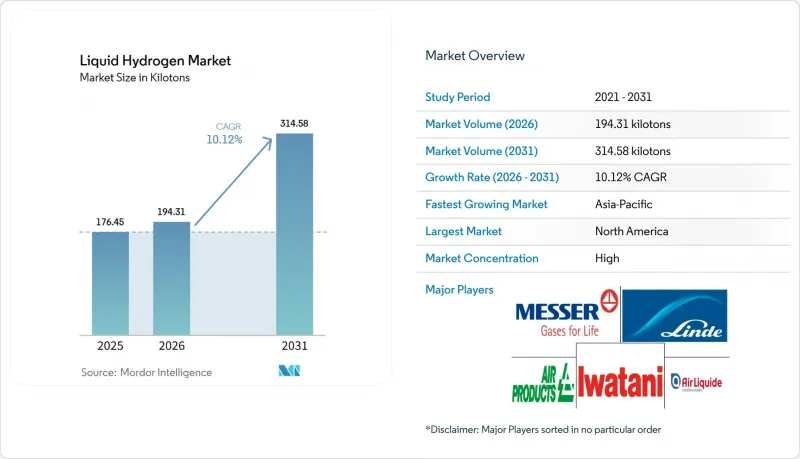
Mordor Intelligence에 의하면, 액체 수소 시장 규모는 2025년에 176.45 킬로톤으로 추산 되고 있어 2026년 194.31 킬로톤에서 확대해, 2031년까지 314.58 킬로톤에 이른다고 전망되고 있습니다.
예측 기간(2026-2031년) 동안 연평균 성장률(CAGR) 10.12%로 확대되어 2031년까지 314.58킬로톤에 도달할 것으로 예측됩니다.
본 보고서는 공급 형태(극저온 탱크, 고압 튜브 트레일러), 최종 사용자 산업(항공우주(우주 공간 포함), 자동차, 선박, 기타) 및 지역(아시아태평양, 북미, 유럽, 남미, 중동 및 아프리카)별로 분류되어 있습니다. 시장 전망은 수량(톤) 단위로 표시됩니다.
전 세계 액체 수소 시장 동향 및 인사이트
아르테미스 계획 이후 발사 빈도의 급증 및 달 탐사 임무
NASA의 아르테미스 계획은 우주 공간에서 수개월에 걸친 저장 기간 동안 제로 보일오프(zero boil-off) 기술이 추진제 손실을 98%까지 줄일 수 있음을 입증함으로써, 액체 추진제의 물류 방식을 재정의했습니다. 항공우주 업계의 주요 기업들은 현재 이러한 인사이트력을 위성 유지보수 아키텍처에 통합하고 있으며, 이는 첨단 액체 수소 시스템에 대한 2차 수요를 창출하고 있습니다. ESA는 2027년 달 게이트웨이를 목표로 동등한 제로 보일오프 프레임워크 도입을 추진 중이며, 이로 인해 지리적 수요가 확대되고 있습니다. 민간 발사 사업자들은 공급 리스크를 헤지하기 위해 발사대 근처에 액화 설비를 병설하고 있으며, 이러한 움직임이 지역별 역량 확충을 가속화하고 있습니다. 전반적으로 민간 및 상업 임무의 급증은 액체 수소 시장의 장기적인 전망을 확고히 하고 있습니다.
상용 FCEV 트럭 도입에는 디포 규모의 LH2 급유가 필요합니다.
메르세데스-벤츠와 에어 프로덕츠(Air Products)가 진행한 GenH2 실증 시험에서는 1,000km의 주행 거리와 15분 미만의 충전 시간을 기록하며, 클래스 8 트럭에서 액체 수소의 우월성이 입증되었습니다. 현재 유럽의 차량 함대 입찰에서는 디포 규모의 액체 수소 대응 능력이 필수 조건으로 요구되고 있으며, TEAL Mobility는 2030년까지 100곳의 충전소 설치를 계획하고 있으며, 각 충전소는 높은 처리량을 지원하는 설계로 구축될 예정입니다. 대형 트럭용 운송 회랑의 정비가 진행됨에 따라, 하루 20-40톤의 액화 능력을 갖춘 스키드에 대한 수요가 잇따르고 있습니다. 사업자들이 디젤 연료와의 비용 경쟁력을 추구하는 가운데, 액체 수소 시장은 더 높은 질량 에너지 밀도에 기인한 총 소유 비용(TCO) 절감이라는 이점을 누리고 있습니다.
소형 충전소의 높은 보일오프 손실
하루 처리 용량이 200kg 미만인 충전소에서는 일반적으로 하루 2-3%의 보일오프가 발생하여 단위당 수익성을 저해하고 있습니다. 보일오프가 전혀 발생하지 않는 아키텍처도 존재하지만, 그 높은 설비 투자 비용(CAPEX)은 교통량이 적은 충전소에게는 장벽이 되고 있습니다. 도요타의 증기 재활용 시스템은 이를 완화하지만, 운영상의 복잡성을 가중시킵니다. 그 결과, 개발업체들은 액화 설비를 일원화한 허브 앤 스포크(hub-and-spoke)형 모델을 선호하지만, 이로 인해 지방으로의 확장이 제한되고 운송 비용도 상승하여 액체 수소 시장의 단기적인 보급은 둔화되고 있습니다.
부문 분석
2025년에는 극저온 탱크가 액체 수소 시장 규모의 60.62%를 차지하며 시장을 주도했습니다. 이는 우주 비행 분야에서 쌓아온 기존 활용 실적과 새롭게 입증된 ‘증발 제로’ 성능 기준을 반영한 결과입니다. 이 부문의 성장은 다층 단열 기술의 발전과, 투과성을 낮추면서도 무게를 최대 3분의 1까지 줄여주는 복합재 쉘 덕분입니다. 사업자에게 있어 고정형 극저온 저장 시설은 급증하는 급유 수요에 효율적으로 대응할 수 있기 때문에 핵심 자산으로 간주됩니다. 진공 재킷이 장착된 배관이나 능동형 열 관리와 같은 기술적 업그레이드를 통해 극저온 탱크는 하루 5톤 이상의 차량을 보유한 허브에 가장 비용 효율적인 선택지가 되었습니다.
고압 튜브 트레일러는 시장 점유율은 작지만, 2031년까지 연평균 성장률(CAGR) 11.05%를 나타낼 것으로 예측됩니다. 이는 고정식 탱크 팜에 필요한 운송량을 충족하지 못하는 초기 단계의 운송 경로에 적합하며, 투자자에게는 진입 비용이 낮고 경로 유연성이 높다는 장점이 있습니다. Verne의 극저온 압축 플랫폼은 이 두 가지 운송 방식을 연결해 주는 것으로, 표준 700바 튜브에 비해 부피 밀도가 2배이며, 시간이 오래 걸리는 벤트 사이클 없이도 연속 적재가 가능합니다. 2026년부터 2027년까지 이루어질 차량 총중량 규제의 조화 및 ADR(유럽 위험물 운송 규정) 준수를 통해 주간 화물 운송 네트워크 전반에 걸쳐 채택이 확대되어, 액체 수소 시장의 잠재적 규모가 더욱 커질 것입니다.
지역별 분석
북미는 2025년 총량의 42.10%를 차지하고 있으며, 이는 NASA의 조달 주기, 캘리포니아주의 LCFS 크레딧, 그리고 에너지부의 H2Hubs 자금 지원을 반영한 것입니다. 멕시코만 연안의 수 기가와트 규모 전해조 파이프라인은 기존 석유화학 인프라와 연계되어 있으며, 지상 극저온 탱크를 보완하는 염동 저장 옵션을 제공합니다. 이 지역의 액체 수소 시장은 2025년 7월 LH2 차량 규정을 법제화한 FMVSS 안전 기준에 힘입어 더욱 탄력을 받고 있으며, 이는 OEM의 생산 계획에 따른 위험을 완화하고 있습니다.
아시아태평양은 중국의 안양 메가 프로젝트와 한국이 추진하는 78억 달러 규모의 서해안 수소 벨트의 견인 효과로 2031년까지 연평균 성장률(CAGR) 11.12%라는 가장 빠른 복합 성장이 예상됩니다. HD KSOE와 가와사키가 개발 중인 대형 수송선은 일본 및 싱가포르로의 해상 수출 경로를 확립하여 선순환을 창출하는 생태계를 형성하고 있습니다. 재생에너지를 활용한 전해에 대한 정부 주도의 고정가격임베디드제도(FIT)로 인해 공급 비용이 절감되는 한편, 국내 트럭 제조업체들은 2029년까지 2만 대의 수소연료전지차(FCEV) 생산을 계획하고 있어 수요 증가가 더욱 가속화되고 있습니다. 이러한 동향들이 맞물리면서, 세계 액체 수소 시장공급 능력 균형이 동아시아로 이동하고 있습니다.
유럽의 인프라 구축은 에어 리퀴드(Air Liquide)의 1억 1,000만 유로 규모 ENHANCE 프로젝트와, 2029년까지 2,700km의 수소 회랑을 구축하는 IPCEI Hy2Infra 파이프라인 계획이 중심이 되고 있습니다. RED III의 운송 할당량 및 Fit-for-55 목표와 같은 정책 수단을 통해 항공, 해운, 철강 업계의 탈탄소화 도입이 가속화되고 있습니다. 이 지역은 기가(giga) 규모의 액화 플랜트 건설에서는 뒤처져 있지만, 수입 터미널 및 암모니아를 수소로 분해하는 프로젝트 네트워크를 통해 유럽은 액체 수소 산업에 있어 수요가 높은 시장으로서의 입지를 확고히 하고 있습니다. 남미, 중동 및 아프리카는 여전히 발전 단계에 있지만, 미래성이 기대되고 있으며, 특히 GasLog의 극저온 운송 기술에 기반한 오만에서 유럽으로의 수출 구상이 주목받고 있습니다.
기타 혜택:
- 엑셀 형식 시장 예측(ME) 시트
- 3개월간의 애널리스트 지원
자주 묻는 질문
목차
제1장 서론
제2장 조사 방법
제3장 주요 요약
제4장 시장 구도
제5장 시장 규모와 성장 예측
제6장 경쟁 구도
제7장 시장 기회와 향후 전망
JHS 26.08.11According to Mordor Intelligence, the liquid hydrogen market size was estimated at 176.45 kilotons in 2025 and is estimated to grow from 194.31 kilotons in 2026 to reach 314.58 kilotons by 2031, at a CAGR of 10.12% during the forecast period (2026-2031).
This report is Segmented by Distribution (Cryogenic Tanks and High-Pressure Tube Trailers), End-User Industry (Aerospace (including Outer Space), Automotive, Marine, and Other End-User Industries), and Geography (Asia-Pacific, North America, Europe, South America, and Middle East and Africa). The Market Forecasts are Provided in Terms of Volume (Tons).
Global Liquid Hydrogen Market Trends and Insights
Surging Launch Cadence and Lunar Mission Programs Post-Artemis
NASA's Artemis agenda has re-defined liquid propellant logistics by proving that zero-boil-off technology cuts propellant loss by 98% during multi-month storage in space. Aerospace primes now incorporate these findings into satellite-servicing architectures, creating a secondary pull for advanced liquid hydrogen systems. ESA aims to deploy a comparable zero-boil-off framework for its 2027 lunar gateway, broadening geographic demand. Private launch providers are co-locating liquefiers near pads to hedge supply risk, a move that accelerates regional capacity build-outs. Collectively, the surge in civil and commercial missions is anchoring long-term visibility for the liquid hydrogen market.
Commercial FCEV Truck Roll-Outs Needing Depot-Scale LH2 Refueling
Mercedes-Benz GenH2 trials with Air Products validated liquid hydrogen's superiority for Class 8 trucks by logging 1,000 km ranges and sub-15-minute refuels. Fleet tenders in Europe now stipulate depot-scale liquid hydrogen capability, while TEAL Mobility plans 100 refueling stations by 2030, each designed for high-throughput loading. Heavy-duty corridor build-outs are cascading into demand for 20-40 ton-per-day liquefaction skids. As operators chase diesel parity, the liquid hydrogen market benefits from total-cost-of-ownership gains linked to higher gravimetric energy density.
High Boil-Off Losses for Small-Footprint Stations
Throughputs below 200 kg/day typically suffer 2-3% daily boil-off, eroding unit economics. While zero-boil-off architectures exist, the CAPEX premium is prohibitive for low-traffic stations. Toyota's vapor-recycling system offers mitigation but adds operational complexity. As a result, developers favor hub-and-spoke models with centralized liquefaction, but that limits rural coverage and raises transport costs, muting near-term dispersion of the liquid hydrogen market.
Other drivers and restraints analyzed in the detailed report include:
- Asia-Pacific Gigawatt-Scale Liquefiers Coming Online
- Cost-Down in Ortho-Para Catalytic Conversion Packs
- Limited Global Helium Supply for LH2 Pumps and Seals
For complete list of drivers and restraints, kindly check the Table Of Contents.
Segment Analysis
Cryogenic tanks dominated the liquid hydrogen market size with 60.62% of total volume in 2025, reflecting their legacy use in spaceflight and newly validated zero-boil-off performance benchmarks. The segment's growth stems from multilayer insulation advances and composite shells that reduce weight by up to one-third while cutting permeation. Operators view stationary cryogenic depots as foundational assets because they scale efficiently with refueling demand spikes. Technological upgrades, including vacuum-jacketed lines and active thermal management, make cryogenic tanks the most cost-effective option for fleet hubs above 5 tons/day.
High-pressure tube trailers, though holding a smaller slice, are forecast to log an 11.05% CAGR through 2031. They attract early-stage corridors that lack the volumes needed for fixed tank farms, giving investors a lower entry cost and route flexibility. Verne's cryo-compressed platform bridges the two modalities, offering 2X the volumetric density of standard 700 bar tubes and enabling back-to-back loading without time-consuming vent cycles. Regulatory harmonization on gross vehicle mass and ADR compliance in 2026-2027 will widen adoption across interstate freight networks, widening the addressable surface for the liquid hydrogen market.
Complete Report Scope:
- By Distribution
- Cryogenic Tanks
- High-Pressure Tube Trailers
- By End-User Industry
- Aerospace (Including Outer Space)
- Automotive
- Marine
- Other End-user Industries
- By Geography
- Asia-Pacific
- China
- India
- Japan
- South Korea
- ASEAN Countries
- Rest of Asia-Pacific
- North America
- United States
- Canada
- Mexico
- Europe
- Germany
- United Kingdom
- France
- Italy
- Russia
- NORDIC Countries
- Rest of Europe
- South America
- Brazil
- Argentina
- Rest of South America
- Middle East and Africa
- Saudi Arabia
- South Africa
- Rest of Middle East and Africa
- Asia-Pacific
Geography Analysis
North America captured 42.10% of 2025 volume, reflecting NASA procurement cycles, California's LCFS credits, and Department of Energy H2Hubs funding. Multi-gigawatt electrolyzer pipelines along the Gulf Coast are pairing with existing petrochemical infrastructure, offering salt-cavern storage options that complement above-ground cryogenic tanks. The liquid hydrogen market in the region is additionally buoyed by the July 2025 FMVSS safety standard that codified LH2 vehicle regulations, de-risking OEM production planning.
Asia-Pacific is poised for the fastest compound lift at 11.12% CAGR to 2031, fueled by China's Anyang megaproject and Korea's USD 7.8 billion West Coast Hydrogen Belt. Large-scale carriers under development by HD KSOE and Kawasaki establish maritime export lanes to Japan and Singapore, creating a self-reinforcing ecosystem. Government-backed feed-in tariffs for renewable-powered electrolysis reduce delivered cost, while domestic truck OEMs plan 20,000 FCEV unit output by 2029, deepening offtake. These developments collectively re-balance global liquid hydrogen market capacity toward the East.
Europe's build-out centers on Air Liquide's EUR 110 million ENHANCE project and the IPCEI Hy2Infra pipeline plan that strings 2,700 km of hydrogen corridors by 2029. Policy levers such as RED III transport quotas and Fit-for-55 targets accelerate adoption across aviation, maritime, and steel decarbonization. Though the region trails in giga-scale liquefiers, a web of import terminals and ammonia-to-hydrogen cracking projects positions Europe as a high-demand sink for the liquid hydrogen industry. South America and the Middle East and Africa remain nascent but show promise, notably Oman-to-Europe export concepts backed by GasLog's cryogenic shipping technology.
- Air Liquide
- Air Products and Chemicals, Inc.
- Iwatani Corporation
- Kawasaki Heavy Industries, Ltd.
- Linde PLC
- MATHESON Tri-Gas, Inc.
- Messer SE and Co. KGaA
- NIPPON SANSO HOLDINGS CORPORATION
- Olin Corporation
- Plug Power Inc.
- Universal Industrial Gases
Additional Benefits:
- The market estimate (ME) sheet in Excel format
- 3 months of analyst support
TABLE OF CONTENTS
1 Introduction
- 1.1 Study Assumptions and Market Definition
- 1.2 Scope of the Study
2 Research Methodology
3 Executive Summary
4 Market Landscape
- 4.1 Market Overview
- 4.2 Market Drivers
- 4.2.1 Surging Launch Cadence and Lunar-Mission Programs Post-Artemis
- 4.2.2 Commercial FCEV Truck Roll-Outs Needing Depot-Scale LH2 Refuelling
- 4.2.3 Asia-Pacific Gigawatt-Scale Liquefiers Coming Online
- 4.2.4 Cost-Down in Ortho-Para Catalytic Conversion Packs
- 4.2.5 Cryogenic Carbon-Composite Tank Breakthroughs
- 4.3 Market Restraints
- 4.3.1 High Boil-Off Losses for Small-Footprint Stations
- 4.3.2 Limited Global Helium Supply for LH2 Pumps and Seals
- 4.3.3 Electro-Intensiveness of Liquefaction Inflates Green-H2 LCOH
- 4.4 Value Chain Analysis
- 4.5 Porter's Five Forces
- 4.5.1 Bargaining Power of Suppliers
- 4.5.2 Bargaining Power of Buyers
- 4.5.3 Threat of New Entrants
- 4.5.4 Threat of Substitutes
- 4.5.5 Degree of Competition
5 Market Size and Growth Forecasts (Volume)
- 5.1 By Distribution
- 5.1.1 Cryogenic Tanks
- 5.1.2 High-Pressure Tube Trailers
- 5.2 By End-User Industry
- 5.2.1 Aerospace (Including Outer Space)
- 5.2.2 Automotive
- 5.2.3 Marine
- 5.2.4 Other End-user Industries
- 5.3 By Geography
- 5.3.1 Asia-Pacific
- 5.3.1.1 China
- 5.3.1.2 India
- 5.3.1.3 Japan
- 5.3.1.4 South Korea
- 5.3.1.5 ASEAN Countries
- 5.3.1.6 Rest of Asia-Pacific
- 5.3.2 North America
- 5.3.2.1 United States
- 5.3.2.2 Canada
- 5.3.2.3 Mexico
- 5.3.3 Europe
- 5.3.3.1 Germany
- 5.3.3.2 United Kingdom
- 5.3.3.3 France
- 5.3.3.4 Italy
- 5.3.3.5 Russia
- 5.3.3.6 NORDIC Countries
- 5.3.3.7 Rest of Europe
- 5.3.4 South America
- 5.3.4.1 Brazil
- 5.3.4.2 Argentina
- 5.3.4.3 Rest of South America
- 5.3.5 Middle East and Africa
- 5.3.5.1 Saudi Arabia
- 5.3.5.2 South Africa
- 5.3.5.3 Rest of Middle East and Africa
- 5.3.1 Asia-Pacific
6 Competitive Landscape
- 6.1 Market Concentration
- 6.2 Strategic Moves
- 6.3 Market Share (%)/Ranking Analysis
- 6.4 Company Profiles (includes Global level Overview, Market level overview, Core Segments, Financials as available, Strategic Information, Market Rank/Share, Products and Services, Recent Developments)
- 6.4.1 Air Liquide
- 6.4.2 Air Products and Chemicals, Inc.
- 6.4.3 Iwatani Corporation
- 6.4.4 Kawasaki Heavy Industries, Ltd.
- 6.4.5 Linde PLC
- 6.4.6 MATHESON Tri-Gas, Inc.
- 6.4.7 Messer SE and Co. KGaA
- 6.4.8 NIPPON SANSO HOLDINGS CORPORATION
- 6.4.9 Olin Corporation
- 6.4.10 Plug Power Inc.
- 6.4.11 Universal Industrial Gases
7 Market Opportunities and Future Outlook
- 7.1 White-space and Unmet-Need Assessment


