

|
시장보고서
상품코드
2100739
인도의 승용차 시장 : 점유율 분석, 업계 동향 및 통계, 성장 예측(2026-2031년)India Passenger Car - Market Share Analysis, Industry Trends & Statistics, Growth Forecasts (2026 - 2031) |
||||||
 Mordor Intelligence
Mordor Intelligence에 의하면, 인도 승용차 시장 규모는 2025년 413억 4,000만 달러에서 2026년에는 444억 5,000만 달러로 확대되어 2026-2031년까지 CAGR 7.51%로 성장을 지속하여, 2031년에는 638억 4,000만 달러에 이를 것으로 예측됩니다.
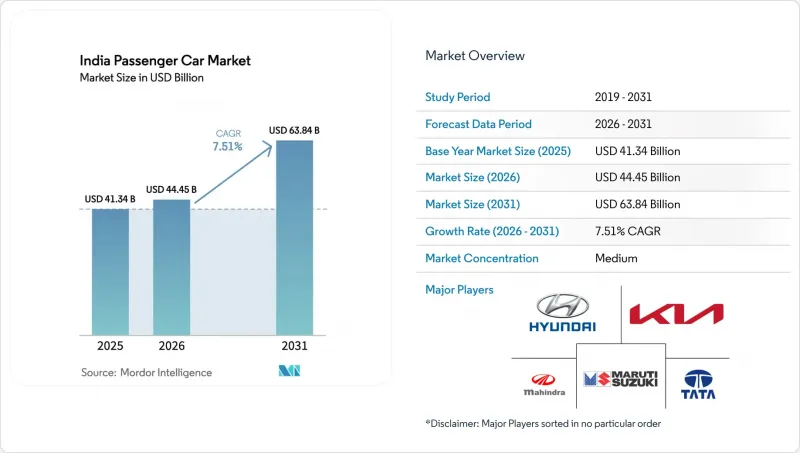
본 보고서는 차종 구성(해치백, MPV, 세단, SUV), 구동 방식(하이브리드 전기차 및 내연기관차), 변속기(수동, 자동, AMT/IMT, DCT/CVT), 가격대(50만 루피 이하, 기타), 소유 형태(개인 및 플릿)별로 분류되어 있습니다. 예측치는 금액(달러)과 판매 대수(대)로 표시되어 있습니다.
인도 승용차 시장 동향과 인사이트
전장 4,000-4,400mm급 소형 SUV 공급 급증
예측 기간 동안 GST(상품 및 서비스세)와 추가 과세 세율 인하로 인해 전장 4미터 이하 SUV 부문에서 수많은 신차 모델이 출시되었습니다. 최근 출시된 마르티 프롱크스, 현대 엑스터, 타타 펀치, 마힌드라 XUV 3XO, 기아 소넷 등의 모델은 각각 상당한 세금 부담 경감의 혜택을 받아 전반적으로 큰 판매 실적을 달성했습니다. 다양한 기능을 갖춘 소형 SUV에 대한 강력한 수요를 상징하는 마힌드라의 ‘XUV 3XO’는 출시 직후 압도적인 수의 예약을 기록했습니다. 현대자동차의 ‘K1’이나 마르티의 ‘하트텍(Heartect)’과 같은 공통 플랫폼을 통해 금형 비용이 여러 모델에 분산되는 한편, 이러한 클러스터링이 가격 경쟁을 심화시켰습니다. 각 브랜드가 재고 증가에 대응하기 위해 액세서리 세트 판매나 보증 기간 연장 등을 실시한 결과, 중형 부문의 실세 가격은 소폭 하락했습니다.
CNG 인프라 확충으로 인해 운영 비용의 패리티 달성까지 걸리는 기간이 단축되었습니다.
2024년 초부터 2025년 말까지 CNG 충전소 수가 대폭 증가하여, 도시 지역의 주유소 가격에 비해 뚜렷한 비용 우위를 가져왔습니다. 자주 이용하는 사용자에게 있어, 출고 시 CNG 사양이 적용된 차량의 투자 회수 기간은 상당히 단축되었습니다. 이러한 추세에 힘입어 마르티는 여러 모델에서 CNG 차량 판매를 대폭 늘릴 수 있었습니다. 한편, 현대와 타타도 일부 모델에 CNG 옵션을 도입함으로써 라인업을 확충하고 있습니다. 앞으로를 내다보면, 규제 당국은 2020년대 말까지 충전소 확충을 위한 야심 찬 목표를 설정하고 있습니다. 그러나 과제는 여전히 남아 있습니다. 트렁크 공간 축소나 출력의 소폭 저하와 같은 상충 관계로 인해, CNG 차량의 보급률은 총 판매 대수의 극히 일부에 그치고 있습니다.
대리점의 과잉 재고가 50일분을 초과하여 OEM의 생산에 압박을 가하고 있습니다.
유통 재고가 대폭 증가하여 정상 수준을 상회함에 따라 미판매 대수가 상당수에 달했습니다. 이 문제를 해결하기 위해 마르티는 2026년 1월 생산량을 상당한 비율로 감축했습니다. 한편, 현대와 타타는 플로어플랜 기간을 연장하여 딜러의 자금 사정을 지원하는 조치를 취했으나, 그 결과 차량 1대당 이자 부담이 증가했습니다. 2025년 내내 인도 중앙은행은 레포 금리를 안정적인 수준으로 유지했기 때문에 자동차 대출 금리는 비교적 높은 수준을 유지했고, 이는 축제 시즌 수요를 억제하는 결과를 낳았습니다. 2025년 4분기에는 대폭적인 할인 판매가 이루어지면서 OEM의 매출 총이익률이 현저히 하락했습니다.
부문 분석
스포츠 유틸리티 차량(SUV)은 2025년 인도 승용차 시장의 인도 대수의 53.47%를 차지했으며, 2031년까지 연평균 7.53%의 성장률을 보일 것으로 전망됩니다. 마르티 프롱크스, 현대 엑스터, 타타 펀치와 같은 전장 4미터 이하의 SUV는 GST(상품 및 서비스세)와 추가 과세 세율 인하의 혜택을 받고 있습니다. 이러한 세제 혜택으로 인해 차량의 전체 수명 주기에 걸친 소유 비용이 대폭 감소하여, 이러한 SUV는 구매를 희망하는 가구에게 더욱 합리적인 가격으로 제공되고 있습니다. 마힌드라의 스콜피오-N과 XUV700은 견조한 수요를 보이며, 프리미엄 부문에서 후륜구동 및 4WD 기능의 매력을 부각시키고 있습니다. 한편, 해치백 시장 점유율은 하락하고 있으며, 이는 첫 차를 구매하는 층이 SUV로 이동하고 있는 추세를 반영하고 있습니다. 세단은 마르티 디아르에 대한 안정적인 기업용 수요에 힘입어 견고한 입지를 유지하고 있습니다. 또한 다목적 차량은 특히 농촌 지역에서 대가족의 이동 수요를 계속해서 충족시키고 있습니다.
SUV의 인기가 급증함에 따라 플랫폼 공유가 확대되고 있습니다. 현대자동차의 K1 플랫폼은 현재 여러 모델의 기반이 되고 있으며, 차량당 연구개발비용을 대폭 절감하는 데 성공했습니다. 또한, 마르티의 ‘하트엑트’ 플랫폼은 유연한 모델 전환을 가능하게 하여 구자라트 공장의 생산 효율을 높이고 있습니다. 이러한 경쟁 구도 속에서 닛산 ‘마그나이트’나 르노 ‘카이거’와 같은 모델의 실적은 제품 차별화보다 서비스 접근성이 중요하다는 점을 여실히 보여주고 있습니다. 게다가 소비자들의 큰 관심을 끌고 있는 타타의 ‘Curvv EV’ 쿠페와 같은 혁신적인 차체 스타일은 해당 부문이 성숙 단계에 접어들고 있음에도 잠재적인 성장 기회를 보여주고 있습니다.
2025년에는 내연기관 차량이 시장 점유율의 83.35%를 차지했으나, 전기차는 PM E-DRIVE의 대대적인 수요 촉진 정책에 힘입어 2031년까지 연평균 성장률(CAGR) 7.61%를 기록할 전망입니다. 타타 모터스는 전기차 시장을 휩쓸며 ‘넥슨 EV’, ‘티아고 EV’, ‘펀치 EV’ 각 모델로 견실한 판매 실적을 올렸고, 판매 점유율의 대부분을 차지했습니다. 타타 모터스는 이러한 모델들을 합리적인 가격대에 전략적으로 포지셔닝함으로써 시장 내 영향력을 확대하는 데 성공했습니다. 대조적으로, 프리미엄 가격대에 포지셔닝된 현대자동차의 ‘아이오닉 5’와 기아의 ‘EV6’는 제한된 판매 대수에 그쳤습니다. 내연기관차(ICE) 중에서는 가솔린차가 여전히 가장 선호되는 선택지였고, 그 다음으로 디젤차가 뒤를 이었으나, 마르티의 바이퓨얼 차량 라인업 덕분에 CNG차도 눈에 띄는 성장세를 보였습니다. 이는 소비자가 선택할 수 있는 옵션이 다양하다는 점을 여실히 보여줍니다.
하이브리드 차량 부문은 눈에 띄는 성장을 보였으며, 그 선두에 선 것은 ‘토요타 하이라이더’입니다. 이 차량은 가솔린 차량에 비해 연비가 대폭 향상되었을 뿐만 아니라, 세제 혜택도 받고 있습니다. 그러나 플러그인 하이브리드 전기차나 연료전지차는 높은 초기 비용과 미비한 인프라 등의 요인으로 인해 보급에 어려움을 겪고 있습니다. 향후 배기가스 기준에 관한 명확한 정책이 구동 기술에 대한 중기적인 투자 판단을 좌우하게 될 것이지만, 내연기관차(내연차)가 현재도 견조한 추세를 보이고 있는 점을 고려할 때, 급격한 변화라기보다는 단계적인 전환이 진행될 것으로 보입니다.
기타 혜택
- 엑셀 형식 시장 예측(ME) 시트
- 3개월간의 애널리스트 지원
자주 묻는 질문
목차
제1장 서론
제2장 조사 방법
제3장 주요 요약
제4장 산업 주요 동향
제5장 시장 구도
제6장 시장 규모와 성장 예측
제7장 경쟁 구도
제8장 시장 기회와 향후 전망
제9장 부록
제10장 CEO가 생각해야 할 중요 전략적 과제
JHS 26.08.11According to Mordor Intelligence, the Indian passenger car market size is expected to grow from USD 41.34 billion in 2025 to USD 44.45 billion in 2026 and is forecast to reach USD 63.84 billion by 2031 at a 7.51% CAGR over 2026-2031.
This report is Segmented by Vehicle Configuration (Hatchback, MPV, Sedan, and SUV), Propulsion Type (Hybrid & Electric and ICE), Transmission (Manual, Automatic, AMT/IMT, and DCT/CVT), Price Band (Less Than or Equal To INR 5 Lakh and More), and Ownership (Personal and Fleet). Forecasts in Value (USD) and Volume (Units).
India Passenger Car Market Trends and Insights
Surging Compact-SUV Supply From 4,000-4,400 mm Length Bracket
Lower GST-plus-cess slabs spurred several launches in the sub-4-meter SUV segment during the forecast period. Recently launched models, including Maruti Fronx, Hyundai Exter, Tata Punch, Mahindra XUV 3XO, and Kia Sonet, collectively achieved significant sales volumes, with each benefiting from notable tax savings . Mahindra's XUV 3XO, highlighting the strong demand for feature-rich compact SUVs, received an overwhelming number of reservations shortly after its launch. While shared architectures, such as Hyundai's K1 and Maruti's Heartect, spread tooling costs across various models, this clustering heightened price competition. As brands offered bundled accessories and extended warranties to manage rising inventories, transaction prices in the mid-range segment experienced a slight decline.
CNG Infrastructure Build-Out Reducing Running-Cost Parity Time
Between early 2024 and late 2025, the number of CNG outlets experienced significant growth, offering a notable cost advantage over gasoline prices at urban pumps. For regular users, the payback period for factory-fitted CNG cars has become considerably shorter. This trend has driven Maruti to achieve substantial CNG sales across multiple models . Meanwhile, Hyundai and Tata have expanded their offerings by introducing CNG options in several models. Looking ahead, regulators have set ambitious targets for station expansion by the end of the decade. However, challenges persist: trade-offs like reduced boot space and slight power reductions have limited CNG adoption to a fraction of total volumes.
Dealer Inventory Overhang More Than 50 Days Pressuring OEM Production
Channel stock increased significantly, exceeding the usual levels, which resulted in a substantial number of unsold units. To address this issue, Maruti reduced its January 2026 production by a notable percentage. At the same time, Hyundai and Tata implemented measures to support dealer liquidity by extending floor-plan tenures, which led to additional interest expenses per car. Throughout 2025, the Reserve Bank of India maintained the repo rate at a steady level, keeping auto-loan rates relatively high and suppressing festive demand. During the last quarter of 2025, significant discounting caused a noticeable decline in OEM gross margins.
Other drivers and restraints analyzed in the detailed report include:
- Digital-First Aspirational Younger Buyers
- E-Commerce-Fuelled Urban Gig-Fleet Demand
- Intensifying Price War in Entry Hatchbacks Squeezing Margins
For complete list of drivers and restraints, kindly check the Table Of Contents.
Segment Analysis
Sports Utility Vehicles controlled 53.47% of 2025 deliveries within the Indian passenger car market size and should advance at a 7.53% trajectory to 2031. Sub-4-meter SUVs like the Maruti Fronx, Hyundai Exter, and Tata Punch benefit from a reduced GST-plus-cess slab. This tax break significantly lowers ownership costs over the vehicle's lifecycle, making these SUVs more accessible to aspirational households. Mahindra's Scorpio-N and XUV700 have demonstrated strong demand, highlighting the appeal of rear-wheel-drive and 4x4 features in the premium segment. Meanwhile, hatchbacks have seen a decline in market share, reflecting a trend of first-time buyers shifting towards SUVs. Sedans have maintained a stable presence, supported by consistent fleet demand for the Maruti Dzire, while multi-purpose vehicles continue to address the mobility needs of joint families, particularly in rural areas.
The surge in SUV popularity has led to shared platforms; Hyundai's K1 platform now underpins multiple models, achieving significant reductions in per-unit R&D costs. Maruti's Heartect platform, enabling flexible model transitions, has enhanced production efficiency at its Gujarat plant. In this competitive landscape, the performance of models like the Nissan Magnite and Renault Kiger underscores the importance of service accessibility over product differentiation. Furthermore, innovative body styles, such as Tata's Curvv EV coupe, which has attracted considerable consumer interest, indicate potential growth opportunities even as the segment matures.
Internal Combustion Engines kept 83.35% command in 2025; however, EVs are slated to record a 7.61% CAGR through 2031, aided by substantial PM E-DRIVE demand incentives. Tata Motors dominated the EV market, accounting for a significant share of sales with strong performance across its Nexon EV, Tiago EV, and Punch EV models. By strategically pricing these models in the affordable range, Tata Motors successfully broadened its market reach. In contrast, Hyundai's Ioniq 5 and Kia's EV6, positioned in the premium price segment, managed to capture only a limited volume. Among internal combustion engine (ICE) vehicles, gasoline remained the most preferred choice, followed by diesel, while CNG gained notable traction due to Maruti's bi-fuel offerings. This highlights the varied choices available to consumers.
The hybrid segment experienced notable growth, led by the Toyota Hyryder, which offers significant fuel efficiency improvements compared to gasoline and benefits from favorable tax rates. However, plug-in hybrids and fuel-cell vehicles have struggled to gain traction, hindered by their high initial costs and limited infrastructure. While clear policies on future emission standards will shape medium-term investment decisions in propulsion technologies, the current resilience of ICE vehicles suggests a gradual transition rather than a sudden shift.
Complete Report Scope:
- By Vehicle Configuration
- Hatchback
- Multi-Purpose Vehicle
- Sedan
- Sports Utility Vehicle
- By Propulsion Type
- Hybrid & Electric Vehicles
- Battery Electric
- Hybrid Electric
- Plug-in Hybrid Electric
- Fuel-cell Electric
- Internal Combustion Engine (ICE)
- CNG
- Diesel
- Gasoline
- LPG
- Hybrid & Electric Vehicles
- By Transmission Type
- Manual
- Automatic (Torque-Converter)
- Automated-Manual / iMT
- Dual-Clutch / CVT
- By Price Band
- Less than or equal to INR 5 lakh
- INR 5-10 lakh
- INR 10-20 lakh
- More than INR 20 lakh
- By Ownership Model
- Personal
- Fleet (Ride-hailing, Subscription, Leasing)
List of Companies Covered in this Report:
- Maruti Suzuki India Limited
- Hyundai Motor India Limited
- Tata Motors Limited
- Mahindra & Mahindra Limited
- Kia Corporation
- Toyota Kirloskar Motor Pvt. Ltd.
- Honda Cars India Ltd.
- MG Motor India Pvt. Ltd.
- Renault India Pvt. Ltd.
- Nissan Motor India Pvt. Ltd.
- Volkswagen AG
- BYD India Pvt. Ltd.
- Audi AG
- BMW India Pvt. Ltd.
Additional Benefits:
- The market estimate (ME) sheet in Excel format
- 3 months of analyst support
TABLE OF CONTENTS
1 Introduction
- 1.1 Study Assumptions & Market Definition
- 1.2 Scope of the Study
2 Research Methodology
3 Executive Summary
4 Key Industry Trend
- 4.1 Urbanization, Population & Vehicle/Transit Demand
- 4.2 Car Ownership & Motorization Rate
- 4.3 EV Penetration in Car Market
- 4.4 Fuel vs Electricity Price Spread (Per km, ICE vs EV)
- 4.5 EV vs ICE Total Cost of Ownership (TCO) Gap
- 4.6 Financing & Ownership Models (Loans, Leasing, Subscription)
- 4.7 Battery Chemistry Mix & Pack Energy Density (LFP vs NMC etc.)
- 4.8 Home, Workplace & Public Charger Access / Density
- 4.9 Fast-Charging Network Coverage & Power Bands
- 4.10 Alternative Fuels Infrastructure (Hydrogen for FCEVs)
- 4.11 Subsidy & Consumer Incentive Value (Purchase, Tax, Toll/Parking Benefits)
- 4.12 OEM EV Line-up & Model Pipeline
- 4.13 Value-Chain & Distribution-Channel Analysis
- 4.14 Regulatory, Fiscal & Industrial Policy Framework
5 Market Landscape
- 5.1 Market Overview
- 5.2 Market Drivers
- 5.2.1 Surging Compact-SUV Supply From 4000-4400 Mm Length Bracket
- 5.2.2 CNG Infrastructure Build-Out Reducing Running-Cost Parity Time
- 5.2.3 Digital-First Aspirational Younger Buyers
- 5.2.4 E-Commerce-Fuelled Urban Gig-Fleet Demand
- 5.2.5 OEMs Leveraging India as Global Small-Car Export Hub
- 5.2.6 In-House Software-Defined-Vehicle Stacks Lowering Model-Cycle Time
- 5.3 Market Restraints
- 5.3.1 Dealer Inventory Overhang More Than 50 Days Pressuring OEM Production
- 5.3.2 Intensifying Price War in Entry Hatchbacks Squeezing Margins
- 5.3.3 Long-Tail Chip Shortages in Body-Control & ADAS ECUS
- 5.3.4 Patchy Fast-Charger Uptime Outside Tier-1 Cities
- 5.4 Value / Supply-Chain Analysis
- 5.5 Regulatory Landscape
- 5.6 Technological Outlook
- 5.7 Porter's Five Forces
- 5.7.1 Threat of New Entrants
- 5.7.2 Bargaining Power of Suppliers
- 5.7.3 Bargaining Power of Buyers
- 5.7.4 Threat of Substitutes
- 5.7.5 Competitive Rivalry
6 Market Size & Growth Forecasts (Value (USD) and Volume (Units))
- 6.1 By Vehicle Configuration
- 6.1.1 Hatchback
- 6.1.2 Multi-Purpose Vehicle
- 6.1.3 Sedan
- 6.1.4 Sports Utility Vehicle
- 6.2 By Propulsion Type
- 6.2.1 Hybrid & Electric Vehicles
- 6.2.1.1 Battery Electric
- 6.2.1.2 Hybrid Electric
- 6.2.1.3 Plug-in Hybrid Electric
- 6.2.1.4 Fuel-cell Electric
- 6.2.2 Internal Combustion Engine (ICE)
- 6.2.2.1 CNG
- 6.2.2.2 Diesel
- 6.2.2.3 Gasoline
- 6.2.2.4 LPG
- 6.2.1 Hybrid & Electric Vehicles
- 6.3 By Transmission Type
- 6.3.1 Manual
- 6.3.2 Automatic (Torque-Converter)
- 6.3.3 Automated-Manual / iMT
- 6.3.4 Dual-Clutch / CVT
- 6.4 By Price Band
- 6.4.1 Less than or equal to INR 5 lakh
- 6.4.2 INR 5-10 lakh
- 6.4.3 INR 10-20 lakh
- 6.4.4 More than INR 20 lakh
- 6.5 By Ownership Model
- 6.5.1 Personal
- 6.5.2 Fleet (Ride-hailing, Subscription, Leasing)
7 Competitive Landscape
- 7.1 Strategic Moves
- 7.2 Market Share Analysis
- 7.3 Company Profiles (includes Global Level Overview, Market Level Overview, Core Segments, Financials as Available, Strategic Information, Market Rank/Share for Key Companies, Products and Services, SWOT Analysis, and Recent Developments)
- 7.3.1 Maruti Suzuki India Limited
- 7.3.2 Hyundai Motor India Limited
- 7.3.3 Tata Motors Limited
- 7.3.4 Mahindra & Mahindra Limited
- 7.3.5 Kia Corporation
- 7.3.6 Toyota Kirloskar Motor Pvt. Ltd.
- 7.3.7 Honda Cars India Ltd.
- 7.3.8 MG Motor India Pvt. Ltd.
- 7.3.9 Renault India Pvt. Ltd.
- 7.3.10 Nissan Motor India Pvt. Ltd.
- 7.3.11 Volkswagen AG
- 7.3.12 BYD India Pvt. Ltd.
- 7.3.13 Audi AG
- 7.3.14 BMW India Pvt. Ltd.
8 Market Opportunities & Future Outlook
- 8.1 White-space & Unmet-need Assessment
9 Appendix
- 9.1 Global Overview
- 9.2 Porter's Five Forces Framework (Global)
- 9.3 Global Value-Chain Analysis
- 9.4 Market Dynamics (DROs)
- 9.5 Sources & References
- 9.6 List of Tables & Figures
- 9.7 Primary Insights
- 9.8 Data Pack
- 9.9 Glossary of Terms


