

|
시장보고서
상품코드
2113183
3D 프린팅 재료 및 서비스 : 시장 점유율 분석, 업계 동향 및 통계, 성장 예측(2026-2031년)3D Printing Materials And Services - Market Share Analysis, Industry Trends & Statistics, Growth Forecasts (2026 - 2031) |
||||||
 Mordor Intelligence
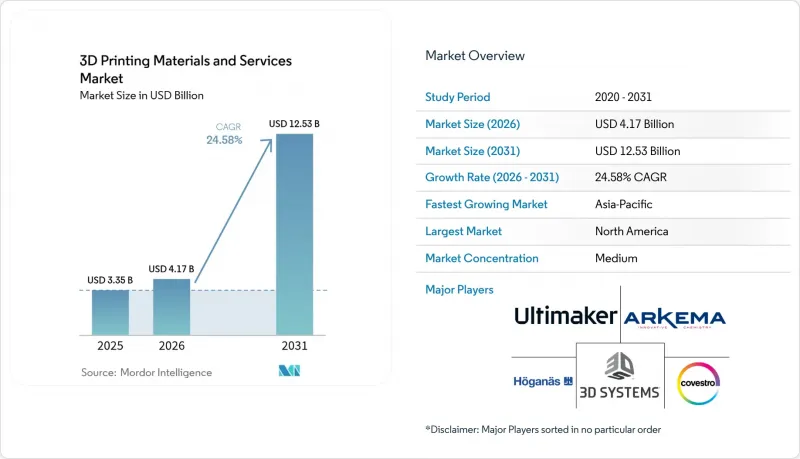
Mordor Intelligence에 의하면, 3D 프린팅 재료 및 서비스 시장 규모는 2025년 33억 5,000만 달러로 평가되었습니다. 2026년에는 41억 7,000만 달러로 확대되어 2026년부터 2031년에 걸쳐 CAGR 24.58%로 성장을 지속하여, 2031년에는 125억 3,000만 달러에 이를 것으로 예측됩니다.
본 보고서는 제공(소재 등), 기술(FDM/FFF, SLS/SLA/DLP, DMLS/EBM/L-PBF 등), 형태(소재)(필라멘트, 분말 등),용도(프로토타이핑, 기능성 부품 등), 최종 사용자(항공우주 및 방위, 자동차·e-모빌리티 등), 지역별로 분류되어 있습니다.
세계의 3D 프린팅 재료 및 서비스 시장 동향 및 인사이트
항공우주 분야에서의 금속 AM의 급속한 보급
규제 당국은 현재 비행 용도로 사용되는 인증된 금속 AM 부품의 사용을 승인하고 있습니다. 머티리얼라이즈(Materialise)는 2025년에 EN 9100 인증을 획득하여, 항공우주 품질 기준을 충족하는 구조용 티타늄·알루미늄 부품을 공급할 수 있게 되었습니다. 또한, America Makes와 협력한 미국의 국방 프로그램에서는 인증 프로세스의 표준화가 진행되고 있으며, 3D Systems는 이미 우주 임무를 위해 임무에 필수적인 티타늄 또는 알루미늄 부품 2,000개 이상을 납품했습니다. 이러한 성과는 안전성이 극히 중요한 부품 분야에서 적층 가공(AM)의 유효성을 입증하는 것이며, 기존 주조 부품에서 적층 가공 부품으로의 조달 전환을 가속화하고 있습니다.
비용 절감 압박으로 온디맨드 서비스 확대
재고 비용의 급등과 금형 비용 증가로 인해 제조업체들은 분산형 서비스 제공업체에 제조를 위탁하고 있습니다. MX3D는 2025년에 700만 유로를 조달하여, 원자재 폐기량을 최대 90%까지 줄이는 ‘프린트 온 디맨드(Print-on-Demand)’ 모델을 통한 와이어 아크 AM의 확대를 도모하고 있습니다. Protolabs는 2024년 3D 프린팅 사업에서 8,300만 달러의 매출을 기록하며, 리드타임과 자유 현금 흐름을 단축하는 ‘서비스 퍼스트’ 모델의 상업적 성공을 입증했습니다.
고순도 금속 분말 가격 변동
티타늄 및 구리 분말 가격은 광석 공급 부족과 규제 강화로 인해 변동하고 있으며, 이로 인해 항공우주 및 의료 분야 제조의 부품 원가가 상승하고 있습니다. 티타늄 AM 시장은 2032년까지 14억 달러에 달할 것으로 예상되지만, 공급 불안정으로 인해 OEM 기업들은 이익률을 유지하기 위해 원자재 비축이나 스크랩 재활용을 할 수밖에 없는 상황입니다. 특히 에너지 요금이 높은 유럽에서는 이러한 경향이 두드러집니다.
부문별 분석
서비스 부문은 2025년 매출의 57.40%를 차지했으며, 기업들이 설계 검증 및 소량 생산을 외부에 위탁함에 따라 연평균 성장률(CAGR) 13.55%로 확대되고 있습니다. 3D 프린팅 소재·서비스 시장에서 서비스 부문 시장 규모는 2025년에 19억 2,000만 달러에 달했으며, 2031년까지 41억 2,000만 달러를 넘어설 것으로 전망됩니다. 3Dock과 같은 공급업체가 제공하는 구독 패키지는 간헐적인 이용자의 진입 장벽을 낮추고 있습니다. 소재 부문은 규모는 작지만, 높은 수익률을 보이는 특수 분말 및 바이오 폴리머를 통해 서비스 혁신을 주도하고 있습니다. 소재 부문은 분말 침적 용융(PBF)용 분말에 힘입어 연평균 11.40%의 성장률을 보이고 있습니다. 2025년에는 필라멘트가 47.10%라는 최대 점유율을 차지했습니다. HP의 무할로겐 PA 12 FR은 엄격한 난연성 기준을 충족하면서도 운영 비용을 20% 절감하는 엔지니어링 폴리머의 대표적인 사례입니다. 재생 필라멘트와 복합 펠릿의 발전은 환경 부담 감소를 추구하는 고객들로부터 지지를 받고 있으며, 서비스 제공에 있어 소재 중심의 차별화를 강화하고 있습니다.
FDM/FFF는 방대한 도입 실적과 합리적인 가격대 덕분에 2025년에도 매출 점유율 37.20%를 유지했습니다. 이 부문은 여전히 10.40%의 성장률을 보이고 있지만, MJF·바인더 제팅은 13.20%의 연평균 성장률(CAGR)로 이를 앞지르는 추세입니다. 이러한 분말 기반 기술은 지그 및 고정구, 소-중량 생산 로트에 적합한 거의 등방성 특성을 제공합니다. HP와 INDO-MIM의 바인더 제팅 분야 제휴는 항공우주 분야 검증을 통과한 금속 부품의 양산화를 추진하고 있으며, 양산 체제가 갖춰져 있음을 보여줍니다.
SLA, DLP, SLS는 정밀한 치과용 모델 및 의료기기에서 여전히 중요한 역할을 하고 있습니다. EOS의 시스템은 환자별로 맞춤 제작된 두개골 임플란트를 며칠 만에 제조하여 병원의 처리 능력을 향상시키고 있습니다. 현재 틈새 시장인 와이어 아크 AM은 MX3D의 자금 조달을 통한 사업 확장이 보여주듯이, 에너지 및 해양 분야의 대형 티타늄 구조물 제조에서 주목을 받고 있습니다.
지역별 분석
2025년 매출액 중 북미가 39.20%를 차지했습니다. 방위 프로그램으로 인해 금속 AM 인증이 가속화되고 있으며, GE 에어로스페이스의 10억 달러 규모 생산 능력 확장은 국내 AM 공급망을 강화할 것입니다. 병원에서는 수술 시간을 최대 30% 단축하는 3D 프린팅 해부 모형이 채택되어 의료 분야 수요를 뒷받침하고 있습니다. 유럽은 2위의 점유율을 차지하고 있으며, 독일의 도입 실적과 EU의 재활용 가능 소재에 대한 인센티브에 힘입고 있습니다. 폴리프로필렌 폐기물을 필라멘트로 변환하는 프라운호퍼의 프로젝트는 정책 주도형 혁신을 여실히 보여주고 있습니다. 스페인이 ‘Formnext 2025’의 파트너국으로 지정된 것은 해당 지역의 제조업 부흥과 수출 지향성을 부각시키고 있습니다. 아시아태평양은 연평균 성장률(CAGR) 14.45%로 가장 빠르게 성장하고 있는 지역입니다. 중국에서는 자동차, 전자기기, 인공 고관절 분야에서 AM이 활용되고 있는 반면, 일본에서는 정밀 금형 제조에 중점을 두고 있습니다. 정부의 보조금, 탄탄한 제조 생태계, 그리고 의료비 증가가 수요를 뒷받침하고 있습니다. 남미 및 중동의 신흥 시장에서는 석유 및 가스 산업의 예비 부품이나 항공우주 부품에 AM이 활용되고 있으며, 규모는 작지만 향후 성장을 위한 거점으로 자리 잡고 있습니다.
기타 혜택 :
- 엑셀 형식 시장 예측(ME) 시트
- 3개월간의 애널리스트 지원
자주 묻는 질문
목차
제1장 서론
제2장 조사 방법
제3장 개요
제4장 시장 구도
제5장 시장 규모 및 성장 예측
제6장 경쟁 구도
제7장 시장 기회 및 향후 전망
KTH 26.08.31According to Mordor Intelligence, the 3D printing materials and services market size market is expected to grow from USD 3.35 billion in 2025 to USD 4.17 billion in 2026 and is forecast to reach USD 12.53 billion by 2031 at 24.58% CAGR over 2026-2031.
This report is Segmented by Offering ( Materials and More), Technology ( FDM / FFF, SLS / SLA / DLP, DMLS / EBM / L-PBF and More), Form (Materials) ( Filament, Powder and More), Application ( Prototyping, Functional Parts and More), End-User ( Aerospace and Defense, Automotive and E-Mobility, and More), and Geography
Global 3D Printing Materials And Services Market Trends and Insights
Rapid adoption of metal AM in aerospace
Regulators now accept certified metal AM parts for flight use. Materialise obtained EN 9100 accreditation in 2025, unlocking the supply of structural titanium and aluminum components that meet aerospace quality standards. Parallel U.S. defense programs with America Makes are standardizing qualification pathways, and 3D Systems has already delivered over 2,000 mission-critical titanium or aluminum components for space missions.These milestones validate AM for safety-critical parts, accelerating procurement away from legacy castings.
Cost-down pressure fueling on-demand services
Inventory inflation and tooling costs have led manufacturers to outsource builds to distributed service bureaus. MX3D raised EUR 7 million in 2025 to scale Wire Arc AM on a Print-on-Demand model that cuts raw-material waste by up to 90%. Protolabs reported USD 83 million in 2024 3D-printing revenue, illustrating commercial traction for service-first models that compress lead time and free cash flow.
Volatility of high-purity metal powder prices
Prices for titanium and copper powders swing with ore shortages and regulatory curbs, inflating bill-of-material costs for aerospace and medical builds. The titanium AM market is expected to reach USD 1.4 billion by 2032, yet supply instability forces OEMs to stockpile feedstock and recycle scrap to maintain margins, especially in Europe, where energy tariffs are high.
Other drivers and restraints analyzed in the detailed report include:
- Bio-compatible polymers for point-of-care
- Hybrid extrusion for lightweight e-mobility
- Energy-intensive post-processing inflating TCO
For complete list of drivers and restraints, kindly check the Table Of Contents.
Segment Analysis
Services generated 57.40% of 2025 revenue and are expanding at a 13.55% CAGR as enterprises outsource design validation and low-volume production. The 3D printing materials and services market size for services stood at USD 1.92 billion in 2025 and is forecast to exceed USD 4.12 billion by 2031. Subscription packages from providers like 3Dock lower entry barriers for intermittent users. Materials, while smaller, fuel service innovation through higher-margin specialty powders and bio-polymers. The materials segment is growing 11.40% per year, propelled by powders for powder-bed fusion. Filament held the largest 47.10% share in 2025. HP's halogen-free PA 12 FR illustrates how engineered polymers trim operating costs by 20% while meeting strict flame-retardancy norms. Advancements in recycled filament and composite pellets appeal to customers seeking lower environmental impact, reinforcing material-driven differentiation within service offerings.
FDM/FFF retained a 37.20% revenue share in 2025 through its vast installed base and accessible price point. The segment still registers 10.40% growth, but MJF and Binder Jetting are outpacing it at a 13.20% CAGR. These powder-based technologies deliver near-isotropic properties that suit jigs, fixtures, and low-to-mid-volume production runs. HP and INDO-MIM's binder-jet partnership is scaling metal parts that pass aerospace validation, indicating readiness for serial output.
SLA, DLP, and SLS retain relevance for precision dental models and medical devices. EOS systems fabricate patient-specific cranial implants within days, enhancing hospital throughput. Wire Arc AM, currently niche, is gaining traction for large titanium structures in energy and maritime sectors, as demonstrated by MX3D's funded expansion.
Complete Report Scope:
- By Offering
- Materials
- Plastics (PLA, ABS/ASA, PETG, Photopolymers)
- Metals (Ti-6Al-4V, Inconel, AlSi10Mg, SS 316L)
- Ceramics (Alumina, Zirconia, Silicon Nitride)
- CompositesandOthers (Carbon-Fiber, Bio-Polymers)
- Services
- Rapid Prototyping
- ToolingandFixtures
- Production / Bridge Manufacturing
- DesignandEngineering Services
- Materials
- By Technology
- FDM / FFF
- SLS / SLA / DLP
- MJFandBinder Jetting
- DMLS / EBM / L-PBF
- Other Emerging (LCD, CLIP, WAAM)
- By Form (Materials)
- Filament
- Powder
- Liquid / Resin
- By Application
- Prototyping
- Functional Parts
- ToolingandMolds
- DentalandOrthopedic Implants
- By End-user
- AerospaceandDefense
- Automotiveande-Mobility
- HealthcareandLife Sciences
- Industrial Machinery
- Consumer ProductsandElectronics
- ConstructionandArchitecture
- By Geography
- North America
- US
- Canada
- Europe
- Germany
- France
- UK
- Rest of Europe
- Asia Pacific
- China
- Japan
- South Korea
- Rest of Asia Pacific
- South America
- Brazil
- Rest of South America
- Middle East and Africa
- GCC
- South Africa
- Rest of Middle East and Africa
- North America
Geography Analysis
North America accounted for 39.20% of 2025 revenue. Defense programs accelerate metal AM qualification, and GE Aerospace's USD 1 billion capacity expansion will strengthen domestic AM supply chains. Hospitals adopt printed anatomical models that cut surgical time by up to 30%, adding healthcare pull. Europe holds the second-largest position, bolstered by Germany's installed base and EU incentives for recyclable materials. Fraunhofer's project that converts polypropylene waste to filament illustrates policy-driven innovation. Spain's designation as Formnext 2025 partner country underscores the region's manufacturing renaissance and export orientation. Asia Pacific is the fastest-growing region at 14.45% CAGR. China deploys AM for automotive, electronics, and hip implants, while Japan emphasizes precision tooling. Government grants, a deep manufacturing ecosystem, and rising healthcare spending underpin demand. Emerging markets in South America and the Middle East use AM for oil-and-gas spares and aerospace parts, providing additional, though smaller, growth nodes.
- 3D Systems Corp.
- Stratasys Ltd.
- EOS GmbH
- General Electric (GE Additive)
- HP Inc.
- SLM Solutions Group AG
- Desktop Metal Inc.
- Materialise NV
- Arkema SA
- BASF Forward AM
- Evonik Industries AG
- Hoganas AB
- Sandvik AB
- Royal DSM (Covestro)
- Markforged Holding Corp.
- Protolabs Inc.
- Voxeljet AG
- ExOne (Desktop Metal)
- Carbon Inc.
- Ultimaker B.V.
- Carpenter Technology Corporation
- Renishaw plc
- Xometry Inc.
Additional Benefits:
- The market estimate (ME) sheet in Excel format
- 3 months of analyst support
TABLE OF CONTENTS
1 INTRODUCTION
- 1.1 Study AssumptionsandMarket Definition
- 1.2 Scope of the Study
2 RESEARCH METHODOLOGY
3 EXECUTIVE SUMMARY
4 MARKET LANDSCAPE
- 4.1 Market Overview
- 4.2 Market Drivers
- 4.2.1 Rapid Adoption of Metal AM in Aerospace for Air-Worthiness Certified Parts
- 4.2.2 Cost-Down Pressure Fueling On-Demand Manufacturing Services in USandEU
- 4.2.3 Bio-compatible Polymers Unlocking Point-of-Care Medical Printing in Asia
- 4.2.4 Hybrid Material Extrusion Enabling Lightweight e-Mobility Components
- 4.3 Market Restraints
- 4.3.1 Volatility of High-Purity Metal Powder Prices
- 4.3.2 Limited Qualification Standards for AM in Critical Parts
- 4.4 Value/Supply-Chain Analysis
- 4.5 RegulatoryandTechnological Outlook
- 4.6 Porter's Five Forces
- 4.6.1 Threat of New Entrants
- 4.6.2 Bargaining Power of Buyers
- 4.6.3 Bargaining Power of Suppliers
- 4.6.4 Threat of Substitutes
- 4.6.5 Intensity of Competitive Rivalry
- 4.7 COVID-19 and Geo-economic Impact Assessment
5 MARKET SIZE AND GROWTH FORECASTS (VALUE)
- 5.1 By Offering
- 5.1.1 Materials
- 5.1.1.1 Plastics (PLA, ABS/ASA, PETG, Photopolymers)
- 5.1.1.2 Metals (Ti-6Al-4V, Inconel, AlSi10Mg, SS 316L)
- 5.1.1.3 Ceramics (Alumina, Zirconia, Silicon Nitride)
- 5.1.1.4 CompositesandOthers (Carbon-Fiber, Bio-Polymers)
- 5.1.2 Services
- 5.1.2.1 Rapid Prototyping
- 5.1.2.2 ToolingandFixtures
- 5.1.2.3 Production / Bridge Manufacturing
- 5.1.2.4 DesignandEngineering Services
- 5.1.1 Materials
- 5.2 By Technology
- 5.2.1 FDM / FFF
- 5.2.2 SLS / SLA / DLP
- 5.2.3 MJFandBinder Jetting
- 5.2.4 DMLS / EBM / L-PBF
- 5.2.5 Other Emerging (LCD, CLIP, WAAM)
- 5.3 By Form (Materials)
- 5.3.1 Filament
- 5.3.2 Powder
- 5.3.3 Liquid / Resin
- 5.4 By Application
- 5.4.1 Prototyping
- 5.4.2 Functional Parts
- 5.4.3 ToolingandMolds
- 5.4.4 DentalandOrthopedic Implants
- 5.5 By End-user
- 5.5.1 AerospaceandDefense
- 5.5.2 Automotiveande-Mobility
- 5.5.3 HealthcareandLife Sciences
- 5.5.4 Industrial Machinery
- 5.5.5 Consumer ProductsandElectronics
- 5.5.6 ConstructionandArchitecture
- 5.6 By Geography
- 5.6.1 North America
- 5.6.1.1 US
- 5.6.1.2 Canada
- 5.6.2 Europe
- 5.6.2.1 Germany
- 5.6.2.2 France
- 5.6.2.3 UK
- 5.6.2.4 Rest of Europe
- 5.6.3 Asia Pacific
- 5.6.3.1 China
- 5.6.3.2 Japan
- 5.6.3.3 South Korea
- 5.6.3.4 Rest of Asia Pacific
- 5.6.4 South America
- 5.6.4.1 Brazil
- 5.6.4.2 Rest of South America
- 5.6.5 Middle East and Africa
- 5.6.5.1 GCC
- 5.6.5.2 South Africa
- 5.6.5.3 Rest of Middle East and Africa
- 5.6.1 North America
6 COMPETITIVE LANDSCAPE
- 6.1 Market Concentration
- 6.2 Strategic MovesandFunding
- 6.3 Market Share Analysis
- 6.4 Company Profiles (includes Global level Overview, Market level overview, Core Segments, Financials as available, Strategic Information, Market Rank/Share for key companies, ProductsandServices, and Recent Developments)
- 6.4.1 3D Systems Corp.
- 6.4.2 Stratasys Ltd.
- 6.4.3 EOS GmbH
- 6.4.4 General Electric (GE Additive)
- 6.4.5 HP Inc.
- 6.4.6 SLM Solutions Group AG
- 6.4.7 Desktop Metal Inc.
- 6.4.8 Materialise NV
- 6.4.9 Arkema SA
- 6.4.10 BASF Forward AM
- 6.4.11 Evonik Industries AG
- 6.4.12 Hoganas AB
- 6.4.13 Sandvik AB
- 6.4.14 Royal DSM (Covestro)
- 6.4.15 Markforged Holding Corp.
- 6.4.16 Protolabs Inc.
- 6.4.17 Voxeljet AG
- 6.4.18 ExOne (Desktop Metal)
- 6.4.19 Carbon Inc.
- 6.4.20 Ultimaker B.V.
- 6.4.21 Carpenter Technology Corporation
- 6.4.22 Renishaw plc
- 6.4.23 Xometry Inc.
7 MARKET OPPORTUNITIES AND FUTURE OUTLOOK
- 7.1 White-spaceandUnmet-need Assessment


