

|
시장보고서
상품코드
2113325
폴리우레탄(PU) 핫멜트 접착제 : 시장 점유율 분석, 업계 동향과 통계, 성장 예측(2026-2031년)Polyurethane (PU) Hot-melt Adhesive - Market Share Analysis, Industry Trends & Statistics, Growth Forecasts (2026 - 2031) |
||||||
 Mordor Intelligence
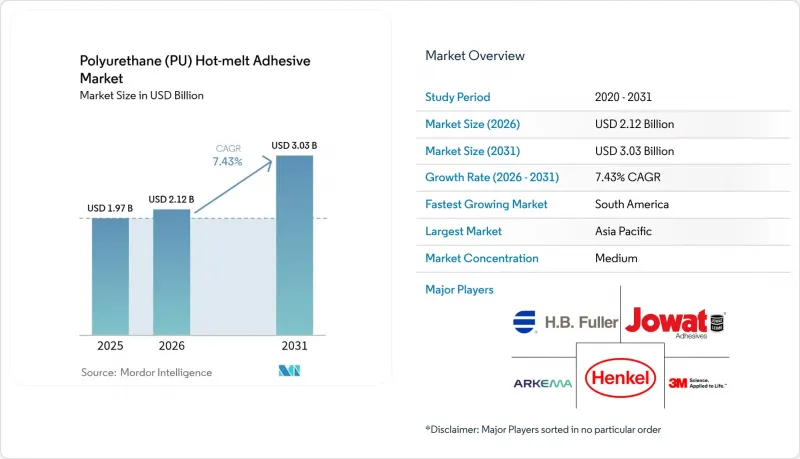
Mordor Intelligence에 따르면 2026년 폴리우레탄 핫멜트 접착제 시장 규모는 21억 2,000만 달러로 추정되며, 2025년 19억 7,000만 달러에서 확대되어 2031년에는 30억 3,000만 달러에 달할 것으로 예측됩니다.
2026-2031년 동안 연평균 성장률(CAGR) 7.43%로 성장할 것으로 전망됩니다.
본 보고서는 유형(반응성, 비반응성), 용도(종이, 판지, 포장, 전자·전기, 자동차, 가구·목공, 신발, 헬스케어, 섬유, 제본, 기타), 지역(아시아태평양, 북미, 유럽, 남미, 중동 및 아프리카)별로 분류되어 있습니다. 시장 예측은 금액(달러)으로 표시되어 있습니다.
세계 폴리우레탄(PU) 핫멜트 접착제 시장의 동향 및 인사이트
E-Commerce 자동화가 케이스 밀봉 수요를 견인
자동화된 주문 처리 센터는 24시간 가동되며, 라인 정지나 테이프 재부착을 유발하지 않고 몇 초 이내에 골판지 상자를 후공정으로 이송할 수 있도록 즉시 초기 접착력을 발휘하는 접착제가 요구되고 있습니다. 반응형 폴리우레탄 핫멜트는 더 넓은 온도 범위에서 내재 강도를 유지함으로써 에틸렌-비닐 아세테이트(EVA) 계열 등급을 능가하는 성능을 발휘하며, 공조 시설이 갖춰지지 않은 물류 허브에서도 일관된 밀봉을 실현합니다. 또한 점도가 균일하기 때문에 ‘주문형 용융’ 방식의 디스펜서에서 사용하기 쉽습니다. 이를 통해 탱크의 탄 자국이 해소되고, 세척을 위한 가동 중단 시간이 단축됩니다. 이는 고속 케이스 패커 시스템 통합업체가 중시하는 주요 지표 중 하나입니다. 물류 사업자들이 인건비를 현 수준으로 유지하면서 SKU 증가에 대응하기 위해 기존 라인을 개조하고 있는 가운데, 노드슨(Nordson)사는 자사의 ‘플러그 앤 플레이’ 방식 용융기 시리즈에서 두 자릿수의 수주 증가를 보고하고 있습니다. 현재 많은 소포가 컨베이어의 가속, 자동 분리, 로봇을 통한 분류를 거치기 때문에 접착제는 기존 핫멜트를 쉽게 벗겨낼 수 있는 반복적인 동적 하중을 견뎌내야 합니다. 따라서 E-Commerce 창고가 새로운 분류 레인을 추가하거나, 사소한 접착 불량조차 감지하는 IoT 지원 품질 모니터링 시스템을 도입할 때마다 폴리우레탄 핫멜트 접착제 시장은 그 혜택을 누리고 있습니다.
전자기기의 소형화에는 저온 PUR 핫멜트 접착제가 필수적
휴대폰 제조사, 웨어러블 기기 전문 제조사, 자동차 산업의 1차 공급업체들은 기존 핫멜트 접착제에 수반되는 160°C 이상의 도포 온도를 견딜 수 없는, 1mm 이하의 틈새를 가진 어셈블리를 설계하는 경우가 늘고 있습니다. 새롭게 배합된 폴리우레탄 계열 제품은 100-120°C에서 유동하며, 파인 피치 볼 그리드 어레이(BGA)에서 발생하는 솔더 피로를 방지하는 동시에 가교 반응을 일으켜 열 사이클을 거치더라도 내구성을 유지합니다. 접이식 디스플레이나 플렉서블 인쇄회로기판은 반복적인 굽힘 동작 중에 전단 응력이나 박리 응력이 발생하지만, 폴리우레탄의 파단 신장은 에폭시나 아크릴계 제품보다 피로 요건을 충분히 충족합니다. 5G 안테나를 수납하는 기기 케이스도 전자기 호환성(EMC) 시험을 통과해야 합니다. 현재 특수 PUR HMA(폴리우레탄 핫멜트 접착제)에는 무게를 늘리지 않으면서 국소적인 차폐 효과를 만들어내는 판상 전도성 필러가 배합되어 있습니다. 의료용 전자기기의 경우 감마선 조사나 오토클레이브를 통한 멸균 사이클이 이루어지는데, 폴리우레탄은 가수분해에 의한 열화에 강하고 접착면의 무결성을 유지할 수 있어 매력적인 소재로 자리 잡고 있습니다. 모든 제품 카테고리에서 엣지 컴퓨팅 모듈이 보급되는 가운데, 폴리우레탄 핫멜트 접착제 시장은 소형 폼팩터와 열 관리가 요구되는 모든 부문에서 새로운 수요를 창출하고 있습니다.
MDI/TDI 가격 변동이 이익률을 압박
2023년부터 2025년까지 미국의 생산 중단과 중국의 무역 조치로 인해 공급이 혼란을 겪었고, 구매자들이 현물 시장으로 내몰린 결과 MDI 가격은 45%나 변동했습니다. 장기 계약을 체결하지 않은 소규모 접착제 가공업체들은 연간 가격표에 묶여 있는 포장 및 목공 고객들에게 이러한 가격 급등분을 전가하는 데 어려움을 겪고 있습니다. 다우(Dow)사가 텍사스주에서 실시한 5억 달러 규모의 확장 프로젝트는 2024년 말에 가동을 시작했으나, 물류상의 제약과 시운전 단계의 생산 확대에 따라 상황 개선은 단계적으로 진행될 전망입니다. 또한, 현지 통화 표시 계약을 체결한 브라질과 인도의 배합 제조업체의 경우, 달러에 대한 환율 변동으로 인해 구매력이 더욱 하락했습니다. 이러한 요인들이 복합적으로 작용하여 매출 총이익률이 압박을 받고, 새로운 배합 라인에 대한 설비 투자가 지연될 가능성이 있어, 폴리우레탄 핫멜트 접착제 시장의 성장세가 일시적으로 둔화될 우려가 있습니다.
부문별 분석
2025년, 반응성 등급은 세계 시장 규모의 62.12%를 차지하며 그 주도적 지위를 유지할 전망입니다. 이는 수분에 의한 가교 반응을 통해 열가소성 수지 유사 제품으로는 달성할 수 없는 내열성, 내습성, 내화학성을 확보하기 때문입니다. 시장을 선도하는 각 공급업체들은 현재 디스펜싱 시 유리 이소시아네이트의 방출을 억제하는 실란계 스캐빈저를 첨가하여, 성능을 저하시키지 않으면서도 유럽의 새로운 작업장 노출 기준을 충족하고 있습니다. 비반응성 등급은 연평균 성장률(CAGR) 7.89%를 기록할 것으로 예측되며, 영구적인 접착이 필수적이지 않은 골판지 상자 밀봉이나 섬유 라미네이트와 같은 부문에서도 재배치 가능성 및 재활용 가능성이 중요함을 보여줍니다.
두 범주에 걸쳐 하이브리드 화학 기술에 대한 투자로 인해 즉각적인 접착력과 지연 경화의 경계가 모호해지고 있습니다. 헨켈은 모노머형 디이소시아네이트 함유율을 0.1% 이하로 억제하면서도 24시간 후 10 MPa를 초과하는 인장 전단 강도를 달성하는 미량 방출형 반응성 PUR 핫멜트 접착제를 판매하고 있습니다. 동시에, 배합 개발자들은 완전한 수분 경화 전에 생산 라인 속도에 가까운 처리가 가능한, 급속 결정화를 특징으로 하는 열가소성 PUR 블렌드를 개발하고 있습니다. 이러한 혁신의 기세에 힘입어, 폴리우레탄 핫멜트 접착제 시장은 앞으로도 성능의 양극단을 향한 연구 개발에 계속 집중할 것으로 확실시됩니다.
지역별 분석
2025년, 아시아태평양은 전 세계 매출의 45.78%를 차지했습니다. 이는 중국의 휴대용 단말기 수출과 인도의 자동차 조립 라인이 반응성 PUR 프리폴리머를 대량으로 소비했기 때문입니다. 일본의 성숙한 의료기기 생태계에서는 마이크로카테터나 영상용 프로브에 사용되는 저점도·초고순도 등급의 제품에 대해 프리미엄 가격이 형성되어 있습니다. 한국의 메모리 칩 제조 공장에서는 언더필 및 리드 접합 공정에 실이 잘 생기지 않는 PUR 핫멜트 접착제가 채택되어, 경기 침체기에도 소비량을 뒷받침하고 있습니다.
북미에서는 골판지 포장 및 가구 제조 분야에서 핫멜트 장비 도입 기반이 여전히 대규모로 유지되고 있습니다. 이 지역의 엄격한 VOC 규제는 LEED(에너지 및 환경 디자인 리더십)의 실내 공기질 기준을 충족하는 저배출형 PUR 스틱을 뒷받침하고 있으며, 이를 통해 폴리우레탄 핫멜트 접착제 시장은 하이브리드형 핫멜트 제품에 대한 시장 점유율을 지킬 수 있습니다. 멕시코의 니어쇼어링 추세로 인해 가전제품 공급업체들은 아시아의 생산 라인을 재현하도록 촉구하고 있으며, 이를 위해서는 동일한 저도포 온도의 PUR 배합이 요구됩니다.
유럽은 지속가능성 분야의 리더십을 통해 다른 지역과의 차별화를 꾀하고 있습니다. 접착제 구매자들은 종종 ‘크래들-투-게이트(cradle-to-gate)’ 탄소발자국 공개를 요구하고 있으며, 이에 따라 PUR 공급업체들은 독립 검사 기관을 통해 바이오 기반 함량 인증을 취득하도록 촉진되고 있습니다. 독일과 스페인의 자동차 산업 클러스터에서는 단일 소재로 재활용이 용이하도록 폴리프로필렌으로 제작된 내장재 기판과 호환되는 접착제가 지정되어 있습니다. 남미는 7.67%로 지역별 가장 높은 연평균 성장률(CAGR)을 보이고 있습니다. 이는 브라질의 건설 산업 및 가공 식품 공장이 수출 시장의 안전 기준을 충족하기 위해 용제 기반 시스템을 완전히 건너뛰고 PUR로 직접 전환하고 있기 때문입니다. 거시경제의 변동에도 불구하고, 이러한 추세로 인해 폴리우레탄 핫멜트 접착제 시장은 지리적으로 다각화되어, 기회가 가득한 상태를 유지할 것으로 보장됩니다.
기타 혜택
- 엑셀 형식의 시장 예측(ME) 시트
- 3개월간의 애널리스트 지원
자주 묻는 질문
목차
제1장 소개
제2장 조사 방법
제3장 주요 요약
제4장 시장 구도
제5장 시장 규모와 성장 예측
제6장 경쟁 구도
제7장 시장 기회와 향후 전망
KSM 26.08.25According to Mordor Intelligence, polyurethane hot-melt adhesive market size in 2026 is estimated at USD 2.12 billion, growing from 2025 value of USD 1.97 billion with 2031 projections showing USD 3.03 billion, growing at 7.43% CAGR over 2026-2031.
This report is Segmented by Type (Reactive and Non-Reactive), Application (Paper Board and Packaging, Electronics and Electrical, Automotive, Furniture and Woodworking, Footwear, Healthcare, Textiles, Bookbinding, and Other Applications), and Geography (Asia-Pacific, North America, Europe, South America, and Middle East and Africa). The Market Forecasts are Provided in Terms of Value (USD).
Global Polyurethane (PU) Hot-melt Adhesive Market Trends and Insights
E-commerce Automation Boosting Case-Sealing Demand
Automated fulfillment centers operate around the clock and require adhesives that develop instant green strength so cartons can be moved downstream within seconds without causing line stoppages or tape rework. Reactive polyurethane hot melts outperform ethylene-vinyl acetate (EVA) grades by retaining cohesive strength across a wider temperature envelope, enabling consistent seals even in unconditioned distribution hubs. Uniform viscosity also facilitates melt-on-demand dispensing equipment, which eliminates tank charring and reduces downtime for cleaning, a top metric tracked by integrators of high-speed case packers. Nordson has reported double-digit order growth for its plug-and-play melter series as logistics operators retrofit legacy lines to handle SKU proliferation while keeping labor inputs flat. Because many parcels now encounter conveyor acceleration, automated singulation, and robotic sortation, adhesives must withstand repetitive dynamic loads that can easily peel traditional hot melts. Therefore, the polyurethane hot melt adhesives market benefits each time an e-commerce warehouse adds new sort lanes or adopts IoT-enabled quality monitoring that flags even minor seal failures.
Electronics Miniaturization Requires Low-Temperature PUR HMAs
Handset makers, wearables specialists, and automotive Tier 1 suppliers increasingly design assemblies with sub-millimeter gaps that cannot tolerate the 160 °C-plus application temperatures associated with legacy hot melts. Newly formulated polyurethane grades flow at 100-120 °C, avoiding solder fatigue on fine-pitch ball-grid arrays while still crosslinking to provide permanence through thermal cycling. Foldable displays and flexible printed circuits generate shear and peel stresses during repeated bends, and polyurethane's elongation at break satisfies that fatigue requirement better than epoxy or acrylic solutions. Device cabins that house 5G antennas must also meet electromagnetic compatibility tests; specialty PUR HMAs (Polyurethane Hot Melt Adhesives) now incorporate plate-like conductive fillers that create local shielding without adding weight. In medical electronics, sterilization via gamma irradiation or autoclave cycles makes polyurethane attractive because it resists hydrolytic degradation and retains bond line integrity. With edge-computing modules proliferating in every product category, the polyurethane hot melt adhesives market finds fresh outlets wherever small form factors and heat management converge.
MDI/TDI Price Volatility Squeezes Margins
Prices for MDI swung 45% between 2023 and 2025 as outages in the United States and trade actions in China disrupted flows and pushed buyers into the spot market. Smaller adhesive converters without long-term contracts struggle to pass through such spikes to packaging or woodworking customers bound by annual price lists. Dow's USD 500 million expansion in Texas came online in late 2024, yet logistical constraints and commissioning ramp-ups mean relief will phase in gradually. Currency fluctuations against the US dollar further eroded purchasing power for Brazil and India formulators, denominated in local contracts. The net effect trims gross margins and can delay capex for new blending lines, temporarily muting growth trajectories in the polyurethane hot melt adhesives market.
Other drivers and restraints analyzed in the detailed report include:
- VOC-Driven Shift Away from Solvent-Borne Adhesives
- Automotive Lightweighting and Modular Interiors
- Stricter Free-Isocyanate Exposure Regulations
For complete list of drivers and restraints, kindly check the Table Of Contents.
Segment Analysis
In 2025, reactive grades commanded 62.12% of worldwide value, a leadership position they will maintain because their moisture-induced crosslinking locks in heat, moisture, and chemical resistance unattainable with thermoplastic analogs. Market-leading suppliers now add silane scavengers that curb free-isocyanate release during dispensing, satisfying new European workplace thresholds without eroding performance. Non-reactive variants are forecast to record a 7.89% CAGR, illustrating that repositionability and recyclability also matter in sectors such as corrugated-case sealing or textile lamination, where permanent bonds are not mandatory.
Across both categories, investments in hybrid chemistries blur lines between instant tack and deferred cure. Henkel markets micro-emission reactive PUR HMAs that keep monomeric di-isocyanate below 0.1% yet achieve tensile shear greater than 10 MPa after 24 hours. Concurrently, formulators develop thermoplastic PUR blends with rapid crystallization that permit near-line-speed handling before complete moisture cure. Such innovation dynamics assure that the polyurethane hot melt adhesives market will continue funneling R&D into both performance extremes.
Complete Report Scope:
- By Type
- Reactive
- Non-Reactive
- By Application
- Paper, Board, and Packaging
- Electronics and Electrical
- Automotive
- Furniture and Woodworking
- Footwear
- Healthcare
- Textiles
- Bookbinding
- Other Applications
- By Geography
- Asia-Pacific
- China
- India
- Japan
- South Korea
- Rest of Asia-Pacific
- North America
- United States
- Canada
- Mexico
- Europe
- Germany
- United Kingdom
- France
- Italy
- Russia
- Rest of Europe
- South America
- Brazil
- Argentina
- Rest of South America
- Middle East and Africa
- Saudi Arabia
- South Africa
- Rest of Middle East and Africa
- Asia-Pacific
Geography Analysis
Asia-Pacific generated 45.78% of global turnover in 2025 as China's handheld device exports and India's auto assembly lines pulled tanker volumes of reactive PUR prepolymers. Japan's mature medical-device ecosystem commands premium pricing for low-viscosity, ultra-pure grades that flow into micro-catheters and imaging probes. South Korea's memory-chip fabs lean on low-stringing PUR HMAs for under-fill and lid-attach processes, bolstering consumption even during cyclical downturns.
North America maintains a large installed base of hot-melt equipment in corrugated packaging and furniture manufacturing. The region's tight VOC regulations favor micro-emission PUR sticks that achieve LEED (Leadership in Energy and Environmental Design) indoor-air benchmarks, helping the polyurethane hot melt adhesives market defend share against hybrid hot melts. Mexico's near-shoring wave encourages consumer-electronics suppliers to replicate Asian production lines, requiring the same low-application-temperature PUR formulas.
Europe differentiates itself through sustainability leadership. Adhesive buyers often request full cradle-to-gate carbon footprints, prompting PUR suppliers to certify bio-based content through independent labs. Automotive clusters in Germany and Spain specify adhesives compatible with polypropylene interior substrates to facilitate single-material recycling. South America exhibits the fastest regional CAGR at 7.67% because Brazilian construction and packaged-food plants are skipping solvent systems altogether and leaping straight to PUR to meet export-market safety codes. Even with macroeconomic volatility, these dynamics guarantee that the polyurethane hot melt adhesives market remains geographically diversified and opportunity-rich.
- 3M
- Arkema
- BASF
- BC Adhesives
- Chemence
- Collano Adhesives
- DIC CORPORATION
- Franklin International
- H.B. Fuller Company
- Henkel Corporation
- HRANIPEX Czech Republic k.s.
- Huntsman
- IFS Industries Inc.
- Jowat SE
- KLEIBERIT SE & Co. KG
- Sika AG
- Tex Year Industries Inc.
- Toyo-Morton
Additional Benefits:
- The market estimate (ME) sheet in Excel format
- 3 months of analyst support
TABLE OF CONTENTS
1 Introduction
- 1.1 Study Assumptions and Market Definition
- 1.2 Scope of the Study
2 Research Methodology
3 Executive Summary
4 Market Landscape
- 4.1 Market Overview
- 4.2 Market Drivers
- 4.2.1 E-commerce automation boosting case-sealing demand
- 4.2.2 Electronics miniaturization requires low-temp PUR HMAs
- 4.2.3 VOC-driven shift away from solvent-borne adhesives
- 4.2.4 Automotive lightweighting and modular interiors
- 4.2.5 Bio-based polyols win sustainability labels
- 4.3 Market Restraints
- 4.3.1 MDI/TDI price volatility squeezes margins
- 4.3.2 Stricter free-isocyanate exposure regulations
- 4.3.3 Scarcity of specialty low-viscosity reactive tackifiers
- 4.4 Value Chain Analysis
- 4.5 Porter's Five Forces
- 4.5.1 Bargaining Power of Suppliers
- 4.5.2 Bargaining Power of Buyers
- 4.5.3 Threat of New Entrants
- 4.5.4 Threat of Substitutes
- 4.5.5 Degree of Competition
5 Market Size and Growth Forecasts (Value)
- 5.1 By Type
- 5.1.1 Reactive
- 5.1.2 Non-Reactive
- 5.2 By Application
- 5.2.1 Paper, Board, and Packaging
- 5.2.2 Electronics and Electrical
- 5.2.3 Automotive
- 5.2.4 Furniture and Woodworking
- 5.2.5 Footwear
- 5.2.6 Healthcare
- 5.2.7 Textiles
- 5.2.8 Bookbinding
- 5.2.9 Other Applications
- 5.3 By Geography
- 5.3.1 Asia-Pacific
- 5.3.1.1 China
- 5.3.1.2 India
- 5.3.1.3 Japan
- 5.3.1.4 South Korea
- 5.3.1.5 Rest of Asia-Pacific
- 5.3.2 North America
- 5.3.2.1 United States
- 5.3.2.2 Canada
- 5.3.2.3 Mexico
- 5.3.3 Europe
- 5.3.3.1 Germany
- 5.3.3.2 United Kingdom
- 5.3.3.3 France
- 5.3.3.4 Italy
- 5.3.3.5 Russia
- 5.3.3.6 Rest of Europe
- 5.3.4 South America
- 5.3.4.1 Brazil
- 5.3.4.2 Argentina
- 5.3.4.3 Rest of South America
- 5.3.5 Middle East and Africa
- 5.3.5.1 Saudi Arabia
- 5.3.5.2 South Africa
- 5.3.5.3 Rest of Middle East and Africa
- 5.3.1 Asia-Pacific
6 Competitive Landscape
- 6.1 Market Concentration
- 6.2 Strategic Moves
- 6.3 Market Share (%)/Ranking Analysis
- 6.4 Company Profiles (includes Global level Overview, Market level overview, Core Segments, Financials as available, Strategic Information, Market Rank/Share for key companies, Products and Services, and Recent Developments)
- 6.4.1 3M
- 6.4.2 Arkema
- 6.4.3 BASF
- 6.4.4 BC Adhesives
- 6.4.5 Chemence
- 6.4.6 Collano Adhesives
- 6.4.7 DIC CORPORATION
- 6.4.8 Franklin International
- 6.4.9 H.B. Fuller Company
- 6.4.10 Henkel Corporation
- 6.4.11 HRANIPEX Czech Republic k.s.
- 6.4.12 Huntsman
- 6.4.13 IFS Industries Inc.
- 6.4.14 Jowat SE
- 6.4.15 KLEIBERIT SE & Co. KG
- 6.4.16 Sika AG
- 6.4.17 Tex Year Industries Inc.
- 6.4.18 Toyo-Morton
7 Market Opportunities and Future Outlook
- 7.1 White-space and Unmet-Need Assessment


