

|
시장보고서
상품코드
2115881
폴리에스테르계 핫멜트 접착제 시장 : 시장 점유율 분석, 업계 동향 및 통계, 성장 예측(2026-2031년)Polyester Hot Melt Adhesives - Market Share Analysis, Industry Trends & Statistics, Growth Forecasts (2026 - 2031) |
||||||
 Mordor Intelligence
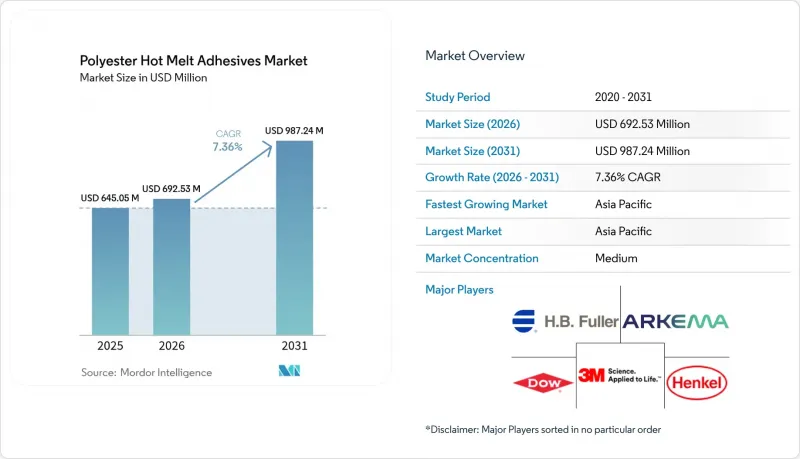
Mordor Intelligence에 의하면, 폴리에스테르계 핫멜트 접착제 시장 규모는 2025년 6억 4,505만 달러로 평가되었고, 2026년에는 6억 9,253만 달러로 추정되고, 2026-2031년 CAGR 7.36%로 성장을 지속할 전망이며, 2031년에는 9억 8,724만 달러에 이를 것으로 예측됩니다.
본 보고서는 용도별(산업용 조립, 식품·의료용 포장 등), 수지 화학별(방향족 폴리에스터, 지방족 폴리에스터 등), 형태별(펠릿/과립, 블록/슬래브 등), 최종 이용 산업별(포장, 자동차 및 운송, 기타) 및 지역별(아시아태평양, 북미, 유럽, 남미, 중동 및 아프리카)로 분류되어 있습니다.
세계의 폴리에스테르계 핫멜트 접착제 시장 동향 및 인사이트
무용제 포장용 접착제에 대한 수요 증가
각 포장 제조업체들은 용제계 라미네이트 제품에서 100% 고형분 폴리에스테르계 핫멜트로 전환함으로써 용제 배출을 제거하고 에너지 사용량을 절감하고 있습니다. Henkel, Dow, Kraton은 최근 식품 접촉 안전성을 저해하지 않으면서 바이오 유래 TackFire를 도입함으로써 TECHNOMELT 시리즈의 탄소 발자국을 25% 줄였습니다. EU의 VOC 규제가 강화됨에 따라 이러한 전환은 더욱 가속화되고 있으며, 한편 가공업체 입장에서는 생산 라인의 속도 향상과 비용이 많이 드는 용제 회수 설비가 불필요해진다는 이점이 있습니다. 또한, 폴리에스테르계 배합은 금속화 필름에 대한 접착력을 향상시키고 내습성도 높이기 때문에 고급 배리어 포장재로 매력적입니다.
자동차 경량화에 따른 접착 요건
경량화와 전동화를 추구하는 자동차 제조업체들은 리벳 고정이나 용접으로는 비용 효율적으로 접합할 수 없는 알루미늄, 탄소섬유 및 첨단 강재를 접합하기 위해 폴리에스테르계 핫멜트 접착제에 의존하고 있습니다. 이러한 열가소성 접착제는 급격한 온도 변화와 습윤 진동에 견딜 뿐만 아니라, 사용 종료 시 재활용을 위해 부품의 분해를 용이하게 합니다. 전기자동차의 파워 일렉트로닉스 고집적화에 따라 보닛 내부의 열적 스트레스가 증가하고 있습니다. 150°C에서 사용하도록 최적화된 폴리에스테르계 접착제는 기계적 무결성을 유지하면서 배터리 모듈을 안전하게 절연합니다.
대체재의 가용성
리그닌계 핫멜트, 반응성 폴리우레탄계 및 첨단 시아노아크릴레이트계는 특정 용도에서 폴리에스테르와 동등하거나 그 이상의 성능을 발휘하여, 저비용과 높은 환경 친화성을 추구하는 구매자들의 관심을 끌고 있습니다. 이러한 대체재들이 보급됨에 따라 폴리에스터 공급업체의 가격 결정력이 제한될 뿐만 아니라, 기술적 차이가 미미한 경우에는 신규 프로젝트가 이러한 대체재로 유입될 가능성이 있습니다.
부문 분석
산업용 조립 부문은 폴리에스터계 핫멜트 접착제 시장에서 여전히 가장 큰 점유율을 차지했으며, 2025년에는 35.20%의 점유율을 유지하며 달러 기준 폴리에스터계 핫멜트 접착제 시장 규모 순위에서 1위를 차지했습니다. 이 부문에서는 자동차용 접착이 주류를 이루고 있으며, 다중 소재 구조를 결합하고 수명 주기 동안 극심한 온도 변화를 견딜 수 있는 접착제의 능력이 매우 중요합니다. 차량의 전동화로 인해 보닛 내부의 최고 온도가 상승하고 있어, 내열성이 뛰어난 폴리에스테르계 핫멜트 접착제의 필요성이 더욱 높아지고 있습니다. 그 밖의 산업용도로는 가전제품, 가구, 필터 조립 등이 있으며, 이들 모두 빠른 경화성과 깨끗한 가공이라는 장점을 활용하고 있습니다.
식품 및 의료용 포장은 가장 빠르게 성장하는 용도로, 2031년까지 연평균 성장률(CAGR) 8.24%로 확대될 전망입니다. 브랜드 소유주들은 엄격한 전환 기준을 충족하면서도 생산 라인의 에너지 수요를 줄일 수 있는 무용제·저취성 접착제를 선호합니다. 레토르트 파우치 및 뚜껑 필름용 박리 가능한 열밀봉 코팅은 산업용 조립과 포장 기능의 융합을 상징합니다. 전자기기 포장 및 열밀봉 코팅이 시장의 다양성을 높이는 한편, 섬유 라미네이트는 유연한 접착력, 통기성, 내세탁성이 융합된 새로운 분야로 부상하고 있습니다.
방향족 폴리에스테르는 2025년 매출의 46.00%를 차지했으며, 높은 유리 전이 온도, 응집 강도, 그리고 자동차 및 전자 기기의 작동 조건에 대한 내구성이 높이 평가받고 있습니다. 폴리에스테르계 핫멜트 접착제 시장 점유율 우위는 수십 년에 걸친 최적화, 원자재의 쉬운 입수성, 그리고 폭넓은 배합 노하우에 기인합니다.
그러나 바이오 유래 및 일부 바이오 유래 폴리에스테르는 연평균 성장률(CAGR) 8.22%로 가장 빠른 성장이 전망되는 화학 계열입니다. 공급업체들은 식물 유래 이산, 재생 PET 및 CO₂ 기반 중간체를 활용하여 기계적 성능을 저하시키지 않으면서 탄소 발자국을 줄이고 있습니다. 소비재 및 의료기기 분야의 고객들은 지속가능성 노력을 중시하고 있으며, 석유화학제품에 대한 의존에 대한 법적 규제 압력으로 인해 기존의 비용 측면에서의 우위는 점차 축소될 것입니다. 알킬계 폴리에스테르는 틈새 시장인 생분해성 또는 퇴비화 가능한 용도에 사용되는 반면, 코폴리에스테르 계열 화학 물질은 결정성과 용융 점도를 미세 조정하여 기판에 대한 습윤성과 재가공성을 최적화하고 있습니다. 지속적인 연구 개발을 통해 성능과 지속가능성 기준이 모두 높아지는 가운데, 폴리에스테르계 핫멜트 접착제 시장은 계속해서 활기를 띠고 있습니다.
지역별 분석
아시아태평양은 2025년에 전 세계 매출의 39.60%를 차지한 것으로 평가되었으며, 2031년까지 연평균 성장률(CAGR) 8.12%를 기록할 전망입니다. 중국의 전기차 생산 확대, 인도의 스마트폰 조립 거점, 그리고 일본의 고정밀 전자기기 공장은 모두 대량의 폴리에스테르계 핫멜트 접착제를 소비하고 있습니다. 각 지역 당국은 첨단 소재에 대한 투자를 촉진하고 있으며, 이로 인해 헨켈(Henkel), 시카(Sika)와 같은 기업들이 현지 생산 능력을 확대하도록 뒷받침하고 있습니다. 그 결과, 납기 기간이 단축되고 기술 지원이 고객의 제품 개발 워크플로우에 통합되고 있습니다. Pidilite Industries의 2025년 연결 순매출은 12,337 카롤 루피(14억 8,000만 달러)에 달할 것으로 예상되며, 이는 해당 지역 수요 기반이 성숙해졌음을 입증합니다.
북미는 여전히 혁신의 거점으로, 자동차 경량화를 위한 엄격한 목표를 추진하는 동시에 바이오 유래 화학 기술을 선도하고 있습니다. EU 규제로 인해 디이소시아네이트 및 고VOC 함유 소재의 사용이 제한되는 가운데, 폴리에스터계 핫멜트가 주요 해결책으로 부상하고 있습니다. 두 지역 모두 학술 기관 및 스타트업 기업과 협력하여 CO₂ 유래 단량체의 양산화를 추진하고 있으며, 순환 경제 내 접착제 분야에서 리더십을 발휘하고 있습니다.
남미, 중동 및 아프리카에서는 취급량은 적지만, 미개척된 잠재력을 지니고 있습니다. 인프라 확충과 포장 식품 부문의 성장이 보다 광범위한 채택을 뒷받침하고 있습니다. 지역 가공업체들이 설비를 현대화하고 무용제 생산 라인을 도입함에 따라, 폴리에스터계 핫멜트 공급업체들은 수년에 걸친 계약 물량을 확보하고 세계 네트워크의 회복력을 강화하는 그린필드 프로젝트를 수주하고 있습니다.
기타 혜택 :
- 엑셀 형식 시장 예측(ME) 시트
- 3개월간의 애널리스트 지원
자주 묻는 질문
목차
제1장 서론
제2장 조사 방법
제3장 개요
제4장 시장 구도
제5장 시장 규모 및 성장 예측
제6장 경쟁 구도
제7장 시장 기회 및 향후 전망
AJY 26.09.01According to Mordor Intelligence, the polyester hot melt adhesives market size is expected to grow from USD 645.05 million in 2025 to USD 692.53 million in 2026 and is forecast to reach USD 987.24 million by 2031 at 7.36% CAGR over 2026-2031.
This report is Segmented by Application (Industrial Assembly, Food & Medical Packaging, and More), Resin Chemistry (Aromatic Polyester, Aliphatic Polyester, and More), Form (Pellets/Granules, Blocks/Slabs, and More), End-Use Industry (Packaging, Automotive & Transportation, and More), and Geography (Asia-Pacific, North America, Europe, South America, Middle East and Africa).
Global Polyester Hot Melt Adhesives Market Trends and Insights
Rising Demand for Solvent-Free Packaging Adhesives
Packaging producers are eliminating solvent emissions and cutting energy use by shifting from solvent-borne laminating products to 100% solids polyester hot melts. Henkel, Dow, and Kraton recently cut the carbon footprint of the TECHNOMELT range by 25% by introducing bio-based tackifiers without sacrificing food-contact safety. Tightening EU VOC limits further accelerates this switch, while converters benefit from quicker line speeds and the elimination of costly solvent-recovery equipment. Polyester formulations also improve adhesion to metallised films and enhance moisture resistance, making them attractive for premium barrier packaging.
Lightweight Automotive Bonding Requirements
Vehicle makers pursuing weight reduction and electrification rely on polyester hot melts to join aluminium, carbon fibre, and advanced steels that cannot be riveted or welded cost-effectively. These thermoplastic adhesives withstand wide temperature swings, damp vibration, and allow easier component disassembly for end-of-life recycling. Increasing power-electronics density in electric vehicles heightens under-hood thermal stress; polyester chemistries tailored for 150 °C service safely insulate battery modules while maintaining mechanical integrity.
Availability of Substitutes
Lignin-based hot melts, reactive polyurethane systems, and advanced cyanoacrylates match or exceed polyester performance in certain uses and attract buyers seeking lower cost or higher green content. As these alternatives scale, they cap pricing power for polyester suppliers and can divert new projects when technical differences are minimal.
Other drivers and restraints analyzed in the detailed report include:
- Growth in Miniaturised Electronic Components
- Wearable Smart-Textile Bonding Emergence
- Volatile Petrochemical Diacid & Glycol Prices
For complete list of drivers and restraints, kindly check the Table Of Contents.
Segment Analysis
Industrial assembly remains the largest slice of the polyester hot melt adhesives market, holding 35.20% share in 2025 and topping the USD polyester hot melt adhesives market size rankings. Automotive bonding dominates this segment, where the adhesive's ability to unite multi-material structures and survive life-cycle temperature extremes is critical. Vehicle electrification raises peak under-hood temperatures, further reinforcing the need for thermally resilient polyester hot melts. Other industrial uses include appliance, furniture, and filter assembly, each benefiting from fast set times and clean processing.
Food and medical packaging is the fastest-growing application, advancing at an 8.24% CAGR through 2031. Brand owners favour solvent-free, low-odour adhesives that meet stringent migration limits while reducing line energy demand. Peelable heat-seal coatings for retort pouches and lidding films illustrate the crossover between industrial assembly and packaging functions. Electronics packaging and heat-seal coatings add diversity, while textile laminates offer an emerging arena where flexible adhesion, breathability, and wash resistance converge.
Aromatic polyester commands 46.00% of 2025 revenues, prized for high glass-transition temperature, cohesive strength, and resistance to automotive and electronic operating conditions. The polyester hot melt adhesives market share advantage stems from decades of optimisation, ready availability of raw materials, and broad formulation know-how.
Bio-based and partially bio-based polyester, however, is the fastest-growing chemistry at 8.22% CAGR. Suppliers leverage plant-derived diacids, recycled PET, and CO2-based intermediates to cut carbon footprint without losing mechanical performance. Customers in consumer goods and medical devices value the sustainability story, and legislative pressure on petrochemical dependence will narrow legacy cost advantages. Aliphatic polyester serves niche biodegradable or compostable end-uses, while copolyester chemistries fine-tune crystallinity and melt viscosity for tailored substrate wet-out or reworkability. Continuous R&D keeps the polyester hot melt adhesives market dynamic as performance and sustainability benchmarks rise in tandem.
Complete Report Scope:
- By Application
- Industrial Assembly
- Automotive
- Others
- Food and Medical Packaging
- Electrical and Electronics Components
- Heat-Seal Coatings
- Textile Laminates
- Others
- Industrial Assembly
- By Resin Chemistry
- Aromatic Polyester
- Aliphatic Polyester
- Copolyester
- Bio-based/Partially Bio-based Polyester
- By Form
- Pellets/Granules
- Blocks/Slabs
- Sticks
- Film/Web
- Powder/Microspheres
- By End-use Industry
- Packaging (Food, Medical, Industrial)
- Automotive and Transportation
- Electronics and Electrical
- Textile and Footwear
- Furniture and Woodworking
- Others
- By Geography
- Asia-Pacific
- China
- India
- Japan
- South Korea
- Rest of Asia-Pacific
- North America
- United States
- Canada
- Mexico
- Europe
- Germany
- United Kingdom
- Italy
- France
- Rest of Europe
- South America
- Brazil
- Argentina
- Rest of South America
- Middle East and Africa
- Saudi Arabia
- South Africa
- Rest of Middle East and Africa
- Asia-Pacific
Geography Analysis
Asia Pacific held 39.60% of global sales in 2025 and is on track for an 8.12% CAGR to 2031. China's electric-vehicle buildout, India's smartphone assembly hubs, and Japan's high-precision electronics plants all consume large volumes of polyester hot melts. Regional authorities promote investment in advanced materials, encouraging Henkel and Sika to add local capacity, which shortens delivery cycles and integrates technical support into customers' product-development workflows. Consolidated net sales at Pidilite Industries reached INR 12,337 crore (USD 1.48 billion) in 2025, underscoring the region's maturing demand base.
North America remains an innovation powerhouse, driving stringent automotive lightweighting targets and pioneering bio-based chemistries. EU regulations steer materials away from diisocyanates and high-VOCs, making polyester hot melts a go-to solution. Both regions collaborate with academia and start-ups to scale CO2-derived monomers, showcasing leadership in circular-economy adhesives.
South America, the Middle East, and Africa register smaller volumes but represent untapped potential. Infrastructure expansion and growing packaged-food sectors support wider adoption. As regional converters modernise equipment and embrace solvent-free lines, polyester hot melt suppliers win green-field projects that lock in multi-year contract volumes and strengthen global network resilience.
- 3M
- Arkema (Bostik)
- Avery Dennison Corporation
- Beardow Adams Ltd.
- Buhnen GmbH & Co. KG
- Cattie Adhesives
- Dow
- Dymax Corporation
- Evonik Industries AG
- H.B. Fuller Company
- HellermannTyton
- Henkel AG & Co. KGaA
- Jowat SE
- Nihon Matai Co., Ltd.
- Sika AG
- Spiderbond Adhesives Co., Ltd.
- Toagosei Co., Ltd.
Additional Benefits:
- The market estimate (ME) sheet in Excel format
- 3 months of analyst support
TABLE OF CONTENTS
1 Introduction
- 1.1 Study Assumptions and Market Definition
- 1.2 Scope of the Study
2 Research Methodology
3 Executive Summary
4 Market Landscape
- 4.1 Market Overview
- 4.2 Market Drivers
- 4.2.1 Rising demand for solvent-free packaging adhesives
- 4.2.2 Lightweight automotive bonding requirements
- 4.2.3 Growth in miniaturised electronic components
- 4.2.4 Wearable smart-textile bonding emergence
- 4.2.5 Medical-grade low-temperature film adhesives
- 4.3 Market Restraints
- 4.3.1 Availiablity Of subsitutes
- 4.3.2 Volatile petrochemical diacid and glycol prices
- 4.3.3 High Raw Material and Production Costs
- 4.4 Value Chain Analysis
- 4.5 Porter's Five Forces
- 4.5.1 Bargaining Power of Suppliers
- 4.5.2 Bargaining Power of Buyers
- 4.5.3 Threat of New Entrants
- 4.5.4 Threat of Substitutes
- 4.5.5 Degree of Competition
5 Market Size and Growth Forecasts (Value)
- 5.1 By Application
- 5.1.1 Industrial Assembly
- 5.1.1.1 Automotive
- 5.1.1.2 Others
- 5.1.2 Food and Medical Packaging
- 5.1.3 Electrical and Electronics Components
- 5.1.4 Heat-Seal Coatings
- 5.1.5 Textile Laminates
- 5.1.6 Others
- 5.1.1 Industrial Assembly
- 5.2 By Resin Chemistry
- 5.2.1 Aromatic Polyester
- 5.2.2 Aliphatic Polyester
- 5.2.3 Copolyester
- 5.2.4 Bio-based/Partially Bio-based Polyester
- 5.3 By Form
- 5.3.1 Pellets/Granules
- 5.3.2 Blocks/Slabs
- 5.3.3 Sticks
- 5.3.4 Film/Web
- 5.3.5 Powder/Microspheres
- 5.4 By End-use Industry
- 5.4.1 Packaging (Food, Medical, Industrial)
- 5.4.2 Automotive and Transportation
- 5.4.3 Electronics and Electrical
- 5.4.4 Textile and Footwear
- 5.4.5 Furniture and Woodworking
- 5.4.6 Others
- 5.5 By Geography
- 5.5.1 Asia-Pacific
- 5.5.1.1 China
- 5.5.1.2 India
- 5.5.1.3 Japan
- 5.5.1.4 South Korea
- 5.5.1.5 Rest of Asia-Pacific
- 5.5.2 North America
- 5.5.2.1 United States
- 5.5.2.2 Canada
- 5.5.2.3 Mexico
- 5.5.3 Europe
- 5.5.3.1 Germany
- 5.5.3.2 United Kingdom
- 5.5.3.3 Italy
- 5.5.3.4 France
- 5.5.3.5 Rest of Europe
- 5.5.4 South America
- 5.5.4.1 Brazil
- 5.5.4.2 Argentina
- 5.5.4.3 Rest of South America
- 5.5.5 Middle East and Africa
- 5.5.5.1 Saudi Arabia
- 5.5.5.2 South Africa
- 5.5.5.3 Rest of Middle East and Africa
- 5.5.1 Asia-Pacific
6 Competitive Landscape
- 6.1 Market Concentration
- 6.2 Strategic Moves
- 6.3 Market Share Analysis
- 6.4 Company Profiles (includes Global level Overview, Market level overview, Core Segments, Financials as available, Strategic Information, Market Rank/Share for key companies, Products and Services, and Recent Developments)
- 6.4.1 3M
- 6.4.2 Arkema (Bostik)
- 6.4.3 Avery Dennison Corporation
- 6.4.4 Beardow Adams Ltd.
- 6.4.5 Buhnen GmbH & Co. KG
- 6.4.6 Cattie Adhesives
- 6.4.7 Dow
- 6.4.8 Dymax Corporation
- 6.4.9 Evonik Industries AG
- 6.4.10 H.B. Fuller Company
- 6.4.11 HellermannTyton
- 6.4.12 Henkel AG & Co. KGaA
- 6.4.13 Jowat SE
- 6.4.14 Nihon Matai Co., Ltd.
- 6.4.15 Sika AG
- 6.4.16 Spiderbond Adhesives Co., Ltd.
- 6.4.17 Toagosei Co., Ltd.
7 Market Opportunities and Future Outlook
- 7.1 White-space and Unmet-Need Assessment
- 7.2 Sustainability and Bio-Based Innovations


