

|
시장보고서
상품코드
2113380
인도의 석유 및 가스 다운스트림 : 시장 점유율 분석, 업계 동향과 통계, 성장 예측(2026-2031년)India Oil And Gas Downstream - Market Share Analysis, Industry Trends & Statistics, Growth Forecasts (2026 - 2031) |
||||||
 Mordor Intelligence
Mordor Intelligence에 따르면 인도의 석유 및 가스 다운스트림 시장 규모는 2025년에 51억 1,000만 달러로 평가되며, 2026년 53억 6,000만 달러에서 2031년까지 68억 1,000만 달러에 달할 것으로 추정되며, 예측 기간(2026-2031년) 동안 CAGR은 4.89%가 될 전망입니다.
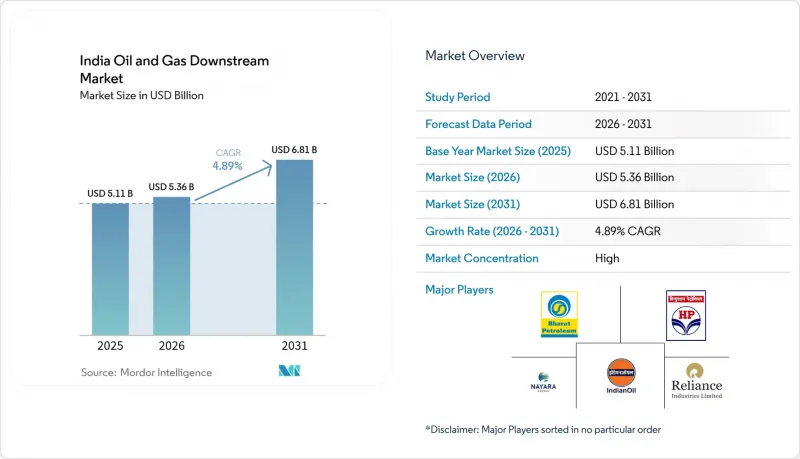
본 보고서는 유형(정유소, 석유화학 플랜트), 제품 유형(정제 석유 제품, 석유화학제품, 윤활유) 및 유통 채널(직판/도매, 판매 대리점/상업, 소매)별로 분류되어 있습니다. 시장 규모 및 전망은 금액(달러)으로 표시되어 있습니다.
인도 석유 및 가스 다운스트림 시장의 동향과 인사이트
중산층의 연료 수요 증가
2·3선 도시의 자동차 보유 대수는 연평균 12%의 속도로 증가하고 있으며, 성장세가 정체된 대도시권을 능가하는 속도로 인도 석유 및 가스 다운스트림 시장 전체에 분산된 수요 거점을 창출하고 있습니다. 인도 석유 공사(Indian Oil Corporation)는 이러한 성장 거점을 대상으로 2026년까지 농촌 지역에 5,000곳의 신규 소매 거점을 설립할 계획입니다. 또한 중산층의 구매력은 프리미엄 윤활유 및 특수 제품의 소비를 견인하고 있으며, 이로 인해 소매업체의 단위당 이익률을 끌어올리고 있습니다. 항공 터빈 연료 수요도 이러한 추세를 반영하고 있으며, 2030년까지 여객 수가 두 배로 증가할 것으로 예상됨에 따라 제트 연료의 크랙 마진은 더욱 견고해질 전망입니다. 이러한 추세들이 맞물리면서 정유사 및 유통업체의 수익 전망이 밝아지고 있으며, 저장, 물류, 고객 대상 기술에 대한 새로운 투자가 촉진되고 있습니다.
바랏 스테이지 VI 규제 대응을 위한 설비 투자
업계 전체적으로 150억 달러가 넘는 설비 투자를 통해 BS-VI 황 규제를 준수하기 위해 수소화 처리 설비, 접촉 개질 설비 및 블렌딩 시스템이 업그레이드되었습니다. 힌두스탄 페트롤리엄(Hindustan Petroleum)의 비자그 정유소만 해도 12억 달러를 투자하여 타사보다 앞서 업그레이드를 완료하고, 인도의 석유 및 가스 다운스트림 시장에서 생산능력 확대를 위한 자금을 확보했습니다. 선도 기업들은 현재 국내에서 프리미엄 BS-VI 연료를 판매하는 동시에 유황 규제가 엄격한 시장으로 수출하며 정제 마진율을 확대하고 있습니다. 반면, 중소 정유업체들은 자금 조달에 어려움을 겪고 있어, 규정 준수 비용을 분산하기 위해 합작 투자나 합병을 검토하고 있습니다. 그 결과, 이러한 규제 전환점은 업계 재편과 기술 보급을 가속화하고 있습니다.
설비 투자의 초과 및 지연
신규 프로젝트나 확장 계획에서는 평균 18-24개월의 지연과 최대 40%에 달하는 비용 초과가 문제로 대두되고 있으며, 이는 인도의 석유 및 가스 다운스트림 시장에서 대차대조표에 부담을 주고, 예상되었던 처리 능력 증가를 저해하고 있습니다. 환경 허가 취득, 토지 수용 관련 분쟁, 숙련된 노동자 부족이 주요 병목 현상으로 대두되고 있습니다. 예를 들어, 바라트 페트롤리엄(Bharat Petroleum)의 비나(Vina) 확장 프로젝트는 30개월의 지연을 겪으며 비용이 41억 달러로 불어났고, 내부수익률(IRR) 예상치를 끌어내렸습니다. 일정이 지연될 때마다 자금 조달 비용이 상승하고 배당 유연성이 제한될 뿐만 아니라, 이사회는 보다 보수적인 투자 속도와 자산을 최소화한 파트너십을 선택하도록 압박받고 있습니다.
부문별 분석
2025년 현재, 정유소는 인도 석유 및 가스 다운스트림 시장의 65.12%를 차지하고 있으며, 이는 정부가 수년 동안 수입 대체형 정제를 통한 에너지 안보를 중시해 온 것을 반영합니다. 잠나가르 한 곳만으로도 하루 130만 배럴 이상을 처리하고 있어, 인도가 석유 제품의 순수출국이라는 위상을 뒷받침하고 있습니다. 이 부문은 디젤 및 제트 연료의 수율을 높이고 유럽 및 아프리카로의 수익성 높은 수출을 뒷받침하는 주택 개보수에 대한 추가 투자의 혜택을 받고 있습니다. 한편, 석유화학 플랜트는 규모는 작지만 2031년까지 연평균 성장률(CAGR) 7.22%를 기록할 전망이며, 인도의 전체 석유 및 가스 다운스트림 시장에서 가장 빠른 생산량 확대를 주도하게 될 것입니다.
통합형 O2C(원유에서 화학제품으로) 콤플렉스로의 전환을 통해 사업자는 마진 동향에 따라 원료를 연료와 화학제품 중 어느 쪽으로 배분할지 유연하게 전환할 수 있게 됩니다. ONGC Petro Additions Limited의 다헤지 콤플렉스는 이러한 유연성을 잘 보여주는 대표적인 사례로, 정유소의 나프타를 단순한 증류 분획에 비해 더 높은 스프레드를 얻을 수 있는 폴리머 생산 라인으로 전환하고 있습니다. 석유·폭발물 안전 기구(PESO)의 체계에 기반한 기술 업그레이드를 통해 공정 안전성이 향상되었으며, 기존 정유소 인근에 위치한 신규 화학 플랜트에 대한 투자자들의 신뢰가 더욱 강화되고 있습니다.
기타 혜택:
- 엑셀 형식의 시장 예측(ME) 시트
- 3개월간의 애널리스트 지원
자주 묻는 질문
목차
제1장 소개
제2장 조사 방법
제3장 주요 요약
제4장 시장 구도
제5장 시장 규모와 성장 예측
제6장 경쟁 구도
제7장 시장 기회와 향후 전망
KSM 26.08.25According to Mordor Intelligence, the India oil and gas downstream market size was valued at USD 5.11 billion in 2025 and estimated to grow from USD 5.36 billion in 2026 to reach USD 6.81 billion by 2031, at a CAGR of 4.89% during the forecast period (2026-2031).
This report is Segmented by Type (Refineries and Petrochemical Plants), Product Type (Refined Petroleum Products, Petrochemicals, and Lubricants), and Distribution Channel (Direct Sales/Wholesale, Distributors/Commercial, and Retail). The Market Sizes and Forecasts are Provided in Terms of Value (USD).
India Oil And Gas Downstream Market Trends and Insights
Rising Middle-Class Fuel Demand
Vehicle ownership in Tier-2 and Tier-3 cities is increasing at a rate of 12% annually, outpacing the plateauing metros and creating dispersed demand nodes across the India oil and gas downstream market. Indian Oil Corporation plans to establish 5,000 new rural retail outlets by 2026, targeting these growth centers. Middle-class purchasing power is also driving the consumption of premium lubricants and specialty products, thereby boosting per-unit margins for retailers. Aviation turbine-fuel demand mirrors this trend as passenger numbers are set to double by 2030, further underpinning jet-fuel cracks. Together, these dynamics strengthen revenue visibility for refiners and marketers, supporting fresh investments in storage, logistics, and customer-facing technologies.
Bharat Stage-VI Compliance Capex
Sector-wide capex topping USD 15 billion has upgraded hydrotreaters, catalytic reformers, and blending systems to comply with BS-VI sulfur limits. Hindustan Petroleum's Vizag refinery alone invested USD 1.2 billion, completing upgrades ahead of peers and freeing funds for capacity growth in the India oil and gas downstream market. Early movers now sell premium BS-VI fuels domestically and export to sulfur-stringent markets, widening gross-refining margins. Smaller refiners face a capital-access squeeze and are considering joint ventures or mergers to dilute compliance costs. The regulatory milestone consequently accelerates industry consolidation and the diffusion of technology.
Capex Overruns & Delays
Project delays averaging 18-24 months and cost overruns up to 40% plague greenfield and expansion schemes, straining balance sheets and diluting forecast capacity additions in the India oil and gas downstream market. Environmental clearances, land acquisition disputes, and skilled labor shortages emerge as the primary bottlenecks. Bharat Petroleum's Bina expansion, for instance, slipped 30 months and ballooned to USD 4.1 billion, eroding IRR assumptions. Financing costs rise with each schedule slippage, curtailing dividend flexibility and nudging boards toward more conservative investment pacing or asset-light partnerships.
Other drivers and restraints analyzed in the detailed report include:
- Hydrogen & Bio-Fuels Blending Push
- Digital Refinery OPEX Optimization
- Margin Volatility vs. Crude Prices
For complete list of drivers and restraints, kindly check the Table Of Contents.
Segment Analysis
Refineries account for 65.12% of India's oil and gas downstream market share in 2025, reflecting the long-standing government emphasis on energy security through import-substitution refining. Jamnagar alone processes more than 1.3 million barrels per day, underpinning India's status as a net product exporter. This segment benefits from additional residential upgrading investments that increase diesel and jet-fuel yields and support lucrative exports to Europe and Africa. However, petrochemical plants-though smaller in base-are set to log a 7.22% CAGR to 2031, driving the fastest volumetric expansion across the India oil and gas downstream market.
The push toward integrated O2C complexes allows operators to toggle feedstocks between fuels and chemicals based on margin signals. ONGC Petro Additions Limited's Dahej complex exemplifies such flexibility, channeling refinery naphtha into polymer chains that command higher spreads compared to simple distillates. Technology upgrades under the Petroleum and Explosives Safety Organisation framework improve process safety, further strengthening investor confidence in new chemical units adjacent to legacy refineries.
Complete Report Scope:
- By Type
- Refineries
- Petrochemical Plants
- By Product Type
- Refined Petroleum Products
- Petrochemicals
- Lubricants
- By Distribution Channel
- Direct Sales/Wholesale
- Distributors/Commercial
- Retail
List of Companies Covered in this Report:
- Indian Oil Corporation Ltd
- Bharat Petroleum Corporation Ltd
- Hindustan Petroleum Corporation Ltd
- Reliance Industries Ltd
- Nayara Energy Ltd
- Mangalore Refinery & Petrochemicals Ltd
- Chennai Petroleum Corporation Ltd
- GAIL (India) Ltd
- Oil & Natural Gas Corporation
- Petronet LNG Ltd
- Indian Strategic Petroleum Reserves Ltd
- HPCL-Mittal Energy Ltd (HMEL)
- ONGC Petro additions Ltd (OPaL)
- Numaligarh Refinery Ltd
- Assam Petrochemicals Ltd
- Bharat Oman Refineries Ltd
- Adani Total Gas Ltd
- Ineos Styrolution India Ltd
- Haldia Petrochemicals Ltd
- Nayara Energy - Vadinar Refinery
Additional Benefits:
- The market estimate (ME) sheet in Excel format
- 3 months of analyst support
TABLE OF CONTENTS
1 Introduction
- 1.1 Study Assumptions & Market Definition
- 1.2 Scope of the Study
2 Research Methodology
3 Executive Summary
4 Market Landscape
- 4.1 Market Overview
- 4.2 Market Drivers
- 4.2.1 Rising middle-class fuel demand
- 4.2.2 Bharat Stage-VI compliance capex
- 4.2.3 Petrochemicals demand growth
- 4.2.4 Hydrogen & bio-fuels blending push
- 4.2.5 Digital refinery OPEX optimisation
- 4.2.6 Aviation traffic rebound
- 4.3 Market Restraints
- 4.3.1 Capex overruns & delays
- 4.3.2 Margin volatility vs crude prices
- 4.3.3 ESG / net-zero capital flight
- 4.3.4 EV adoption biting gasoline demand
- 4.4 Supply-Chain Analysis
- 4.5 Regulatory Landscape
- 4.6 Technological Outlook
- 4.7 Refining Capacity Analysis
- 4.8 Porter's Five Forces
- 4.8.1 Threat of New Entrants
- 4.8.2 Bargaining Power of Suppliers
- 4.8.3 Bargaining Power of Buyers
- 4.8.4 Threat of Substitutes
- 4.8.5 Competitive Rivalry
- 4.9 PESTLE Analysis
5 Market Size & Growth Forecasts
- 5.1 By Type
- 5.1.1 Refineries
- 5.1.2 Petrochemical Plants
- 5.2 By Product Type
- 5.2.1 Refined Petroleum Products
- 5.2.2 Petrochemicals
- 5.2.3 Lubricants
- 5.3 By Distribution Channel
- 5.3.1 Direct Sales/Wholesale
- 5.3.2 Distributors/Commercial
- 5.3.3 Retail
6 Competitive Landscape
- 6.1 Market Concentration
- 6.2 Strategic Moves (M&A, Partnerships, PPAs)
- 6.3 Market Share Analysis (Market Rank/Share for key companies)
- 6.4 Company Profiles (includes Global level Overview, Market level overview, Core Segments, Financials as available, Strategic Information, Products & Services, and Recent Developments)
- 6.4.1 Indian Oil Corporation Ltd
- 6.4.2 Bharat Petroleum Corporation Ltd
- 6.4.3 Hindustan Petroleum Corporation Ltd
- 6.4.4 Reliance Industries Ltd
- 6.4.5 Nayara Energy Ltd
- 6.4.6 Mangalore Refinery & Petrochemicals Ltd
- 6.4.7 Chennai Petroleum Corporation Ltd
- 6.4.8 GAIL (India) Ltd
- 6.4.9 Oil & Natural Gas Corporation
- 6.4.10 Petronet LNG Ltd
- 6.4.11 Indian Strategic Petroleum Reserves Ltd
- 6.4.12 HPCL-Mittal Energy Ltd (HMEL)
- 6.4.13 ONGC Petro additions Ltd (OPaL)
- 6.4.14 Numaligarh Refinery Ltd
- 6.4.15 Assam Petrochemicals Ltd
- 6.4.16 Bharat Oman Refineries Ltd
- 6.4.17 Adani Total Gas Ltd
- 6.4.18 Ineos Styrolution India Ltd
- 6.4.19 Haldia Petrochemicals Ltd
- 6.4.20 Nayara Energy - Vadinar Refinery
7 Market Opportunities & Future Outlook
- 7.1 White-space & Unmet-Need Assessment


