

|
시장보고서
상품코드
2113705
동남아시아의 석유 및 가스 다운스트림 : 시장 점유율 분석, 업계 동향 및 통계, 성장 예측(2026-2031년)Southeast Asia Oil And Gas Downstream - Market Share Analysis, Industry Trends & Statistics, Growth Forecasts (2026 - 2031) |
||||||
 Mordor Intelligence
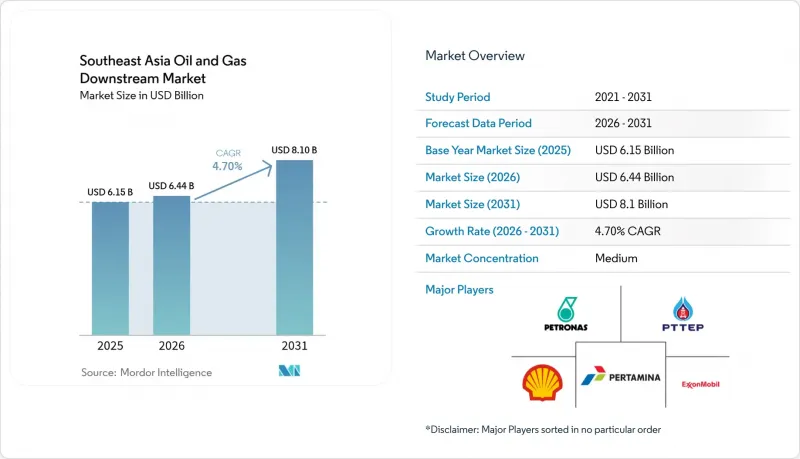
Mordor Intelligence에 의하면, 동남아시아의 석유 및 가스 다운스트림 시장 규모는 2025년 61억 5,000만 달러로 평가되었습니다. 2026년에는 64억 4,000만 달러로 확대되어 2026년부터 2031년에 걸쳐 CAGR 4.7%로 성장을 지속하여, 2031년에는 81억 달러에 이를 것으로 예측됩니다.
본 보고서는 유형별(정유시설 및 석유화학 플랜트), 제품 유형별(정제 석유 제품, 석유화학제품, 윤활유), 유통 채널별(직접 판매·도매, 유통업체·상업, 소매), 지역별(인도네시아, 말레이시아, 태국, 베트남, 필리핀, 싱가포르,미얀마, 기타 동남아시아 국가)로 분류되어 있습니다.
동남아시아의 석유 및 가스 다운스트림 시장 동향 및 인사이트
신종 코로나바이러스 감염 확산 이후 해당 지역의 제트 연료 수요 급증
아세안 전역의 항공 수요가 급격히 회복되면서, 2024년 싱가포르 창이 공항의 제트 연료 출하량은 820만 톤에 달하고, 2019년 기준치를 15% 상회했습니다. 쿠알라룸푸르 국제공항 및 수완나품 국제공항에서도 마찬가지로 수요가 증가함에 따라, 제트 연료 수율을 높이는 방향으로 정유시설 설비 구성을 변경하는 것이 정당화되었습니다. 에어아시아와 싱가포르항공 등의 항공사는 항공기 가동률을 회복하는 동시에 지방 도시 노선을 확대했습니다. 이를 위해서는 여러 거점에 걸친 연료 물류가 필요하며, 통합 공급 계약에 대한 안정적인 수요를 창출하고 있습니다. 첨단 수소화 처리 설비를 갖춘 정유시설는 인증 항공 연료를 통해 프리미엄 스프레드를 확보하고 있으며, 이를 통해 동남아시아의 석유 및 가스 다운스트림 시장의 수익성 회복력을 강화하고 있습니다. 수요 전망이 명확해짐에 따라, 계절별 크랙 스프레드에 따라 제트 연료와 디젤 생산을 전환할 수 있는 분별 선택형 설비에 대한 투자가 촉진되고 있습니다. 또한, 수요량의 예측 가능성은 하류 사업자가 장기 인수 계약을 협상하는 데에도 도움이 되며, 새로운 통합 프로젝트 전반에 걸친 대차대조표 계획의 기반이 되고 있습니다.
탄소 가격 제도의 지역적 통합이 진전
싱가포르는 2024년에 탄소세를 톤당 25싱가포르달러로 인상하고, 2030년까지 80싱가포르달러까지 단계적으로 인상할 예정입니다. 이러한 움직임은 태국의 시범 거래 제도와 인도네시아의 2025년 세제 체계에도 반영되어 있습니다. CO2 비용의 격차로 인해 사업자들은 플레어 가스 회수, 열 통합 개조, 연소 후 회수 기술을 도입하도록 장려받고 있으며, 이를 통해 단위당 배출량을 줄이고 규정 준수 비용을 상쇄할 수 있는 거래 가능한 크레딧을 창출하고 있습니다. 쿠알라룸푸르와 싱가포르의 금융 센터는 국경을 초월한 크레딧 시장을 촉진하여, 다국에 걸쳐 사업을 전개하는 사업자들이 포트폴리오를 최적화할 수 있도록 지원하고 있습니다. 탄소 포집과 수소 대응 연소로를 결합한 플랜트는 스코프 3 배출량에 대한 전 세계 고객들의 임박한 심사에 대비하고 있습니다. 조기 도입 기업들은 이미 검증 가능한 배출 감축을 요구하는 다국적 물류 기업들과의 프리미엄 계약을 통해 저탄소 디젤 및 벙커 연료 혼합으로 수익을 창출하고 있습니다. 전반적으로 탄소 가격의 조화는 ‘보상’과 ‘제재’라는 양면의 인센티브를 제공하며, 동남아시아의 석유 및 가스 다운스트림 시장에서의 기술 도입을 가속화하고 있습니다.
EPC 공급망 병목 현상에 따른 설비 투자 비용 급등
2022년부터 2024년에 걸쳐 철강 및 특수 합금 가격이 40% 급등하고, 대구경 반응 장치의 납기 기간이 24개월에 달함에 따라 수소화 분해 장치 및 에틸렌 분해 장치에 대한 지출이 증가했습니다. 삼성엔지니어링과 현대엔지니어링은 펭게란 및 발릭파판 사업에서 조달 지연을 보고했으며, 이로 인해 일정을 재조정할 수밖에 없게 되어 프로젝트의 순현재가치가 하락하고 있습니다. 현재 자금 조달 구조에는 더 큰 예비비와 물가 연동형 가격 상승 조항이 포함되어 있어, 신용위원회의 승인 절차가 복잡해지고 있습니다. 견고한 공급업체와의 제휴 관계나 모듈식 건설 계획을 가진 사업자는 비용 급증을 부분적으로 상쇄할 수 있지만, 소규모 사업자는 높은 진입 장벽에 직면해 있습니다. 지속적인 병목 현상으로 인해 생산 능력 확대 일정이 연기될 우려가 있으며, 동남아시아의 석유 및 가스 하류 시장의 단기적인 공급 증가세가 둔화될 가능성이 있습니다.
부문별 분석
2025년 매출액 중 정유시설이 65.74%를 차지했으나, 2031년까지 동남아시아의 석유 및 가스 하류 시장에서 석유화학 플랜트가 연평균 성장률(CAGR) 6.02%라는 가장 높은 성장률을 나타낼 것으로 예측됩니다. 정유시설 부문은 규모의 경제, 연안 물류 및 가격 스프레드 변동에 따라 ‘스위트’ 원유에서 ‘사워’ 원유로 전환이 가능한 원유 대응형 구성을 활용하고 있습니다. 싱가포르의 통합 클러스터만 해도 하루 150만 배럴을 처리하여 아세안 전역의 수출 파이프라인에 공급하고 있습니다. 그럼에도 불구하고, 휘발유 수요에 대한 지속적인 위험으로 인해 사업자들은 스팀 크래커 증설 및 방향족 화합물 추출로 방향을 전환하고 있으며, 이를 통해 경쟁력 있는 나프타의 경제성을 수익화하고 있습니다.
석유화학 통합을 통해 증산된 나프타를 에틸렌 기반의 파생 제품 체인으로 전환함으로써 배럴당 총 마진이 확대됩니다. 말레이시아의 RAPID 복합 시설은 이러한 전환을 구현하고 있으며, 통합된 오프가스 회수 및 공유 열병합 발전 시스템을 도입하여 단위 비용을 절감하고 있습니다. 태국의 맵타풋 확장 프로젝트는 자동차 부품 공급업체를 위한 틈새 엘라스토머 및 특수 올레핀을 통합하여 비연료 부문에서의 가치 창출을 강화하고 있습니다. 이러한 접근 방식을 통해 자동차 연료 시장의 변동성에 대한 노출을 최소화하고, 동남아시아의 전체 석유 및 가스 다운스트림 시장에서 직면한 전기화 및 탈탄소화라는 역풍 속에서도 자산 기반의 미래 가치를 확보하고 있습니다.
기타 혜택 :
- 엑셀 형식 시장 예측(ME) 시트
- 3개월간의 애널리스트 지원
자주 묻는 질문
목차
제1장 서론
제2장 조사 방법
제3장 주요 요약
제4장 시장 구도
제5장 시장 규모 및 성장 예측
제6장 경쟁 구도
제7장 시장 기회 및 향후 전망
KTH 26.08.26According to Mordor Intelligence, the southeast asia oil and gas downstream market size is expected to grow from USD 6.15 billion in 2025 to USD 6.44 billion in 2026 and is forecast to reach USD 8.1 billion by 2031 at 4.7% CAGR over 2026-2031.
This report is Segmented by Type (Refineries and Petrochemical Plants), Product Type (Refined Petroleum Products, Petrochemicals, and Lubricants), Distribution Channel (Direct Sales/Wholesale, Distributors/Commercial, and Retail), and Geography (Indonesia, Malaysia, Thailand, Vietnam, Philippines, Singapore, Myanmar, and Rest of Southeast Asia).
Southeast Asia Oil And Gas Downstream Market Trends and Insights
Rapid Recovery of Regional Jet-Fuel Demand Post-COVID
Aviation traffic across ASEAN rebounded sharply, pushing 2024 jet-fuel liftings at Singapore Changi to 8.2 million t, 15% above the 2019 baseline. Parallel upticks at Kuala Lumpur International and Suvarnabhumi airports were sufficient to justify refinery configuration shifts toward higher jet-fuel yields. Airlines such as AirAsia and Singapore Airlines restored fleet utilization while expanding secondary-city routes, which require multi-node fuel logistics and create stable pull-through for integrated supply contracts. Refineries equipped with advanced hydro-treaters capture premium spreads on certified aviation fuel, thereby reinforcing the margin resilience of the Southeast Asia oil and gas downstream market. Demand visibility encourages capital outlays for distillate-selective units that can toggle between jet fuel and diesel depending on seasonal crack spreads. Predictable volume signals also help downstream operators negotiate long-term offtake agreements that underpin balance-sheet planning across new integration projects.
Rising Regional Integration of Carbon-Pricing Schemes
Singapore lifted its carbon levy to SGD 25 t-CO2 in 2024 and will incrementally raise it to SGD 80 by 2030, a move mirrored by Thailand's pilot trading system and Indonesia's 2025 tax framework. Differentiated CO2 costs prompt operators to deploy flare-gas recovery, heat-integration retrofits, and post-combustion capture, thereby reducing unit emissions and creating tradable credits that offset compliance expenses. Financial centers in Kuala Lumpur and Singapore facilitate cross-border credit markets, enabling portfolio optimization for multi-country operators. Plants that couple carbon capture with hydrogen-ready furnaces position themselves for the looming scrutiny of global customers on Scope 3 emissions. Early adopters already monetize lower-carbon diesel and bunker blends through premium contracts with multinational logistics firms seeking verifiable emission reductions. Collectively, carbon-pricing harmonization supplies both carrot and stick incentives that accelerate technology uptake within the Southeast Asia oil and gas downstream market.
High Capital-Cost Escalations Amid EPC Supply-Chain Crunch
Steel and specialty-alloy prices surged 40% between 2022 and 2024, while delivery lead times for large-bore reactors stretched to 24 months, inflating outlays on hydrocrackers and ethylene crackers. Samsung Engineering and Hyundai Engineering reported procurement delays on Pengerang and Balikpapan units, forcing schedule re-baselines and eroding project net present values. Financing structures now incorporate larger contingency cushions and index-linked escalation clauses, adding complexity to credit-committee approvals. Operators with robust supplier alliances and modular construction plans partially offset cost blowouts, but smaller players confront prohibitive entry barriers. Persistent bottlenecks threaten to defer capacity-addition timelines, softening near-term supply growth in the Southeast Asia oil and gas downstream market.
Other drivers and restraints analyzed in the detailed report include:
- Expansion of IMO 2020-Compliant Bunkering Hubs
- Accelerated Petrochemical Integration at Existing Refineries
- Growing EV Penetration Suppressing Gasoline Demand
For complete list of drivers and restraints, kindly check the Table Of Contents.
Segment Analysis
Refineries commanded 65.74% of 2025 revenue, but petrochemical units are expected to deliver the Southeast Asia oil and gas downstream market's fastest 6.02% CAGR through 2031. The refinery cohort leverages economies of scale, coastal logistics, and crude-flex configurations that can shift from sweet to sour slates as price spreads fluctuate. Singapore's integrated cluster alone processes 1.5 million bpd and feeds export pipelines across ASEAN. Nevertheless, the sustained risk of gasoline demand propels operators toward steam-cracker add-ons and aromatics extraction, which monetizes competitive naphtha economics.
Petrochemical integration increases the overall margin per barrel by converting incremental naphtha into ethylene-based derivative chains. Malaysia's RAPID complex embodies this shift, deploying unified off-gas recovery and shared cogeneration to lower unit costs. Thailand's Map Ta Phut expansion packages niche elastomers and specialty olefins for automotive component suppliers, reinforcing non-fuel value capture. The approach minimises exposure to motor-fuel cycling, future-proofing asset bases against electrification and decarbonization headwinds across the Southeast Asia oil and gas downstream market.
Complete Report Scope:
- By Sector
- Refineries
- Petrochemical Plants
- By Product Type
- Refined Petroleum Products
- Petrochemicals
- Lubricants
- By Distribution Channel
- Direct Sales/Wholesale
- Distributors/Commercial
- Retail
- By Geography
- Indonesia
- Malaysia
- Thailand
- Vietnam
- Philippines
- Singapore
- Myanmar
- Rest of Southeast Asia
List of Companies Covered in this Report:
- Shell plc
- PTT Public Company Ltd
- PT Pertamina
- Petroliam Nasional Berhad (PETRONAS)
- Exxon Mobil Corp
- Vietnam Oil & Gas Group (PetroVietnam)
- Perusahaan Gas Negara Tbk
- Chevron Corporation
- TotalEnergies SE
- SK Energy
- Hyundai Engineering Co.
- Bangchak Corp
- IRPC Public Co.
- Hengyi Industries Sdn Bhd
- Pilipinas Shell Petroleum Corp
- Thai Oil Public Co.
- PT Chandra Asri Petrochemical Tbk
- Petron Corp
- Brunei Shell Petroleum
- Idemitsu Kosan (Vietnam JV)
Additional Benefits:
- The market estimate (ME) sheet in Excel format
- 3 months of analyst support
TABLE OF CONTENTS
1 Introduction
- 1.1 Study Assumptions & Market Definition
- 1.2 Scope of the Study
2 Research Methodology
3 Executive Summary
4 Market Landscape
- 4.1 Market Overview
- 4.2 Market Drivers
- 4.2.1 Rapid recovery of regional jet-fuel demand post-COVID
- 4.2.2 Rising regional integration of carbon-pricing schemes
- 4.2.3 Expansion of IMO 2020-compliant bunkering hubs
- 4.2.4 Mainstream fuel-quality upgrades (Euro-V standards)
- 4.2.5 Accelerated petrochemical integration at existing refineries
- 4.2.6 AI-driven predictive maintenance reducing OPEX
- 4.3 Market Restraints
- 4.3.1 High capital cost escalations amid EPC supply-chain crunch
- 4.3.2 Growing EV penetration suppressing gasoline demand
- 4.3.3 Stringent green-bond taxonomy limiting fossil-fuel financing
- 4.3.4 Skilled-labor shortages for complex turnaround projects
- 4.4 Supply-Chain Analysis
- 4.5 Regulatory Landscape
- 4.6 Technological Outlook
- 4.7 Refining Capacity Analysis
- 4.8 Porter's Five Forces
- 4.8.1 Bargaining Power of Suppliers
- 4.8.2 Bargaining Power of Buyers
- 4.8.3 Threat of New Entrants
- 4.8.4 Threat of Substitutes
- 4.8.5 Industry Rivalry
5 Market Size & Growth Forecasts
- 5.1 By Sector
- 5.1.1 Refineries
- 5.1.2 Petrochemical Plants
- 5.2 By Product Type
- 5.2.1 Refined Petroleum Products
- 5.2.2 Petrochemicals
- 5.2.3 Lubricants
- 5.3 By Distribution Channel
- 5.3.1 Direct Sales/Wholesale
- 5.3.2 Distributors/Commercial
- 5.3.3 Retail
- 5.4 By Geography
- 5.4.1 Indonesia
- 5.4.2 Malaysia
- 5.4.3 Thailand
- 5.4.4 Vietnam
- 5.4.5 Philippines
- 5.4.6 Singapore
- 5.4.7 Myanmar
- 5.4.8 Rest of Southeast Asia
6 Competitive Landscape
- 6.1 Market Concentration
- 6.2 Strategic Moves (M&A, Partnerships, PPAs)
- 6.3 Market Share Analysis (Market Rank/Share for key companies)
- 6.4 Company Profiles (includes Global level Overview, Market level overview, Core Segments, Financials as available, Strategic Information, Products & Services, and Recent Developments)
- 6.4.1 Shell plc
- 6.4.2 PTT Public Company Ltd
- 6.4.3 PT Pertamina
- 6.4.4 Petroliam Nasional Berhad (PETRONAS)
- 6.4.5 Exxon Mobil Corp
- 6.4.6 Vietnam Oil & Gas Group (PetroVietnam)
- 6.4.7 Perusahaan Gas Negara Tbk
- 6.4.8 Chevron Corporation
- 6.4.9 TotalEnergies SE
- 6.4.10 SK Energy
- 6.4.11 Hyundai Engineering Co.
- 6.4.12 Bangchak Corp
- 6.4.13 IRPC Public Co.
- 6.4.14 Hengyi Industries Sdn Bhd
- 6.4.15 Pilipinas Shell Petroleum Corp
- 6.4.16 Thai Oil Public Co.
- 6.4.17 PT Chandra Asri Petrochemical Tbk
- 6.4.18 Petron Corp
- 6.4.19 Brunei Shell Petroleum
- 6.4.20 Idemitsu Kosan (Vietnam JV)
7 Market Opportunities & Future Outlook
- 7.1 White-space & Unmet-Need Assessment


