

|
시장보고서
상품코드
2113381
농업용 로봇 및 메카트로닉스 : 시장 점유율 분석, 업계 동향과 통계, 성장 예측(2026-2031년)Agricultural Robots And Mechatronics - Market Share Analysis, Industry Trends & Statistics, Growth Forecasts (2026 - 2031) |
||||||
 Mordor Intelligence
Mordor Intelligence에 따르면 농업용 로봇 및 메카트로닉스 시장 규모는 2025년에 43억 달러로 평가되며, 2026년 49억 9,000만 달러에서 2031년까지 104억 5,000만 달러에 달할 것으로 예측되며, 예측 기간(2026-2031년) 동안 CAGR은 15.95%가 될 전망입니다.
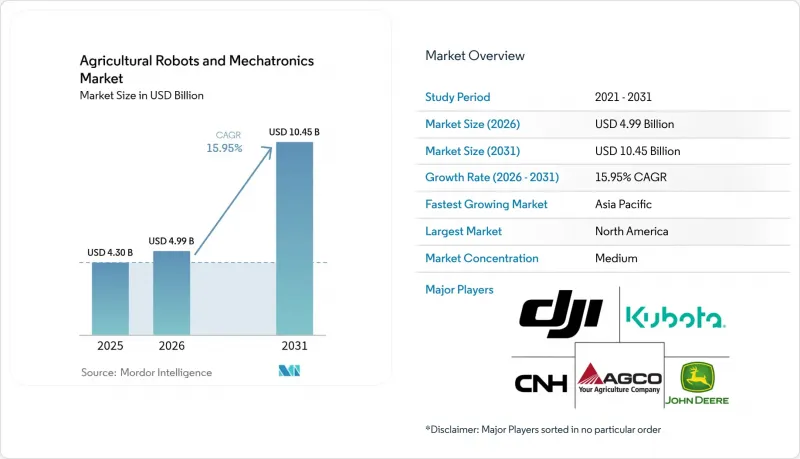
본 보고서는 유형별(자율주행 트랙터, 무인항공기, 착유 로봇 등), 용도별(작물 생산, 축산, 산림 관리 등), 및 지역별(북미, 유럽, 아시아태평양, 남미, 중동 등)로 분류되어 있습니다. 시장 예측은 금액(달러)으로 표시되어 있습니다.
세계 농업용 로봇 및 메카트로닉스 시장의 동향과 인사이트
첨단 비전 기술과 인공지능(AI)을 통해 1cm 미만의 정밀도로 제초 가능
현재 머신비전은 50밀리초 만에 98%의 정확도로 잡초와 작물을 식별할 수 있으며, 이를 통해 시속 8킬로미터로 이동하면서도 레이저나 마이크로스프레이 시스템이 개별 식물을 표적으로 삼을 수 있게 되었습니다. Carbon Robotics는 2024년에 100대 이상의 ‘LaserWeeder’를 도입하여 제초제 사용량을 80% 줄이는 동시에, 1에이커당 인건비를 200달러 절감했습니다. Deere & Company의 ‘See and Spray Ultimate’는 36대의 카메라와 Nvidia Orin 프로세서를 결합해 실시간 잡초 지도를 생성함으로써 1센티미터 미만의 정밀도로 살포할 수 있게 했습니다. EcoRobotix사의 태양광발전식 ‘Aerial Robot Arms(ARA)’ 로봇은 디젤 연료 보급이 필요 없어 가동 시간을 연장하고 있습니다. 'Journal of Field Robotics'지에 게재된 동료 심사 논문에 따르면, 하이퍼스펙트럼 이미징 기술을 활용하면 잡초가 육안으로 확인 가능해지기 7일 전에 발아 전 잡초를 탐지할 수 있는 것으로 확인되었으며, 2027년까지 예방적 제초 작업이 시행될 가능성이 시사되고 있습니다.
LiDAR(광 검출·측정) 및 멀티스펙트럼 센서의 비용 하락이 로봇 가격을 낮추고 있다
2020년에 8,000달러에 판매되던 솔리드 스테이트 LiDAR 모듈은 현재 1,200달러 미만으로 떨어졌으며,다중 스펙트럼 카메라도 1만 5,000달러에서 3,500달러로 가격이 하락함에 따라 로봇의 부품 원가가 약 30% 절감되었습니다. Trimble사의 저비용 GNSS-RTK(전지구위성항법시스템·실시간 키네마틱) 수신기는 고가의 베이스 스테이션을 필요로 하지 않으면서도 위치 측정 오차를 2센티미터 미만으로 억제합니다. 비용 절감 덕분에 AGCO 코퍼레이션이나 쿠보타 주식회사와 같은 중견 벤더들은 5,000에이커 규모의 농장뿐만 아니라 500에이커 규모의 농가에도 자율주행 패키지를 판매할 수 있게 되었습니다. 야마하 발동기의 무인 헬리콥터 ‘RMAX(Maximum Relaxation)’는 논에서 운용 시 고급 드론보다 40% 저렴한 가격을 실현하고 있습니다. 'MDPI Sensors' 저널의 연구에 따르면, 저비용 카메라로도 정규화 식생 지수(NDVI) 매핑에서 연구용 수준의 성능의 92%를 달성할 수 있게 되었다고 합니다.
높은 초기 투자 비용
완전 자율주행 트랙터의 판매 가격은 35만-45만 달러로, 기존 모델의 3-4배에 달하며, 브라질이나 인도의 많은 500에이커 규모 농장의 연간 매출액을 상회합니다. 15만 달러짜리 개조 키트조차도 중규모 농장의 설비 예산의 40%를 차지해 버립니다. 연방준비제도이사회(FRB)의 조사에 따르면, 2024년에는 자율형 농업기계에 대한 대출 신청의 38%가 부채 대비 자산 비율이 높다는 이유로 기각되었습니다. 대당 18만 유로(19만 5,000달러)인 데라발(DeLaval)사의 착유 로봇을 도입할 경우, 100두의 젖소를 사육하는 낙농장의 설비 갱신 비용은 40만 달러에 육박합니다. 'Agricultural Finance Review'지에 따르면, 1,000에이커 미만의 농장에서는 투자 회수에 12년이 걸리는 반면, 3,000에이커 이상의 농장에서는 4년 만에 회수할 수 있는 것으로 나타났습니다.
부문 분석
자율주행 트랙터는 2025년 매출의 37.40%를 차지하며, 농업용 로봇 및 메카트로닉스 시장의 주축을 이루고 있습니다. 무인항공기(UAV)는 연평균 성장률(CAGR) 21.90%로 성장할 전망이며, 이는 모든 장비 카테고리 중 가장 높은 성장률입니다. Deere사는 2024년에 1,200대의 8R 트랙터 개조 모델을 출하했으며, 부품 비용의 하락에 따라 2025년에는 그 수를 두 배로 늘릴 전망입니다. DJI의 드론 ‘Agras T50’은 시간당 40에이커를 살포할 수 있으며, 이미 중국 드론 살포기 시장에서 35%의 점유율을 차지하고 있습니다.
지상 및 공중 플랫폼 간의 연계가 점점 더 강화되고 있습니다. AGCO의 ‘Xaver’와 같은 군집형 접근 방식을 통해 토양 다짐이 60% 감소한 것이 입증되었습니다. 쿠보타의 벼용 모내기 기계 ‘Agri Robo MR1000A’는 일본 니가타현에서 15%의 보급률을 달성했으며, 현재 호주에서 밀 파종용으로 개량이 진행되고 있습니다. 이는 특정 작업에 특화된 설계가 지역을 초월하여 활용될 수 있음을 보여줍니다. 야마하 발동기의 특정 용도용 헬리콥터 ‘RMAX’는 전용으로 설계된 기체가 범용 드론보다 40% 저렴한 비용으로 운용될 수 있음을 입증하고 있습니다. 정밀 농업 연구에 따르면, 하이브리드형 기체는 단일 플랫폼 전략에 비해 순이익률을 22% 향상시키는 것으로 확인되었습니다. 이러한 동향은 농업용 로봇 및 메카트로닉스 시장 전체에 걸친 지속적인 수요를 뒷받침하고 있습니다.
지역별 분석
북미는 2025년 농업용 로봇 및 메카트로닉스 시장 매출 점유율의 39.30%를 차지했습니다. 농장 규모가 넓고, 4세대 LTE 커버리지율이 92%에 달하며, 미국 농무부(USDA)의 보조금 덕분에 도입이 가속화되고 있습니다. 자율주행 트랙터는 평균 농지 면적이 1,200에이커를 넘는 아이오와주, 일리노이주, 네브래스카주에 집중되어 있습니다. 캐나다 프레리 지역의 농장에서는 노동력 부족을 보완하기 위해 자율주행형 곡물 운반차가 도입되고 있으며, 2024년에는 연방 정부의 ‘AgriInnovate’ 보조금을 통해 420개 농장의 설비 비용 중 30%가 지원되었습니다. 멕시코의 온실 재배 부문에서는 노동력 부족이 22%를 초과함에 따라 로봇 수확기 도입이 진행되고 있습니다.
아시아태평양은 가장 빠르게 성장하고 있으며, 연평균 성장률(CAGR)은 19.60%로 예측됩니다. 중국은 드론 및 트랙터 비용의 최대 40%를 보조하여 2025년까지 기계화율 70%라는 목표 달성을 뒷받침하고 있습니다. 인도의 새로운 시야 외(BVLOS) 운용 규정에 따라 가르다 에어로스페이스(Garuda Aerospace)는 230만 에이커의 농지에 1,800대의 살포용 드론을 배치할 수 있게 되었습니다. 일본 쿠보타 아그리로보의 모내기기는 니가타현 벼 재배 면적의 15%를 담당하고 있는 반면, 호주의 스웜팜 로보틱스사의 곡물 운반차는 19%에 달하는 인력 부족 문제를 해결하고 있습니다.
유럽은 2024년 예상 매출의 상당 부분을 차지하고 있으며, 현저한 성장률이 예상됩니다. 공동농업정책(CAP)에서는 직접 지급금의 일정 비율이 환경 보전 프로그램에 배정되고 있어, 이에 따라 스페인의 딸기 생산자들은 2년 내에 투자 회수가 예상되는 나이오(Naio)사의 제초 로봇 도입을 촉진받고 있습니다. 독일에서는 현재 젖소 사육군의 상당 부분에 착유 로봇이 도입되어, 필요한 노동력이 3분의 1로 감소했습니다. 프랑스의 포도밭에서는 농약 감축 목표를 달성하기 위해 Monarch Tractor사와 Fendt사의 자율주행 트랙터 활용이 점점 확대되고 있습니다. 남미, 중동 및 아프리카는 합쳐서 시장 가치에 기여하고 있으며, 브라질의 사탕수수 농장과 남아프리카의 포도원을 주축으로 강력한 성장률이 예상됩니다.
기타 혜택:
- 엑셀 형식의 시장 예측(ME) 시트
- 3개월간의 애널리스트 지원
자주 묻는 질문
목차
제1장 소개
제2장 조사 방법
제3장 주요 요약
제4장 시장 구도
제5장 시장 규모와 성장 예측
제6장 경쟁 구도
제7장 시장 기회와 향후 전망
KSM 26.08.25According to Mordor Intelligence, the agricultural robots and mechatronics market size was valued at USD 4.30 billion in 2025 and estimated to grow from USD 4.99 billion in 2026 to reach USD 10.45 billion by 2031, at a CAGR of 15.95% during the forecast period (2026-2031).
This report is Segmented by Type (Autonomous Tractors, Unmanned Aerial Vehicles, Milking Robots, and More), by Application (Crop Production, Animal Husbandry, Forest Control, and More), and by Geography (North America, Europe, Asia-Pacific, South America, Middle East, and More). The Market Forecasts are Provided in Terms of Value (USD).
Global Agricultural Robots And Mechatronics Market Trends and Insights
Advanced Vision-Artificial intelligence (AI) Enables Sub-Centimeter Weeding Accuracy
Machine vision now distinguishes weeds from crops with 98% accuracy in 50 milliseconds, allowing laser or micro-spray systems to target individual plants while traveling 8 kilometers per hour. Carbon Robotics deployed over 100 LaserWeeder units in 2024, cutting herbicide use by 80% and labor costs by USD 200 per acre. Deere & Company's See and Spray Ultimate pairs 36 cameras with Nvidia Orin processors, creating real-time weed maps to guide sub-centimeter spraying. EcoRobotix's sun-powered Aerial Robot Arms (ARA) robot extends operating hours by eliminating diesel refueling. Peer-reviewed work in the Journal of Field Robotics confirms that hyperspectral imaging detects pre-emergent weeds seven days before they become visible, hinting at prophylactic weeding routines by 2027.
Declining Light Detection and Ranging (LIDAR) and Multispectral Sensor Costs Cut Robot Prices
Solid-state Light Detection and Ranging (LIDAR) modules that retailed at USD 8,000 in 2020 now cost under USD 1,200, while multispectral cameras fell from USD 15,000 to USD 3,500, lowering robot bills of material by roughly 30%. Trimble's low-cost Global Navigation Satellite System-Real-Time Kinematic (GNSS-RTK) receivers reduce positioning error to under 2 centimeters without expensive base stations. Cost compression lets mid-tier vendors such as AGCO Corporation and Kubota Corporation sell autonomy packages to 500-acre growers rather than only 5,000-acre operations. Yamaha Motor's Maximum Relaxation (RMAX) unmanned helicopter undercuts premium drones by 40% in rice farms. Studies in MDPI Sensors show low-cost cameras now achieve 92% of research-grade performance for normalized difference vegetation index mapping.
High Initial Capital Outlay
Fully autonomous tractors sell for USD 350,000-450,000, three to four times a conventional model and above annual revenue for many 500-acre farms in Brazil and India. Retrofit kits that cost USD 150,000 still consume 40% of a medium farm's equipment budget. The Federal Reserve found that 38% of autonomous-equipment loan applications were rejected in 2024 due to high debt-to-asset ratios . DeLaval milking robots priced at EUR 180,000 (USD 195,000) per unit push a 100-cow dairy's upgrade cost near USD 400,000. Agricultural Finance Review shows payback stretches to 12 years for farms under 1,000 acres, compared with four years for operations above 3,000 acres.
Other drivers and restraints analyzed in the detailed report include:
- Shortage and Cost of Labor
- Robot-as-a-Service Financing Unlocks Small and Medium Farm Adoption
- Connectivity Gaps in Rural Areas
For complete list of drivers and restraints, kindly check the Table Of Contents.
Segment Analysis
Autonomous tractors generated 37.40% of 2025 revenue, anchoring the agricultural robots and mechatronics market. Unmanned aerial vehicles are set to grow at a 21.90% CAGR, the fastest of any equipment class. Deere shipped 1,200 retrofit 8R tractors in 2024 and expects to double that in 2025 as component costs shrink. DJI's Agras T50 drone sprays 40 acres per hour and already owns 35% of China's drone-sprayer segment.
Ground and aerial platforms increasingly work together. Swarm approaches such as AGCO's Xaver have shown a 60% soil-compaction reduction. Kubota's Agri Robo MR1000A rice transplanter, which achieved 15% penetration in Japan's Niigata Prefecture, is being adapted for wheat seeding in Australia, illustrating how task-specific designs can cross geographies. Yamaha Motor's task-specific RMAX helicopter proves that specialized designs can undercut general-purpose drones by 40%. Precision Agriculture research confirms hybrid fleets lift net margins 22% over single-platform strategies. These developments reinforce sustained demand across the agricultural robots and mechatronics market.
Complete Report Scope:
- By Type
- Autonomous Tractors
- Unmanned Aerial Vehicles (UAVs)
- Milking Robots
- Other Types
- By Application
- Crop Production
- Animal Husbandry
- Forest Control
- Other Applications
- By Geography
- North America
- United States
- Canada
- Mexico
- Rest of North America
- Europe
- Spain
- United Kingdom
- France
- Germany
- Russia
- Italy
- Rest of Europe
- Asia-Pacific
- China
- India
- Japan
- Australia
- Rest of Asia-Pacific
- South America
- Brazil
- Argentina
- Rest of South America
- Middle East
- Saudi Arabia
- United Arab Emirates
- Rest of Middle East
- Africa
- South Africa
- Nigeria
- Rest of Africa
- North America
Geography Analysis
North America generated 39.30% of the 2025 revenue share in the agricultural robots and mechatronics market. Wide farm sizes, 92% fourth-generation Long Term Evolution coverage, and the United States Department of Agriculture (USDA) subsidies speed adoption. Autonomous tractors cluster in Iowa, Illinois, and Nebraska, where average holdings exceed 1,200 acres. Canada's Prairie farms use autonomous grain carts to offset labor gaps, and federal AgriInnovate grants funded 30% of equipment bills for 420 operations in 2024. Mexico's greenhouse sector is turning to robotic harvesters as labor deficits surpass 22%.
Asia-Pacific is the fastest mover, projected at 19.60% CAGR. China subsidizes up to 40% of drone and tractor costs, pushing mechanization toward a 70% target by 2025 . India's new beyond-visual-line-of-sight rules let Garuda Aerospace deploy 1,800 spraying drones across 2.3 million acres. Japan's Kubota Agri Robo transplanter controls 15% of the planted rice area in Niigata Prefecture, while Australia's SwarmFarm Robotics grain carts combat a 19% labor shortage.
Europe accounted for a significant share of the projected 2024 revenue and is projected to grow at a notable rate. The Common Agricultural Policy allocates a portion of direct payments to eco-schemes, encouraging Spanish strawberry growers to adopt Naio weeders, which offer a two-year payback period. In Germany, a substantial percentage of dairy herds are now equipped with milking robots, reducing labor requirements by one-third. French vineyards are increasingly utilizing autonomous tractors from Monarch Tractor and Fendt to comply with pesticide-reduction targets. South America, the Middle East, and Africa collectively contribute to the market value and are projected to grow at strong rates, driven by Brazil's sugarcane farms and South African vineyards.
- Deere & Company
- DJI
- AGCO Corporation
- CNH Industrial N.V.
- Kubota Corporation
- DeLaval
- GEA Group Aktiengesellschaft
- Yamaha Motor Co., Ltd.
- Trimble Inc.
- XAG Co., Ltd.
- Naio Technologies Inc.
- Autonomous Solutions, Inc.
- EagleNXT
- Monarch Tractor
- EcoRobotix SA
Additional Benefits:
- The market estimate (ME) sheet in Excel format
- 3 months of analyst support
TABLE OF CONTENTS
1 Introduction
- 1.1 Study Assumptions and Market Definition
- 1.2 Scope of the Study
2 Research Methodology
3 Executive Summary
4 Market Landscape
- 4.1 Market Overview
- 4.2 Market Drivers
- 4.2.1 Advanced Vision-Artificial intelligence (AI) Enables Sub-Centimeter Weeding Accuracy
- 4.2.2 Declining Light Detection and Ranging (LIDAR) and Multispectral Sensor Costs Cut Robot Prices
- 4.2.3 Shortage and Cost of Labor
- 4.2.4 Robot-as-a-Service Financing Unlocks Small and Medium Farm Adoption
- 4.2.5 Government Smart-Farming Incentives and Carbon-Credit Schemes
- 4.2.6 Agricultural Original Equipment Manufacturers (OEMs) Autonomy Roadmaps
- 4.3 Market Restraints
- 4.3.1 High Initial Capital Outlay
- 4.3.2 Connectivity Gaps in Rural Areas
- 4.3.3 Complexity of Multi-Vendor System Integration
- 4.3.4 Evolving Liability and Safety Regulations for Field Autonomy
- 4.4 Regulatory Landscape
- 4.5 Technological Outlook
- 4.6 Porter's Five Forces Analysis
- 4.6.1 Bargaining Power of Suppliers
- 4.6.2 Bargaining Power of Buyers
- 4.6.3 Threat of New Entrants
- 4.6.4 Threat of Substitutes
- 4.6.5 Intensity of Competitive Rivalry
5 Market Size and Growth Forecasts (Value)
- 5.1 By Type
- 5.1.1 Autonomous Tractors
- 5.1.2 Unmanned Aerial Vehicles (UAVs)
- 5.1.3 Milking Robots
- 5.1.4 Other Types
- 5.2 By Application
- 5.2.1 Crop Production
- 5.2.2 Animal Husbandry
- 5.2.3 Forest Control
- 5.2.4 Other Applications
- 5.3 By Geography
- 5.3.1 North America
- 5.3.1.1 United States
- 5.3.1.2 Canada
- 5.3.1.3 Mexico
- 5.3.1.4 Rest of North America
- 5.3.2 Europe
- 5.3.2.1 Spain
- 5.3.2.2 United Kingdom
- 5.3.2.3 France
- 5.3.2.4 Germany
- 5.3.2.5 Russia
- 5.3.2.6 Italy
- 5.3.2.7 Rest of Europe
- 5.3.3 Asia-Pacific
- 5.3.3.1 China
- 5.3.3.2 India
- 5.3.3.3 Japan
- 5.3.3.4 Australia
- 5.3.3.5 Rest of Asia-Pacific
- 5.3.4 South America
- 5.3.4.1 Brazil
- 5.3.4.2 Argentina
- 5.3.4.3 Rest of South America
- 5.3.5 Middle East
- 5.3.5.1 Saudi Arabia
- 5.3.5.2 United Arab Emirates
- 5.3.5.3 Rest of Middle East
- 5.3.6 Africa
- 5.3.6.1 South Africa
- 5.3.6.2 Nigeria
- 5.3.6.3 Rest of Africa
- 5.3.1 North America
6 Competitive Landscape
- 6.1 Market Concentration
- 6.2 Strategic Moves
- 6.3 Market Share Analysis
- 6.4 Company Profiles (Includes Global Level Overview, Market Level Overview, Core Segments, Financials as Available, Strategic Information, Market Rank/Share for Key Companies, Products and Services, and Recent Developments)
- 6.4.1 Deere & Company
- 6.4.2 DJI
- 6.4.3 AGCO Corporation
- 6.4.4 CNH Industrial N.V.
- 6.4.5 Kubota Corporation
- 6.4.6 DeLaval
- 6.4.7 GEA Group Aktiengesellschaft
- 6.4.8 Yamaha Motor Co., Ltd.
- 6.4.9 Trimble Inc.
- 6.4.10 XAG Co., Ltd.
- 6.4.11 Naio Technologies Inc.
- 6.4.12 Autonomous Solutions, Inc.
- 6.4.13 EagleNXT
- 6.4.14 Monarch Tractor
- 6.4.15 EcoRobotix SA


