

|
시장보고서
상품코드
2122700
농업용 로봇 시장 : 시장 점유율 분석, 업계 동향 및 통계, 성장 예측(2026-2031년)Agricultural Robots - Market Share Analysis, Industry Trends & Statistics, Growth Forecasts (2026 - 2031) |
||||||
 Mordor Intelligence
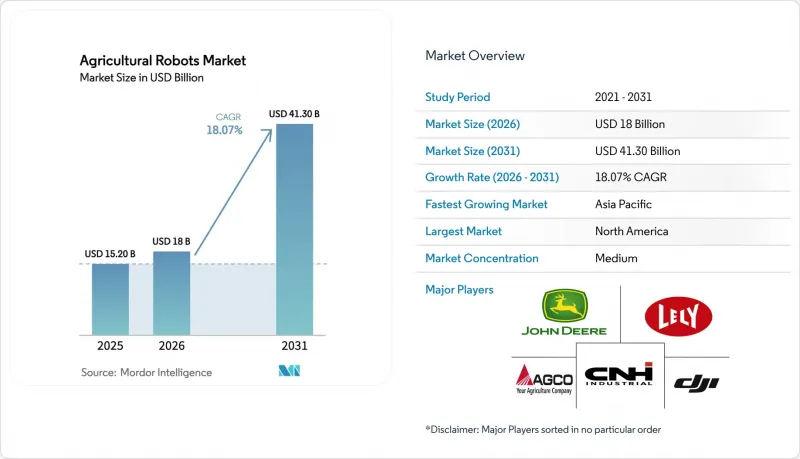
Mordor Intelligence에 의하면, 농업용 로봇 시장은 2025년 152억 달러로 평가되었고, 2026년 180억 달러에서 2031년까지 413억 달러로 확대될 것으로 예측되며, 2026-2031년 연평균 복합 성장률(CAGR)은 18.07%를 나타낼 전망입니다.
본 보고서는 제품 유형별(무인 트랙터, 무인 항공기 및 드론, 착유 로봇 등), 용도별(작물 재배, 가축 관리, 낙농 관리, 수산 양식 등), 구성 요소별(하드웨어, 소프트웨어, 서비스), 지역별(북미, 남미, 유럽,아시아태평양 등)으로 분류되어 있습니다. 시장 예측은 금액(달러) 기준으로 제시되어 있습니다.
세계의 농업용 로봇 시장 동향 및 인사이트
선진 농업국에서의 노동력 부족 가속화
농업 인력 부족은 미국, 유럽, 일본에서 자본 배분의 우선순위를 재편하고 있습니다. 미국에서는 2023년에 임시 근로자 비자 프로그램을 통해 31만 676건의 비자가 발급되었음에도 불구하고, 2025년 4월 농작물 작업자 고용자 수는 불과 63만 7,000명에 그치고 있어, 외국인 노동자의 유입만으로는 국내 노동력의 유출을 완전히 보충할 수 없음을 보여주고 있습니다. 일본에서는 2030년까지 농업 종사자 수가 100만 명 아래로 떨어지고 평균 연령이 68세를 넘을 것으로 예측되고 있으며, 독일, 프랑스, 네덜란드에서도 유사한 인구 구조적 압박이 우려되고 있습니다. 여전히 수작업 수확에 의존하고 있는 딸기나 사과 등의 특산 작물은 일정 차질이나 갑작스러운 노동력 부족으로 인해 시즌 전체의 수익을 잃을 가능성이 있어 가장 큰 위험에 직면해 있습니다. 사람의 반복적인 동작을 재현하는 자율형 수확기는 시간당 인건비가 18달러를 초과하면 수익성이 확보됩니다. 캘리포니아주와 서유럽에서는 생산자들이 기계에 대응할 수 있도록 과수원과 줄 간격을 재설계하고 있어, 이 기준치는 이미 넘어섰습니다. 인건비 절감 효과는 여러 시즌에 걸쳐 누적됩니다. 새로운 방식을 정착시키려면 작물의 재배 주기를 한 번 완전히 거칠 필요가 있으므로, 시장 성장에 미치는 영향은 중기적으로 집중될 것입니다.
머신 비전 카메라와 LiDAR의 가격 하락
센서 비용이 급격히 하락함에 따라, 장비 제조업체와 생산자 모두에게 진입 장벽이 낮아지고 있습니다. 2020년에는 1만 달러였던 솔리드 스테이트 LiDAR 유닛은 2024년 말까지 1,000달러 미만으로 떨어졌습니다. 이는 자동차 업계의 규모의 경제에 힘입어 90%나 가격이 하락한 결과입니다. 추론 칩이 내장된 카메라 모듈의 가격은 2022년부터 2025년 사이에 개당 500달러에서 150달러 미만으로 떨어졌습니다. Deere사는 Nvidia Jetson 엣지 AI 보드를 자사의 ‘See and Spray Ultimate’ 플랫폼에 통합하여, 초당 20장의 이미지를 처리하고 50밀리초 이내에 노즐을 작동시킴으로써 제초제 사용량을 최대 80%까지 줄였습니다. 센서 비용의 하락은 제품 개발 주기의 단축과 모듈식 설계의 촉진으로 이어져, 그동안 고액의 연구개발비를 감당할 수 없었던 지역 제조업체들에게도 시장 진입의 길을 열어줍니다. 이러한 비용 절감 효과는 출하와 동시에 즉각적으로 나타나기 때문에 단기적인 성장에 크게 기여하게 될 것입니다.
다중 벤더 농업 플랫폼 간의 상호 운용성 과제
대부분의 장비 제조업체는 독자적인 데이터 형식을 채택하고 있어, 서로 다른 제조업체의 장비가 혼재된 환경에서 원활한 연동을 방해하고 있습니다. ‘Deere Operations Center’,‘CNH Industrial Raven Autonomy’, 그리고 ‘AGCO Fuse’는 각각 독자적인 메시지 프로토콜을 채택하고 있어, 농업인은 특정 공급업체로 통일하거나 미들웨어를 통한 통합에 투자할 수밖에 없습니다. 농업 산업 전자 재단(Agricultural Industry Electronics Foundation)은 ISO 11783 규격을 공표했습니다. 그러나 벤더들은 자사의 경쟁 우위를 지키기 위해 독자적인 확장 기능을 추가하는 경우가 많습니다. 브랜드를 넘나드는 자동화를 시도하는 농가는 데이터 사일로화, 호환되지 않는 지도 레이어, 그리고 중복된 구독 문제에 직면하게 됩니다. 통합 컨설팅은 총 소유 비용을 증가시키고 프로젝트 배포를 지연시킬 가능성이 있습니다. 표준 채택에는 역사적으로 5년에서 7년이 소요되므로, 이러한 제약이 시장 성장에 미치는 영향은 중기적이라고 분류됩니다.
부문 분석
2025년, 농부들이 밭 조사와 센티미터 단위의 정밀도로 농약을 살포하는 두 가지 기능을 겸비한 무인 항공기(UAV) 및 드론을 적극적으로 도입한 결과, 이러한 장비는 농업용 로봇 시장 점유율의 36.0%를 차지했습니다. DJI Agras T50 드론은 40kg의 적재 능력을 갖추고 있으며, 시간당 20헥타르를 커버하여 지상 살포기에 비해 살포 시간을 60% 단축합니다. 중국과 동남아시아의 벼농사 및 밀밭에서 공중 로봇이 대규모로 도입된 것은 기존 업무 흐름에 얼마나 쉽게 통합될 수 있는지를 여실히 보여줍니다. 특히 주목할 점은 드론으로 수집된 데이터가 가변 시비 모델에 활용되어 설비 투자가 구체적인 수확량 증가로 이어지고 있다는 점입니다. 각 하드웨어 제조업체는 드론의 단품 판매에 더해 구독형 분석 서비스를 결합하여 제공함으로써, 비행 데이터를 지속적인 수익원으로 전환하고 있습니다. 위성 이미지의 정확도가 향상되고 있음에도 불구하고, 드론은 공간 분해능과 유연한 운용 기간이라는 측면에서 우위를 유지하고 있으며, 이를 통해 다양한 작물 분야에서 리더십을 계속 지켜가고 있습니다.
수확·채취용 로봇은 2026-2031년 연평균 성장률(CAGR) 18.9%를 나타낼 것으로 예측되며, 이는 농업용 로봇 시장에서 가장 빠른 성장 궤도입니다. 예전에는 작업자를 실어 나르던 과수원용 플랫폼에는 현재 사과, 복숭아, 베리류를 수확하기 위한 로봇 팔이 탑재되어 있습니다. 소프트 그립 방식의 엔드 이펙터와 머신 비전 카메라가 과일의 숙성도를 추적하고, 레이저를 이용한 표적 포착이 과일의 손상을 줄이는 동시에 포장 효율을 높이고 있습니다. Carbon Robotics사의 레이저 제초 시스템은 이미 현장 사용에 견딜 수 있는 내구성을 입증했으며, 1분당 5,000그루의 잡초를 제거하고 있습니다. 벤처 자금의 투입으로 캘리포니아주, 워싱턴주, 뉴사우스웨일스주 전역에서 상업적 시범 사업이 가속화되고 있으며, 각 서비스 제공업체들은 3번째 시즌까지 계절 근로자와의 1에이커당 비용을 동등한 수준으로 맞출 것을 보장하고 있습니다. 통제된 환경 농업이 확대됨에 따라, 온실 재배 토마토, 오이, 잎채소에 특화된 로봇이 수익원을 더욱 다각화하여 이 부문 시장 평균을 상회하는 성장을 이끌 것입니다.
2025년에는 옥수수, 대두, 밀 생산자들이 자율 주행 트랙터와 살포용 드론을 활용하여 광대한 농지를 센티미터 단위의 정밀도로 관리한 결과, 작물 재배가 농업용 로봇 시장의 44.0% 점유율을 차지했습니다. 이러한 줄 재배 농지의 규모와 균일성 덕분에 로봇은 장시간 가동할 수 있게 되었으며, 시즌마다 가변 시비량을 최적화하는 고품질 데이터 세트를 생성하고 있습니다. 2025년에는 축산 관리 분야도 큰 점유율을 차지했습니다. 이는 로봇 착유, 건강 모니터링용 목걸이, 자동 사료 공급 시스템 등이 주도한 결과로, 이를 통해 낙농가들은 노동 시간을 절반으로 줄이면서 생산량의 안정성을 높일 수 있게 되었습니다. ‘Lely Astronaut A5’와 같은 낙농 전용 솔루션은 하루 최대 60마리의 젖소를 처리할 수 있어, 작업자가 부가가치가 더 높은 젖소 무리의 건강 관리 업무에 전념할 수 있게 할 뿐만 아니라 4년 미만의 짧은 기간 내에 투자 회수를 실현하고 있습니다.
온실 농업은 2031년까지 연평균 성장률(CAGR) 17.4%로 확대될 것으로 예측되며, 이는 응용 분야 중 가장 빠른 성장 궤도입니다. 이는 환경이 제어된 레이아웃 덕분에 시각 유도형 로봇이 즉시 생산성을 발휘할 수 있기 때문입니다. 북미 및 서유럽의 수직 농장 운영자들은 현재 인건비가 급등하고 작업 위험이 급속히 높아지고 있는 시설에서 로봇을 활용한 식재기 및 수확기를 사용하여 24시간 체제로 운영하고 있습니다. Naio Technologies의 ‘Oz’ 플랫폼 등, 당초 노지 재배의 제초 작업에서 실증된 기술이 현재는 온실 재배 토마토와 오이에도 응용되어, 섬세한 줄기를 손상시키지 않도록 칼날을 정밀하게 제어할 수 있게 되었습니다. 도시 농업이 확대됨에 따라 지속적인 생산 주기에서 인공지능(AI) 엔진으로 안정적인 데이터 스트림이 공급되며, 로봇의 전략적 가치는 단순한 노동력 대체를 넘어 높아지고 있어 농업용 로봇 시장 전체의 규모 확대에 기여하고 있습니다.
지역별 분석
북미는 2025년에 33.0%의 점유율을 차지했습니다. 이는 중서부의 대규모 줄 재배 농장과 캘리포니아주의 고부가가치 특산 작물 재배 사업에 힘입은 것으로, 해당 주에서 고용된 근로자의 평균 시급은 19.52달러였습니다. 2024년에 Deere사의 자율 주행형 8R 트랙터가 양산됨에 따라, 옥수수 및 대두 생산자들에게는 시즌 내내 무인 운전을 실현할 수 있는 상업적인 길이 열렸습니다. 캐나다 프레리 주에서는 자율 주행으로의 업그레이드 비용의 최대 30%를 보조하는 주 정부 환급 프로그램이 도입되어, 밀 및 카놀라(유채) 분야에서 도입이 진행되었습니다. 탄탄한 딜러 네트워크가 있음에도 불구하고, 주요 브랜드 간의 상호 운용성 장벽이 성장을 저해하고 있습니다. 이는 농가가 단일 공급업체의 생태계에 얽매이는 것을 꺼리기 때문입니다.
아시아태평양은 2031년까지 연평균 14.8%의 성장이 예상되며, 이는 지역별로는 가장 빠른 속도입니다. 일본은 급격한 인구 감소에 직면해 있으며, 농가의 평균 연령은 68세를 넘었습니다. 이 문제를 해결하기 위해 농림수산성은 하루에 10헥타르의 모내기가 가능한 자율형 모내기기에게 보조금을 지급하고 있습니다. 중국은 2025년까지 스마트 농업 보급률을 30%로 끌어올릴 계획을 추진했으며, FJDynamics와 같은 국내 제조업체에 자금을 지원하고 있습니다. 이 회사는 5,000대째 자율형 제초기를 출하했는데, 그 출하 속도는 아시아태평양에서 실적이 가장 좋은 지역의 평균 시급에 해당하며, 집단적 자율성을 높이고 있습니다. 호주에서는 제초제 내성 라이그래스 대책으로 로봇 제초기가 활용되고 있으며, Carbon Robotics사는 2024년에 퀸즐랜드주와 뉴사우스웨일스주에서 20대의 ‘LaserWeeder’를 도입했습니다.
유럽에서는 독일, 네덜란드, 프랑스에서 2024년에 Lely, DeLaval, GEA사의 착유 로봇을 합쳐 1만 대 이상 도입하여 노동 시간을 절반으로 줄이는 동시에 수확량의 안정성을 높였습니다. 중동 및 아프리카은 규모는 비교적 작지만, 물 부족이나 열 스트레스로 인해 인력이 제한되는 수경 재배 온실에서 로봇의 시범 운용을 진행하고 있습니다.
기타 혜택 :
- 엑셀 형식 시장 예측(ME) 시트
- 3개월간의 애널리스트 지원
자주 묻는 질문
목차
제1장 서론
제2장 조사 방법
제3장 주요 요약
제4장 시장 구도
제5장 시장 규모 및 성장 예측
제6장 경쟁 구도
제7장 시장 기회 및 향후 전망
AJY 26.09.07According to Mordor Intelligence, the agricultural robots market is projected to expand from USD 15.2 billion in 2025 and USD 18.0 billion in 2026 to USD 41.3 billion by 2031, registering a CAGR of 18.07% between 2026 to 2031.
This report is Segmented by Product Type (Driverless Tractors, Unmanned Aerial Vehicles and Drones, Milking Robots, and More), by Application (Crop Farming, Livestock Management, Dairy Management, Aquaculture, and More), by Component (Hardware, Software, and Services), and by Geography (North America, South America, Europe, Asia-Pacific, and More). The Market Forecasts are Provided in Terms of Value (USD).
Global Agricultural Robots Market Trends and Insights
Accelerating Labor Shortages in Industrialized Farming Nations
Farm labor scarcity is reshaping capital-allocation priorities across the United States, Europe, and Japan. In the United States, only 637,000 hired crop workers were counted in April 2025, despite the temporary worker visa program issuing 310,676 visas in 2023, indicating that guest-worker inflows cannot fully offset domestic labor exits. Japan projects that its farmer population will plunge below one million by 2030, with an average age surpassing 68 years, and similar demographic pressures are also haunting Germany, France, and the Netherlands. Specialty crops such as strawberries and apples, which still depend on hand-picking, face the greatest risk because scheduling errors or sudden worker shortages can wipe out full-season profits. Autonomous harvesters that replicate repetitive human motions offer an economic breakeven once hourly labor costs exceed USD 18, a threshold already surpassed in California and Western Europe, as growers redesign orchards and row spacing to accommodate machines. Labor savings compound over multiple seasons. Because a full crop cycle is needed to embed new practices, the impact on market growth is concentrated in the medium term.
Declining Price of Machine-Vision Cameras and LiDAR
Rapid cost deflation in sensors is lowering entry barriers for both equipment makers and growers. Solid-state LiDAR units, which cost USD 10,000 in 2020, dropped below USD 1,000 by late 2024, a 90% reduction driven by economies of scale in the automotive sector. Camera modules with onboard inference chips decreased in price from USD 500 to under USD 150 per unit between 2022 and 2025. Deere integrated Nvidia Jetson edge-AI boards into its See and Spray Ultimate platform to process 20 images per second and trigger nozzles within 50 milliseconds, slashing herbicide volumes by up to 80%. Lower sensor bills shorten product development cycles, encourage modular designs, and open doors for regional manufacturers that could not previously afford expensive research and development. The affordability gains materialize immediately upon shipment, resulting in a significant short-term growth contribution.
Inter-Operability Gaps Among Multi-Vendor Farm Platforms
Most equipment brands maintain proprietary data formats that prevent seamless coordination across mixed fleets. Deere Operations Center, CNH Industrial Raven Autonomy, and AGCO Fuse each apply unique message protocols, forcing growers either to standardize on one supplier or invest in middleware integration. The Agricultural Industry Electronics Foundation has published ISO 11783 standards. However, vendors often add private extensions to protect their competitive moats. Farmers who attempt cross-brand automation confront data silos, incompatible map layers, and duplicative subscriptions. Integration consulting can inflate the total cost of ownership and slow project rollouts. Because standards adoption historically stretches over five to seven years, the restraint's drag on market growth is classified as medium-term.
Other drivers and restraints analyzed in the detailed report include:
- Venture-Capital Influx into Autonomous Harvesting Start-Ups
- Synergistic use of Agricultural Robots with Carbon-Credit Platforms
- Low Internet of Things Coverage in Rural Zones
For complete list of drivers and restraints, kindly check the Table Of Contents.
Segment Analysis
Unmanned aerial vehicles and drones captured 36.0% of the agricultural robots market share in 2025 as growers embraced their dual ability to scout fields and spray inputs with centimeter-accurate targeting. The DJI Agras T50 drone carries a 40-kilogram payload and covers 20 hectares per hour, trimming application time by 60% compared to ground sprayers. The large-scale adoption of aerial robots in rice and wheat paddies across China and Southeast Asia highlights the ease of integrating them into existing workflows. Notably, data gathered by drones feeds into variable-rate fertilizer models, linking equipment spending to tangible yield gains. Hardware manufacturers are layering subscription-based analytics on top of one-time drone sales, turning flight data into recurring revenue streams. As satellite imagery improves, drones continue to hold an edge in spatial resolution and flexible deployment windows, thereby preserving their leadership across various crop types.
Harvesting and picking robots are projected to grow at a CAGR of 18.9% between 2026 and 2031, the fastest trajectory in the agricultural robots market. Orchard platforms that once moved workers now carry robotic arms to pick apples, peaches, and berries. Soft-grip end-effectors and machine-vision cameras track fruit ripeness, while laser targeting reduces bruising and boosts pack-out rates. Laser weeding systems from Carbon Robotics already demonstrate field-ready durability, removing 5,000 weeds per minute. Venture funding is accelerating commercial pilots across California, Washington, and New South Wales, with service providers guaranteeing per-acre cost parity with seasonal labor by the third season. As controlled-environment agriculture expands, robots tailored to greenhouse tomatoes, cucumbers, and leafy greens will further diversify revenue, driving the category's out-performances.
Crop farming commanded a 44.0% market share of agricultural robots in 2025, as growers of corn, soybeans, and wheat leveraged autonomous tractors and spray drones to cover broad acreages with centimeter-level precision. The scale and uniformity of these row-crop fields enable robots to log long duty cycles and generate high-quality data sets that refine variable-rate prescriptions season after season. Livestock management accounted for a significant share in 2025, driven by robotic milking, health-monitoring collars, and automated feeding systems that enable dairy operators to reduce labor hours by half while enhancing yield consistency. Dairy-specific solutions, such as the Lely Astronaut A5, can handle up to 60 cows a day, freeing workers for higher-value herd-health tasks and validating payback timelines of fewer than four years.
Greenhouse farming is forecast to expand at a 17.4% compound annual growth rate through 2031, the fastest trajectory within the application mix, because controlled-environment layouts make vision-guided robots immediately productive. Vertical-farm operators in North America and Western Europe now rely on robotic transplanters and harvesters to operate around the clock in facilities where human labor costs exceed and ergonomic risks rise quickly. Technologies first proven in open-field weeding, such as Naio Technologies Oz platform, are now adapted for greenhouse tomatoes and cucumbers, enabling precise blade control that avoids delicate stems. As urban agriculture scales, continuous production cycles feed a steady data stream into artificial-intelligence engines, raising the strategic worth of robots beyond labor substitution and helping boost the overall agricultural robots market size.
Complete Report Scope:
- By Product Type
- Driverless Tractors
- Unmanned Aerial Vehicles and Drones
- Milking Robots
- Harvesting and Picking Robots
- Weeding Robots
- Others
- By Application
- Crop Farming
- Livestock Management
- Dairy Management
- Aquaculture
- Greenhouse Farming
- By Component
- Hardware
- Software
- Services
- By Geography
- North America
- United States
- Canada
- Mexico
- Rest of North America
- South America
- Brazil
- Argentina
- Rest of South America
- Europe
- Germany
- United Kingdom
- France
- Italy
- Spain
- Russia
- Rest of Europe
- Asia-Pacific
- China
- Japan
- India
- Australia
- Rest of Asia-Pacific
- Middle East
- Saudi Arabia
- United Arab Emirates
- Rest of Middle East
- Africa
- South Africa
- Egypt
- Rest of Africa
- North America
Geography Analysis
North America held a 33.0% share in 2025, bolstered by large row-crop farms in the Midwest and high-value specialty crop operations in California, where the average hourly wage for hired labor was USD 19.52. The serial production of the Deere autonomous 8R tractor in 2024 provided corn and soybean growers with a commercial path to full-season driverless operation. Canada's Prairie provinces introduced provincial rebate programs covering up to 30% of autonomous upgrades, increasing adoption in the wheat and canola sectors. Despite robust dealer networks, interoperability barriers among major brands temper growth because growers hesitate to lock into single-vendor ecosystems.
The Asia-Pacific region is projected to grow at a rate of 14.8% per year through 2031, the fastest regional pace. Japan faces a rapid demographic contraction, with the average age of farmers exceeding 68 years. To address this, the Ministry of Agriculture, Forestry, and Fisheries subsidizes autonomous rice transplanters capable of planting 10 hectares daily. China's plan to achieve 30% smart-farming coverage by 2025 channels funds into domestic manufacturers such as FJDynamics, which shipped its five-thousandth autonomous mower, at a rate equivalent to the average hourly wage for the fastest-performing region in the Asia-Pacific region, enhancing collective autonomy. Australia leverages robotic weeders to counter herbicide-resistant ryegrass, and Carbon Robotics deployed 20 LaserWeeder units across Queensland and New South Wales in 2024.
In Europe, Germany, the Netherlands, and France together installed more than 10,000 Lely, DeLaval, and GEA milking robots in 2024, cutting labor hours by half and improving yield consistency. The Middle East and Africa, though comparatively smaller, are piloting robots in hydroponic greenhouses where water scarcity and heat stress limit human labor.
- Deere & Company
- CNH Industrial B.V.
- AGCO Corporation
- DJI
- Lely
- YANMAR HOLDINGS CO., LTD.
- KUBOTA Corporation
- Naio Technologies Inc.
- Harvest Automation Solutions.
- EagleNXT
- BouMatic
- GEA Group Aktiengesellschaft
- EcoRobotix
- FJDYNAMICS PTE.LTD.
- FarmWise Labs
Additional Benefits:
- The market estimate (ME) sheet in Excel format
- 3 months of analyst support
TABLE OF CONTENTS
1 Introduction
- 1.1 Study Assumptions & Market Definition
- 1.2 Scope of the Study
2 Research Methodology
3 Executive Summary
4 Market Landscape
- 4.1 Market Overview
- 4.2 Market Drivers
- 4.2.1 Accelerating labor shortages in industrialized farming nations
- 4.2.2 Declining price of machine-vision cameras and LiDAR
- 4.2.3 Policy incentives for sustainable and precision farming
- 4.2.4 Venture-capital influx into autonomous harvesting start-ups
- 4.2.5 Synergistic use of agricultural robots with carbon-credit platforms
- 4.2.6 Ag-robot subscription models boosting SME affordability
- 4.3 Market Restraints
- 4.3.1 Inter-operability gaps among multi-vendor farm platforms
- 4.3.2 Low internet-of-things (IoT) coverage in rural zones
- 4.3.3 High up-front retro-fitting cost for legacy implements
- 4.3.4 Cyber-security concerns around GNSS spoofing of ag-robots
- 4.4 Regulatory Landscape
- 4.5 Technological Outlook
- 4.6 Porter's Five Forces Analysis
- 4.6.1 Threat of New Entrants
- 4.6.2 Bargaining Power of Suppliers
- 4.6.3 Bargaining Power of Buyers
- 4.6.4 Threat of Substitutes
- 4.6.5 Competitive Rivalry
5 Market Size and Growth Forecasts (Value)
- 5.1 By Product Type
- 5.1.1 Driverless Tractors
- 5.1.2 Unmanned Aerial Vehicles and Drones
- 5.1.3 Milking Robots
- 5.1.4 Harvesting and Picking Robots
- 5.1.5 Weeding Robots
- 5.1.6 Others
- 5.2 By Application
- 5.2.1 Crop Farming
- 5.2.2 Livestock Management
- 5.2.3 Dairy Management
- 5.2.4 Aquaculture
- 5.2.5 Greenhouse Farming
- 5.3 By Component
- 5.3.1 Hardware
- 5.3.2 Software
- 5.3.3 Services
- 5.4 By Geography
- 5.4.1 North America
- 5.4.1.1 United States
- 5.4.1.2 Canada
- 5.4.1.3 Mexico
- 5.4.1.4 Rest of North America
- 5.4.2 South America
- 5.4.2.1 Brazil
- 5.4.2.2 Argentina
- 5.4.2.3 Rest of South America
- 5.4.3 Europe
- 5.4.3.1 Germany
- 5.4.3.2 United Kingdom
- 5.4.3.3 France
- 5.4.3.4 Italy
- 5.4.3.5 Spain
- 5.4.3.6 Russia
- 5.4.3.7 Rest of Europe
- 5.4.4 Asia-Pacific
- 5.4.4.1 China
- 5.4.4.2 Japan
- 5.4.4.3 India
- 5.4.4.4 Australia
- 5.4.4.5 Rest of Asia-Pacific
- 5.4.5 Middle East
- 5.4.5.1 Saudi Arabia
- 5.4.5.2 United Arab Emirates
- 5.4.5.3 Rest of Middle East
- 5.4.6 Africa
- 5.4.6.1 South Africa
- 5.4.6.2 Egypt
- 5.4.6.3 Rest of Africa
- 5.4.1 North America
6 Competitive Landscape
- 6.1 Market Concentration
- 6.2 Strategic Moves
- 6.3 Market Share Analysis
- 6.4 Company Profiles (includes Global Level Overview, Market Level Overview, Core Segments, Financials as Available, Strategic Information, Market Rank/Share for Key Companies, Products and Services, and Recent Developments)
- 6.4.1 Deere & Company
- 6.4.2 CNH Industrial B.V.
- 6.4.3 AGCO Corporation
- 6.4.4 DJI
- 6.4.5 Lely
- 6.4.6 YANMAR HOLDINGS CO., LTD.
- 6.4.7 KUBOTA Corporation
- 6.4.8 Naio Technologies Inc.
- 6.4.9 Harvest Automation Solutions.
- 6.4.10 EagleNXT
- 6.4.11 BouMatic
- 6.4.12 GEA Group Aktiengesellschaft
- 6.4.13 EcoRobotix
- 6.4.14 FJDYNAMICS PTE.LTD.
- 6.4.15 FarmWise Labs


