

|
시장보고서
상품코드
2113396
방광암 치료 및 진단 : 시장 점유율 분석, 업계 동향과 통계, 성장 예측(2026-2031년)Bladder Cancer Therapeutics And Diagnostics - Market Share Analysis, Industry Trends & Statistics, Growth Forecasts (2026 - 2031) |
||||||
 Mordor Intelligence
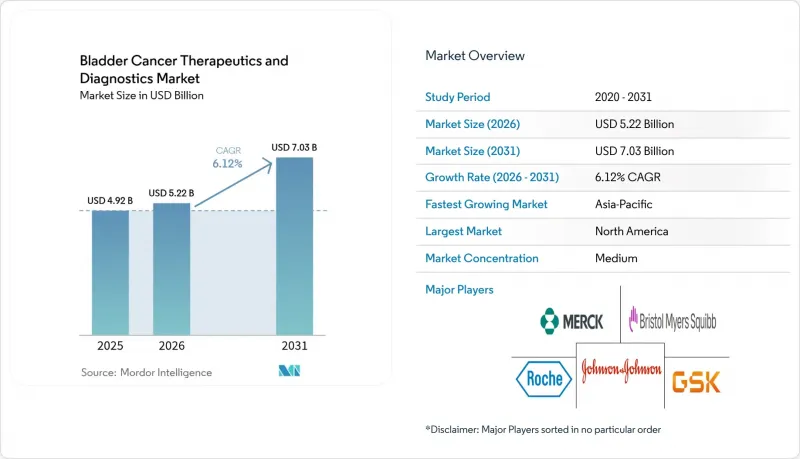
Mordor Intelligence에 따르면 2026년 방광암 치료 및 진단 시장 규모는 52억 2,000만 달러로 추정되며, 2025년 49억 2,000만 달러에서 확대되어 2031년에는 70억 3,000만 달러에 달할 것으로 예측됩니다.
2026년부터 2031년까지의 연평균 성장률(CAGR)은 6.12%에 달할 것으로 전망됩니다.
본 보고서는 제품별(치료제, 진단제), 암 종류별(요로상피암, 편평상피암, 선암 및 기타 희귀암), 최종사용자별(병원, 외래 수술 센터, 전문 의료 센터 등), 지역별(북미, 유럽, 아시아태평양, 중동 및 아프리카 등)로 분류되어 있습니다. 시장 전망은 금액(달러) 기준으로 제시되어 있습니다.
세계 방광암 치료 및 진단 시장의 동향 및 인사이트
세계 방광암 발병률의 상승
고령화가 진행되고 직업상 발암성 물질에 대한 노출이 지속되는 가운데, 발병률은 계속 상승하고 있습니다. 역학 데이터에 따르면 65세 이상 인구에서 꾸준한 증가세가 나타나고 있으며, 진단적 감시 및 다제 병용요법에 대한 수요가 높아지고 있습니다. 영상 진단 및 소변 검사를 통한 조기 발견으로, 특히 비근층 침윤성 방광암의 경우 치료 대상이 되는 환자층이 확대되고 있습니다. 의료 제도에서는 높은 재발률에 따른 반복적인 치료에 대응하기 위해 전문 비뇨기과 센터를 확충하고, 훈련된 인력에 대한 투자를 추진하고 있습니다. 이러한 재발의 반복으로 인해 방광경 검사 장비, 소모품 및 보조 요법의 수익이 유지되고 있습니다. 현재 경제 모델에는 평생에 걸친 모니터링과 관련된 간접 비용이 반영되어 있어, 재발 위험을 낮추는 기술로의 전환이 더욱 촉진되고 있습니다.
면역관문억제제 및 ADC의 신속한 승인
규제 심사 절차의 신속화로 개발 주기가 단축되어, 환자들이 새로운 생물학적 제제에 조기에 접근할 수 있게 되었습니다. FDA는 엔포르탐브 베도틴 및 듀르발맙과 같은 약물에 ‘획기적 치료제 지정(Breakthrough Designation)’을 부여하여, 3상 임상시험 후 5년 이내에 시판이 가능하도록 했습니다. 생존 기간 연장 효과는 설득력이 있습니다. 펨브롤리주맙과 엔포르탐브 베도틴의 병용요법에서는 전체 생존 기간의 중앙값이 33.8개월인 반면, 화학요법에서는 15.9개월에 그칩니다. 탄탄한 파이프라인을 보유한 신규 진입 기업들은 선구자로서의 우위를 확보하며 높은 가격 책정을 실현하고 있습니다. 기존의 화학요법제 제조사들은 바이오의약품 공동 개발에 나서지 않으면 방광암 치료 및 진단제 시장에서 점유율이 하락할 위험에 직면하게 될 것입니다.
주요 항암제의 특허 만료와 제네릭 의약품에 의한 시장 잠식
마이토마이신 C 및 시스플라틴의 특허 만료로 인해 제네릭 의약품과의 경쟁이 격화되어 치료제의 이익률이 압박받고 있습니다. 가격 하락은 지불자 입장에서는 유리하지만, 연구 개발에 재투자하는 데 필요한 제조사의 수익을 압박합니다. 제네릭 의약품은 접근성을 확대하는 한편, 판매량을 여러 공급업체로 분산시켜 규모의 경제 효과를 약화시킵니다. 이해관계자들은 저비용 세포독성 약물과 고부가가치 바이오의약품을 결합한 하이브리드 요법을 모색하며, 합리적인 가격과 유효성 간의 균형을 맞추고 있습니다. 그러나 번들 가격에 대한 협상은 이미 예산 압박에 직면해 있는 병원 시스템의 조달 과정에 복잡성을 더하고 있습니다.
부문 분석
방광암 치료 및 진단 시장에서 2025년 매출의 62.10%를 치료제가 차지하고 있으며, 이는 전신 투여제 및 방광 내 투여제의 반복 투여와 높은 단가를 반영한 것입니다. 면역요법 단독의 경우, 펨브롤리주맙, 두르발마브, 니볼마브의 적응증 확장에 힘입어 연평균 성장률(CAGR) 8.25%로 성장할 것으로 예측됩니다. 엔포르탐브-베도틴 등의 항체약물접합체(ADC)는 특히 백금계 약물이 적응증에서 제외되는 환자군에서 새로운 구제 치료의 길을 열어주고 있습니다. 방광암 치료 및 진단 시장 내 진단 분야의 시장 규모는 조기 발견을 종합적으로 향상시키는 블루라이트 내시경, 4K 이미징 타워, AI를 활용한 소변 검사 등에 힘입어 확대되고 있습니다.
TAR-200이나 UGN-102와 같은 방광 내 투여 플랫폼은 화학요법제를 방광벽에 직접 방출함으로써 전신 노출을 줄이면서도 유효성을 유지할 수 있어 주목받고 있습니다. 진료가 외래 중심으로 전환됨에 따라, 진단 기기 제조사들은 일회용 내시경 및 형광 염료의 생산 규모를 확대하고 있습니다. DNA 메틸화와 단백질 마커를 결합한 분자 패널은 진료 지침에 채택될 시기가 다가오고 있으며, 보험 급여의 일관성이 확보되는 대로 감시 알고리즘을 재정의할 준비가 되어 있습니다.
지역별 분석
북미는 2025년 매출의 44.20%를 차지하고 있으며, 이는 FDA의 신속 심사 프로그램 활성화, 전미종합암네트워크(NCCN)의 지침 개정, 그리고 블루라이트 방광경 검사 키트 및 소변 바이오마커 검사를 지원하는 메디케어의 보험 환급에 힘입은 결과입니다. 민간 보험사들도 연방 정부의 결정에 발맞추는 경향이 강해지고 있어, 이로 인해 전국적인 접근성이 원활해지고 있습니다. 캐나다에서는 주 전체를 아우르는 구매 단체를 활용하여 생물학적 제제에 대한 유리한 가격 협상을 진행하고 있는 반면, 멕시코에서는 ‘세구로 포풀라르(Seguro Popular)’ 개혁을 통해 암 치료에 대한 공적 보험 적용 범위를 확대하고 있습니다. 국경을 넘는 환자 이동은 여전히 제한적이지만, 미국과 멕시코 국경 지역의 3차 의료 기관에 새로운 치료법이 보급됨에 따라 증가할 가능성이 있습니다.
아시아태평양은 중국, 일본, 인도가 암 의료 인프라 구축을 추진함에 따라 2031년까지 10.40%라는 지역 내 가장 높은 연평균 성장률(CAGR)을 기록할 것으로 예상됩니다. 중국 내 현지 제조 파트너십을 통해 체크포인트 억제제의 단가가 절감되어 각 성의 암 센터에서 도입이 촉진되고 있습니다. 일본에서는 주로 충실한 국민건강보험에 의한 급여 체계 덕분에 엔포르탐브 베도친 및 펨브롤리주맙의 도입률이 계속해서 높은 수준을 유지하고 있습니다. 인도의 민간 병원 체인은 블루라이트 방광경 검사를 단계적으로 도입하고 있으며, 보험 보급이 더욱 확대될 때까지는 가처분 소득으로 본인 부담금을 충당할 수 있는 대도시를 우선적으로 대상으로 하고 있습니다. 싱가포르와 말레이시아 등 아세안(ASEAN) 국가에서는 가치 기반 의료(VBC) 시범 사업의 일환으로, AI를 활용한 소변 검사 시범 도입이 진행되고 있습니다.
유럽에서는 유럽의약품청(EMA)의 조정된 심사 절차와 비용 대비 효과의 명확성을 중시하는 각국의 의료 기술 평가에 힘입어 균형 잡힌 성장이 나타나고 있습니다. 독일의 DRG(진단 관련군) 제도에서는 외래 진료 패키지 내에서 블루라이트 방광경 검사의 보험 급여가 이루어지고 있어, 입원을 수반하는 방광경 검사에서 이 제도로의 전환이 촉진되고 있습니다. 영국의 ‘암 치료제 기금(Cancer Drugs Fund)’은 신규 ADC(항체약물접합체)에 대한 조건부 접근을 가속화하는 동시에, NHS(국민보건서비스)의 전면적인 자금 지원 결정에 기여할 레지스트리 데이터를 수집하고 있습니다. 남유럽 시장에서는 공동 입찰을 통해 조달을 통합하고, 집약된 조달 물량을 활용하여 생물학적 제제의 할인 협상을 진행하는 한편, 가이드라인에 근거한 혁신적인 치료법에 대한 개방적인 접근을 유지하고 있습니다.
기타 혜택:
- 엑셀 형식의 시장 예측(ME) 시트
- 3개월간의 애널리스트 지원
자주 묻는 질문
목차
제1장 소개
제2장 조사 방법
제3장 주요 요약
제4장 시장 구도
제5장 시장 규모와 성장 예측
제6장 경쟁 구도
제7장 시장 기회와 향후 전망
KSM 26.08.25According to Mordor Intelligence, the bladder cancer therapeutics and diagnostics market size in 2026 is estimated at USD 5.22 billion, growing from 2025 value of USD 4.92 billion with 2031 projections showing USD 7.03 billion, growing at 6.12% CAGR over 2026-2031.
This report is Segmented by Product (Therapeutics, Diagnostics), Cancer Type (Urothelial Carcinoma, Squamous-Cell Carcinoma, Adenocarcinoma & Other Rare Types), End User (Hospitals, Ambulatory Surgical Centers, Speciality Centers, and More), and Geography (North America, Europe, Asia-Pacific, Middle East & Africa, and More). The Market Forecasts are Provided in Terms of Value (USD).
Global Bladder Cancer Therapeutics And Diagnostics Market Trends and Insights
Rising Global Bladder-Cancer Incidence
Incidence continues to climb as aging populations expand and occupational carcinogen exposure persists. Epidemiological data indicate a steady rise among individuals >=65 years, heightening demand for diagnostic surveillance and multi-line therapies. Earlier detection through imaging and urine-based assays swells the treatment-eligible cohort, particularly for non-muscle invasive disease. Health systems are scaling specialized urology centers and investing in trained personnel to cope with repeat interventions linked to high recurrence rates. These recurrent episodes sustain revenue generation for cystoscopy equipment, consumables, and adjuvant therapies. Economic models now incorporate indirect costs tied to lifetime monitoring, reinforcing the shift toward technologies that reduce recurrence risk.
Rapid Approvals of Immune-Checkpoint Inhibitors & ADCs
Accelerated regulatory pathways compress development cycles and hasten patient access to novel biologics. The FDA granted breakthrough status to agents such as enfortumab vedotin and durvalumab, enabling commercial launch within five years of pivotal trials. Survival gains are persuasive; combining pembrolizumab with enfortumab vedotin delivers 33.8-month median overall survival versus 15.9 months for chemotherapy. Market entrants with robust pipelines secure first-mover advantages and command premium pricing. Traditional chemotherapy suppliers must now co-develop biologics or risk market erosion in the bladder cancer therapeutic and diagnostics market.
Patent Expiries & Generic Erosion of Key Chemo Drugs
The expiration of mitomycin C and cisplatin patents invites generic competition that compresses therapy margins. Price declines favour payers but constrain manufacturer revenues needed for R&D reinvestment. Although generics widen access, they split volumes across multiple suppliers, diluting scale efficiencies. Stakeholders explore hybrid regimens that pair low-cost cytotoxics with premium biologics, balancing affordability with efficacy. Yet negotiations over bundled pricing introduce complexity into procurement processes for hospital systems already under budget pressure.
Other drivers and restraints analyzed in the detailed report include:
- Wider Adoption of Blue-Light & 4K Cystoscopy
- AI-Driven Urine-Biomarker Algorithms
- High Cost / Reimbursement Hurdles for Novel Biologics
For complete list of drivers and restraints, kindly check the Table Of Contents.
Segment Analysis
Therapeutics commanded 62.10% of 2025 revenue within the bladder cancer therapeutic and diagnostics market, reflecting the repeated dosing and high unit prices of systemic and intravesical agents. Immunotherapy alone is forecast to grow at an 8.25% CAGR, backed by expanding labels for pembrolizumab, durvalumab, and nivolumab. Antibody-drug conjugates such as enfortumab vedotin open new salvage pathways, especially for platinum-ineligible cohorts. The bladder cancer therapeutic and diagnostics market size for diagnostics is climbing, driven by blue-light scopes, 4K imaging towers, and AI-enabled urine assays that collectively enhance early detection.
Intravesical delivery platforms like TAR-200 and UGN-102 gain traction by releasing chemotherapy directly into the bladder wall, reducing systemic exposure while preserving efficacy. Diagnostic firms scale production of single-use scopes and fluorescent dyes as procedure volumes migrate to ambulatory settings. Molecular panels that combine DNA methylation and protein markers edge toward guideline endorsement, poised to redefine surveillance algorithms once reimbursement alignment occurs.
Complete Report Scope:
- By Product
- Therapeutics
- Chemotherapy
- Immunotherapy
- Antibody-Drug Conjugates
- Intravesical Drug-Delivery Devices
- Diagnostics
- Cystoscopy
- Bladder Ultrasound & Imaging
- Urinalysis & Dipstick Tests
- Urine & Liquid-biopsy Biomarker Panels
- Therapeutics
- By Cancer Type
- Urothelial Carcinoma
- Squamous-cell Carcinoma
- Adenocarcinoma & Other Rare Types
- By End User
- Hospitals
- Ambulatory Surgical Centers
- Speciality Centers
- Academic and Research Institutes
- By Geography
- North America
- United States
- Canada
- Mexico
- Europe
- Germany
- United Kingdom
- France
- Italy
- Spain
- Rest of Europe
- Asia-Pacific
- China
- Japan
- India
- Australia
- South Korea
- Rest of Asia-Pacific
- Middle East & Africa
- GCC
- South Africa
- Rest of Middle East & Africa
- South America
- Brazil
- Argentina
- Rest of South America
- North America
Geography Analysis
North America contributed 44.20% of 2025 revenue, driven by strong FDA-accelerated programs, National Comprehensive Cancer Network guideline updates, and Medicare reimbursement that supports blue-light cystoscopy kits and urine-biomarker assays. Private payers are increasingly aligning with federal determinations, thereby smoothing nationwide access. Canada leverages pan-provincial buying groups to negotiate favorable biologic pricing, while Mexico expands public oncology coverage through reforms to Seguro Popular. Cross-border patient flows remain limited but could increase as novel therapies spread to tertiary centers along the US-Mexico border.
The Asia Pacific is expected to deliver the fastest regional CAGR of 10.40% through 2031, as China, Japan, and India undertake upgrades to their oncology infrastructure. China's local manufacturing partnerships reduce unit costs for checkpoint inhibitors, catalyzing uptake in provincial cancer centers. Japan maintains a high adoption rate of enfortumab vedotin and pembrolizumab, mainly due to robust national health insurance coverage. Indian private chains are gradually introducing blue-light cystoscopy, prioritizing metropolitan cities where disposable incomes support out-of-pocket payments until wider insurance penetration occurs. ASEAN countries such as Singapore and Malaysia pilot AI-enabled urine diagnostics within value-based care pilots.
Europe exhibits balanced growth driven by the European Medicines Agency's coordinated review process and national health technology assessments that emphasize cost-benefit clarity. Germany's DRG system reimburses blue-light scopes within outpatient packages, encouraging migration away from admission-based cystoscopies. The United Kingdom's Cancer Drugs Fund accelerates conditional access to novel ADCs while collecting registry data to inform full NHS funding decisions. Southern European markets harmonize procurement via joint tenders, using pooled volumes to negotiate biologic discounts while maintaining open access to guideline-backed innovations.
- Roche
- Merck
- Bristol-Myers Squibb
- Pfizer
- Johnson & Johnson
- Novartis
- AstraZeneca
- GlaxoSmithKline
- Astellas Pharma
- Abbott Laboratories
- Olympus
- Pacific Edge Ltd (Cxbladder)
- UroGen Pharma Ltd
- CG Oncology
- ImmunityBio Inc.
- Teleflex
- Boston Scientific
- Coloplast
- Endo International
- Ameritech Diagnostic Reagent (Jiaxing) Co.
Additional Benefits:
- The market estimate (ME) sheet in Excel format
- 3 months of analyst support
TABLE OF CONTENTS
1 Introduction
- 1.1 Study Assumptions & Market Definition
- 1.2 Scope of the Study
2 Research Methodology
3 Executive Summary
4 Market Landscape
- 4.1 Market Overview
- 4.2 Market Drivers
- 4.2.1 Rising Global Bladder-Cancer Incidence
- 4.2.2 Rapid Approvals of Immune-Checkpoint Inhibitors & ADCs
- 4.2.3 Wider Adoption of Blue-Light & 4K Cystoscopy
- 4.2.4 Ai-Driven Urine-Biomarker Algorithms
- 4.2.5 Growth of ASC-Based Cystoscopy Volumes
- 4.2.6 Re-Fillable Intravesical Drug-Delivery Devices
- 4.3 Market Restraints
- 4.3.1 Patent Expiries & Generic Erosion of Key Chemo Drugs
- 4.3.2 High Cost / Reimbursement Hurdles for Novel Biologics
- 4.3.3 Global BCG Shortages Disrupting Therapy Patterns
- 4.3.4 Limited Blue-Light Equipment Availability in EMS
- 4.4 Regulatory Landscape
- 4.5 Porter's Five Forces Analysis
- 4.5.1 Threat of New Entrants
- 4.5.2 Bargaining Power of Buyers
- 4.5.3 Bargaining Power of Suppliers
- 4.5.4 Threat of Substitutes
- 4.5.5 Intensity of Rivalry
5 Market Size & Growth Forecasts (Value in USD)
- 5.1 By Product
- 5.1.1 Therapeutics
- 5.1.1.1 Chemotherapy
- 5.1.1.2 Immunotherapy
- 5.1.1.3 Antibody-Drug Conjugates
- 5.1.1.4 Intravesical Drug-Delivery Devices
- 5.1.2 Diagnostics
- 5.1.2.1 Cystoscopy
- 5.1.2.2 Bladder Ultrasound & Imaging
- 5.1.2.3 Urinalysis & Dipstick Tests
- 5.1.2.4 Urine & Liquid-biopsy Biomarker Panels
- 5.1.1 Therapeutics
- 5.2 By Cancer Type
- 5.2.1 Urothelial Carcinoma
- 5.2.2 Squamous-cell Carcinoma
- 5.2.3 Adenocarcinoma & Other Rare Types
- 5.3 By End User
- 5.3.1 Hospitals
- 5.3.2 Ambulatory Surgical Centers
- 5.3.3 Speciality Centers
- 5.3.4 Academic and Research Institutes
- 5.4 By Geography
- 5.4.1 North America
- 5.4.1.1 United States
- 5.4.1.2 Canada
- 5.4.1.3 Mexico
- 5.4.2 Europe
- 5.4.2.1 Germany
- 5.4.2.2 United Kingdom
- 5.4.2.3 France
- 5.4.2.4 Italy
- 5.4.2.5 Spain
- 5.4.2.6 Rest of Europe
- 5.4.3 Asia-Pacific
- 5.4.3.1 China
- 5.4.3.2 Japan
- 5.4.3.3 India
- 5.4.3.4 Australia
- 5.4.3.5 South Korea
- 5.4.3.6 Rest of Asia-Pacific
- 5.4.4 Middle East & Africa
- 5.4.4.1 GCC
- 5.4.4.2 South Africa
- 5.4.4.3 Rest of Middle East & Africa
- 5.4.5 South America
- 5.4.5.1 Brazil
- 5.4.5.2 Argentina
- 5.4.5.3 Rest of South America
- 5.4.1 North America
6 Competitive Landscape
- 6.1 Market Concentration
- 6.2 Market Share Analysis
- 6.3 Company Profiles (includes Global-level Overview, Market-level Overview, Core Segments, Financials, Strategic Info, Market Rank/Share, Products & Services, Recent Developments)
- 6.3.1 F. Hoffmann-La Roche Ltd
- 6.3.2 Merck & Co. Inc.
- 6.3.3 Bristol-Myers Squibb Company
- 6.3.4 Pfizer Inc.
- 6.3.5 Johnson & Johnson (Janssen)
- 6.3.6 Novartis AG
- 6.3.7 AstraZeneca PLC
- 6.3.8 GlaxoSmithKline PLC
- 6.3.9 Astellas Pharma Inc.
- 6.3.10 Abbott Laboratories
- 6.3.11 Olympus Corporation
- 6.3.12 Pacific Edge Ltd (Cxbladder)
- 6.3.13 UroGen Pharma Ltd
- 6.3.14 CG Oncology
- 6.3.15 ImmunityBio Inc.
- 6.3.16 Teleflex Inc.
- 6.3.17 Boston Scientific Corp.
- 6.3.18 Coloplast A/S
- 6.3.19 Endo International plc
- 6.3.20 Ameritech Diagnostic Reagent (Jiaxing) Co.
7 Market Opportunities & Future Outlook
- 7.1 White-space & Unmet-need Assessment


