

|
시장보고서
상품코드
2116102
갑상선암 진단 : 시장 점유율 분석, 업계 동향 및 통계, 성장 예측(2026-2031년)Thyroid Cancer Diagnostics - Market Share Analysis, Industry Trends & Statistics, Growth Forecasts (2026 - 2031) |
||||||
 Mordor Intelligence
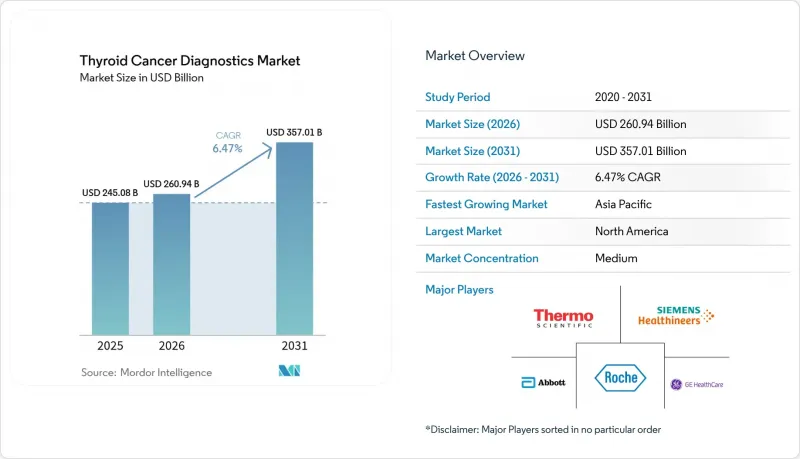
Mordor Intelligence에 의하면, 2026년 갑상선암 진단 시장 규모는 2,609억 4,000만 달러로 추정되고 2025년 2,450억 8,000만 달러에서 확대해, 2031년에는 3,570억 1,000만 달러에 이를 것으로 예측됩니다.
2026-2031년 동안 연평균 성장률(CAGR) 6.47%로 성장할 것으로 전망됩니다.
본 보고서는 암 유형(유두암, 낭성암, 기타), 진단 기술(영상, 혈액 유래 바이오마커, 기타), 최종 사용자(병원 실험실, 암 진단센터, 독립 검사 기관, 기타), 지역(북미, 유럽, 아시아태평양, 기타)별로 분류되어 있습니다. 시장 전망은 금액(달러) 기준으로 제시되어 있습니다.
세계의 갑상선암 진단 시장 동향 및 인사이트
영상 진단 감도 향상에 따른 발생률 상승
AI가 탑재된 초음파 프로브는 현재 1cm 미만의 결절을 89%의 정확도로 감지할 수 있게 되어, 지역 클리닉과 3차 의료기관 간의 격차를 좁히고 있습니다. Siemens Healthineers의 ‘Acuson Sequoia’ 플랫폼은 장기 자동 라벨링 기능을 추가하여 스캔부터 보고서 작성까지의 시간을 단축하고, 내분비 외과 의사에게 결과를 전달하는 비율을 높이고 있습니다. 감도 향상으로 생검 건수가 증가함에 따라, 이어지는 진단 과정에서 유전체 분류법 및 액체 생검 검사의 활용이 확대되고 있습니다. 조기 발견이 수익을 끌어올리는 한편, 임상의들은 과잉 진단이나 과잉 치료에 대한 경계를 늦추지 않고, 즉시 수술이 아닌 적극적인 경과 관찰이 필요한 완만한 병변을 식별하는 위험 계층화 알고리즘의 도입을 촉진하고 있습니다.
정부 주도의 갑상선암 검진 및 인식 제고 프로그램
중국, 일본, 한국의 국가적 노력에서는 갑상선 촉진 및 초음파 검사가 여러 암을 대상으로 한 검진 캠페인에 포함되어 있으며, 정보 전달 경로의 표준화와 검진 참여율 향상을 도모하고 있습니다. 일본의 암 센터는 의료 서비스가 미치지 않는 도도부현으로 이동 검진 차량을 유도하기 위한 상세한 발생률 지도를 공표하고 있습니다. 보고 의무에 따라 지역 암 등록부가 충실해졌으며, AI를 활용한 분류 모델을 검증하기 위한 대규모 데이터 세트가 구축되고 있습니다. 선별 검사와 관련된 규제에서는 일반적으로 가이드라인에서 권장하는 분자 검사 패널이 참조되므로, 지역 검사 기관에는 NGS 워크플로우 도입이 요구되고 있습니다. 이러한 프로그램에 대한 장기적인 자금 지원으로 지속적인 수요가 확보되는 동시에, 비용 효율성 향상을 위해 제조업체들이 생산의 현지화를 추진하도록 장려되고 있습니다.
숙련된 내분비 세포 병리학자 부족
해부병리학 분야의 인력 공석률은 해마다 증가하고 있으며, 영국의 검사실 중 권장되는 인력 배치 기준을 충족하는 곳은 불과 3.0%에 불과합니다. 이러한 인력 부족으로 인해 생검부터 보고까지의 주기가 길어지면서 치료 방침 결정이 지연되고 있습니다. 병원에서는 저위험 도말 검체를 선별하기 위해 로슈사의 클라우드 기반 AI 슬라이드 검토 시스템을 도입하고 있지만, 확정 진단을 위해서는 여전히 전문의 자격을 갖춘 전문가가 필요합니다. 연수 프로그램에서는 펠로우십 정원을 확대하고 있으나, 현직자들의 대량 은퇴가 임박해 있어 이 인력 부족 현상은 향후 10년 동안 지속될 전망입니다.
부문별 분석
2025년에는 유두암이 검사 수요의 대부분을 차지하여 갑상선암 진단 시장의 79.65%를 차지했습니다. 이 압도적인 점유율 덕분에 초음파 검사, 세포진 검사, 차세대 염기서열 분석(NGS)을 통한 분류 검사의 안정적인 기초 검사 건수가 확보되고 있습니다. 유두암 병변은 예후가 양호하기 때문에 임상의들은 저위험 환자를 수술에서 제외하고 적극적인 경과 관찰로 유도하기 위해 분자 위험 패널을 점점 더 많이 활용하고 있습니다. 미분화암은 발생률의 2% 이하를 차지할 뿐이지만, 신속한 치료 조정을 위해 광범위한 유전체 프로파일링과 체액 생검을 통한 모니터링이 필요하기 때문에 연평균 성장률(CAGR) 7.88%를 견인하고 있습니다. RET 융합 양성 결과는 현재 셀페르카티닙의 사용 지침이 되고 있으며, 이에 따라 진단 시와 재발 시 동반 진단이 필수적입니다.
수질암이나 낭성암 등 희귀 아형을 대상으로 하는 갑상선암 진단 시장 규모는 칼시토닌 검사 및 코어 바늘 생검의 보급을 배경으로 꾸준히 확대될 것으로 예측됩니다. 낭성 병변은 여전히 세포진단으로는 검출이 어렵기 때문에 내분비 클리닉에서는 ThyroSeq 및 Afirma의 도입이 급속히 진행되고 있습니다. RET 및 RAS 돌연변이를 대상으로 한 표적 검사는 예후 예측과 추적 관찰 전략을 정교화하여, 서비스 제공이 가능한 시장 전체를 확대되고 있습니다. 키나아제 억제제를 대상으로 한 연구자 주도 임상 검사가 증가하고 있어, 모든 조직 유형에 걸친 종합적인 유전체 프로파일링이 더욱 정착되어 장기적인 수익을 뒷받침하고 있습니다.
지역별 분석
북미는 2025년 매출의 38.74%를 차지하며, 갑상선암 진단 시장에서 가장 규모가 큰 지역 기여 요인으로서의 입지를 공고히 했습니다. 메디케어의 MolDX 보험 적용과 민간 보험사의 대응이 폭넓은 접근성을 뒷받침하고 있는 반면, 미국의 임상 지침에서는 베데스다 분류 III-V에 해당하는 결절에 대한 분자 분류법의 채택을 권장하고 있습니다. 캐나다에서는 주 정부가 자금을 지원하는 보험 제도를 통해 초음파 검사 및 세포 검사가 보장되고 있지만, 유전체 시퀀싱에 대한 보험 적용은 선택적으로 이루어지고 있어 공공 및 민간 부문 수요에 편차가 발생하고 있습니다. 멕시코에서는 연방 정부의 투자로 도시 지역의 종양학 서비스가 개선되고 있지만, 농촌 지역과의 격차는 여전히 남아 있습니다. 이 지역의 혁신 생태계가 AI 모델 개발을 주도하고 있으며, GE Healthcare와 NVIDIA는 병리학자 부족을 완화하기 위한 실시간 초음파 분류 시스템을 공동 개발하고 있습니다.
아시아태평양은 7.90%라는 가장 높은 연평균 성장률(CAGR)을 기록하고 있습니다. 중국에서는 단계적 암 검진 이니셔티브의 일환으로 지역 클리닉에 갑상선 초음파 검사가 도입되어, 지역 분자진단 거점으로의 검체 송부가 증가하고 있습니다. 일본에서는 인구 기반 등록 제도를 통해 불필요한 생검을 줄이면서도, 위험이 높은 지역에서는 검사 건수를 확보하는 정밀한 검진 기준이 확립되어 있습니다. 인도에서는 민간암 진료 체인이 급속히 확대되면서 NGS 패널에 대한 접근성이 향상되고 있지만, 가격 측면의 과제는 여전히 남아 있습니다. 한국에서는 보험에 기반한 건강검진 문화 덕분에 검사 실시율이 높으며, AI 스타트업들이 미국 식품의약국(FDA)의 승인을 받기 전에 국내에서 트리아지 플랫폼의 상용화를 추진하는 움직임이 보입니다. 아시아태평양의 갑상선암 진단 시장 점유율은 현지 제조업체들이 비용 최적화된 시퀀싱 키트를 출시함에 따라 확대될 것으로 예측됩니다.
유럽에서는 동반진단 승인 절차를 명확히 하는 유럽의약품청(EMA)의 중앙 심사 제도에 힘입어, 첨단 진단 기술의 도입이 성숙한 수준을 유지하고 있습니다. 독일에서는 전국 규모의 AI 초음파 검사 품질 레지스트리 운영이 이루어지고 있는 반면, 영국의 국민보건서비스(NHS)는 유전체 의료 서비스를 통해 유전체 분류 도구의 도입을 추진하고 있습니다. 남유럽 국가들에서는 EU 부흥 기금의 지원을 받아 하이브리드 PET/MRI 스캐너 조달을 가속화하고 있습니다. 유럽 전역의 환급 기준 통일은 여전히 진행 중이지만, 공동 조달을 통해 시약 단가가 낮아져 소규모 회원국들에 혜택을 주고 있습니다. 이러한 동향이 맞물려 갑상선암 진단 시장을 뒷받침하고 있지만, 그 성장률은 아시아태평양에 비해 상대적으로 낮은 수준에 머물러 있습니다.
기타 혜택
- 엑셀 형식 시장 예측(ME) 시트
- 3개월간의 애널리스트 지원
자주 묻는 질문
목차
제1장 서론
제2장 조사 방법
제3장 개요
제4장 시장 구도
제5장 시장 규모 및 성장 예측(금액, 2024-2030년)
제6장 경쟁 구도
제7장 시장 기회 및 향후 전망
KTH 26.08.31According to Mordor Intelligence, the thyroid cancer diagnostics market size in 2026 is estimated at USD 260.94 billion, growing from 2025 value of USD 245.08 billion with 2031 projections showing USD 357.01 billion, growing at 6.47% CAGR over 2026-2031.
This report is Segmented by Cancer Type (Papillary Carcinoma, Follicular Carcinoma, and More), Diagnostic Technique (Imaging, Blood-Based Biomarkers, and More), End User (Hospital Laboratories, Cancer Diagnostic Centers, Independent Reference Labs, and More), and Geography (North America, Europe, Asia-Pacific, and More). The Market Forecasts are Provided in Terms of Value (USD).
Global Thyroid Cancer Diagnostics Market Trends and Insights
Rising Incidence from Improved Imaging Sensitivity
AI-enabled ultrasound probes now detect sub-centimeter nodules with 89% accuracy, narrowing the gap between community clinics and tertiary centers. Siemens Healthineers' Acuson Sequoia platform adds automated organ labeling, cutting scan-to-report time and driving referral rates to endocrine surgeons. Increased sensitivity boosts biopsy volume, which lifts utilization of genomic classifiers and liquid biopsy tests that follow in the diagnostic cascade. While earlier capture fuels revenue, clinicians remain vigilant about over-diagnosis and overtreatment, spurring adoption of risk-stratification algorithms that flag indolent lesions for active surveillance instead of immediate surgery.
Government-Led Thyroid Cancer Screening & Awareness Programs
National initiatives in China, Japan and South Korea incorporate thyroid palpation and ultrasound into multi-cancer campaigns, standardizing referral pathways and lifting testing adherence. Japan's Cancer Center publishes granular incidence maps that guide mobile screening vans toward underserved prefectures. Mandatory reporting feeds regional cancer registries, creating large datasets that validate AI triage models. Screening regulations typically reference guideline-endorsed molecular panels, putting pressure on local laboratories to acquire NGS workflows. The programs' long-term funding ensures recurring demand while encouraging manufacturers to localize production for cost efficiencies.
Shortage of Skilled Endocrine Cytopathologists
Anatomic pathology vacancy rates rise annually; only 3.0% of U.K. laboratories meet recommended staffing levels. The shortage lengthens biopsy-to-report cycles and delays treatment decisions. Hospitals adopt cloud-based AI slide reviewers from Roche to triage low-risk smears, yet confirmatory reads still need board-certified experts. Training programs expand fellowship seats, but incumbents face retirement cliffs, extending the constraint well into the next decade.
Other drivers and restraints analyzed in the detailed report include:
- Rapid Adoption of NGS-Based Genomic Classifiers
- Expanding Reimbursement for Molecular Tests in OECD Markets
- High Out-Of-Pocket Cost for Advanced Molecular Panels
For complete list of drivers and restraints, kindly check the Table Of Contents.
Segment Analysis
Papillary carcinoma generated the bulk of testing demand, holding 79.65% of the thyroid cancer diagnostics market in 2025. This dominance ensures steady baseline volume for ultrasound, cytology and NGS classifiers. Papillary lesions present favorable outcomes, so clinicians increasingly deploy molecular risk panels to spare low-risk patients from surgery, channeling them to active surveillance instead. Anaplastic carcinoma, despite accounting for less than 2% of incidence, drives a 7.88% CAGR by necessitating broad genomic profiling and liquid biopsy monitoring for rapid therapeutic adjustments. RET-fusion positivity now guides use of selpercatinib, which in turn mandates companion diagnostics at diagnosis and relapse.
The thyroid cancer diagnostics market size for rare subtypes such as medullary and follicular carcinoma is projected to scale steadily on the back of calcitonin assays and core-needle biopsy adoption. Follicular lesions still evade cytology, so ThyroSeq and Afirma uptake is brisk in endocrine clinics. Targeted testing for RET and RAS mutations refines prognostication and follow-up strategies, widening the overall serviceable market. Rising investigator-initiated trials for kinase inhibitors further entrench comprehensive genomic profiling across all histologies, sustaining long-term revenue.
Complete Report Scope:
- By Cancer Type
- Papillary Carcinoma
- Follicular Carcinoma
- Medullary Carcinoma
- Anaplastic Carcinoma
- Other Cancer Types
- By Diagnostic Technique
- Imaging
- Ultrasound
- CT / MRI
- PET / SPECT
- Blood-Based Biomarkers
- TSH / T4 / T3 Panel
- Thyroglobulin & Anti-Tg
- Calcitonin / CEA
- Tissue Biopsy
- Fine-Needle Aspiration Cytology
- Core Needle Biopsy
- Liquid Biopsy
- Other Diagnostic Techniques
- Imaging
- By End User
- Hospital Laboratories
- Cancer Diagnostic Centers
- Independent Reference Labs
- Other End Users
- Geography
- North America
- United States
- Canada
- Mexico
- South America
- Brazil
- Argentina
- Rest of South America
- Europe
- Germany
- United Kingdom
- France
- Spain
- Italy
- Russia
- Rest of Europe
- Asia-Pacific
- China
- Japan
- India
- Australia
- South Korea
- Rest of Asia-Pacific
- Middle East & Africa
- GCC
- South Africa
- Rest of Middle East & Africa
- South America
- Brazil
- Argentina
- Rest of South America
- North America
Geography Analysis
North America generated 38.74% of 2025 revenue, cementing its status as the largest regional contributor to the thyroid cancer diagnostics market. Medicare's MolDX coverage and private payer alignment underpin broad access, while U.S. clinical guidelines promote molecular classifiers for Bethesda III-V nodules. Canada covers ultrasound and cytology through provincially funded plans but reimburses genomic sequencing selectively, creating mixed public-private demand. Mexico improves urban oncology services through federal investment, although rural disparities persist. The region's innovation ecosystem propels AI model development, with GE HealthCare and NVIDIA co-engineering real-time ultrasound triage that mitigates pathologist shortages.
Asia-Pacific posts the fastest 7.90% CAGR. China's tiered cancer screening initiatives embed thyroid ultrasound in community clinics, escalating specimen submission to regional molecular hubs. Japan's population-based registry supports precision screening thresholds that reduce unnecessary biopsies yet ensure high testing volume where risk is elevated. India's rapid expansion of private oncology chains increases access to NGS panels, although pricing remains a hurdle. South Korea's insurance-backed check-up culture produces high scan rates, encouraging AI start-ups to commercialize triage platforms domestically before seeking U.S. Food and Drug Administration (FDA) clearance. The thyroid cancer diagnostics market share in Asia-Pacific will grow as local manufacturers release cost-optimized sequencing kits.
Europe maintains mature uptake of advanced diagnostics, guided by the European Medicines Agency's centralized review that clarifies companion-diagnostic pathways. Germany pilots nationwide AI ultrasound quality registries, while the United Kingdom's National Health Service (NHS) uplifts genomic classifier adoption through the Genomic Medicine Service. Southern European nations accelerate procurement of hybrid PET/MRI scanners, supported by EU recovery funds. Pan-European reimbursement parity remains a work in progress; however, collaborative procurement reduces per-unit reagent costs, benefiting smaller member states. These dynamics collectively boost the thyroid cancer diagnostics market, albeit at lower relative growth than Asia-Pacific.
- Abbott Laboratories
- Thermo Fisher Scientific
- Eli Lilly and Company
- Siemens Healthineers
- GE Healthcare
- Bio-Rad Laboratories
- Agilent Technologies
- Koninklijke Philips
- Roche
- Illumina
- Daiichi Sankyo
- Quest Diagnostics
- Veracyte
- Guardant Health
- Myriad Genetics
- Exact Sciences
- Fulgent Genetics
- Hologic
- Thyrocare Technologies
- Beckton Dickinson
- PerkinElmer
Additional Benefits:
- The market estimate (ME) sheet in Excel format
- 3 months of analyst support
TABLE OF CONTENTS
1 Introduction
- 1.1 Study Assumptions & Market Definition
- 1.2 Scope of the Study
2 Research Methodology
3 Executive Summary
4 Market Landscape
- 4.1 Market Overview
- 4.2 Market Drivers
- 4.2.1 Rising Incidence Due To Improved Imaging Sensitivity
- 4.2.2 Government-Led Thyroid Cancer Screening & Awareness Programs
- 4.2.3 Rapid Adoption Of NGS-Based Genomic Classifiers
- 4.2.4 Expanding Reimbursement for Molecular Tests in OECD Markets
- 4.2.5 AI-Driven Ultrasound Triage Tools in Primary Care
- 4.2.6 Shift Toward PET/MRI Hybrid Restaging Protocols
- 4.3 Market Restraints
- 4.3.1 Shortage Of Skilled Endocrine Cytopathologists
- 4.3.2 High Out-Of-Pocket Cost for Advanced Molecular Panels
- 4.3.3 Guideline Pushback on Over-Diagnosis & Active-Surveillance Preference
- 4.3.4 Regulatory Uncertainty for AI Decision-Support Algorithms
- 4.4 Regulatory Landscape
- 4.5 Porter's Five Forces Analysis
- 4.5.1 Threat of New Entrants
- 4.5.2 Bargaining Power of Buyers
- 4.5.3 Bargaining Power of Suppliers
- 4.5.4 Threat of Substitutes
- 4.5.5 Competitive Rivalry
5 Market Size & Growth Forecasts (Value, 2024-2030)
- 5.1 By Cancer Type
- 5.1.1 Papillary Carcinoma
- 5.1.2 Follicular Carcinoma
- 5.1.3 Medullary Carcinoma
- 5.1.4 Anaplastic Carcinoma
- 5.1.5 Other Cancer Types
- 5.2 By Diagnostic Technique
- 5.2.1 Imaging
- 5.2.1.1 Ultrasound
- 5.2.1.2 CT / MRI
- 5.2.1.3 PET / SPECT
- 5.2.2 Blood-Based Biomarkers
- 5.2.2.1 TSH / T4 / T3 Panel
- 5.2.2.2 Thyroglobulin & Anti-Tg
- 5.2.2.3 Calcitonin / CEA
- 5.2.3 Tissue Biopsy
- 5.2.3.1 Fine-Needle Aspiration Cytology
- 5.2.3.2 Core Needle Biopsy
- 5.2.4 Liquid Biopsy
- 5.2.5 Other Diagnostic Techniques
- 5.2.1 Imaging
- 5.3 By End User
- 5.3.1 Hospital Laboratories
- 5.3.2 Cancer Diagnostic Centers
- 5.3.3 Independent Reference Labs
- 5.3.4 Other End Users
- 5.4 Geography
- 5.4.1 North America
- 5.4.1.1 United States
- 5.4.1.2 Canada
- 5.4.1.3 Mexico
- 5.4.2 South America
- 5.4.2.1 Brazil
- 5.4.2.2 Argentina
- 5.4.2.3 Rest of South America
- 5.4.3 Europe
- 5.4.3.1 Germany
- 5.4.3.2 United Kingdom
- 5.4.3.3 France
- 5.4.3.4 Spain
- 5.4.3.5 Italy
- 5.4.3.6 Russia
- 5.4.3.7 Rest of Europe
- 5.4.4 Asia-Pacific
- 5.4.4.1 China
- 5.4.4.2 Japan
- 5.4.4.3 India
- 5.4.4.4 Australia
- 5.4.4.5 South Korea
- 5.4.4.6 Rest of Asia-Pacific
- 5.4.5 Middle East & Africa
- 5.4.5.1 GCC
- 5.4.5.2 South Africa
- 5.4.5.3 Rest of Middle East & Africa
- 5.4.6 South America
- 5.4.6.1 Brazil
- 5.4.6.2 Argentina
- 5.4.6.3 Rest of South America
- 5.4.1 North America
6 Competitive Landscape
- 6.1 Market Concentration
- 6.2 Market Share Analysis
- 6.3 Company Profiles (includes Global level Overview, Market level overview, Core Segments, Financials as available, Strategic Information, Market Rank/Share for key companies, Products & Services, and Recent Developments)
- 6.3.1 Abbott
- 6.3.2 Thermo Fisher Scientific, Inc.
- 6.3.3 Eli Lilly & Company
- 6.3.4 Siemens Healthineers
- 6.3.5 GE HealthCare
- 6.3.6 Bio-Rad Laboratories
- 6.3.7 Agilent Technologies
- 6.3.8 Koninklijke Philips
- 6.3.9 F. Hoffmann-La Roche Ltd
- 6.3.10 Illumina
- 6.3.11 Daiichi Sankyo
- 6.3.12 Quest Diagnostics
- 6.3.13 Veracyte
- 6.3.14 Guardant Health
- 6.3.15 Myriad Genetics
- 6.3.16 Exact Sciences
- 6.3.17 Fulgent Genetics
- 6.3.18 Hologic
- 6.3.19 Thyrocare Technologies
- 6.3.20 Becton, Dickinson & Co.
- 6.3.21 PerkinElmer
7 Market Opportunities & Future Outlook
- 7.1 White-Space & Unmet-Need Assessment


