

|
시장보고서
상품코드
2113430
첨단 상처 관리 : 시장 점유율 분석, 업계 동향과 통계, 성장 예측(2026-2031년)Advanced Wound Care Management - Market Share Analysis, Industry Trends & Statistics, Growth Forecasts (2026 - 2031) |
||||||
 Mordor Intelligence
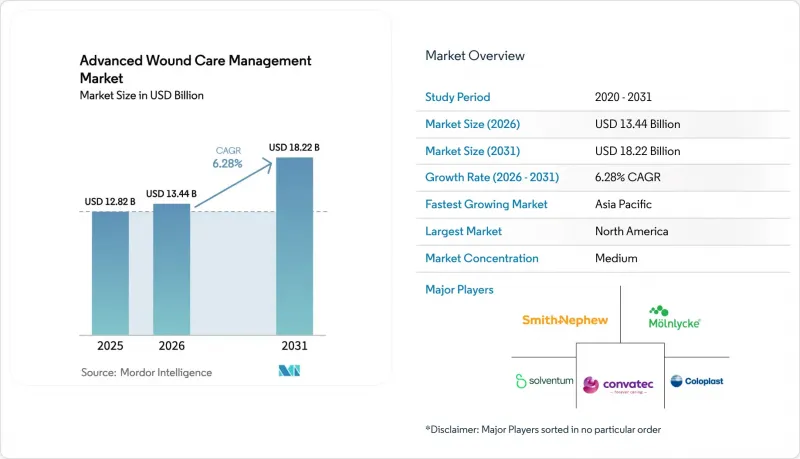
Mordor Intelligence에 따르면 첨단 상처 관리 시장 규모는 2025년 128억 2,000만 달러에서 2026년에는 134억 4,000만 달러로 확대되어 2031년까지 182억 2,000만 달러에 달할 것으로 예상되며, 2026년부터 2031년까지 CAGR 6.28%로 성장할 것으로 전망됩니다.
본 보고서는 제품별(첨단 상처 피복재 등), 상처 유형별(외과적·외상성 등), 기술 플랫폼별(기존 수동형 등), 환자 연령대별(소아 등), 최종사용자별(병원·외래 수술 센터 등), 유통 채널별(병원 직접 조달 등), 및 지역별로 분류되어 있습니다. 시장 예측은 금액(달러) 기준으로 제시되어 있습니다.
세계 첨단 상처 관리 시장의 동향 및 인사이트
당뇨병 및 고령화에 따른 만성 상처 유병률의 급증
당뇨병 환자 수는 계속 증가하고 있으며, 인구에서 고령자가 차지하는 비율도 높아짐에 따라 치유가 어려운 궤양을 앓고 있는 환자가 꾸준히 증가하고 있습니다. 미국 및 서유럽에서는 재입원에 대한 제재가 도입됨에 따라 만성 상처 예방이 병원에 있어 재정적 우선 과제가 되고 있습니다. 메드트로닉은 고령 환자 대상 시술 건수 증가에 힘입어 2024 회계연도에 상처 관리 분야에서 한 자릿수 후반대의 높은 성장률을 기록했습니다. 현재 의료계에서는 첨단 드레싱 재료, 생체 이식편, 음압 요법 장치를 고비용 합병증을 줄이기 위한 도구로 인식하고 있습니다. 절단 수술과 장기 입원이 보험사의 지출을 늘리는 가운데, 종합적인 상처 관리 솔루션에 대한 수요가 증가하고 있습니다. 다학제적 협력을 통한 외래 센터에 대한 투자가 일관된 프로토콜 채택을 더욱 촉진하고 있습니다.
차세대 항균·보습 드레싱의 급속한 보급
병원에서는 수술 후 감염을 억제하기 위해 은, 폴리헥사나이드, 꿀, 요오드가 함유된 드레싱의 표준화가 진행되고 있습니다. 팬데믹 기간 동안의 감염 대책으로 인해 항균 장벽의 가치가 부각됨에 따라, 이러한 치료 방침의 전환은 더욱 가속화되었습니다. 스미스 앤 네퓨(Smith & Nephew)는 자사의 일회용 음압 요법 플랫폼 ‘PICO’가 감염률을 감소시켰음을 보여주는 2024년 데이터를 공개했으며, 이에 따라 예방 대책 패키지에 ‘ALLEVYN LIFE’ 폼의 채택이 확대되었습니다. 보습성 폼과 하이드로콜로이드는 드레싱 교체 빈도를 줄여 간호 인력의 시간을 확보하는 동시에 환자의 쾌적성을 향상시킵니다. 약제 선정 위원회가 단가가 아닌 치료 과정 전체의 비용을 중시하게 됨에 따라, 재입원율 감소를 입증하는 임상 데이터를 보유한 공급업체가 우선적으로 채택되고 있습니다. 또한, 프로토콜 업데이트에 대해 직원을 교육하는 벤더의 지원 프로그램도 도입을 가속화하고 있습니다.
신흥 경제국에서의 환자 1인당 높은 비용과 단편적인 보험 급여
첨단 상처 치료는 1회 치료 주기당 500달러를 초과하는 경우가 많으며, 이 금액은 많은 신흥국의 평균월 소득을 상회합니다. 이러한 시장에서는 본인 부담금이 주를 이루며, 공공 의약품 목록에서는 고가의 의료기기나 생물학적 제제가 제외되는 경향이 있습니다. 제조사는 주 또는 에미리트 차원의 승인 절차를 거쳐야 하지만, 제출 형식이 각기 다르기 때문에 시장 출시까지의 기간이 길어지고 있습니다. 도시 지역의 부유층 환자를 대상으로 하는 사립 병원에서는 최신 제품이 도입되고 있지만, 그 사용량은 여전히 제한적입니다. 그 결과, 공공 의료 시스템에서는 여전히 기존의 거즈나 저가 폼 소재가 사용되고 있어 전반적인 성장 가능성을 저해하고 있습니다.
부문 분석
의료기기 및 부속품(주로 음압 펌프)은 9.46%의 연평균 성장률(CAGR)을 기록하며, 부문별 가장 높은 성장률을 보일 것으로 전망됩니다. 첨단 상처 피복재는 61.46%의 점유율을 차지하며 판매량에서 주도권을 유지하고 있으며, 첨단 상처 관리 시장의 경제적 기반으로 계속 자리매김할 것으로 확실시됩니다. 휴대용 음압상처치료(NPWT)와 감염 감소 간의 연관성을 보여주는 증거로 인해 보험사의 지원이 강화되었습니다. 또한, 스미스 앤 네퓨(Smith & Nephew)사의 ‘RENASYS EDGE’ 출시로 사용자 친화적인 설계가 도입을 가속화할 것임이 입증되었습니다. 이식편 및 매트릭스는 자가 이식이 부적절한 3도 화상이나 당뇨병성 궤양과 같은 틈새 적응증을 차지하고 있습니다. 외용제는 특히 음압 요법에 앞서 시행되는 효소 기반 데브리드먼트 프로토콜에서 이러한 제품을 보완하는 역할을 수행하고 있습니다.
공공 의료 기관에서는 가격 민감성으로 인해 바이오의약품의 보급이 억제되고 있지만, 전문 의료 센터에서의 대상별 보상 제도가 꾸준한 수요를 뒷받침하고 있습니다. 의료기기는 병원이 입원 기간 단축을 통해 취득 비용을 상쇄할 수 있기 때문에 포괄 지급 제도와의 일관성이 확보되고 있습니다. 그 결과, 의료기기와 상처 피복재를 통합한 솔루션을 제공하는 공급업체는 교차 판매를 통한 시너지 효과를 누리고 있습니다. 자본 설비를 제공하지 않는 경쟁사들은 조달 위원회가 전체 포트폴리오를 보유한 파트너를 중심으로 공급업체 목록을 통합함에 따라 시장에서 뒤처질 위험에 직면해 있습니다.
화상 및 기타 복합 상처 시장은 연평균 성장률(CAGR) 10.34%로 확대될 전망이며, 현재 지출의 33.66%를 차지하는 외과적 상처 및 외상성 상처를 크게 상회할 것으로 예상됩니다. 개발도상국에서의 산업 활동 활성화와 도시 지역의 교통량 증가로 인해 중증 외상 발생률이 상승하고 있으며, 첨단 이식재의 잠재 시장이 확대되고 있습니다. 케레시스(Keresis)사의 어피 매트릭스는 중증 당뇨병성 족부궤양에서 표준 치료보다 우수한 효과를 보였으며, 기존 이식재를 대체하는 생체 유래 대체재의 유효성이 입증되었습니다. 수술 부위는 여전히 안정적인 수익원이지만, 첨단 드레싱 재료가 이미 대부분의 수술실에서 표준으로 자리 잡았기 때문에 성장은 완만해지고 있습니다. 욕창 예방은 규제 당국의 주목을 받고 있으며, 장기 요양 시설에서는 예방적 폼 재료의 사용이 권장되고 있습니다.
당뇨병성 족부궤양 및 정맥성 하지 궤양은 수개월에 걸친 치료가 필요하기 때문에 지속적인 수익을 창출합니다. 그러나 많은 의료 제도에서 보상 상한선이 설정되어 있어, 제품 구성은 비용 대비 효과가 높은 선택지로 제한되고 있습니다. 단계적인 제품 포트폴리오를 제공하는 제조사는 임상적 요구와 지불 주체의 제약을 모두 충족시키며, 모든 상처 범주에서 시장 진입을 유지할 수 있습니다. 전반적으로 상처의 원인은 다양하기 때문에 차별화된 솔루션이 요구되며, 부문별로 명확한 가치 제안을 하는 공급업체가 성장 기회를 포착할 수 있습니다.
지역별 분석
북미는 광범위한 보험 적용 범위, 높은 전문 의료 인력 밀도, 그리고 NPWT의 광범위한 도입에 힘입어 2025년 매출의 36.41%를 차지했습니다. 포괄적 지불 모델은 재입원을 줄이는 중재를 평가하기 때문에 고품질 바이오의약품과 커넥티드 드레싱이 경제적으로 매력적인 선택지가 되고 있습니다. 규제 경로가 명확하게 정해져 있어 신속한 제품 도입이 가능합니다. 병원들은 통합 상처 치료 센터를 활용하여 프로토콜을 표준화하고 치료 결과를 모니터링하고 있습니다.
유럽에서는 공적 의료 제도가 엄격한 가격 상한선과 타협하는 가운데, 성장은 완만하지만 꾸준합니다. 영국 국립의료기술평가원(NICE)은 지속적으로 기술 평가를 발표하고 있으며, 그 지침은 지역 전체의 병원 처방집 수립에 반영되고 있습니다. 아일랜드의 근거 기반 가격 책정 체계는 지출을 억제하는 한편, 검증된 혁신 기술에 대한 환자의 접근성을 보장하고 있습니다. 저온 플라즈마 및 기타 새로운 치료법은 광범위한 도입을 위해 현지 근거가 더 축적되기를 기다리고 있는 상황이며, 단기적인 성장 가속화는 둔화되고 있습니다.
아시아태평양은 2031년까지 연평균 성장률(CAGR)이 8.04%로 가장 빠른 성장세를 보이고 있으며, 중국과 인도의 도시 지역 당뇨병 유병률이 14%를 초과하는 것이 그 원동력이 되고 있습니다. 민관 협력에 의한 병원 건설 확대와 규제 조화를 통해 의료기기 승인까지의 기간이 단축되고 있습니다. 일본과 한국에서는 고령화 사회를 배경으로 고급 솔루션이 도입되고 있으나, 보험 급여 상한선으로 인해 판매량의 급증은 억제되고 있습니다. 다국적 제조사들은 가격 통제 메커니즘과 지역별 입찰 주기에 대응하기 위해 현지 판매 대리점과 제휴하고 있습니다. 지역별 상황에는 편차가 있으나, 미충족 수요의 규모가 크기 때문에 아시아태평양은 첨단 상처 관리 시장의 주요 성장 동력이 되고 있습니다.
중동 및 아프리카는 낮은 기점에서 성장하고 있습니다. 걸프협력회의(GCC) 회원국의 높은 당뇨병 유병률이 수요를 뒷받침하고 있지만, 본인 부담금으로 인해 고가의 바이오의약품 보급은 여전히 제한되고 있습니다. 남아프리카공화국에서는 민간 보험의 보급 확대에 힘입어 사하라 이남 아프리카 지역의 성장을 주도하고 있습니다. 공급망 제약과 인력 부족이 지역 전체의 추가적인 발전을 저해하고 있습니다.
남미는 브라질과 아르헨티나가 주도하고 있으며, 이들 국가의 사립 병원에서는 화상 및 외과적 상처에 대한 고품질 치료법이 중시되고 있습니다. 환율 변동과 경기 순환이 구매력에 영향을 미치고 있지만, 3차 의료기관을 대상으로 한 집중적인 투자 덕분에 의료기기 수주는 완만하지만 꾸준히 이어지고 있습니다. 보다 광범위한 보급을 위해서는 보험급여 제도의 추가적인 정비와 임상의사 연수 체계의 확충이 기대됩니다.
기타 혜택:
- 엑셀 형식의 시장 예측(ME) 시트
- 3개월간의 애널리스트 지원
자주 묻는 질문
목차
제1장 소개
제2장 조사 방법
제3장 주요 요약
제4장 시장 구도
제5장 시장 규모와 성장 예측
제6장 경쟁 구도
제7장 시장 기회와 향후 전망
KSM 26.08.25According to Mordor Intelligence, the advanced wound care management market size is expected to increase from USD 12.82 billion in 2025 to USD 13.44 billion in 2026 and reach USD 18.22 billion by 2031, growing at a CAGR of 6.28% over 2026-2031.
This report is Segmented by Product (Advanced Dressings, and More), Wound Type (Surgical & Traumatic, and More), Technology Platform (Conventional Passive, and More), Patient Age Group (Pediatric, and More), End User (Hospitals & ASCs, and More), Distribution Channel (Direct Hospital Procurement, and More), and Geography. The Market Forecasts are Provided in Terms of Value (USD).
Global Advanced Wound Care Management Market Trends and Insights
Prevalence Surge of Chronic Wounds Linked to Diabetes and Aging Populations
Diabetes continues to rise, and older adults are growing as a share of the population, creating a steady inflow of patients with hard-to-heal ulcers. In the United States and Western Europe, readmission penalties have made chronic wound prevention a financial priority for hospitals. Medtronic recorded high single-digit growth in wound management during fiscal 2024 after increased procedure volumes among elderly patients. Health systems now view advanced dressings, biologic grafts, and negative-pressure devices as tools to reduce costly complications. As amputations and prolonged hospital stays drive payer spending, demand for comprehensive wound solutions escalates. Investments in multidisciplinary outpatient centers are further reinforcing consistent protocol adoption.
Rapid Adoption of Next-Generation Antimicrobial and Moisture-Retentive Dressings
Hospitals are standardizing silver, polyhexanide, honey, and iodine dressings to curb surgical site infections. The procedural pivot intensified after pandemic-era infection-control measures highlighted the value of antimicrobial barriers. Smith & Nephew published 2024 data showing its PICO single-use negative-pressure platform cut infection rates, and adoption of ALLEVYN LIFE foam into prevention bundles followed. Moisture-retentive foams and hydrocolloids reduce dressing changes, freeing nursing time and improving patient comfort. As formulary committees weigh total episode cost instead of unit price, suppliers with clinical dossiers that demonstrate readmission reduction gain preferred status. Vendor support programs that train staff on protocol updates also expedite uptake.
High Per-Patient Cost and Fragmented Reimbursement in Emerging Economies
Advanced wound therapies often cost more than USD 500 per treatment cycle, a figure that eclipses average monthly incomes in many emerging countries. Out-of-pocket spending dominates these markets, and public formularies tend to exclude premium devices and biologics. Manufacturers must navigate province- or emirate-level approval processes, each with distinct submission formats, prolonging time to market. Private hospitals serving affluent urban patients adopt the newest products, but volume remains limited. As a result, conventional gauze and low-priced foams persist across public systems, moderating overall growth potential.
Other drivers and restraints analyzed in the detailed report include:
- Expanded Reimbursement and Home-Healthcare Utilization
- Smart Sensor-Integrated Dressings Enabling Tele-Wound Monitoring
- Shortage of Certified Wound-Care Specialists Globally
For complete list of drivers and restraints, kindly check the Table Of Contents.
Segment Analysis
Devices and accessories, primarily negative-pressure pumps, will record a 9.46% CAGR, the fastest in the segment hierarchy. Advanced dressings retain volume dominance with a 61.46% stake, ensuring they remain the economic backbone of the advanced wound care management market. Evidence linking portable NPWT to infection reduction strengthened payer support, and Smith & Nephew's RENASYS EDGE launch illustrated how user-friendly engineering accelerates uptake. Grafts and matrices occupy niche indications, notably third-degree burns and diabetic ulcers, where autografts are unsuitable. Topical agents complement these products, especially in enzymatic debridement protocols that precede negative-pressure therapy.
Although price sensitivity restrains biologics in public facilities, targeted reimbursement in specialty centers fosters steady demand. Devices enjoy bundled payment alignment because hospitals can offset acquisition cost through shorter length of stay. Consequently, suppliers with integrated device-dressing solutions capture cross-selling synergies. Competitors that lack capital equipment offerings risk marginalization as procurement committees consolidate vendor lists around full-portfolio partners.
Burns and other complex wounds will climb at a 10.34% CAGR, well ahead of surgical and traumatic wounds that currently hold a 33.66% slice of spending. Rising industrial activity and urban traffic in developing nations increase severe trauma incidence, expanding the addressable pool for advanced grafts. Kerecis fish-skin matrices demonstrated superiority over standard care in severe diabetic foot ulcers, validating biologic alternatives to traditional grafts. Surgical sites remain a stable revenue base, but growth moderates because advanced dressings are already standard in most operating rooms. Pressure ulcer prevention gains regulatory focus, steering long-term care facilities toward prophylactic foam usage.
Diabetic foot and venous leg ulcers yield recurring revenues because they demand months of treatment. However, reimbursement caps limit product mix to cost-effective choices in many health systems. Manufacturers that offer tiered portfolios can match clinical need with payer constraints, sustaining participation across wound classes. Overall, heterogeneity in wound etiology requires differentiated solutions, and vendors that articulate segment-specific value propositions capture upside.
Complete Report Scope:
- By Product
- Advanced Dressings
- Devices & Accessories (e.g., NPWT)
- Grafts & Matrices
- Topical Agents
- By Wound Type
- Surgical & Traumatic Wounds
- Diabetic Foot Ulcers
- Pressure Ulcers
- Venous Leg Ulcers
- Burns & Other Complex Wounds
- By Technology Platform
- Conventional Passive Dressings
- Antimicrobial/Drug-Eluting Dressings
- Smart Sensor-Integrated Dressings
- Bio-engineered Skin Substitutes
- Negative-Pressure Wound Therapy Systems
- Electrical & Ultrasound Stimulation Devices
- Others
- By Patient Age Group
- Pediatric (0-17 yrs)
- Adult (18-64 yrs)
- Geriatric (65 yrs +)
- By End User
- Hospitals & Ambulatory Surgical Centers
- Home Healthcare Settings
- Long-Term Care & Rehabilitation Facilities
- By Distribution Channel
- Direct Hospital Procurement
- Retail & Specialty Stores
- E-commerce
- By Geography
- North America
- United States
- Canada
- Mexico
- Europe
- Germany
- France
- United Kingdom
- Italy
- Spain
- Rest of Europe
- Asia-Pacific
- China
- Japan
- India
- South Korea
- Australia
- Rest of Asia-Pacific
- Middle East & Africa
- GCC
- South Africa
- Rest of Middle East & Africa
- South America
- Brazil
- Argentina
- Rest of South America
- North America
Geography Analysis
North America contributed 36.41% of 2025 revenue, underpinned by broad insurance coverage, specialized clinician density, and extensive NPWT adoption. Bundled payment models reward interventions that cut readmissions, making premium biologics and connected dressings financially attractive. Regulatory pathways are well defined, enabling nimble product introductions. Hospitals leverage integrated wound centers to standardize protocols and monitor outcomes.
Europe exhibits slower but steady growth as public health systems negotiate aggressive price ceilings. The National Institute for Health and Care Excellence continues to publish technology evaluations, and its guidance informs hospital formularies across the region. Ireland's evidence-linked pricing framework tightens spending but secures patient access to validated innovations. Cold plasma and other novel modalities await additional local evidence before widespread inclusion, moderating near-term acceleration.
Asia-Pacific is the fastest mover with an 8.04% CAGR through 2031, energized by urban diabetes prevalence exceeding 14% in China and India. Public-private hospital build-outs and regulatory harmonization shorten device approval timelines. Japan and South Korea adopt high-end solutions amid aging populations, although reimbursement caps curb volume escalation. Multinational manufacturers partner with domestic distributors to navigate price control mechanisms and regional tender cycles. Despite heterogeneity, the scale of unmet need positions Asia-Pacific as the principal expansion engine within the advanced wound care management market.
The Middle East and Africa advance from a low base. High diabetes rates in Gulf Cooperation Council states support demand, but out-of-pocket payments still limit uptake of high-cost biologics. South Africa anchors Sub-Saharan momentum with expanding private insurance penetration. Supply-chain constraints and workforce gaps temper broader regional progress.
South America is led by Brazil and Argentina, where private hospitals value premium therapies for burns and surgical wounds. Currency volatility and economic cycles influence purchasing power, yet targeted investments in tertiary centers sustain a modest pipeline of device orders. Broader adoption awaits deeper reimbursement alignment and clinician training infrastructure.
- Advanced Medical Solutions Group
- Advancis Medical
- B. Braun
- Cardinal Health
- Coloplast
- Convatec
- Derma Sciences (Integra)
- DeRoyal Industries
- Genewel Co., Ltd.
- Hollister
- Integra LifeSciences Corp.
- Lohmann & Rauscher GmbH
- Medline Industries
- Medtronic
- MiMedx Group Inc.
- Molnlycke Health Care
- Organogenesis
- Hartmann Group
- Smiths Group
- Solventum
- Urgo Medical
Additional Benefits:
- The market estimate (ME) sheet in Excel format
- 3 months of analyst support
TABLE OF CONTENTS
1 Introduction
- 1.1 Study Assumptions & Market Definition
- 1.2 Scope of the Study
2 Research Methodology
3 Executive Summary
4 Market Landscape
- 4.1 Market Overview
- 4.2 Market Drivers
- 4.2.1 Prevalence Surge of Chronic Wounds Linked to Diabetes & Ageing Populations
- 4.2.2 Rapid Adoption of Next-Gen Antimicrobial & Moisture-Retentive Dressings
- 4.2.3 Expanded Reimbursement & Home-Healthcare Utilization
- 4.2.4 Smart Sensor-Integrated "Connected" Dressings Enabling Tele-Wound Monitoring
- 4.2.5 Clinical Uptake of Biologic & Stem-Cell Skin Substitutes
- 4.2.6 Sustainability Push for Bio-Sourced Dressing Materials
- 4.3 Market Restraints
- 4.3.1 High Per-Patient Cost & Fragmented Reimbursement in Emerging Economies
- 4.3.2 Shortage of Certified Wound-Care Specialists Globally
- 4.3.3 Supply-Chain Risk for Alginate / Foam Raw Materials (Climate-Impacted Harvests)
- 4.3.4 Regulatory Ambiguity Around Nano-Tech & Bio-Engineered Dressings
- 4.4 Value / Supply-Chain Analysis
- 4.5 Regulatory Landscape
- 4.6 Technological Outlook
- 4.7 Porter's Five Forces Analysis
- 4.7.1 Threat of New Entrants
- 4.7.2 Bargaining Power of Suppliers
- 4.7.3 Bargaining Power of Buyers
- 4.7.4 Threat of Substitutes
- 4.7.5 Intensity of Competitive Rivalry
5 Market Size & Growth Forecasts (Value in USD)
- 5.1 By Product
- 5.1.1 Advanced Dressings
- 5.1.2 Devices & Accessories (e.g., NPWT)
- 5.1.3 Grafts & Matrices
- 5.1.4 Topical Agents
- 5.2 By Wound Type
- 5.2.1 Surgical & Traumatic Wounds
- 5.2.2 Diabetic Foot Ulcers
- 5.2.3 Pressure Ulcers
- 5.2.4 Venous Leg Ulcers
- 5.2.5 Burns & Other Complex Wounds
- 5.3 By Technology Platform
- 5.3.1 Conventional Passive Dressings
- 5.3.2 Antimicrobial/Drug-Eluting Dressings
- 5.3.3 Smart Sensor-Integrated Dressings
- 5.3.4 Bio-engineered Skin Substitutes
- 5.3.5 Negative-Pressure Wound Therapy Systems
- 5.3.6 Electrical & Ultrasound Stimulation Devices
- 5.3.7 Others
- 5.4 By Patient Age Group
- 5.4.1 Pediatric (0-17 yrs)
- 5.4.2 Adult (18-64 yrs)
- 5.4.3 Geriatric (65 yrs +)
- 5.5 By End User
- 5.5.1 Hospitals & Ambulatory Surgical Centers
- 5.5.2 Home Healthcare Settings
- 5.5.3 Long-Term Care & Rehabilitation Facilities
- 5.6 By Distribution Channel
- 5.6.1 Direct Hospital Procurement
- 5.6.2 Retail & Specialty Stores
- 5.6.3 E-commerce
- 5.7 By Geography
- 5.7.1 North America
- 5.7.1.1 United States
- 5.7.1.2 Canada
- 5.7.1.3 Mexico
- 5.7.2 Europe
- 5.7.2.1 Germany
- 5.7.2.2 France
- 5.7.2.3 United Kingdom
- 5.7.2.4 Italy
- 5.7.2.5 Spain
- 5.7.2.6 Rest of Europe
- 5.7.3 Asia-Pacific
- 5.7.3.1 China
- 5.7.3.2 Japan
- 5.7.3.3 India
- 5.7.3.4 South Korea
- 5.7.3.5 Australia
- 5.7.3.6 Rest of Asia-Pacific
- 5.7.4 Middle East & Africa
- 5.7.4.1 GCC
- 5.7.4.2 South Africa
- 5.7.4.3 Rest of Middle East & Africa
- 5.7.5 South America
- 5.7.5.1 Brazil
- 5.7.5.2 Argentina
- 5.7.5.3 Rest of South America
- 5.7.1 North America
6 Competitive Landscape
- 6.1 Market Concentration
- 6.2 Market Share Analysis
- 6.3 Company Profiles (includes Global level Overview, Market level overview, Core Segments, Financials as available, Strategic Information, Market Rank/Share for key companies, Products & Services, and Recent Developments)
- 6.3.1 Advanced Medical Solutions Group plc
- 6.3.2 Advancis Medical
- 6.3.3 B. Braun Melsungen AG
- 6.3.4 Cardinal Health Inc.
- 6.3.5 Coloplast A/S
- 6.3.6 ConvaTec Group Plc
- 6.3.7 Derma Sciences (Integra)
- 6.3.8 DeRoyal Industries
- 6.3.9 Genewel Co., Ltd.
- 6.3.10 Hollister Incorporated
- 6.3.11 Integra LifeSciences Corp.
- 6.3.12 Lohmann & Rauscher GmbH
- 6.3.13 Medline Industries LP
- 6.3.14 Medtronic plc
- 6.3.15 MiMedx Group Inc.
- 6.3.16 Molnlycke Health Care AB
- 6.3.17 Organogenesis Holdings Inc.
- 6.3.18 Paul Hartmann AG
- 6.3.19 Smith & Nephew plc
- 6.3.20 Solventum
- 6.3.21 Urgo Medical
7 Market Opportunities & Future Outlook
- 7.1 White-space & Unmet-Need Assessment


